

Crypto.Andy
552 පෝස්ටු

Crypto.Andy
වාර්තා කරන්න
පරිශීලක අවහිර කරන්න
Top #1 Community Creator on CoinMarketCap according to CoinGape | Investor and trader | Listing & Institutional Services Partner of WhiteBIT | Affiliate & Listing Partner of BitUnix | Listing Partner of BitMart & MEXC
0 හඹා යමින්
4 හඹා යන්නන්
26 කැමති විය
පෝස්ටු
·
--
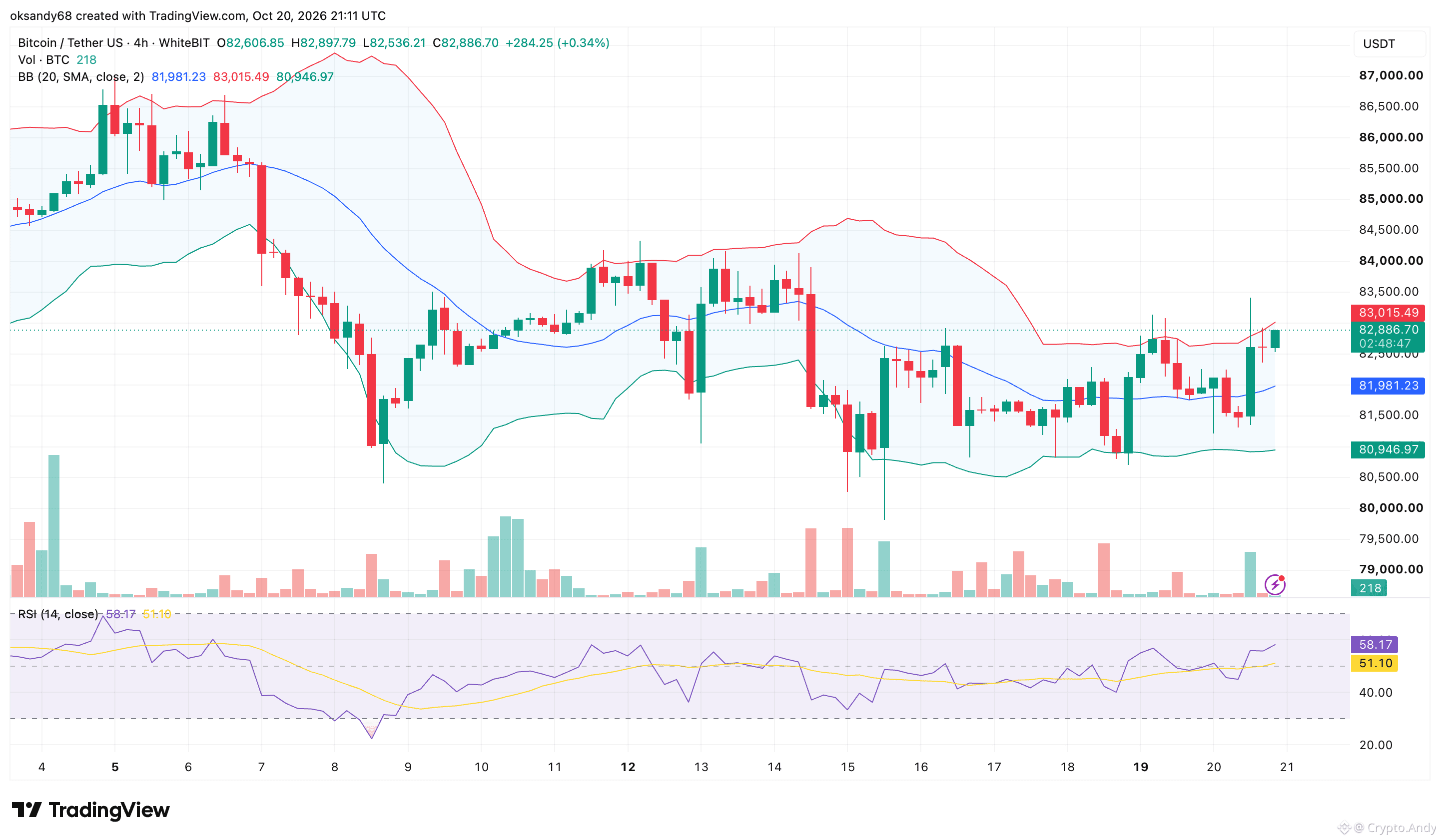
$BTC shot above $83K after headlines about a new US-Iran peace plan. The excitement didn’t last long: traders figured a quick deal is unlikely and BTC gave back a good part of the move. What the chart shows (4H): 🕯 The spike candle left a long wick near $83,700, so sellers were waiting up there 📊 Price is now ~$82,900, pressing the upper Bollinger Band at ~$83,000 🌡 RSI is at 58, so there’s still room before it gets overheated Levels I’m watching: 🔴 $83,000–83,700: the wick zone. A 4H close above it opens the way to $84K+ 🟢 $82,000: the middle band, the first support 🟢 $81,000: lower band and the bottom of the range Until we get a clean close above the wick, I treat this as another fakeout inside the range. Did the peace headlines catch you in a long? 👇 DYOR! #BTC Price Analysis# #Bitcoin Price Prediction: What is Bitcoins next move?#
$BTC shot above $83K after headlines about a new US-Iran peace plan. The excitement didn’t last long: traders figured a quick deal is unlikely and BTC gave back a good part of the move. What the chart shows (4H): 🕯 The spike candle left a long wick near $83,700, so sellers were waiting up there 📊 Price is now ~$82,900, pressing the upper Bollinger Band at ~$83,000 🌡 RSI is at 58, so there’s still room before it gets overheated Levels I’m watching: 🔴 $83,000–83,700: the wick zone. A 4H close above it opens the way to $84K+ 🟢 $82,000: the middle band, the first support 🟢 $81,000: lower band and the bottom of the range Until we get a clean close above the wick, I treat this as another fakeout inside the range. Did the peace headlines catch you in a long? 👇 DYOR! #BTC Price Analysis# #Bitcoin Price Prediction: What is Bitcoins next move?#
67
·
--
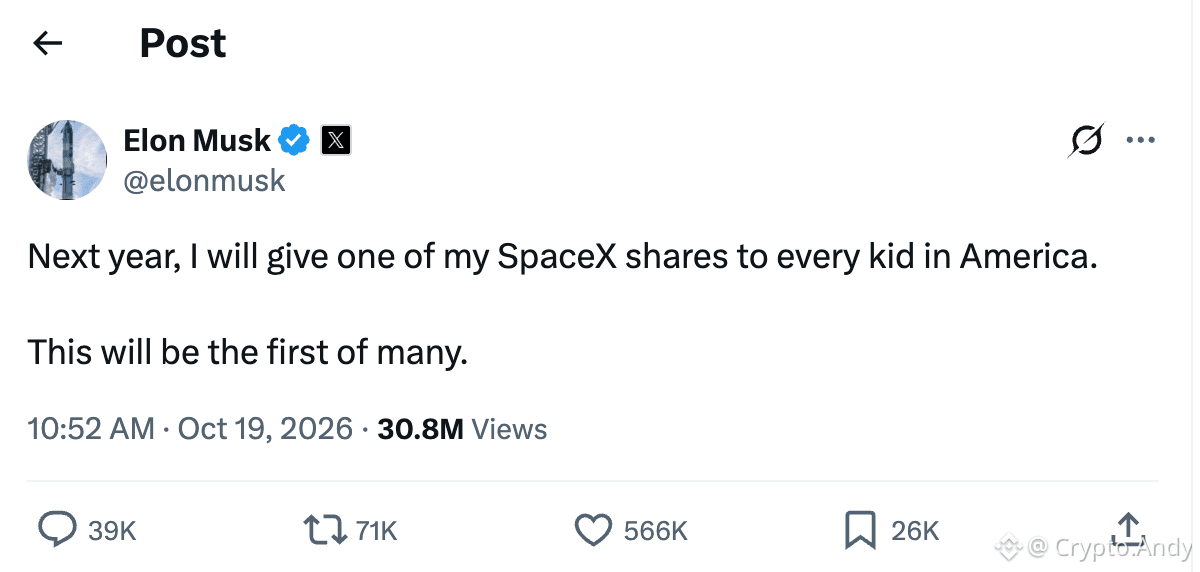
🚀 Musk is giving SpaceX shares to every kid in America On Monday, Elon Musk posted on X that next year he will give one of his $SPCX shares to every child in the US, and called it “the first of many.” There are about 73 million kids under 18 in the US. At the current price of around $146 per share, that’s a gift worth more than $10B, roughly 1% of Musk’s fortune 😳 Musk hasn’t explained how the distribution will work. Most likely it will go through Trump Accounts, the government investment accounts for children, which already accept stock donations. More short news in my community 📲 https://bit.ly/4jdykHo The timing is also interesting. The announcement came one day before SpaceX’s Q3 earnings, which drop today, October 20, after the market closes. It’s hard to imagine better marketing ahead of a report 😄 In August, SpaceX showed $7.8B in revenue and a $541M net loss for Q2. Today we’ll see if the numbers got better. Would you be happy to get a SpaceX share as a gift, or would you rather have $BTC ? 👇 #BTC Price Analysis# #Macro Insights#
🚀 Musk is giving SpaceX shares to every kid in America On Monday, Elon Musk posted on X that next year he will give one of his $SPCX shares to every child in the US, and called it “the first of many.” There are about 73 million kids under 18 in the US. At the current price of around $146 per share, that’s a gift worth more than $10B, roughly 1% of Musk’s fortune 😳 Musk hasn’t explained how the distribution will work. Most likely it will go through Trump Accounts, the government investment accounts for children, which already accept stock donations. More short news in my community 📲 https://bit.ly/4jdykHo The timing is also interesting. The announcement came one day before SpaceX’s Q3 earnings, which drop today, October 20, after the market closes. It’s hard to imagine better marketing ahead of a report 😄 In August, SpaceX showed $7.8B in revenue and a $541M net loss for Q2. Today we’ll see if the numbers got better. Would you be happy to get a SpaceX share as a gift, or would you rather have $BTC ? 👇 #BTC Price Analysis# #Macro Insights#
97
·
--
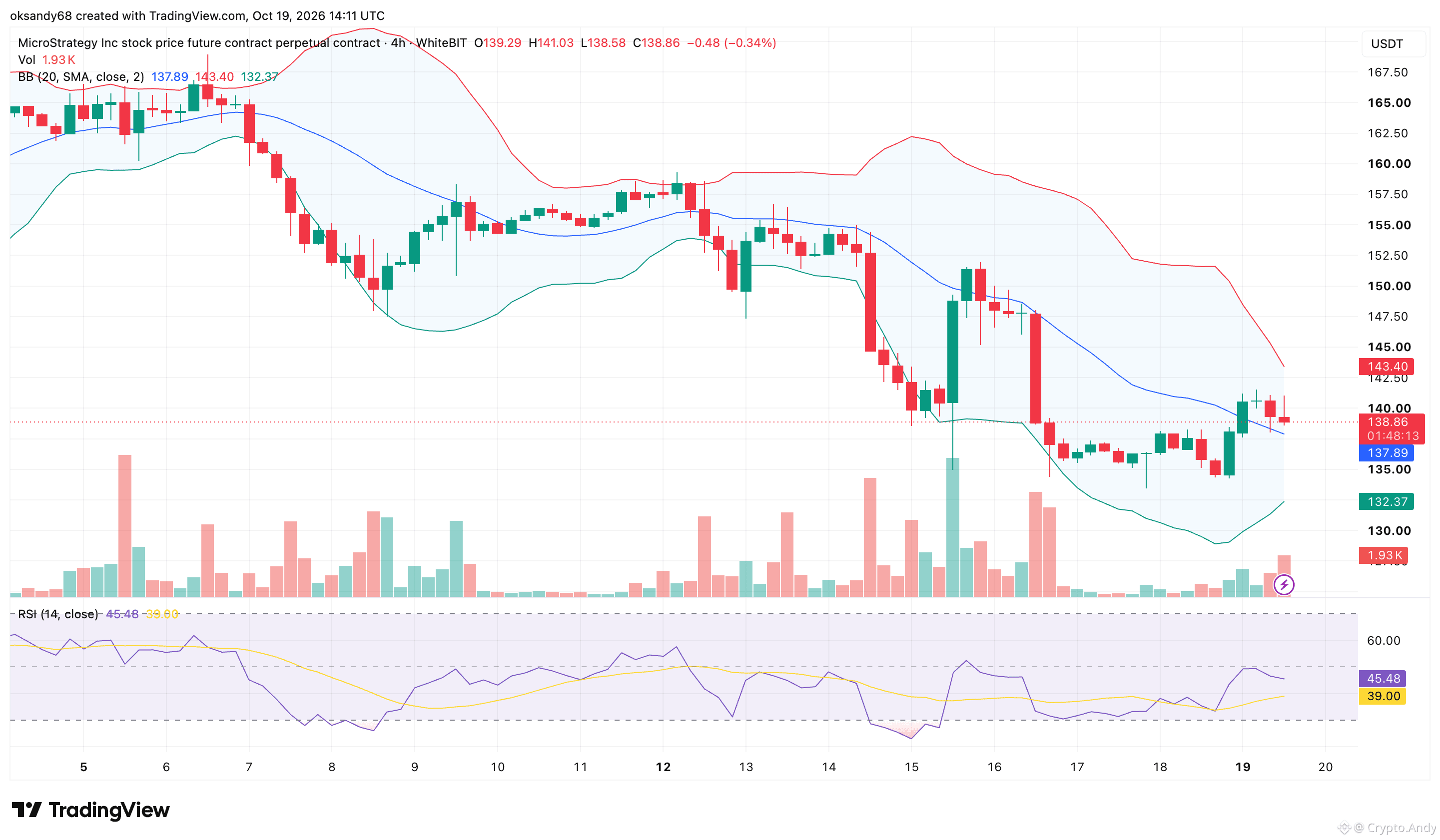
$MSTR : A Software Company That Owns 4% of All $BTC I’m currently putting together a stocks guide for beginners, and one company appears on every list for crypto people: Strategy, formerly MicroStrategy. It’s basically the biggest corporate bet on BTC in the world. The company holds about 848,000 Bitcoin, roughly 4% of all BTC that will ever exist. Its average purchase price is around $75K, so with BTC near $82K the stack is still in profit. Did you know? 🤔 Strategy started in 1989 as a regular business software company. It only began buying Bitcoin years later, and now its stock trades almost like a leveraged BTC position. Another detail many people missed: the company known for “never selling” actually sold 1,690 BTC in August to buy back its preferred shares. What the chart shows (MSTR perp, 4H): 📉 Over the past two weeks the price slid from ~$165 to a low near $134 📈 Today it bounced back to ~$141 and is now sitting at the middle Bollinger Band, around $138 🌡 RSI is at 45 Levels I’m watching: 🟢 $132–134: lower band and recent lows 🔴 $143: upper band and the first real test for buyers Since MSTR follows Bitcoin so closely, a lot depends on whether $BTC can hold above $80K. If it does, MSTR has a good chance to retest $143 and then $150. #BTC Price Analysis# #Macro Insights#
$MSTR : A Software Company That Owns 4% of All $BTC I’m currently putting together a stocks guide for beginners, and one company appears on every list for crypto people: Strategy, formerly MicroStrategy. It’s basically the biggest corporate bet on BTC in the world. The company holds about 848,000 Bitcoin, roughly 4% of all BTC that will ever exist. Its average purchase price is around $75K, so with BTC near $82K the stack is still in profit. Did you know? 🤔 Strategy started in 1989 as a regular business software company. It only began buying Bitcoin years later, and now its stock trades almost like a leveraged BTC position. Another detail many people missed: the company known for “never selling” actually sold 1,690 BTC in August to buy back its preferred shares. What the chart shows (MSTR perp, 4H): 📉 Over the past two weeks the price slid from ~$165 to a low near $134 📈 Today it bounced back to ~$141 and is now sitting at the middle Bollinger Band, around $138 🌡 RSI is at 45 Levels I’m watching: 🟢 $132–134: lower band and recent lows 🔴 $143: upper band and the first real test for buyers Since MSTR follows Bitcoin so closely, a lot depends on whether $BTC can hold above $80K. If it does, MSTR has a good chance to retest $143 and then $150. #BTC Price Analysis# #Macro Insights#
27
·
--
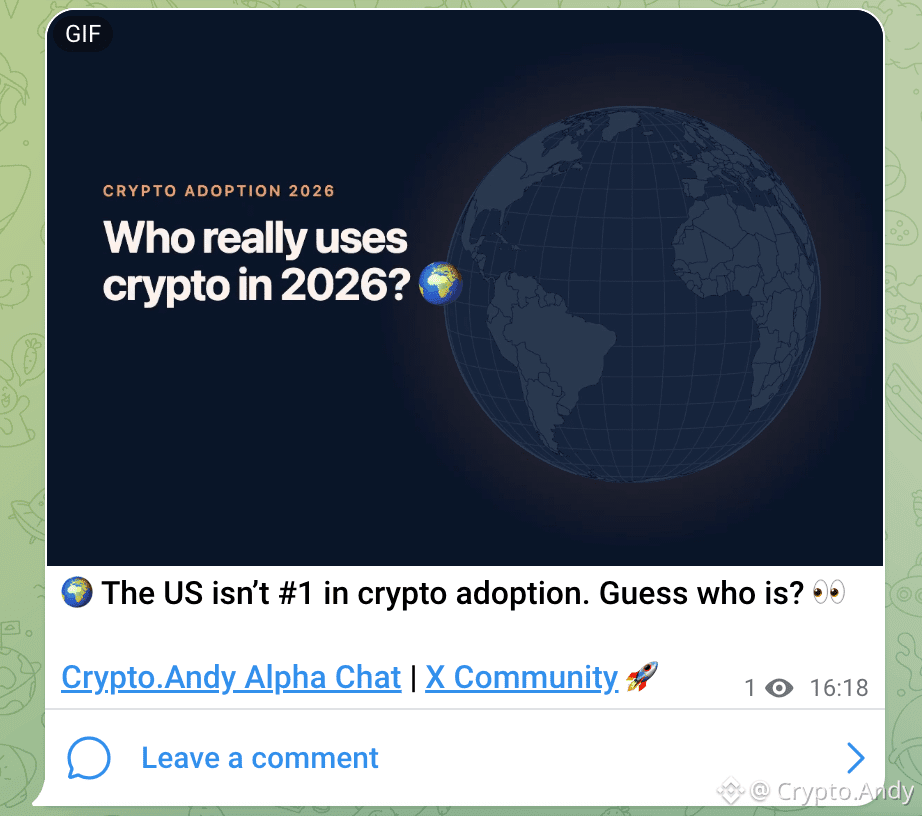
The US is №1 in the world by money flowing into crypto like $BTC , but only №20 by people sending crypto to each other 🤔 That’s one of the most interesting details from Chainalysis’ new 2026 Global Crypto Adoption Index. In the US, crypto is mostly an investment: people buy it through ETFs and apps and hold it. Nigeria shows a very different picture. It ranks first in the world for person-to-person transfers and cross-border flows, because there crypto often replaces a bank. And Brazil, which uses crypto in both ways, took first place overall. I broke down all three countries and the full top 10 in my community https://bit.ly/4jdykHo How does your country use crypto? 🌍 #BTC Price Analysis# #Bitcoin Price Prediction: What is Bitcoins next move?#
The US is №1 in the world by money flowing into crypto like $BTC , but only №20 by people sending crypto to each other 🤔 That’s one of the most interesting details from Chainalysis’ new 2026 Global Crypto Adoption Index. In the US, crypto is mostly an investment: people buy it through ETFs and apps and hold it. Nigeria shows a very different picture. It ranks first in the world for person-to-person transfers and cross-border flows, because there crypto often replaces a bank. And Brazil, which uses crypto in both ways, took first place overall. I broke down all three countries and the full top 10 in my community https://bit.ly/4jdykHo How does your country use crypto? 🌍 #BTC Price Analysis# #Bitcoin Price Prediction: What is Bitcoins next move?#
40
·
--
☀️ Happy Monday, everyone! Here’s a quick look at the market today: Top 5 crypto: 🟢 $BTC : $83,014 (+1.12%) 🟢 ETH: $2,444 (+0.87%) 🟢 BNB: $726.70 (+0.56%) 🟢 XRP: $1.32 (+1.31%) 🟢 SOL: $105.83 (+1.82%) Crypto stocks: 🔴 Strategy (MSTR): $136.83 (−9.56%) 🔴 Coinbase (COIN): $173.16 (−5.79%) 🔴 Circle (CRCL): $82.22 (−5.46%) 🔴 Block (XYZ): $77.89 (−2.43%) 🔴 IREN: $26.99 (−11.19%) #BTC Price Analysis# #Bitcoin Price Prediction: What is Bitcoins next move?#
☀️ Happy Monday, everyone! Here’s a quick look at the market today: Top 5 crypto: 🟢 $BTC : $83,014 (+1.12%) 🟢 ETH: $2,444 (+0.87%) 🟢 BNB: $726.70 (+0.56%) 🟢 XRP: $1.32 (+1.31%) 🟢 SOL: $105.83 (+1.82%) Crypto stocks: 🔴 Strategy (MSTR): $136.83 (−9.56%) 🔴 Coinbase (COIN): $173.16 (−5.79%) 🔴 Circle (CRCL): $82.22 (−5.46%) 🔴 Block (XYZ): $77.89 (−2.43%) 🔴 IREN: $26.99 (−11.19%) #BTC Price Analysis# #Bitcoin Price Prediction: What is Bitcoins next move?#

63
·
--
☀️ Happy Monday, everyone! The weekend is over, which means it’s time for $BTC charts, fresh levels and new trades again 📊 Wishing you all a calm start to the week, clean entries and as few stop losses as possible 😄 Here’s what I’m working on today: I want to dig deeper into stocks and figure out which ones could work best for a beginner’s portfolio. Which companies are worth a look, how to balance risk, and where to start if you’ve never bought a stock before. Would that be interesting for you? 👇 🔥 Yes, show me 🤔 Stick to crypto #BTC Price Analysis# #Macro Insights#
☀️ Happy Monday, everyone! The weekend is over, which means it’s time for $BTC charts, fresh levels and new trades again 📊 Wishing you all a calm start to the week, clean entries and as few stop losses as possible 😄 Here’s what I’m working on today: I want to dig deeper into stocks and figure out which ones could work best for a beginner’s portfolio. Which companies are worth a look, how to balance risk, and where to start if you’ve never bought a stock before. Would that be interesting for you? 👇 🔥 Yes, show me 🤔 Stick to crypto #BTC Price Analysis# #Macro Insights#

69
·
--
I Unboxed a Business Crypto $BTC Deposit Plan. Here’s What Was Inside Crypto lending has been getting more and more attention from institutions this year. 📈 In a Nomura and Laser Digital survey published in April, 65% of institutional investors said they’re targeting lending and tokenized assets. For a business, this usually means a deposit plan agreed upon one-to-one with a provider. I like to picture it as a building set. 🧩 Everyone gets the same five pieces in the box, and every company snaps them together around its own cash flow. So, what’s in the box? 🔹 Part 1, the amount. How much the company can set aside without touching day-to-day operations. 🔹 Part 2, the assets. Which coins go in, whether that’s stablecoins, BTC, or a mix? 🔹 Part 3, the term. How long the funds can stay in the plan, based on the cash forecast. 🔹 Part 4, the rate. What the provider offers for that specific amount, asset, and term. 🔹 Part 5, early exit. What happens if the money is needed sooner than planned? The key thing to check is whether the provider lets you rebuild the model your way or only hands you a pre-glued set. WhiteBIT Crypto Lending for Businesses, for example, could set up deposit plans individually. https://institutional.whitebit.com/crypto-lending-for-business?utm_source=coinmarketcap&utm_medium=lendb2_andy&utm_campaign=post Terms might range from 10 days to a few years; several cryptocurrencies could be available; rates are flexible; and early-closing conditions are agreed with each client. Plans start from 600,000 USDT. If you were building your first $BTC deposit plan, which brick would you lay down first? 🧩 Disclaimer: This is not financial or investment advice. Do your own research before making any decisions. Use at your own risk. #BTC Price Analysis# #Bitcoin Price Prediction: What is Bitcoins next move?#
I Unboxed a Business Crypto $BTC Deposit Plan. Here’s What Was Inside Crypto lending has been getting more and more attention from institutions this year. 📈 In a Nomura and Laser Digital survey published in April, 65% of institutional investors said they’re targeting lending and tokenized assets. For a business, this usually means a deposit plan agreed upon one-to-one with a provider. I like to picture it as a building set. 🧩 Everyone gets the same five pieces in the box, and every company snaps them together around its own cash flow. So, what’s in the box? 🔹 Part 1, the amount. How much the company can set aside without touching day-to-day operations. 🔹 Part 2, the assets. Which coins go in, whether that’s stablecoins, BTC, or a mix? 🔹 Part 3, the term. How long the funds can stay in the plan, based on the cash forecast. 🔹 Part 4, the rate. What the provider offers for that specific amount, asset, and term. 🔹 Part 5, early exit. What happens if the money is needed sooner than planned? The key thing to check is whether the provider lets you rebuild the model your way or only hands you a pre-glued set. WhiteBIT Crypto Lending for Businesses, for example, could set up deposit plans individually. https://institutional.whitebit.com/crypto-lending-for-business?utm_source=coinmarketcap&utm_medium=lendb2_andy&utm_campaign=post Terms might range from 10 days to a few years; several cryptocurrencies could be available; rates are flexible; and early-closing conditions are agreed with each client. Plans start from 600,000 USDT. If you were building your first $BTC deposit plan, which brick would you lay down first? 🧩 Disclaimer: This is not financial or investment advice. Do your own research before making any decisions. Use at your own risk. #BTC Price Analysis# #Bitcoin Price Prediction: What is Bitcoins next move?#

·
--
☕ Sunday mode: on Today is a day to rest from the charts, the news and the constant price checking 😌 Go for a walk, spend time with your loved ones, or just enjoy your coffee without looking at the $BTC price every five minutes. The market will still be here tomorrow, and so will we. New charts, levels and fresh ideas are coming on Monday 📊 #BTC Price Analysis# #Bitcoin Price Prediction: What is Bitcoins next move?#
☕ Sunday mode: on Today is a day to rest from the charts, the news and the constant price checking 😌 Go for a walk, spend time with your loved ones, or just enjoy your coffee without looking at the $BTC price every five minutes. The market will still be here tomorrow, and so will we. New charts, levels and fresh ideas are coming on Monday 📊 #BTC Price Analysis# #Bitcoin Price Prediction: What is Bitcoins next move?#

84
·
--
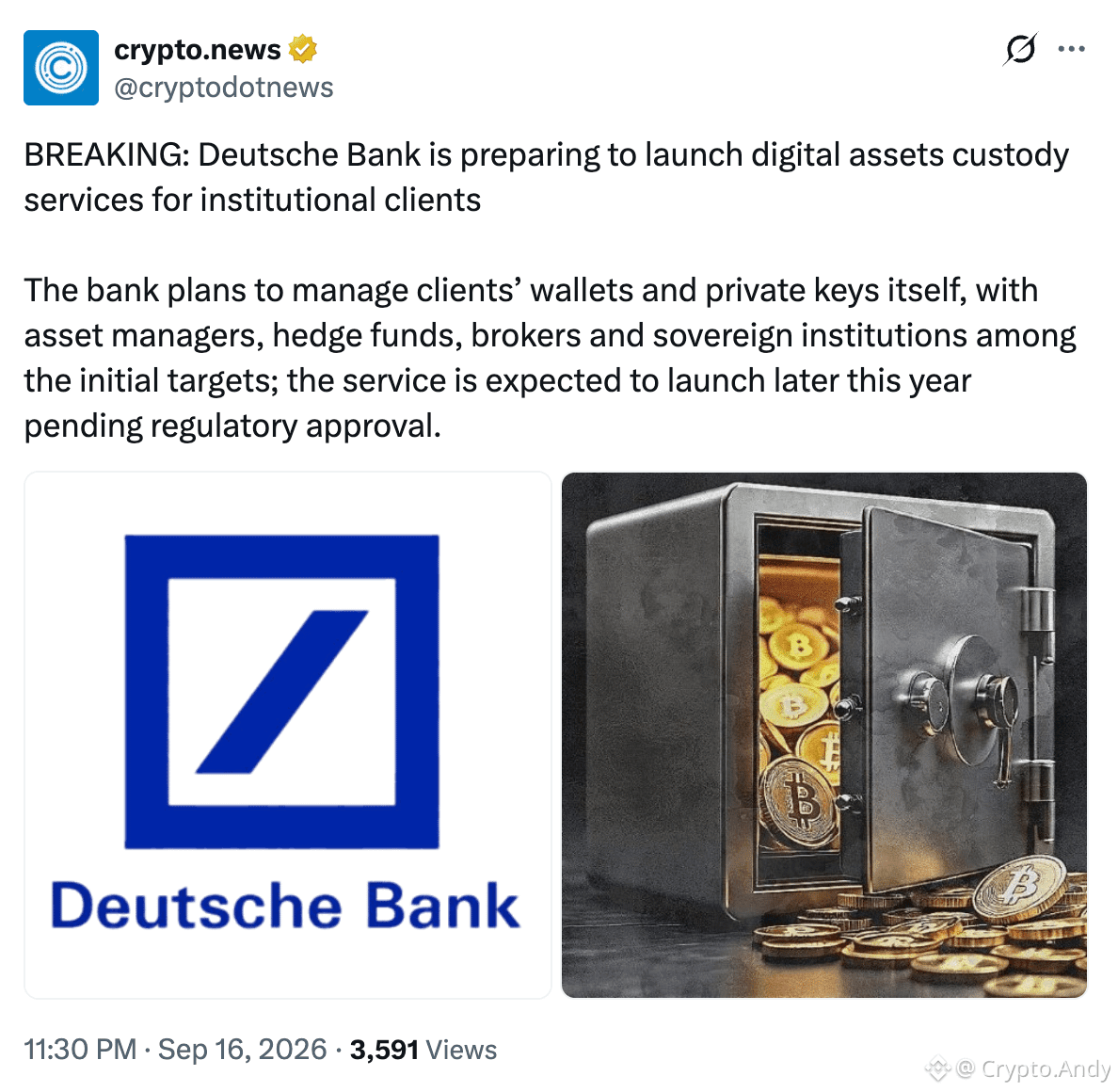
One of Europe’s biggest banks is about to start holding crypto 🏦 Deutsche Bank says its first digital asset custody service is only weeks from launch. In a Reuters interview on October 16, corporate bank co-head Gerald Podobnik said the service will start with $BTC and Ether custody in Germany. The idea is simple: the bank will manage wallets and private keys for its clients, so funds and companies won’t have to build their own key management systems. Protection will include cold and warm storage, multi-person approvals and backup infrastructure. The bank’s materials also list USDC, EURC and EURAU among the supported assets. Still, stablecoin services, tokenized deposits and digital securities are planned as the next step, so the first day will most likely focus on $BTC and ETH. A few things to keep in mind: 🔹 the service is for institutions, corporates and wealth managers, not retail clients 🔹 Germany comes first, with Asian financial centers planned for 2027 🔹 the exact launch date still depends on regulatory and technical readiness For me, this is another sign that crypto is becoming part of everyday banking infrastructure. When a bank of this size starts holding Bitcoin for its corporate clients, it’s much easier for other companies to follow. #BTC Price Analysis# #Bitcoin Price Prediction: What is Bitcoins next move?#
One of Europe’s biggest banks is about to start holding crypto 🏦 Deutsche Bank says its first digital asset custody service is only weeks from launch. In a Reuters interview on October 16, corporate bank co-head Gerald Podobnik said the service will start with $BTC and Ether custody in Germany. The idea is simple: the bank will manage wallets and private keys for its clients, so funds and companies won’t have to build their own key management systems. Protection will include cold and warm storage, multi-person approvals and backup infrastructure. The bank’s materials also list USDC, EURC and EURAU among the supported assets. Still, stablecoin services, tokenized deposits and digital securities are planned as the next step, so the first day will most likely focus on $BTC and ETH. A few things to keep in mind: 🔹 the service is for institutions, corporates and wealth managers, not retail clients 🔹 Germany comes first, with Asian financial centers planned for 2027 🔹 the exact launch date still depends on regulatory and technical readiness For me, this is another sign that crypto is becoming part of everyday banking infrastructure. When a bank of this size starts holding Bitcoin for its corporate clients, it’s much easier for other companies to follow. #BTC Price Analysis# #Bitcoin Price Prediction: What is Bitcoins next move?#
·
--
I Unboxed a Business Crypto Deposit Plan. Here’s What Was Inside Crypto $BTC lending has been getting more and more attention from institutions this year. 📈 In a Nomura and Laser Digital survey published in April, 65% of institutional investors said they’re targeting lending and tokenized assets. For a business, this usually means a deposit plan agreed upon one-to-one with a provider. I like to picture it as a building set. 🧩 Everyone gets the same five pieces in the box, and every company snaps them together around its own cash flow. So, what’s in the box? 🔹 Part 1, the amount. How much the company can set aside without touching day-to-day operations. 🔹 Part 2, the assets. Which coins go in, whether that’s stablecoins, BTC, or a mix? 🔹 Part 3, the term. How long the funds can stay in the plan, based on the cash forecast. 🔹 Part 4, the rate. What the provider offers for that specific amount, asset, and term. 🔹 Part 5, early exit. What happens if the money is needed sooner than planned? The key thing to check is whether the provider lets you rebuild the model your way or only hands you a pre-glued set. WhiteBIT Crypto Lending for Businesses, for example, could set up deposit plans individually. https://institutional.whitebit.com/crypto-lending-for-business?utm_source=coinmarketcap&utm_medium=lendb2_andy&utm_campaign=post Terms might range from 10 days to a few years; several cryptocurrencies could be available; rates are flexible; and early-closing conditions are agreed with each client. Plans start from 600,000 USDT. If you were building your first deposit plan, which brick would you lay down first? 🧩 Disclaimer: This is not financial or investment advice. Do your own research before making any decisions. Use at your own risk. #BTC Price Analysis# #Bitcoin Price Prediction: What is Bitcoins next move?#
I Unboxed a Business Crypto Deposit Plan. Here’s What Was Inside Crypto $BTC lending has been getting more and more attention from institutions this year. 📈 In a Nomura and Laser Digital survey published in April, 65% of institutional investors said they’re targeting lending and tokenized assets. For a business, this usually means a deposit plan agreed upon one-to-one with a provider. I like to picture it as a building set. 🧩 Everyone gets the same five pieces in the box, and every company snaps them together around its own cash flow. So, what’s in the box? 🔹 Part 1, the amount. How much the company can set aside without touching day-to-day operations. 🔹 Part 2, the assets. Which coins go in, whether that’s stablecoins, BTC, or a mix? 🔹 Part 3, the term. How long the funds can stay in the plan, based on the cash forecast. 🔹 Part 4, the rate. What the provider offers for that specific amount, asset, and term. 🔹 Part 5, early exit. What happens if the money is needed sooner than planned? The key thing to check is whether the provider lets you rebuild the model your way or only hands you a pre-glued set. WhiteBIT Crypto Lending for Businesses, for example, could set up deposit plans individually. https://institutional.whitebit.com/crypto-lending-for-business?utm_source=coinmarketcap&utm_medium=lendb2_andy&utm_campaign=post Terms might range from 10 days to a few years; several cryptocurrencies could be available; rates are flexible; and early-closing conditions are agreed with each client. Plans start from 600,000 USDT. If you were building your first deposit plan, which brick would you lay down first? 🧩 Disclaimer: This is not financial or investment advice. Do your own research before making any decisions. Use at your own risk. #BTC Price Analysis# #Bitcoin Price Prediction: What is Bitcoins next move?#

1
·
--
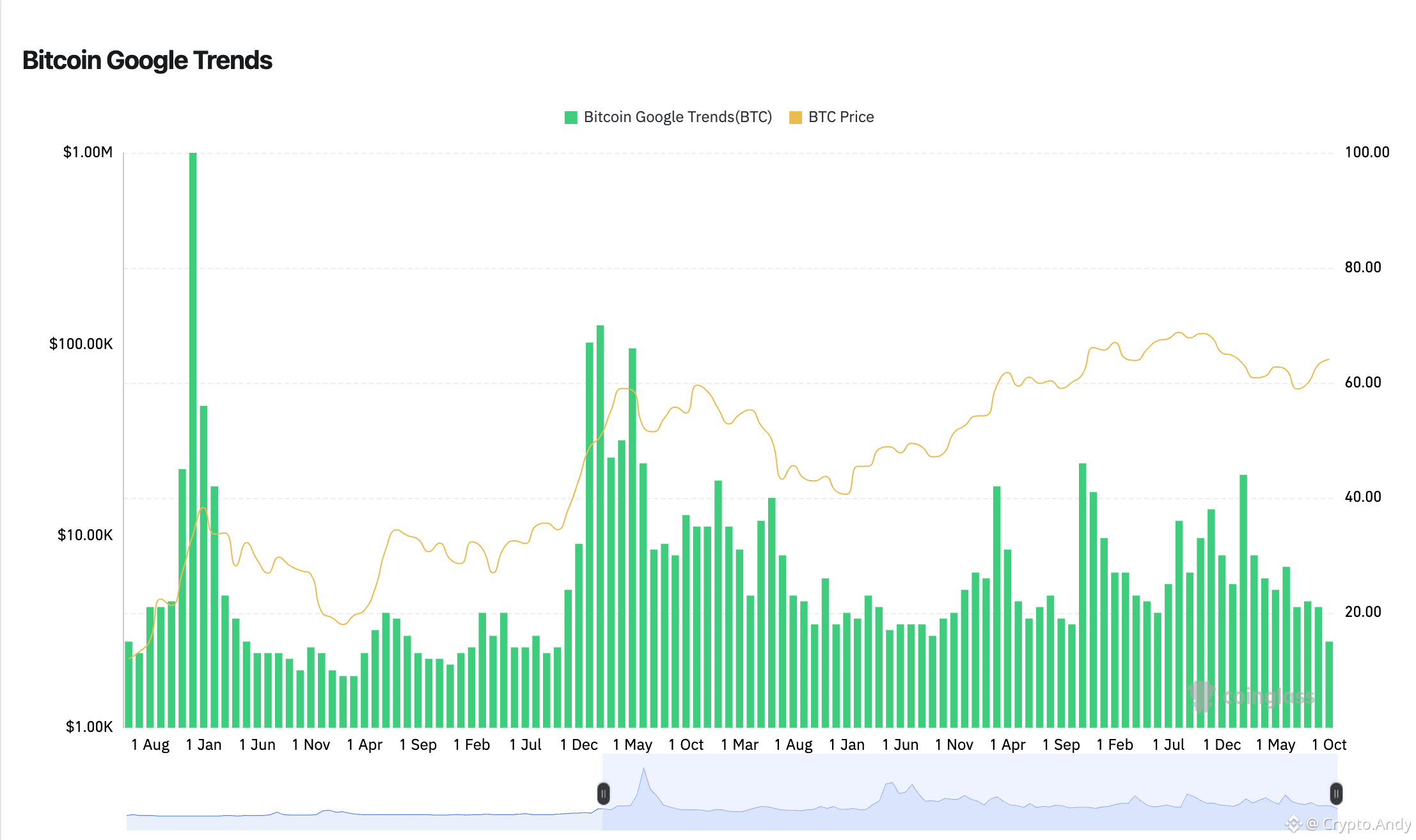
Nobody is googling $BTC anymore... Google searches for “bitcoin” have dropped to about 14 on a 100-point scale, the lowest level in roughly six years. On-chain analyst Willy Woo calls this a buy signal: historically, the quietest periods have been the best time to accumulate. History supports the idea. Searches peaked in December 2017, right when $BTC topped near $20,000. During the 2018–2019 bear market, they fell to around 10, which turned out to be a strong buying window. This cycle looks a bit different, though. Searches for “bitcoin” never climbed above ~45, while searches for “BTCUSD” hit a record in 2025, just before the October all-time high. This suggests that traders and ETF investors now drive most of the attention, rather than curious newcomers. The signal also has a timing issue. In 2021, search interest peaked about six months before the price top, so it’s better used as a background indicator than as an exact entry point. For scale, Bitcoin is worth about $1.65 trillion, while gold is around $29.3 trillion, roughly 18 times more. Some see that as room to grow, while others point to elections, wars and energy issues as reasons for BTC to stay in a range for a while. Do you see this quiet period as a chance to accumulate? 🤔 #BTC Price Analysis# #Bitcoin Price Prediction: What is Bitcoins next move?#
Nobody is googling $BTC anymore... Google searches for “bitcoin” have dropped to about 14 on a 100-point scale, the lowest level in roughly six years. On-chain analyst Willy Woo calls this a buy signal: historically, the quietest periods have been the best time to accumulate. History supports the idea. Searches peaked in December 2017, right when $BTC topped near $20,000. During the 2018–2019 bear market, they fell to around 10, which turned out to be a strong buying window. This cycle looks a bit different, though. Searches for “bitcoin” never climbed above ~45, while searches for “BTCUSD” hit a record in 2025, just before the October all-time high. This suggests that traders and ETF investors now drive most of the attention, rather than curious newcomers. The signal also has a timing issue. In 2021, search interest peaked about six months before the price top, so it’s better used as a background indicator than as an exact entry point. For scale, Bitcoin is worth about $1.65 trillion, while gold is around $29.3 trillion, roughly 18 times more. Some see that as room to grow, while others point to elections, wars and energy issues as reasons for BTC to stay in a range for a while. Do you see this quiet period as a chance to accumulate? 🤔 #BTC Price Analysis# #Bitcoin Price Prediction: What is Bitcoins next move?#
42
·
--
☕ Saturday thoughts This week Charles Schwab finished rolling out crypto trading to all eligible retail clients. Now they can buy $BTC and Ether right inside their regular Schwab accounts, next to their stocks and ETFs. It sounds like a small update, but think about the scale. Schwab manages around $13 trillion, and its clients already hold about 20% of all assets in spot crypto ETFs. Many of these people have never opened a crypto exchange account and probably never will. Now they don’t need to. Schwab’s research team is also quite optimistic. They point to almost $60B in Bitcoin ETF inflows since early 2024 and say BTC volatility has dropped to around 40, from the old 50–60 range. For a traditional broker, this is pretty much saying that Bitcoin has grown up 😄 There is a price for this convenience, though. Each trade costs 0.75%, which is a lot compared with most crypto exchanges. Still, many investors will happily pay it just to keep everything in one familiar place. Would you buy crypto through your bank or broker or do you prefer exchanges? 👇 #BTC Price Analysis# #Bitcoin Price Prediction: What is Bitcoins next move?#
☕ Saturday thoughts This week Charles Schwab finished rolling out crypto trading to all eligible retail clients. Now they can buy $BTC and Ether right inside their regular Schwab accounts, next to their stocks and ETFs. It sounds like a small update, but think about the scale. Schwab manages around $13 trillion, and its clients already hold about 20% of all assets in spot crypto ETFs. Many of these people have never opened a crypto exchange account and probably never will. Now they don’t need to. Schwab’s research team is also quite optimistic. They point to almost $60B in Bitcoin ETF inflows since early 2024 and say BTC volatility has dropped to around 40, from the old 50–60 range. For a traditional broker, this is pretty much saying that Bitcoin has grown up 😄 There is a price for this convenience, though. Each trade costs 0.75%, which is a lot compared with most crypto exchanges. Still, many investors will happily pay it just to keep everything in one familiar place. Would you buy crypto through your bank or broker or do you prefer exchanges? 👇 #BTC Price Analysis# #Bitcoin Price Prediction: What is Bitcoins next move?#

54
·
--
According to Santiment, the number of wallets holding between 10 and 10,000 $BTC has reached a new all-time high of 20,338 addresses. This group has been growing nonstop since mid-July, even with all the price swings. CryptoQuant data shows the same picture. Whale balances, excluding exchanges and mining pools, grew from about 2.94M $BTC at the end of August to almost 3M BTC. That’s around 60,000 BTC added, or +2%, and the highest level this year. Accumulation slowed down in September, then sped up sharply in late September and early October, after the price had already started to recover. In other words, whales didn’t try to guess the bottom. They kept buying as the rebound unfolded. Analysts say this could help absorb profit-taking and turn a short bounce into a longer move up. CryptoQuant also adds a fair caveat: sharp balance changes can sometimes come from wallet reshuffling, so the real confirmation will be whales holding or adding during pullbacks. Do you follow whale activity when you make your own trades? 🤔 #BTC Price Analysis# #Bitcoin Price Prediction: What is Bitcoins next move?#
According to Santiment, the number of wallets holding between 10 and 10,000 $BTC has reached a new all-time high of 20,338 addresses. This group has been growing nonstop since mid-July, even with all the price swings. CryptoQuant data shows the same picture. Whale balances, excluding exchanges and mining pools, grew from about 2.94M $BTC at the end of August to almost 3M BTC. That’s around 60,000 BTC added, or +2%, and the highest level this year. Accumulation slowed down in September, then sped up sharply in late September and early October, after the price had already started to recover. In other words, whales didn’t try to guess the bottom. They kept buying as the rebound unfolded. Analysts say this could help absorb profit-taking and turn a short bounce into a longer move up. CryptoQuant also adds a fair caveat: sharp balance changes can sometimes come from wallet reshuffling, so the real confirmation will be whales holding or adding during pullbacks. Do you follow whale activity when you make your own trades? 🤔 #BTC Price Analysis# #Bitcoin Price Prediction: What is Bitcoins next move?#

77
·
--
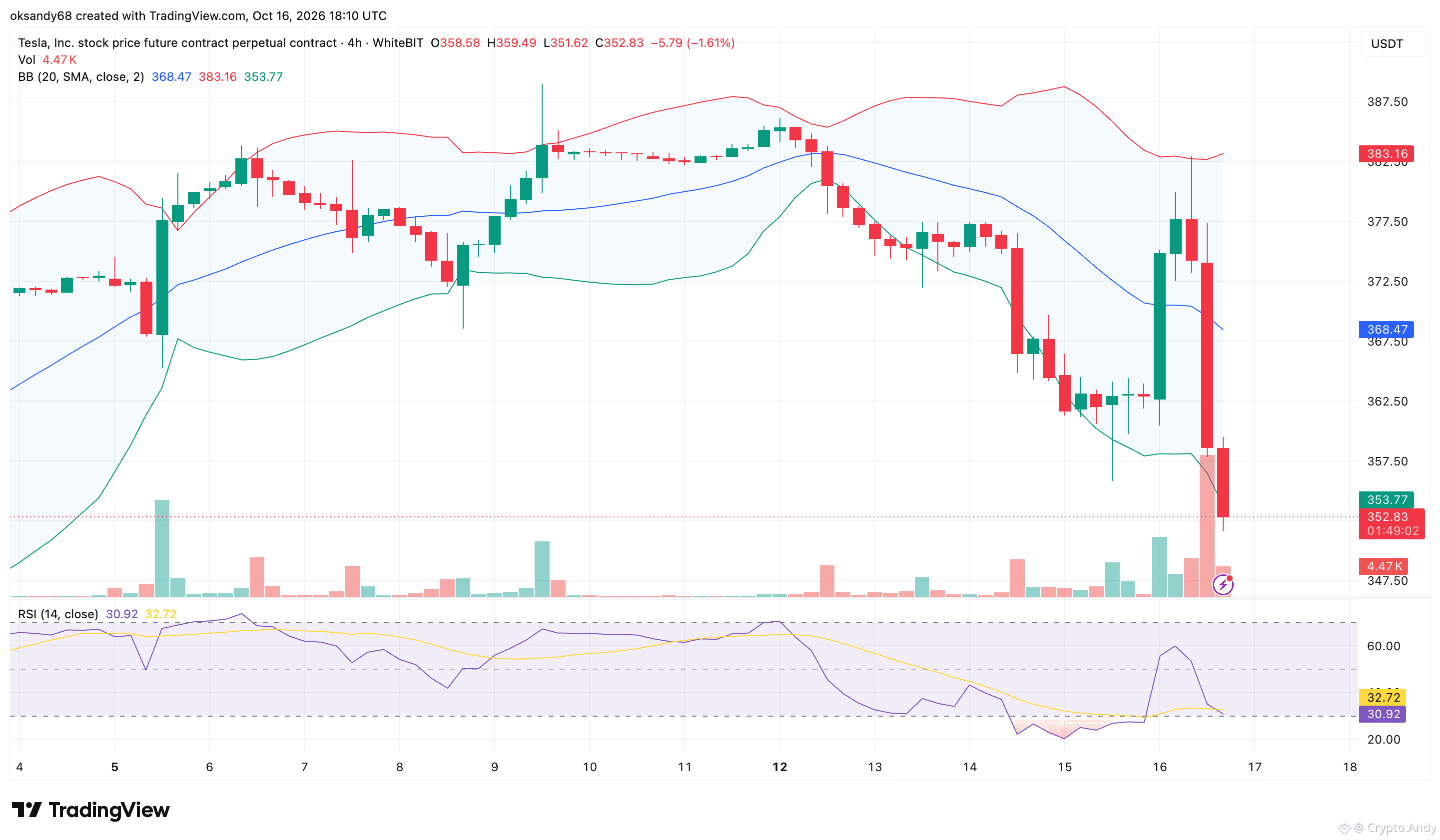
Tesla’s Roadster can fly and flip in the air. The $TSLA stock decided to copy only the flip part 🙃 From $382 down to $353 in less than a day. #Macro Insights# #Tesla
Tesla’s Roadster can fly and flip in the air. The $TSLA stock decided to copy only the flip part 🙃 From $382 down to $353 in less than a day. #Macro Insights# #Tesla
63
·
--
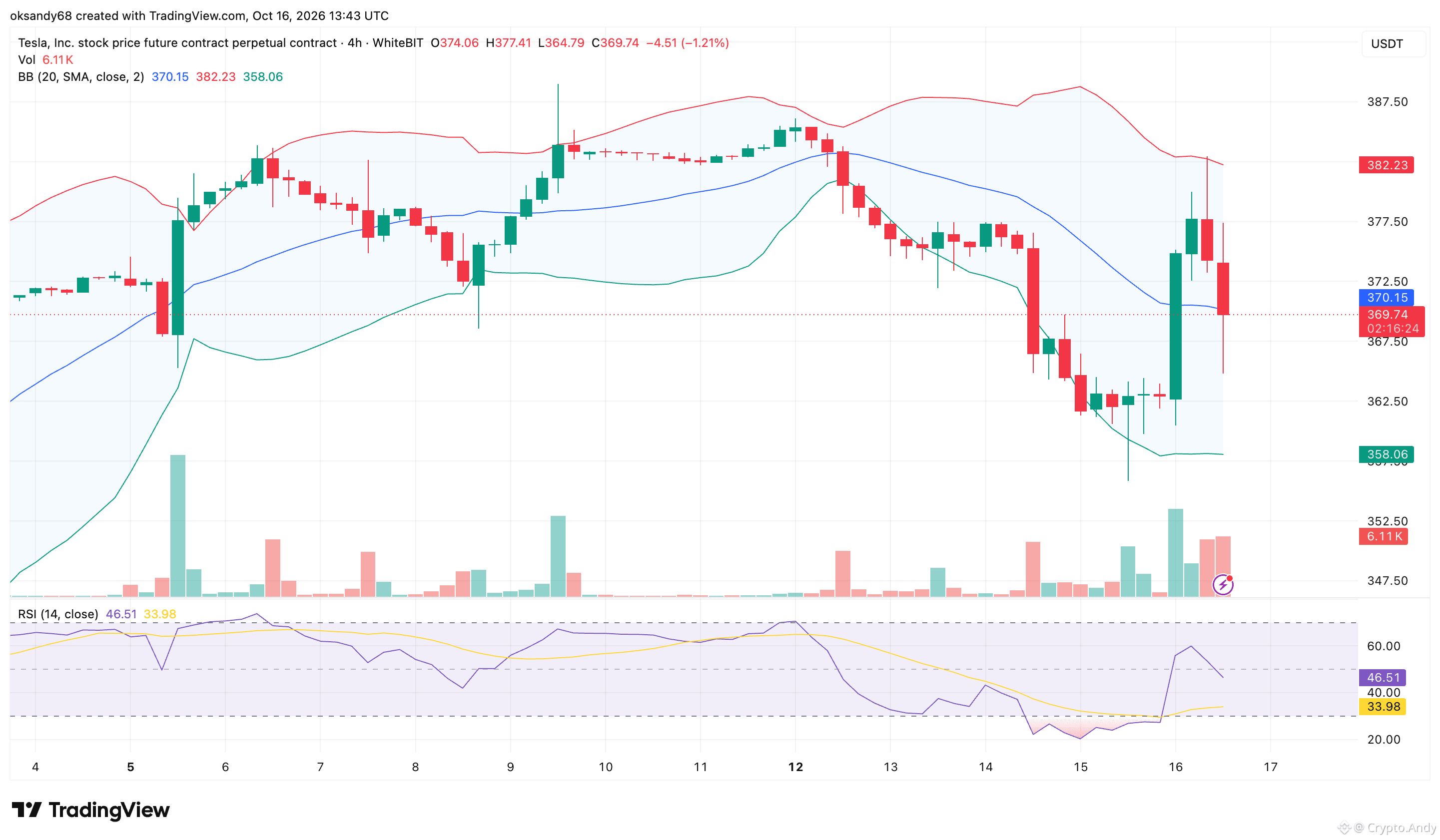
$TSLA just made a car fly 🚀 At SpaceX’s test site in Texas, Tesla finally unveiled the new Roadster. The car drove upside down on a ramp, launched into the air, did a flip and landed back on its wheels. In the demo it also hit 0–60 mph in 0.81 seconds. The Roadster comes in three versions: 🔹 Performance: no thrusters 🔹 Thrust: rear boosters for extra acceleration 🔹 Rocket: invite-only, single seat, 10 thrusters and a full flight system. This is the only version that can fly Production is planned for 2028. What the chart shows ($TSLA perp, 4H): After the event, the price jumped from about $363 to a high near $382, right at the upper Bollinger Band. Buyers couldn’t hold that level, and the price pulled back to $369.7, right at the middle band (~$370). RSI bounced from oversold levels near 20 on October 15 and is now cooling at ~46. Levels I’m watching: 🟢 $358: lower band and this week’s low 🔴 $382: post-presentation high and upper band If the price holds above $370, a retest of $382 is possible. A drop below $358 would erase the whole presentation rally. Would you pay $250K just to reserve a Roadster with rocket thrusters? 🤔 #Tesla #Macro Insights#
$TSLA just made a car fly 🚀 At SpaceX’s test site in Texas, Tesla finally unveiled the new Roadster. The car drove upside down on a ramp, launched into the air, did a flip and landed back on its wheels. In the demo it also hit 0–60 mph in 0.81 seconds. The Roadster comes in three versions: 🔹 Performance: no thrusters 🔹 Thrust: rear boosters for extra acceleration 🔹 Rocket: invite-only, single seat, 10 thrusters and a full flight system. This is the only version that can fly Production is planned for 2028. What the chart shows ($TSLA perp, 4H): After the event, the price jumped from about $363 to a high near $382, right at the upper Bollinger Band. Buyers couldn’t hold that level, and the price pulled back to $369.7, right at the middle band (~$370). RSI bounced from oversold levels near 20 on October 15 and is now cooling at ~46. Levels I’m watching: 🟢 $358: lower band and this week’s low 🔴 $382: post-presentation high and upper band If the price holds above $370, a retest of $382 is possible. A drop below $358 would erase the whole presentation rally. Would you pay $250K just to reserve a Roadster with rocket thrusters? 🤔 #Tesla #Macro Insights#

120
·
--
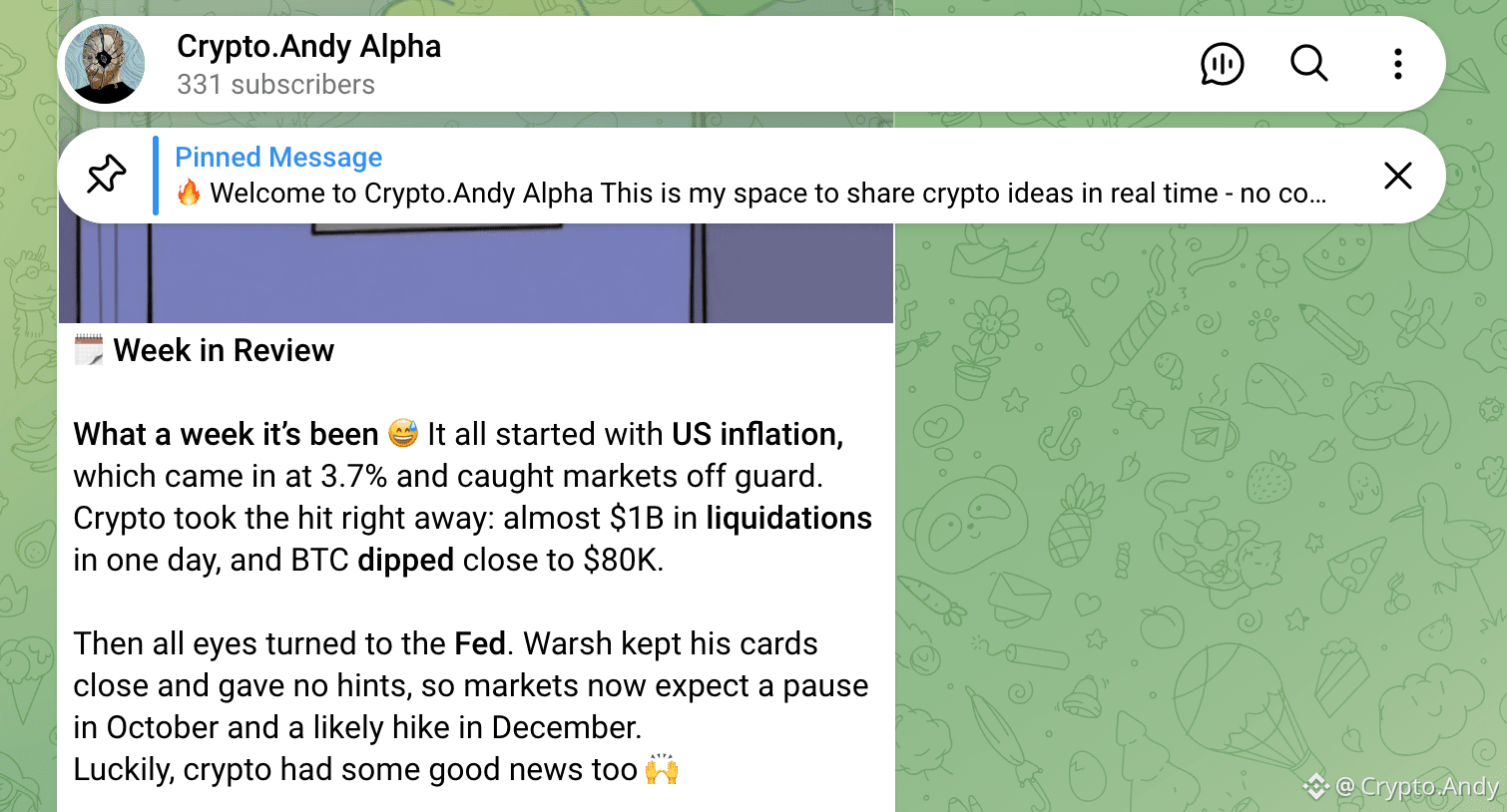
Every Friday I drop a weekly digest in my community and it’s already become a little tradition 😄 This week was a busy one: US inflation at 3.7%, almost $1B in crypto liquidations, and $BTC dipping close to $80K. Warsh gave no hints, so markets now expect a pause in October and a likely hike in December. There was good news too 🙌 USDC became the EU’s first “significant” stablecoin, Mastercard launched stablecoin payments, and Kraken is buying a bank in Lithuania. The full digest, with Tesla’s rocket Roadster and Netflix layoffs, is already waiting in Crypto.Andy's Community: https://bit.ly/4jdykHo See you there every Friday 👋 #BTC Price Analysis# #Bitcoin Price Prediction: What is Bitcoins next move?#
Every Friday I drop a weekly digest in my community and it’s already become a little tradition 😄 This week was a busy one: US inflation at 3.7%, almost $1B in crypto liquidations, and $BTC dipping close to $80K. Warsh gave no hints, so markets now expect a pause in October and a likely hike in December. There was good news too 🙌 USDC became the EU’s first “significant” stablecoin, Mastercard launched stablecoin payments, and Kraken is buying a bank in Lithuania. The full digest, with Tesla’s rocket Roadster and Netflix layoffs, is already waiting in Crypto.Andy's Community: https://bit.ly/4jdykHo See you there every Friday 👋 #BTC Price Analysis# #Bitcoin Price Prediction: What is Bitcoins next move?#
2
·
--
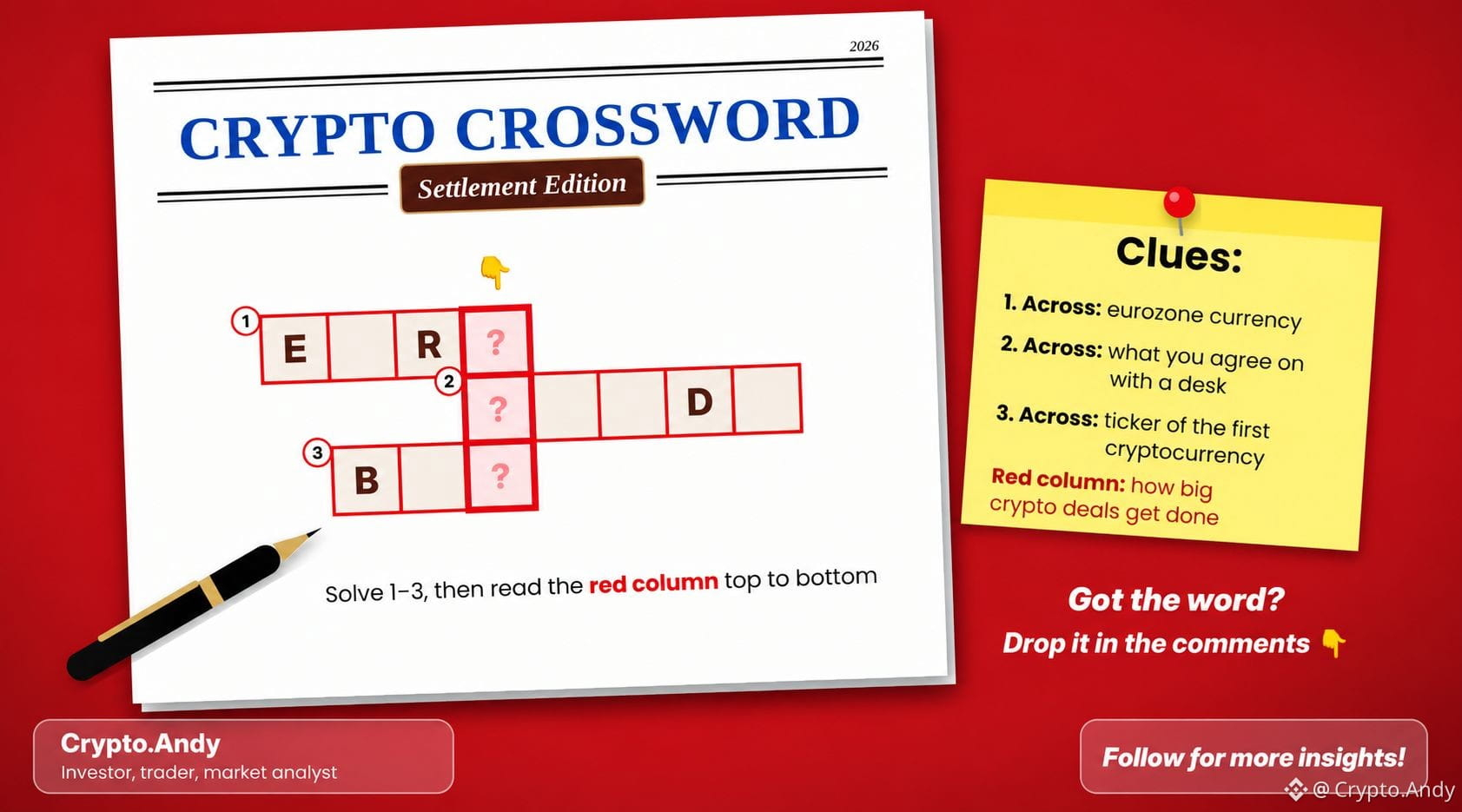
What Happens After You Agree a $BTC Price on an OTC Desk? OTC trading keeps growing in 2026 and according to Finery Markets, institutional spot OTC volume rose 43% year over year in Q1 and the number of trades jumped by 160%. With that many deals going through, there's one moment that deserves more attention than it gets. 🤔 Agreeing on the price feels like the finish line, but the trade only really closes once the fiat lands. And that part can get messy. So I took one trade and looked at it from both sides of the table. If you're the client, you just want to send the money through whatever your bank handles best, quickly and without random fees eating into the amount. If you're the provider, the price is already locked and you're waiting for the wire ⏳ You need to know when it's coming and how to match it to the right trade. In the full article on Medium, I break down both perspectives, share a short checklist of what to agree before you trade, and look at how WhiteBIT, Gemini and BitGo approach fiat settlement: https://medium.com/@oksandy68/ever-wondered-what-your-otc-provider-is-waiting-for-after-the-price-is-locked-93a1a7db4538 What matters more to you in an OTC deal: the best price or the fastest settlement? #BTC Price Analysis# #Bitcoin Price Prediction: What is Bitcoins next move?#
What Happens After You Agree a $BTC Price on an OTC Desk? OTC trading keeps growing in 2026 and according to Finery Markets, institutional spot OTC volume rose 43% year over year in Q1 and the number of trades jumped by 160%. With that many deals going through, there's one moment that deserves more attention than it gets. 🤔 Agreeing on the price feels like the finish line, but the trade only really closes once the fiat lands. And that part can get messy. So I took one trade and looked at it from both sides of the table. If you're the client, you just want to send the money through whatever your bank handles best, quickly and without random fees eating into the amount. If you're the provider, the price is already locked and you're waiting for the wire ⏳ You need to know when it's coming and how to match it to the right trade. In the full article on Medium, I break down both perspectives, share a short checklist of what to agree before you trade, and look at how WhiteBIT, Gemini and BitGo approach fiat settlement: https://medium.com/@oksandy68/ever-wondered-what-your-otc-provider-is-waiting-for-after-the-price-is-locked-93a1a7db4538 What matters more to you in an OTC deal: the best price or the fastest settlement? #BTC Price Analysis# #Bitcoin Price Prediction: What is Bitcoins next move?#
45
·
--
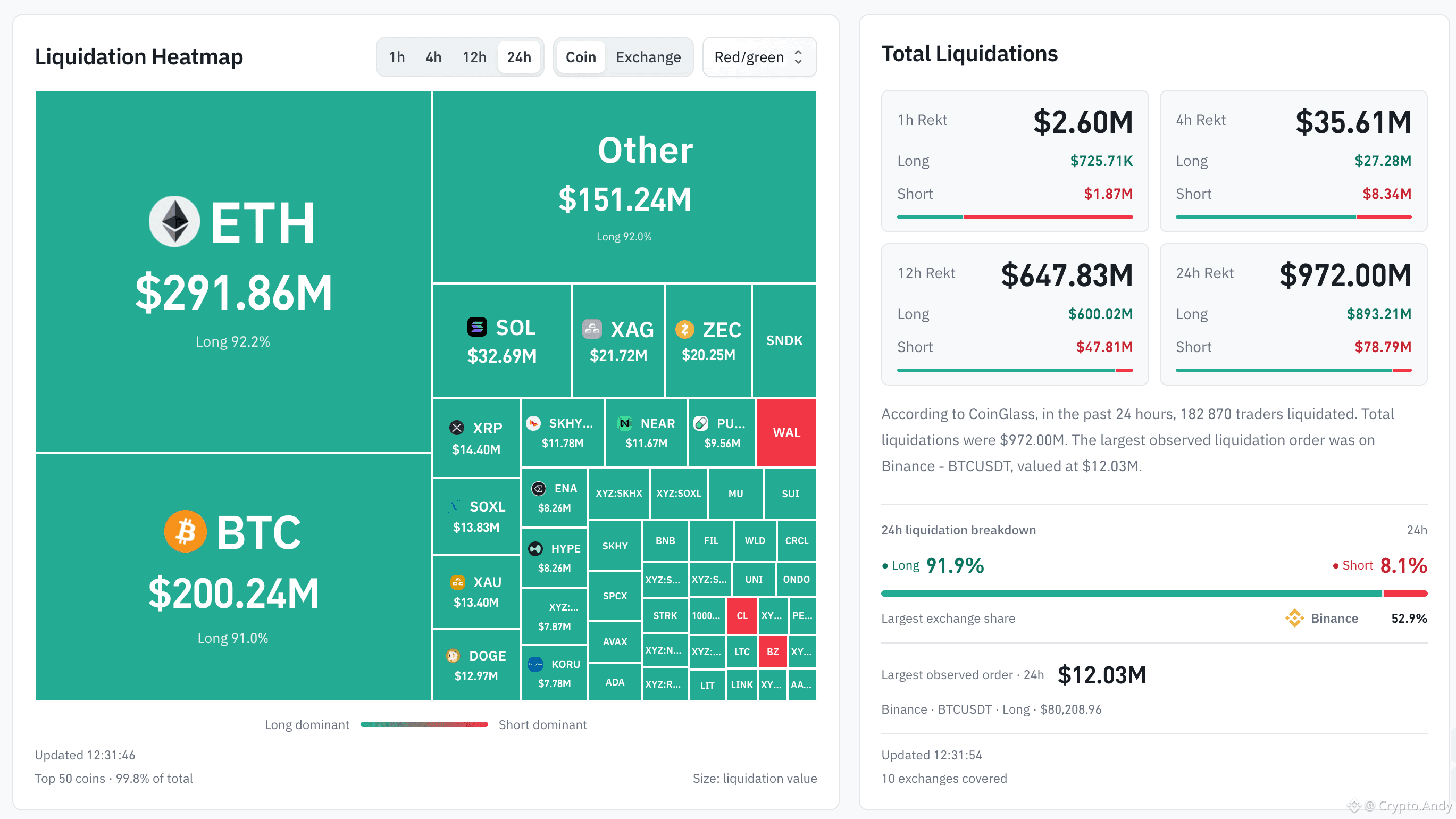
Almost $1 billion in crypto liquidations in 24 hours, and the selloff is global 📉 According to CoinGlass, $972M was wiped out in a day, and about 92% of it came from long positions. More than 182,000 traders were liquidated. The largest single order was a $12M $BTC long on Binance, closed at around $80,200. Ethereum took the biggest hit with $292M in liquidations, followed by Bitcoin at $200M. Stocks didn’t look any better. The Nasdaq dropped 1.9% after hotter-than-expected US inflation data, and chipmakers led the decline. Asia picked up the selling the next morning. South Korea’s KOSPI fell almost 9% and triggered a trading halt, its 10th this year. Japan’s Nikkei 225 lost 5%. The main driver is the Fed. After the inflation report, markets raised the odds of another rate hike at the October 27–28 meeting to about 32%. Higher rates usually mean less appetite for risk, and crypto feels it first. #BTC Price Analysis# #Macro Insights#
Almost $1 billion in crypto liquidations in 24 hours, and the selloff is global 📉 According to CoinGlass, $972M was wiped out in a day, and about 92% of it came from long positions. More than 182,000 traders were liquidated. The largest single order was a $12M $BTC long on Binance, closed at around $80,200. Ethereum took the biggest hit with $292M in liquidations, followed by Bitcoin at $200M. Stocks didn’t look any better. The Nasdaq dropped 1.9% after hotter-than-expected US inflation data, and chipmakers led the decline. Asia picked up the selling the next morning. South Korea’s KOSPI fell almost 9% and triggered a trading halt, its 10th this year. Japan’s Nikkei 225 lost 5%. The main driver is the Fed. After the inflation report, markets raised the odds of another rate hike at the October 27–28 meeting to about 32%. Higher rates usually mean less appetite for risk, and crypto feels it first. #BTC Price Analysis# #Macro Insights#
81
·
--
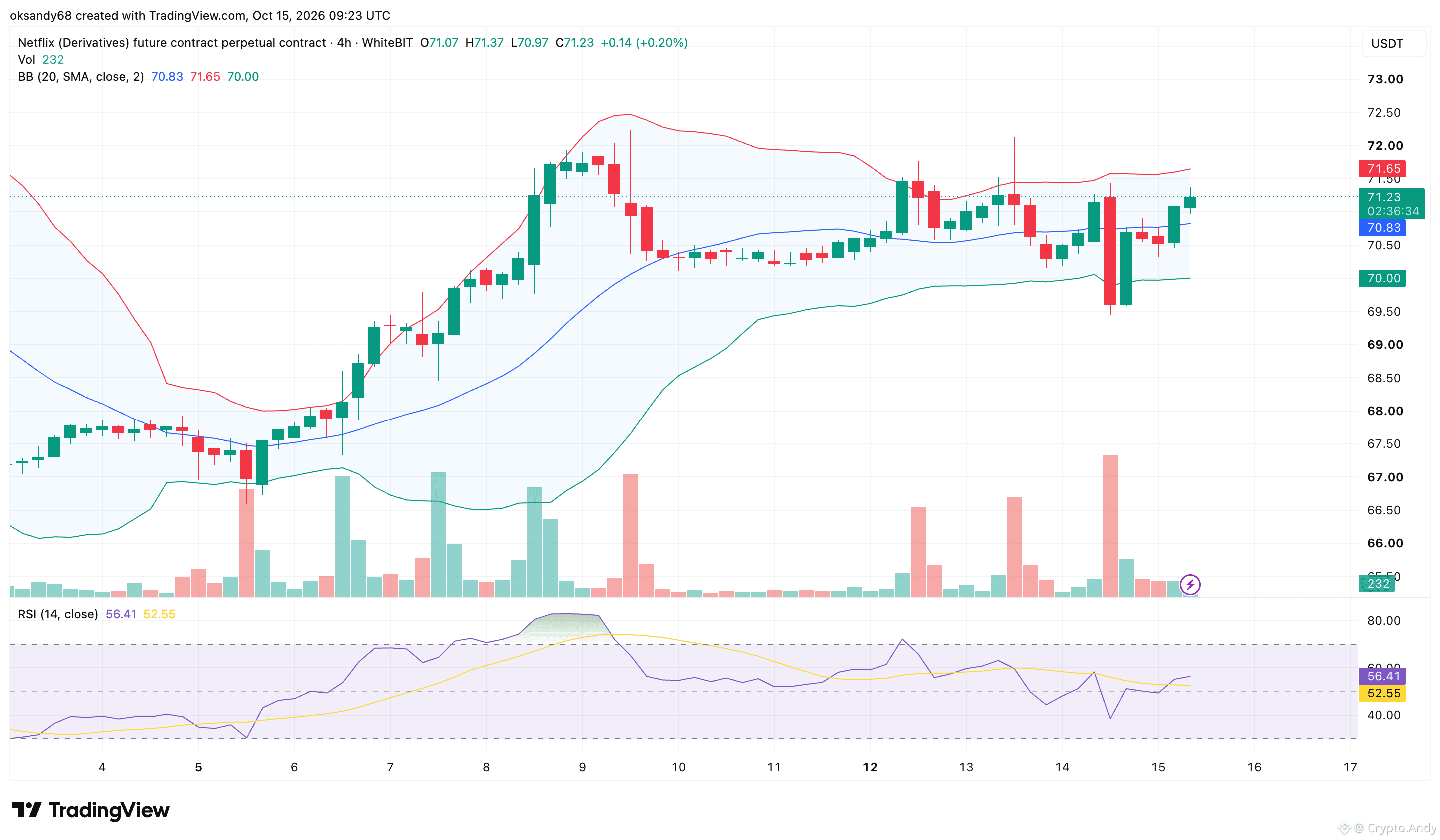
📍 Netflix announced its biggest layoffs since 2022 The company is cutting about 6% of its staff, roughly 1,000 people. Management says the business is still growing and the yearly forecast holds. $NFLX is down about 25% this year. On the 4H chart, October 14 brought a sharp red candle from $71.6 to $69.5 on the biggest volume of the month. Hot US inflation data hit the market the same day. Buyers recovered the drop almost immediately and the price is back at $71.2. Since October 9 the price has been stuck between $70 and $72, and the Bollinger Bands are getting tighter. A breakout above $72 opens room for growth, while a close below $69.5 would signal a deeper pullback. I’m watching which side breaks first 👀 #Netflix #Macro Insights# #Altcoin Season#
📍 Netflix announced its biggest layoffs since 2022 The company is cutting about 6% of its staff, roughly 1,000 people. Management says the business is still growing and the yearly forecast holds. $NFLX is down about 25% this year. On the 4H chart, October 14 brought a sharp red candle from $71.6 to $69.5 on the biggest volume of the month. Hot US inflation data hit the market the same day. Buyers recovered the drop almost immediately and the price is back at $71.2. Since October 9 the price has been stuck between $70 and $72, and the Bollinger Bands are getting tighter. A breakout above $72 opens room for growth, while a close below $69.5 would signal a deeper pullback. I’m watching which side breaks first 👀 #Netflix #Macro Insights# #Altcoin Season#
107
·
--
🧲 Standard Chartered Opens $BTC and $ETH Trading to Wealthy UAE Clients Standard Chartered now lets professional investors in the UAE buy BTC and ETH straight from their regular bank accounts. There’s no separate crypto app and no transfers back and forth, you just log in and buy 😎 The catch is that you need at least AED 4M (~$1.1M) in net assets to get in. And the bank isn’t wasting time. In early September it opened crypto trading to institutional clients and barely a month later wealthy individuals are getting access too. The UAE keeps turning into a real crypto magnet On Monday, Payward, Kraken’s parent company, got approval from Dubai’s regulator VARA and back in July Revolut received preliminary VARA approval 🇦🇪 WhiteBIT joined the list too, with In-Principle Approval from VARA. It’s more like a green light to move on to the next stage. Is Dubai about to become the world’s crypto capital? 🇦🇪 #BTC Price Analysis# #BTC Price Analysis#
🧲 Standard Chartered Opens $BTC and $ETH Trading to Wealthy UAE Clients Standard Chartered now lets professional investors in the UAE buy BTC and ETH straight from their regular bank accounts. There’s no separate crypto app and no transfers back and forth, you just log in and buy 😎 The catch is that you need at least AED 4M (~$1.1M) in net assets to get in. And the bank isn’t wasting time. In early September it opened crypto trading to institutional clients and barely a month later wealthy individuals are getting access too. The UAE keeps turning into a real crypto magnet On Monday, Payward, Kraken’s parent company, got approval from Dubai’s regulator VARA and back in July Revolut received preliminary VARA approval 🇦🇪 WhiteBIT joined the list too, with In-Principle Approval from VARA. It’s more like a green light to move on to the next stage. Is Dubai about to become the world’s crypto capital? 🇦🇪 #BTC Price Analysis# #BTC Price Analysis#
39
තවත් අන්තර්ගතයන් ගවේෂණය කිරීමට ඇතුල් වන්න
Binance චතුරශ්රය හි ගෝලීය ක්රිප්ටෝ පරිශීලකයින් හා එක්වන්න
⚡️ ක්රිප්ටෝ පිළිබඳ නවතම සහ ප්රයෝජනවත් තොරතුරු ලබා ගන්න.
💬 ලොව විශාලතම ක්රිප්ටෝ හුවමාරුව මගින් විශ්වාස කෙරේ.
👍 සත්යායනය කරන ලද නිර්මාණකරුවන්ගෙන් සැබෑ විදසුන් සොයා ගන්න.
විද්යුත් තැපෑල / දුරකථන අංකය
නැගී එන මාතෘකා
CanMicrosoftDeliverOnAI
107,375 නැරඹීම්
829 සාකච්ඡා කරමින්
Earnings Season Session 3: Will Google & Microsoft Beat Earnings Expectations?
Binance Square Official
·67 කැමත්ත දැක්වීම්
·18.6k නැරඹීම්
CanGoogleDefindItsCore
50,770 නැරඹීම්
594 සාකච්ඡා කරමින්
FOMCWatch
9.1M නැරඹීම්
28,065 සාකච්ඡා කරමින්