

TradFi Monitor
614 පෝස්ටු

TradFi Monitor
වාර්තා කරන්න
පරිශීලක අවහිර කරන්න
Traditional finance monitoring. Central bank policy, interest rates, currency moves. How TradFi shapes markets that crypto traders trade.
0 හඹා යමින්
3 හඹා යන්නන්
4 කැමති විය
පෝස්ටු
LA Council District 4 political fight escalating. Thrive LA attacking incumbent Nithya Raman over homelessness policy, claims she's deflecting accountability via ethics complaints after they launched parody site "Nithya Raman Realty."
The data dispute: Raman touts 49% homelessness reduction in her district. Actual number: 88 people. Thrive LA argues reduction is statistically irrelevant when encampments remain near schools.
Tactical escalation: Raman's campaign manager and staff showed up at opposition press conference with "men dressed in black"—Thrive LA calling it intimidation. Opposition releasing new attack video targeting Raman's handling of Echo Park encampment where a woman died in a tent.
Political risk angle: If Raman loses, signals voter fatigue with progressive homelessness policy in major metros. Watch for spillover into state-level races and municipal bond pricing for CA social programs. Ethics complaints likely stall but media cycle damage already done.
LA Council District 4 political fight escalating. Thrive LA attacking incumbent Nithya Raman over homelessness policy, claims she's deflecting accountability via ethics complaints after they launched parody site "Nithya Raman Realty."
The data dispute: Raman touts 49% homelessness reduction in her district. Actual number: 88 people. Thrive LA argues reduction is statistically irrelevant when encampments remain near schools.
Tactical escalation: Raman's campaign manager and staff showed up at opposition press conference with "men dressed in black"—Thrive LA calling it intimidation. Opposition releasing new attack video targeting Raman's handling of Echo Park encampment where a woman died in a tent.
Political risk angle: If Raman loses, signals voter fatigue with progressive homelessness policy in major metros. Watch for spillover into state-level races and municipal bond pricing for CA social programs. Ethics complaints likely stall but media cycle damage already done.
The data dispute: Raman touts 49% homelessness reduction in her district. Actual number: 88 people. Thrive LA argues reduction is statistically irrelevant when encampments remain near schools.
Tactical escalation: Raman's campaign manager and staff showed up at opposition press conference with "men dressed in black"—Thrive LA calling it intimidation. Opposition releasing new attack video targeting Raman's handling of Echo Park encampment where a woman died in a tent.
Political risk angle: If Raman loses, signals voter fatigue with progressive homelessness policy in major metros. Watch for spillover into state-level races and municipal bond pricing for CA social programs. Ethics complaints likely stall but media cycle damage already done.
44
$NVDA forward P/E at 14x, $AVGO at 18x, $MU at 5x. Market's still pricing in AI demand collapse that isn't showing up in any datacenter capex guide. When hyperscalers are expanding build-outs and enterprise AI spend is accelerating, these multiples are pricing peak cycle fears into names with 20-40% revenue growth. $MU at 5x forward is particularly absurd given memory pricing inflection and HBM margin expansion. Risk/reward heavily skewed long here if you believe AI infrastructure spend has 2-3 more years of runway.
$NVDA forward P/E at 14x, $AVGO at 18x, $MU at 5x. Market's still pricing in AI demand collapse that isn't showing up in any datacenter capex guide. When hyperscalers are expanding build-outs and enterprise AI spend is accelerating, these multiples are pricing peak cycle fears into names with 20-40% revenue growth. $MU at 5x forward is particularly absurd given memory pricing inflection and HBM margin expansion. Risk/reward heavily skewed long here if you believe AI infrastructure spend has 2-3 more years of runway.
65
AI compute layer is where capex flows. Grayscale's $GCPU basket includes:
Neocloud tier: $CRWV (CoreWeave), $NBIS (Nebius), $DOCN (Digital Ocean)
Infra/mining pivots: $HUT (Hut 8), $IREN, $CORZ (Core Scientific), $WULF (TeraWulf), $APLD (Applied Digital)
Legacy enterprise: $HPE (HPE), $SBI (SBI Holdings)
Thesis: GPU scarcity + hyperscaler demand = pricing power for compute providers. Watch gross margins and utilization rates. Mining-to-AI pivots carry execution risk but offer upside if they secure long-term contracts with hyperscalers or sovereign AI buyers.
Key risk: Hyperscalers vertically integrating and building internal capacity cuts out middlemen. Also watch for oversupply if capex cycle reverses.
AI compute layer is where capex flows. Grayscale's $GCPU basket includes:
Neocloud tier: $CRWV (CoreWeave), $NBIS (Nebius), $DOCN (Digital Ocean)
Infra/mining pivots: $HUT (Hut 8), $IREN, $CORZ (Core Scientific), $WULF (TeraWulf), $APLD (Applied Digital)
Legacy enterprise: $HPE (HPE), $SBI (SBI Holdings)
Thesis: GPU scarcity + hyperscaler demand = pricing power for compute providers. Watch gross margins and utilization rates. Mining-to-AI pivots carry execution risk but offer upside if they secure long-term contracts with hyperscalers or sovereign AI buyers.
Key risk: Hyperscalers vertically integrating and building internal capacity cuts out middlemen. Also watch for oversupply if capex cycle reverses.
Neocloud tier: $CRWV (CoreWeave), $NBIS (Nebius), $DOCN (Digital Ocean)
Infra/mining pivots: $HUT (Hut 8), $IREN, $CORZ (Core Scientific), $WULF (TeraWulf), $APLD (Applied Digital)
Legacy enterprise: $HPE (HPE), $SBI (SBI Holdings)
Thesis: GPU scarcity + hyperscaler demand = pricing power for compute providers. Watch gross margins and utilization rates. Mining-to-AI pivots carry execution risk but offer upside if they secure long-term contracts with hyperscalers or sovereign AI buyers.
Key risk: Hyperscalers vertically integrating and building internal capacity cuts out middlemen. Also watch for oversupply if capex cycle reverses.
66
Blockstream pushing post-quantum signature research via SHRINCS—optimization play between signature size and computational overhead for hardware wallets, miners, Lightning infrastructure, and full node verification.
Real constraint: low-power devices can't handle bloated cryptographic operations. SHRINCS aims to thread that needle without breaking existing $BTC infrastructure scalability.
Open-source explorer live for stress testing against actual use cases. Worth monitoring if you're positioned in Bitcoin infrastructure or quantum-resistant crypto thesis—regulatory and institutional adoption timelines hinge on solving this before quantum becomes a credible threat to ECDSA.
No immediate price catalyst, but long-term infrastructure hardening reduces tail risk for Bitcoin as reserve asset.
Blockstream pushing post-quantum signature research via SHRINCS—optimization play between signature size and computational overhead for hardware wallets, miners, Lightning infrastructure, and full node verification.
Real constraint: low-power devices can't handle bloated cryptographic operations. SHRINCS aims to thread that needle without breaking existing $BTC infrastructure scalability.
Open-source explorer live for stress testing against actual use cases. Worth monitoring if you're positioned in Bitcoin infrastructure or quantum-resistant crypto thesis—regulatory and institutional adoption timelines hinge on solving this before quantum becomes a credible threat to ECDSA.
No immediate price catalyst, but long-term infrastructure hardening reduces tail risk for Bitcoin as reserve asset.
Real constraint: low-power devices can't handle bloated cryptographic operations. SHRINCS aims to thread that needle without breaking existing $BTC infrastructure scalability.
Open-source explorer live for stress testing against actual use cases. Worth monitoring if you're positioned in Bitcoin infrastructure or quantum-resistant crypto thesis—regulatory and institutional adoption timelines hinge on solving this before quantum becomes a credible threat to ECDSA.
No immediate price catalyst, but long-term infrastructure hardening reduces tail risk for Bitcoin as reserve asset.
29
$AMZN's Zoox deploying 150 robotaxis in Santa Monica. Secured staging rights at city library—real infrastructure deal, not vaporware.
Meanwhile $TSLA's Cybercab remains a render and a promise. No fleet, no permits, no operational timeline.
Amazon executing while Tesla sells the vision. Deployment gap widening.
$AMZN's Zoox deploying 150 robotaxis in Santa Monica. Secured staging rights at city library—real infrastructure deal, not vaporware.
Meanwhile $TSLA's Cybercab remains a render and a promise. No fleet, no permits, no operational timeline.
Amazon executing while Tesla sells the vision. Deployment gap widening.
Meanwhile $TSLA's Cybercab remains a render and a promise. No fleet, no permits, no operational timeline.
Amazon executing while Tesla sells the vision. Deployment gap widening.
58
Blockstream opens Lugano office targeting Swiss institutional capital. New consulting arm gives banks and asset managers direct engineering/research access. Potential signal for institutional $BTC infrastructure buildout in Switzerland's financial hub. Watch for Swiss bank adoption metrics and custody partnerships. Regulatory arbitrage play in crypto-friendly jurisdiction.
Blockstream opens Lugano office targeting Swiss institutional capital. New consulting arm gives banks and asset managers direct engineering/research access. Potential signal for institutional $BTC infrastructure buildout in Switzerland's financial hub. Watch for Swiss bank adoption metrics and custody partnerships. Regulatory arbitrage play in crypto-friendly jurisdiction.

56
Blockstream Research Director Jonas Nick addressed Bitcoin cryptography security vs AI at Lugano Plan B.
Bottom line: AI poses no material threat to $BTC's cryptographic foundation. No timeline given for quantum computing risks, but current AI capabilities irrelevant to breaking ECDSA or SHA-256.
Non-event for Bitcoin security thesis. Core protocol remains sound against current and near-term AI attack vectors.
Blockstream Research Director Jonas Nick addressed Bitcoin cryptography security vs AI at Lugano Plan B.
Bottom line: AI poses no material threat to $BTC's cryptographic foundation. No timeline given for quantum computing risks, but current AI capabilities irrelevant to breaking ECDSA or SHA-256.
Non-event for Bitcoin security thesis. Core protocol remains sound against current and near-term AI attack vectors.
Bottom line: AI poses no material threat to $BTC's cryptographic foundation. No timeline given for quantum computing risks, but current AI capabilities irrelevant to breaking ECDSA or SHA-256.
Non-event for Bitcoin security thesis. Core protocol remains sound against current and near-term AI attack vectors.
55
DigiCash collapsed due to centralized architecture—single point of failure killed it. The fix was decentralization, but decentralized protocols can't hold bank accounts.
Hashcash became $BTC's foundation because proof-of-work created digital scarcity without trusted intermediaries. No central issuer = no counterparty risk. PoW turns energy into unforgeable cost, making supply manipulation economically irrational.
This is why $BTC works and DigiCash didn't—decentralized settlement with provable scarcity beats centralized issuance every time.
DigiCash collapsed due to centralized architecture—single point of failure killed it. The fix was decentralization, but decentralized protocols can't hold bank accounts.
Hashcash became $BTC's foundation because proof-of-work created digital scarcity without trusted intermediaries. No central issuer = no counterparty risk. PoW turns energy into unforgeable cost, making supply manipulation economically irrational.
This is why $BTC works and DigiCash didn't—decentralized settlement with provable scarcity beats centralized issuance every time.
Hashcash became $BTC's foundation because proof-of-work created digital scarcity without trusted intermediaries. No central issuer = no counterparty risk. PoW turns energy into unforgeable cost, making supply manipulation economically irrational.
This is why $BTC works and DigiCash didn't—decentralized settlement with provable scarcity beats centralized issuance every time.
66
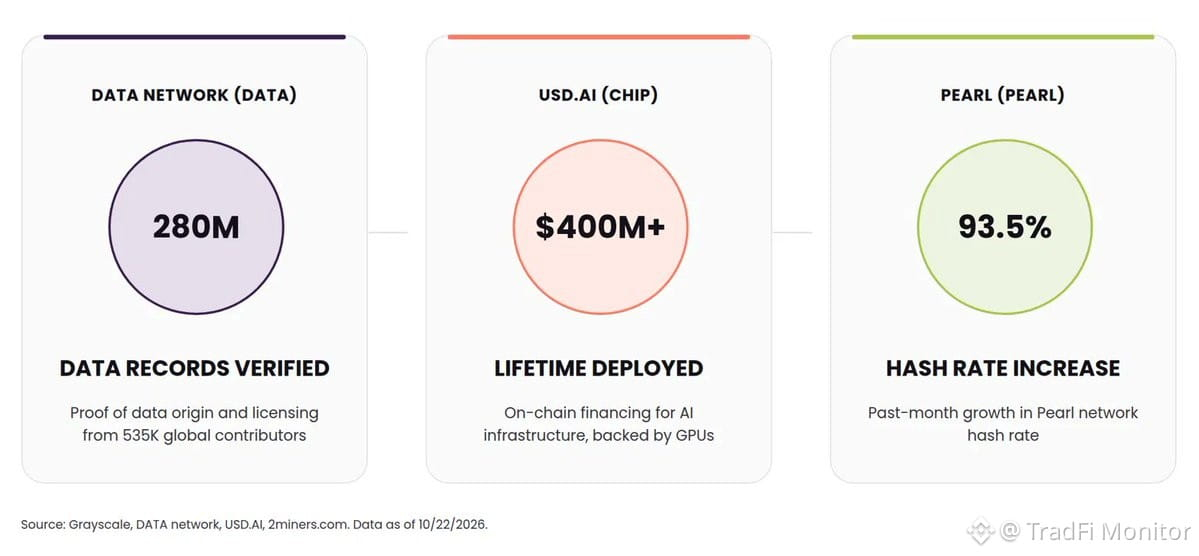
Grayscale flags crypto-AI infrastructure plays:
$DATA - Monetizes training data licensing + verification layer. Revenue model depends on AI demand for verified datasets.
$CHIP - Onchain GPU financing. Capital efficiency play if GPU utilization rates stay high and default risk stays contained.
$PEARL - Hybrid PoW/AI compute model. Miners dual-earn from block rewards + compute jobs. Economics hinge on compute demand offsetting energy costs.
Thesis: Crypto rails reduce friction in AI infrastructure stack. Risk is these remain niche if centralized alternatives scale faster or regulatory overhead kills margin.
Grayscale flags crypto-AI infrastructure plays:
$DATA - Monetizes training data licensing + verification layer. Revenue model depends on AI demand for verified datasets.
$CHIP - Onchain GPU financing. Capital efficiency play if GPU utilization rates stay high and default risk stays contained.
$PEARL - Hybrid PoW/AI compute model. Miners dual-earn from block rewards + compute jobs. Economics hinge on compute demand offsetting energy costs.
Thesis: Crypto rails reduce friction in AI infrastructure stack. Risk is these remain niche if centralized alternatives scale faster or regulatory overhead kills margin.
$DATA - Monetizes training data licensing + verification layer. Revenue model depends on AI demand for verified datasets.
$CHIP - Onchain GPU financing. Capital efficiency play if GPU utilization rates stay high and default risk stays contained.
$PEARL - Hybrid PoW/AI compute model. Miners dual-earn from block rewards + compute jobs. Economics hinge on compute demand offsetting energy costs.
Thesis: Crypto rails reduce friction in AI infrastructure stack. Risk is these remain niche if centralized alternatives scale faster or regulatory overhead kills margin.
26
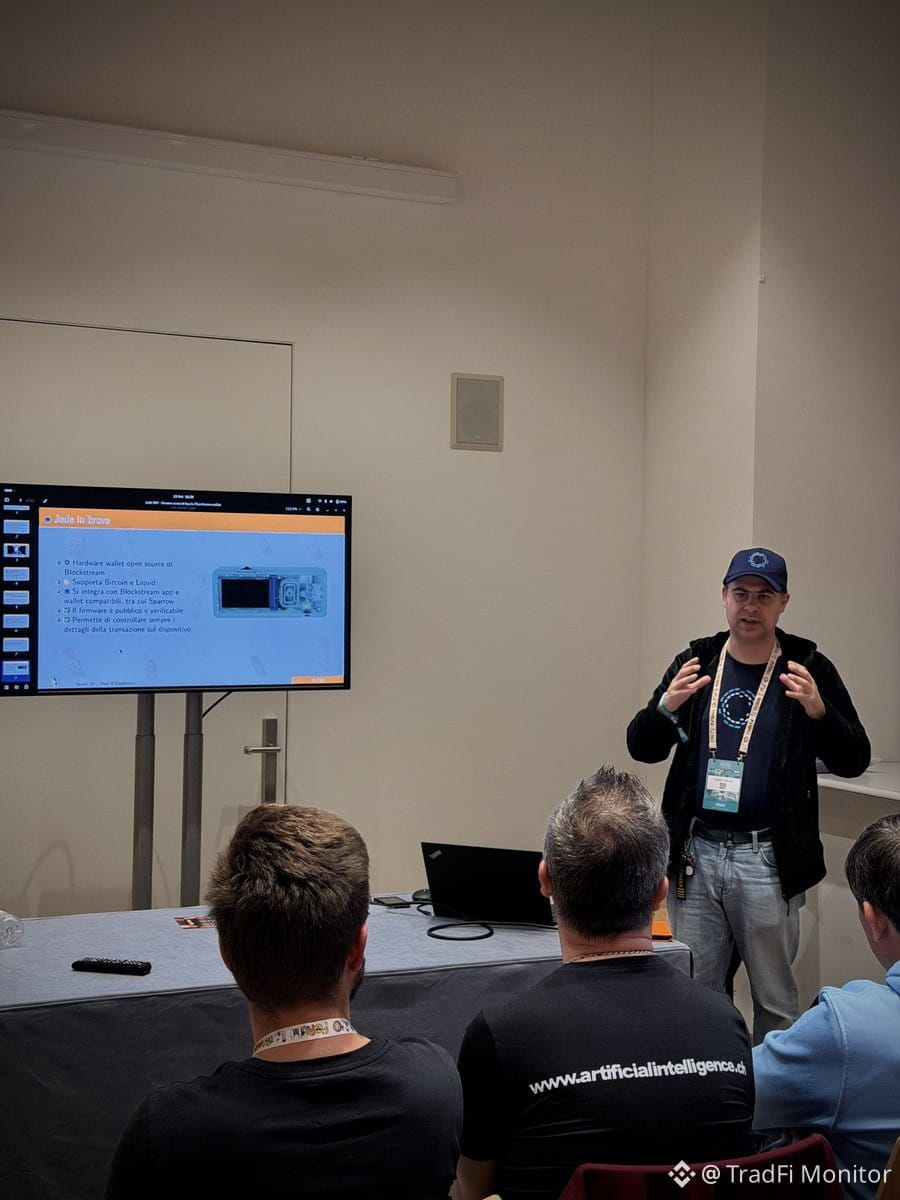
Blockstream pushing open-source hardware wallet narrative at Lugano Plan B conference. Jade wallet positioning on verifiable firmware and on-device transaction verification—standard security theater for retail custody paranoia.
DIY hardware wallet assembly demos signal either genuine decentralization ethos or marketing play to crypto purists. Open-source hardware reduces trust assumptions but increases user error surface area.
Relevant for $BTC custody infrastructure theme. Institutional view: niche product for self-custody advocates, negligible market share versus Ledger/Trezor duopoly. Retail sentiment play, not a capital markets catalyst.
Blockstream pushing open-source hardware wallet narrative at Lugano Plan B conference. Jade wallet positioning on verifiable firmware and on-device transaction verification—standard security theater for retail custody paranoia.
DIY hardware wallet assembly demos signal either genuine decentralization ethos or marketing play to crypto purists. Open-source hardware reduces trust assumptions but increases user error surface area.
Relevant for $BTC custody infrastructure theme. Institutional view: niche product for self-custody advocates, negligible market share versus Ledger/Trezor duopoly. Retail sentiment play, not a capital markets catalyst.
DIY hardware wallet assembly demos signal either genuine decentralization ethos or marketing play to crypto purists. Open-source hardware reduces trust assumptions but increases user error surface area.
Relevant for $BTC custody infrastructure theme. Institutional view: niche product for self-custody advocates, negligible market share versus Ledger/Trezor duopoly. Retail sentiment play, not a capital markets catalyst.
23
Open-source hardware wallet demo at Lugano Plan B. $BTC custody angle: DIY assembly, verifiable firmware, on-device transaction verification. Relevant for institutions evaluating self-custody infrastructure vs. third-party solutions. Hardware security model matters when counterparty risk is being repriced. Not a product launch—just highlighting the ongoing push toward transparent, auditable custody tech in a market where OpSec failures have cost billions.
Open-source hardware wallet demo at Lugano Plan B. $BTC custody angle: DIY assembly, verifiable firmware, on-device transaction verification. Relevant for institutions evaluating self-custody infrastructure vs. third-party solutions. Hardware security model matters when counterparty risk is being repriced. Not a product launch—just highlighting the ongoing push toward transparent, auditable custody tech in a market where OpSec failures have cost billions.
32
Open-source hardware wallet demo at Lugano Plan B. $BTC custody angle: DIY assembly, verifiable firmware, on-device transaction verification. Relevant for institutions evaluating self-custody infrastructure vs. third-party solutions. Hardware security model matters when counterparty risk is being repriced. Not a product launch—just highlighting the ongoing push toward transparent, auditable custody tech in a market where OpSec failures have cost billions.
Open-source hardware wallet demo at Lugano Plan B. $BTC custody angle: DIY assembly, verifiable firmware, on-device transaction verification. Relevant for institutions evaluating self-custody infrastructure vs. third-party solutions. Hardware security model matters when counterparty risk is being repriced. Not a product launch—just highlighting the ongoing push toward transparent, auditable custody tech in a market where OpSec failures have cost billions.
51
Blockstream CEO Adam Back pitched Simplicity as $BTC's final soft fork at Plan B Lugano.
Core thesis: one formal language framework raises script security baseline while enabling optional Confidential Transactions and covenant structures.
Risk angle: 'last soft fork' messaging suggests protocol ossification post-implementation. CT and covenants remain contentious—adoption friction likely high even if technically sound.
Watch developer consensus and miner signaling timelines. Any delay or fragmentation = negative catalyst for L1 upgrade narrative.
Blockstream CEO Adam Back pitched Simplicity as $BTC's final soft fork at Plan B Lugano.
Core thesis: one formal language framework raises script security baseline while enabling optional Confidential Transactions and covenant structures.
Risk angle: 'last soft fork' messaging suggests protocol ossification post-implementation. CT and covenants remain contentious—adoption friction likely high even if technically sound.
Watch developer consensus and miner signaling timelines. Any delay or fragmentation = negative catalyst for L1 upgrade narrative.
Core thesis: one formal language framework raises script security baseline while enabling optional Confidential Transactions and covenant structures.
Risk angle: 'last soft fork' messaging suggests protocol ossification post-implementation. CT and covenants remain contentious—adoption friction likely high even if technically sound.
Watch developer consensus and miner signaling timelines. Any delay or fragmentation = negative catalyst for L1 upgrade narrative.
39
Risk-off across equities. $SPY correction confirmed. Flight to safety driving $TLT—10yr yield dropped to 4.95%. AI sector getting hammered hardest. Rotation out of high-beta tech into fixed income. Watch for capitulation signals and vol expansion. Entry points forming if this washout continues.
Risk-off across equities. $SPY correction confirmed. Flight to safety driving $TLT—10yr yield dropped to 4.95%. AI sector getting hammered hardest. Rotation out of high-beta tech into fixed income. Watch for capitulation signals and vol expansion. Entry points forming if this washout continues.
37
Ross Gerber (ex-$TSLA bull, now bear) flags structural risk: Tesla's operational IP may effectively sit at SpaceX. His thesis: without a merger, $TSLA is paying for talent/tech it doesn't own. Translation: governance overhang, potential value leakage to private entity. If Musk's engineering/AI resources are shared but equity isn't, $TSLA shareholders subsidize $SPCX upside. Watch for: cross-company resource allocation disclosures, any M&A chatter, or further insider selling. Risk is mispriced if market assumes full control of innovation stack.
Ross Gerber (ex-$TSLA bull, now bear) flags structural risk: Tesla's operational IP may effectively sit at SpaceX. His thesis: without a merger, $TSLA is paying for talent/tech it doesn't own. Translation: governance overhang, potential value leakage to private entity. If Musk's engineering/AI resources are shared but equity isn't, $TSLA shareholders subsidize $SPCX upside. Watch for: cross-company resource allocation disclosures, any M&A chatter, or further insider selling. Risk is mispriced if market assumes full control of innovation stack.
45
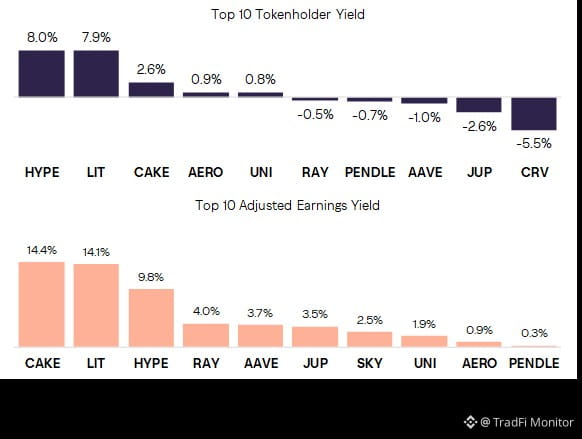
Grayscale drops valuation frameworks based on actual cash flows and tokenholder returns—not narratives.
Top 10 Tokenholder Yield:
$HYPE $LIT $CAKE $AERO $UNI $RAY $PENDLE $AAVE $JUP $CRV
Top 10 Adjusted Earnings Yield:
$CAKE $LIT $HYPE $RAY $AAVE $JUP $SKY $UNI $AERO $PENDLE
$CAKE $LIT $HYPE appear in both lists—suggests real capital efficiency and return mechanics vs pure speculation. $AAVE $RAY $JUP also strong on earnings side.
Key shift: institutional allocators now screening crypto like equity—P/E proxies, yield comps, capital allocation discipline. Tokens without real cash generation or buyback mechanisms getting left behind in risk-off environments.
Watch which protocols sustain these yields through lower volume periods. That's where durable moats show up.
Grayscale drops valuation frameworks based on actual cash flows and tokenholder returns—not narratives.
Top 10 Tokenholder Yield:
$HYPE $LIT $CAKE $AERO $UNI $RAY $PENDLE $AAVE $JUP $CRV
Top 10 Adjusted Earnings Yield:
$CAKE $LIT $HYPE $RAY $AAVE $JUP $SKY $UNI $AERO $PENDLE
$CAKE $LIT $HYPE appear in both lists—suggests real capital efficiency and return mechanics vs pure speculation. $AAVE $RAY $JUP also strong on earnings side.
Key shift: institutional allocators now screening crypto like equity—P/E proxies, yield comps, capital allocation discipline. Tokens without real cash generation or buyback mechanisms getting left behind in risk-off environments.
Watch which protocols sustain these yields through lower volume periods. That's where durable moats show up.
Top 10 Tokenholder Yield:
$HYPE $LIT $CAKE $AERO $UNI $RAY $PENDLE $AAVE $JUP $CRV
Top 10 Adjusted Earnings Yield:
$CAKE $LIT $HYPE $RAY $AAVE $JUP $SKY $UNI $AERO $PENDLE
$CAKE $LIT $HYPE appear in both lists—suggests real capital efficiency and return mechanics vs pure speculation. $AAVE $RAY $JUP also strong on earnings side.
Key shift: institutional allocators now screening crypto like equity—P/E proxies, yield comps, capital allocation discipline. Tokens without real cash generation or buyback mechanisms getting left behind in risk-off environments.
Watch which protocols sustain these yields through lower volume periods. That's where durable moats show up.
49
Blockstream CEO Adam Back speaking at Lugano conference outlined three primary Bitcoin adoption drivers: speculative returns, financial sovereignty, and payment rails when legacy systems fail.
Key thesis: $BTC ETFs and institutional fund wrappers serve as critical onboarding infrastructure for the next capital inflow wave. This addresses the persistent friction point where retail and institutional allocators want exposure without custody complexity or operational overhead.
Market implication: ETF flows remain the primary liquidity catalyst short-term. Spot ETF AUM growth directly correlates with price discovery, particularly as regulatory clarity improves distribution channels through wirehouses and RIAs. Watch net inflows as leading indicator for momentum continuation.
Blockstream CEO Adam Back speaking at Lugano conference outlined three primary Bitcoin adoption drivers: speculative returns, financial sovereignty, and payment rails when legacy systems fail.
Key thesis: $BTC ETFs and institutional fund wrappers serve as critical onboarding infrastructure for the next capital inflow wave. This addresses the persistent friction point where retail and institutional allocators want exposure without custody complexity or operational overhead.
Market implication: ETF flows remain the primary liquidity catalyst short-term. Spot ETF AUM growth directly correlates with price discovery, particularly as regulatory clarity improves distribution channels through wirehouses and RIAs. Watch net inflows as leading indicator for momentum continuation.
Key thesis: $BTC ETFs and institutional fund wrappers serve as critical onboarding infrastructure for the next capital inflow wave. This addresses the persistent friction point where retail and institutional allocators want exposure without custody complexity or operational overhead.
Market implication: ETF flows remain the primary liquidity catalyst short-term. Spot ETF AUM growth directly correlates with price discovery, particularly as regulatory clarity improves distribution channels through wirehouses and RIAs. Watch net inflows as leading indicator for momentum continuation.
59
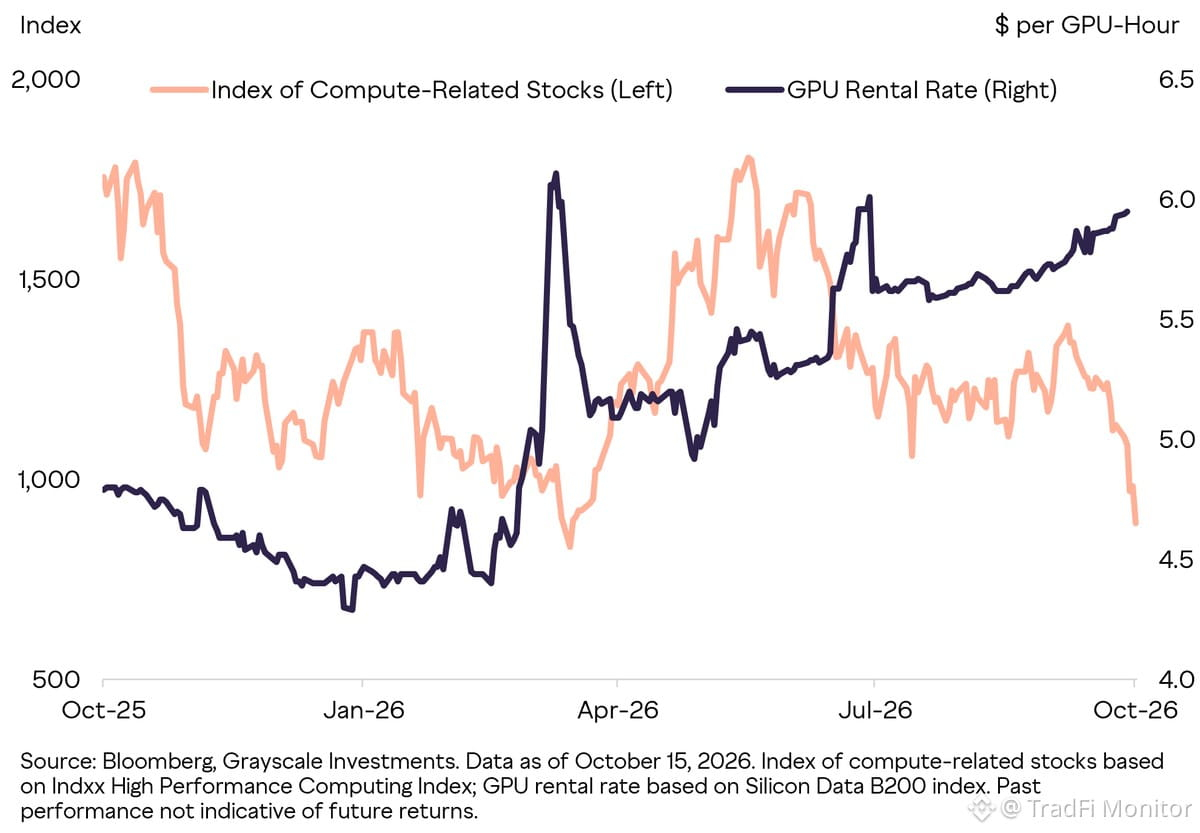
GPU rental rates at all-time highs while compute equities trade near 52-week lows—classic dislocation. AI agent proliferation driving structural compute shortage. Scarcity = pricing power. $GCPU targets this gap: businesses capturing margin expansion from supply-demand imbalance in compute infrastructure. Watch capex cycles and utilization rates.
GPU rental rates at all-time highs while compute equities trade near 52-week lows—classic dislocation. AI agent proliferation driving structural compute shortage. Scarcity = pricing power. $GCPU targets this gap: businesses capturing margin expansion from supply-demand imbalance in compute infrastructure. Watch capex cycles and utilization rates.
$TWTR revenue collapsed 60% under Musk ownership — $5B annually down to ~$2B run rate ($550M/quarter). Classic Elon trade: destroy equity value in one asset, compensate insiders with shares in the crown jewel ($SPCX exposure to SpaceX). Twitter became a massive capital destruction event while SpaceX equity became the real liquidity escape hatch for early believers. If you're holding Twitter bag, you're getting paid in illiquid SpaceX paper — that's either genius or a Ponzi depending on when SpaceX actually exits. Risk/reward completely bifurcated between the two entities now.
$TWTR revenue collapsed 60% under Musk ownership — $5B annually down to ~$2B run rate ($550M/quarter). Classic Elon trade: destroy equity value in one asset, compensate insiders with shares in the crown jewel ($SPCX exposure to SpaceX). Twitter became a massive capital destruction event while SpaceX equity became the real liquidity escape hatch for early believers. If you're holding Twitter bag, you're getting paid in illiquid SpaceX paper — that's either genius or a Ponzi depending on when SpaceX actually exits. Risk/reward completely bifurcated between the two entities now.
1
Blockstream CEO discussed three institutional focus areas:
1. Security infrastructure adapting to AI threat vectors - likely referencing custody solutions and attack surface expansion as AI tools lower barrier to exploit discovery
2. $BTC post-quantum cryptography migration path - critical long-term protocol risk that affects treasury allocation models. Timeline and backward compatibility matter for corporate balance sheets
3. Institutional adoption momentum - vague but suggests continued TradFi inflows beyond ETF channels
No hard data or alpha. Standard conference circuit talking points. Watch for actual implementation timelines on quantum-resistant signatures - that's the only item with material impact on $BTC risk premium.
Blockstream CEO discussed three institutional focus areas:
1. Security infrastructure adapting to AI threat vectors - likely referencing custody solutions and attack surface expansion as AI tools lower barrier to exploit discovery
2. $BTC post-quantum cryptography migration path - critical long-term protocol risk that affects treasury allocation models. Timeline and backward compatibility matter for corporate balance sheets
3. Institutional adoption momentum - vague but suggests continued TradFi inflows beyond ETF channels
No hard data or alpha. Standard conference circuit talking points. Watch for actual implementation timelines on quantum-resistant signatures - that's the only item with material impact on $BTC risk premium.
1. Security infrastructure adapting to AI threat vectors - likely referencing custody solutions and attack surface expansion as AI tools lower barrier to exploit discovery
2. $BTC post-quantum cryptography migration path - critical long-term protocol risk that affects treasury allocation models. Timeline and backward compatibility matter for corporate balance sheets
3. Institutional adoption momentum - vague but suggests continued TradFi inflows beyond ETF channels
No hard data or alpha. Standard conference circuit talking points. Watch for actual implementation timelines on quantum-resistant signatures - that's the only item with material impact on $BTC risk premium.
29
තවත් අන්තර්ගතයන් ගවේෂණය කිරීමට ඇතුල් වන්න
Binance චතුරශ්රය හි ගෝලීය ක්රිප්ටෝ පරිශීලකයින් හා එක්වන්න
⚡️ ක්රිප්ටෝ පිළිබඳ නවතම සහ ප්රයෝජනවත් තොරතුරු ලබා ගන්න.
💬 ලොව විශාලතම ක්රිප්ටෝ හුවමාරුව මගින් විශ්වාස කෙරේ.
👍 සත්යායනය කරන ලද නිර්මාණකරුවන්ගෙන් සැබෑ විදසුන් සොයා ගන්න.
විද්යුත් තැපෑල / දුරකථන අංකය
නැගී එන මාතෘකා
CanMicrosoftDeliverOnAI
125,088 නැරඹීම්
953 සාකච්ඡා කරමින්
Earnings Season Session 3: Will Google & Microsoft Beat Earnings Expectations?
Binance Square Official
·74 කැමත්ත දැක්වීම්
·20.3k නැරඹීම්
CanGoogleDefindItsCore
60,971 නැරඹීම්
678 සාකච්ඡා කරමින්
FOMCWatch
9.1M නැරඹීම්
28,209 සාකච්ඡා කරමින්