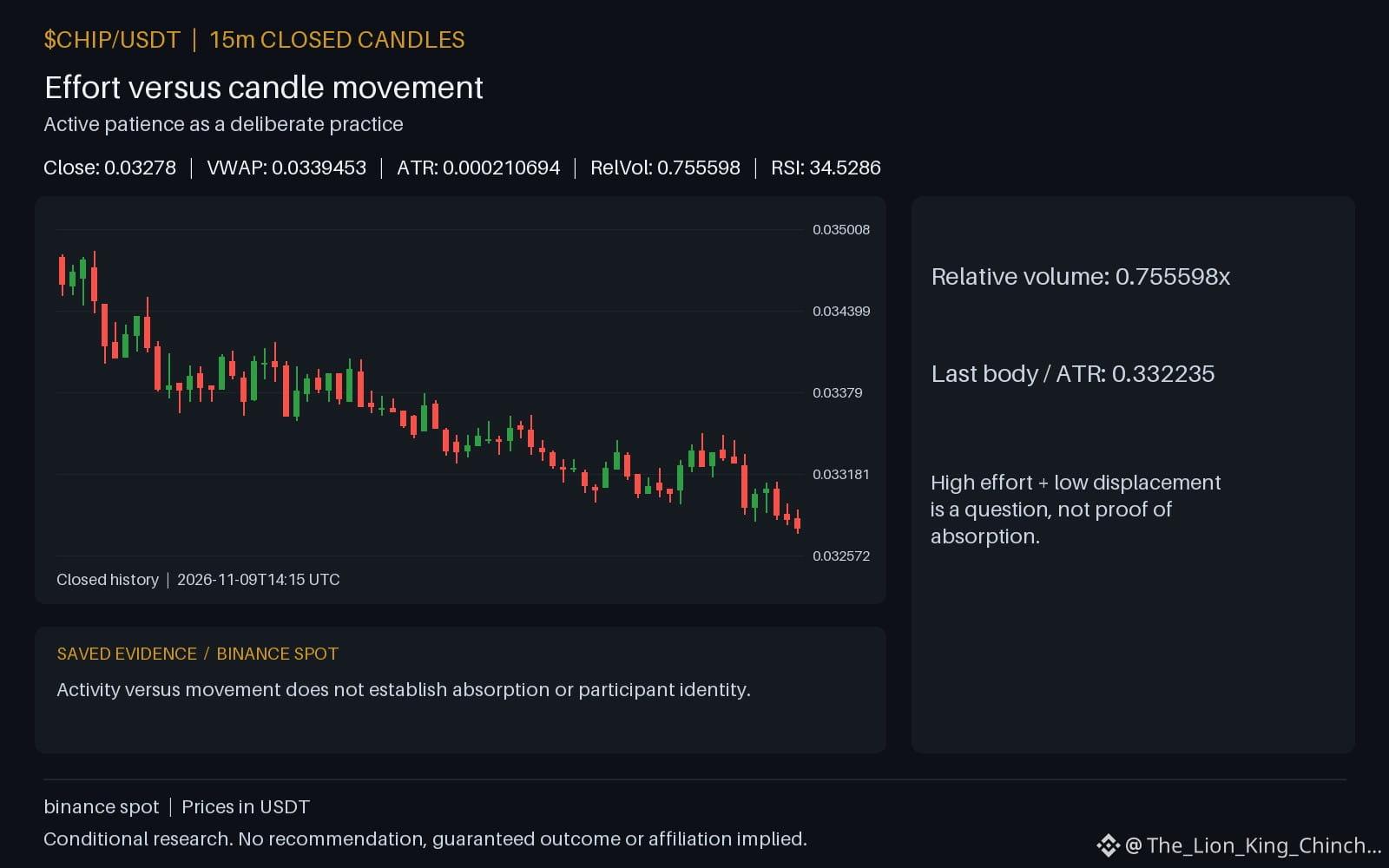
$CHIP: The Decision Lens – Training Active Patience
A common assumption is that waiting for a clearer signal wastes time and opportunity. In a thought experiment, imagine two hypothetical entries for $CHIP when the price sits below 0.0328 and the hourly direction is down. The first trader rushes in as soon as a small dip appears, accepting a tight stop because the entry feels immediate. The second trader pauses, watches the price test the same support level a second time, and only commits if the move shows a modest retrace toward 0.0331103. Both scenarios use the same market observation, but the trade‑off differs: entry quality versus chasing.
The counterexample highlights that a hurried entry can increase the chance of being stopped out by normal volatility, while a patient entry may miss the first micro‑move but gains a better risk‑to‑reward profile. The risk of the patient approach is the opportunity cost of not being in the market while a brief rally occurs.
What could change the reading? If the relative volume rose above baseline, the support breach might carry more conviction, shifting the balance toward quicker action. Conversely, a flat volume environment supports the patient stance.
A practical self‑check: after each observation, ask whether the current price action adds new information beyond the initial support break or simply repeats noise. If the answer is no, the patient path remains valid; if yes, consider a more aggressive entry. Active patience, therefore, is not idle waiting but a disciplined decision rule that balances entry quality against the cost of waiting.
Probabilistic market research, not a recommendation or guaranteed return.
What helps you treat patience as an active skill rather than a boring wait?
#CHIP #RiskManagement #CryptoLearning