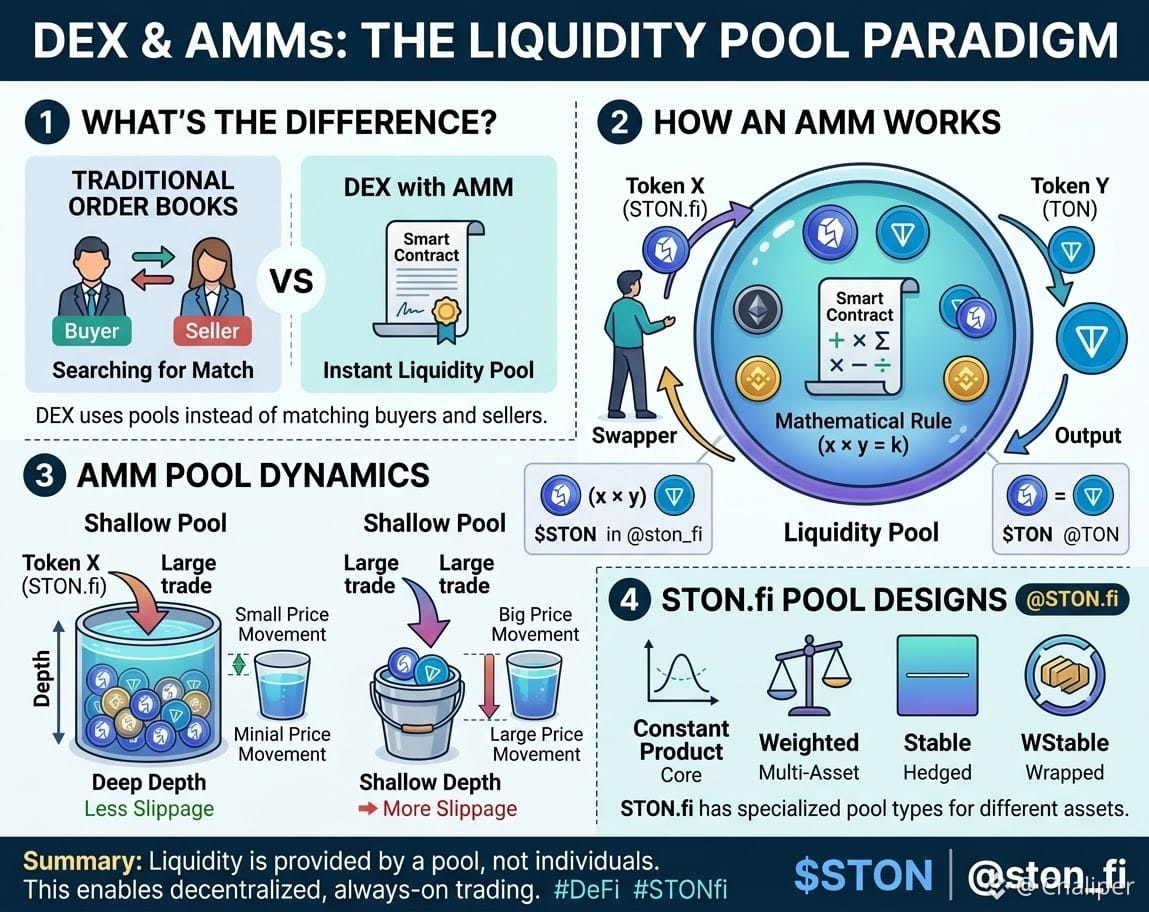
What is an AMM, and why does a DEX need one?
When you trade on a centralized exchange, an order book can match buyers and sellers.
A decentralized exchange can work differently.
An Automated Market Maker, or AMM, uses liquidity pools and mathematical rules to determine swap prices.
On @ston_fi, liquidity pools hold assets that users can trade against.
When someone swaps one token for another, the balance inside the pool changes.
That change affects the price of the next swap.
A classic AMM model can be represented as:
x × y = k
The important idea is that the pool provides the liquidity instead of waiting for a specific buyer or seller to match your order.
This is also why liquidity depth matters.
If a pool is shallow, a relatively large trade can change the pool ratio significantly and create higher price impact.
If the pool is deeper, it can generally absorb larger trades with less movement in the pool price.
STON.fi also supports different pool designs, including Constant Product, Weighted, Stable, and WStable pools, which are built for different types of assets and liquidity conditions.
So an AMM is not simply a formula.
It is a different way of organizing market liquidity.
Instead of matching every buyer with a seller, the market can use liquidity already sitting in a pool.
That is one of the key mechanisms that makes decentralized trading possible.
$STON @STONfi DEX
#DeFi #STONfi
When you trade on a centralized exchange, an order book can match buyers and sellers.
A decentralized exchange can work differently.
An Automated Market Maker, or AMM, uses liquidity pools and mathematical rules to determine swap prices.
On @ston_fi, liquidity pools hold assets that users can trade against.
When someone swaps one token for another, the balance inside the pool changes.
That change affects the price of the next swap.
A classic AMM model can be represented as:
x × y = k
The important idea is that the pool provides the liquidity instead of waiting for a specific buyer or seller to match your order.
This is also why liquidity depth matters.
If a pool is shallow, a relatively large trade can change the pool ratio significantly and create higher price impact.
If the pool is deeper, it can generally absorb larger trades with less movement in the pool price.
STON.fi also supports different pool designs, including Constant Product, Weighted, Stable, and WStable pools, which are built for different types of assets and liquidity conditions.
So an AMM is not simply a formula.
It is a different way of organizing market liquidity.
Instead of matching every buyer with a seller, the market can use liquidity already sitting in a pool.
That is one of the key mechanisms that makes decentralized trading possible.
$STON @STONfi DEX
#DeFi #STONfi