


What caught my attention with Zcash is not that Grayscale’s Zcash ETF reached $1 billion in AUM.
It is how little of that number actually came from new investor money.
ZCSH reached $1 billion on September 24 after launching on August 25. That means the fund doubled its reported assets in roughly 16 days.
At first glance that looks like strong demand.
But cumulative net inflows were only around $306.12 million.
So less than one third of the current $1 billion AUM came from fresh capital.
The rest of the story comes from the assets ZCSH already had.
The ETF was converted from Grayscale’s older Zcash Trust which had been holding ZEC since 2017. Those existing holdings were carried into the ETF structure.
Then ZEC itself nearly doubled after the ETF started trading.
ZEC was around $1,533 at the time of the report and had gained roughly 92% over the previous 30 days.
That creates an important difference.
The ETF can show much higher AUM without receiving the same amount of new money because the assets it already owns are becoming more valuable.
For me this makes the $1 billion headline less useful than the $306 million inflow number.
The next question is whether fresh capital keeps entering ZCSH after the initial launch excitement.
That matters because rising AUM from price appreciation is very different from rising AUM because investors keep buying the fund.
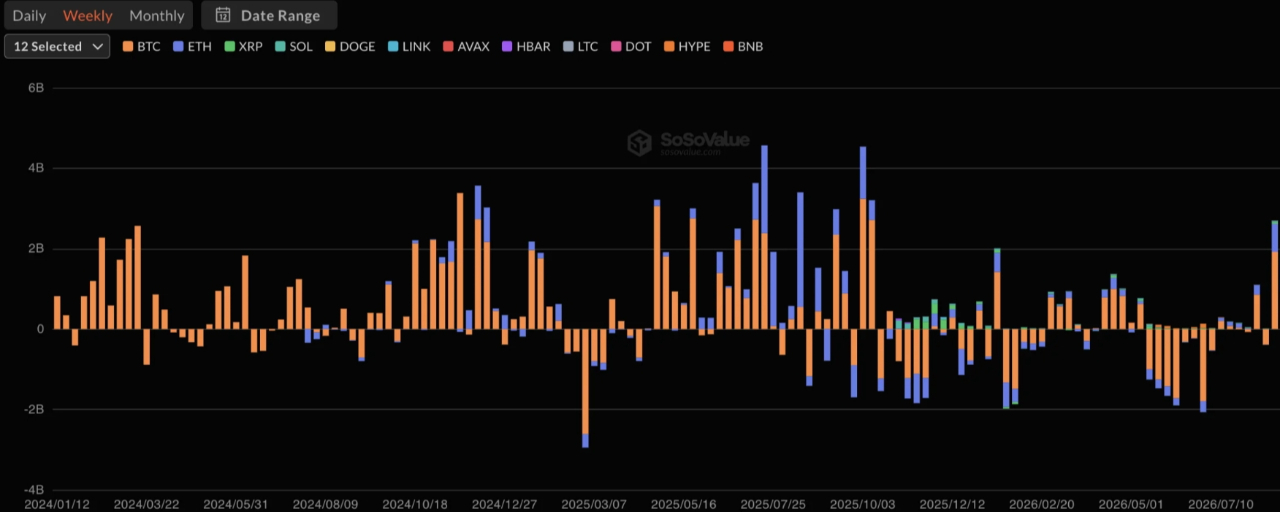
The broader ETF market also had a strong week.
Bitcoin ETFs attracted around $2.25 billion.
Ethereum ETFs brought in roughly $602.94 million.
Solana ETFs saw around $101.55 million.
XRP ETFs recorded about $52.95 million.
These numbers show that crypto investment products are still attracting meaningful capital across several assets.
But Zcash has a different setup right now.
Its AUM growth has been helped by both inherited ZEC holdings and a major move in the underlying asset.
So I would not use the $1 billion figure alone as proof that $1 billion of new demand has entered Zcash.
The more important number to watch from here is fresh net inflows.
If those continue growing while ZEC remains strong then the ETF story becomes much more interesting.
If AUM keeps rising mainly because ZEC price rises then the headline can look stronger than the actual new demand underneath it.
That is the distinction I am watching now.