

#duskevm
duskevm
18,391 views
252 සාකච්ඡා කරමින්
උණුසුම්
නවතම

·
--
උසබ තත්ත්වය
$DUSK
{spot}(DUSKUSDT)
Privacy meets DeFi!
Moving assets on-chain shouldn’t mean exposing every balance to everyone.
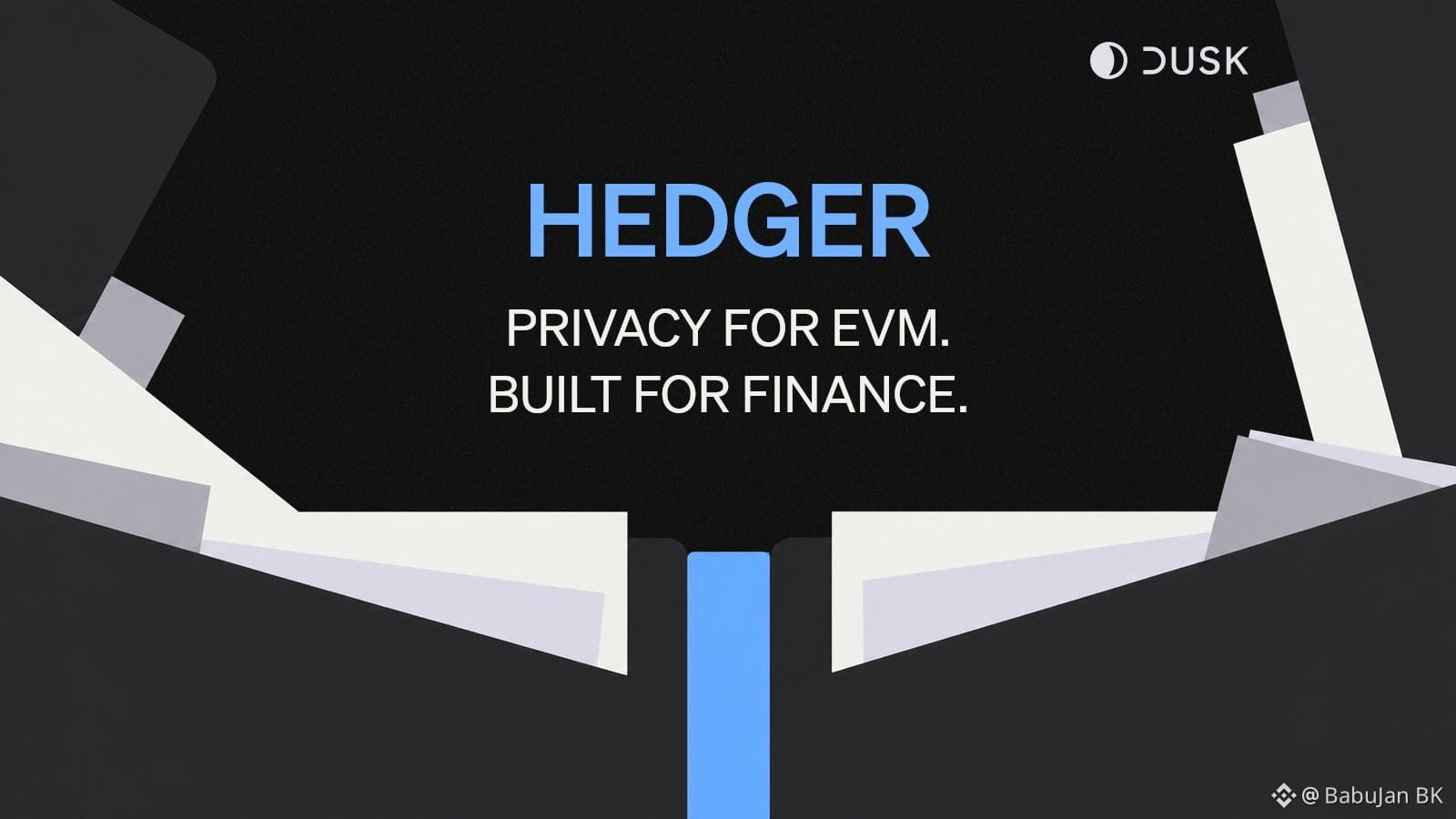
Hedger aims to bring confidential transfers to DuskEVM keeping balances and transfer amounts encrypted while transactions remain verifiable.
Privacy + transparency, without sacrificing verification.
Could this be a major step for private on-chain finance?
What do you think about Hedger
#dusk #DuskEVM #crypto
$DUSK
Privacy meets DeFi!
Moving assets on-chain shouldn’t mean exposing every balance to everyone.
Hedger aims to bring confidential transfers to DuskEVM keeping balances and transfer amounts encrypted while transactions remain verifiable.
Privacy + transparency, without sacrificing verification.
Could this be a major step for private on-chain finance?
What do you think about Hedger
#dusk #DuskEVM #crypto
Privacy meets DeFi!
Moving assets on-chain shouldn’t mean exposing every balance to everyone.
Hedger aims to bring confidential transfers to DuskEVM keeping balances and transfer amounts encrypted while transactions remain verifiable.
Privacy + transparency, without sacrificing verification.
Could this be a major step for private on-chain finance?
What do you think about Hedger
#dusk #DuskEVM #crypto
1
145


·
--
අර්ධ වශයෙන් සත්යයි
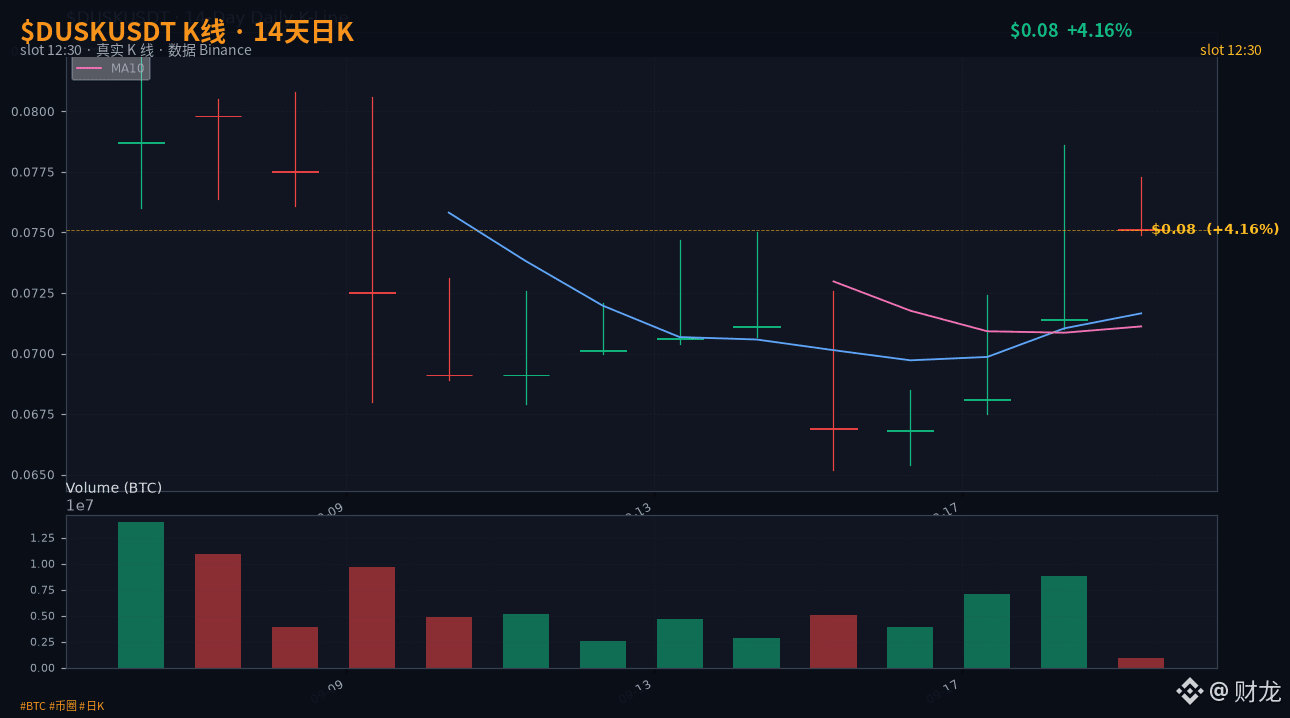
$DUSK 24 小时涨了 4.16%,报 0.08 美元一线磨。但昨天 @DuskFoundation 把这条链的 EVM 端和代币那条线明着接上去了,这是上线以来官方第一次把「应用跑起来」和「代币被用」写在同一句话里。
之前五周多,这条链讲的都是兼容 Solidity 工具栈、隐私层在 EVM 里改按需隐私、Chain ID 744 主网已经在线、Foundry 那套开发框架直接对齐主网接口,全是「能跑」的维度。但能跑不等于有活儿,活儿进不到代币那头,链上动作和代币就是两张皮。
9-18 这条帖子不一样,@Dusk 直接点名:代币付合约部署、付用户交易、付网络费、付质押,链上每多一个应用跑起来,代币那头就多一份需求。一边把 8 月那张长文里的产品收入路径(Dusk Trade 收手续费、买回、烧、应用层分配)摊开,一边把开发者门槛这件事从「能不能写」推进到「写完部署一次到底要烧多少代币」。
对 Solidity 开发者来说,这条链最值钱的不是 EVM 兼容,这条路上竞争太密。值钱的是隐私层在合约层给你按需加的那道隐私盾:订单簿可混淆,余额可屏蔽,所有权可密,但监管那头该看的接口按需开。不用自己写零知识电路,直接调用就行。配合 8 月就开始讲的应用层上 €300M 资产池、9 月把跨链数据栈接进来,这条链上的应用不是在「做 DeFi demo」,而是在「做合规金融基础设施」,两件事的市场天花板差一个数量级。
官方的逻辑链第一次讲透了:开发者进来 → 合约部署消耗代币 → 链上交易活跃 → 交易费持续吃掉代币 → 产品端(交易平台 / 身份层 / 隐私层)产生收入 → 收入反哺代币端。这是 Dusk 这条链上线以来第一次,「代币值不值得拿」这个问题官方给了完整的答案。
值得看的就一个问题:下一个在主网部署合约的项目,会是什么行业的?#dusk #DuskEVM #代币用在哪
$DUSK 24 小时涨了 4.16%,报 0.08 美元一线磨。但昨天 @DuskFoundation 把这条链的 EVM 端和代币那条线明着接上去了,这是上线以来官方第一次把「应用跑起来」和「代币被用」写在同一句话里。
之前五周多,这条链讲的都是兼容 Solidity 工具栈、隐私层在 EVM 里改按需隐私、Chain ID 744 主网已经在线、Foundry 那套开发框架直接对齐主网接口,全是「能跑」的维度。但能跑不等于有活儿,活儿进不到代币那头,链上动作和代币就是两张皮。
9-18 这条帖子不一样,@Dusk 直接点名:代币付合约部署、付用户交易、付网络费、付质押,链上每多一个应用跑起来,代币那头就多一份需求。一边把 8 月那张长文里的产品收入路径(Dusk Trade 收手续费、买回、烧、应用层分配)摊开,一边把开发者门槛这件事从「能不能写」推进到「写完部署一次到底要烧多少代币」。
对 Solidity 开发者来说,这条链最值钱的不是 EVM 兼容,这条路上竞争太密。值钱的是隐私层在合约层给你按需加的那道隐私盾:订单簿可混淆,余额可屏蔽,所有权可密,但监管那头该看的接口按需开。不用自己写零知识电路,直接调用就行。配合 8 月就开始讲的应用层上 €300M 资产池、9 月把跨链数据栈接进来,这条链上的应用不是在「做 DeFi demo」,而是在「做合规金融基础设施」,两件事的市场天花板差一个数量级。
官方的逻辑链第一次讲透了:开发者进来 → 合约部署消耗代币 → 链上交易活跃 → 交易费持续吃掉代币 → 产品端(交易平台 / 身份层 / 隐私层)产生收入 → 收入反哺代币端。这是 Dusk 这条链上线以来第一次,「代币值不值得拿」这个问题官方给了完整的答案。
值得看的就一个问题:下一个在主网部署合约的项目,会是什么行业的?#dusk #DuskEVM #代币用在哪
之前五周多,这条链讲的都是兼容 Solidity 工具栈、隐私层在 EVM 里改按需隐私、Chain ID 744 主网已经在线、Foundry 那套开发框架直接对齐主网接口,全是「能跑」的维度。但能跑不等于有活儿,活儿进不到代币那头,链上动作和代币就是两张皮。
9-18 这条帖子不一样,@Dusk 直接点名:代币付合约部署、付用户交易、付网络费、付质押,链上每多一个应用跑起来,代币那头就多一份需求。一边把 8 月那张长文里的产品收入路径(Dusk Trade 收手续费、买回、烧、应用层分配)摊开,一边把开发者门槛这件事从「能不能写」推进到「写完部署一次到底要烧多少代币」。
对 Solidity 开发者来说,这条链最值钱的不是 EVM 兼容,这条路上竞争太密。值钱的是隐私层在合约层给你按需加的那道隐私盾:订单簿可混淆,余额可屏蔽,所有权可密,但监管那头该看的接口按需开。不用自己写零知识电路,直接调用就行。配合 8 月就开始讲的应用层上 €300M 资产池、9 月把跨链数据栈接进来,这条链上的应用不是在「做 DeFi demo」,而是在「做合规金融基础设施」,两件事的市场天花板差一个数量级。
官方的逻辑链第一次讲透了:开发者进来 → 合约部署消耗代币 → 链上交易活跃 → 交易费持续吃掉代币 → 产品端(交易平台 / 身份层 / 隐私层)产生收入 → 收入反哺代币端。这是 Dusk 这条链上线以来第一次,「代币值不值得拿」这个问题官方给了完整的答案。
值得看的就一个问题:下一个在主网部署合约的项目,会是什么行业的?#dusk #DuskEVM #代币用在哪
1
1
465
·
--
සත්යායනය කළ
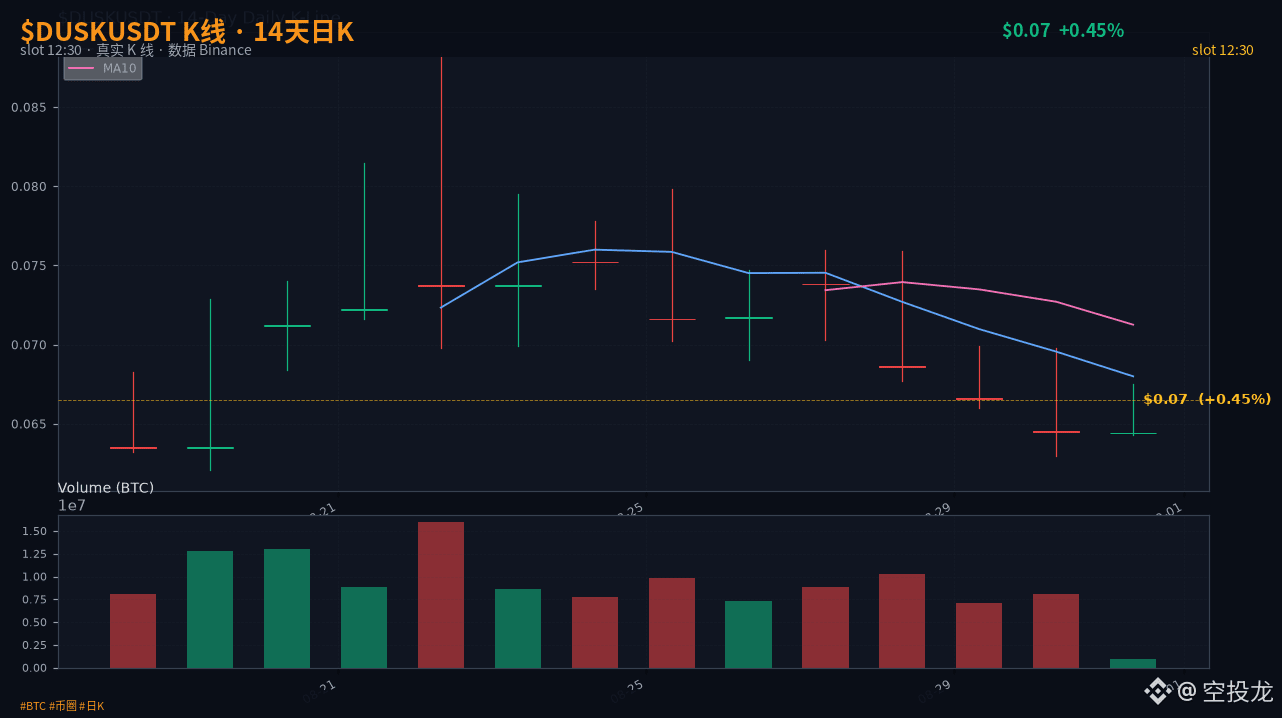
$DUSK 24 小时微涨 0.45%,报 0.07 美元一线磨,但今天真正该看的不是价格。
@Dusk 这条链的隐私引擎,2026 上半年最值得拆的不是它能做隐私,而是它**怎么用密码学做隐私**。绝大多数去中心化金融的隐私方案只用零知识证明,一套零知识包打天下;它偏不,它同时叠了**同态加密** (基于椭圆曲线,能在加密数值上直接算)和零知识两层,中间还塞了双账户模型做兼容性,三层组合,牺牲性能换合规与隐私的兼得。
这套设计落到具体能力,有几个数字值得记:**客户端浏览器证明不到 2 秒** (意味着钱包里就能跑,不用中心化证明器);**资产所有权与转账全链路加密** (持仓金额别人看不见);**审计接口按需开放** (监管需要的时候可解,但用户日常默认隐藏);更重要的,**混淆订单簿**已经在铺设。做市商挂单意图不外泄,机构才会真正进来。
这套拼法的核心矛盾:它选了以太坊账户模型,所以**放弃了完全匿名**,换来合规审计能力。换句话说,它不是给你一个影子金库,而是给监管一张「我随时能开,但平时不上锁」的钥匙。
#dusk #DuskEVM #合规隐私合约
(仅供研究,非投资建议)
$DUSK 24 小时微涨 0.45%,报 0.07 美元一线磨,但今天真正该看的不是价格。
@Dusk 这条链的隐私引擎,2026 上半年最值得拆的不是它能做隐私,而是它**怎么用密码学做隐私**。绝大多数去中心化金融的隐私方案只用零知识证明,一套零知识包打天下;它偏不,它同时叠了**同态加密** (基于椭圆曲线,能在加密数值上直接算)和零知识两层,中间还塞了双账户模型做兼容性,三层组合,牺牲性能换合规与隐私的兼得。
这套设计落到具体能力,有几个数字值得记:**客户端浏览器证明不到 2 秒** (意味着钱包里就能跑,不用中心化证明器);**资产所有权与转账全链路加密** (持仓金额别人看不见);**审计接口按需开放** (监管需要的时候可解,但用户日常默认隐藏);更重要的,**混淆订单簿**已经在铺设。做市商挂单意图不外泄,机构才会真正进来。
这套拼法的核心矛盾:它选了以太坊账户模型,所以**放弃了完全匿名**,换来合规审计能力。换句话说,它不是给你一个影子金库,而是给监管一张「我随时能开,但平时不上锁」的钥匙。
#dusk #DuskEVM #合规隐私合约
(仅供研究,非投资建议)
@Dusk 这条链的隐私引擎,2026 上半年最值得拆的不是它能做隐私,而是它**怎么用密码学做隐私**。绝大多数去中心化金融的隐私方案只用零知识证明,一套零知识包打天下;它偏不,它同时叠了**同态加密** (基于椭圆曲线,能在加密数值上直接算)和零知识两层,中间还塞了双账户模型做兼容性,三层组合,牺牲性能换合规与隐私的兼得。
这套设计落到具体能力,有几个数字值得记:**客户端浏览器证明不到 2 秒** (意味着钱包里就能跑,不用中心化证明器);**资产所有权与转账全链路加密** (持仓金额别人看不见);**审计接口按需开放** (监管需要的时候可解,但用户日常默认隐藏);更重要的,**混淆订单簿**已经在铺设。做市商挂单意图不外泄,机构才会真正进来。
这套拼法的核心矛盾:它选了以太坊账户模型,所以**放弃了完全匿名**,换来合规审计能力。换句话说,它不是给你一个影子金库,而是给监管一张「我随时能开,但平时不上锁」的钥匙。
#dusk #DuskEVM #合规隐私合约
(仅供研究,非投资建议)
734
I used to think Real World Assets (RWAs) were mostly about one thing: taking traditional financial assets like bonds, ETFs, or securities and putting them on a blockchain. Tokenize the asset, and the difficult part is done… or so I thought.
The deeper I looked into Dusk, the more I realized the real challenge isn’t tokenization—it’s building an infrastructure that regulated finance can actually use. 🏛️
What stands out to me is DuskEVM. Yes, it’s Solidity-compatible, making it familiar for Ethereum developers. But the more interesting layer is how it connects with Hedger to enable confidential EVM-based workflows that remain cryptographically verifiable. That feels like a much bigger innovation than simply supporting smart contracts.
In regulated markets, privacy and transparency aren’t opposites—they need to coexist. A transaction might stay hidden from the public while still being fully auditable by authorized institutions. That’s where technologies like homomorphic encryption and zero-knowledge proofs become incredibly meaningful. They’re not just privacy tools; they’re compliance tools.
This is also why Dusk’s vision for native issuance is worth watching. Tokenizing an asset is only the first chapter. If issuance, trading, settlement, and compliance can all happen on-chain within one architecture, the blockchain becomes financial infrastructure rather than just a ledger.
I’m not claiming Dusk has already proven the model. The real test will come with broader mainnet adoption and live financial workflows. But it’s definitely one of the projects making me rethink what blockchain in capital markets could actually become. 🚀@Dusk_Foundation
#dusk #RWA! #DuskEVM #Hedger #Blockchain #Tokenization #ZeroKnowledge #Privacy #DeFi #Crypto #Binance
$DUSK
I used to think Real World Assets (RWAs) were mostly about one thing: taking traditional financial assets like bonds, ETFs, or securities and putting them on a blockchain. Tokenize the asset, and the difficult part is done… or so I thought.
The deeper I looked into Dusk, the more I realized the real challenge isn’t tokenization—it’s building an infrastructure that regulated finance can actually use. 🏛️
What stands out to me is DuskEVM. Yes, it’s Solidity-compatible, making it familiar for Ethereum developers. But the more interesting layer is how it connects with Hedger to enable confidential EVM-based workflows that remain cryptographically verifiable. That feels like a much bigger innovation than simply supporting smart contracts.
In regulated markets, privacy and transparency aren’t opposites—they need to coexist. A transaction might stay hidden from the public while still being fully auditable by authorized institutions. That’s where technologies like homomorphic encryption and zero-knowledge proofs become incredibly meaningful. They’re not just privacy tools; they’re compliance tools.
This is also why Dusk’s vision for native issuance is worth watching. Tokenizing an asset is only the first chapter. If issuance, trading, settlement, and compliance can all happen on-chain within one architecture, the blockchain becomes financial infrastructure rather than just a ledger.
I’m not claiming Dusk has already proven the model. The real test will come with broader mainnet adoption and live financial workflows. But it’s definitely one of the projects making me rethink what blockchain in capital markets could actually become. 🚀@Dusk
#dusk #RWA! #DuskEVM #Hedger #Blockchain #Tokenization #ZeroKnowledge #Privacy #DeFi #Crypto #Binance
$DUSK
The deeper I looked into Dusk, the more I realized the real challenge isn’t tokenization—it’s building an infrastructure that regulated finance can actually use. 🏛️
What stands out to me is DuskEVM. Yes, it’s Solidity-compatible, making it familiar for Ethereum developers. But the more interesting layer is how it connects with Hedger to enable confidential EVM-based workflows that remain cryptographically verifiable. That feels like a much bigger innovation than simply supporting smart contracts.
In regulated markets, privacy and transparency aren’t opposites—they need to coexist. A transaction might stay hidden from the public while still being fully auditable by authorized institutions. That’s where technologies like homomorphic encryption and zero-knowledge proofs become incredibly meaningful. They’re not just privacy tools; they’re compliance tools.
This is also why Dusk’s vision for native issuance is worth watching. Tokenizing an asset is only the first chapter. If issuance, trading, settlement, and compliance can all happen on-chain within one architecture, the blockchain becomes financial infrastructure rather than just a ledger.
I’m not claiming Dusk has already proven the model. The real test will come with broader mainnet adoption and live financial workflows. But it’s definitely one of the projects making me rethink what blockchain in capital markets could actually become. 🚀@Dusk
#dusk #RWA! #DuskEVM #Hedger #Blockchain #Tokenization #ZeroKnowledge #Privacy #DeFi #Crypto #Binance
$DUSK
91

·
--
සත්යායනය කළ
#DUSKARMY. #DuskEVM
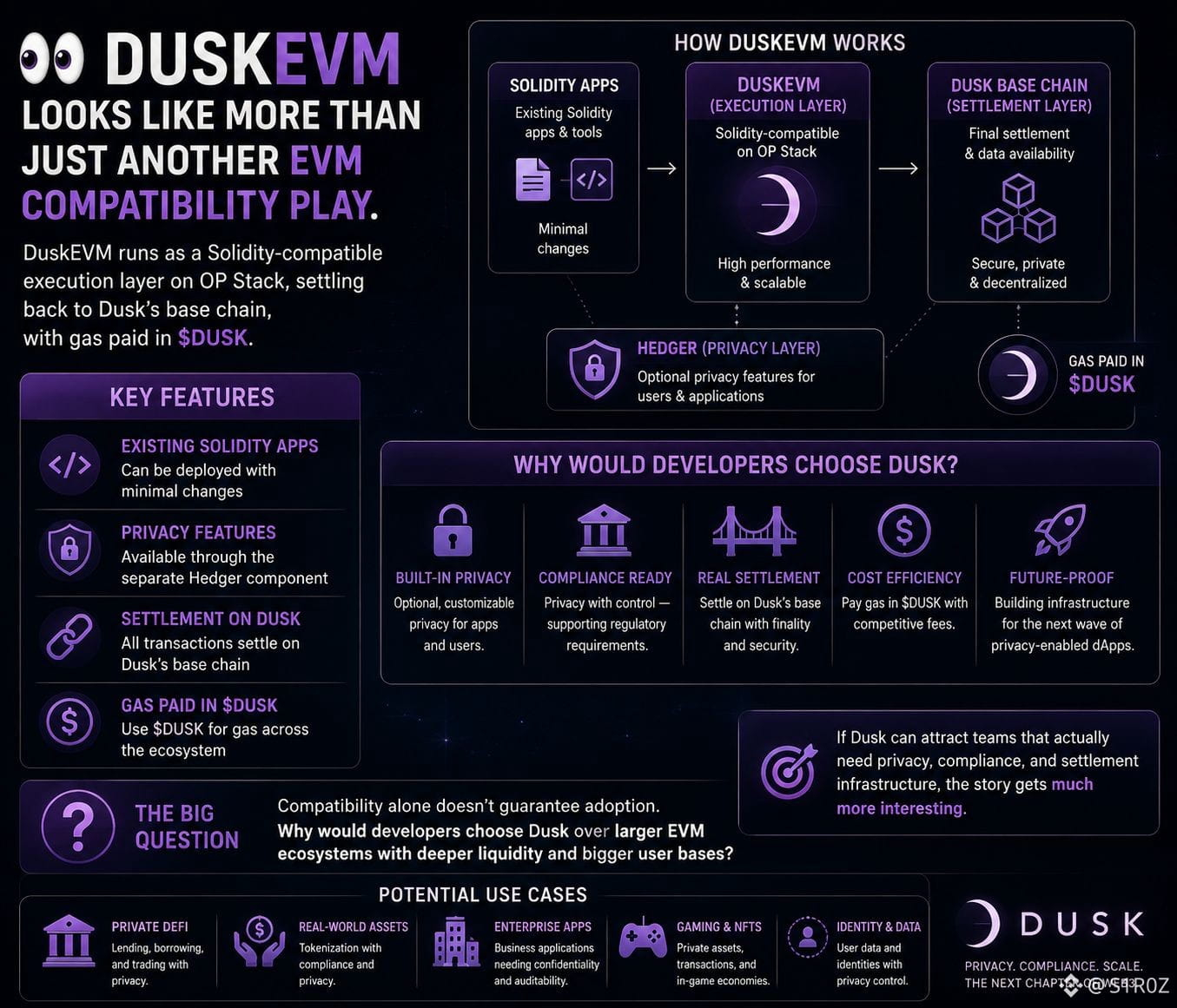
👀 DuskEVM looks like more than just another EVM compatibility play.
@Dusk_Foundation
{spot}(GPSUSDT)
{spot}(TUTUSDT)
DuskEVM runs as a Solidity-compatible execution layer on OP Stack, settling back to Dusk’s base chain, with gas paid in $DUSK .
$TUT ,$GPS
The interesting part is the privacy angle:
⚙️ Existing Solidity apps can be deployed with minimal changes
🔐 Privacy features are available through the separate Hedger component
⛓️ Settlement happens on Dusk’s base chain
💰 Gas is paid in DUSK
{spot}(DUSKUSDT)
But compatibility alone doesn't guarantee adoption.
The real question: Why would developers choose Dusk over larger EVM ecosystems with deeper liquidity and bigger user bases?
If Dusk can attract teams that actually need privacy, compliance, and settlement infrastructure, the story gets much more interesting.
#Ethereum✅ #Crypto #Blockchain
#DUSKARMY. #DuskEVM
👀 DuskEVM looks like more than just another EVM compatibility play.
@Dusk
DuskEVM runs as a Solidity-compatible execution layer on OP Stack, settling back to Dusk’s base chain, with gas paid in $DUSK .
$TUT ,$GPS
The interesting part is the privacy angle:
⚙️ Existing Solidity apps can be deployed with minimal changes
🔐 Privacy features are available through the separate Hedger component
⛓️ Settlement happens on Dusk’s base chain
💰 Gas is paid in DUSK
But compatibility alone doesn't guarantee adoption.
The real question: Why would developers choose Dusk over larger EVM ecosystems with deeper liquidity and bigger user bases?
If Dusk can attract teams that actually need privacy, compliance, and settlement infrastructure, the story gets much more interesting.
#Ethereum✅ #Crypto #Blockchain
👀 DuskEVM looks like more than just another EVM compatibility play.
@Dusk
DuskEVM runs as a Solidity-compatible execution layer on OP Stack, settling back to Dusk’s base chain, with gas paid in $DUSK .
$TUT ,$GPS
The interesting part is the privacy angle:
⚙️ Existing Solidity apps can be deployed with minimal changes
🔐 Privacy features are available through the separate Hedger component
⛓️ Settlement happens on Dusk’s base chain
💰 Gas is paid in DUSK
But compatibility alone doesn't guarantee adoption.
The real question: Why would developers choose Dusk over larger EVM ecosystems with deeper liquidity and bigger user bases?
If Dusk can attract teams that actually need privacy, compliance, and settlement infrastructure, the story gets much more interesting.
#Ethereum✅ #Crypto #Blockchain
1
40

#dusk $DUSK @Dusk_Foundation
Dusk’s Modular Stack: Three Layers, One Purpose
What if blockchain architecture treated settlement and execution as separate jobs?
@Dusk_Foundation is taking that approach with a modular design built around three components:
1. DuskDS — the settlement foundation
It handles consensus, finality, data availability, and Dusk’s native transaction models, including Moonlight for public transfers and Phoenix for shielded transfers.
2. DuskEVM — the EVM path
Developers can use Solidity and familiar Ethereum tooling while applications settle through DuskDS. This makes the environment more accessible for EVM-based DeFi and tokenized-asset applications.
3. DuskVM — direct L1 execution
DuskVM runs Rust/WASM smart contracts directly on Dusk L1, making it suited to applications that need deeper access to Dusk’s transaction models, privacy, or zero-knowledge capabilities.
The interesting part is the separation itself: different applications can choose the execution environment they need without replacing the underlying settlement layer.
For $DUSK , this creates a foundation where EVM compatibility, direct L1 execution, privacy, and deterministic settlement can work within the same broader architecture.
#DUSK #DuskEVM #DuskVM
Poll: 🏗️ What part of Dusk’s modular architecture interests you most?
#dusk $DUSK @Dusk
Dusk’s Modular Stack: Three Layers, One Purpose
What if blockchain architecture treated settlement and execution as separate jobs?
@Dusk is taking that approach with a modular design built around three components:
1. DuskDS — the settlement foundation
It handles consensus, finality, data availability, and Dusk’s native transaction models, including Moonlight for public transfers and Phoenix for shielded transfers.
2. DuskEVM — the EVM path
Developers can use Solidity and familiar Ethereum tooling while applications settle through DuskDS. This makes the environment more accessible for EVM-based DeFi and tokenized-asset applications.
3. DuskVM — direct L1 execution
DuskVM runs Rust/WASM smart contracts directly on Dusk L1, making it suited to applications that need deeper access to Dusk’s transaction models, privacy, or zero-knowledge capabilities.
The interesting part is the separation itself: different applications can choose the execution environment they need without replacing the underlying settlement layer.
For $DUSK , this creates a foundation where EVM compatibility, direct L1 execution, privacy, and deterministic settlement can work within the same broader architecture.
#DUSK #DuskEVM #DuskVM
Poll: 🏗️ What part of Dusk’s modular architecture interests you most?
Dusk’s Modular Stack: Three Layers, One Purpose
What if blockchain architecture treated settlement and execution as separate jobs?
@Dusk is taking that approach with a modular design built around three components:
1. DuskDS — the settlement foundation
It handles consensus, finality, data availability, and Dusk’s native transaction models, including Moonlight for public transfers and Phoenix for shielded transfers.
2. DuskEVM — the EVM path
Developers can use Solidity and familiar Ethereum tooling while applications settle through DuskDS. This makes the environment more accessible for EVM-based DeFi and tokenized-asset applications.
3. DuskVM — direct L1 execution
DuskVM runs Rust/WASM smart contracts directly on Dusk L1, making it suited to applications that need deeper access to Dusk’s transaction models, privacy, or zero-knowledge capabilities.
The interesting part is the separation itself: different applications can choose the execution environment they need without replacing the underlying settlement layer.
For $DUSK , this creates a foundation where EVM compatibility, direct L1 execution, privacy, and deterministic settlement can work within the same broader architecture.
#DUSK #DuskEVM #DuskVM
Poll: 🏗️ What part of Dusk’s modular architecture interests you most?
🔹 DuskDS — Settlement
0%
🔹 DuskEVM — EVM compatibility
100%
🔹 DuskVM — Native execution
0%
🔹 🔐 Privacy & compliance
0%
1 ඡන්ද • ඡන්දය අවසන්
1
2
84

·
--
සත්යායනය කළ
ලිපිය
DUSK:RWA 进入下一阶段,核心可能不只是“资产上链”最近比较值得关注的一个方向是 Dusk。
很多 RWA 项目解决的是“把现实资产映射到链上”,但 Dusk 想做的更进一步——让资产发行、交易、合规、隐私以及结算等金融业务流程,本身就能够在链上运行。
其中最值得关注的是即将推进的 DuskEVM 主网。DuskEVM 为开发者和机构提供熟悉的 Solidity/EVM 开发环境,同时通过 Hedger 引入同态加密(HE)和零知识证明(ZKP),探索在金融场景中实现隐私保护 + 合规审查 + 选择性披露。
应用层还有 Dusk Trade,定位类似面向代币化金融资产的 Neobroker,将用户注册、钱包连接、资产发现、交易、支付协调和结算整合到一个市场界面,目前覆盖的方向包括 MMF、ETF、债券以及 RWA。
更重要的是,Dusk 正在推进机构级生态建设,包括与 Chainlink、NPEX 等合作。其中 NPEX 是受到荷兰 AFM 监管的交易所,并计划通过 Dusk 将超过 3 亿欧元的资产带到链上。
所以我认为,Dusk 值得关注的逻辑并不是简单的“又一个 RWA 公链”,而是:
EVM + 隐私 + 合规 + RWA + 原生发行 + 机构资产
如果未来传统金融资产真正大规模进入链上,市场需要的可能并不是单纯的公开账本,而是能够同时解决隐私、监管、交易和结算问题的基础设施。
Dusk 目前正在押注的,正是这一条路线。
RWA 的下一阶段,可能不是“把资产搬上链”,而是让金融市场本身在链上运行。
#DUSK #DuskNetwork #RWA #DuskEVM $DUSK
@Dusk_Foundation
DUSK:RWA 进入下一阶段,核心可能不只是“资产上链”
最近比较值得关注的一个方向是 Dusk。
很多 RWA 项目解决的是“把现实资产映射到链上”,但 Dusk 想做的更进一步——让资产发行、交易、合规、隐私以及结算等金融业务流程,本身就能够在链上运行。
其中最值得关注的是即将推进的 DuskEVM 主网。DuskEVM 为开发者和机构提供熟悉的 Solidity/EVM 开发环境,同时通过 Hedger 引入同态加密(HE)和零知识证明(ZKP),探索在金融场景中实现隐私保护 + 合规审查 + 选择性披露。
应用层还有 Dusk Trade,定位类似面向代币化金融资产的 Neobroker,将用户注册、钱包连接、资产发现、交易、支付协调和结算整合到一个市场界面,目前覆盖的方向包括 MMF、ETF、债券以及 RWA。
更重要的是,Dusk 正在推进机构级生态建设,包括与 Chainlink、NPEX 等合作。其中 NPEX 是受到荷兰 AFM 监管的交易所,并计划通过 Dusk 将超过 3 亿欧元的资产带到链上。
所以我认为,Dusk 值得关注的逻辑并不是简单的“又一个 RWA 公链”,而是:
EVM + 隐私 + 合规 + RWA + 原生发行 + 机构资产
如果未来传统金融资产真正大规模进入链上,市场需要的可能并不是单纯的公开账本,而是能够同时解决隐私、监管、交易和结算问题的基础设施。
Dusk 目前正在押注的,正是这一条路线。
RWA 的下一阶段,可能不是“把资产搬上链”,而是让金融市场本身在链上运行。
#DUSK #DuskNetwork #RWA #DuskEVM $DUSK
@Dusk
很多 RWA 项目解决的是“把现实资产映射到链上”,但 Dusk 想做的更进一步——让资产发行、交易、合规、隐私以及结算等金融业务流程,本身就能够在链上运行。
其中最值得关注的是即将推进的 DuskEVM 主网。DuskEVM 为开发者和机构提供熟悉的 Solidity/EVM 开发环境,同时通过 Hedger 引入同态加密(HE)和零知识证明(ZKP),探索在金融场景中实现隐私保护 + 合规审查 + 选择性披露。
应用层还有 Dusk Trade,定位类似面向代币化金融资产的 Neobroker,将用户注册、钱包连接、资产发现、交易、支付协调和结算整合到一个市场界面,目前覆盖的方向包括 MMF、ETF、债券以及 RWA。
更重要的是,Dusk 正在推进机构级生态建设,包括与 Chainlink、NPEX 等合作。其中 NPEX 是受到荷兰 AFM 监管的交易所,并计划通过 Dusk 将超过 3 亿欧元的资产带到链上。
所以我认为,Dusk 值得关注的逻辑并不是简单的“又一个 RWA 公链”,而是:
EVM + 隐私 + 合规 + RWA + 原生发行 + 机构资产
如果未来传统金融资产真正大规模进入链上,市场需要的可能并不是单纯的公开账本,而是能够同时解决隐私、监管、交易和结算问题的基础设施。
Dusk 目前正在押注的,正是这一条路线。
RWA 的下一阶段,可能不是“把资产搬上链”,而是让金融市场本身在链上运行。
#DUSK #DuskNetwork #RWA #DuskEVM $DUSK
@Dusk
2
8
6.2k

සත්යායනය කළ
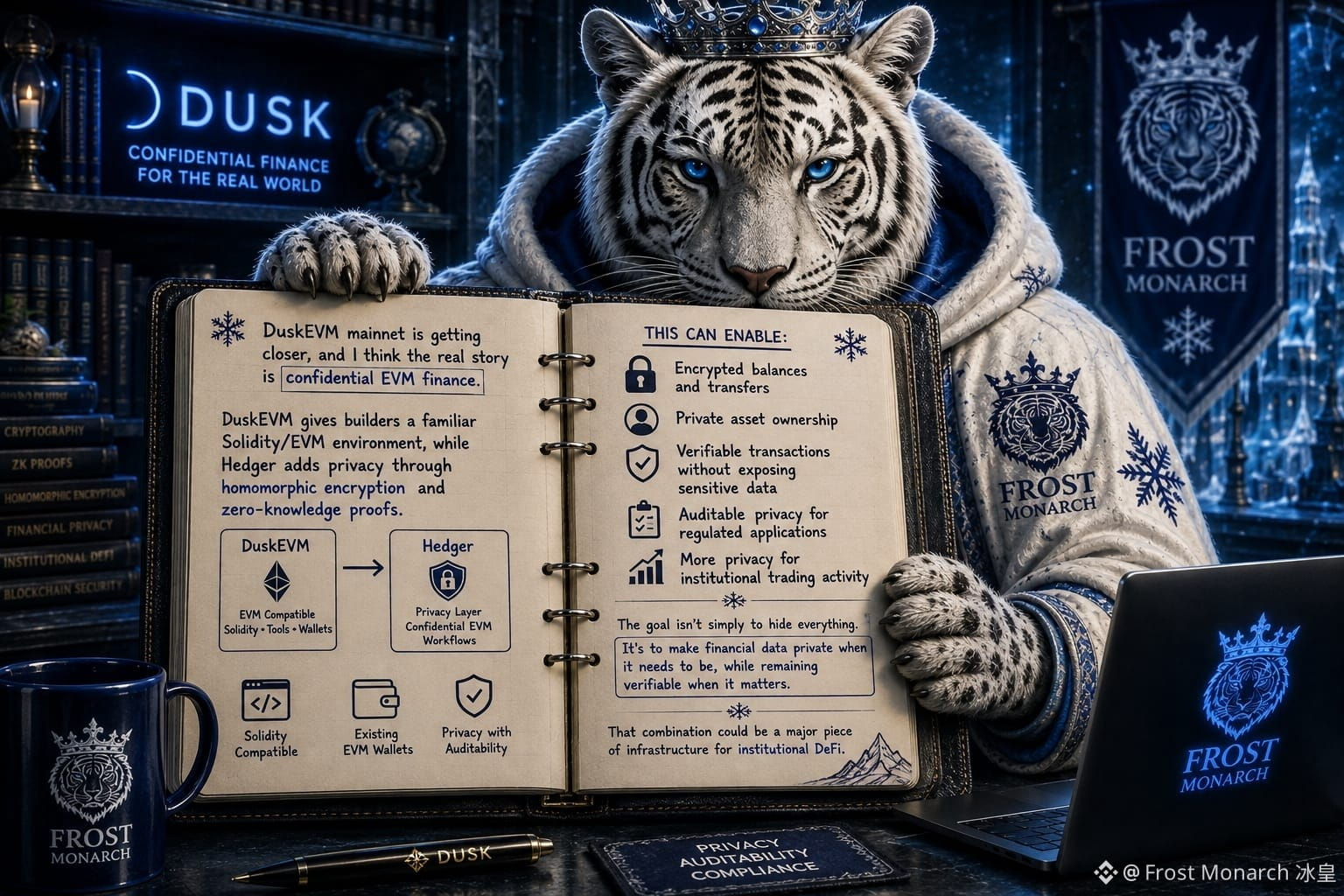
I’ve been watching DuskEVM closely, and I think the real story is confidential EVM finance.
DuskEVM gives builders a familiar Solidity/EVM environment, while Hedger adds privacy through homomorphic encryption and zero-knowledge proofs.
What I find interesting is what this could enable:
→ Encrypted balances and transfers
→ Private asset ownership
→ Verifiable transactions without exposing sensitive data
→ Auditable privacy for regulated applications
→ More privacy for institutional trading activity
I don’t think the goal is simply to hide everything.
The bigger idea is making financial data private when it needs to be, while remaining verifiable when it matters.
To me, that combination could become a major piece of infrastructure for institutional DeFi.
#DuskEVM #dusk $DUSK @Dusk_Foundation
{future}(DUSKUSDT)
I’ve been watching DuskEVM closely, and I think the real story is confidential EVM finance.
DuskEVM gives builders a familiar Solidity/EVM environment, while Hedger adds privacy through homomorphic encryption and zero-knowledge proofs.
What I find interesting is what this could enable:
→ Encrypted balances and transfers
→ Private asset ownership
→ Verifiable transactions without exposing sensitive data
→ Auditable privacy for regulated applications
→ More privacy for institutional trading activity
I don’t think the goal is simply to hide everything.
The bigger idea is making financial data private when it needs to be, while remaining verifiable when it matters.
To me, that combination could become a major piece of infrastructure for institutional DeFi.
#DuskEVM #dusk $DUSK @Dusk
DuskEVM gives builders a familiar Solidity/EVM environment, while Hedger adds privacy through homomorphic encryption and zero-knowledge proofs.
What I find interesting is what this could enable:
→ Encrypted balances and transfers
→ Private asset ownership
→ Verifiable transactions without exposing sensitive data
→ Auditable privacy for regulated applications
→ More privacy for institutional trading activity
I don’t think the goal is simply to hide everything.
The bigger idea is making financial data private when it needs to be, while remaining verifiable when it matters.
To me, that combination could become a major piece of infrastructure for institutional DeFi.
#DuskEVM #dusk $DUSK @Dusk
23
2
10
256

#dusk $DUSK @Dusk_Foundation They didn't refactor. They demolished.
The Dusk intern said NO to V1.0 and brought the wrecking ball.
Old design? Gone.
Old code? Gone.
Old limits? Also gone.
In its place: THEDUSKINTERN.COM 🌙
A whole new skyscraper built for builders.
Inside: #DuskEVM tools, TDI drops, and $TDI.
Built on #Dusk. By an Intern.
Caution: Intern at Work.
This is what shipping fast in Web 3 looks like.
Break things. Build bigger. Launch experiments.
Privacy + Compliance + EVM = The new era starts here.
@Dusk_Foundation Foundation $DUSK #RWA #dusk
#dusk $DUSK @Dusk They didn't refactor. They demolished.
The Dusk intern said NO to V1.0 and brought the wrecking ball.
Old design? Gone.
Old code? Gone.
Old limits? Also gone.
In its place: THEDUSKINTERN.COM 🌙
A whole new skyscraper built for builders.
Inside: #DuskEVM tools, TDI drops, and $TDI.
Built on #Dusk. By an Intern.
Caution: Intern at Work.
This is what shipping fast in Web 3 looks like.
Break things. Build bigger. Launch experiments.
Privacy + Compliance + EVM = The new era starts here.
@Dusk Foundation $DUSK #RWA #dusk
The Dusk intern said NO to V1.0 and brought the wrecking ball.
Old design? Gone.
Old code? Gone.
Old limits? Also gone.
In its place: THEDUSKINTERN.COM 🌙
A whole new skyscraper built for builders.
Inside: #DuskEVM tools, TDI drops, and $TDI.
Built on #Dusk. By an Intern.
Caution: Intern at Work.
This is what shipping fast in Web 3 looks like.
Break things. Build bigger. Launch experiments.
Privacy + Compliance + EVM = The new era starts here.
@Dusk Foundation $DUSK #RWA #dusk
61

I’ve been watching Dusk because it’s building infrastructure for regulated financial applications, and I recently added a small $DUSK position to my portfolio.
What changed my view wasn’t another tokenization headline. It was the distinction between representing an asset onchain and actually designing its lifecycle around the ledger.
I initially thought @Dusk_Foundation was mainly about privacy. But the native issuance angle made me look at it differently.
If issuance, transfers, servicing, access controls, and settlement can be structured around the same onchain environment, some reconciliation between separate systems could disappear. That matters because regulated assets aren't just about creating a token. The messy part is everything happening around it.
DuskEVM gives builders familiar EVM tooling, while DuskDS provides deterministic finality, data availability, and privacy-capable transaction models.
That combination is interesting to me because it targets workflow design, not just asset representation.
Still, I’m not fully convinced yet. Legal structures, authorized venues, custody, liquidity, and institutional adoption can’t simply be solved by protocol design.
But I’ve started seeing Dusk less as “another tokenization chain” and more as infrastructure for rebuilding parts of the financial lifecycle.
The real question for me is whether institutions actually use that flexibility at scale.
$RED $EDEN #DUSK #DuskEVM #Web3 #Tokenization
{spot}(DUSKUSDT)
{spot}(EDENUSDT)
{spot}(REDUSDT)
🗳️ What matters most for Dusk’s adoption?
I’ve been watching Dusk because it’s building infrastructure for regulated financial applications, and I recently added a small $DUSK position to my portfolio.
What changed my view wasn’t another tokenization headline. It was the distinction between representing an asset onchain and actually designing its lifecycle around the ledger.
I initially thought @Dusk was mainly about privacy. But the native issuance angle made me look at it differently.
If issuance, transfers, servicing, access controls, and settlement can be structured around the same onchain environment, some reconciliation between separate systems could disappear. That matters because regulated assets aren't just about creating a token. The messy part is everything happening around it.
DuskEVM gives builders familiar EVM tooling, while DuskDS provides deterministic finality, data availability, and privacy-capable transaction models.
That combination is interesting to me because it targets workflow design, not just asset representation.
Still, I’m not fully convinced yet. Legal structures, authorized venues, custody, liquidity, and institutional adoption can’t simply be solved by protocol design.
But I’ve started seeing Dusk less as “another tokenization chain” and more as infrastructure for rebuilding parts of the financial lifecycle.
The real question for me is whether institutions actually use that flexibility at scale.
$RED $EDEN #DUSK #DuskEVM #Web3 #Tokenization
🗳️ What matters most for Dusk’s adoption?
What changed my view wasn’t another tokenization headline. It was the distinction between representing an asset onchain and actually designing its lifecycle around the ledger.
I initially thought @Dusk was mainly about privacy. But the native issuance angle made me look at it differently.
If issuance, transfers, servicing, access controls, and settlement can be structured around the same onchain environment, some reconciliation between separate systems could disappear. That matters because regulated assets aren't just about creating a token. The messy part is everything happening around it.
DuskEVM gives builders familiar EVM tooling, while DuskDS provides deterministic finality, data availability, and privacy-capable transaction models.
That combination is interesting to me because it targets workflow design, not just asset representation.
Still, I’m not fully convinced yet. Legal structures, authorized venues, custody, liquidity, and institutional adoption can’t simply be solved by protocol design.
But I’ve started seeing Dusk less as “another tokenization chain” and more as infrastructure for rebuilding parts of the financial lifecycle.
The real question for me is whether institutions actually use that flexibility at scale.
$RED $EDEN #DUSK #DuskEVM #Web3 #Tokenization
🗳️ What matters most for Dusk’s adoption?
🔹 Native issuance
33%
🔹 Privacy + compliance
67%
🔹 Onchain settlement
0%
6 ඡන්ද • ඡන්දය අවසන්
44
23
191

සත්යායනය කළ
Instant Finality & Quiet Conviction
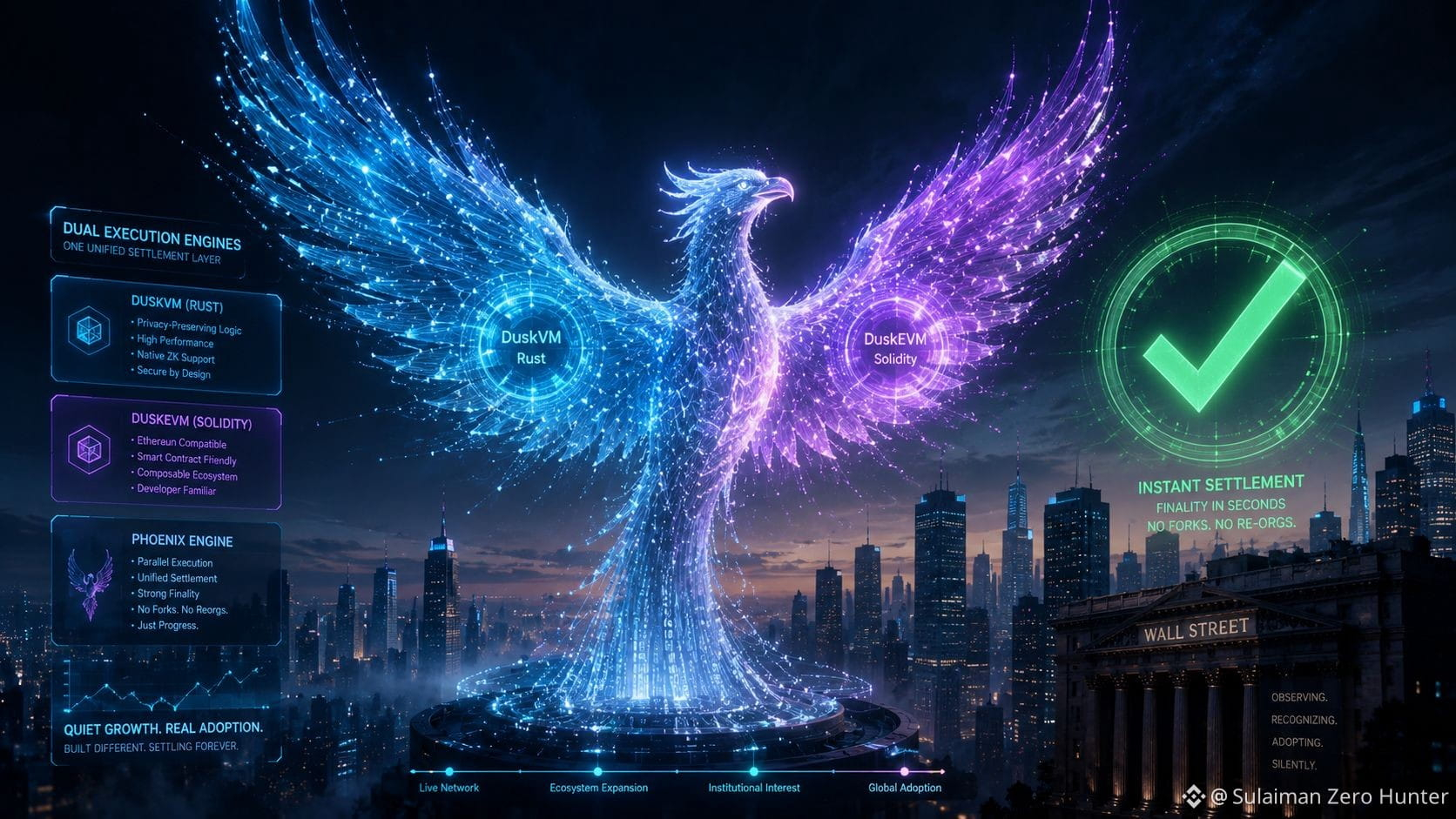
Let's talk settlement. $DUSK uses Succinct Attestation consensus. Once a block is ratified, it's permanent. No forks. No re-orgs. No probabilistic waiting.
For bond trades and private placements, that instant finality is non-negotiable.
Under the hood, the Phoenix engine treats funds as encrypted "Notes" (UTXO model). Thanks to built-in Diffie-Hellman randomization, transactions are entirely unlinkable—even repeated trades from the same party can't be correlated. True financial privacy.
And they run dual VMs—DuskVM (Rust/WASM for native performance) alongside DuskEVM (OP Stack Rollup for Solidity devs). Native speed + Ethereum's ecosystem. Best of both worlds, zero compromise.
What I like most? They're quiet about it. No loud promises, no meme-chasing—just steady work on real infrastructure. Watching DuskEVM come online and the quiet partnerships forming… this feels like one of those projects that grows in the background while everyone else argues about hype.
Institutions don't need more transparency. They need the ability to choose.
$DUSK gives them that choice—bridging the gap between legacy finance and decentralized rails, without forcing either side to compromise.
Still early, still learning… but this one definitely stuck with me.
@Dusk_Foundation #dusk $DUSK #DuskEVM #DUSK
{spot}(DUSKUSDT)
Instant Finality & Quiet Conviction
Let's talk settlement. $DUSK uses Succinct Attestation consensus. Once a block is ratified, it's permanent. No forks. No re-orgs. No probabilistic waiting.
For bond trades and private placements, that instant finality is non-negotiable.
Under the hood, the Phoenix engine treats funds as encrypted "Notes" (UTXO model). Thanks to built-in Diffie-Hellman randomization, transactions are entirely unlinkable—even repeated trades from the same party can't be correlated. True financial privacy.
And they run dual VMs—DuskVM (Rust/WASM for native performance) alongside DuskEVM (OP Stack Rollup for Solidity devs). Native speed + Ethereum's ecosystem. Best of both worlds, zero compromise.
What I like most? They're quiet about it. No loud promises, no meme-chasing—just steady work on real infrastructure. Watching DuskEVM come online and the quiet partnerships forming… this feels like one of those projects that grows in the background while everyone else argues about hype.
Institutions don't need more transparency. They need the ability to choose.
$DUSK gives them that choice—bridging the gap between legacy finance and decentralized rails, without forcing either side to compromise.
Still early, still learning… but this one definitely stuck with me.
@Dusk #dusk $DUSK #DuskEVM #DUSK
Let's talk settlement. $DUSK uses Succinct Attestation consensus. Once a block is ratified, it's permanent. No forks. No re-orgs. No probabilistic waiting.
For bond trades and private placements, that instant finality is non-negotiable.
Under the hood, the Phoenix engine treats funds as encrypted "Notes" (UTXO model). Thanks to built-in Diffie-Hellman randomization, transactions are entirely unlinkable—even repeated trades from the same party can't be correlated. True financial privacy.
And they run dual VMs—DuskVM (Rust/WASM for native performance) alongside DuskEVM (OP Stack Rollup for Solidity devs). Native speed + Ethereum's ecosystem. Best of both worlds, zero compromise.
What I like most? They're quiet about it. No loud promises, no meme-chasing—just steady work on real infrastructure. Watching DuskEVM come online and the quiet partnerships forming… this feels like one of those projects that grows in the background while everyone else argues about hype.
Institutions don't need more transparency. They need the ability to choose.
$DUSK gives them that choice—bridging the gap between legacy finance and decentralized rails, without forcing either side to compromise.
Still early, still learning… but this one definitely stuck with me.
@Dusk #dusk $DUSK #DuskEVM #DUSK
2
39

·
--
බෙයාරිෂ්
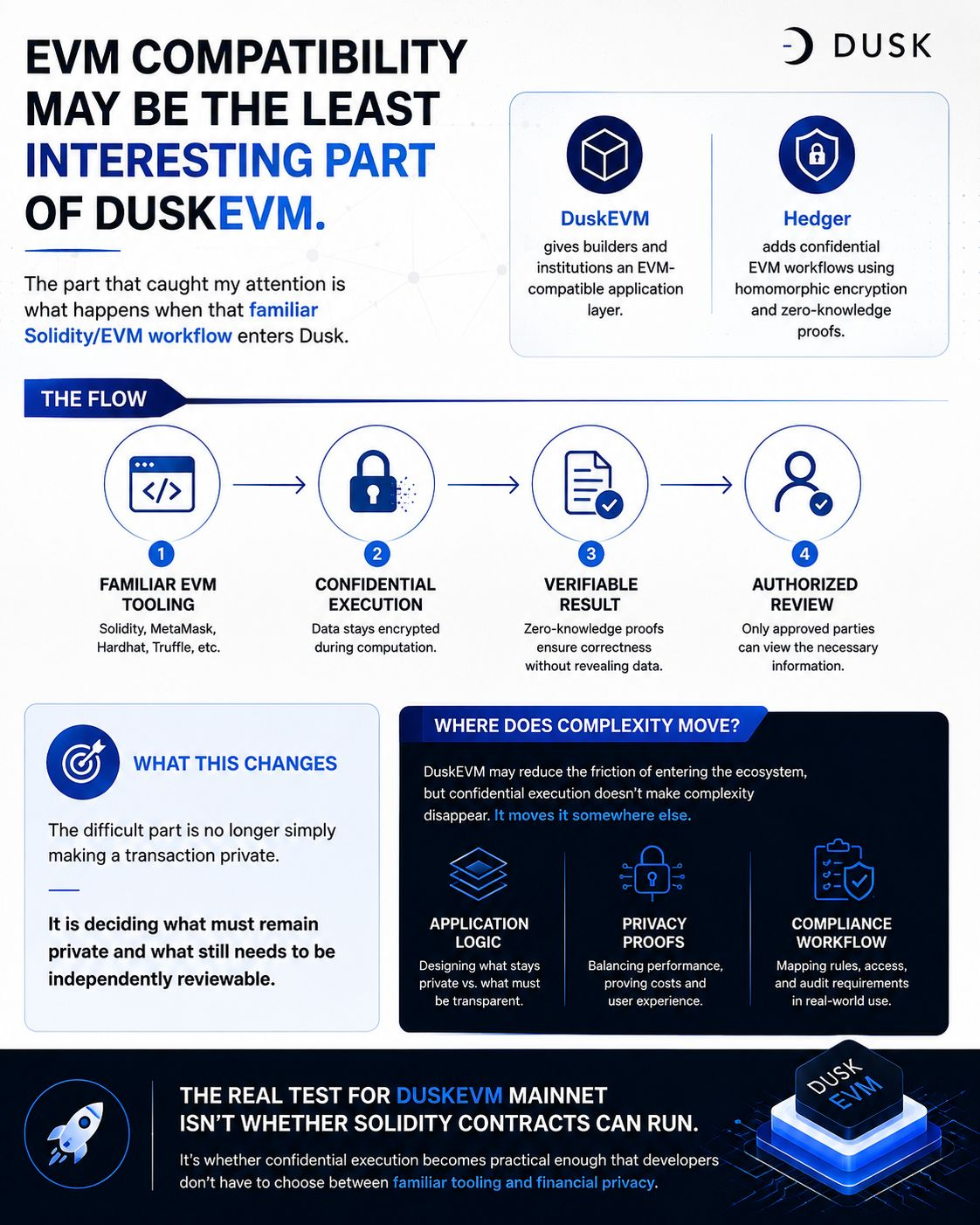
$TMX $BTC EVM compatibility may be the least interesting part of DuskEVM.
The part that caught my attention is what happens when that familiar Solidity/EVM workflow enters Dusk.
#DuskEVM gives builders and institutions an EVM-compatible application layer, while Hedger adds confidential EVM workflows using homomorphic encryption and zero-knowledge proofs.
So the flow becomes:
familiar EVM tooling → confidential execution → verifiable result → authorized review
That changes the problem for me.
The difficult part is no longer simply making a transaction private. It is deciding what must remain private and what still needs to be independently reviewable.
And that creates an unexpected consequence.
DuskEVM may reduce the friction of entering the ecosystem, but confidential execution doesn’t make complexity disappear. It moves it somewhere else — into application logic, privacy proofs, or the compliance workflow around them.
The real test for DuskEVM mainnet isn’t whether Solidity contracts can run.
It’s whether confidential execution becomes practical enough that developers don’t have to choose between familiar tooling and financial privacy.
@Dusk_Foundation $DUSK #dusk
$TMX $BTC EVM compatibility may be the least interesting part of DuskEVM.
The part that caught my attention is what happens when that familiar Solidity/EVM workflow enters Dusk.
#DuskEVM gives builders and institutions an EVM-compatible application layer, while Hedger adds confidential EVM workflows using homomorphic encryption and zero-knowledge proofs.
So the flow becomes:
familiar EVM tooling → confidential execution → verifiable result → authorized review
That changes the problem for me.
The difficult part is no longer simply making a transaction private. It is deciding what must remain private and what still needs to be independently reviewable.
And that creates an unexpected consequence.
DuskEVM may reduce the friction of entering the ecosystem, but confidential execution doesn’t make complexity disappear. It moves it somewhere else — into application logic, privacy proofs, or the compliance workflow around them.
The real test for DuskEVM mainnet isn’t whether Solidity contracts can run.
It’s whether confidential execution becomes practical enough that developers don’t have to choose between familiar tooling and financial privacy.
@Dusk $DUSK #dusk
The part that caught my attention is what happens when that familiar Solidity/EVM workflow enters Dusk.
#DuskEVM gives builders and institutions an EVM-compatible application layer, while Hedger adds confidential EVM workflows using homomorphic encryption and zero-knowledge proofs.
So the flow becomes:
familiar EVM tooling → confidential execution → verifiable result → authorized review
That changes the problem for me.
The difficult part is no longer simply making a transaction private. It is deciding what must remain private and what still needs to be independently reviewable.
And that creates an unexpected consequence.
DuskEVM may reduce the friction of entering the ecosystem, but confidential execution doesn’t make complexity disappear. It moves it somewhere else — into application logic, privacy proofs, or the compliance workflow around them.
The real test for DuskEVM mainnet isn’t whether Solidity contracts can run.
It’s whether confidential execution becomes practical enough that developers don’t have to choose between familiar tooling and financial privacy.
@Dusk $DUSK #dusk
120
·
--
උසබ තත්ත්වය
සත්යායනය කළ
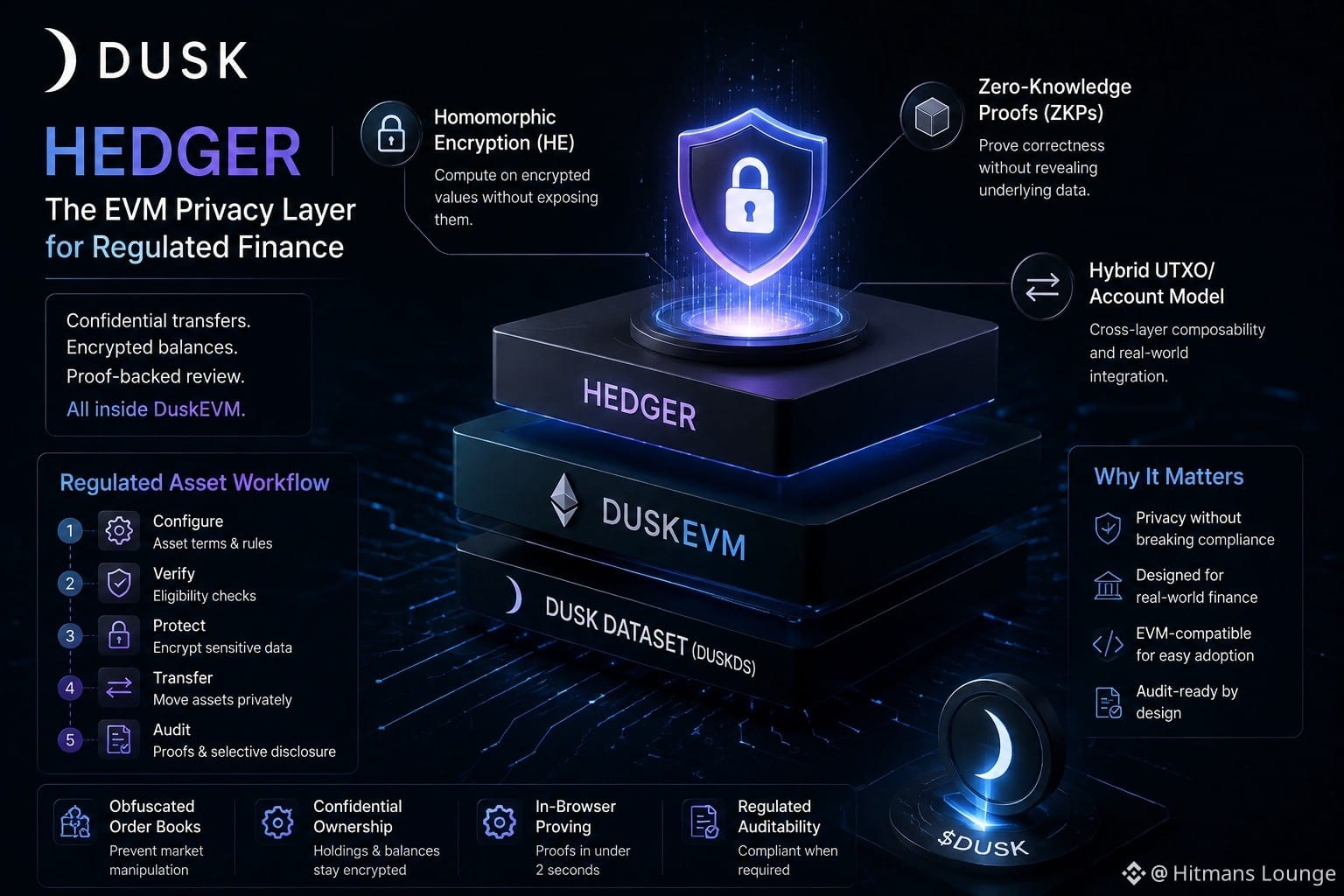
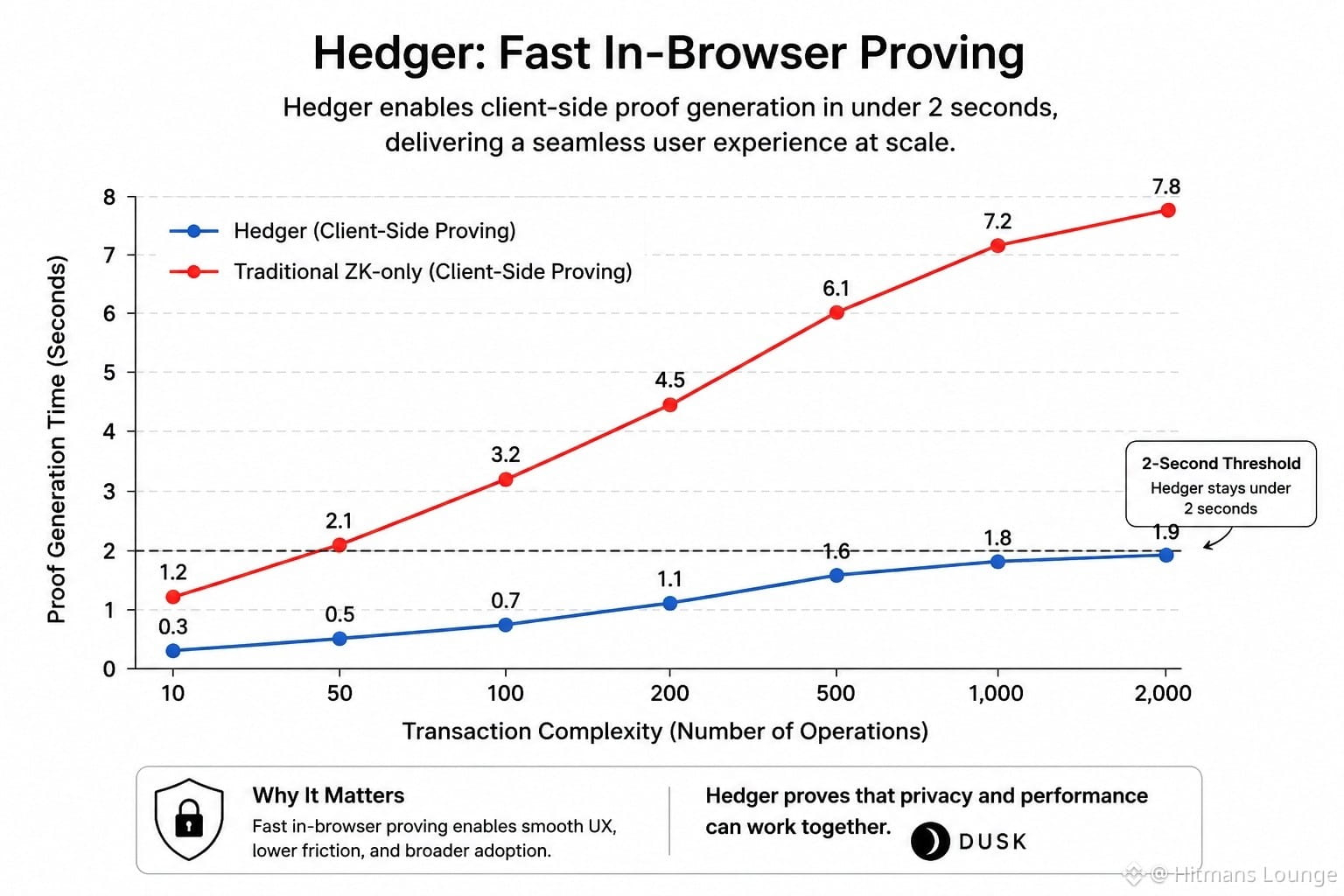
@Dusk_Foundation is building privacy infrastructure for regulated onchain finance, and I’ve been looking more closely at how Hedger fits into DuskEVM.
I actually added a small $DUSK position after initially hesitating. What changed my mind wasn’t another privacy headline—it was the way Hedger handles hidden values.
Hedger combines homomorphic encryption with zero-knowledge proofs, so balances and transfer amounts can stay encrypted while the network can still prove that the required rules were followed.
That made me think differently about adoption.
I used to see privacy mainly as “hide the transaction.” Now I think the more important feature is hiding sensitive financial information without breaking the review process.
For regulated assets, that distinction could matter a lot. An institution may not want its position size or trading activity public, but it still needs eligibility checks and audit paths.
I’m still cautious, though. The real test is whether users and institutions actually find this workflow simple enough to use. Sophisticated cryptography doesn't automatically create better UX.
My small position is basically a way for me to keep watching that experiment.
If Hedger can make confidential transfers feel normal rather than complicated, I think that’s where the interesting adoption story starts. 🧐
$AKE $ACE #DUSK #DuskEVM #Privacy #Hedger
@Dusk is building privacy infrastructure for regulated onchain finance, and I’ve been looking more closely at how Hedger fits into DuskEVM.
I actually added a small $DUSK position after initially hesitating. What changed my mind wasn’t another privacy headline—it was the way Hedger handles hidden values.
Hedger combines homomorphic encryption with zero-knowledge proofs, so balances and transfer amounts can stay encrypted while the network can still prove that the required rules were followed.
That made me think differently about adoption.
I used to see privacy mainly as “hide the transaction.” Now I think the more important feature is hiding sensitive financial information without breaking the review process.
For regulated assets, that distinction could matter a lot. An institution may not want its position size or trading activity public, but it still needs eligibility checks and audit paths.
I’m still cautious, though. The real test is whether users and institutions actually find this workflow simple enough to use. Sophisticated cryptography doesn't automatically create better UX.
My small position is basically a way for me to keep watching that experiment.
If Hedger can make confidential transfers feel normal rather than complicated, I think that’s where the interesting adoption story starts. 🧐
$AKE $ACE #DUSK #DuskEVM #Privacy #Hedger
I actually added a small $DUSK position after initially hesitating. What changed my mind wasn’t another privacy headline—it was the way Hedger handles hidden values.
Hedger combines homomorphic encryption with zero-knowledge proofs, so balances and transfer amounts can stay encrypted while the network can still prove that the required rules were followed.
That made me think differently about adoption.
I used to see privacy mainly as “hide the transaction.” Now I think the more important feature is hiding sensitive financial information without breaking the review process.
For regulated assets, that distinction could matter a lot. An institution may not want its position size or trading activity public, but it still needs eligibility checks and audit paths.
I’m still cautious, though. The real test is whether users and institutions actually find this workflow simple enough to use. Sophisticated cryptography doesn't automatically create better UX.
My small position is basically a way for me to keep watching that experiment.
If Hedger can make confidential transfers feel normal rather than complicated, I think that’s where the interesting adoption story starts. 🧐
$AKE $ACE #DUSK #DuskEVM #Privacy #Hedger
70
26
562
·
--
#dusk $DUSK @Dusk_Foundation
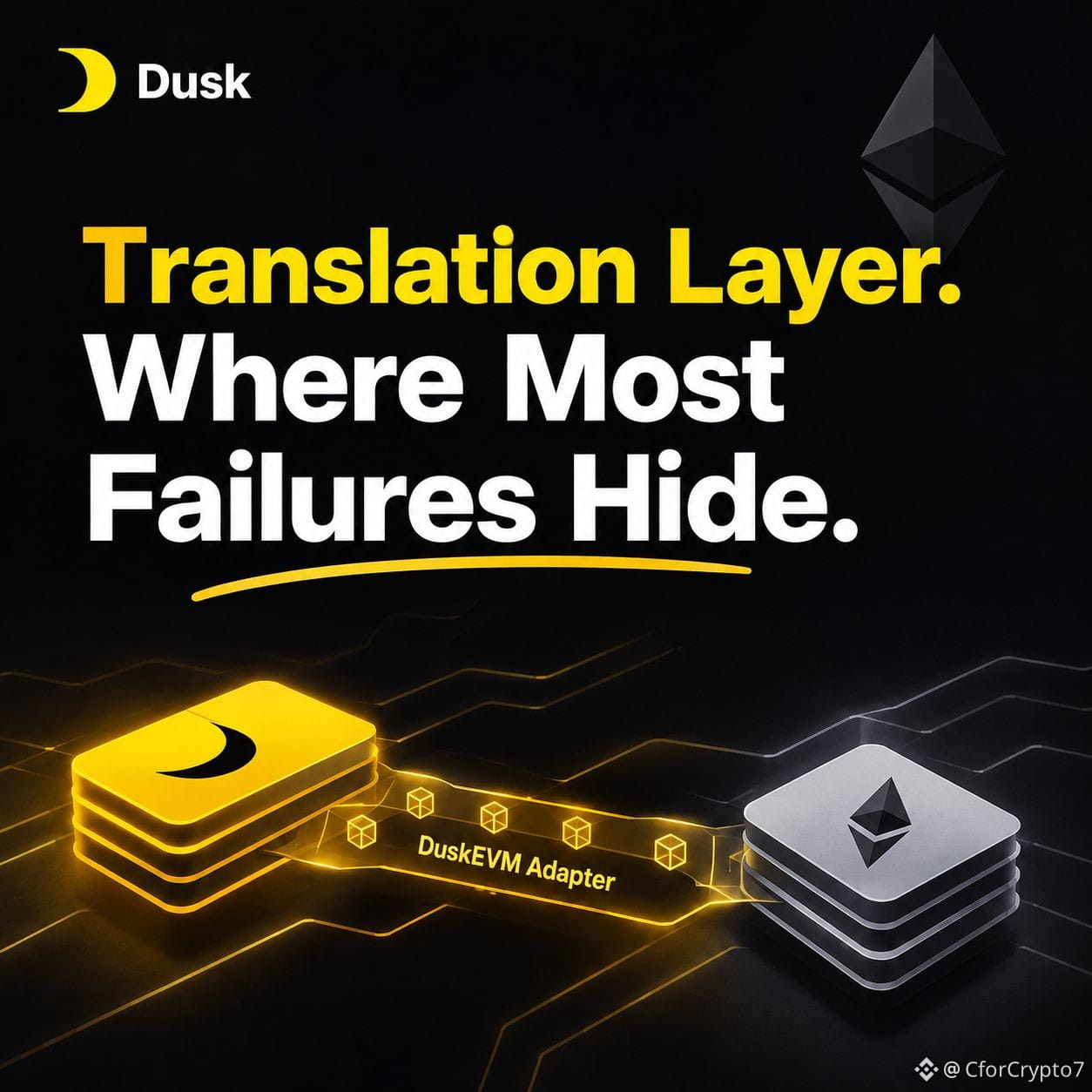
I was reading the DuskEVM adapter documentation last night and the “just a proxy” description still doesn’t sit well with me.
That’s the translation layer, and translation layers are where the interesting failures hide.
It takes Dusk’s GraphQL/RUES state and recasts it as an Ethereum-style JSON-RPC — blocks, receipts, logs, proofs — plus a LUX-to-WEI conversion and caller-identifier model that doesn’t neatly map to how Ethereum contracts think about msg.sender.
The path to happiness is well documented.
There are no failure modes, at least not that I’ve found.
If the adapter’s index lags behind the local state on disk, does the Ethereum client see stale data? An error?
Or something that looks right and isn’t? I’m also curious about what happens to the logic of the contention game once the final disk assumptions deviate from what the OP stack was built on.
And when EVM tooling assumes runtime behavior the disk contract model can't actually be satisfied — does it fail loudly, or silently?
If someone runs a DuskEVM node or pushes the adapter under real load,
I'd really like to hear if the state mapping holds up,
or where it cracks.
#DuskEVM #Dusk/usdt✅
#SanDiskRises7%OnRevenueGrowthOutlook
#dusk $DUSK @Dusk
I was reading the DuskEVM adapter documentation last night and the “just a proxy” description still doesn’t sit well with me.
That’s the translation layer, and translation layers are where the interesting failures hide.
It takes Dusk’s GraphQL/RUES state and recasts it as an Ethereum-style JSON-RPC — blocks, receipts, logs, proofs — plus a LUX-to-WEI conversion and caller-identifier model that doesn’t neatly map to how Ethereum contracts think about msg.sender.
The path to happiness is well documented.
There are no failure modes, at least not that I’ve found.
If the adapter’s index lags behind the local state on disk, does the Ethereum client see stale data? An error?
Or something that looks right and isn’t? I’m also curious about what happens to the logic of the contention game once the final disk assumptions deviate from what the OP stack was built on.
And when EVM tooling assumes runtime behavior the disk contract model can't actually be satisfied — does it fail loudly, or silently?
If someone runs a DuskEVM node or pushes the adapter under real load,
I'd really like to hear if the state mapping holds up,
or where it cracks.
#DuskEVM #Dusk/usdt✅
#SanDiskRises7%OnRevenueGrowthOutlook
I was reading the DuskEVM adapter documentation last night and the “just a proxy” description still doesn’t sit well with me.
That’s the translation layer, and translation layers are where the interesting failures hide.
It takes Dusk’s GraphQL/RUES state and recasts it as an Ethereum-style JSON-RPC — blocks, receipts, logs, proofs — plus a LUX-to-WEI conversion and caller-identifier model that doesn’t neatly map to how Ethereum contracts think about msg.sender.
The path to happiness is well documented.
There are no failure modes, at least not that I’ve found.
If the adapter’s index lags behind the local state on disk, does the Ethereum client see stale data? An error?
Or something that looks right and isn’t? I’m also curious about what happens to the logic of the contention game once the final disk assumptions deviate from what the OP stack was built on.
And when EVM tooling assumes runtime behavior the disk contract model can't actually be satisfied — does it fail loudly, or silently?
If someone runs a DuskEVM node or pushes the adapter under real load,
I'd really like to hear if the state mapping holds up,
or where it cracks.
#DuskEVM #Dusk/usdt✅
#SanDiskRises7%OnRevenueGrowthOutlook
6
3
113

·
--
සත්යායනය කළ
Fourteen days ago this started with block 22450093 and two words: the glass ledger problem. I want to close on whether Dusk actually closed that gap, or just moved it.
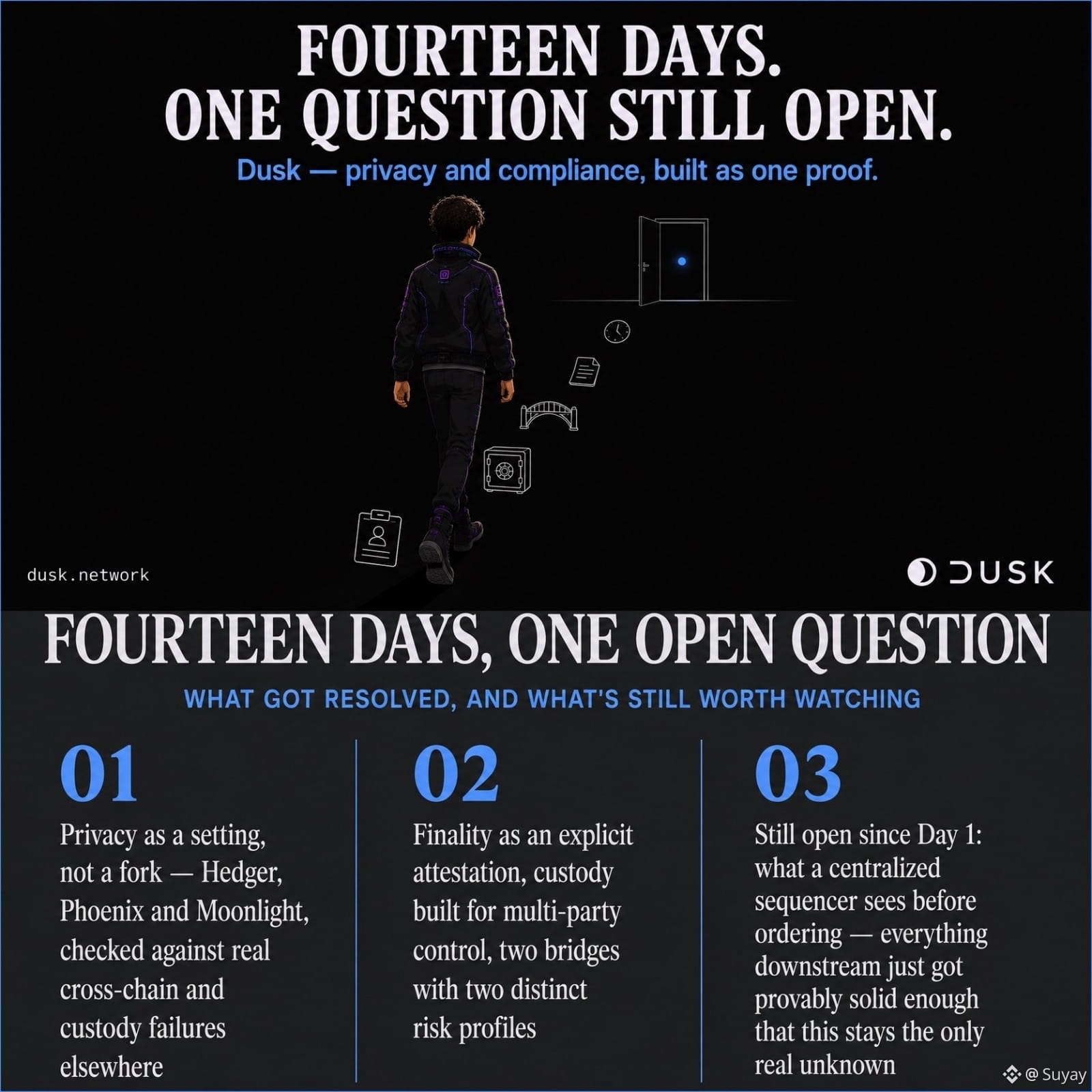
Hedger encrypts DuskEVM transactions end to end, but the open question from Day 1 was what a centralized sequencer sees before ordering anything. That one never got a clean answer, and it shouldn't have. Everything else this campaign covered was really about whether the rest of the system earns trust anyway: Moonlight and Phoenix letting privacy be a setting instead of a fork, Succinct Attestation turning finality into an explicit attestation instead of a waiting game, custody routed through infrastructure built for multi-party control instead of one key, two differently-shaped bridges carrying two different risk profiles depending on which one you're actually using.
None of it erases the sequencer question. What it does is make everything downstream of ordering, settlement, custody, identity, disclosure, provably solid, so the one unresolved piece stays exactly that small instead of hiding inside a bigger pile of unknowns.
I came into this thinking regulated finance onchain meant picking transparency or privacy. What actually changed my mind over these fourteen days is that Dusk keeps treating that as the wrong question, privacy and compliance as one proof, not a tradeoff.
Still watching that sequencer, though. Some questions are supposed to stay open.
#dusk $DUSK @Dusk_Foundation #DuskEVM
Fourteen days ago this started with block 22450093 and two words: the glass ledger problem. I want to close on whether Dusk actually closed that gap, or just moved it.
Hedger encrypts DuskEVM transactions end to end, but the open question from Day 1 was what a centralized sequencer sees before ordering anything. That one never got a clean answer, and it shouldn't have. Everything else this campaign covered was really about whether the rest of the system earns trust anyway: Moonlight and Phoenix letting privacy be a setting instead of a fork, Succinct Attestation turning finality into an explicit attestation instead of a waiting game, custody routed through infrastructure built for multi-party control instead of one key, two differently-shaped bridges carrying two different risk profiles depending on which one you're actually using.
None of it erases the sequencer question. What it does is make everything downstream of ordering, settlement, custody, identity, disclosure, provably solid, so the one unresolved piece stays exactly that small instead of hiding inside a bigger pile of unknowns.
I came into this thinking regulated finance onchain meant picking transparency or privacy. What actually changed my mind over these fourteen days is that Dusk keeps treating that as the wrong question, privacy and compliance as one proof, not a tradeoff.
Still watching that sequencer, though. Some questions are supposed to stay open.
#dusk $DUSK @Dusk #DuskEVM
Hedger encrypts DuskEVM transactions end to end, but the open question from Day 1 was what a centralized sequencer sees before ordering anything. That one never got a clean answer, and it shouldn't have. Everything else this campaign covered was really about whether the rest of the system earns trust anyway: Moonlight and Phoenix letting privacy be a setting instead of a fork, Succinct Attestation turning finality into an explicit attestation instead of a waiting game, custody routed through infrastructure built for multi-party control instead of one key, two differently-shaped bridges carrying two different risk profiles depending on which one you're actually using.
None of it erases the sequencer question. What it does is make everything downstream of ordering, settlement, custody, identity, disclosure, provably solid, so the one unresolved piece stays exactly that small instead of hiding inside a bigger pile of unknowns.
I came into this thinking regulated finance onchain meant picking transparency or privacy. What actually changed my mind over these fourteen days is that Dusk keeps treating that as the wrong question, privacy and compliance as one proof, not a tradeoff.
Still watching that sequencer, though. Some questions are supposed to stay open.
#dusk $DUSK @Dusk #DuskEVM
13
8
383

·
--
සත්යායනය කළ
Your bank has never seen your balance. it still knows every check you write is good. It looks strange and Sounds impossible!
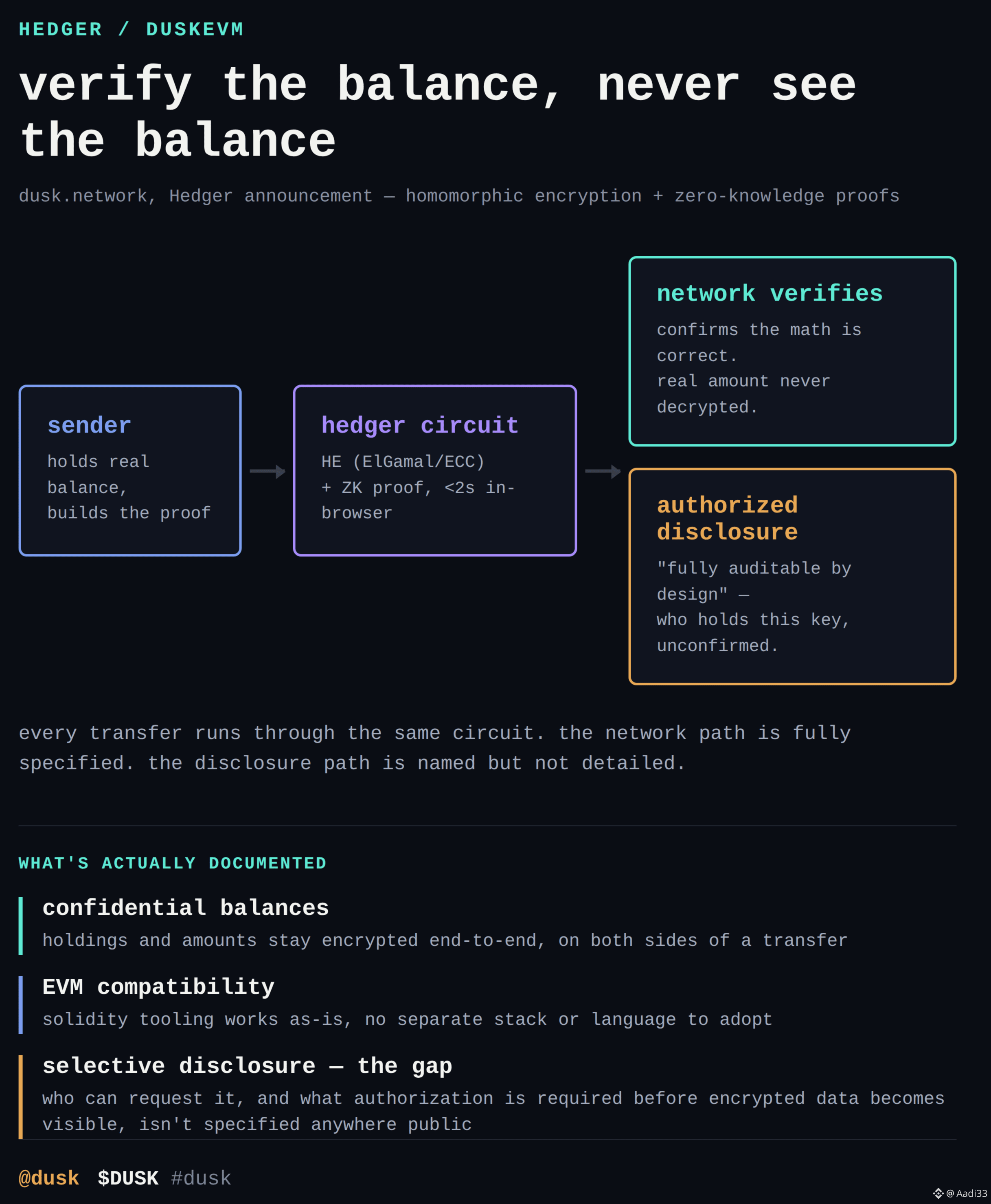
That's basically what @Dusk_Foundation is doing with hedger. it combines homomorphic encryption with zero-knowledge proofs, encrypting holdings and transaction amounts while still letting the network verify everything's correct without exposing the undErlying values and it does it in under two seconds without leaving your browser. because duskevm is EVM-compatible, it works with the solidity tooling developers already know.
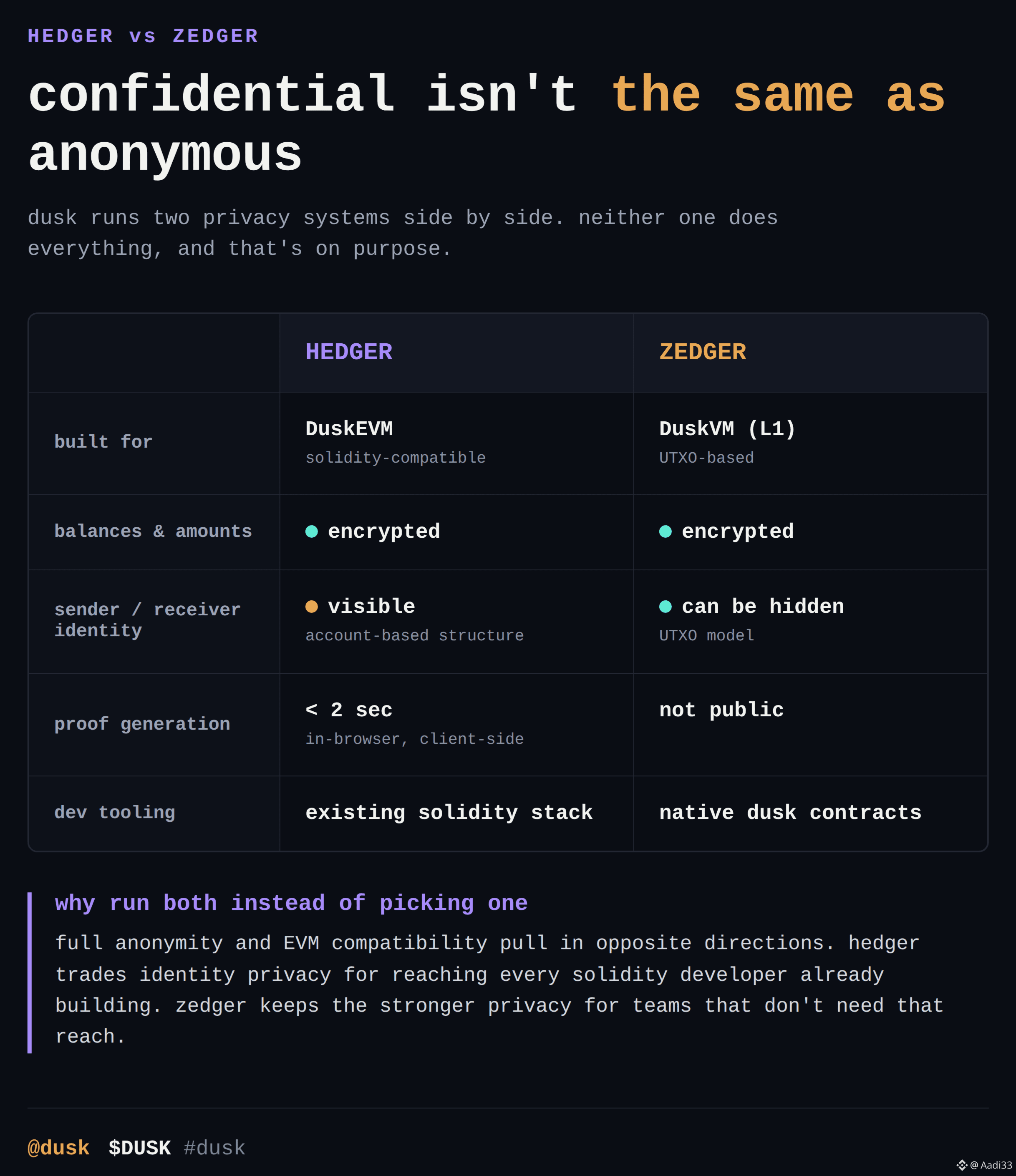
the interesting part is what it doesn't try to do. zedger was built around a UTXO model and can offer stronger anonymity, while hedger is designed for the EVM environment and focuses on confidential transactions and balances rather than full anonymity.
i'm not saying that's a flaw. it's the tradeoff for bringing privacy into an EVM environment instead of asking developers to move to a completely different stack.
dusk also says hedger is fully auditable by design and supports selective disclosure when regulated participants need evidence. what's still worth digging into is how that disclosure actually works, who can request it and what authorization is required bef0re encrypted data becomes visible.
that's where "private but auditable" becomes more than a slogan.
@Dusk_Foundation $DUSK #dusk
#DuskEVM
Your bank has never seen your balance. it still knows every check you write is good. It looks strange and Sounds impossible!
That's basically what @Dusk is doing with hedger. it combines homomorphic encryption with zero-knowledge proofs, encrypting holdings and transaction amounts while still letting the network verify everything's correct without exposing the undErlying values and it does it in under two seconds without leaving your browser. because duskevm is EVM-compatible, it works with the solidity tooling developers already know.
the interesting part is what it doesn't try to do. zedger was built around a UTXO model and can offer stronger anonymity, while hedger is designed for the EVM environment and focuses on confidential transactions and balances rather than full anonymity.
i'm not saying that's a flaw. it's the tradeoff for bringing privacy into an EVM environment instead of asking developers to move to a completely different stack.
dusk also says hedger is fully auditable by design and supports selective disclosure when regulated participants need evidence. what's still worth digging into is how that disclosure actually works, who can request it and what authorization is required bef0re encrypted data becomes visible.
that's where "private but auditable" becomes more than a slogan.
@Dusk $DUSK #dusk
#DuskEVM
That's basically what @Dusk is doing with hedger. it combines homomorphic encryption with zero-knowledge proofs, encrypting holdings and transaction amounts while still letting the network verify everything's correct without exposing the undErlying values and it does it in under two seconds without leaving your browser. because duskevm is EVM-compatible, it works with the solidity tooling developers already know.
the interesting part is what it doesn't try to do. zedger was built around a UTXO model and can offer stronger anonymity, while hedger is designed for the EVM environment and focuses on confidential transactions and balances rather than full anonymity.
i'm not saying that's a flaw. it's the tradeoff for bringing privacy into an EVM environment instead of asking developers to move to a completely different stack.
dusk also says hedger is fully auditable by design and supports selective disclosure when regulated participants need evidence. what's still worth digging into is how that disclosure actually works, who can request it and what authorization is required bef0re encrypted data becomes visible.
that's where "private but auditable" becomes more than a slogan.
@Dusk $DUSK #dusk
#DuskEVM
26
1
17
221

·
--
සත්යායනය කළ
#dusk $DUSK @Dusk_Foundation
🤔Why are so many RWA projects still stuck in theoretical hype while institutional capital waits on the sidelines?
I’ve been looking for projects that can actually bridge traditional finance with #Web3 and @Dusk_Foundation Trade caught my attention.👀
Built as a neobroker on #DuskEVM , it brings MMFs, ETFs, bonds and RWAs on-chain, combining real ownership, instant settlement and DeFi-grade composability within a regulated framework.
This is the kind of infrastructure that could make tokenized finance feel less like a narrative and more like real market infrastructure.
@Dusk_Foundation $DUSK #dusk
📊 Which tokenized asset would you most want to trade on-chain?
#dusk $DUSK @Dusk
🤔Why are so many RWA projects still stuck in theoretical hype while institutional capital waits on the sidelines?
I’ve been looking for projects that can actually bridge traditional finance with #Web3 and @Dusk Trade caught my attention.👀
Built as a neobroker on #DuskEVM , it brings MMFs, ETFs, bonds and RWAs on-chain, combining real ownership, instant settlement and DeFi-grade composability within a regulated framework.
This is the kind of infrastructure that could make tokenized finance feel less like a narrative and more like real market infrastructure.
@Dusk $DUSK #dusk
📊 Which tokenized asset would you most want to trade on-chain?
🤔Why are so many RWA projects still stuck in theoretical hype while institutional capital waits on the sidelines?
I’ve been looking for projects that can actually bridge traditional finance with #Web3 and @Dusk Trade caught my attention.👀
Built as a neobroker on #DuskEVM , it brings MMFs, ETFs, bonds and RWAs on-chain, combining real ownership, instant settlement and DeFi-grade composability within a regulated framework.
This is the kind of infrastructure that could make tokenized finance feel less like a narrative and more like real market infrastructure.
@Dusk $DUSK #dusk
📊 Which tokenized asset would you most want to trade on-chain?
💨MMFs
57%
ETFs & Stock Baskets
0%
👉Bonds & Fixed Income
29%
🤝Traditional RWAs
14%
7 ඡන්ද • ඡන්දය අවසන්
89
2
47
574
අර්ධ වශයෙන් සත්යයි
දින 30 වෙළෙඳ $DUSK 68.2 USDT
I've been running a small position in $DUSK for a few weeks now, mostly watching. Nothing dramatic, picked up a bit more yesterday after I noticed something in the protocol docs that I hadn't seen anyone talking about.
It's about what happens when consensus just... stops working. Not from an attack. Not from a bug. Just from validators going quiet.
Dusk has something called Emergency Mode, and my initial read was that it existed to produce emergency blocks. That's not quite right.
The real point is preserving liveness when stake participation becomes unreliable.
Here's what caught my attention: Dusk doesn't freeze if validators keep missing. Instead, it lets previous consensus iterations stay open while new ones begin simultaneously. Remaining provisioners get more attempts to find agreement rather than hitting a hard wall.
The priority rule matters too. If multiple iterations succeed at once, the protocol always favors the lowest numbered iteration. That's how it resolves the competing block problem without needing manual intervention.
And if even that fails, the Emergency Block Request kicks in.
Once EBRs representing majority stake accumulate, the chain produces an empty block ! no transactions, just continuity and a fresh seed for the next round.
That design choice tells me @Dusk_Foundation isn't building for ideal conditions.
It's building for the moment those conditions break.
What I genuinely don't know yet is how this recovery path holds up if participation stays degraded across multiple consecutive rounds. That's the stress test I'd want to see documented.
#Dusk #EmergencyMode #DuskEVM
{spot}(DUSKUSDT)
What matters most about Dusk's Emergency Mode design?
I've been running a small position in $DUSK for a few weeks now, mostly watching. Nothing dramatic, picked up a bit more yesterday after I noticed something in the protocol docs that I hadn't seen anyone talking about.
It's about what happens when consensus just... stops working. Not from an attack. Not from a bug. Just from validators going quiet.
Dusk has something called Emergency Mode, and my initial read was that it existed to produce emergency blocks. That's not quite right.
The real point is preserving liveness when stake participation becomes unreliable.
Here's what caught my attention: Dusk doesn't freeze if validators keep missing. Instead, it lets previous consensus iterations stay open while new ones begin simultaneously. Remaining provisioners get more attempts to find agreement rather than hitting a hard wall.
The priority rule matters too. If multiple iterations succeed at once, the protocol always favors the lowest numbered iteration. That's how it resolves the competing block problem without needing manual intervention.
And if even that fails, the Emergency Block Request kicks in.
Once EBRs representing majority stake accumulate, the chain produces an empty block ! no transactions, just continuity and a fresh seed for the next round.
That design choice tells me @Dusk isn't building for ideal conditions.
It's building for the moment those conditions break.
What I genuinely don't know yet is how this recovery path holds up if participation stays degraded across multiple consecutive rounds. That's the stress test I'd want to see documented.
#Dusk #EmergencyMode #DuskEVM
What matters most about Dusk's Emergency Mode design?
It's about what happens when consensus just... stops working. Not from an attack. Not from a bug. Just from validators going quiet.
Dusk has something called Emergency Mode, and my initial read was that it existed to produce emergency blocks. That's not quite right.
The real point is preserving liveness when stake participation becomes unreliable.
Here's what caught my attention: Dusk doesn't freeze if validators keep missing. Instead, it lets previous consensus iterations stay open while new ones begin simultaneously. Remaining provisioners get more attempts to find agreement rather than hitting a hard wall.
The priority rule matters too. If multiple iterations succeed at once, the protocol always favors the lowest numbered iteration. That's how it resolves the competing block problem without needing manual intervention.
And if even that fails, the Emergency Block Request kicks in.
Once EBRs representing majority stake accumulate, the chain produces an empty block ! no transactions, just continuity and a fresh seed for the next round.
That design choice tells me @Dusk isn't building for ideal conditions.
It's building for the moment those conditions break.
What I genuinely don't know yet is how this recovery path holds up if participation stays degraded across multiple consecutive rounds. That's the stress test I'd want to see documented.
#Dusk #EmergencyMode #DuskEVM
What matters most about Dusk's Emergency Mode design?
🔗Chain liveness above all
66%
⚖️The iteration priority rule
17%
🧪Still needs a stress test
17%
6 ඡන්ද • ඡන්දය අවසන්
76
37
278

·
--
උසබ තත්ත්වය
සත්යායනය කළ
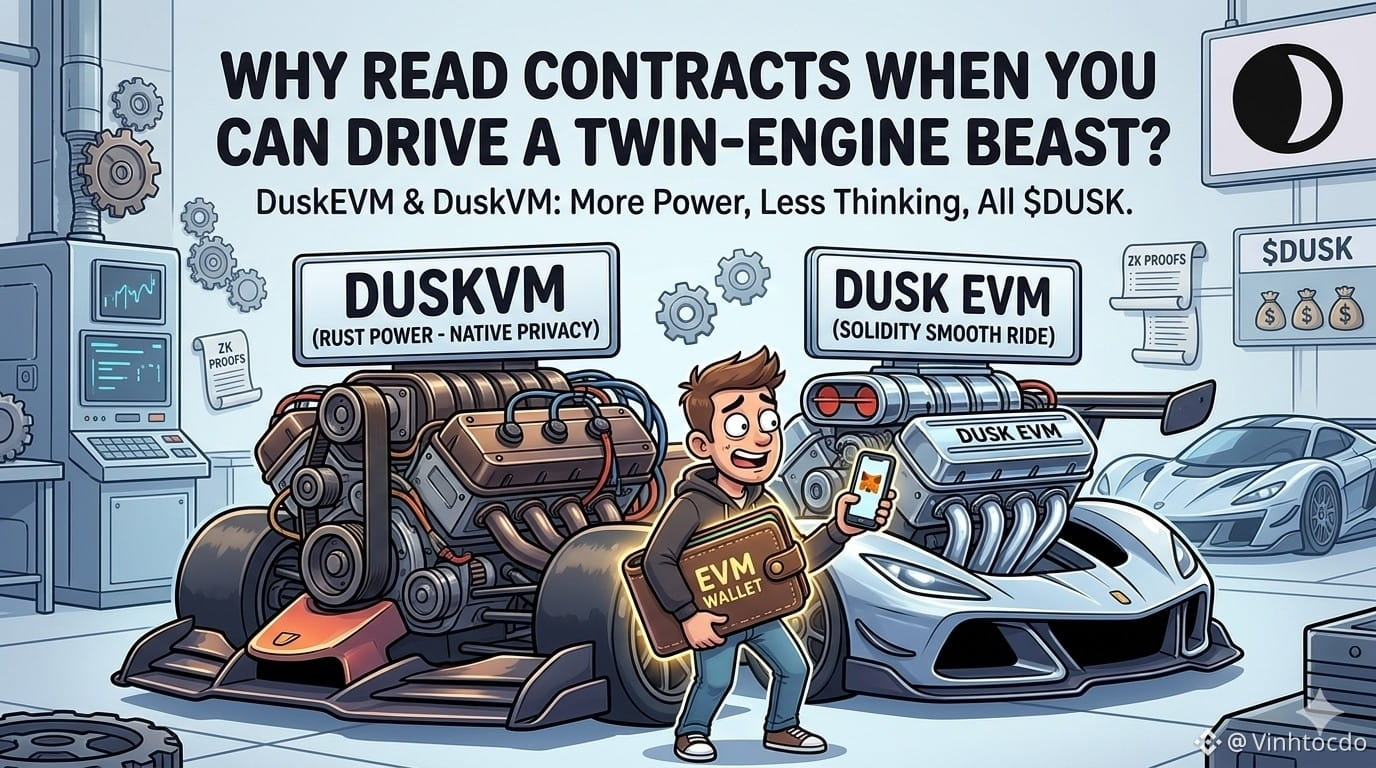
DuskVM and DuskEVM. 2 in 1.
Back at @dusk headquarters, I inspected our tech arsenal and found out we possess a twin-engine beast! 🏎️⚙️
Dusk equips devs with two powerhouses: DuskVM (raw Rust/WASM power for native, deep zero-knowledge privacy) and DuskEVM (the smooth Solidity lane for Ethereum dApps).
I’m just a trader, not a coder, so how do we use it? Easy! We don't read smart contracts. We just interact with DuskEVM dApps on the Testnet via familiar EVM wallets. The benefit? Massive liquidity migration and bulletproof privacy without learning new tech. Just bridge your test tokens, test the private dApps, and stack your $DUSK !
Not financial advice!
#dusk @Dusk_Foundation #DuskEVM #PrivacyTech $TRUMP $ENA
DuskVM and DuskEVM. 2 in 1.
Back at @dusk headquarters, I inspected our tech arsenal and found out we possess a twin-engine beast! 🏎️⚙️
Dusk equips devs with two powerhouses: DuskVM (raw Rust/WASM power for native, deep zero-knowledge privacy) and DuskEVM (the smooth Solidity lane for Ethereum dApps).
I’m just a trader, not a coder, so how do we use it? Easy! We don't read smart contracts. We just interact with DuskEVM dApps on the Testnet via familiar EVM wallets. The benefit? Massive liquidity migration and bulletproof privacy without learning new tech. Just bridge your test tokens, test the private dApps, and stack your $DUSK !
Not financial advice!
#dusk @Dusk #DuskEVM #PrivacyTech $TRUMP $ENA
Back at @dusk headquarters, I inspected our tech arsenal and found out we possess a twin-engine beast! 🏎️⚙️
Dusk equips devs with two powerhouses: DuskVM (raw Rust/WASM power for native, deep zero-knowledge privacy) and DuskEVM (the smooth Solidity lane for Ethereum dApps).
I’m just a trader, not a coder, so how do we use it? Easy! We don't read smart contracts. We just interact with DuskEVM dApps on the Testnet via familiar EVM wallets. The benefit? Massive liquidity migration and bulletproof privacy without learning new tech. Just bridge your test tokens, test the private dApps, and stack your $DUSK !
Not financial advice!
#dusk @Dusk #DuskEVM #PrivacyTech $TRUMP $ENA
27
21
134
·
--
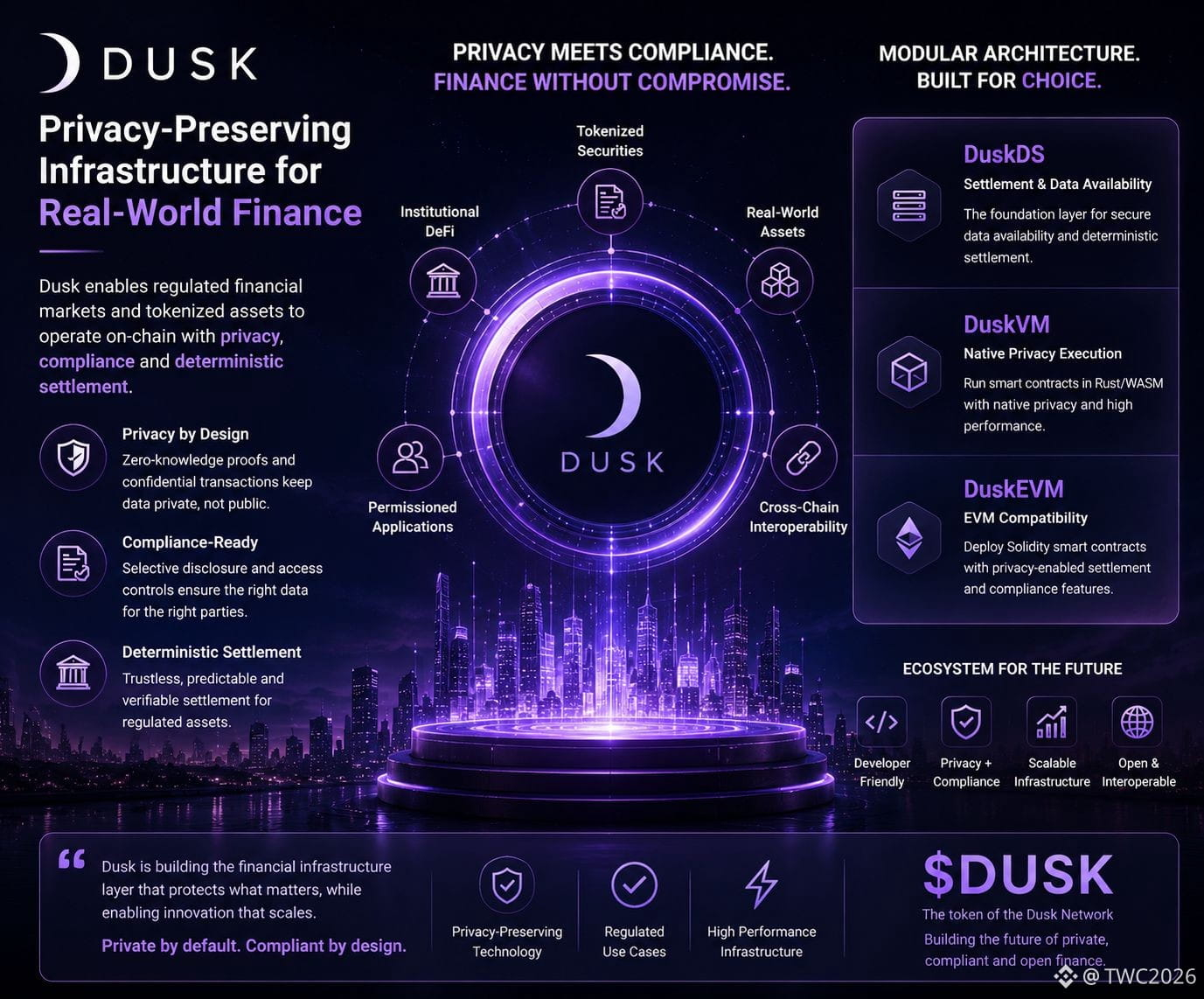
@Dusk_Foundation is building something DeFi and tokenized finance will increasingly need: privacy without losing compliance. Public blockchains are powerful because transactions can be transparent and verifiable, but regulated financial markets cannot expose every balance, position, investor detail, or transaction publicly. @Dusk_Foundation approaches this challenge by combining zero-knowledge technology, confidential transfers, selective disclosure, access controls, and deterministic settlement. �
Dusk +1
What makes this approach interesting is the idea that privacy does not have to mean hiding everything. Authorized participants can receive the information they need, while sensitive data remains protected from unnecessary public exposure. This can be especially relevant for tokenized securities, real-world assets, institutional DeFi, and other financial workflows where eligibility, reporting, transfer restrictions, and settlement rules matter. �
DOCS +1
Dusk also uses a modular architecture, with #DuskDS focused on settlement and data availability, #DuskVM for native Rust/WASM execution, and #DuskEVM for EVM-compatible applications. That gives developers different paths depending on whether an application prioritizes native privacy, familiar EVM tooling, or regulated settlement infrastructure. �
DOCS
For me, the interesting part of Dusk is not simply “privacy.” It is the combination of privacy, compliance and predictable settlement in one financial infrastructure. If more real-world assets and institutional markets move on-chain, these capabilities could become increasingly important. #dusk $DUSK
@Dusk is building something DeFi and tokenized finance will increasingly need: privacy without losing compliance. Public blockchains are powerful because transactions can be transparent and verifiable, but regulated financial markets cannot expose every balance, position, investor detail, or transaction publicly. @Dusk approaches this challenge by combining zero-knowledge technology, confidential transfers, selective disclosure, access controls, and deterministic settlement. �
Dusk +1
What makes this approach interesting is the idea that privacy does not have to mean hiding everything. Authorized participants can receive the information they need, while sensitive data remains protected from unnecessary public exposure. This can be especially relevant for tokenized securities, real-world assets, institutional DeFi, and other financial workflows where eligibility, reporting, transfer restrictions, and settlement rules matter. �
DOCS +1
Dusk also uses a modular architecture, with #DuskDS focused on settlement and data availability, #DuskVM for native Rust/WASM execution, and #DuskEVM for EVM-compatible applications. That gives developers different paths depending on whether an application prioritizes native privacy, familiar EVM tooling, or regulated settlement infrastructure. �
DOCS
For me, the interesting part of Dusk is not simply “privacy.” It is the combination of privacy, compliance and predictable settlement in one financial infrastructure. If more real-world assets and institutional markets move on-chain, these capabilities could become increasingly important. #dusk $DUSK
Dusk +1
What makes this approach interesting is the idea that privacy does not have to mean hiding everything. Authorized participants can receive the information they need, while sensitive data remains protected from unnecessary public exposure. This can be especially relevant for tokenized securities, real-world assets, institutional DeFi, and other financial workflows where eligibility, reporting, transfer restrictions, and settlement rules matter. �
DOCS +1
Dusk also uses a modular architecture, with #DuskDS focused on settlement and data availability, #DuskVM for native Rust/WASM execution, and #DuskEVM for EVM-compatible applications. That gives developers different paths depending on whether an application prioritizes native privacy, familiar EVM tooling, or regulated settlement infrastructure. �
DOCS
For me, the interesting part of Dusk is not simply “privacy.” It is the combination of privacy, compliance and predictable settlement in one financial infrastructure. If more real-world assets and institutional markets move on-chain, these capabilities could become increasingly important. #dusk $DUSK
63
තවත් අන්තර්ගතයන් ගවේෂණය කිරීමට ඇතුල් වන්න
Binance චතුරශ්රය හි ගෝලීය ක්රිප්ටෝ පරිශීලකයින් හා එක්වන්න
⚡️ ක්රිප්ටෝ පිළිබඳ නවතම සහ ප්රයෝජනවත් තොරතුරු ලබා ගන්න.
💬 ලොව විශාලතම ක්රිප්ටෝ හුවමාරුව මගින් විශ්වාස කෙරේ.
👍 සත්යායනය කරන ලද නිර්මාණකරුවන්ගෙන් සැබෑ විදසුන් සොයා ගන්න.
විද්යුත් තැපෑල / දුරකථන අංකය
නැගී එන මාතෘකා
1
#UKFCAWinsCourtOrderToRecover851400Pounds
28,138 views
733 සාකච්ඡා කරමින්
2
#ChainlinkLaunchesCCIP2WithEnterpriseVerification
42,487 views
914 සාකච්ඡා කරමින්
3
#GoldFallsTo$4144
14,949 views
156 සාකච්ඡා කරමින්
4
#QNTFallsOver40%FromMorningHigh
87,596 views
1,332 සාකච්ඡා කරමින්
5
#USDTAdds845900HoldersInPast7Days
16,946 views
402 සාකච්ඡා කරමින්
6
#KospiFalls2.7%SamsungSKHynixDropOver5%
28,942 views
580 සාකච්ඡා කරමින්
7
#BitgetCEOConfirms$388MStolenInHack
5,304 views
42 සාකච්ඡා කරමින්
8
#BTCFallsBelow$83000
31,914 views
167 සාකච්ඡා කරමින්
9
#BitgetDetailsSecurityIncidentTimeline
49,209 views
734 සාකච්ඡා කරමින්
10
#BitcoinSpotETFs$2.39BWeeklyNetInflow
15,071 views
49 සාකච්ඡා කරමින්