

#starknet
starknet
747,293 views
1,445 සාකච්ඡා කරමින්
උණුසුම්
නවතම

·
--
ලිපිය
Starknet's 47% Rally Is Real. The Next 7 Days Will Decide If It Holds.Starknet caught fire last week. STRK climbed roughly 47% in seven days, from around $0.035 to a high near $0.0607, its strongest level since May. Volume exploded to more than seven times the 30-day average on October 3, and the token clawed its way back into the top 100 by market cap. For a Layer 2 that had spent months bleeding against its launch highs, the move felt sudden.
It was not random.
Three catalysts landed inside a 72-hour window. On October 2, Starknet announced it would cover bridging fees for the first 100 Bitcoin moved onto the network through strkBTC, a Bitcoin-backed asset designed for Starknet's DeFi ecosystem. A weekly faucet distributing roughly $833 per week to up to 100 users was part of the same push. The message was clear: bring Bitcoin liquidity onto Starknet, and the network will make it cheap to try. Two days later, on October 5, Starknet deployed its v0.14.4 mainnet upgrade, expanding single-proof transaction limits to 1.1 billion Layer 2 gas. That upgrade does not cut user fees in any meaningful way, but it gives developers room to build heavier applications and privacy-focused smart contracts. Then the weekly revenue figure crossed $50,000 for the first time, a small number in absolute terms but a directionally important one for a network still searching for real fee demand.
That is the fundamental story. Now look at the chart.
STRK is trading near $0.0576, up about 8.7% over the last 24 hours. Daily volume sits near $155 million, and the market cap is around $428 million. The breakout came after more than a week of consolidation between $0.041 and $0.044, a tight range that finally cracked on October 3. Since then, the token has gained roughly 48% over seven days and nearly doubled over the past month. It remains about 62% below its level from a year ago, which tells you how much ground there is to recover.
The technical picture is bullish on momentum but stretched on timing. The 14-day Relative Strength Index hit 74.60 after the seven-day run, comfortably above the 70 threshold that traders use to flag overbought conditions. That reading does not mean the rally is finished. It means short-term momentum has expanded quickly, and pullbacks become more likely when spot volume stops expanding. The MACD on the daily chart is still supportive, with the line above its signal and a positive histogram. The weekly RSI has turned higher after months of bullish divergence. Those are constructive signals, but they describe what already happened.
What matters now are two price levels. On the upside, $0.065 is the May high and the next real resistance. A decisive close above that zone would mark Starknet's highest level since February and confirm the breakout as more than a short squeeze. On the downside, $0.05 is the first support. It was the level that capped price action before the breakout, and holding it now would validate the move as a genuine trend shift rather than a liquidity grab. Below $0.05, the $0.041 consolidation zone comes back into play.
Then there is the supply question.
On October 15, roughly 127 million STRK tokens unlock for early contributors and investors, worth about $7.4 million at current prices. Unlocks are not automatic sells. Recipients can hold, stake, or sell in pieces. But the timing matters because the rally depends on fresh demand absorbing that supply. Starknet's maximum supply is uncapped, which means the circulating count will keep growing for years. For the price to hold its gains, network usage and strkBTC adoption need to grow faster than the token supply does. That is the real test, not the unlock date itself.
Bulls have a clear job over the next week. Defend $0.05 on any pullback. Push through $0.065 with volume that confirms genuine buying rather than a thin breakout. Show that strkBTC incentives are pulling Bitcoin onto the network in measurable amounts, not just generating headlines. The weekly revenue crossing $50,000 is a start. The next data points will tell whether it accelerates or stalls.
If $0.05 breaks with volume, the setup weakens quickly. The $0.041 zone would become the next logical area to watch, and the overbought RSI would have room to reset. That does not invalidate Starknet's BTCFi thesis. It simply means the market got ahead of the fundamentals, and the correction would be the price of that impatience.
The interesting thing about this rally is what it is not. It is not a memecoin pump. It is not a vague roadmap promise. It is a Layer 2 with a declining price, a shrinking narrative, and a sudden shift toward Bitcoin liquidity and privacy infrastructure that actually connects to the token's demand model. That does not guarantee success. Starknet still competes with dozens of other L2s for users, and Bitcoin capital is notoriously slow to move. But the market is finally paying attention for a reason that goes beyond a green candle.
The next seven days will show whether that attention has staying power or whether it was just a well-timed incentive and a crowded short.
$STRK
{future}(STRKUSDT)
#STARKNET #BTCFi #CryptoAnalysis #TokenUnlock
Starknet's 47% Rally Is Real. The Next 7 Days Will Decide If It Holds.
Starknet caught fire last week. STRK climbed roughly 47% in seven days, from around $0.035 to a high near $0.0607, its strongest level since May. Volume exploded to more than seven times the 30-day average on October 3, and the token clawed its way back into the top 100 by market cap. For a Layer 2 that had spent months bleeding against its launch highs, the move felt sudden.
It was not random.
Three catalysts landed inside a 72-hour window. On October 2, Starknet announced it would cover bridging fees for the first 100 Bitcoin moved onto the network through strkBTC, a Bitcoin-backed asset designed for Starknet's DeFi ecosystem. A weekly faucet distributing roughly $833 per week to up to 100 users was part of the same push. The message was clear: bring Bitcoin liquidity onto Starknet, and the network will make it cheap to try. Two days later, on October 5, Starknet deployed its v0.14.4 mainnet upgrade, expanding single-proof transaction limits to 1.1 billion Layer 2 gas. That upgrade does not cut user fees in any meaningful way, but it gives developers room to build heavier applications and privacy-focused smart contracts. Then the weekly revenue figure crossed $50,000 for the first time, a small number in absolute terms but a directionally important one for a network still searching for real fee demand.
That is the fundamental story. Now look at the chart.
STRK is trading near $0.0576, up about 8.7% over the last 24 hours. Daily volume sits near $155 million, and the market cap is around $428 million. The breakout came after more than a week of consolidation between $0.041 and $0.044, a tight range that finally cracked on October 3. Since then, the token has gained roughly 48% over seven days and nearly doubled over the past month. It remains about 62% below its level from a year ago, which tells you how much ground there is to recover.
The technical picture is bullish on momentum but stretched on timing. The 14-day Relative Strength Index hit 74.60 after the seven-day run, comfortably above the 70 threshold that traders use to flag overbought conditions. That reading does not mean the rally is finished. It means short-term momentum has expanded quickly, and pullbacks become more likely when spot volume stops expanding. The MACD on the daily chart is still supportive, with the line above its signal and a positive histogram. The weekly RSI has turned higher after months of bullish divergence. Those are constructive signals, but they describe what already happened.
What matters now are two price levels. On the upside, $0.065 is the May high and the next real resistance. A decisive close above that zone would mark Starknet's highest level since February and confirm the breakout as more than a short squeeze. On the downside, $0.05 is the first support. It was the level that capped price action before the breakout, and holding it now would validate the move as a genuine trend shift rather than a liquidity grab. Below $0.05, the $0.041 consolidation zone comes back into play.
Then there is the supply question.
On October 15, roughly 127 million STRK tokens unlock for early contributors and investors, worth about $7.4 million at current prices. Unlocks are not automatic sells. Recipients can hold, stake, or sell in pieces. But the timing matters because the rally depends on fresh demand absorbing that supply. Starknet's maximum supply is uncapped, which means the circulating count will keep growing for years. For the price to hold its gains, network usage and strkBTC adoption need to grow faster than the token supply does. That is the real test, not the unlock date itself.
Bulls have a clear job over the next week. Defend $0.05 on any pullback. Push through $0.065 with volume that confirms genuine buying rather than a thin breakout. Show that strkBTC incentives are pulling Bitcoin onto the network in measurable amounts, not just generating headlines. The weekly revenue crossing $50,000 is a start. The next data points will tell whether it accelerates or stalls.
If $0.05 breaks with volume, the setup weakens quickly. The $0.041 zone would become the next logical area to watch, and the overbought RSI would have room to reset. That does not invalidate Starknet's BTCFi thesis. It simply means the market got ahead of the fundamentals, and the correction would be the price of that impatience.
The interesting thing about this rally is what it is not. It is not a memecoin pump. It is not a vague roadmap promise. It is a Layer 2 with a declining price, a shrinking narrative, and a sudden shift toward Bitcoin liquidity and privacy infrastructure that actually connects to the token's demand model. That does not guarantee success. Starknet still competes with dozens of other L2s for users, and Bitcoin capital is notoriously slow to move. But the market is finally paying attention for a reason that goes beyond a green candle.
The next seven days will show whether that attention has staying power or whether it was just a well-timed incentive and a crowded short.
$STRK
#STARKNET #BTCFi #CryptoAnalysis #TokenUnlock
It was not random.
Three catalysts landed inside a 72-hour window. On October 2, Starknet announced it would cover bridging fees for the first 100 Bitcoin moved onto the network through strkBTC, a Bitcoin-backed asset designed for Starknet's DeFi ecosystem. A weekly faucet distributing roughly $833 per week to up to 100 users was part of the same push. The message was clear: bring Bitcoin liquidity onto Starknet, and the network will make it cheap to try. Two days later, on October 5, Starknet deployed its v0.14.4 mainnet upgrade, expanding single-proof transaction limits to 1.1 billion Layer 2 gas. That upgrade does not cut user fees in any meaningful way, but it gives developers room to build heavier applications and privacy-focused smart contracts. Then the weekly revenue figure crossed $50,000 for the first time, a small number in absolute terms but a directionally important one for a network still searching for real fee demand.
That is the fundamental story. Now look at the chart.
STRK is trading near $0.0576, up about 8.7% over the last 24 hours. Daily volume sits near $155 million, and the market cap is around $428 million. The breakout came after more than a week of consolidation between $0.041 and $0.044, a tight range that finally cracked on October 3. Since then, the token has gained roughly 48% over seven days and nearly doubled over the past month. It remains about 62% below its level from a year ago, which tells you how much ground there is to recover.
The technical picture is bullish on momentum but stretched on timing. The 14-day Relative Strength Index hit 74.60 after the seven-day run, comfortably above the 70 threshold that traders use to flag overbought conditions. That reading does not mean the rally is finished. It means short-term momentum has expanded quickly, and pullbacks become more likely when spot volume stops expanding. The MACD on the daily chart is still supportive, with the line above its signal and a positive histogram. The weekly RSI has turned higher after months of bullish divergence. Those are constructive signals, but they describe what already happened.
What matters now are two price levels. On the upside, $0.065 is the May high and the next real resistance. A decisive close above that zone would mark Starknet's highest level since February and confirm the breakout as more than a short squeeze. On the downside, $0.05 is the first support. It was the level that capped price action before the breakout, and holding it now would validate the move as a genuine trend shift rather than a liquidity grab. Below $0.05, the $0.041 consolidation zone comes back into play.
Then there is the supply question.
On October 15, roughly 127 million STRK tokens unlock for early contributors and investors, worth about $7.4 million at current prices. Unlocks are not automatic sells. Recipients can hold, stake, or sell in pieces. But the timing matters because the rally depends on fresh demand absorbing that supply. Starknet's maximum supply is uncapped, which means the circulating count will keep growing for years. For the price to hold its gains, network usage and strkBTC adoption need to grow faster than the token supply does. That is the real test, not the unlock date itself.
Bulls have a clear job over the next week. Defend $0.05 on any pullback. Push through $0.065 with volume that confirms genuine buying rather than a thin breakout. Show that strkBTC incentives are pulling Bitcoin onto the network in measurable amounts, not just generating headlines. The weekly revenue crossing $50,000 is a start. The next data points will tell whether it accelerates or stalls.
If $0.05 breaks with volume, the setup weakens quickly. The $0.041 zone would become the next logical area to watch, and the overbought RSI would have room to reset. That does not invalidate Starknet's BTCFi thesis. It simply means the market got ahead of the fundamentals, and the correction would be the price of that impatience.
The interesting thing about this rally is what it is not. It is not a memecoin pump. It is not a vague roadmap promise. It is a Layer 2 with a declining price, a shrinking narrative, and a sudden shift toward Bitcoin liquidity and privacy infrastructure that actually connects to the token's demand model. That does not guarantee success. Starknet still competes with dozens of other L2s for users, and Bitcoin capital is notoriously slow to move. But the market is finally paying attention for a reason that goes beyond a green candle.
The next seven days will show whether that attention has staying power or whether it was just a well-timed incentive and a crowded short.
$STRK
#STARKNET #BTCFi #CryptoAnalysis #TokenUnlock
7

·
--
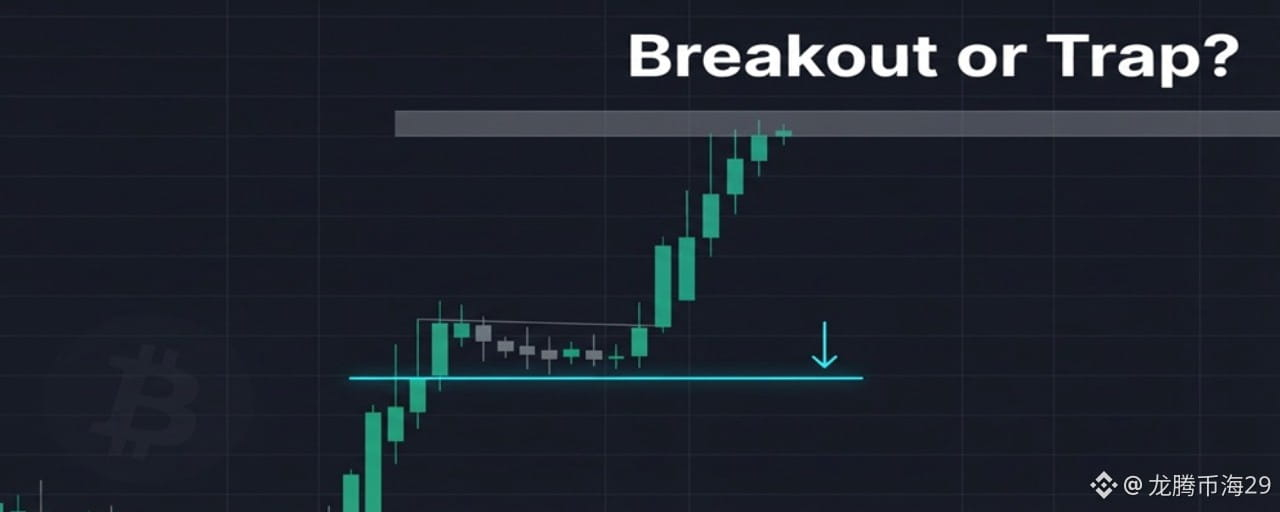
The upgrade went live. So why is STRK still struggling?
Starknet v0.14.4 is now live on mainnet. It adds support for proving block sized transactions, with up to 1.1B L2 gas in a proof.
That is a real technical upgrade.
But the market reaction is more interesting.
STRK is around 0.05 now, after reaching roughly 0.0609 during the recent surge. Today’s Binance-linked data shows a range around 0.0456–0.0523.
📊 STRK MAP
🟢 0.0456 current-day low
🟡 0.0500–0.0520 decision zone
🔴 0.0609 recent breakout high
The bullish thesis:
Starknet is expanding beyond the “Ethereum ZK L2” narrative, with Bitcoin integration and higher capacity proving adding potential utility.
But there is a problem.
A better network does not automatically mean higher token demand.
And the next supply test is already visible: about 127M STRK is scheduled for release on October 15.
So STRK now has two things to prove:
Can the upgrade create real usage?
And can that demand absorb new supply?
If 0.0456 holds, buyers still have a structure to defend.
If 0.0609 returns, the market is showing that fundamentals are catching up with price.
Which matters more for STRK from here: stronger technology or stronger token demand? 👀
$STRK
{future}(STRKUSDT)
#strk #STARKNET t #crypto
The upgrade went live. So why is STRK still struggling?
Starknet v0.14.4 is now live on mainnet. It adds support for proving block sized transactions, with up to 1.1B L2 gas in a proof.
That is a real technical upgrade.
But the market reaction is more interesting.
STRK is around 0.05 now, after reaching roughly 0.0609 during the recent surge. Today’s Binance-linked data shows a range around 0.0456–0.0523.
📊 STRK MAP
🟢 0.0456 current-day low
🟡 0.0500–0.0520 decision zone
🔴 0.0609 recent breakout high
The bullish thesis:
Starknet is expanding beyond the “Ethereum ZK L2” narrative, with Bitcoin integration and higher capacity proving adding potential utility.
But there is a problem.
A better network does not automatically mean higher token demand.
And the next supply test is already visible: about 127M STRK is scheduled for release on October 15.
So STRK now has two things to prove:
Can the upgrade create real usage?
And can that demand absorb new supply?
If 0.0456 holds, buyers still have a structure to defend.
If 0.0609 returns, the market is showing that fundamentals are catching up with price.
Which matters more for STRK from here: stronger technology or stronger token demand? 👀
$STRK
#strk #STARKNET t #crypto
Starknet v0.14.4 is now live on mainnet. It adds support for proving block sized transactions, with up to 1.1B L2 gas in a proof.
That is a real technical upgrade.
But the market reaction is more interesting.
STRK is around 0.05 now, after reaching roughly 0.0609 during the recent surge. Today’s Binance-linked data shows a range around 0.0456–0.0523.
📊 STRK MAP
🟢 0.0456 current-day low
🟡 0.0500–0.0520 decision zone
🔴 0.0609 recent breakout high
The bullish thesis:
Starknet is expanding beyond the “Ethereum ZK L2” narrative, with Bitcoin integration and higher capacity proving adding potential utility.
But there is a problem.
A better network does not automatically mean higher token demand.
And the next supply test is already visible: about 127M STRK is scheduled for release on October 15.
So STRK now has two things to prove:
Can the upgrade create real usage?
And can that demand absorb new supply?
If 0.0456 holds, buyers still have a structure to defend.
If 0.0609 returns, the market is showing that fundamentals are catching up with price.
Which matters more for STRK from here: stronger technology or stronger token demand? 👀
$STRK
#strk #STARKNET t #crypto

1
226

·
--
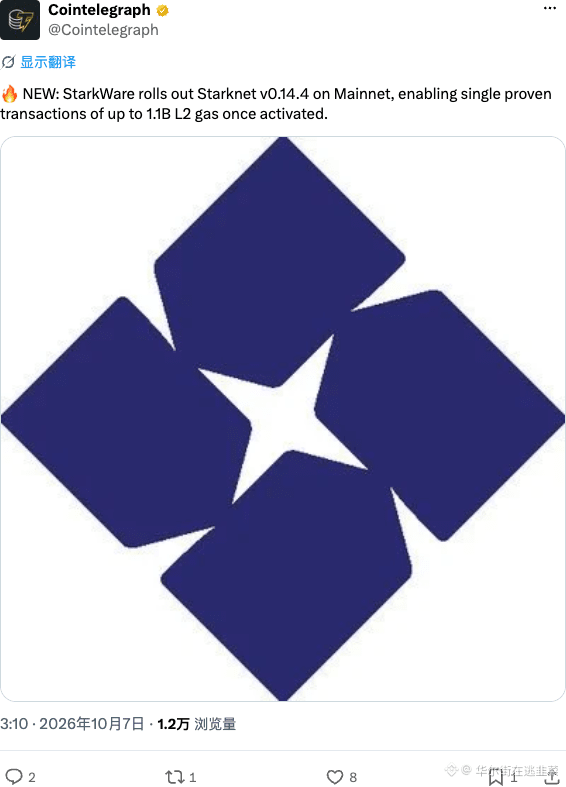
主网都上1.1B gas的单笔证明交易了,Starknet这波扩容是真刀真枪。
v0.14.4激活后,单块处理能力直接拉到新量级,复杂合约、链上游戏这些重计算场景终于不用被gas卡脖子。之前总说ZK-R扩容是期货,现在期货在交割。
不过提醒一句:能力上线≠需求爆发,生态活跃度才是估值锚。技术上STARK确实领先,就看应用端接不接得住。
$STRK #Starknet
主网都上1.1B gas的单笔证明交易了,Starknet这波扩容是真刀真枪。
v0.14.4激活后,单块处理能力直接拉到新量级,复杂合约、链上游戏这些重计算场景终于不用被gas卡脖子。之前总说ZK-R扩容是期货,现在期货在交割。
不过提醒一句:能力上线≠需求爆发,生态活跃度才是估值锚。技术上STARK确实领先,就看应用端接不接得住。
$STRK #Starknet
v0.14.4激活后,单块处理能力直接拉到新量级,复杂合约、链上游戏这些重计算场景终于不用被gas卡脖子。之前总说ZK-R扩容是期货,现在期货在交割。
不过提醒一句:能力上线≠需求爆发,生态活跃度才是估值锚。技术上STARK确实领先,就看应用端接不接得住。
$STRK #Starknet
221
·
--
සත්යායනය කළ
STRK回调超11%,解锁压力提前释放过去24小时(截至北京时间10月6日约8:50),$STRK 报约0.0526美元,跌约11.5%,币安现货成交额约1210万美元,是今天跌幅居前的主流币之一。
Starknet是以太坊上基于零知识证明的二层网络。10月初,STRK曾走出一波较强的反弹,背后是10月5日的v0.14.4网络升级,以及strkBTC相关激励活动带来的热度。但涨上去之后,问题很快出现:技术指标进入超买区,获利盘开始兑现;同时,10月15日将有约1.27亿枚STRK解锁,市场担心新增供给形成抛压,部分资金选择提前离场。
为什么值得关注?这是一个典型的“升级利好已兑现、解锁利空在前方”的组合。对代币解锁周期规律明显的项目,解锁前一两周常常是压力最大的时段。
后续可以观察解锁前后的链上转账动向,尤其是大额地址是否向交易所转入;以及strkBTC等生态激励能否带来持续的真实使用量。短线抄底需要等待企稳信号。
以上内容仅供参考,不构成投资建议。
#STRK #Starknet #热门币
STRK回调超11%,解锁压力提前释放
过去24小时(截至北京时间10月6日约8:50),$STRK 报约0.0526美元,跌约11.5%,币安现货成交额约1210万美元,是今天跌幅居前的主流币之一。
Starknet是以太坊上基于零知识证明的二层网络。10月初,STRK曾走出一波较强的反弹,背后是10月5日的v0.14.4网络升级,以及strkBTC相关激励活动带来的热度。但涨上去之后,问题很快出现:技术指标进入超买区,获利盘开始兑现;同时,10月15日将有约1.27亿枚STRK解锁,市场担心新增供给形成抛压,部分资金选择提前离场。
为什么值得关注?这是一个典型的“升级利好已兑现、解锁利空在前方”的组合。对代币解锁周期规律明显的项目,解锁前一两周常常是压力最大的时段。
后续可以观察解锁前后的链上转账动向,尤其是大额地址是否向交易所转入;以及strkBTC等生态激励能否带来持续的真实使用量。短线抄底需要等待企稳信号。
以上内容仅供参考,不构成投资建议。
#STRK #Starknet #热门币
Starknet是以太坊上基于零知识证明的二层网络。10月初,STRK曾走出一波较强的反弹,背后是10月5日的v0.14.4网络升级,以及strkBTC相关激励活动带来的热度。但涨上去之后,问题很快出现:技术指标进入超买区,获利盘开始兑现;同时,10月15日将有约1.27亿枚STRK解锁,市场担心新增供给形成抛压,部分资金选择提前离场。
为什么值得关注?这是一个典型的“升级利好已兑现、解锁利空在前方”的组合。对代币解锁周期规律明显的项目,解锁前一两周常常是压力最大的时段。
后续可以观察解锁前后的链上转账动向,尤其是大额地址是否向交易所转入;以及strkBTC等生态激励能否带来持续的真实使用量。短线抄底需要等待企稳信号。
以上内容仅供参考,不构成投资建议。
#STRK #Starknet #热门币
237


·
--
බෙයාරිෂ්
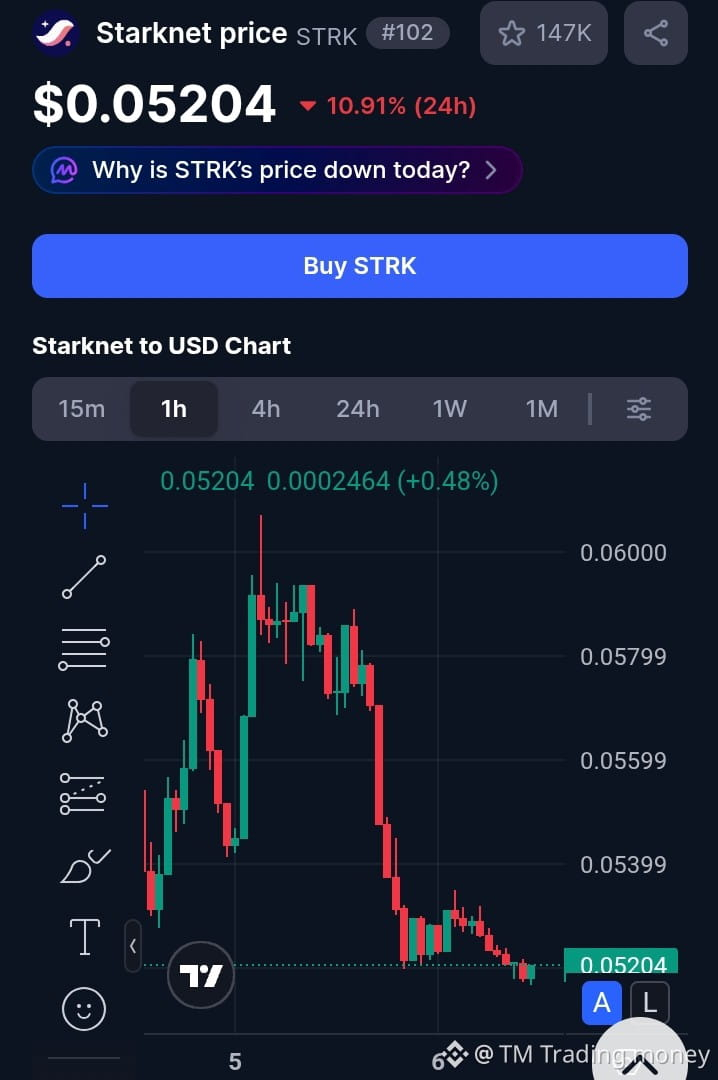
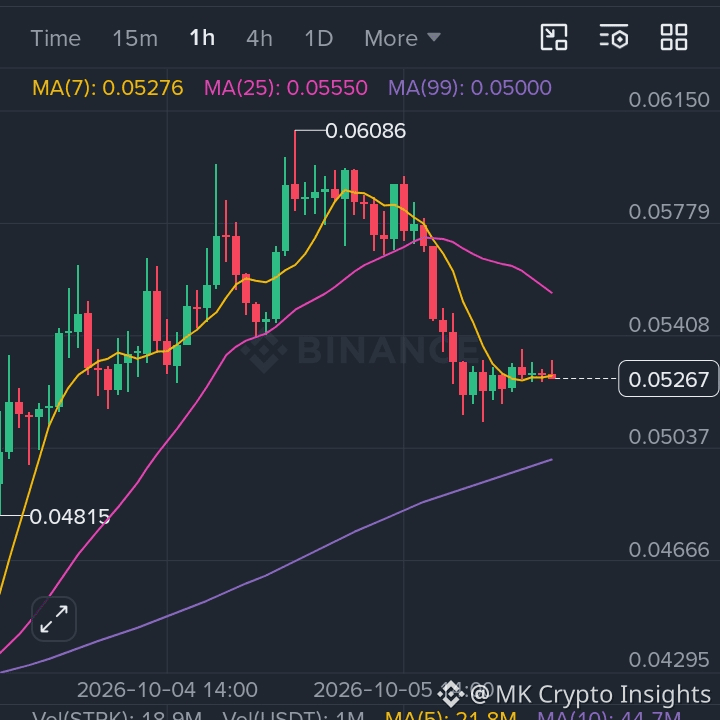
$STRK is down 11% today 📉 It slid from **0.0609** and is now moving sideways around **0.0527**, with volume drying up.
{future}(STRKUSDT)
It's below the MA25 (0.0555) but still above the MA99 (0.0500), so it's stuck in the middle: a pause after the drop, not a reversal yet.
**My read: neutral to bearish** until it reclaims **0.0555**. Lose **0.0512** and the MA99 near **0.0500** becomes the next big test. 👀
#strkusdt #Starknet #cryptouniverseofficial
$STRK is down 11% today 📉 It slid from **0.0609** and is now moving sideways around **0.0527**, with volume drying up.
It's below the MA25 (0.0555) but still above the MA99 (0.0500), so it's stuck in the middle: a pause after the drop, not a reversal yet.
**My read: neutral to bearish** until it reclaims **0.0555**. Lose **0.0512** and the MA99 near **0.0500** becomes the next big test. 👀
#strkusdt #Starknet #cryptouniverseofficial
It's below the MA25 (0.0555) but still above the MA99 (0.0500), so it's stuck in the middle: a pause after the drop, not a reversal yet.
**My read: neutral to bearish** until it reclaims **0.0555**. Lose **0.0512** and the MA99 near **0.0500** becomes the next big test. 👀
#strkusdt #Starknet #cryptouniverseofficial
163


·
--
CryptoJobs3
·
--
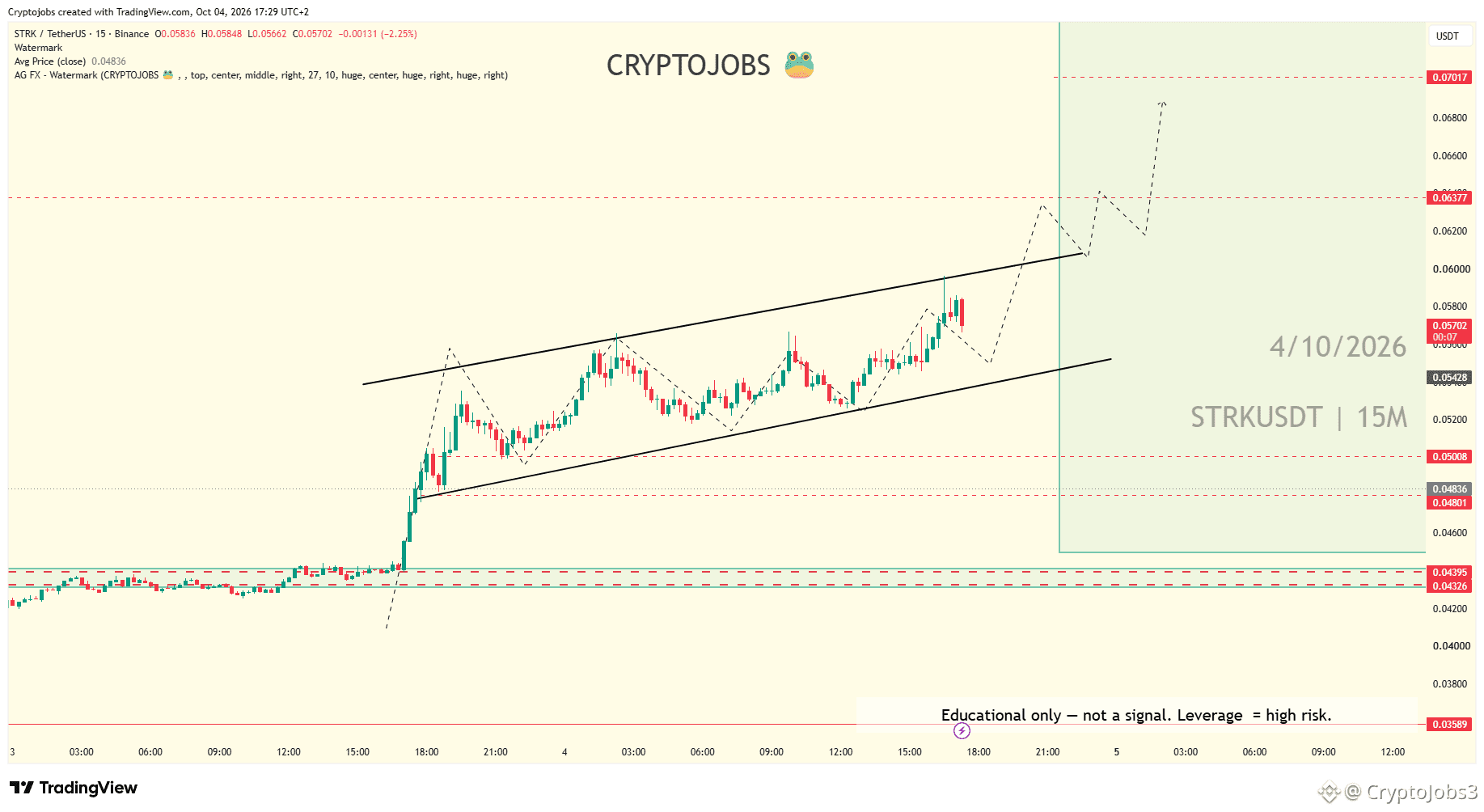
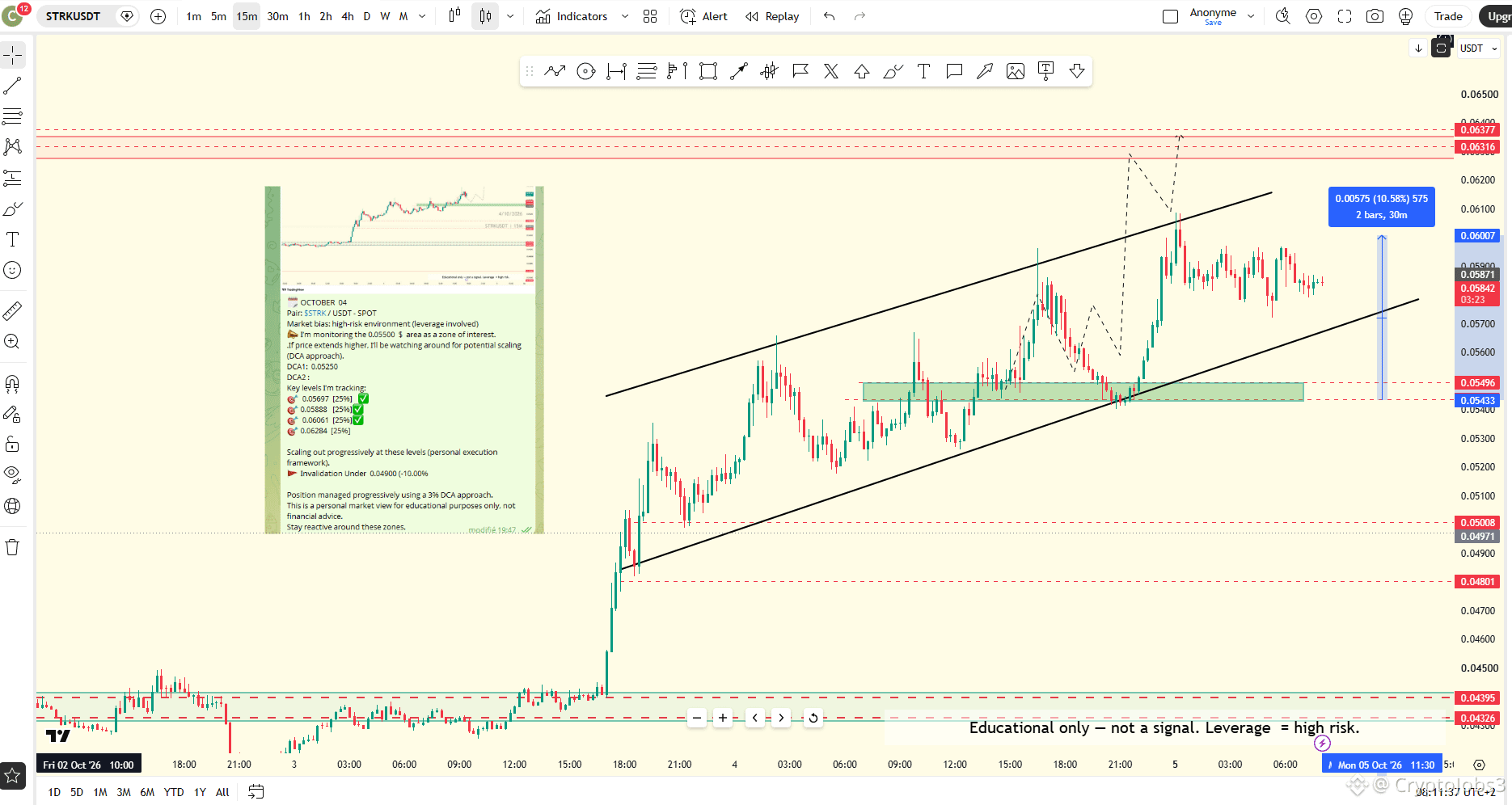
Weekly correction is in on $STRK and resistances won't hold
Upper weekly level I see: 0.07800 - 0.0800 🎯
Bulls should remain in control above 0.0480 and 0.04400
NFA
#STRK #altcoins
Upper weekly level I see: 0.07800 - 0.0800 🎯
Bulls should remain in control above 0.0480 and 0.04400
NFA
#STRK #altcoins
1
1.1k

·
--
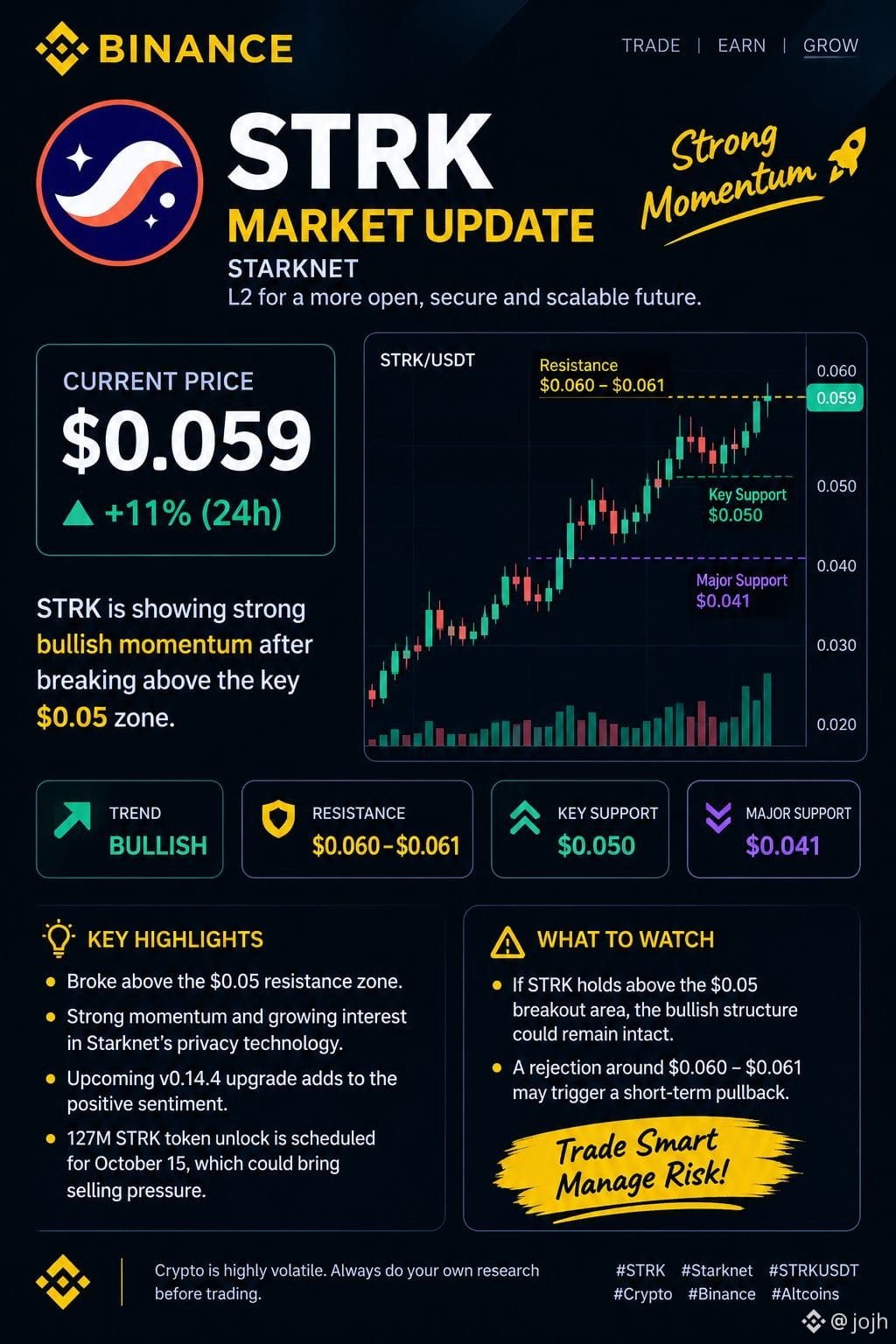
$STRK is showing strong bullish momentum after breaking above the key $0.05 zone.
📈 Current Price: ~$0.059
🔥 Trend: Bullish
🎯 Resistance: $0.060–$0.061
🟢 Key Support: $0.050
🟡 Major Support: $0.041
If $STRK holds above the $0.05 breakout area, the bullish structure could remain intact. A rejection around $0.060–$0.061 may trigger a short-term pullback.
⚠️ Risk Management: Crypto is highly volatile. Always do your own research before trading.
#STRK #Starknet #STRKUSDT #CryptoTrading
{future}(STRKUSDT)
$STRK is showing strong bullish momentum after breaking above the key $0.05 zone.
📈 Current Price: ~$0.059
🔥 Trend: Bullish
🎯 Resistance: $0.060–$0.061
🟢 Key Support: $0.050
🟡 Major Support: $0.041
If $STRK holds above the $0.05 breakout area, the bullish structure could remain intact. A rejection around $0.060–$0.061 may trigger a short-term pullback.
⚠️ Risk Management: Crypto is highly volatile. Always do your own research before trading.
#STRK #Starknet #STRKUSDT #CryptoTrading
📈 Current Price: ~$0.059
🔥 Trend: Bullish
🎯 Resistance: $0.060–$0.061
🟢 Key Support: $0.050
🟡 Major Support: $0.041
If $STRK holds above the $0.05 breakout area, the bullish structure could remain intact. A rejection around $0.060–$0.061 may trigger a short-term pullback.
⚠️ Risk Management: Crypto is highly volatile. Always do your own research before trading.
#STRK #Starknet #STRKUSDT #CryptoTrading
1
224

{spot}(STRKUSDT)
UPDATE: $STRK TP1 HIT! 🚀🔥
Remember my call at $0.05714? TP1 $0.060 DONE! ✅
Entry: $0.054-$0.056 → Now $0.060+ = +7% profit! 💰
Next Targets: $0.070 → $0.080 → $0.10
I moved SL to entry — Risk free now! 🔒
Did you follow? Comment your PNL! 👇
#STRK #Starknet #TradingUpdate
Original call 👉
[https://app.binance.com/uni-qr/cpos/373706727734819?r=KSY8FE0T&l=en&uco=IHFsLnuqhoFyybH1DTXbRg&uc=app_square_share_link&us=copylink](https://app.binance.com/uni-qr/cpos/373706727734819?r=KSY8FE0T&l=en&uco=IHFsLnuqhoFyybH1DTXbRg&uc=app_square_share_link&us=copylink)
UPDATE: $STRK TP1 HIT! 🚀🔥
Remember my call at $0.05714? TP1 $0.060 DONE! ✅
Entry: $0.054-$0.056 → Now $0.060+ = +7% profit! 💰
Next Targets: $0.070 → $0.080 → $0.10
I moved SL to entry — Risk free now! 🔒
Did you follow? Comment your PNL! 👇
#STRK #Starknet #TradingUpdate
Original call 👉
https://app.binance.com/uni-qr/cpos/373706727734819?r=KSY8FE0T&l=en&uco=IHFsLnuqhoFyybH1DTXbRg&uc=app_square_share_link&us=copylink
Remember my call at $0.05714? TP1 $0.060 DONE! ✅
Entry: $0.054-$0.056 → Now $0.060+ = +7% profit! 💰
Next Targets: $0.070 → $0.080 → $0.10
I moved SL to entry — Risk free now! 🔒
Did you follow? Comment your PNL! 👇
#STRK #Starknet #TradingUpdate
Original call 👉
https://app.binance.com/uni-qr/cpos/373706727734819?r=KSY8FE0T&l=en&uco=IHFsLnuqhoFyybH1DTXbRg&uc=app_square_share_link&us=copylink
1
203

·
--
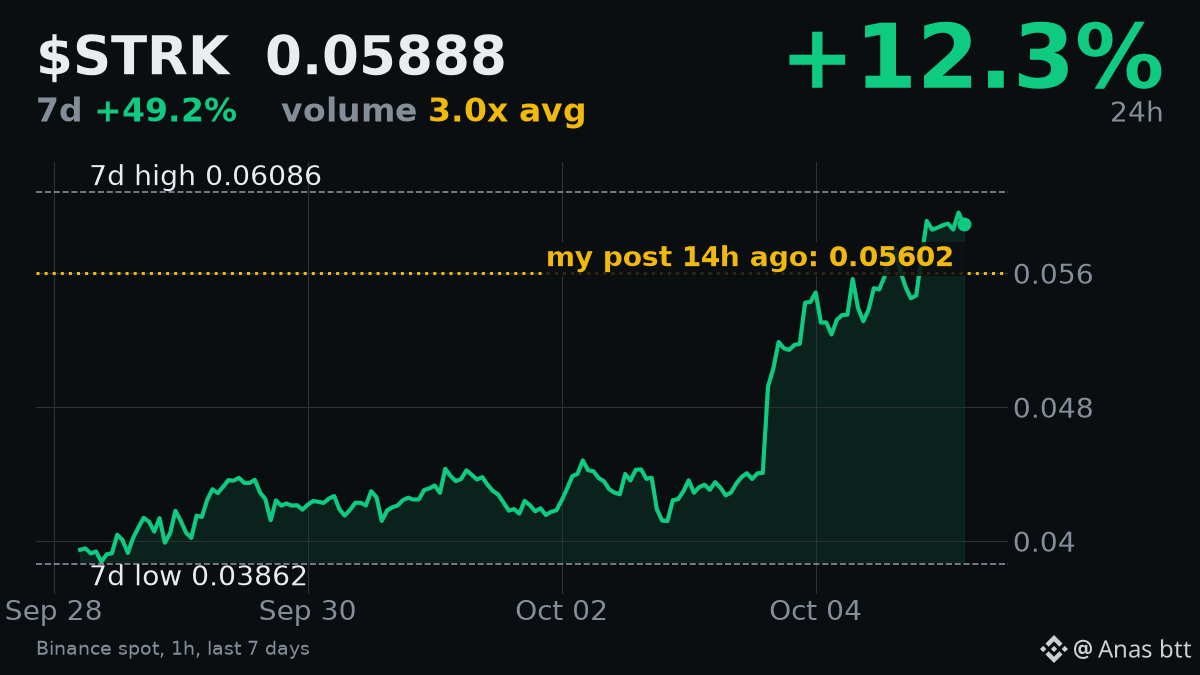
$STRK is now up 49.2% in 7 days, and it is 3.3% from its weekly high. 14 hours ago I said the level to hold was 0.05349. It held.
Then: 0.05602. Now: 0.05888. That is another 5.1% since my last post, and price never needed to test the level I named.
The volume picture changed too. The 24h volume is about 21.9M USDT, lower than the 27.4M I noted last time, but it is still 2.97x its 7-day average. So the move is still drawing far more trading than a normal day, just less than at the peak of the burst.
Hourly RSI is 64.8: strong, not yet stretched. BTC is up 1.45% and Fear & Greed rose to 70 (Greed), so the market is helping, but a 49% week is STRK's own story.
Updated view: the trend is intact. The next test is the 7-day high at 0.06086. A clean move above it on rising volume would be a new leg.
The level that now matters is 0.05602, my last post's price. A fall back under it would mean the follow-through is fading.
#Starknet #WeeklyHigh
$STRK is now up 49.2% in 7 days, and it is 3.3% from its weekly high. 14 hours ago I said the level to hold was 0.05349. It held.
Then: 0.05602. Now: 0.05888. That is another 5.1% since my last post, and price never needed to test the level I named.
The volume picture changed too. The 24h volume is about 21.9M USDT, lower than the 27.4M I noted last time, but it is still 2.97x its 7-day average. So the move is still drawing far more trading than a normal day, just less than at the peak of the burst.
Hourly RSI is 64.8: strong, not yet stretched. BTC is up 1.45% and Fear & Greed rose to 70 (Greed), so the market is helping, but a 49% week is STRK's own story.
Updated view: the trend is intact. The next test is the 7-day high at 0.06086. A clean move above it on rising volume would be a new leg.
The level that now matters is 0.05602, my last post's price. A fall back under it would mean the follow-through is fading.
#Starknet #WeeklyHigh
Then: 0.05602. Now: 0.05888. That is another 5.1% since my last post, and price never needed to test the level I named.
The volume picture changed too. The 24h volume is about 21.9M USDT, lower than the 27.4M I noted last time, but it is still 2.97x its 7-day average. So the move is still drawing far more trading than a normal day, just less than at the peak of the burst.
Hourly RSI is 64.8: strong, not yet stretched. BTC is up 1.45% and Fear & Greed rose to 70 (Greed), so the market is helping, but a 49% week is STRK's own story.
Updated view: the trend is intact. The next test is the 7-day high at 0.06086. A clean move above it on rising volume would be a new leg.
The level that now matters is 0.05602, my last post's price. A fall back under it would mean the follow-through is fading.
#Starknet #WeeklyHigh
1
144

·
--
උසබ තත්ත්වය
🔥 $STRK يخرج من القاع… هل بدأت الانفجـارة؟
عملة Starknet (STRK) تعيش موجة صعود قوية، مع قفزة كبيرة في حجم التداول والزخم خلال الساعات الأخيرة. السعر اخترق 0.05$ ووصل قرب 0.06$، بينما أصبح هذا المستوى اختبارًا حاسمًا لاستمرار الموجة.
📊 فنيًا: الثبات فوق 0.055$ قد يدفع نحو 0.065–0.07$، بينما فقدان 0.048$ قد يعيد السعر للتصحيح.
⚠️ والأخطر: يوجد فتح توكنات قادم في 15 أكتوبر بنحو 127 مليون STRK، لذلك يجب مراقبة ضغط البيع.
🚨 $STRK الآن تحت المجهر… هل نشاهد 0.07$ قريبًا؟ 👀🔥
$STRK
{future}(STRKUSDT)
#STRK #Starknet #Binance #crypto
🔥 $STRK يخرج من القاع… هل بدأت الانفجـارة؟
عملة Starknet (STRK) تعيش موجة صعود قوية، مع قفزة كبيرة في حجم التداول والزخم خلال الساعات الأخيرة. السعر اخترق 0.05$ ووصل قرب 0.06$، بينما أصبح هذا المستوى اختبارًا حاسمًا لاستمرار الموجة.
📊 فنيًا: الثبات فوق 0.055$ قد يدفع نحو 0.065–0.07$، بينما فقدان 0.048$ قد يعيد السعر للتصحيح.
⚠️ والأخطر: يوجد فتح توكنات قادم في 15 أكتوبر بنحو 127 مليون STRK، لذلك يجب مراقبة ضغط البيع.
🚨 $STRK الآن تحت المجهر… هل نشاهد 0.07$ قريبًا؟ 👀🔥
$STRK
#STRK #Starknet #Binance #crypto
عملة Starknet (STRK) تعيش موجة صعود قوية، مع قفزة كبيرة في حجم التداول والزخم خلال الساعات الأخيرة. السعر اخترق 0.05$ ووصل قرب 0.06$، بينما أصبح هذا المستوى اختبارًا حاسمًا لاستمرار الموجة.
📊 فنيًا: الثبات فوق 0.055$ قد يدفع نحو 0.065–0.07$، بينما فقدان 0.048$ قد يعيد السعر للتصحيح.
⚠️ والأخطر: يوجد فتح توكنات قادم في 15 أكتوبر بنحو 127 مليون STRK، لذلك يجب مراقبة ضغط البيع.
🚨 $STRK الآن تحت المجهر… هل نشاهد 0.07$ قريبًا؟ 👀🔥
$STRK
#STRK #Starknet #Binance #crypto
1
211

·
--
🚨 $STRK ESTÁ DESPERTANDO 🔥
Starknet se está separando del resto del mercado y está mostrando uno de los movimientos más interesantes de estas últimas horas.
📊 Miren la gráfica en tiempo real.
Mientras el mercado cripto avanza de forma moderada, $STRK está acelerando con fuerza, acompañado por un fuerte aumento de actividad en futuros.
¿Qué está impulsando el movimiento?
🔥 Volumen de futuros disparándose
🐋 Señales de acumulación de grandes operadores
₿ Nueva narrativa alrededor de liquidez de Bitcoin
📈 Open Interest aumentando
⚡ Momentum claramente superior al mercado
Starknet está intentando atraer BTC hacia su ecosistema DeFi mediante strkBTC, permitiendo utilizar Bitcoin dentro de su red para staking y otras estrategias.
Ahora viene lo importante:
Después de una subida rápida, mantener el volumen será clave. Si los compradores siguen entrando, STRK podría intentar extender el movimiento; si el volumen desaparece, la toma de ganancias puede llegar rápido.
👀 La gráfica está hablando.
¿$STRK apenas está comenzando o ya viene una corrección?
#Starknet #Crypto #Altcoins #Bitcoin
{spot}(STRKUSDT)
#BinanceSquare
🚨 $STRK ESTÁ DESPERTANDO 🔥
Starknet se está separando del resto del mercado y está mostrando uno de los movimientos más interesantes de estas últimas horas.
📊 Miren la gráfica en tiempo real.
Mientras el mercado cripto avanza de forma moderada, $STRK está acelerando con fuerza, acompañado por un fuerte aumento de actividad en futuros.
¿Qué está impulsando el movimiento?
🔥 Volumen de futuros disparándose
🐋 Señales de acumulación de grandes operadores
₿ Nueva narrativa alrededor de liquidez de Bitcoin
📈 Open Interest aumentando
⚡ Momentum claramente superior al mercado
Starknet está intentando atraer BTC hacia su ecosistema DeFi mediante strkBTC, permitiendo utilizar Bitcoin dentro de su red para staking y otras estrategias.
Ahora viene lo importante:
Después de una subida rápida, mantener el volumen será clave. Si los compradores siguen entrando, STRK podría intentar extender el movimiento; si el volumen desaparece, la toma de ganancias puede llegar rápido.
👀 La gráfica está hablando.
¿$STRK apenas está comenzando o ya viene una corrección?
#Starknet #Crypto #Altcoins #Bitcoin
#BinanceSquare
Starknet se está separando del resto del mercado y está mostrando uno de los movimientos más interesantes de estas últimas horas.
📊 Miren la gráfica en tiempo real.
Mientras el mercado cripto avanza de forma moderada, $STRK está acelerando con fuerza, acompañado por un fuerte aumento de actividad en futuros.
¿Qué está impulsando el movimiento?
🔥 Volumen de futuros disparándose
🐋 Señales de acumulación de grandes operadores
₿ Nueva narrativa alrededor de liquidez de Bitcoin
📈 Open Interest aumentando
⚡ Momentum claramente superior al mercado
Starknet está intentando atraer BTC hacia su ecosistema DeFi mediante strkBTC, permitiendo utilizar Bitcoin dentro de su red para staking y otras estrategias.
Ahora viene lo importante:
Después de una subida rápida, mantener el volumen será clave. Si los compradores siguen entrando, STRK podría intentar extender el movimiento; si el volumen desaparece, la toma de ganancias puede llegar rápido.
👀 La gráfica está hablando.
¿$STRK apenas está comenzando o ya viene una corrección?
#Starknet #Crypto #Altcoins #Bitcoin
#BinanceSquare
93

·
--
🚨 $STRK IS MAKING NOISE 👀🔥
STRK just extended its rally, but there’s no single headline behind the latest move.
The bigger picture looks like this:
₿ Bitcoin liquidity push via strkBTC
🐋 Large accumulation
📈 Spot volume exploding
⚡ Futures & open interest rising
And while the broader market is only mildly bullish, STRK is outperforming.
Momentum is building… but can $STRK keep the pressure on? 👀🚀
#STRK #Starknet #BinanceSquare
🚨 $STRK IS MAKING NOISE 👀🔥
STRK just extended its rally, but there’s no single headline behind the latest move.
The bigger picture looks like this:
₿ Bitcoin liquidity push via strkBTC
🐋 Large accumulation
📈 Spot volume exploding
⚡ Futures & open interest rising
And while the broader market is only mildly bullish, STRK is outperforming.
Momentum is building… but can $STRK keep the pressure on? 👀🚀
#STRK #Starknet #BinanceSquare
STRK just extended its rally, but there’s no single headline behind the latest move.
The bigger picture looks like this:
₿ Bitcoin liquidity push via strkBTC
🐋 Large accumulation
📈 Spot volume exploding
⚡ Futures & open interest rising
And while the broader market is only mildly bullish, STRK is outperforming.
Momentum is building… but can $STRK keep the pressure on? 👀🚀
#STRK #Starknet #BinanceSquare
312
DOGE, FET & STRK: Broad-Based Momentum Across Meme, AI and Layer-2 Narratives
DOGE is trading near $0.09566, up approximately +2.64% over the latest 24-hour session. Price has held close to its intraday high of $0.09624, pointing to steady short-term demand, while the active trading volume shows that the meme-coin segment remains highly responsive to broader market sentiment.
FET is trading around $0.2538, gaining roughly +12.20% in 24 hours. It is leading this group on momentum after moving between $0.2209 and $0.2599. The sharp range expansion reflects renewed attention toward AI-linked crypto infrastructure, though it also signals higher volatility and the potential for rapid sentiment shifts.
STRK is trading near $0.05646, up about +10.25% over the latest 24 hours. After reaching a session high of $0.05962, STRK is showing strong participation relative to its opening level. Its move highlights renewed interest in Layer-2 exposure, but the wide intraday range suggests traders are still actively reassessing risk.
Overall, FET and STRK are showing stronger short-term momentum, while DOGE is advancing with comparatively steadier price action. Sustained volume and broader risk appetite will remain key factors in determining whether the current strength can persist.
#Dogecoin #FET #Starknet #CryptoMarket #Binance
$DOGE
{spot}(DOGEUSDT)
$FET
{spot}(FETUSDT)
$STRK
{spot}(STRKUSDT)
DOGE, FET & STRK: Broad-Based Momentum Across Meme, AI and Layer-2 Narratives
DOGE is trading near $0.09566, up approximately +2.64% over the latest 24-hour session. Price has held close to its intraday high of $0.09624, pointing to steady short-term demand, while the active trading volume shows that the meme-coin segment remains highly responsive to broader market sentiment.
FET is trading around $0.2538, gaining roughly +12.20% in 24 hours. It is leading this group on momentum after moving between $0.2209 and $0.2599. The sharp range expansion reflects renewed attention toward AI-linked crypto infrastructure, though it also signals higher volatility and the potential for rapid sentiment shifts.
STRK is trading near $0.05646, up about +10.25% over the latest 24 hours. After reaching a session high of $0.05962, STRK is showing strong participation relative to its opening level. Its move highlights renewed interest in Layer-2 exposure, but the wide intraday range suggests traders are still actively reassessing risk.
Overall, FET and STRK are showing stronger short-term momentum, while DOGE is advancing with comparatively steadier price action. Sustained volume and broader risk appetite will remain key factors in determining whether the current strength can persist.
#Dogecoin #FET #Starknet #CryptoMarket #Binance
$DOGE
$FET
$STRK
DOGE is trading near $0.09566, up approximately +2.64% over the latest 24-hour session. Price has held close to its intraday high of $0.09624, pointing to steady short-term demand, while the active trading volume shows that the meme-coin segment remains highly responsive to broader market sentiment.
FET is trading around $0.2538, gaining roughly +12.20% in 24 hours. It is leading this group on momentum after moving between $0.2209 and $0.2599. The sharp range expansion reflects renewed attention toward AI-linked crypto infrastructure, though it also signals higher volatility and the potential for rapid sentiment shifts.
STRK is trading near $0.05646, up about +10.25% over the latest 24 hours. After reaching a session high of $0.05962, STRK is showing strong participation relative to its opening level. Its move highlights renewed interest in Layer-2 exposure, but the wide intraday range suggests traders are still actively reassessing risk.
Overall, FET and STRK are showing stronger short-term momentum, while DOGE is advancing with comparatively steadier price action. Sustained volume and broader risk appetite will remain key factors in determining whether the current strength can persist.
#Dogecoin #FET #Starknet #CryptoMarket #Binance
$DOGE
$FET
$STRK
1
54

·
--
උසබ තත්ත්වය
🚀 $STRK — LONG SETUP
Entry: 0.0548 – 0.0558
TP1: 0.0585 | TP2: 0.0610
SL: 0.0525
STRK is showing strong momentum with heavy buying pressure. A clean hold above entry could open another upside move.
#strk #Starknet
#ZamaRises15.99%ToIntradayHigh$0.09
{spot}(STRKUSDT)
🚀 $STRK — LONG SETUP
Entry: 0.0548 – 0.0558
TP1: 0.0585 | TP2: 0.0610
SL: 0.0525
STRK is showing strong momentum with heavy buying pressure. A clean hold above entry could open another upside move.
#strk #Starknet
#ZamaRises15.99%ToIntradayHigh$0.09
Entry: 0.0548 – 0.0558
TP1: 0.0585 | TP2: 0.0610
SL: 0.0525
STRK is showing strong momentum with heavy buying pressure. A clean hold above entry could open another upside move.
#strk #Starknet
#ZamaRises15.99%ToIntradayHigh$0.09
3
269

·
--
Завтра у Starknet важливе оновлення. А сьогодні великі ордери вже набрали +23,75 млн $STRK 👇
STRK зараз +25,7% за 24 години. Але цікавіше те, що відбувається всередині цього руху.
5 жовтня запланований Starknet v0.14.4 — апгрейд, який розширює SNIP-36 і дозволяє доказам охоплювати обчислення розміром до 1,1 млрд L2 gas.
Тепер дивимось на Binance:
🐋 великі ордери: +23,75 млн STRK
◼️ середні: −37,97 млн
🟢 малі: +0,79 млн
📊 загальний Money Flow: −13,43 млн
І ось аномалія:
загальний потік негативний, але великі ордери активно купують.
За 5 днів великі надходження становлять +33,92 млн STRK, з яких близько +23,79 млн припадає на останні 24 години.
Тобто напередодні оновлення ми бачимо одночасно +25% ціни та різке посилення великих покупок.
Але є нюанс: запуск v0.14.4 зазначений як pending governance approval, а після такого руху реакція на саму подію може бути зовсім іншою.
👉 Я б зараз стежив за одним показником: чи залишаться великі ордери позитивними після запуску оновлення.
Якщо вони почнуть виходити — картина зміниться дуже швидко.
Що побачимо завтра: продовження руху чи “sell the news”?
#Starknet
{spot}(STRKUSDT)
Завтра у Starknet важливе оновлення. А сьогодні великі ордери вже набрали +23,75 млн $STRK 👇
STRK зараз +25,7% за 24 години. Але цікавіше те, що відбувається всередині цього руху.
5 жовтня запланований Starknet v0.14.4 — апгрейд, який розширює SNIP-36 і дозволяє доказам охоплювати обчислення розміром до 1,1 млрд L2 gas.
Тепер дивимось на Binance:
🐋 великі ордери: +23,75 млн STRK
◼️ середні: −37,97 млн
🟢 малі: +0,79 млн
📊 загальний Money Flow: −13,43 млн
І ось аномалія:
загальний потік негативний, але великі ордери активно купують.
За 5 днів великі надходження становлять +33,92 млн STRK, з яких близько +23,79 млн припадає на останні 24 години.
Тобто напередодні оновлення ми бачимо одночасно +25% ціни та різке посилення великих покупок.
Але є нюанс: запуск v0.14.4 зазначений як pending governance approval, а після такого руху реакція на саму подію може бути зовсім іншою.
👉 Я б зараз стежив за одним показником: чи залишаться великі ордери позитивними після запуску оновлення.
Якщо вони почнуть виходити — картина зміниться дуже швидко.
Що побачимо завтра: продовження руху чи “sell the news”?
#Starknet
STRK зараз +25,7% за 24 години. Але цікавіше те, що відбувається всередині цього руху.
5 жовтня запланований Starknet v0.14.4 — апгрейд, який розширює SNIP-36 і дозволяє доказам охоплювати обчислення розміром до 1,1 млрд L2 gas.
Тепер дивимось на Binance:
🐋 великі ордери: +23,75 млн STRK
◼️ середні: −37,97 млн
🟢 малі: +0,79 млн
📊 загальний Money Flow: −13,43 млн
І ось аномалія:
загальний потік негативний, але великі ордери активно купують.
За 5 днів великі надходження становлять +33,92 млн STRK, з яких близько +23,79 млн припадає на останні 24 години.
Тобто напередодні оновлення ми бачимо одночасно +25% ціни та різке посилення великих покупок.
Але є нюанс: запуск v0.14.4 зазначений як pending governance approval, а після такого руху реакція на саму подію може бути зовсім іншою.
👉 Я б зараз стежив за одним показником: чи залишаться великі ордери позитивними після запуску оновлення.
Якщо вони почнуть виходити — картина зміниться дуже швидко.
Що побачимо завтра: продовження руху чи “sell the news”?
#Starknet
1
477

صيد القرصان #04 | $STRK
🚨 STRK دخل رادار القرصان!
العملة شهدت حركة قوية اليوم، ووصلت لفترة وجيزة فوق 0.056$، لكن الزخم أصبح مرتفعًا جدًا، لذلك مطاردة السعر الآن ليست لعبتنا. �
The Cryptonomist +١
🎯 خطة القرصان:
🟢 نراقب إعادة الاختبار والثبات فوق منطقة الدعم.
🔥 السيناريو الإيجابي:
استعادة القمة + حجم تداول قوي
➡️ استمرار الصعود محتمل.
🔴 السيناريو السلبي:
فشل الثبات وظهور ضغط بيع
➡️ ننتظر تصحيحًا أعمق.
⚠️ قاعدة القرصان:
لا تطارد شمعة انفجارية…
ننتظرها ترجع لنا. 🎯
👀 هل $STRK سيكمل الصعود أم يحتاج تصحيح؟
👇 صاعد 🚀 / تصحيح 📉
🏴☠️ Crypto Hunter — نصطاد الفرص، لا نطاردها.
#strk
##BinanceSquareTalks
{future}(STRKUSDT)
#Starknet #CryptoCrisis #BinanceSquare
صيد القرصان #04 | $STRK
🚨 STRK دخل رادار القرصان!
العملة شهدت حركة قوية اليوم، ووصلت لفترة وجيزة فوق 0.056$، لكن الزخم أصبح مرتفعًا جدًا، لذلك مطاردة السعر الآن ليست لعبتنا. �
The Cryptonomist +١
🎯 خطة القرصان:
🟢 نراقب إعادة الاختبار والثبات فوق منطقة الدعم.
🔥 السيناريو الإيجابي:
استعادة القمة + حجم تداول قوي
➡️ استمرار الصعود محتمل.
🔴 السيناريو السلبي:
فشل الثبات وظهور ضغط بيع
➡️ ننتظر تصحيحًا أعمق.
⚠️ قاعدة القرصان:
لا تطارد شمعة انفجارية…
ننتظرها ترجع لنا. 🎯
👀 هل $STRK سيكمل الصعود أم يحتاج تصحيح؟
👇 صاعد 🚀 / تصحيح 📉
🏴☠️ Crypto Hunter — نصطاد الفرص، لا نطاردها.
#strk
##BinanceSquareTalks
#Starknet #CryptoCrisis #BinanceSquare
🚨 STRK دخل رادار القرصان!
العملة شهدت حركة قوية اليوم، ووصلت لفترة وجيزة فوق 0.056$، لكن الزخم أصبح مرتفعًا جدًا، لذلك مطاردة السعر الآن ليست لعبتنا. �
The Cryptonomist +١
🎯 خطة القرصان:
🟢 نراقب إعادة الاختبار والثبات فوق منطقة الدعم.
🔥 السيناريو الإيجابي:
استعادة القمة + حجم تداول قوي
➡️ استمرار الصعود محتمل.
🔴 السيناريو السلبي:
فشل الثبات وظهور ضغط بيع
➡️ ننتظر تصحيحًا أعمق.
⚠️ قاعدة القرصان:
لا تطارد شمعة انفجارية…
ننتظرها ترجع لنا. 🎯
👀 هل $STRK سيكمل الصعود أم يحتاج تصحيح؟
👇 صاعد 🚀 / تصحيح 📉
🏴☠️ Crypto Hunter — نصطاد الفرص، لا نطاردها.
#strk
##BinanceSquareTalks
#Starknet #CryptoCrisis #BinanceSquare
1
1
205

·
--
🚀 STRK (Starknet) — Ethereum Scaling Is Getting Bigger!
Starknet is building a powerful Layer-2 ecosystem focused on scaling Ethereum with high throughput, lower fees, and advanced ZK technology. ⚡
🔹 Strong Ethereum connection
🔹 Zero-Knowledge technology
🔹 Growing DeFi & Web3 ecosystem
🔹 Potentially strong narrative in the next bull market 📈
STRK is still a project worth watching closely. 👀
💭 Could STRK become one of the stronger L2 tokens of the next bull run?
#STRK #Starknet #Ethereum✅ #Layer2 #Crypto #Altcoins #BullRun #Web3 #defi
{spot}(STRKUSDT)
🚀 STRK (Starknet) — Ethereum Scaling Is Getting Bigger!
Starknet is building a powerful Layer-2 ecosystem focused on scaling Ethereum with high throughput, lower fees, and advanced ZK technology. ⚡
🔹 Strong Ethereum connection
🔹 Zero-Knowledge technology
🔹 Growing DeFi & Web3 ecosystem
🔹 Potentially strong narrative in the next bull market 📈
STRK is still a project worth watching closely. 👀
💭 Could STRK become one of the stronger L2 tokens of the next bull run?
#STRK #Starknet #Ethereum✅ #Layer2 #Crypto #Altcoins #BullRun #Web3 #defi
Starknet is building a powerful Layer-2 ecosystem focused on scaling Ethereum with high throughput, lower fees, and advanced ZK technology. ⚡
🔹 Strong Ethereum connection
🔹 Zero-Knowledge technology
🔹 Growing DeFi & Web3 ecosystem
🔹 Potentially strong narrative in the next bull market 📈
STRK is still a project worth watching closely. 👀
💭 Could STRK become one of the stronger L2 tokens of the next bull run?
#STRK #Starknet #Ethereum✅ #Layer2 #Crypto #Altcoins #BullRun #Web3 #defi
1
259
·
--
උසබ තත්ත්වය
🚀 $STRK LONG SETUP
Entry: 0.0880–0.0900
TP1: 0.0940
TP2: 0.0980
SL: 0.0845
STRK is showing strong momentum and is among today’s stronger movers. Wait for confirmation around entry and manage risk carefully.
#strk #Starknet #BitcoinSpotETFsDraw$6.34BInflowsInQ3
🚀 $STRK LONG SETUP
Entry: 0.0880–0.0900
TP1: 0.0940
TP2: 0.0980
SL: 0.0845
STRK is showing strong momentum and is among today’s stronger movers. Wait for confirmation around entry and manage risk carefully.
#strk #Starknet #BitcoinSpotETFsDraw$6.34BInflowsInQ3
Entry: 0.0880–0.0900
TP1: 0.0940
TP2: 0.0980
SL: 0.0845
STRK is showing strong momentum and is among today’s stronger movers. Wait for confirmation around entry and manage risk carefully.
#strk #Starknet #BitcoinSpotETFsDraw$6.34BInflowsInQ3
1
190

·
--
Starknet is quickly positioning itself as a cornerstone of Ethereum’s scaling future. As a Validity Rollup (ZK-Rollup) Layer 2 network, it has captured the crypto community's attention not just through its STRK token, but through its relentless focus on developer-friendly innovation and massive fee reductions.
Following Ethereum’s Dencun upgrade, Starknet implemented major fee-saving measures that made transactions incredibly cheap, often costing fractions of a cent. This has made it one of the most cost-effective L2 solutions on the market today. For users and developers alike, this is a game-changer, especially for high-frequency use cases like Web3 gaming and decentralized finance (DeFi).
What sets Starknet apart from its competitors is its native programming language, Cairo. While it presents a learning curve for traditional Solidity developers, Cairo unlocks highly efficient smart contracts and allows for provable computing. This technological edge is drawing a dedicated wave of developers who are building decentralized applications that simply are not possible on standard EVM chains.
Looking ahead, the Starknet roadmap is highly promising. With discussions and proposals around the implementation of STRK token staking, along with continuous parallel execution upgrades, the ecosystem is priming itself for long-term utility. Additionally, the rise of Starknet Appchains allows enterprises to build customized, scalable networks tailored to their specific needs.
While market volatility always plays a role in short-term token price action, Starknet’s fundamental growth metrics—including developer activity and technological upgrades—suggest it is building a highly sustainable L2 ecosystem. Keep a close eye on Starknet as it continues to push the boundaries of zero-knowledge technology.
#Starknet #STRK #Layer2
Starknet is quickly positioning itself as a cornerstone of Ethereum’s scaling future. As a Validity Rollup (ZK-Rollup) Layer 2 network, it has captured the crypto community's attention not just through its STRK token, but through its relentless focus on developer-friendly innovation and massive fee reductions.
Following Ethereum’s Dencun upgrade, Starknet implemented major fee-saving measures that made transactions incredibly cheap, often costing fractions of a cent. This has made it one of the most cost-effective L2 solutions on the market today. For users and developers alike, this is a game-changer, especially for high-frequency use cases like Web3 gaming and decentralized finance (DeFi).
What sets Starknet apart from its competitors is its native programming language, Cairo. While it presents a learning curve for traditional Solidity developers, Cairo unlocks highly efficient smart contracts and allows for provable computing. This technological edge is drawing a dedicated wave of developers who are building decentralized applications that simply are not possible on standard EVM chains.
Looking ahead, the Starknet roadmap is highly promising. With discussions and proposals around the implementation of STRK token staking, along with continuous parallel execution upgrades, the ecosystem is priming itself for long-term utility. Additionally, the rise of Starknet Appchains allows enterprises to build customized, scalable networks tailored to their specific needs.
While market volatility always plays a role in short-term token price action, Starknet’s fundamental growth metrics—including developer activity and technological upgrades—suggest it is building a highly sustainable L2 ecosystem. Keep a close eye on Starknet as it continues to push the boundaries of zero-knowledge technology.
#Starknet #STRK #Layer2
Following Ethereum’s Dencun upgrade, Starknet implemented major fee-saving measures that made transactions incredibly cheap, often costing fractions of a cent. This has made it one of the most cost-effective L2 solutions on the market today. For users and developers alike, this is a game-changer, especially for high-frequency use cases like Web3 gaming and decentralized finance (DeFi).
What sets Starknet apart from its competitors is its native programming language, Cairo. While it presents a learning curve for traditional Solidity developers, Cairo unlocks highly efficient smart contracts and allows for provable computing. This technological edge is drawing a dedicated wave of developers who are building decentralized applications that simply are not possible on standard EVM chains.
Looking ahead, the Starknet roadmap is highly promising. With discussions and proposals around the implementation of STRK token staking, along with continuous parallel execution upgrades, the ecosystem is priming itself for long-term utility. Additionally, the rise of Starknet Appchains allows enterprises to build customized, scalable networks tailored to their specific needs.
While market volatility always plays a role in short-term token price action, Starknet’s fundamental growth metrics—including developer activity and technological upgrades—suggest it is building a highly sustainable L2 ecosystem. Keep a close eye on Starknet as it continues to push the boundaries of zero-knowledge technology.
#Starknet #STRK #Layer2
197
තවත් අන්තර්ගතයන් ගවේෂණය කිරීමට ඇතුල් වන්න
Binance චතුරශ්රය හි ගෝලීය ක්රිප්ටෝ පරිශීලකයින් හා එක්වන්න
⚡️ ක්රිප්ටෝ පිළිබඳ නවතම සහ ප්රයෝජනවත් තොරතුරු ලබා ගන්න.
💬 ලොව විශාලතම ක්රිප්ටෝ හුවමාරුව මගින් විශ්වාස කෙරේ.
👍 සත්යායනය කරන ලද නිර්මාණකරුවන්ගෙන් සැබෑ විදසුන් සොයා ගන්න.
විද්යුත් තැපෑල / දුරකථන අංකය
නැගී එන මාතෘකා
1
#FedMinutesFocusOnOctoberPause
196,091 views
1,376 සාකච්ඡා කරමින්
2
#BinanceLaunchesBinanceIntelligence
1.1M views
6,569 සාකච්ඡා කරමින්
3
#EvernorthDelaysNasdaqDebutToOct12
17,292 views
320 සාකච්ඡා කරමින්
4
#RobinhoodAdds$25MInBitcoinToBalanceSheet
3,674 views
74 සාකච්ඡා කරමින්
5
#SP500AndNasdaqHitRecordHighs
23,256 views
484 සාකච්ඡා කරමින්
6
#USMortgageRatesRiseTo7.49%
28,926 views
393 සාකච්ඡා කරමින්
7
#BTCFallsBelow$84K
135,806 views
239 සාකච්ඡා කරමින්
8
#DubaiVARAIssuesReserveAssetAuditCircular
48,870 views
962 සාකච්ඡා කරමින්
9
#SECApproves3XBitcoinETF
46,653 views
785 සාකච්ඡා කරමින්
10
#WinklevossFilesSpotZcashETFApplication
54,189 views
884 සාකච්ඡා කරමින්