

#amazonsharesfallabout7%inpremarkettrading
amazonsharesfallabout7%inpremarkettrading
උණුසුම්
නවතම

·
--
$AMZN is getting destroyed in premarket - DOWN 7.1% to $226.48
Why the market is punishing Amazon today:
Q3 Earnings MISS:
Revenue: $201.94B vs $202.22B expected ❌
EPS: $1.89 vs $1.97 expected ❌
Even operating margin at record 13.9% couldn't save it.
Q4 Guidance WEAK:
Guidance midpoint $243.5B vs Wall St expecting higher. Holiday quarter looking soft.
The Real Killer - AI CapEx:
This is why Nasdaq futures -2.19% and tech is bleeding:
Full-year CapEx: $220 BILLION in 2026 - all for AI data centers
Free Cash Flow: -$42.4 BILLION trailing 12 months vs +$14.8B last year
CEO says 2027 spending will be "meaningfully higher"
Market question: When will all this AI spending actually make money?
Amazon + Intel alone set to wipe $300B in market value today. This + Alphabet -12% yesterday = AI trade is in trouble.
Is this a buying opportunity or start of AI bubble burst? #amazon #stockmarket #AITrade #EarningsSeason
#AmazonSharesFallAbout7%InPremarketTrading
1
234

·
--
සත්යායනය කළ
🚨 AMAZON STOCK DROPS 7% — AI SPENDING SPARKS INVESTOR FEARS!
Amazon ($AMZN) shares plunged approximately 7% in premarket trading on October 30 as investors reacted to disappointing earnings and rising AI infrastructure costs.
📉 What's behind the selloff?
• Q3 revenue came in at $201.94 billion, slightly below expectations
• Earnings per share missed analyst forecasts
• AI spending is putting significant pressure on cash flow
• Q4 revenue guidance disappointed investors
🔥 The Bullish Side: AWS revenue surged 39.3%, showing strong demand for cloud and AI infrastructure.
⚠️ The Bearish Side: Heavy AI investment and weaker cash flow could keep pressure on the stock.
The big question is whether Amazon's AI investments will deliver enough returns to justify the massive spending.
Is this a buying opportunity or the beginning of a deeper correction?
#amazonsharesfallabout7%inpremarkettrading $AMZNB
{spot}(AMZNBUSDT)
🚨 AMAZON STOCK DROPS 7% — AI SPENDING SPARKS INVESTOR FEARS!
Amazon ($AMZN) shares plunged approximately 7% in premarket trading on October 30 as investors reacted to disappointing earnings and rising AI infrastructure costs.
📉 What's behind the selloff?
• Q3 revenue came in at $201.94 billion, slightly below expectations
• Earnings per share missed analyst forecasts
• AI spending is putting significant pressure on cash flow
• Q4 revenue guidance disappointed investors
🔥 The Bullish Side: AWS revenue surged 39.3%, showing strong demand for cloud and AI infrastructure.
⚠️ The Bearish Side: Heavy AI investment and weaker cash flow could keep pressure on the stock.
The big question is whether Amazon's AI investments will deliver enough returns to justify the massive spending.
Is this a buying opportunity or the beginning of a deeper correction?
#amazonsharesfallabout7%inpremarkettrading $AMZNB

102

🚨 تراجع سهم أمازون 7% — إنفاق الذكاء الاصطناعي يثير مخاوف المستثمرين!
هبطت أسهم أمازون ($AMZNB ) بنحو 7% في تداولات ما قبل افتتاح السوق يوم 30 أكتوبر، مع تفاعل المستثمرين مع الأرباح المخيبة للآمال وارتفاع تكاليف البنية التحتية للذكاء الاصطناعي.
📉 ما أسباب موجة البيع؟
• بلغت إيرادات الربع الثالث 201.94 مليار دولار، وهي أقل بقليل من التوقعات
• جاءت ربحية السهم دون توقعات المحللين
• يشكل الإنفاق على الذكاء الاصطناعي ضغطًا كبيرًا على التدفق النقدي
• خيبت توقعات إيرادات الربع الرابع آمال المستثمرين
🔥 الجانب المتفائل: قفزت إيرادات AWS بنسبة 39.3%، ما يعكس قوة الطلب على البنية التحتية للسحابة والذكاء الاصطناعي.
⚠️ الجانب المتشائم: قد تواصل الاستثمارات الضخمة في الذكاء الاصطناعي وضعف التدفق النقدي الضغط على السهم.
السؤال الأهم هو ما إذا كانت استثمارات أمازون في الذكاء الاصطناعي ستحقق عوائد كافية لتبرير هذا الإنفاق الضخم.
هل تمثل هذه فرصة للشراء أم بداية تصحيح أعمق؟
متابعة من فضلكم
#amazonsharesfallabout7%inpremarkettrading $AMZNB

1
1

·
--
#amazonsharesfallabout7%inpremarkettrading
📉 CHOC À WALL STREET : LES ACTIONS AMAZON CHUTENT D’ENVIRON 7 % EN RAISON D’INVESTISSEMENTS MASSIFS DANS L’IA ! ⚡
Résultats et chiffre d’affaires décevants : les actions Amazon ont chuté d’environ 7 % lors des échanges avant l’ouverture, après la publication de résultats du troisième trimestre dont le chiffre d’affaires et le BPA étaient légèrement inférieurs aux prévisions consensuelles de Wall Street.
Dépenses d’investissement massives dans les infrastructures d’IA : les dépenses d’investissement ont bondi, l’entreprise ayant rapidement développé ses centres de données pour répondre à la demande croissante en intelligence artificielle, faisant basculer le flux de trésorerie disponible des douze derniers mois dans le rouge.
Le cloud AWS brille : malgré le repli général, Amazon Web Services (AWS) s’est démarqué comme un point positif, accélérant la croissance de son chiffre d’affaires sur un an à près de 39 %.
Prévisions prudentes pour le quatrième trimestre : les prévisions pour le trimestre des achats des fêtes de fin d’année étaient inférieures aux estimations des analystes, déclenchant des inquiétudes à court terme dans le secteur technologique et pesant sur les principaux ETF d’actions.
💬 À VOUS : cette consommation massive de liquidités pour l’IA est-elle un brillant pari sur les infrastructures à long terme, ou les investisseurs ont-ils raison de s’inquiéter de la pression à court terme sur le flux de trésorerie disponible ?
👇 Donnez votre analyse ci-dessous !
$PARTI
{future}(PARTIUSDT)
$BEAMX
{future}(BEAMXUSDT)
$BLESS
{future}(BLESSUSDT)
#amazonsharesfallabout7%inpremarkettrading
📉 CHOC À WALL STREET : LES ACTIONS AMAZON CHUTENT D’ENVIRON 7 % EN RAISON D’INVESTISSEMENTS MASSIFS DANS L’IA ! ⚡
Résultats et chiffre d’affaires décevants : les actions Amazon ont chuté d’environ 7 % lors des échanges avant l’ouverture, après la publication de résultats du troisième trimestre dont le chiffre d’affaires et le BPA étaient légèrement inférieurs aux prévisions consensuelles de Wall Street.
Dépenses d’investissement massives dans les infrastructures d’IA : les dépenses d’investissement ont bondi, l’entreprise ayant rapidement développé ses centres de données pour répondre à la demande croissante en intelligence artificielle, faisant basculer le flux de trésorerie disponible des douze derniers mois dans le rouge.
Le cloud AWS brille : malgré le repli général, Amazon Web Services (AWS) s’est démarqué comme un point positif, accélérant la croissance de son chiffre d’affaires sur un an à près de 39 %.
Prévisions prudentes pour le quatrième trimestre : les prévisions pour le trimestre des achats des fêtes de fin d’année étaient inférieures aux estimations des analystes, déclenchant des inquiétudes à court terme dans le secteur technologique et pesant sur les principaux ETF d’actions.
💬 À VOUS : cette consommation massive de liquidités pour l’IA est-elle un brillant pari sur les infrastructures à long terme, ou les investisseurs ont-ils raison de s’inquiéter de la pression à court terme sur le flux de trésorerie disponible ?
👇 Donnez votre analyse ci-dessous !
$PARTI
$BEAMX
$BLESS
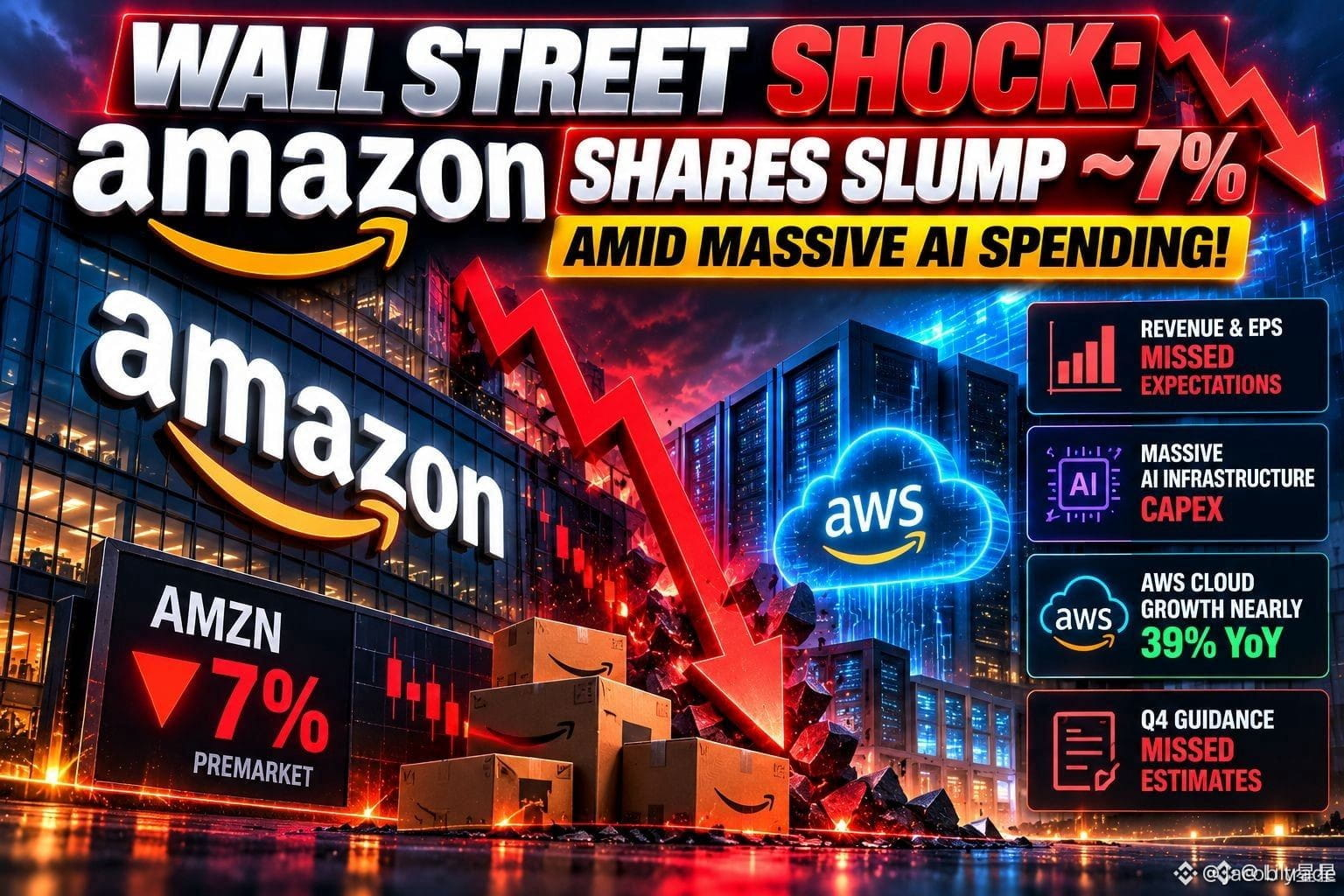
16
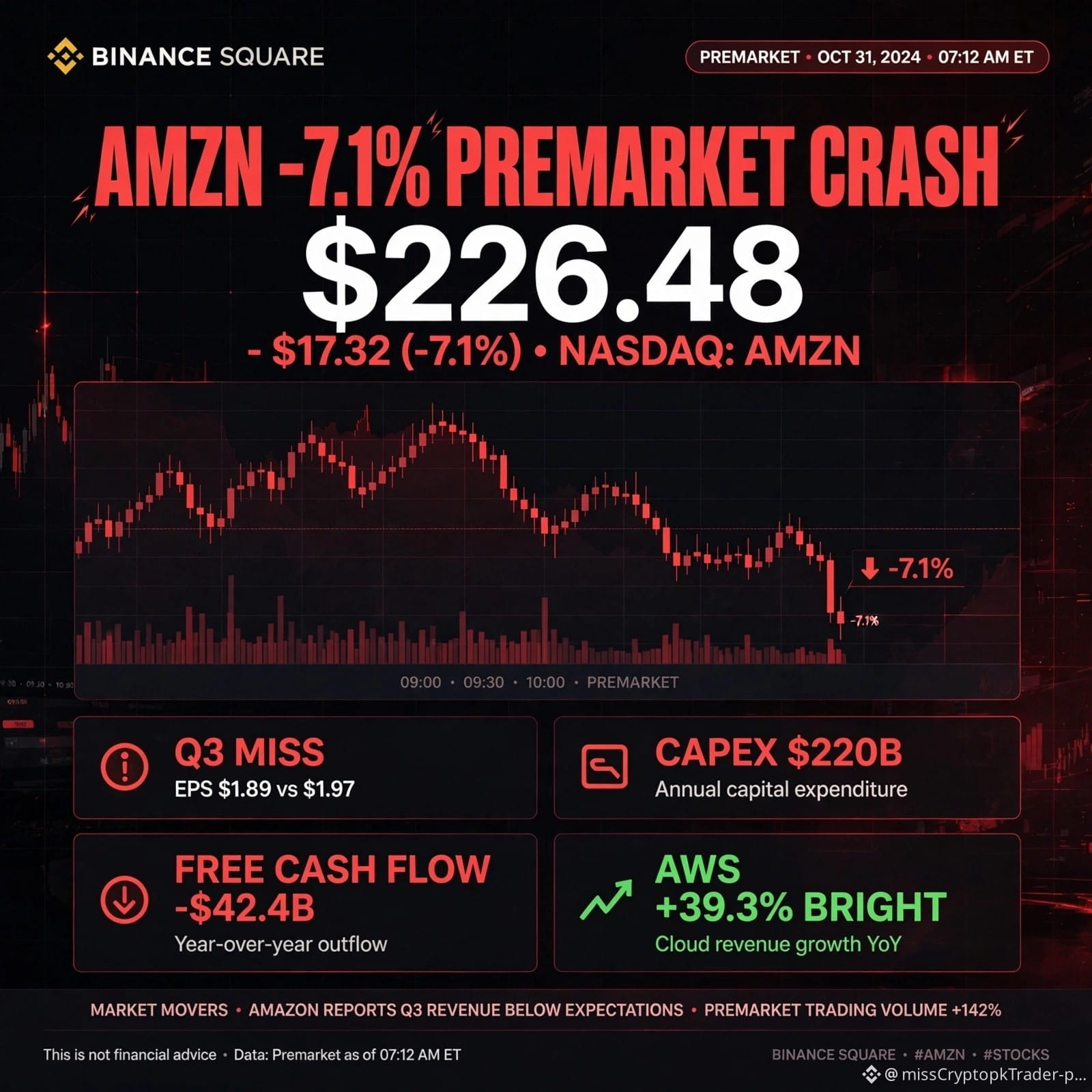
#AmazonSharesFallAbout7%InPremarketTrading
$AMZN -7.1% CRASH IN PREMARKET! WHAT'S NEXT? 📉
AMZN dumpe to $226.48 after Q3 results!
❌ EPS $1.89 vs $1.97 Expected
❌ Revenue $201.94B vs $202.22B Expected
❌ Q4 Guidance $243.5B vs Expectations low
❌ CapEx $220B for AI — Free Cash Flow -$42.4B!
✅ Only Positivity: AWS +39.3% YoY to $46B — fastest in 5 years! CEO says 40%+ growth in 2027 & 2028
Nasdaq futures -2.29% | Market fear back
Is this BUY THE DIP or MORE DOWNSIDE?
My View: Holding $226 could bounce to $232-$240, break $222 = $215 next
Are you buying this dip or waiting?
$AMZN $QQQ
#AmazonSharesFallAbout7%InPremarketTrading #AMZN #NASDAQ #StockMarket
1
193

#amazonsharesfallabout7%inpremarkettrading Amazon gagne de l’argent à la pelle grâce à la croissance de 39 % de son activité cloud AWS, mais son action a tout de même perdu 7 % de sa valeur en Bourse !
Pourquoi ? Parce que le patron Andy Jassy « dépense sans compter » et prévoit d’investir jusqu’à 220 milliards de dollars dans l’IA, ce qui fait passer le flux de trésorerie disponible dans le rouge, à -42,4 milliards de dollars. Wall Street est sous le choc et s’inquiète : quand l’IA rapportera-t-elle enfin de l’argent réel, alors que l’activité de vente au détail affiche une croissance poussive ?
Que doivent faire les traders ? Ne paniquez pas ! Une occasion de faire le plein à bas prix avec une vision à long terme, alors qu’AWS est en passe de devenir une activité valorisée à mille milliards de dollars.
⚠️ Ceci ne constitue pas un conseil financier.
$PARTI
{future}(PARTIUSDT)
$BEAMX
{future}(BEAMXUSDT)
$AMZN
{future}(AMZNUSDT)
#amazonsharesfallabout7%inpremarkettrading Amazon gagne de l’argent à la pelle grâce à la croissance de 39 % de son activité cloud AWS, mais son action a tout de même perdu 7 % de sa valeur en Bourse !
Pourquoi ? Parce que le patron Andy Jassy « dépense sans compter » et prévoit d’investir jusqu’à 220 milliards de dollars dans l’IA, ce qui fait passer le flux de trésorerie disponible dans le rouge, à -42,4 milliards de dollars. Wall Street est sous le choc et s’inquiète : quand l’IA rapportera-t-elle enfin de l’argent réel, alors que l’activité de vente au détail affiche une croissance poussive ?
Que doivent faire les traders ? Ne paniquez pas ! Une occasion de faire le plein à bas prix avec une vision à long terme, alors qu’AWS est en passe de devenir une activité valorisée à mille milliards de dollars.
⚠️ Ceci ne constitue pas un conseil financier.
$PARTI
$BEAMX
$AMZN

63

📉 Amazon Shares Drop Around 7% Premarket👇
Amazon stock fell about 7% in premarket trading after third-quarter results missed revenue and earnings estimates. While AWS delivered its strongest growth in nearly five years at 39%, heavy AI-related capital spending drove elevated cash burn and tempered fourth-quarter guidance.
The market is digesting the trade-off between rapid cloud expansion and near-term free cash flow pressure. Long-term investors often view such infrastructure investments as foundational for future leadership in AI and cloud services.
$AMZNB $AMZN $AMZN.US #CoinVahini #AmazonSharesFallAbout7%InPremarketTrading #AMZN #TechEarnings
AMZNUS-3.14%
AMZNB-3.54%
14

·
--
උසබ තත්ත්වය
#AmazonSharesFallAbout7%InPremarketTrading
📉 #AMAZON SHARES FALL ~7% IN PREMARKET TRADING: POST-EARNINGS ANALYSIS
Despite impressive growth in AWS, Amazon ($AMZN) shares took a notable hit in premarket trading following its latest earnings report. Here is a quick breakdown of what’s driving the market reaction:
🔍 Key Drivers Behind the Drop:
1️⃣ Weak Q4 Guidance & Outlook
Revenue outlook for the holiday quarter came in slightly below market expectations, raising concerns over softer consumer spending and stiff retail competition.
2️⃣ Surging CapEx & Negative Free Cash Flow
Heavy investments in AI infrastructure and data center expansions have pushed projected full-year 2026 CapEx to roughly $220 billion.
Consequently, trailing 12-month free cash flow turned negative (around -$42.4B), fueling debate over near-term capital burn.
3️⃣ Mixed Q3 Earnings
Overall Q3 revenue ($201.9B) and EPS ($1.89) slightly missed analyst consensus estimates.
On the bright side, AWS delivered strong growth (up ~39% YoY to $46B), proving that cloud demand remains robust even as other segments faced headwinds.
🤔 What’s Next for #AMZN? Wall Street is shifting its focus heavily toward AI ROI (Return on Investment) and upcoming holiday sales performance. Can AWS growth offset massive infrastructure expenditures, or will cash-flow pressures weigh further on tech sentiment?
💬 Are you buying the dip on Amazon, or staying cautious on big tech given high AI spending? Let’s discuss in the comments!
#Amazon #AMZN #StockMarket #BinanceSquare #EarningsReport #CloudComputing #Aİ
$PEPE $ALPINE $CRMB
{spot}(PEPEUSDT)
{spot}(ALPINEUSDT)
{spot}(AMZNBUSDT)
#AmazonSharesFallAbout7%InPremarketTrading
📉 #AMAZON SHARES FALL ~7% IN PREMARKET TRADING: POST-EARNINGS ANALYSIS
Despite impressive growth in AWS, Amazon ($AMZN) shares took a notable hit in premarket trading following its latest earnings report. Here is a quick breakdown of what’s driving the market reaction:
🔍 Key Drivers Behind the Drop:
1️⃣ Weak Q4 Guidance & Outlook
Revenue outlook for the holiday quarter came in slightly below market expectations, raising concerns over softer consumer spending and stiff retail competition.
2️⃣ Surging CapEx & Negative Free Cash Flow
Heavy investments in AI infrastructure and data center expansions have pushed projected full-year 2026 CapEx to roughly $220 billion.
Consequently, trailing 12-month free cash flow turned negative (around -$42.4B), fueling debate over near-term capital burn.
3️⃣ Mixed Q3 Earnings
Overall Q3 revenue ($201.9B) and EPS ($1.89) slightly missed analyst consensus estimates.
On the bright side, AWS delivered strong growth (up ~39% YoY to $46B), proving that cloud demand remains robust even as other segments faced headwinds.
🤔 What’s Next for #AMZN? Wall Street is shifting its focus heavily toward AI ROI (Return on Investment) and upcoming holiday sales performance. Can AWS growth offset massive infrastructure expenditures, or will cash-flow pressures weigh further on tech sentiment?
💬 Are you buying the dip on Amazon, or staying cautious on big tech given high AI spending? Let’s discuss in the comments!
#Amazon #AMZN #StockMarket #BinanceSquare #EarningsReport #CloudComputing #Aİ
$PEPE $ALPINE $CRMB
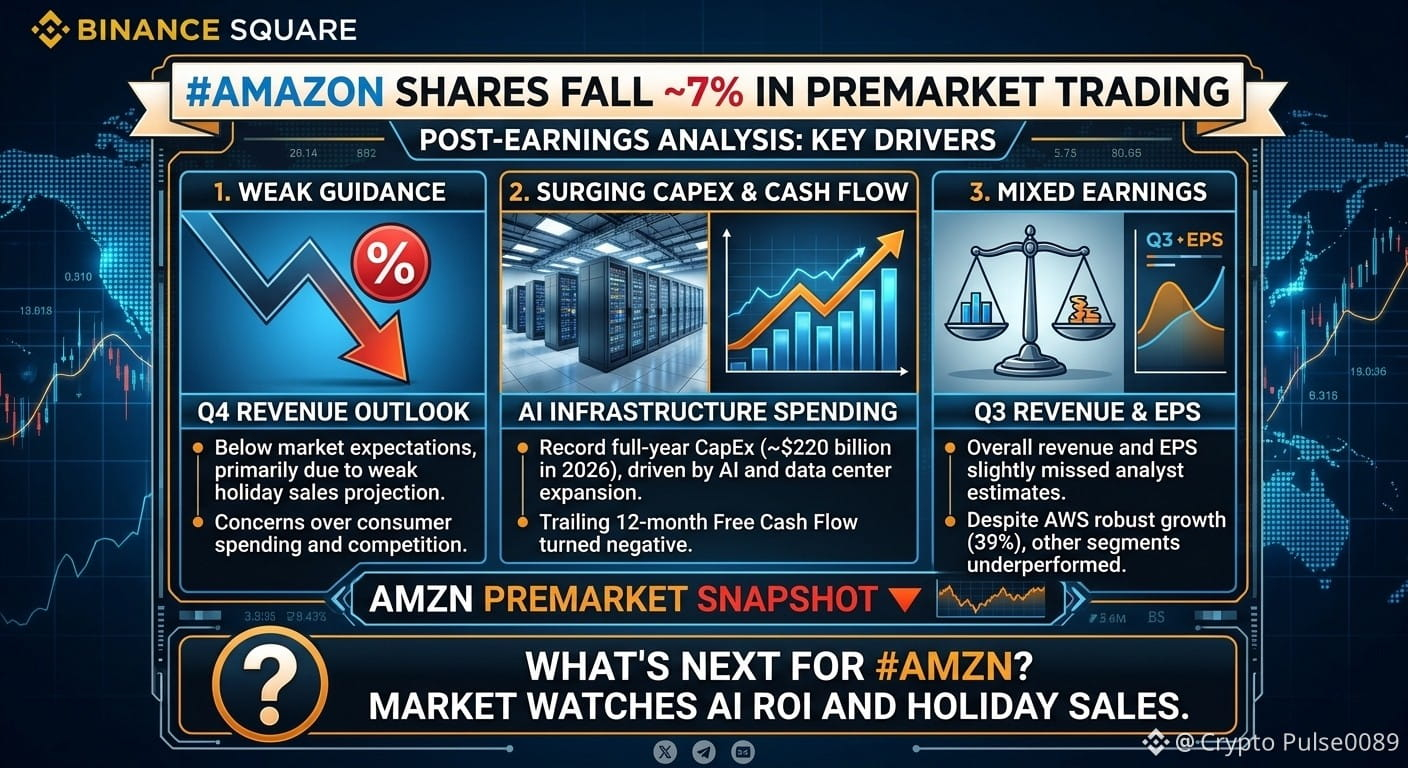
23

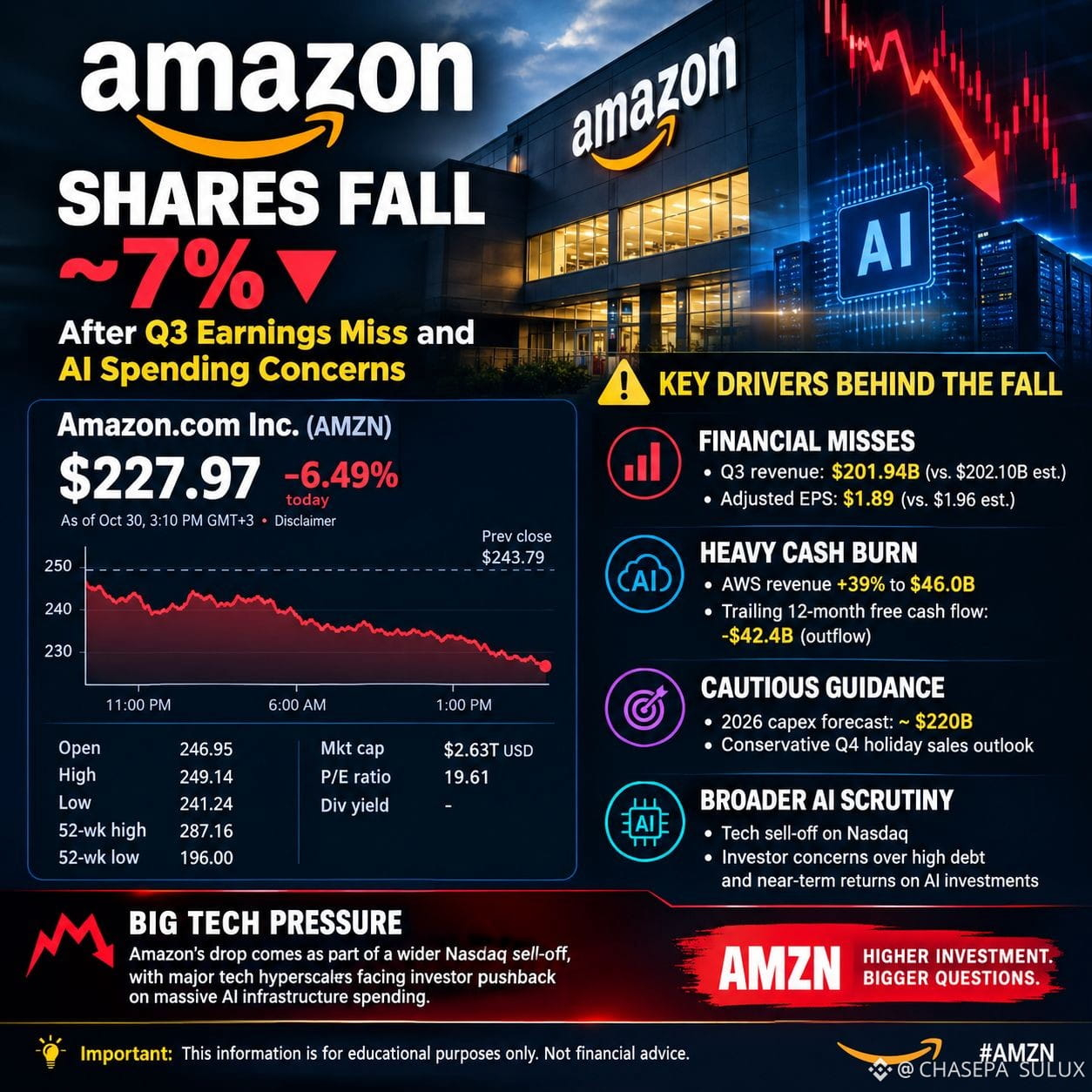
#AmazonSharesFallAbout7%InPremarketTrading 🚨 AMAZON ($AMZN) SHARES SLIDE 6.49% — AI SPENDING SPARKS INVESTOR CONCERNS
📉 Amazon faces growing Wall Street pressure after its Q3 2026 earnings fell short of analyst expectations, raising fresh questions about the cost of its aggressive artificial intelligence expansion.
📊 Key Market Highlights
🔴 Share Price: $227.97, down 6.49%
💰 Q3 Revenue: $201.94 billion vs. $202.10 billion expected
📉 Adjusted EPS: $1.89 vs. $1.96 expected
🟢 AWS Revenue: $46 billion, up 39% year over year
⚠️ Free Cash Flow: Trailing 12-month outflow of $42.4 billion
🏗️ 2026 Capital Expenditure Forecast: Approximately $220 billion
🔍 Why Is Amazon Under Pressure?
Despite strong growth in Amazon Web Services (AWS), investors are increasingly concerned about the enormous cost of building AI infrastructure. Heavy capital spending, weaker-than-expected earnings, and cautious holiday-season sales guidance have added to market uncertainty.
The broader technology sell-off also highlights a growing question for Big Tech: Can massive AI investments deliver sufficient returns to justify their costs?
📈 What Traders Should Watch
Key support and resistance levels for $AMZN.
Upcoming earnings guidance and AWS growth.
Cash flow trends and the return on AI investments.
Broader Nasdaq sentiment and technology-sector volatility.
💡 Market Takeaway: Strong AI growth does not automatically translate into stronger cash flow or higher share prices. Investors may increasingly focus on profitability, spending discipline, and the long-term return on AI infrastructure.
💬 Your View: Is this Amazon sell-off a potential buying opportunity, or could rising AI costs put further pressure on the stock?
⚠️ For educational purposes only. Not financial advice. Markets involve risk.
#Amazon #AMZN #StockMarket #ArtificialIntelligence #AWS #BigTech #Nasdaq #EarningsSeason
2
235


·
--
#AmazonSharesFallAbout7%InPremarketTrading
🚨 Amazon Shares Drop 7% : Is AI Spending Becoming Too Expensive?
Amazon ($AMZN ) is facing strong selling pressure after its Q3 2026 earnings disappointed Wall Street. Shares fell approximately 7% in premarket trading on Friday.
Here’s what caught investors' attention:
- Revenue reached $201.94 billion, slightly below expectations of around $202.2 billion.
- Earnings per share came in at $1.89 versus the expected $1.97.
- AWS revenue surged 39.3% to $46 billion, its fastest growth in nearly five years.
- Trailing 12-month free cash flow turned negative at $42.4 billion, largely due to heavy AI infrastructure investments.
My take: Amazon's cloud business is growing impressively, but investors are becoming more concerned about how much cash Big Tech is spending to build AI infrastructure. Growth alone is no longer enough; the market wants to see measurable returns on that investment.
I'll be watching AWS growth, cash flow and management's future spending plans before judging the next move.
Is this a buying opportunity for $AMZN , or could more downside be ahead? What's your view? 👇
#amazon #AMZN #EarningsSeason #AI
{future}(AMZNUSDT)
#AmazonSharesFallAbout7%InPremarketTrading
🚨 Amazon Shares Drop 7% : Is AI Spending Becoming Too Expensive?
Amazon ($AMZN ) is facing strong selling pressure after its Q3 2026 earnings disappointed Wall Street. Shares fell approximately 7% in premarket trading on Friday.
Here’s what caught investors' attention:
- Revenue reached $201.94 billion, slightly below expectations of around $202.2 billion.
- Earnings per share came in at $1.89 versus the expected $1.97.
- AWS revenue surged 39.3% to $46 billion, its fastest growth in nearly five years.
- Trailing 12-month free cash flow turned negative at $42.4 billion, largely due to heavy AI infrastructure investments.
My take: Amazon's cloud business is growing impressively, but investors are becoming more concerned about how much cash Big Tech is spending to build AI infrastructure. Growth alone is no longer enough; the market wants to see measurable returns on that investment.
I'll be watching AWS growth, cash flow and management's future spending plans before judging the next move.
Is this a buying opportunity for $AMZN , or could more downside be ahead? What's your view? 👇
#amazon #AMZN #EarningsSeason #AI
2
176

·
--
උසබ තත්ත්වය
සත්යායනය කළ
#amazonsharesfallabout7%inpremarkettrading
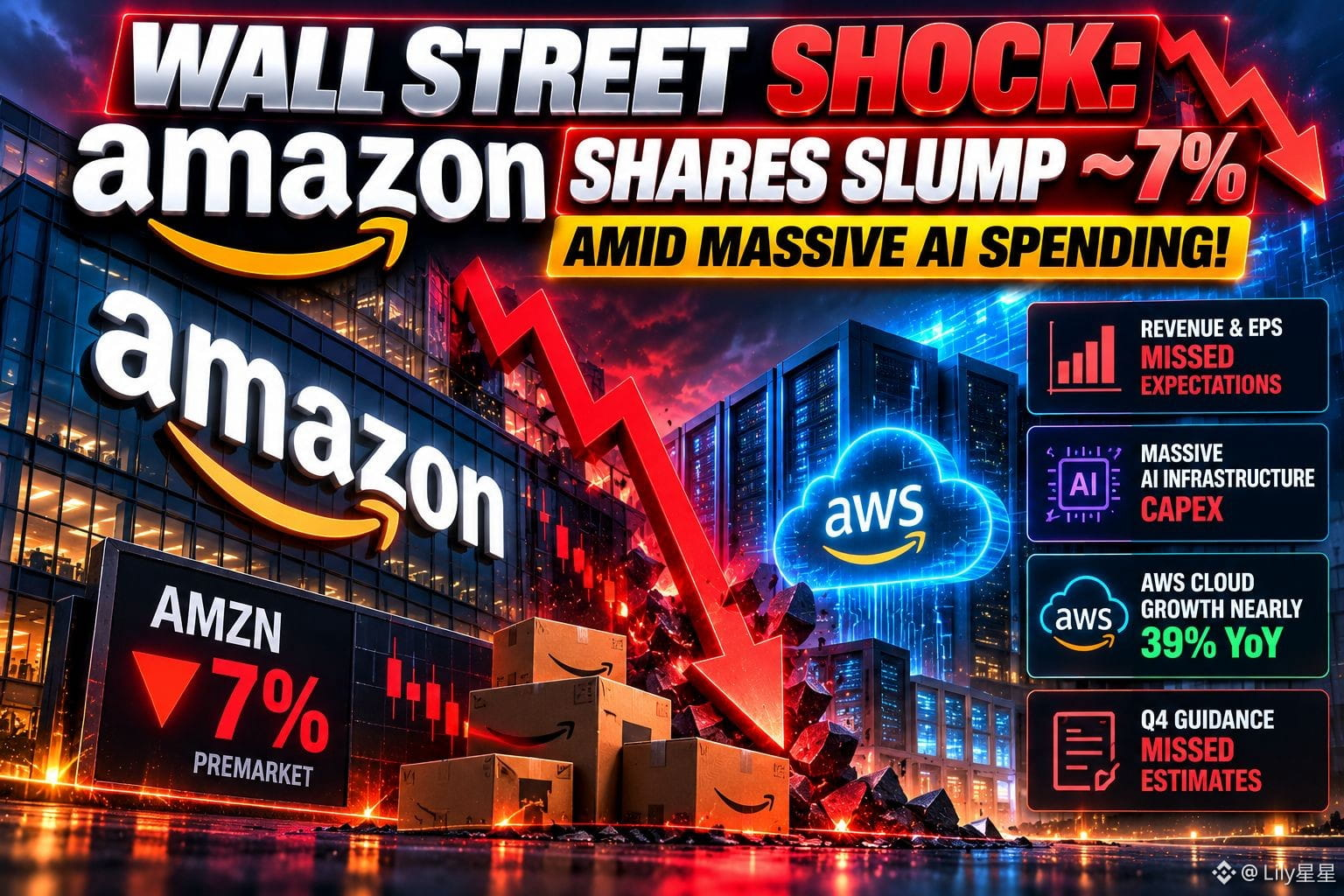
📉 WALL STREET SHOCK: AMAZON SHARES SLUMP ~7% AMID MASSIVE AI SPENDING! 🛍️⚡
Earnings & Revenue Miss: Amazon shares tumbled roughly 7% in premarket trading after reporting Q3 revenue and EPS that fell slightly short of consensus Wall Street expectations.
$ETH
{future}(ETHUSDT)
Massive AI Infrastructure CapEx: Capital expenditures surged as the company aggressively scaled up data centers to meet surging artificial intelligence demand, pushing trailing free cash flow into a sharp negative outflow.
$ZEC
{future}(ZECUSDT)
AWS Cloud Shines: Despite the broader pullback, Amazon Web Services (AWS) stood out as a bright spot, accelerating its year-over-year revenue growth to nearly 39%.
$XRP
{future}(XRPUSDT)
Cautious Q4 Guidance: Forward guidance for the holiday shopping quarter missed analyst estimates, triggering short-term tech sector jitters and weighing on major equity ETFs.
💬 YOUR TURN: Is this massive AI cash burn a brilliant long-term infrastructure play, or are investors right to panic over short-term free cash flow pressure?
👇 Drop your analysis below!
##BinanceWillListPredictPREDICT #TwoAddressesHoldingAbout1.28BUSDTFrozen #amazon #EarningCrypto
#amazonsharesfallabout7%inpremarkettrading
📉 WALL STREET SHOCK: AMAZON SHARES SLUMP ~7% AMID MASSIVE AI SPENDING! 🛍️⚡
Earnings & Revenue Miss: Amazon shares tumbled roughly 7% in premarket trading after reporting Q3 revenue and EPS that fell slightly short of consensus Wall Street expectations.
$ETH
Massive AI Infrastructure CapEx: Capital expenditures surged as the company aggressively scaled up data centers to meet surging artificial intelligence demand, pushing trailing free cash flow into a sharp negative outflow.
$ZEC
AWS Cloud Shines: Despite the broader pullback, Amazon Web Services (AWS) stood out as a bright spot, accelerating its year-over-year revenue growth to nearly 39%.
$XRP
Cautious Q4 Guidance: Forward guidance for the holiday shopping quarter missed analyst estimates, triggering short-term tech sector jitters and weighing on major equity ETFs.
💬 YOUR TURN: Is this massive AI cash burn a brilliant long-term infrastructure play, or are investors right to panic over short-term free cash flow pressure?
👇 Drop your analysis below!
##BinanceWillListPredictPREDICT #TwoAddressesHoldingAbout1.28BUSDTFrozen #amazon #EarningCrypto
1
28

·
--
බෙයාරිෂ්
#amazonsharesfallabout7%inpremarkettrading
🚨 Amazon Shares Drop 7% in Premarket Trading Amid AI Spending Concerns
Amazon shares fell approximately 7% in premarket trading as investors reacted to concerns about rising AI infrastructure costs, cash flow pressure, and future spending plans.
Despite strong growth in its AWS cloud business, Amazon's heavy investment in AI infrastructure is raising questions about how quickly these investments will translate into profits.
📉 Market Impact:
The sell-off highlights growing investor concerns about expensive AI expansion across major technology companies. Weak sentiment in the tech sector could also put indirect pressure on risk-sensitive assets, including Bitcoin and other cryptocurrencies.
Bottom Line: Investors are becoming more cautious about AI spending and profitability. Crypto traders should monitor broader market sentiment before making directional decisions.
#amazon #CryptoNews #stockmarket #BinanceSquare
$MARSCOIN $TIA $XNY
{future}(XNYUSDT)
{future}(TIAUSDT)
{future}(MARSCOINUSDT)
#amazonsharesfallabout7%inpremarkettrading
🚨 Amazon Shares Drop 7% in Premarket Trading Amid AI Spending Concerns
Amazon shares fell approximately 7% in premarket trading as investors reacted to concerns about rising AI infrastructure costs, cash flow pressure, and future spending plans.
Despite strong growth in its AWS cloud business, Amazon's heavy investment in AI infrastructure is raising questions about how quickly these investments will translate into profits.
📉 Market Impact:
The sell-off highlights growing investor concerns about expensive AI expansion across major technology companies. Weak sentiment in the tech sector could also put indirect pressure on risk-sensitive assets, including Bitcoin and other cryptocurrencies.
Bottom Line: Investors are becoming more cautious about AI spending and profitability. Crypto traders should monitor broader market sentiment before making directional decisions.
#amazon #CryptoNews #stockmarket #BinanceSquare
$MARSCOIN $TIA $XNY

13

·
--
උසබ තත්ත්වය
🚨 $AMZN CRASHES 7% PREMARKET — EVEN AWS GROWTH CAN'T SAVE AMAZON! 📉🔥
Amazon just delivered its Q3 earnings, and Wall Street isn't happy. 👀
The problem? AI is growing fast, but it's costing a fortune.
📊 HERE'S WHAT HAPPENED:
🔴 $AMZN: -7% premarket
💰 Revenue: $201.9B, slightly below expectations
☁️ AWS revenue: $46B (+39%)
💸 Free cash flow: -$42.4B over the past 12 months
🔥 2026 capital spending outlook: $220B
And Amazon says AI spending could climb even higher in 2027.
SO HERE'S THE REAL QUESTION…
If AWS is growing this fast, why are investors selling?
Because Wall Street isn't just paying for AI growth anymore.
It wants to see the returns.
🐂 BULLISH: Buyers absorb the earnings sell-off → $AMZN stabilizes → A relief rally could follow.
🐻 BEARISH: Cash flow concerns persist → Tech selling accelerates → Another leg down.
⚠️ THE BIGGEST TRAP?
Buying a 7% dip just because Amazon is a tech giant.
A STRONG BUSINESS DOESN'T ALWAYS MEAN A STRONG STOCK.
Not financial advice. DYOR.
{future}(AMZNUSDT)
#amazonsharesfallabout7%inpremarkettrading #$1.5BInLeveragedCryptoBetsLiquidated #KOSPIFalls3.53%BackBelow6000 #USMidtermElections #StrategySTRCReaches$99.95ForFirstTimeIn165Days
🚨 $AMZN CRASHES 7% PREMARKET — EVEN AWS GROWTH CAN'T SAVE AMAZON! 📉🔥
Amazon just delivered its Q3 earnings, and Wall Street isn't happy. 👀
The problem? AI is growing fast, but it's costing a fortune.
📊 HERE'S WHAT HAPPENED:
🔴 $AMZN : -7% premarket
💰 Revenue: $201.9B, slightly below expectations
☁️ AWS revenue: $46B (+39%)
💸 Free cash flow: -$42.4B over the past 12 months
🔥 2026 capital spending outlook: $220B
And Amazon says AI spending could climb even higher in 2027.
SO HERE'S THE REAL QUESTION…
If AWS is growing this fast, why are investors selling?
Because Wall Street isn't just paying for AI growth anymore.
It wants to see the returns.
🐂 BULLISH: Buyers absorb the earnings sell-off → $AMZN stabilizes → A relief rally could follow.
🐻 BEARISH: Cash flow concerns persist → Tech selling accelerates → Another leg down.
⚠️ THE BIGGEST TRAP?
Buying a 7% dip just because Amazon is a tech giant.
A STRONG BUSINESS DOESN'T ALWAYS MEAN A STRONG STOCK.
Not financial advice. DYOR.
#amazonsharesfallabout7%inpremarkettrading #$1.5BInLeveragedCryptoBetsLiquidated #KOSPIFalls3.53%BackBelow6000 #USMidtermElections #StrategySTRCReaches$99.95ForFirstTimeIn165Days
121

#AmazonSharesFallAbout7%InPremarketTrading
🚨 Amazon Shares Drop 7% — AI Spending Concerns Shake Investor Confidence
Amazon (AMZN) shares fell approximately 7% in premarket trading on Friday after its latest earnings report raised concerns about rising AI infrastructure costs, cash flow, and its fourth-quarter outlook.
📉 What Happened?
Amazon reported Q3 revenue of $201.9 billion, up 12% year-over-year, but slightly below analyst expectations.
The biggest concern was free cash flow, which turned negative by $42.4 billion over the trailing 12 months, largely due to aggressive AI infrastructure investments.
The company also maintained its 2026 capital expenditure forecast at approximately $220 billion, while management indicated that spending could increase further in 2027.
📊 Why Are Investors Concerned?
Despite strong AWS growth of 39%, investors are increasingly questioning whether massive AI investments will generate sufficient returns.
This reflects a broader shift in market sentiment: investors are no longer focusing only on AI growth potential. They also want to see profitability, sustainable cash flow, and clear returns on investment.
🌐 Potential Impact on Crypto Markets
Amazon's decline does not directly determine Bitcoin's direction, but weakness across major technology stocks can influence broader risk sentiment.
If concerns about AI spending spread across financial markets, risk-sensitive assets, including cryptocurrencies, could face additional selling pressure.
Traders should pay attention to:
• Nasdaq performance and broader tech-sector sentiment. • Bitcoin's ability to maintain key support levels. • Institutional risk appetite and liquidity conditions.
🎯 Bottom Line:
Amazon's selloff highlights growing investor caution toward expensive AI expansion. For crypto traders, the key takeaway is broader market sentiment rather than Amazon's stock decline itself.
#Amazon #bitcoin #CryptoMarket #StockMarket
$XNY $GTC $TIA
{future}(XNYUSDT)
{future}(GTCUSDT)
{future}(TIAUSDT)
#AmazonSharesFallAbout7%InPremarketTrading
🚨 Amazon Shares Drop 7% — AI Spending Concerns Shake Investor Confidence
Amazon (AMZN) shares fell approximately 7% in premarket trading on Friday after its latest earnings report raised concerns about rising AI infrastructure costs, cash flow, and its fourth-quarter outlook.
📉 What Happened?
Amazon reported Q3 revenue of $201.9 billion, up 12% year-over-year, but slightly below analyst expectations.
The biggest concern was free cash flow, which turned negative by $42.4 billion over the trailing 12 months, largely due to aggressive AI infrastructure investments.
The company also maintained its 2026 capital expenditure forecast at approximately $220 billion, while management indicated that spending could increase further in 2027.
📊 Why Are Investors Concerned?
Despite strong AWS growth of 39%, investors are increasingly questioning whether massive AI investments will generate sufficient returns.
This reflects a broader shift in market sentiment: investors are no longer focusing only on AI growth potential. They also want to see profitability, sustainable cash flow, and clear returns on investment.
🌐 Potential Impact on Crypto Markets
Amazon's decline does not directly determine Bitcoin's direction, but weakness across major technology stocks can influence broader risk sentiment.
If concerns about AI spending spread across financial markets, risk-sensitive assets, including cryptocurrencies, could face additional selling pressure.
Traders should pay attention to:
• Nasdaq performance and broader tech-sector sentiment. • Bitcoin's ability to maintain key support levels. • Institutional risk appetite and liquidity conditions.
🎯 Bottom Line:
Amazon's selloff highlights growing investor caution toward expensive AI expansion. For crypto traders, the key takeaway is broader market sentiment rather than Amazon's stock decline itself.
#Amazon #bitcoin #CryptoMarket #StockMarket
$XNY $GTC $TIA

68

·
--
Wall Street pasa factura al gasto desmedido en IA:
Amazon ($AMZNB ) se hunde un -7.30% en after-hours mientras Apple ($AAPL) se consolida como refugio.
El S&P 500 ($SPX) ajusta hacia los 7,650 puntos (-0.91%) en el cierre mensual de octubre tras los golpes consecutivos a Alphabet y Amazon.
En Big Tech:
- Castigo severo a Amazon ($AMZN ): Tras caer un -4.25% en sesión regular a $243.79, se desplomó a $225.99 en after-hours (mínimo de $220.17) por el temor a sus $220,000M en gasto de infraestructura.
- Fortaleza en Apple ($AAPLB ): La acción subió un +1.48% a $348.91 y avanzó hasta $352.05 (+0.90%) tras sus resultados, atrayendo el flujo institucional que huye del exceso de Capex.
- Presión de fin de mes en $SPX: Sumado al desplome del -12% en Alphabet ($GOOGLB ), el índice pone a prueba el soporte clave de los 7,650 puntos en el último día hábil de octubre.
¿Aprovecharán los fondos el descuento en $AMZN sobre los $225 o seguirá la rotación defensiva hacia $AAPL? 📉
#AmazonSharesFallAbout7%InPremarketTrading
66

·
--
බෙයාරිෂ්
සත්යායනය කළ
#amazonsharesfallabout7%inpremarkettrading
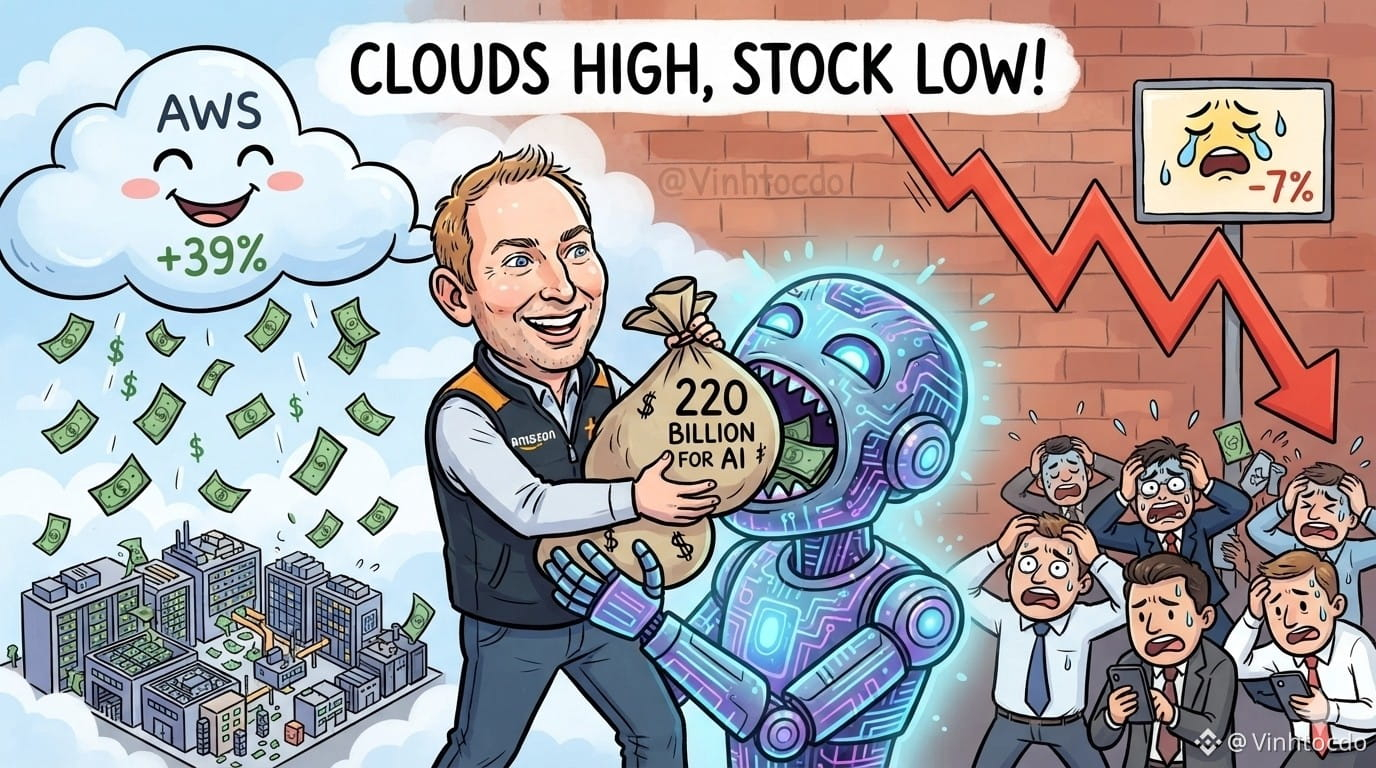
Amazon kiếm tiền như nước nhờ mảng đám mây AWS tăng trưởng 39%, nhưng cổ phiếu vẫn bốc hơi 7% tiền thị trường!
Lý do? Vì sếp Andy Jassy "vung tay quá trán" chi tới 220 tỷ USD cho AI, khiến dòng tiền tự do chuyển sang âm 42.4 tỷ USD. Phố Wall tá hỏa lo lắng không biết khi nào AI mới "đẻ" ra tiền thật, trong khi mảng bán lẻ thì tăng trưởng lẹt đẹt.
Trader phải làm gì? Đừng hoảng loạn! Cơ hội gom hàng giá rẻ cho tầm nhìn dài hạn khi AWS sắp thành mảng kinh doanh nghìn tỷ đô.
⚠️ Đây không phải lời khuyên tài chính.
Đăng ký tài khoản Binance mới để chiến cùng tôi:
Mã giới thiệu: VINHTOCDO
Link: [https://www.binance.com/register?ref=VINHTOCDO](https://www.binance.com/register?ref=VINHTOCDO)
Click giao dịch bên dưới để ủng hộ tôi $AAPLB
{spot}(AAPLBUSDT)
$NVDAB
{spot}(NVDABUSDT)
$AMZNB
{spot}(AMZNBUSDT)
#VINHTOCDO #Amazon #AWS #ArtificialIntelligence #TechStocks #CryptoTrading
#amazonsharesfallabout7%inpremarkettrading
Amazon kiếm tiền như nước nhờ mảng đám mây AWS tăng trưởng 39%, nhưng cổ phiếu vẫn bốc hơi 7% tiền thị trường!
Lý do? Vì sếp Andy Jassy "vung tay quá trán" chi tới 220 tỷ USD cho AI, khiến dòng tiền tự do chuyển sang âm 42.4 tỷ USD. Phố Wall tá hỏa lo lắng không biết khi nào AI mới "đẻ" ra tiền thật, trong khi mảng bán lẻ thì tăng trưởng lẹt đẹt.
Trader phải làm gì? Đừng hoảng loạn! Cơ hội gom hàng giá rẻ cho tầm nhìn dài hạn khi AWS sắp thành mảng kinh doanh nghìn tỷ đô.
⚠️ Đây không phải lời khuyên tài chính.
Đăng ký tài khoản Binance mới để chiến cùng tôi:
Mã giới thiệu: VINHTOCDO
Link: https://www.binance.com/register?ref=VINHTOCDO
Click giao dịch bên dưới để ủng hộ tôi $AAPLB
$NVDAB
$AMZNB
#VINHTOCDO #Amazon #AWS #ArtificialIntelligence #TechStocks #CryptoTrading
2
243

#AmazonSharesFallAbout7%InPremarketTrading
🚨 AMAZON ($AMZN) DROPS 7%! 📉
🔥 A 7% dip could be an opportunity for investors to watch closely!
💰 Is this your chance to buy the dip? 👀
#Amazon #AMZN #Investing #BinanceSquare
$AMZNB
{spot}(AMZNBUSDT)
#AmazonSharesFallAbout7%InPremarketTrading
🚨 AMAZON ($AMZN) DROPS 7%! 📉
🔥 A 7% dip could be an opportunity for investors to watch closely!
💰 Is this your chance to buy the dip? 👀
#Amazon #AMZN #Investing #BinanceSquare
$AMZNB
🚨 AMAZON ($AMZN) DROPS 7%! 📉
🔥 A 7% dip could be an opportunity for investors to watch closely!
💰 Is this your chance to buy the dip? 👀
#Amazon #AMZN #Investing #BinanceSquare
$AMZNB
68

ලිපිය
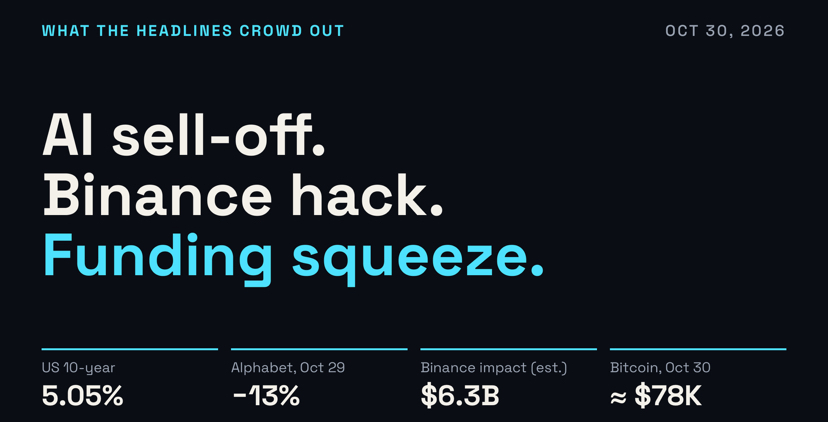
Sell off due To BOJ Hawkish Tone, News are Just Noise.The Funding Squeeze: What the AI and Binance-Hack Headlines Are Crowding OutMarket analysis · October 30, 2026 · Figures as of October 29–30
Two stories dominate the tape. In equities, an AI-spending sell-off gave Alphabet its worst day on record and dragged Amazon, Intel and Asian tech lower. In crypto, the largest hack in the industry’s history, at Binance, pushed Bitcoin to a six-week low. Both are real. Neither fully explains what markets are doing, and the question worth asking is what they have in common.
The answer is not a secret. Nothing in the public reporting points to a hidden event. What the two headlines crowd out is the price and availability of capital: a global bond rout, record borrowing to fund AI, and thinning demand for crypto, all landing at once.
The short version
AI: the sell-off is a funding story dressed as an earnings story. Free cash flow is negative at Alphabet and Amazon, borrowing and equity raises are at records, and the US 10-year yield sits near 5%.The hack: Binance estimates the impact at about $6.3 billion, the biggest on record, yet Bitcoin fell only a few percent on the news. The open questions are who absorbs the unfrozen losses and where the stolen coins go.Crypto’s supports: ETF flows and the largest corporate buyer were already fading before the hack, and Bitcoin had slid from the mid-$80,000s.The common thread: a global bond sell-off that took US, UK, Japanese and French long-term yields to multi-decade highs this month.
What happened
The AI sell-off. Alphabet closed 13% lower on Thursday, its worst day since going public, erasing close to $500 billion in value after slower search and advertising growth, roughly $51 billion of quarterly capital spending and negative free cash flow of about $9.1 billion. Amazon fell about 7% after its own miss, its second straight quarter of negative free cash flow, while keeping a $220 billion 2026 capex plan. Intel dropped more than 20% on weak guidance. Nasdaq futures fell about 2% and Asian markets followed, with Seoul down more than 3%.
The Binance incident. Binance said late Thursday that a security incident had an estimated impact of about $6.3 billion, with roughly $3 billion frozen on-chain, and that it will cover all losses from its SAFU fund and company funds. Its initial finding is that a compromised DevOps engineer’s laptop gave an attacker access to a service container that submitted unauthorized withdrawals, and it says it found no evidence of a wallet private key leak. Analytics firm TRM Labs counted about $6.36 billion leaving Binance wallets across 10 blockchains, mostly within about 20 minutes. TRM and Chainalysis link the theft to North Korea’s TraderTraitor group, an attribution that Binance and governments have not confirmed. Bitcoin fell to roughly $76,500 and about $1.5 billion of leveraged positions, mostly longs, were liquidated.
Why “AI” is only half the explanation
As strategist Anna Wu of Floodlines Research framed it, the worry is less that AI demand has stalled than that costlier funding and credit risk could eventually force the biggest spenders to slow their build-outs. The numbers show why.
Scale. Moody’s warned in July that six major tech companies would spend $785 billion on AI in 2026, approaching $1 trillion in 2027.How it is paid for. Alphabet raised $84.8 billion of equity in June, including $10 billion from Berkshire Hathaway, and Meta announced a $95 billion stock offering on October 26. Morgan Stanley estimates about $570 billion of AI-related debt issuance this year, more than double the prior year’s pace, and some of the borrowing sits off balance sheets in leased data-center vehicles.What credit markets say. Meta’s five-year credit default swaps hit a record near 119 basis points on October 22. Oracle was cut to the lowest investment-grade tier in July, and cover ratios on hyperscaler bond deals fell from about five times in February to about two times in July. Most hyperscalers remain rated comfortably above A, so this is significant debt rather than clearly dangerous debt, but each negative free-cash-flow quarter makes the funding question louder.
The quiet driver: a global bond rout
The US 10-year Treasury yield was just under 4% at the end of February, closed above 5% in September for the first time since 2007 and touched about 5.35% in early October, the highest since 2002. The 30-year closed at 5.67% on October 7. Both have eased, with the 10-year at about 5.05% and the 30-year at about 5.37% at the October 28 close, but both remain far above the levels at which AI funding plans were drawn up.
The move was global. The UK 30-year gilt yield topped 6% for the first time since 1998. Japan’s 10-year yield broke above 3% for the first time since 1996, and its 30-year hit a record 4.235%. France’s 10-year yield touched 5% for the first time since 2002 amid protests and a fight over the 2027 budget, and its spread over German bonds reached 176 basis points on October 23, the widest since 2011. Model estimates of the US 10-year term premium reached their highest in more than a decade, and The Economist put the question of a bond blow-up on its October 10 cover.
The causes are familiar. The oil shock lifted inflation, the Fed, ECB, Bank of Japan and Bank of England are all tightening or leaning that way, and governments are borrowing heavily. For a company that must keep issuing debt and equity to fund capex, and for investors holding assets that pay no yield, a 5% risk-free rate raises the bar for everything else.
Crypto: the supports were thinning before the hack
Bitcoin peaked near $86,000–$87,000 around the turn of the month and had drifted lower for about three weeks before the Binance news, which analysts estimate took only about 2% off the price. Three supports had already weakened:
ETFs. US spot Bitcoin ETFs had net outflows of more than $300 million in October as of late in the month, including a roughly $681 million outflow in the week of October 5–9, the largest since June.The biggest corporate buyer. Strategy bought no Bitcoin in the week of October 19–25, spent about $205 million repurchasing its own preferred shares instead, and has bought only 851 BTC in October against roughly $664 million of buybacks. It holds 848,517 BTC at an average cost of $75,446, so Bitcoin near $77,000–$78,000 is only a few percent above its break-even.Leverage. Long positions took most of the roughly $1.5 billion of liquidations, a sign of crowded positioning. Market data for October 30 also showed Bitcoin moving with the S&P 500, with a correlation of about 65%.
The hack: what is known and what is not
What is known: roughly $6.3 billion of impact, about $3 billion frozen, a compromised engineer’s laptop as the suspected entry point, and a pledge to cover all losses. Tether and Circle froze about $971 million and $823 million of the funds, and Binance’s SAFU emergency fund holds about $1.2 billion. One point for the decentralization debate: the fastest line of defense was two centralized stablecoin issuers.
What is not yet known:
Who absorbs what. One estimate cited by CNBC puts about $3.3 billion as unfrozen. If frozen stablecoins are eventually returned, SAFU could cover roughly a third of what remains, leaving the rest to Binance’s own balance sheet. Binance has pledged full coverage but, in the statements reviewed, has not detailed how.The restart. Deposits and withdrawals are paused during security checks. One market note expects withdrawals back within about 48 hours, which is unconfirmed.The stolen coins. Frozen funds can in principle be returned, but any unfrozen remainder can be moved and sold, which would add selling pressure, most likely through on-chain venues first.Attribution and cause. The North Korea link is an analyst assessment, and Binance has not named a final root cause.
The something else: three things the headlines crowd out
The cost of capital is the common factor. The same global rise in yields sits behind tighter central banks, costlier AI financing and a higher bar for non-yielding assets such as Bitcoin. The AI sell-off and the Binance hack are catalysts; the bond market is the backdrop.Dependence on outside funding. AI capex now leans on continuous bond and equity issuance, and crypto demand leans on continuous ETF and treasury-company buying. When funding tightens, both are exposed at the same time.Growth is narrower than it looks. US third-quarter GDP grew 3.4% with business equipment investment up about 21%, much of it AI-driven, while real disposable income fell 0.3% in September and the saving rate slipped to 3.8%. Central banks cite both AI demand and the energy shock as inflation pressures. If funding costs force an AI capex slowdown, growth loses a prop while inflation keeps policy tight, which is the stagflation corner markets are starting to price.
What this is not: evidence of a cover-up, or a forecast of a crash. Hyperscaler credit is mostly well rated, Binance has pledged to cover losses, and Bitcoin’s reaction to the hack was modest.
What to watch
Binance: the withdrawal restart, any detail on funding the unfrozen losses, movement of the stolen funds and further freezes.Credit: hyperscaler credit default swaps (Meta, Oracle), cover ratios on new bond deals and further equity raises.Bonds: the US 10-year around 5%, the UK 30-year around 6%, and the French spread against its 176 basis point peak as the budget fight continues.Central banks: the Bank of England on November 5, the Fed on December 9, and the ECB and Bank of Japan in December.Crypto flows: Strategy’s weekly Monday filings, ETF flows, and Bitcoin against Strategy’s $75,446 average cost.Energy and politics: Hormuz traffic and the US midterms on November 3.
Bottom line
The AI sell-off and the Binance hack are real, but they are catalysts landing on a market whose funding foundation is under strain. What the headlines crowd out is a global bond rout that has raised the price of money for governments, AI builders and crypto alike, at a moment when energy-driven inflation keeps central banks from easing. If yields keep easing, both stories may fade. If they climb again, expect the most leveraged and externally funded bets to feel it first.
This article is for information only and is not financial advice. Markets are volatile and you can lose money. Do your own research.
Sources and data notes
Figures are as of October 29–30, 2026, and the Binance situation is changing quickly, so check Binance’s official updates. Equities and AI funding draw on CNBC, Euronews, 24/7 Wall St., Fortune as relayed by IBTimes, Bloomberg, Startup Fortune and Seoul Economic Daily. Bond yields draw on CNN, CNBC, the Irish Times, TD Economics, Trading Economics and Admiral Markets compilations of Treasury data. The Binance incident draws on Binance’s statement as reported by CNBC, Forbes, CCN and SOCRadar, and on TRM Labs analysis. Crypto flows draw on KuCoin News, Strategy’s SEC filings, Bitcoin Magazine, CryptoTicker and crypto.news. US growth draws on the Commerce Department release as reported by CNBC and ActionForex, and central-bank inflation commentary on Reuters. Analyst views are the analysts’ own opinions.
#$1.5BInLeveragedCryptoBetsLiquidated #KOSPIFalls3.53%BackBelow6000 #AmazonSharesFallAbout7%InPremarketTrading #USMidtermElections #StrategySTRCReaches$99.95ForFirstTimeIn165Days
Sell off due To BOJ Hawkish Tone, News are Just Noise.
The Funding Squeeze: What the AI and Binance-Hack Headlines Are Crowding OutMarket analysis · October 30, 2026 · Figures as of October 29–30
Two stories dominate the tape. In equities, an AI-spending sell-off gave Alphabet its worst day on record and dragged Amazon, Intel and Asian tech lower. In crypto, the largest hack in the industry’s history, at Binance, pushed Bitcoin to a six-week low. Both are real. Neither fully explains what markets are doing, and the question worth asking is what they have in common.
The answer is not a secret. Nothing in the public reporting points to a hidden event. What the two headlines crowd out is the price and availability of capital: a global bond rout, record borrowing to fund AI, and thinning demand for crypto, all landing at once.
The short version
AI: the sell-off is a funding story dressed as an earnings story. Free cash flow is negative at Alphabet and Amazon, borrowing and equity raises are at records, and the US 10-year yield sits near 5%.The hack: Binance estimates the impact at about $6.3 billion, the biggest on record, yet Bitcoin fell only a few percent on the news. The open questions are who absorbs the unfrozen losses and where the stolen coins go.Crypto’s supports: ETF flows and the largest corporate buyer were already fading before the hack, and Bitcoin had slid from the mid-$80,000s.The common thread: a global bond sell-off that took US, UK, Japanese and French long-term yields to multi-decade highs this month.
What happened
The AI sell-off. Alphabet closed 13% lower on Thursday, its worst day since going public, erasing close to $500 billion in value after slower search and advertising growth, roughly $51 billion of quarterly capital spending and negative free cash flow of about $9.1 billion. Amazon fell about 7% after its own miss, its second straight quarter of negative free cash flow, while keeping a $220 billion 2026 capex plan. Intel dropped more than 20% on weak guidance. Nasdaq futures fell about 2% and Asian markets followed, with Seoul down more than 3%.
The Binance incident. Binance said late Thursday that a security incident had an estimated impact of about $6.3 billion, with roughly $3 billion frozen on-chain, and that it will cover all losses from its SAFU fund and company funds. Its initial finding is that a compromised DevOps engineer’s laptop gave an attacker access to a service container that submitted unauthorized withdrawals, and it says it found no evidence of a wallet private key leak. Analytics firm TRM Labs counted about $6.36 billion leaving Binance wallets across 10 blockchains, mostly within about 20 minutes. TRM and Chainalysis link the theft to North Korea’s TraderTraitor group, an attribution that Binance and governments have not confirmed. Bitcoin fell to roughly $76,500 and about $1.5 billion of leveraged positions, mostly longs, were liquidated.
Why “AI” is only half the explanation
As strategist Anna Wu of Floodlines Research framed it, the worry is less that AI demand has stalled than that costlier funding and credit risk could eventually force the biggest spenders to slow their build-outs. The numbers show why.
Scale. Moody’s warned in July that six major tech companies would spend $785 billion on AI in 2026, approaching $1 trillion in 2027.How it is paid for. Alphabet raised $84.8 billion of equity in June, including $10 billion from Berkshire Hathaway, and Meta announced a $95 billion stock offering on October 26. Morgan Stanley estimates about $570 billion of AI-related debt issuance this year, more than double the prior year’s pace, and some of the borrowing sits off balance sheets in leased data-center vehicles.What credit markets say. Meta’s five-year credit default swaps hit a record near 119 basis points on October 22. Oracle was cut to the lowest investment-grade tier in July, and cover ratios on hyperscaler bond deals fell from about five times in February to about two times in July. Most hyperscalers remain rated comfortably above A, so this is significant debt rather than clearly dangerous debt, but each negative free-cash-flow quarter makes the funding question louder.
The quiet driver: a global bond rout
The US 10-year Treasury yield was just under 4% at the end of February, closed above 5% in September for the first time since 2007 and touched about 5.35% in early October, the highest since 2002. The 30-year closed at 5.67% on October 7. Both have eased, with the 10-year at about 5.05% and the 30-year at about 5.37% at the October 28 close, but both remain far above the levels at which AI funding plans were drawn up.
The move was global. The UK 30-year gilt yield topped 6% for the first time since 1998. Japan’s 10-year yield broke above 3% for the first time since 1996, and its 30-year hit a record 4.235%. France’s 10-year yield touched 5% for the first time since 2002 amid protests and a fight over the 2027 budget, and its spread over German bonds reached 176 basis points on October 23, the widest since 2011. Model estimates of the US 10-year term premium reached their highest in more than a decade, and The Economist put the question of a bond blow-up on its October 10 cover.
The causes are familiar. The oil shock lifted inflation, the Fed, ECB, Bank of Japan and Bank of England are all tightening or leaning that way, and governments are borrowing heavily. For a company that must keep issuing debt and equity to fund capex, and for investors holding assets that pay no yield, a 5% risk-free rate raises the bar for everything else.
Crypto: the supports were thinning before the hack
Bitcoin peaked near $86,000–$87,000 around the turn of the month and had drifted lower for about three weeks before the Binance news, which analysts estimate took only about 2% off the price. Three supports had already weakened:
ETFs. US spot Bitcoin ETFs had net outflows of more than $300 million in October as of late in the month, including a roughly $681 million outflow in the week of October 5–9, the largest since June.The biggest corporate buyer. Strategy bought no Bitcoin in the week of October 19–25, spent about $205 million repurchasing its own preferred shares instead, and has bought only 851 BTC in October against roughly $664 million of buybacks. It holds 848,517 BTC at an average cost of $75,446, so Bitcoin near $77,000–$78,000 is only a few percent above its break-even.Leverage. Long positions took most of the roughly $1.5 billion of liquidations, a sign of crowded positioning. Market data for October 30 also showed Bitcoin moving with the S&P 500, with a correlation of about 65%.
The hack: what is known and what is not
What is known: roughly $6.3 billion of impact, about $3 billion frozen, a compromised engineer’s laptop as the suspected entry point, and a pledge to cover all losses. Tether and Circle froze about $971 million and $823 million of the funds, and Binance’s SAFU emergency fund holds about $1.2 billion. One point for the decentralization debate: the fastest line of defense was two centralized stablecoin issuers.
What is not yet known:
Who absorbs what. One estimate cited by CNBC puts about $3.3 billion as unfrozen. If frozen stablecoins are eventually returned, SAFU could cover roughly a third of what remains, leaving the rest to Binance’s own balance sheet. Binance has pledged full coverage but, in the statements reviewed, has not detailed how.The restart. Deposits and withdrawals are paused during security checks. One market note expects withdrawals back within about 48 hours, which is unconfirmed.The stolen coins. Frozen funds can in principle be returned, but any unfrozen remainder can be moved and sold, which would add selling pressure, most likely through on-chain venues first.Attribution and cause. The North Korea link is an analyst assessment, and Binance has not named a final root cause.
The something else: three things the headlines crowd out
The cost of capital is the common factor. The same global rise in yields sits behind tighter central banks, costlier AI financing and a higher bar for non-yielding assets such as Bitcoin. The AI sell-off and the Binance hack are catalysts; the bond market is the backdrop.Dependence on outside funding. AI capex now leans on continuous bond and equity issuance, and crypto demand leans on continuous ETF and treasury-company buying. When funding tightens, both are exposed at the same time.Growth is narrower than it looks. US third-quarter GDP grew 3.4% with business equipment investment up about 21%, much of it AI-driven, while real disposable income fell 0.3% in September and the saving rate slipped to 3.8%. Central banks cite both AI demand and the energy shock as inflation pressures. If funding costs force an AI capex slowdown, growth loses a prop while inflation keeps policy tight, which is the stagflation corner markets are starting to price.
What this is not: evidence of a cover-up, or a forecast of a crash. Hyperscaler credit is mostly well rated, Binance has pledged to cover losses, and Bitcoin’s reaction to the hack was modest.
What to watch
Binance: the withdrawal restart, any detail on funding the unfrozen losses, movement of the stolen funds and further freezes.Credit: hyperscaler credit default swaps (Meta, Oracle), cover ratios on new bond deals and further equity raises.Bonds: the US 10-year around 5%, the UK 30-year around 6%, and the French spread against its 176 basis point peak as the budget fight continues.Central banks: the Bank of England on November 5, the Fed on December 9, and the ECB and Bank of Japan in December.Crypto flows: Strategy’s weekly Monday filings, ETF flows, and Bitcoin against Strategy’s $75,446 average cost.Energy and politics: Hormuz traffic and the US midterms on November 3.
Bottom line
The AI sell-off and the Binance hack are real, but they are catalysts landing on a market whose funding foundation is under strain. What the headlines crowd out is a global bond rout that has raised the price of money for governments, AI builders and crypto alike, at a moment when energy-driven inflation keeps central banks from easing. If yields keep easing, both stories may fade. If they climb again, expect the most leveraged and externally funded bets to feel it first.
This article is for information only and is not financial advice. Markets are volatile and you can lose money. Do your own research.
Sources and data notes
Figures are as of October 29–30, 2026, and the Binance situation is changing quickly, so check Binance’s official updates. Equities and AI funding draw on CNBC, Euronews, 24/7 Wall St., Fortune as relayed by IBTimes, Bloomberg, Startup Fortune and Seoul Economic Daily. Bond yields draw on CNN, CNBC, the Irish Times, TD Economics, Trading Economics and Admiral Markets compilations of Treasury data. The Binance incident draws on Binance’s statement as reported by CNBC, Forbes, CCN and SOCRadar, and on TRM Labs analysis. Crypto flows draw on KuCoin News, Strategy’s SEC filings, Bitcoin Magazine, CryptoTicker and crypto.news. US growth draws on the Commerce Department release as reported by CNBC and ActionForex, and central-bank inflation commentary on Reuters. Analyst views are the analysts’ own opinions.
#$1.5BInLeveragedCryptoBetsLiquidated #KOSPIFalls3.53%BackBelow6000 #AmazonSharesFallAbout7%InPremarketTrading #USMidtermElections #StrategySTRCReaches$99.95ForFirstTimeIn165Days
62
·
--
උසබ තත්ත්වය
#twoaddressesholdingabout1.28busdtfrozen
🚨 THE $6.3B BINANCE SECURITY INCIDENT: FREEZING ASSETS VS. REAL RECOVERY! 🛡️🔍
$ZEC
{future}(ZECUSDT)
The Attack Vector: Binance’s preliminary investigation revealed that a compromised DevOps engineer's laptop allowed an attacker to access a service container and authorize unauthorized withdrawal transactions—with no private-key leakage detected.
$XRP
{future}(XRPUSDT)
Scale of the Breach & Freezes: The total estimated impact hit approximately $6.3B, with roughly $3B frozen on-chain so far, including $1.28B held across two specific frozen addresses and $3.45M in FDUSD blacklisted by First Digital.
$SOL
{future}(SOLUSDT)
The Swap Loophole: Blockchain analytics from Bitquery reveal that ~$729M in USDT had already been swapped into ETH and TRX before freeze commands took effect. Six of Tether's 11 freeze targets were already emptied.
The Core Lesson: Stablecoin issuers can freeze their own native tokens, but they cannot reverse completed cross-asset swaps.
The Real Custody Risk: This incident shifts the spotlight away from private-key security and onto operational permissions, infrastructure access control, and automated authorization systems.
💬 YOUR TURN: Do you think exchange infrastructure security needs a total overhaul regarding automated internal permissions? Is internal operational risk the biggest blind spot in crypto custody today?
👇 Drop your thoughts below!
"CLICK ON THE BELOW YELLOW COIN TAG TO GO TO DESIRED TRADING PAGE TO GET BENEFIT TRADE"
#KOSPIFalls3.53%BackBelow6000 #USMidtermElections #AmazonSharesFallAbout7%InPremarketTrading #Binance
#twoaddressesholdingabout1.28busdtfrozen
🚨 THE $6.3B BINANCE SECURITY INCIDENT: FREEZING ASSETS VS. REAL RECOVERY! 🛡️🔍
$ZEC
The Attack Vector: Binance’s preliminary investigation revealed that a compromised DevOps engineer's laptop allowed an attacker to access a service container and authorize unauthorized withdrawal transactions—with no private-key leakage detected.
$XRP
Scale of the Breach & Freezes: The total estimated impact hit approximately $6.3B, with roughly $3B frozen on-chain so far, including $1.28B held across two specific frozen addresses and $3.45M in FDUSD blacklisted by First Digital.
$SOL
The Swap Loophole: Blockchain analytics from Bitquery reveal that ~$729M in USDT had already been swapped into ETH and TRX before freeze commands took effect. Six of Tether's 11 freeze targets were already emptied.
The Core Lesson: Stablecoin issuers can freeze their own native tokens, but they cannot reverse completed cross-asset swaps.
The Real Custody Risk: This incident shifts the spotlight away from private-key security and onto operational permissions, infrastructure access control, and automated authorization systems.
💬 YOUR TURN: Do you think exchange infrastructure security needs a total overhaul regarding automated internal permissions? Is internal operational risk the biggest blind spot in crypto custody today?
👇 Drop your thoughts below!
"CLICK ON THE BELOW YELLOW COIN TAG TO GO TO DESIRED TRADING PAGE TO GET BENEFIT TRADE"
#KOSPIFalls3.53%BackBelow6000 #USMidtermElections #AmazonSharesFallAbout7%InPremarketTrading #Binance

3
5.2k

·
--
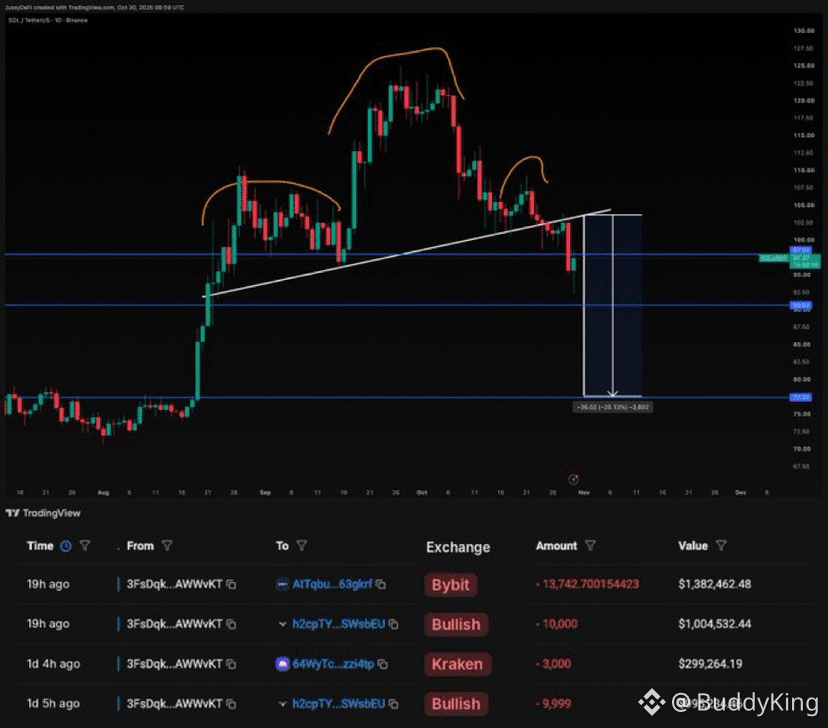
$SOL is facing some serious pressure, and the charts aren't looking encouraging.
Here's what's raising concerns:
1️⃣ A major anonymous whale reportedly sold over 1M SOL worth $100M+ in just six days.
2️⃣ The Binance hacker reportedly moved another 970K SOL, valued at around $96M.
3️⃣ SOL has confirmed a bearish head-and-shoulders breakdown. The $97 target has already been reached, with $90 and $77 now in focus.
Despite upcoming ecosystem upgrades and Breakpoint just 16 days away, the selling pressure shouldn't be ignored.
For now, caution is key. The market needs to prove its strength before bulls can regain control.
Could SOL see another leg down before its next major recovery?
$BEAMX #$1.5BInLeveragedCryptoBetsLiquidated
$SOPH #AmazonSharesFallAbout7%InPremarketTrading
1
1.1k
තවත් අන්තර්ගතයන් ගවේෂණය කිරීමට ඇතුල් වන්න
Binance චතුරශ්රය හි ගෝලීය ක්රිප්ටෝ පරිශීලකයින් හා එක්වන්න
⚡️ ක්රිප්ටෝ පිළිබඳ නවතම සහ ප්රයෝජනවත් තොරතුරු ලබා ගන්න.
💬 ලොව විශාලතම ක්රිප්ටෝ හුවමාරුව මගින් විශ්වාස කෙරේ.
👍 සත්යායනය කරන ලද නිර්මාණකරුවන්ගෙන් සැබෑ විදසුන් සොයා ගන්න.
විද්යුත් තැපෑල / දුරකථන අංකය
නැගී එන මාතෘකා
1
#UniswapA16zSeekDeFiExemptionFromIllinoisCryptoTax
0 නැරඹීම්
8 සාකච්ඡා කරමින්
2
#$1.5BInLeveragedCryptoBetsLiquidated
8,990 නැරඹීම්
136 සාකච්ඡා කරමින්
3
#TrezorSaysCryptoBilisSoldWalletMayContainMaliciousComponents
0 නැරඹීම්
0 සාකච්ඡා කරමින්
4
#KOSPIFalls3.53%BackBelow6000
26,159 නැරඹීම්
622 සාකච්ඡා කරමින්
5
#AmazonSharesFallAbout7%InPremarketTrading
7,223 නැරඹීම්
239 සාකච්ඡා කරමින්
6
#USMidtermElections
158,244 නැරඹීම්
1,864 සාකච්ඡා කරමින්
7
#StrategySTRCReaches$99.95ForFirstTimeIn165Days
3,857 නැරඹීම්
83 සාකච්ඡා කරමින්
8
#BinanceWillListPredictPREDICT
49,285 නැරඹීම්
984 සාකච්ඡා කරමින්
9
#SwitzerlandFirstSpotBitcoinETFExpectedToTradeInNovember
1,760 නැරඹීම්
87 සාකච්ඡා කරමින්
10
#StrategyReports$21BQ3OperatingProfit
1,869 නැරඹීම්
45 සාකච්ඡා කරමින්