


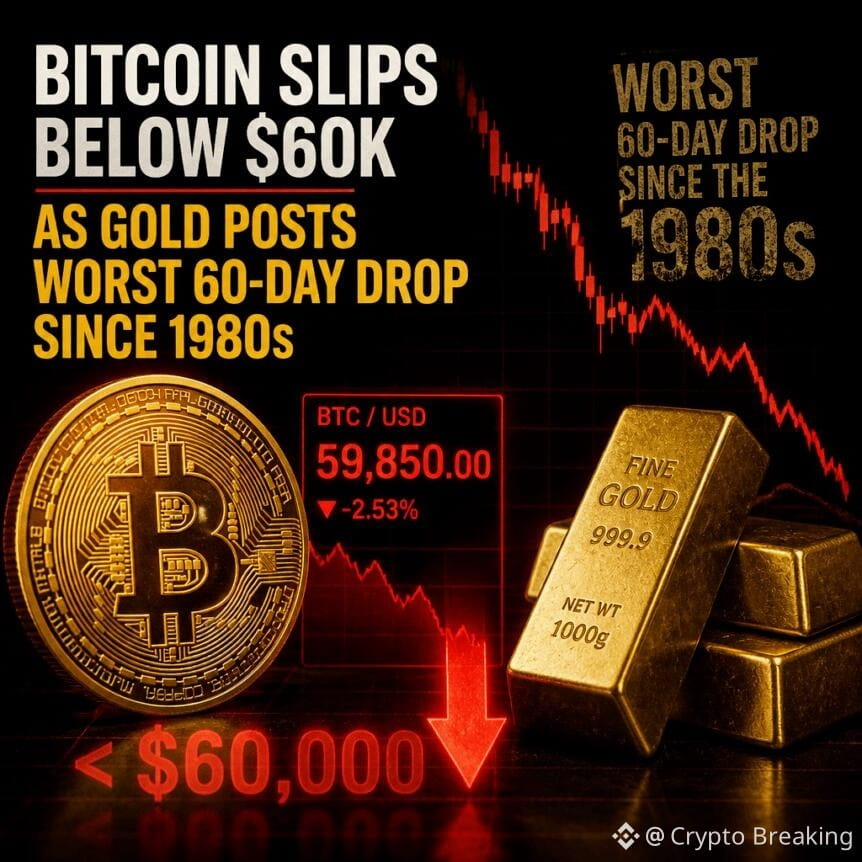
Bitcoin slid below $60,000 on Tuesday after a Monday rebound that was tied to broader risk sentiment following Nvidia’s decision to reinstate CEO Jensen Huang. The move quickly translated into volatility across crypto markets, with liquidation data pointing to a heavy mix of forced selling and short-term hedging.
TradingView data showed BTC/USD trading as low as $59,380 on Bitstamp, roughly 8% below Monday’s intraday high near $64,505. CoinGlass reported $827 million in total crypto liquidations over the prior 24 hours, underscoring how quickly sentiment reversed once equities momentum faded.
Key takeaways
BTC dropped nearly 8% from its $64,505 intraday high to around $59,380 on Bitstamp, slipping back below the psychological $60,000 level.
CoinGlass data put 24-hour crypto liquidations at $827 million, split between $348 million long liquidations and $478 million short liquidations.
Monday’s rebound was linked to Nvidia’s CEO reinstatement, which boosted tech stocks and lifted the Nasdaq by 6.5%.
Onchain analysis highlighted long-term Bitcoin holders selling at a loss, a pattern that can dampen follow-through after rallies.
Gold’s sharp decline over the past two months fed into a broader “liquidity” narrative that appeared to pressure multiple asset classes.
Rebound loses altitude after Nvidia-driven risk rally
Monday’s trading surge received a notable tailwind from Nvidia’s leadership development. According to earlier coverage by Cointelegraph, the reinstatement of Jensen Huang helped trigger a rally not only in crypto but also across traditional markets when Wall Street opened. Nvidia shares reportedly climbed as much as 35% during the move, while the Nasdaq Composite closed 6.5% higher at 24,089.
That risk-on impulse carried into Asia, where AI-trade optimism supported broad gains. Korea’s KOSPI rose 6.3% after posting its lowest close in 11 months. But by Tuesday, Bitcoin’s price action suggested that the rebound did not translate into durable momentum in the crypto market.
Commentary from the Kobeissi Letter cautioned that the broader AI complex could face choppier conditions. In a post on X, the account pointed to “political headlines” tied to what it described as a pivotal CEO controversy, while also noting that the wider AI trade was undergoing a “healthy technical correction.” The same post argued that the latest move looked more like a correction than the start of a prolonged bear market.
For traders, the key takeaway is that Bitcoin’s bounce appears to have been synchronized with an external catalyst—equities and AI sentiment—rather than driven by a purely crypto-specific improvement. Once that linkage broke, BTC struggled to hold the gains.
Liquidations reveal a two-sided scramble around $64,500
Price weakness intensified quickly. Data cited from TradingView placed BTC/USD below $60,000 on Tuesday, after a Monday surge that stopped around $64,505. CoinGlass liquidation statistics show how stressed leveraged positioning became during the reversal: $348 million in long positions and $478 million in short positions were liquidated over the 24 hours leading up to 8am UTC.
Those figures matter because they reflect more than direction—they show that leverage was widespread enough on both sides for a rapid unwind. In practical terms, large liquidation totals often coincide with a “re-pricing” phase where previous momentum bids are cleared, and traders reposition aggressively.
While Monday’s rally lifted prices, Tuesday’s liquidation mix suggests the market quickly became uncertain about whether higher levels would stick.
Gold’s decline and the “domino effect” liquidity narrative
The equity-driven story also overlapped with a sharp move in gold. In the reporting cited, gold gained as much as 1.6% on Monday after registering its lowest daily close since September 2025. But analysts also highlighted gold’s broader two-month slide: gold was down 24.6% over the 60 days to Nov. 23, marking its steepest 60-day decline in 44 years, according to the figures referenced by the article.
Gold remained far below its earlier peak, staying roughly 35% under the January all-time high of $5,602 per ounce, based on the same context. One analyst, Lukas Kuemmerle, argued that a liquidity event beginning in AI stocks was “pulling cash out of every market,” leading commodities to fall regardless of their underlying fundamentals, a theme described in a Monday Substack post attributed to him.
Even though gold is not a direct competitor to Bitcoin, the common thread is capital rotation: when liquidity conditions tighten or sentiment flips, correlated selloffs can emerge across traditionally distinct assets. Investors watching cross-asset signals often look for whether Bitcoin behaves like a standalone store of value during such phases—or continues to trade more like a high-beta risk asset.
Long-term holders selling at a loss may weigh on follow-through
Beyond short-term trading, onchain analysis pointed to a potential headwind for Bitcoin’s rebound. A contributing analyst at CryptoQuant—according to the cited CryptoQuant write-up—warned that long-term Bitcoin holders selling at a loss could limit how strongly Bitcoin responds in subsequent attempts to rally.
The data described that when BTC climbed to around $64,500, long-term holders—defined in the analysis as entities holding BTC for at least 155 days—took an average loss of 33%. The Spent Output Profit Ratio (SOPR) for this cohort fell to 0.67 after dropping to 0.64 on Friday, with the CryptoQuant analysis describing that 0.64 was the second-lowest reading of 2026 at the time.
The analyst also emphasized that capitulation is often a process rather than a single data point. That framing is important for interpreting what comes next: even if selling pressure is peaking, it may not immediately reverse into steady accumulation.
Cointelegraph previously reported earlier in November that newer Bitcoin investors accounted for a large share of realized losses. The implication is that different investor segments have been under pressure at different times—meaning any recovery may require improving conditions across both “newer” and “long-term” cohorts, not just one.
With Bitcoin back below key levels, investors should watch whether liquidation volumes cool while long-term holder SOPR stabilizes or turns upward—signals that could indicate the selling cycle is losing intensity. Equally important is whether equity volatility linked to AI headlines continues to spill over into crypto, or whether Bitcoin can decouple as traders reassess risk.
This article was originally published as Bitcoin Slips Below $60K as Gold Posts Worst 60-Day Drop Since 1980s on Crypto Breaking News – your trusted source for crypto news, Bitcoin news, and blockchain updates.