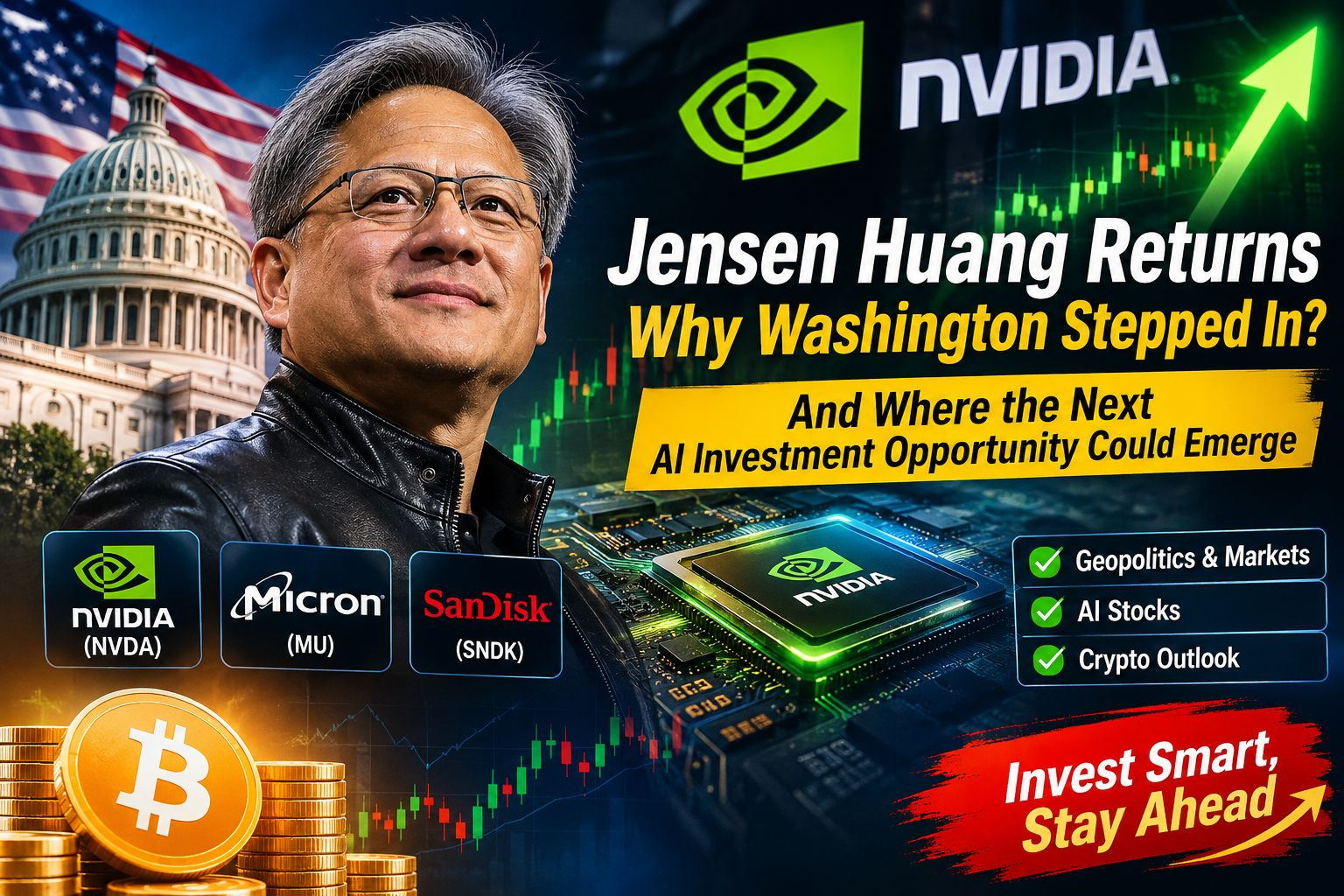

Geopolitics, Institutional Capital & The Next AI Trade | NVDA, MU, SNDK
What happens when one CEO’s return can move the entire US stock market? It tells us something important: AI is no longer just a technology business. It has become a matter of economic power, national security and global capital allocation.
On November 23, 2026, Nvidia’s board unanimously reinstated Jensen Huang as president, CEO and board member, just 11 days after his departure. Colette Kress returned to her role as CFO, while Harvey Jones remained chairman.
The company also established a committee to investigate an alleged foreign intelligence operation targeting Huang. The decision reversed the board’s November 17 position that it had no intention of bringing him back.
Markets responded immediately. Nvidia shares surged nearly 30% in premarket trading before closing November 23 at $165.05, up 31.48%. Nasdaq and S&P 500 futures also rallied sharply.
But the real story goes beyond a CEO returning to his office.
Why did $NVDA ’s leadership become important enough to attract attention at the highest levels of US political power? And what does this mean for investors positioning themselves in AI stocks and crypto?
1. Nvidia Is No Longer Just Another Technology Company
History offers an important lesson: technological leadership and national power have always been closely connected.
During World War II, radar, nuclear research and advanced computing became essential parts of national security. During the Cold War, semiconductor technology and space research became strategic assets in the competition between Washington and Moscow.
Today, artificial intelligence and advanced semiconductors occupy a similar position.
Nvidia’s GPUs power AI data centres, cloud computing, advanced language models and several defence-related applications. Its technology has become a critical part of the infrastructure supporting the next generation of computing.
That makes leadership stability at Nvidia more than a corporate governance issue.
For the United States, maintaining an advantage in advanced computing has economic, industrial and strategic implications. Losing technological leadership could affect everything from productivity growth to military capabilities.
This helps explain why Huang’s return attracted attention beyond Nvidia’s shareholders.
2. Washington’s Involvement: The Geopolitical Calculation
The most interesting part of this episode is the connection between corporate leadership and national security.
The United States and China are competing for influence over the future of AI. Advanced chips are at the centre of that competition.
Washington wants American semiconductor companies to remain globally competitive. At the same time, it wants to control access to technologies that could strengthen the military and strategic capabilities of potential rivals.
This creates a difficult balance.
Nvidia needs international customers, global supply chains and continued investment in research. The US government, however, must consider where its most advanced technology ends up and how it might be used.
The investigation into alleged foreign intelligence activity involving Huang adds another layer to this issue. The allegations should not be treated as established facts. The investigation itself, however, highlights how closely corporate leadership and national security can now intersect.
For investors, this changes the way Nvidia should be evaluated.
Revenue growth and earnings remain important. But export restrictions, government policy, geopolitical tensions and corporate governance deserve equal attention.
A company can report strong financial results and still face significant risks because of decisions made in Washington or Beijing.
3. Institutional Capital: Why Nvidia Can Move the Entire Market
There is a financial reason Nvidia has such a powerful influence on US equities.
Large institutional investors do not operate in isolated markets. Pension funds, sovereign wealth funds, ETFs, hedge funds and asset managers often hold Nvidia alongside other major technology companies.
When Nvidia experiences a major price movement, portfolio valuations and index performance can change quickly.
One detail is worth clarifying: Nvidia’s S&P 500 weighting was not accurately described as 8% in the original report. Its weighting was approximately 5.09% before the November 23 rally, based on the referenced holdings data. The sharp increase in its market value subsequently raised that weighting.
On November 23, Nvidia added approximately $952 billion in market value. The S&P 500 gained 4.73%, while the Nasdaq Composite advanced 6.51%.
That is a remarkable demonstration of concentration risk.
Investors buying an S&P 500 ETF are not allocating equal amounts to 500 companies. Market-cap weighting gives the largest companies considerably more influence.
As a result, Nvidia can materially influence the performance of an index fund even when hundreds of other companies are moving in different directions.
The lesson is straightforward: index investing does not eliminate concentration risk.
4. From NVDA to $MU and $SNDK : Where Could the Next AI Opportunity Emerge?
The next investment question is not simply whether Nvidia can continue rising.
It is where the next wave of AI spending will flow.
AI infrastructure requires much more than GPUs. It needs high-bandwidth memory, advanced storage, networking equipment, electricity and increasingly sophisticated data centres.
This brings two companies into focus: Micron Technology (MU) and SanDisk (SNDK).
Micron (MU): The Memory Behind AI Computing
Advanced AI processors require high-bandwidth memory to handle enormous volumes of data efficiently.
Micron is an important participant in the HBM and DRAM markets. As AI models become more demanding, the need for faster and more efficient memory could create additional opportunities.
However, investors should monitor HBM production capacity, customer demand, pricing and gross margins.
Strong industry demand does not automatically guarantee attractive stock returns.
SanDisk (SNDK): The Growing Importance of AI Storage
AI systems generate and process enormous quantities of data.
That data needs to be stored, accessed and managed efficiently. This is where NAND flash and enterprise SSD technology become increasingly important.
SanDisk operates in this storage market.
If AI data-centre investment continues expanding, demand for enterprise storage could benefit. But NAND pricing cycles, supply conditions, inventory levels and profitability will determine how much of that demand translates into earnings growth.
The distinction matters.
Nvidia, Micron and SanDisk are connected to the same AI investment cycle, but they have different business models and different risk profiles.
Investors should evaluate them separately rather than assuming they will always move together.
5. The Connection Between Geopolitics, AI Stocks and Crypto
At first glance, Nvidia’s leadership change may appear unrelated to Bitcoin and the wider crypto market.
The connection becomes clearer when we look at institutional capital and global liquidity.
First: Institutional Risk Appetite.
When major technology stocks experience sharp losses, institutional investors may reduce exposure to other risky assets. Bitcoin and high-beta altcoins can also face selling pressure.
When confidence returns, capital may gradually move back into risk assets.
Second: Interest Rates and Liquidity.
Geopolitical uncertainty can influence Treasury demand, bond yields and the US dollar.
Higher yields can make speculative assets less attractive. Expectations of lower interest rates and improving liquidity can support demand for Bitcoin and other risk-sensitive assets.
Third: Technology Infrastructure.
AI and crypto both depend on computing infrastructure, electricity and data centres. However, increasing AI demand does not automatically make crypto mining more profitable.
Mining economics still depend on electricity costs, network difficulty, hardware efficiency and Bitcoin prices.
The important takeaway is that Nvidia does not directly determine Bitcoin’s price. Its influence comes through broader changes in market sentiment, institutional positioning and financial conditions.
That is why crypto investors should monitor the Nasdaq, Treasury yields, the dollar and institutional fund flows alongside Bitcoin's own market structure.
6. The Investment Map: How a Political Decision Reaches Your Portfolio
The chain of influence is worth understanding:
US–China Technology Competition
↓
Export controls, national security decisions and government intervention
↓
Nvidia Leadership and Policy Stability
↓
AI Semiconductor Investment
NVDA, MU and SNDK
↓
Institutional Capital Allocation
ETFs, pension funds, hedge funds and sovereign wealth funds
↓
Global Liquidity and Risk Appetite
Dollar, Treasury yields and capital rotation
↓
Portfolio Impact
Bitcoin, altcoins, technology equities and gold
This is how a political decision can eventually affect an ordinary investor's portfolio.
The effect is not automatic, and each stage can introduce new risks. But understanding this chain provides a better framework for analysing global markets than following individual headlines.
7. Practical Investment Strategy: What Should Investors Watch?
In the current environment, I would focus on three areas.
NVDA: Watch whether the rally can hold, along with earnings guidance, demand for advanced GPUs and US export restrictions. Avoid chasing a sharp price increase without examining valuation and market structure.
MU and SNDK: Monitor HBM demand, NAND pricing, production capacity, inventory and gross margins. The key question is whether actual earnings growth can support current market valuations.
BTC and Altcoins: Follow Bitcoin's market structure, ETF flows, the US Dollar Index, Treasury yields, open interest and liquidation levels. A rising Nasdaq alone is not enough to justify aggressive altcoin exposure.
One additional point deserves attention: holding several AI-related stocks does not necessarily mean having a diversified portfolio. Their business models differ, but they may still depend on the same broader AI spending cycle.
Position sizing, stop-loss discipline and sufficient cash reserves remain essential.
Final Thoughts: The Next AI Trade May Be Bigger Than Nvidia
Jensen Huang’s return has temporarily reduced uncertainty surrounding Nvidia’s leadership. But it has not eliminated the broader risks facing the semiconductor industry.
US–China tensions, export restrictions, corporate governance and the possibility of excessive AI investment remain important variables.
The November 23 rally demonstrated just how much influence Nvidia has over the broader financial market.
But the next opportunity may not necessarily come from buying the biggest AI stock after a major rally.
It may come from identifying where institutional capital moves next: high-bandwidth memory, enterprise storage, data-centre infrastructure or other companies supporting the expansion of AI.
For crypto investors, the same principle applies. Understanding global liquidity and institutional risk appetite is often more useful than reacting to individual market headlines.
The real advantage belongs to investors who understand where capital is going before the market fully prices it in.
What do you think will lead the next phase of the AI investment cycle: Nvidia’s GPUs, Micron’s HBM memory, or SanDisk’s data-storage business? And could this institutional capital rotation eventually create another major opportunity in Bitcoin and altcoins?
Share your analysis in the comments.


#NVIDIAReinstatesJensenHuangasCEO #Geopolitics #CryptoAnalysis #altcoins #CryptoNewss