
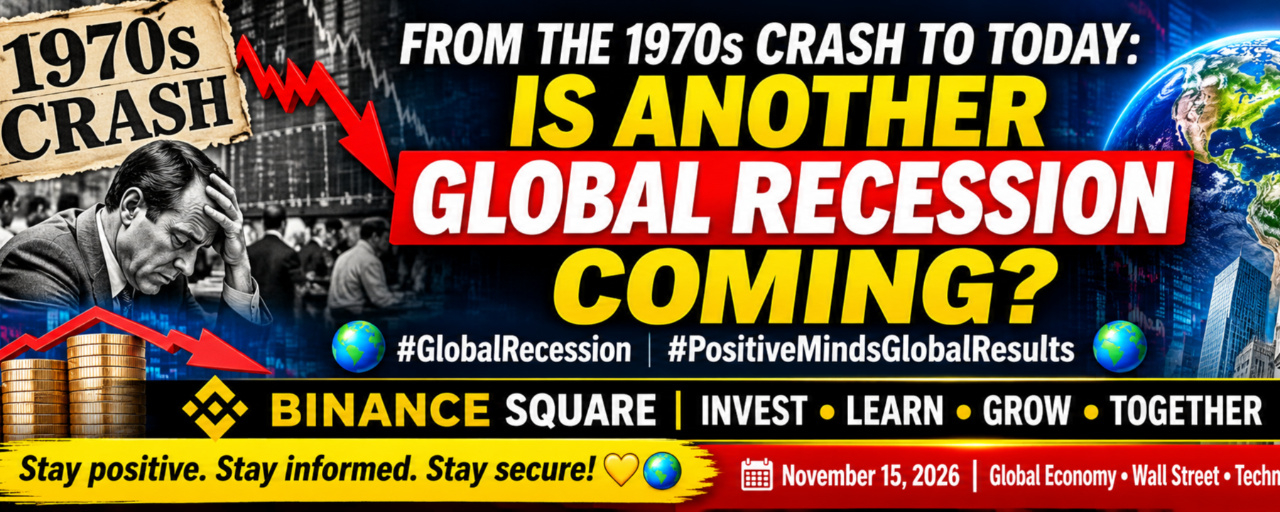

🌍 #GlobalRecession 🌍#PositiveMindsGlobalResults
BINANCE SQUARE | INVEST • LEARN • GROW • TOGETHER
Stay positive. Stay informed. Stay secure! 💛🌍
November 15, 2026 | Global Economy • Wall Street • Technology • Investment Risks
The global economy is facing an important question: Are today's financial pressures warning of another major economic downturn, or are markets simply experiencing a difficult period of adjustment?
History offers important lessons. The devastating US stock market decline of 1973–1974, the global recession of 2020, and Apple's costly Project Titan failure reveal three different risks that investors, businesses and policymakers should not ignore.
1. Are We Facing Another 2020-Style Global Recession?
The 2020 recession was an extraordinary economic shock caused by the COVID-19 pandemic, lockdowns and disruptions to international trade. Businesses closed, unemployment surged and governments introduced massive financial support programmers.
Today's economic environment is different. Investors are dealing with inflation concerns, elevated borrowing costs, geopolitical uncertainty, government debt and changing technology investment patterns.
Key concern: If consumer spending weakens while companies reduce investment and unemployment rises, economic pressure could spread across multiple regions.
However, a recession is not inevitable. Economic growth, employment, inflation and central-bank policy will determine whether current pressures develop into a broader downturn.
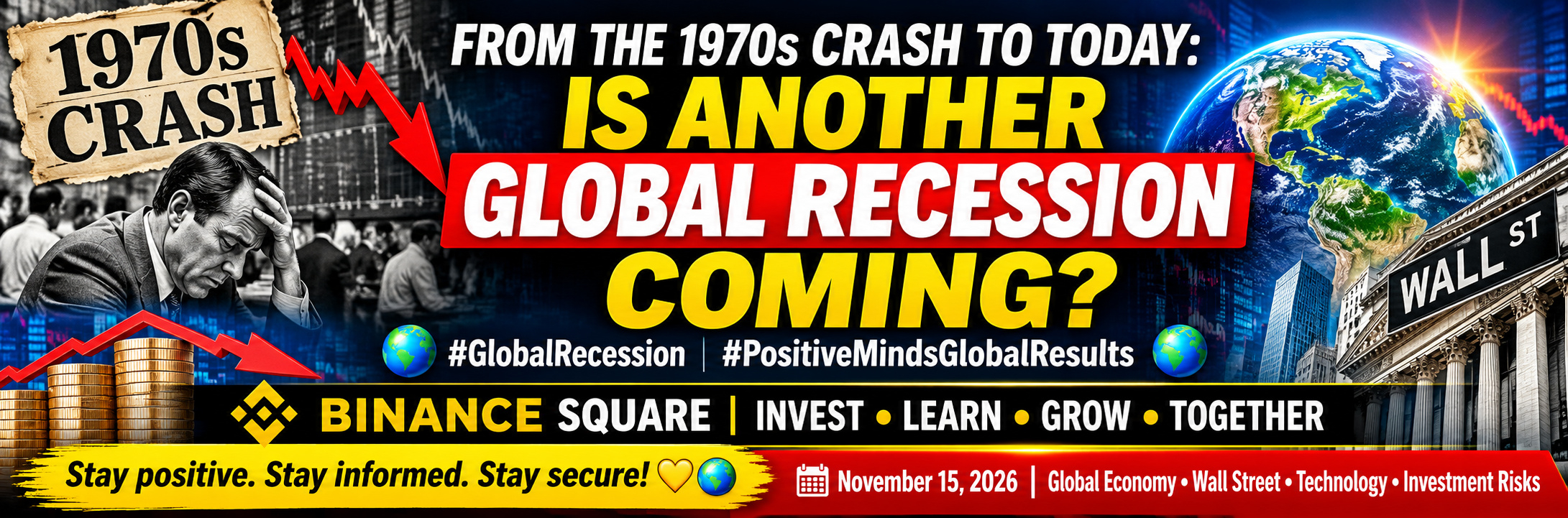
2. The 1973–1974 Wall Street Crash: A Warning From History
The US stock market experienced one of its most painful declines between 1973 and 1974, with the Dow Jones Industrial Average losing approximately 45% from its January 1973 peak to its December 1974 low.
The crisis was driven by a combination of the oil embargo, rising energy costs, inflation, economic stagnation and the collapse of investor confidence.
The episode became closely associated with stagflation — a dangerous combination of weak economic growth, high inflation and unemployment.
Important lesson: Financial markets can experience prolonged declines when inflation, energy disruptions and economic weakness occur together.
3. The Hidden Danger: AI Investment and a Possible Technology Bubble
One of the biggest differences between previous economic crises and today's environment is the enormous amount of capital flowing into artificial intelligence, semiconductors, cloud computing and data centers.
AI investment is supporting economic activity, but it also creates financial risks. If technology companies fail to generate the profits investors expect, valuations could fall and investment spending could slow.
The IMF has identified a reassessment of AI profitability and productivity expectations as a potential downside risk to global growth.
Key concern: A major AI investment correction could affect technology stocks, semiconductor manufacturers, international trade and economies dependent on technology exports.
4. What Could Trigger the Next Major Global Economic Downturn?
Several risks deserve close attention:
Higher interest rates: Expensive borrowing can reduce consumer spending, housing activity and business investment.
Energy market disruptions: Rising oil and gas prices can increase transportation, manufacturing and food costs.
AI investment correction: Disappointing returns could trigger technology-sector losses and reduce capital spending.
Government debt: Rising debt-servicing costs can restrict public spending and economic support.
Weak consumer confidence: When households reduce spending, businesses can face lower revenues, layoffs and declining investment.
These risks could reinforce one another, creating a much bigger economic problem than any single shock.
5. What Should Investors Watch Next?
Investors should look beyond daily stock-market movements and monitor several important indicators:
US unemployment and job creation.
Inflation and central-bank interest-rate decisions.
US Treasury yields and government borrowing costs.
Corporate earnings and AI-related capital expenditure.
Global oil prices and international trade.
Bitcoin, Ethereum and broader cryptocurrency market liquidity.
A combination of deteriorating employment, weaker corporate earnings, falling consumer demand and tightening financial conditions would be a more serious recession warning than a temporary stock-market correction.
6. What Does This Mean for Bitcoin, BNB and Ethereum?
Cryptocurrency markets are not isolated from the global economy. Bitcoin, BNB and Ethereum can face additional selling pressure when investors reduce exposure to risky assets.
However, the relationship is not always straightforward. Lower interest rates and increased liquidity could eventually support digital assets, while persistent inflation and restrictive monetary policy could create further challenges.
Investors should distinguish between short-term price movements and long-term fundamentals, particularly during periods of economic uncertainty.
🌍 FINAL EDITORIAL VIEW: HISTORY DOES NOT REPEAT EXACTLY, BUT FINANCIAL RISKS CAN RETURN
The 1973–1974 market collapse demonstrated how energy shocks and inflation can damage investor confidence. The 2020 recession showed how quickly an unexpected global crisis can disrupt businesses, employment and international trade. Apple's Project Titan provides another important lesson: even extraordinary financial resources cannot eliminate strategic and execution risks.
Today's global economy is not necessarily heading towards another 2020-style recession. The IMF's October 2026 outlook still projects positive global growth of 3.1% in 2026 and 3.4% in 2027.
Nevertheless, the combination of energy uncertainty, high borrowing costs, government debt and concentrated AI investment deserves serious attention.
My view: The biggest danger is not simply a stock-market crash. It is the possibility that several economic weaknesses develop simultaneously and turn a market correction into a wider global economic crisis.
The smartest investors are not those who predict every market movement. They are those who understand risk, protect capital, diversify sensibly and prepare for uncertainty.
⚠️ DISCLAIMER
Disclaimer: This article is for educational and informational purposes only. Economic scenarios are not guaranteed predictions or financial advice. Always conduct independent research (DYOR) and assess your own risk tolerance before making investment decisions.
#GlobalEconomy #GlobalRecession #stockmarket #WallStreet #AIInvestment #AppleProjectTitan #Bitcoin #Ethereum #BNB #CryptoMarket #FinancialMarkets #PositiveMindsGlobalResults