
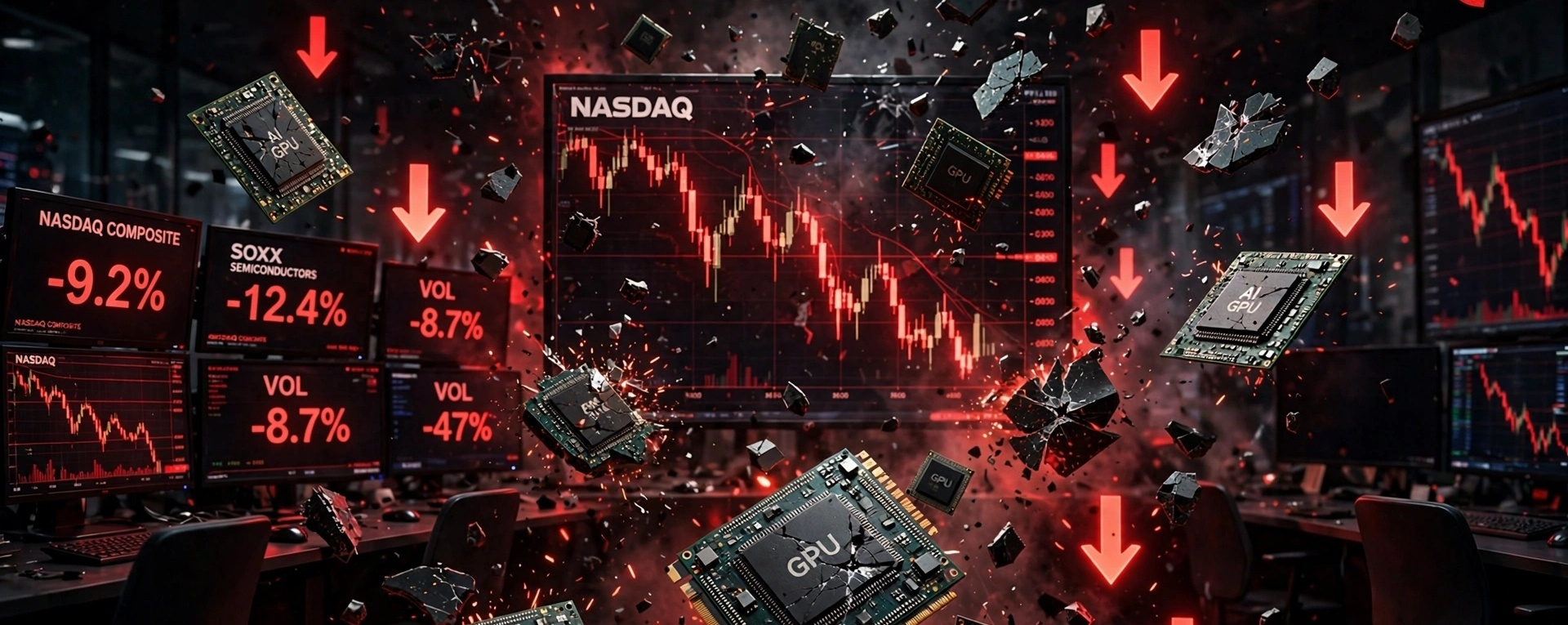

#AIChipSlumpNasdaq $2.5 trillion lost in one day — Is the AI bubble bursting? If you went to bed early on November 5, you might have missed a significant decline in the Nasdaq, the largest since April 2025. The Nasdaq Composite fell 5.52% to 24,315 The Nasdaq-100 fell 6.36% The S&P 500 declined 4.36% The Dow dropped 3.44% The Nasdaq is now officially in correction territory, down over 10% from its record high on October 6. The primary cause of this decline was one sector: AI chips. Nvidia (NVDA): -9.26% — Lost over $400 billion in one day, closing at $181.60 AMD: -17.26% — Despite recording its best quarter ever, with $13.38 billion in revenue, a 44.7% year-over-year increase Micron: -17.46% SanDisk: -22.26% Broadcom: -10.43% Intel: -10.33% ARM: -13.08% Qualcomm: -9.49% The Philadelphia Semiconductor Index fell 12.3%, marking the worst day since the COVID crash in March 2020. All 30 chip stocks closed in negative territory. 1. **US Midterm Election Results** Democrats won the midterms. The market is now concerned about potential new regulations, moratoriums, and delays on new AI data centers in states like Texas, Georgia, and Ohio. UBS estimates that 30% of the expected 2028 US data center additions could face delays. Goldman Sachs suggests that up to 45% of planned capacity may be affected. 2. **Doubts About AI Spending** Large tech companies are investing hundreds of billions in AI infrastructure. Investors are now questioning when this investment will yield returns. While hyperscalers saw a rise on Wednesday with hopes for slower capital expenditures, chips faced a decline on Thursday due to concerns regarding weaker demand. The market is currently uncertain. 3. **Weak Forecasts** Qualcomm reported a 26% year-over-year decline in smartphone chip sales, which undermined confidence across the sector. When a major chip company provides a weak outlook, it often leads to broad selling in the industry. AMD's data center revenue surged 97% year-over-year to $8.55 billion. Demand remains active. Nvidia's earnings report is scheduled for November 17, which will serve as a key indicator. This was not a fundamental collapse; it was driven by a valuation reset, political concerns, and a reduction in crowded positions. The AI trade had become overly saturated, with investors heavily positioned in stocks like NVDA, AMD, and MU. When anxiety arose, many rushed to sell. 1. When the Nasdaq declines, Bitcoin typically follows. A risk-off approach often leads to sell-offs in crypto first. 2. However, during financial panic, savvy investors tend to accumulate assets. 3. Keep an eye on Nvidia's earnings on November 17. A positive report could lead to rebounds in both the Nasdaq and crypto markets, while a negative outcome could result in further declines. - Panic sell your BTC/ETH at a loss - Leverage long positions to try to catch the bottom - Invest all your money in every dip - Hold cash and wait for confirmation before making decisions - Dollar-cost average slowly with small amounts instead of going all-in - Monitor two key levels: Nasdaq support at 24,000 and Bitcoin support at $95,000 - Focus on macroeconomic trends rather than influencers This is not the conclusion of AI; it is the end of uncritical AI enthusiasm. Companies that have substantial revenue will endure, while those driven by hype may not survive. Typically, every bull market experiences 2-3 corrections of 10-15%. This is one of those instances. Weaker investors are exiting, while stronger ones are accumulating. Is this the burst of the AI bubble or a great buying opportunity for 2026? Comment: or Share this with anyone who invested in NVDA at its peak. For further insights on macroeconomics and crypto, follow for data-driven analysis without hype. This is not financial advice. Conduct your own research. This is for educational purposes only.
Присоединяйтесь к пользователям криптовалют по всему миру на Binance Square
⚡️ Получайте новейшую и полезную информацию о криптоактивах.
💬 Нам доверяет крупнейшая в мире криптобиржа.
👍 Получите достоверные аналитические данные от верифицированных создателей контента.
Эл. почта/номер телефона