


Many first-time buyers think the USDT becomes theirs the moment their ₹10,000 leaves the bank over UPI. It doesn't. The coins were locked in escrow when the order opened, and they move to you only after the seller confirms that the rupees arrived.
Here is the whole route in one go. Verify your Binance account and turn on 2FA, open P2P, choose Buy, USDT and INR, filter the ads by UPI or IMPS, and place an order. Then send the exact amount from a bank account in your own name to the details shown inside that order, tap Transferred, Notify Seller, and wait for the release to your Funding wallet. If nothing arrives in time, you appeal from the order page.
👉 Create a Binance account for INR P2P
The questions below follow the order a first INR order raises them. Rupee prices and amounts are illustrations, not quotes.
What does the P2P page ask for before you can buy?
Binance asks for completed identity verification and at least one two-factor method before P2P trading opens. Have these ready too.
A bank account in your name: The name on your Binance account and on the account the rupees leave from should be the same person.
A working UPI ID or IMPS access: Test a small transfer to someone you know if the UPI app or phone is new.
Your bank's own caps: Many banks hold a fresh UPI registration or a new beneficiary to a low limit for the first day.
UPI, IMPS or a bank transfer, which rail fits your first order?
Each INR ad lists the methods it takes. Three matter for a first buy.
UPI: Arrives in seconds and only needs the seller's UPI ID. The standard NPCI ceiling for a person-to-person UPI transfer is ₹1 lakh, and your bank may set a lower one.
IMPS: Also instant and available round the clock, using account number and IFSC. NPCI allows up to ₹5 lakh per transaction on most channels, while banks set their own lower limits and often a cooling period for new beneficiaries.
Bank Transfer (India): Usually NEFT, which settles in half-hourly batches and can take longer to show up. That is a poor fit for a 15-minute order timer.
For ₹5,000 to ₹50,000, UPI is the easy pick. Above the UPI cap, IMPS sends the full amount in one go, which keeps the seller from having to match several transfers.
Some INR ads also carry an automatic-release tag for UPI, where Binance releases the coins once the transfer is detected. On ordinary ads a person checks their bank app first, so allow a few minutes.
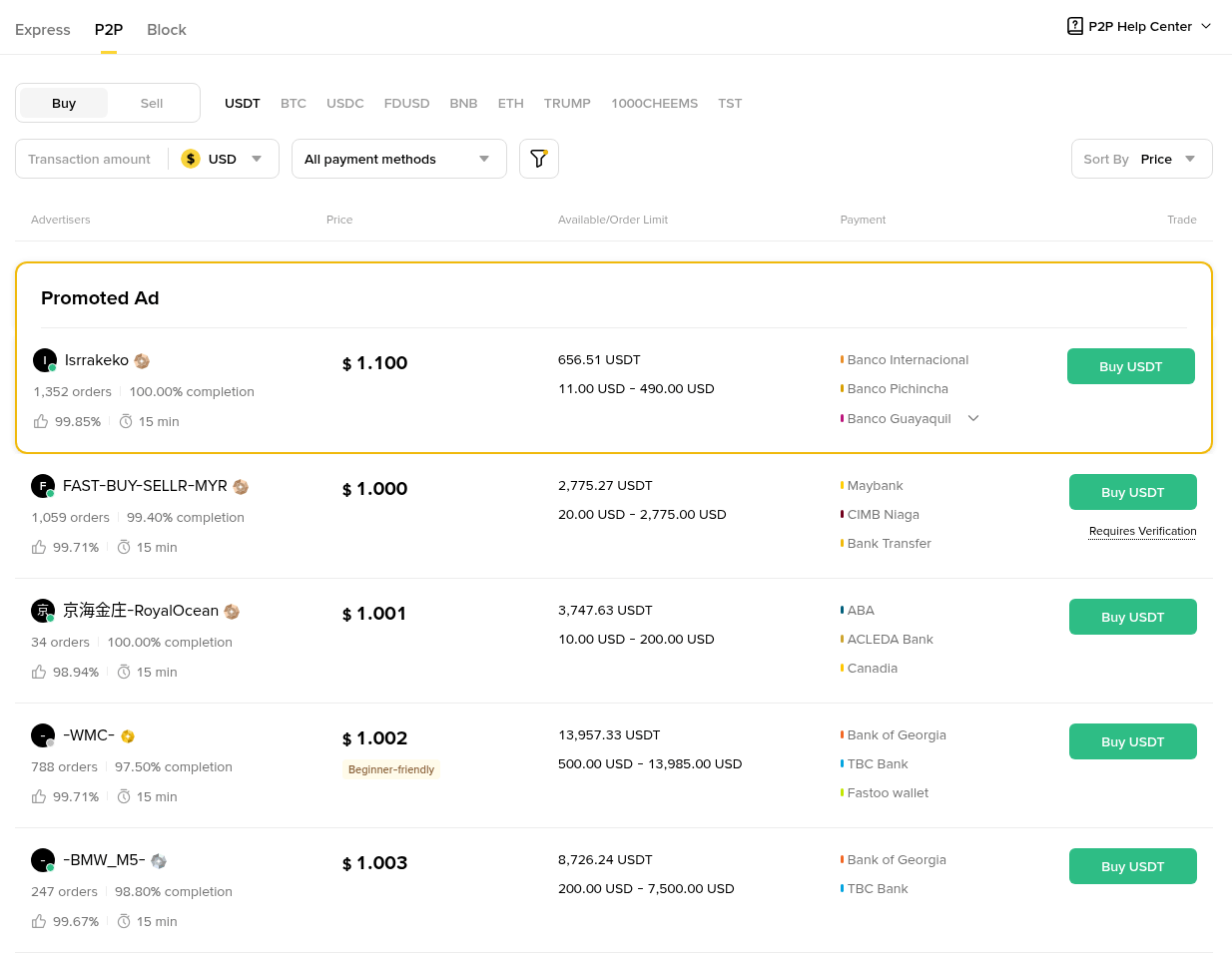
How do you read an INR ad before tapping Buy?
Each row carries six things to check.
Price: Rupees per 1 USDT, set by the advertiser and changing through the day.
Available and limits: How much USDT the seller holds on that ad and the smallest and largest rupee order allowed. An ad with a ₹40,000 minimum won't take your ₹10,000.
Methods: The rails the seller accepts. Filter by UPI or IMPS so you only see ads you can actually complete.
Time limit: 15, 30 or 60 minutes to send the money after the order opens.
Track record: Order count, completion rate and positive feedback. A seller with 2,000 orders at 99.8% has a long visible history.
Extra conditions: Tags such as Requires Verification, plus the seller's written terms, which open before you confirm.
Now a worked comparison. Say you want to spend ₹10,000 and two ads look similar.
Ad A at ₹97.45: ₹10,000 ÷ 97.45 = about 102.61 USDT.
Ad B at ₹97.80: ₹10,000 ÷ 97.80 = about 102.24 USDT.
The gap is roughly 0.37 USDT, close to ₹36. If Ad B's seller has ten times the order history, that ₹36 can buy a calmer first trade.
Binance's P2P announcements list a 0% fee for takers, the side that answers an existing ad, so the real cost of a buy sits in the price. Check the P2P fee rate page for INR before you rely on that.
What happens in the first fifteen minutes after you place the order?
Here is a timed example for that ₹10,000 at ₹97.45 on an ad with a 15-minute limit.
21:02, order placed: 102.61 USDT from the seller is now locked by the platform. Neither side can move it while the order is open.
21:03, open the bank details: Copy the UPI ID or account number from inside the order. Check that the account holder's name matches the seller's verified name.
21:05, send ₹10,000: One transfer, the exact amount, from your own account. Save the 12-digit UTR or reference number your UPI app shows.
21:06, tap Transferred, Notify Seller: The order moves to Releasing. Never tap this before the money has actually left your account.
21:06 to 21:15, wait: The seller checks their bank app. Posting your UTR in the order chat helps.
Release: 102.61 USDT shows in your Funding wallet and the order closes as completed.
Two rules from Binance's own guide sit behind this timeline. Don't cancel an order after sending money unless the seller has refunded you, because cancelling hands the locked coins back to the seller. And cancelling three orders in one day suspends buying for the rest of that day.
Which account settings should be on before you trade?
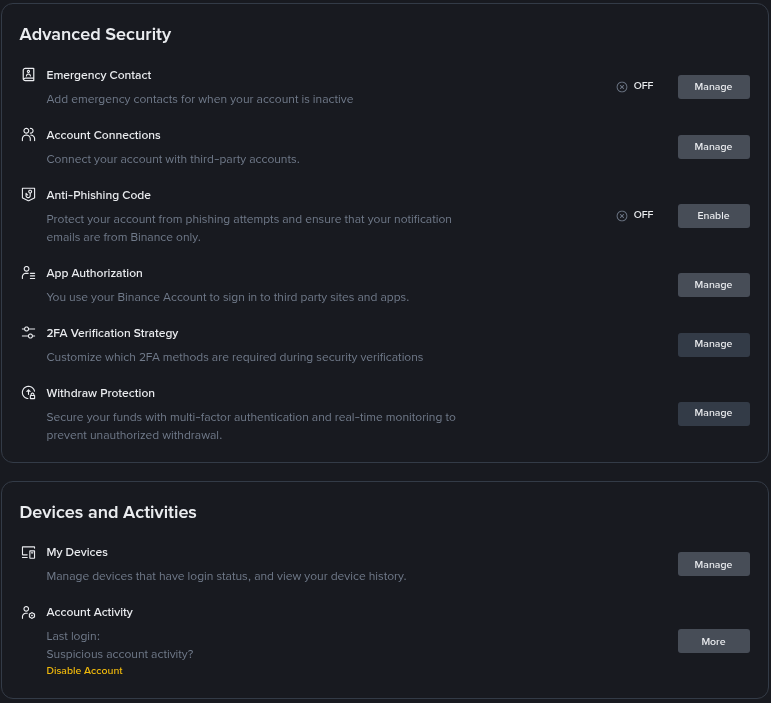
Many P2P scams start with a fake email saying an order was released or flagged. Three settings help.
Anti-Phishing Code: Every genuine Binance email then carries a word you chose. An email about your order without it is fake.
Withdraw Protection: Adds extra checks before coins can leave your account, which matters once USDT sits in it.
My Devices: Shows which phones and browsers are signed in. Remove any you don't recognise before your first trade.
What if the seller hasn't released after you sent the rupees?
Confirm your UPI app shows success and the order says Releasing. If both are true and the timer runs out, work from the order page.
Message the seller: Post the UTR and transfer time in chat. Many delays are a seller away from the phone.
Open an appeal: Tap Help, then Appeal, pick the reason and attach a screenshot of the successful transfer with the UTR visible.
Wait out the reply window: The seller gets 10 minutes to answer. If they don't, the case goes to Binance customer support for review.
Leave the order alone: Don't cancel it while the appeal runs. The locked USDT stays in escrow until support decides.
If you later find a past order that went wrong, this collection of fixes for bank statement problems after P2P trades and deposits covers the paperwork side, such as names that don't match.
What if the seller asks you to send money somewhere else?
Stop. A request in chat to use a different UPI ID, a relative's account or a "company" account is the most common setup for a dispute you can't win.
Only use details inside the order: Anything typed in chat or sent on WhatsApp or Telegram is outside the protection of the order.
Names must match: The receiving account should belong to the verified seller. A third name is a reason to cancel before you send anything.
What if your UPI transfer failed or shows as pending?
A pending UPI transfer is not money the seller has. Don't tap Transferred, Notify Seller on a pending status.
Watch the timer: If it's close to expiring and the status is still unclear, let the order lapse rather than sending a second transfer.
Debited but failed: Failed UPI debits normally reverse to your account on their own. If they don't, raise it with your bank using the UTR.
What if you sent the wrong amount?
Sent too much: You sent ₹10,100 instead of ₹10,000. Say so in chat, ask the seller to return the ₹100 to the same account, and keep the screenshots. If they refuse, mention it in an appeal.
Sent too little: You sent ₹9,000. Don't tap Transferred yet. Ask in chat whether the seller accepts a second transfer of ₹1,000 or prefers a refund of the ₹9,000.
Where does the USDT land, and what comes next?
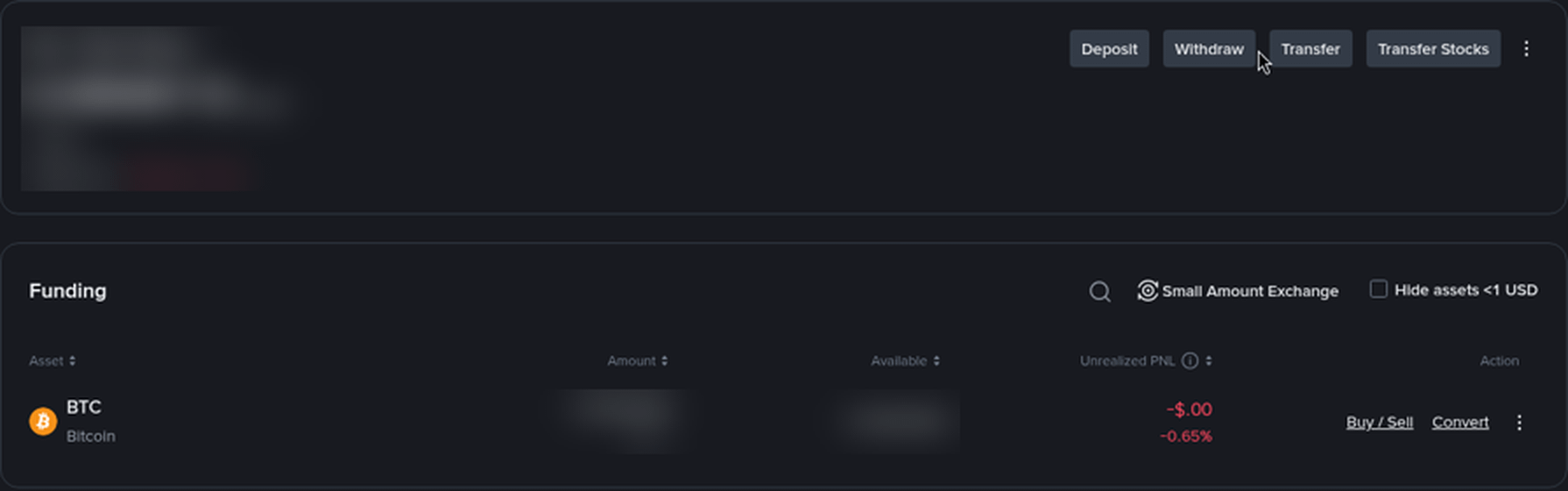
P2P purchases go to the Funding wallet, not to Spot. From there you have three normal options.
Keep it in Funding: Nothing else to do.
Move it to Spot: Use Transfer, from Funding to Spot, if you want to place a Spot order. This internal move is free and instant.
Withdraw to your own wallet: Check the network and the address twice, and send a small test amount first.
Keep the completed order, the UTR and the chat. If you sell this USDT later, the purchase price in rupees becomes your cost for tax.
Does the buyer owe 1% TDS on a P2P purchase?
Under Indian rules, yes, once yearly totals cross a threshold. CBDT Circular 14 of 2022 says that in a buyer-to-seller deal, the person sending the money deducts the 1% TDS on the purchase of a virtual digital asset. Binance P2P ads are commonly reported as not having this deducted by Binance, so the duty sits with you as the buyer.
Thresholds: A "specified person", which covers most salaried people, owes nothing while yearly purchases stay at or under ₹50,000. Other buyers have a ₹10,000 limit.
The law since 1 April 2026: The duty now sits in Section 393(1) of the Income-tax Act, 2025, at the same 1%.
Filing it: A specified person uses Form 141, Schedule D, with their PAN and no TAN, due 30 days after the month in which the tax was cut. It replaced Form 26QE.
What the seller gets: The deducted amount shows as a TDS credit in the seller's Form 26AS and AIS.
Two illustrations for tax year 2026-27, with made-up amounts.
Small buyer: Rohan, salaried, buys ₹10,000, ₹15,000 and ₹20,000 of USDT across the year. The total is ₹45,000, under ₹50,000, so no TDS arises.
One larger order: Ananya, salaried, places a single ₹60,000 order. 1% is ₹600, so the seller would receive ₹59,400 and Ananya would deposit ₹600 through Form 141 using the seller's PAN.
Here is the practical catch. A P2P order expects the exact amount, and ₹59,400 against a ₹60,000 order looks like a short transfer to a seller. Agree on the deduction in chat before you place the order and collect the seller's PAN, or stay with order sizes that keep your yearly total under the threshold. How earlier purchases count once you cross ₹50,000 is a question for your CA.
Selling USDT later is a separate taxable transfer in India, taxed at 30% plus cess on the gain, with no set-off for losses. If you want to see the record-keeping logic behind a sale, a swap or a reward, these worked examples of how sales, swaps and rewards are handled walk through it step by step, though the rates there are not India-specific.
Why do bank accounts get frozen after P2P trades in India?
Money from a cyber fraud often passes through several "mule" accounts before someone uses it to buy crypto on a P2P market. When the victim complains on cybercrime.gov.in or the 1930 helpline, police trace the money and ask banks to block every account it touched.
Sellers carry most of this risk because they receive rupees from strangers. Buyers meet it the day they sell. Courts in Delhi and Kerala have said a lien on the disputed amount should come before freezing a whole account, yet blanket freezes still happen.
Keep P2P on one account: Not your salary account, so a freeze doesn't stop rent and bills.
Pick long histories: Counterparties with many completed orders and verified names lower the odds of mule money.
Archive every order: Order number, chat, UTR and the counterparty's verified name.
If a freeze hits: Ask your bank in writing for the police station or cyber cell, the complaint number and the amount involved, then reply to that officer with your records and speak to a lawyer.
Does Binance share data with Indian authorities?
In 2024 FIU-IND, the Financial Intelligence Unit under India's finance ministry, added Binance as a reporting entity under the anti-money-laundering law. This followed an FIU-IND fine of ₹18.82 crore for operating in India without that registration. As a reporting entity it files reports such as suspicious transaction reports. That registration is about money-laundering reporting, nothing more.
Which mistakes cost INR buyers money on their first order?
Tapping Transferred early: Marking the order before the UPI transfer succeeded.
Cancelling after sending: Giving up the escrow while your rupees sit with the seller.
Chasing the lowest price: Picking a brand-new advertiser to save ₹20 on a ₹10,000 buy.
Using someone else's account: A sibling's UPI ID that doesn't match your Binance name.
Ignoring TDS: Crossing ₹50,000 for the year without a plan for the 1%.
No account yet? The sign-up link near the top uses GETREWARD. The new-user bonus terms on Binance describe task-based rewards worth up to $19,800 for users who qualify.
Treat this page as general information, not tax or financial advice. Prices, limits and Indian tax rules move, so confirm figures in the app and ask a CA about your own case.
FAQ
Can I use my spouse's or parent's UPI ID for a P2P buy?
It is a common cause of rejected orders and disputes. Send from an account in the same name as your verified Binance account.
What is the smallest INR order I can place?
Each advertiser sets a minimum, and some start around ₹200 while others want ₹40,000 or more. Filter by your amount to hide ads you can't use.
What does Requires Verification mean on an ad?
The seller wants extra checks before trading with you, for example a higher verification level. The details appear when you open the ad.
Can I reverse a UPI transfer after the seller released the USDT?
No. Trying to pull back money for a completed order is treated as fraud and can lead to a frozen account on your side.
Disclosure: GETREWARD, the code in the sign-up link above, is mine. Rupee prices, order sizes and TDS figures here are examples only, not quotes or forecasts.