


JPMorgan Chase, AMD, Coca-Cola and four other companies have barred tokenized versions of their shares from OKXICE, the planned venue for tokenized stocks from OKX and NYSE owner Intercontinental Exchange, in a notice dated Tuesday, October 27. That brings the objectors to 33 of the 62 companies the venue first named, worth roughly $17 trillion.
One group is missing from the list. Coinbase, Robinhood, Circle, and Strategy, the crypto stocks among the 62, have not objected, and their own businesses depend in part on putting assets on blockchains.
So why is Wall Street saying no while crypto companies stay in?
Who Has Blocked Tokenized Stocks on OKXICE?
More than half of the original list, and the pace has picked up. OKXICE’s first notice, dated October 4, named 63 stocks from 62 companies. Its October 19 notice listed 16 objectors. By October 27 there were 33, including Microsoft, Alphabet, Broadcom, Goldman Sachs, Wells Fargo, Oracle, Intel and IBM.
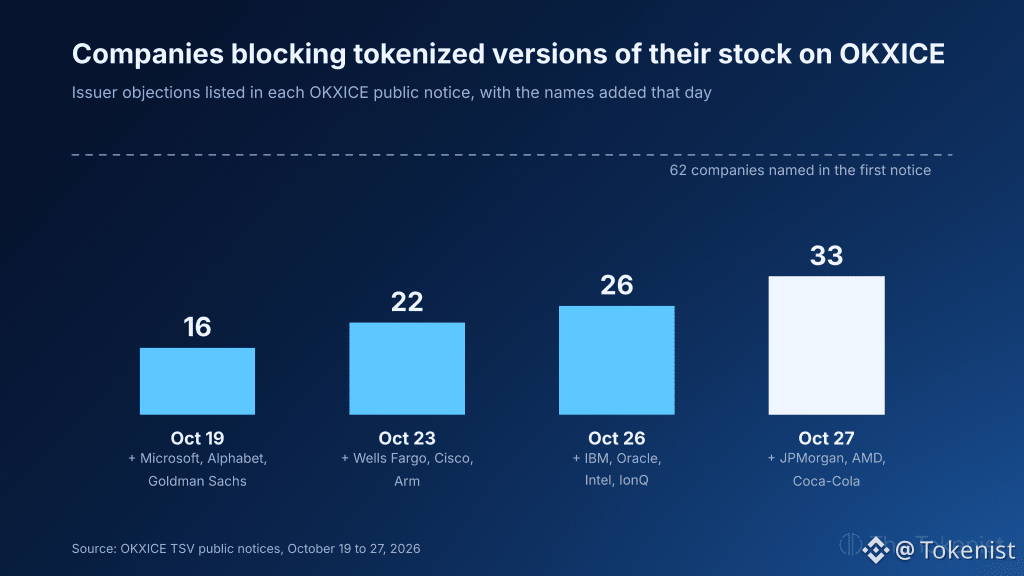
Issuer objections in each OKXICE public notice. Source: OKXICE
The latest seven were JPMorgan, AMD, Applied Materials, Coca-Cola, Adobe, Dell and SanDisk. JPMorgan stands out: it runs its own blockchain unit, Kinexys, and issues deposit tokens for institutional clients, but it still doesn’t want an outside firm tokenizing its shares.
$17 TRILLION worth of stocks now rejects TOKENIZATION. 7 more companies have objected to digital token versions of their shares on OKXICE: 1. JPMorgan $JPM: ~$890B 2. AMD $AMD: ~$870B 3. Coca-Cola $KO: ~$400B 4. Dell $DELL: ~$320B 5. Applied Materials $AMAT: ~$310B 6. Sandisk… https://t.co/jmvXXrkJt5
— Coin Bureau (@coinbureau) October 28, 2026
The rule behind the objections is simple. Under the SEC’s September 17 exemption, a venue that wants to list a stock tokenized by an unaffiliated third party must notify the issuer, which then has 30 days to object. An objection keeps that token off the venue. It doesn’t stop tokenized versions trading elsewhere.
On OKXICE, each token would be backed one-for-one by a real share held by a registered broker-dealer, carry the same dividends and voting rights, and trade around the clock against stablecoins on OKX’s X Layer network. OKXICE co-chair Andrew Cuomo called the objections a “natural response” from companies taking a wait-and-see approach.
Which Crypto Stocks Are Still on the Tokenized Stocks List?
All four of the best-known. Coinbase, Robinhood, Circle and Strategy were named in OKXICE’s first notice, and none appears among the 33 objectors. Custody firm BitGo and tokenization company Securitize were also on the list, Benzinga reported, and haven’t objected either.
Their shares have had a rough month regardless:
Company Ticker Close, Oct 27 Since Oct 2 Premarket, Oct 28 Coinbase COIN $161.09 −12.0% $157.50 Robinhood HOOD $94.56 −16.1% $88.90 Strategy MSTR $141.40 −11.6% $140.90 Circle CRCL $81.58 +0.4% $80.41
October 2 was the last trading day before the first notice. Prices: Yahoo Finance, premarket at 13:00 UTC.
Two of the objectors have crypto roots. CoreWeave began as an Ethereum miner and Applied Digital as a host for Bitcoin miners. Both now sell computing power to AI companies, and both were among the first nine to object.
Why Haven’t Crypto Companies Objected?
None of them has said, and staying off the list isn’t the same as signing up. OKXICE doesn’t say when each issuer was notified, so some 30-day windows may still be open. But objecting would sit awkwardly with what these companies sell.
Robinhood already offers its own Stock Tokens to customers in the European Economic Area. Robinhood Chain, its blockchain, handled more than $80 billion in decentralized exchange volume in its first quarter on mainnet, its third-quarter results show.
Circle issues USDC, one of the three stablecoins, with USDG and USDT, that tokenized stocks on OKXICE would trade against.
Coinbase wants to be “the everything exchange,” as Coinbase Institutional co-CEO Brett Tejpaul put it on Wednesday when it added Ripple’s RLUSD stablecoin.
The objectors haven’t explained themselves either. Their industry has, in part. SIFMA, the main Wall Street trade group, asked the SEC on October 19 to consider requiring companies’ consent before their shares are tokenized, a longer objection period, and a single opt-out that would apply to every venue. Questions about who counts as a shareholder, how votes and corporate actions pass through, and how much trading can move on-chain are still open.
Discover: SEC Filing Outlines 24/7 Plan for 63 OKX Tokenized Stocks
What Comes Next for Crypto Stocks?
Earnings, more than tokenization. Robinhood reported on Tuesday evening: revenue rose 12% to a record $1.42 billion and equity trading volume jumped 53% to $992 billion, but crypto revenue fell 55% to $120 million. Its shares were down 6% before Wednesday’s open, at $88.90.
Coinbase and Strategy report after the close on Thursday, October 29. With Bitcoin near $81,000, down about 36% from its October 2025 peak, both will be judged on how much the slower crypto market has cost them.
OKXICE, for its part, hasn’t set a launch date, and each new notice so far has added objectors. Of the 29 companies that haven’t objected, four are crypto stocks.
Discover: Bitcoin and Gold Are 2026’s Worst Asset Classes So Far, and Crypto Stocks Have Fared Worse: Can Coinbase and Strategy Earnings Change the Story This Week?
For tokenized stocks, the next OKXICE notice will show whether the objections keep coming. For crypto stocks, Thursday’s earnings will matter more.
The post JPMorgan and Coca-Cola Block Tokenized Stocks on OKXICE as Objectors Hit 33. Coinbase and Robinhood Stay Out of the List appeared first on Tokenist.