

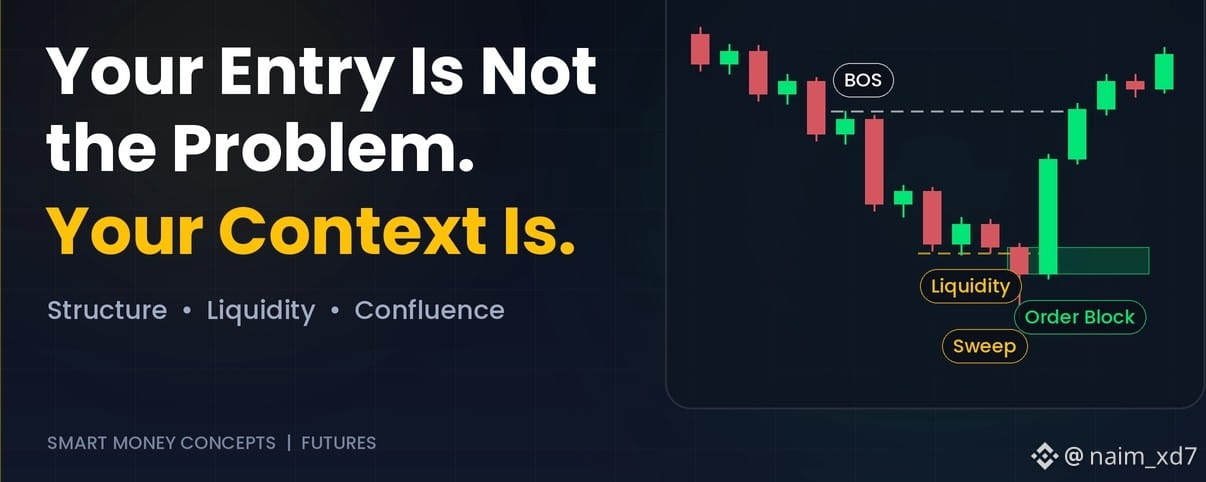

Most experienced traders can mark an Order Block or spot a Fair Value Gap.
So why do good-looking setups still fail?
Because the zone is not the trade. The context is.
1. Start with structure, not with the zone
An Order Block inside a clear Break of Structure is a setup.
The same Order Block against the higher timeframe trend is a trap.
Before any entry, answer two questions:
- What is the higher timeframe bias?
- Did price break structure with displacement, or just wick through a level?
If you cannot answer both, there is no trade yet.
2. Ask where the liquidity is
Price does not move to a zone because it is "support." It moves to where orders are sitting.
Equal highs, equal lows, and obvious swing points hold stop orders. Smart money needs that liquidity to fill size.
Strong setups often follow a liquidity sweep:
1. Price takes a high or a low
2. It rejects fast
3. It leaves a shift in structure and an imbalance behind it
A sweep followed by a shift is a story. A level touched by chance is not.
3. Confluence is a filter, not a decoration
One tool is an opinion. Several tools that agree are a case.
A clean setup usually has:
- Higher timeframe bias in your favour
- A liquidity sweep before the move
- A valid OB or FVG as the entry area
- Volume that supports the move, not just a thin spike
- A clear invalidation point
If one of these is missing, the setup should get smaller or get skipped.
4. The part most traders ignore: fees inside your RR
On Futures, the Risk-Reward you see on the chart is not the real one.
Example: your stop is 0.4% away. At typical taker rates, entry and exit fees plus slippage can cost around 0.1%.
That is 25% of your risk gone before price moves.
A trade drawn as 1:2 can really be closer to 1:1.5 after costs.
Over 100 trades, this is the difference between an edge and a slow leak.
Always measure RR after fees, not before.
5. Invalidation first, target second
Professional traders decide where they are wrong before they decide where they get paid.
Place your stop where the idea is no longer valid, not where the loss feels comfortable.
Then size the position from that stop, never the other way around.
6. How we filter setups at MarketX
We built MarketX around this exact process:
▪ Structure and bias check on higher timeframes
▪ Liquidity and OB / FVG confluence
▪ Volume confirmation
▪ Fee-aware Risk-Reward filter, so weak math never reaches you
▪ Clear Entry, Stop Loss and Target on every signal
▪ Results shown openly, wins and losses
We do not promise profits. We promise a process you can check.
450+ traders are already inside and the first live signals are coming soon.
Early members will see every signal from the very first one.
7. Final thought
The market does not reward the best drawing on the chart.
It rewards the trader with the best process, the best risk control, and the patience to wait.
⚠️ Not financial advice. Futures trading carries high risk and you can lose your capital. Do your own research.
#Binance #Futures #SmartMoneyConcepts #OrderBlock #RiskManagement