


Choosing where to keep your money and trade your assets is one of the most consequential decisions you make as an investor. Unlike a bad stock pick — where you lose money on one position — choosing the wrong platform can result in losing everything at once.
The crypto industry has provided enough cautionary examples to make this point clearly. FTX, Celsius, Voyager, and others collapsed not because of market conditions alone, but because of structural problems that were visible before the collapse — for investors who knew what to look for.
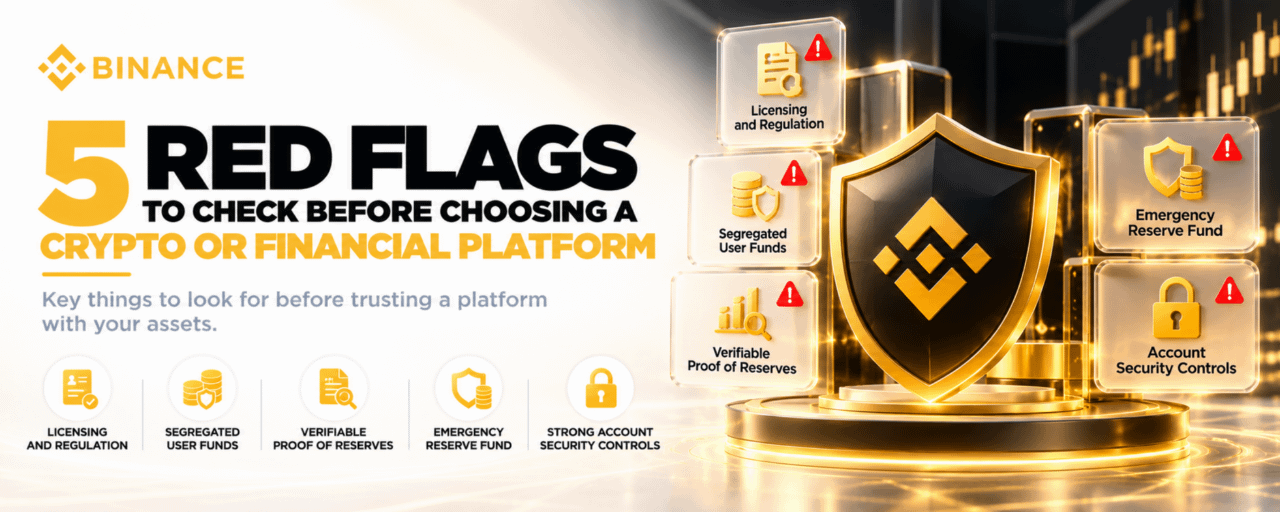
Here are five red flags to check before trusting any platform with your assets.
Red Flag 1: Unclear or Absent Licensing
A platform that cannot clearly explain where it is licensed, under what regulatory framework, and which regulatory body oversees it is a platform that has not done the compliance work that serious financial institutions do.
Licensing matters not because regulators are infallible, but because licensed entities are subject to ongoing oversight, capital requirements, and reporting obligations that create accountability. A platform operating entirely outside regulatory frameworks has made a choice about accountability — and that choice should factor into yours.
What to check: Look for the platform’s regulatory disclosures. Do they list specific licenses? Specific jurisdictions? Specific regulatory bodies? If the answer is vague — “we comply with applicable laws” without specifics — treat that as a warning sign.
What Binance does: Binance holds regulatory approvals or registrations across multiple jurisdictions including France, Italy, Spain, Poland, Sweden, Lithuania, Australia, Bahrain, Kazakhstan, and Abu Dhabi, among others. Each licensed entity operates under the specific requirements of its jurisdiction.
Red Flag 2: No Clear Separation Between User Funds and Platform Funds
The FTX collapse was, at its core, a fund commingling problem. User deposits were not held separately from the platform’s own operating capital — they were used for trading, loans, and operational expenses. When the platform needed liquidity, the user funds were already gone.
This is the single most important structural question to ask about any platform: are user assets held in segregated custody, separate from the platform’s own assets, in a way that would survive the platform’s insolvency?
What to check: Look for explicit statements about how user funds are custodied. Are they held in segregated accounts? Is there a named custodian? What happens to user funds if the platform files for bankruptcy?
What Binance does: User assets are held in custodial accounts separate from Binance’s operating capital. For Binance Stocks, the underlying shares are held by Alpaca Securities — a regulated U.S. custodian — entirely separate from Binance’s balance sheet. This structural separation means that even in an adverse scenario for the platform, the user’s equity holdings have a clear custody chain.
Red Flag 3: No Proof of Reserves — or Proof That Cannot Be Verified
In the aftermath of FTX, the industry developed a new standard: Proof of Reserves — cryptographic verification that a platform actually holds the assets it claims to hold on behalf of users. This is not an audit in the traditional sense. It is a mathematical proof that the on-chain holdings match or exceed the platform’s reported liabilities to users.
The key distinction is verifiability. A platform that publishes a PDF claiming their reserves are adequate is not providing Proof of Reserves. A platform that provides a Merkle tree verification — allowing individual users to verify that their specific balance is included in the total — is providing something that cannot be fabricated.
What to check: Does the platform publish Proof of Reserves? Is it based on Merkle tree verification that users can independently check? How frequently is it updated?
What Binance does: Binance publishes Proof of Reserves monthly, using Merkle tree verification. The most recent report shows coverage ratios above 100% for all major assets: BTC at 105.78%, ETH at 104.21%, BNB at 107.90%, USDT at 101.34%, USDC at 102.66%. Any user can verify that their own balance is included in the reported total.
Red Flag 4: No Emergency Reserve Fund for Users
Even a well-run platform can face unexpected security incidents. A Proof of Reserves that covers user balances is necessary but not sufficient — it does not address what happens if the platform suffers a security breach that results in asset loss.
Platforms that are serious about user protection maintain an emergency reserve specifically designated for protecting users in the event of a security incident. This fund should be pre-committed — not a promise to raise capital after the fact, but actual capital set aside before anything goes wrong.
What to check: Does the platform maintain a named emergency reserve fund for users? How is it funded? What is it designed to cover? Has it ever been used?
What Binance does: Binance maintains the Secure Asset Fund for Users — SAFU — which currently holds $1 billion in capital. SAFU is funded by a percentage of trading fees and is held in assets that are separate from user funds. It is explicitly designated for user protection in the event of a security incident.
Red Flag 5: Weak Account Security Controls
The platform-level protections described above address what happens if the platform itself is compromised or insolvent. But a significant portion of crypto losses come from individual account compromises — phishing attacks, SIM swaps, credential theft, and social engineering.
A platform that does not provide strong, layered account security controls is leaving a substantial portion of the risk unaddressed. And critically, the quality of the security tools a platform provides reflects something about its security culture — a platform that only offers SMS-based 2FA in 2026 has made a choice about how seriously it takes account security.
What to check: Does the platform offer hardware security key support? Authenticator app-based 2FA rather than just SMS? Anti-phishing codes so you can verify communications are genuine? Withdrawal address whitelisting so that funds can only be sent to addresses you have pre-approved? Account activity monitoring?
What Binance does: Binance provides passkeys, authenticator app-based 2FA, hardware security key support, anti-phishing codes embedded in all official communications, withdrawal address whitelisting, and real-time account activity alerts. Enabling all of these takes approximately fifteen minutes and substantially reduces the risk of account compromise from external attacks.
The Five-Question Checklist
Before trusting any platform with significant assets, ask these five questions:
Where is this platform licensed, and by which regulatory body? If the answer is vague, dig deeper or walk away.
Are user funds held in segregated custody, separate from the platform’s own capital? If the answer is unclear, the answer is probably no.
Does this platform publish verifiable Proof of Reserves, with Merkle tree verification? If not, you are taking the platform’s word for it.
Does this platform maintain a pre-committed emergency reserve for user protection? A promise to compensate users after the fact is not the same as capital set aside before.
What account security controls does this platform provide? If the answer is only a username and password, or only SMS-based 2FA, the platform is not serious about account security.
No platform is zero-risk. But the platforms that have done the work to answer these five questions clearly are the ones that have made their risk profile legible — and a legible risk profile is the foundation for an informed decision.
Disclaimer: This article is for educational purposes only and does not constitute financial or investment advice. Always conduct your own research before choosing a financial platform.