

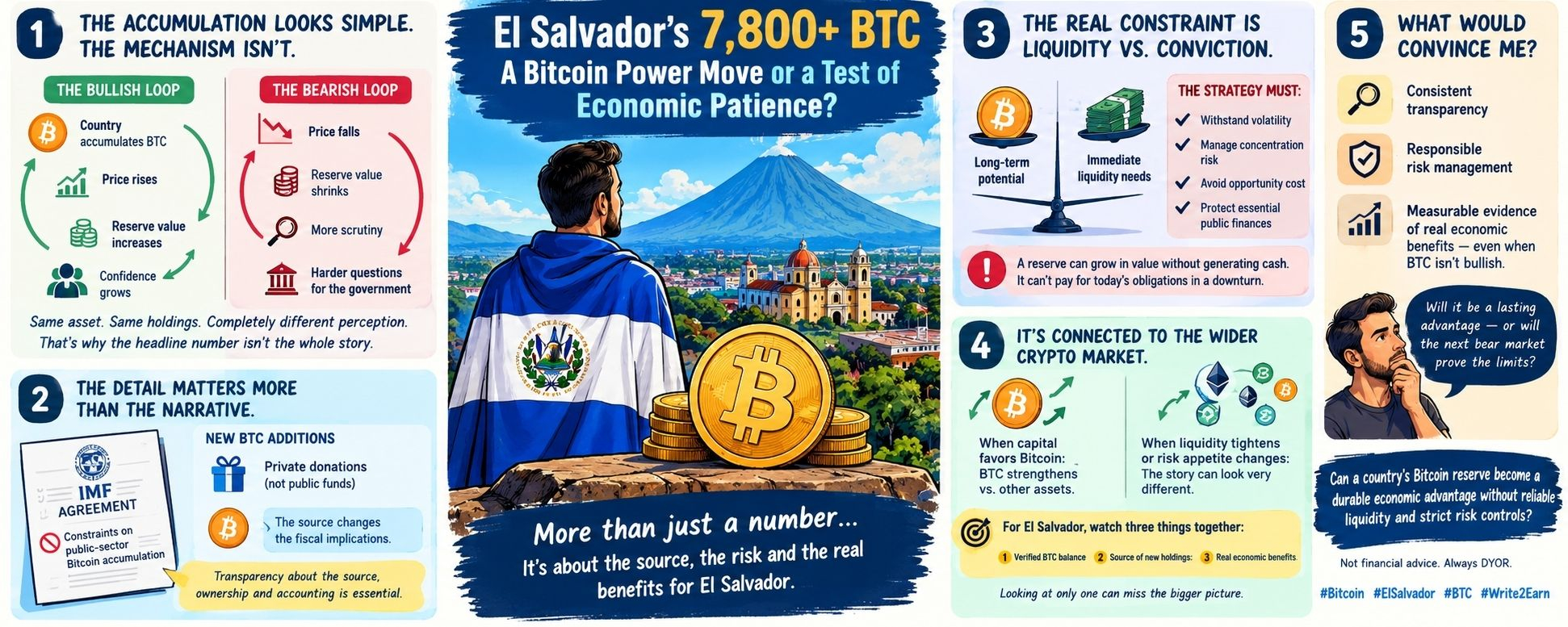

🇸🇻 El Salvador’s 7,800+ BTC: A Bitcoin Power Move or a Test of Economic Patience?
I've been looking at El Salvador's Bitcoin strategy, and honestly, the number isn't what interests me most.
The country's reported holdings have climbed above 7,800 BTC. But I'm starting to wonder whether the real story is no longer about how much Bitcoin a government can accumulate. It's about whether that strategy can survive the conditions that make Bitcoin difficult to hold in the first place. 🧵
1️⃣ The accumulation looks simple. The mechanism isn't.
Think about the loop.
A country accumulates $BTC → Bitcoin's market price rises → the reserve's dollar value increases → confidence in the strategy grows.
That can strengthen the argument for Bitcoin as a strategic asset.
But reverse the loop.
Bitcoin falls → the reserve's market value shrinks → financial scrutiny increases → the government faces harder questions about risk and opportunity cost.
Same asset. Same holdings. Completely different public perception.
That's why I wouldn't judge the strategy by the headline number alone.
2️⃣ Here's the detail I'm watching more closely. 👀
El Salvador's Bitcoin reserve has continued growing even as its agreement with the IMF places constraints on public-sector Bitcoin accumulation.
Recent reporting attributes new additions to private donations rather than purchases using public resources. That distinction matters because the source of the Bitcoin changes the fiscal implications of the strategy.
I'm not saying that automatically makes the policy successful or unsuccessful.
I'm saying the details matter more than the narrative.
If holdings increase through verifiable donations, that is economically different from allocating additional taxpayer funds to buy BTC. Transparency about the source, ownership and accounting is essential to understanding what's actually happening.
3️⃣ The real constraint is liquidity versus conviction. 📉
This is where my thinking gets more cautious.
A Bitcoin reserve can appreciate substantially without generating cash for public expenses. If the government needs money for obligations during a market downturn, it cannot assume that the reserve's long-term potential will solve an immediate liquidity problem.
So the strategy has to satisfy a difficult condition:
The potential long-term benefit must justify the volatility, concentration risk and opportunity cost without compromising essential public finances.
That is a much harder test than simply holding through a dip.
And it matters beyond El Salvador. Governments, institutions and crypto investors are all exploring how $BTC fits into a broader financial system. The question is whether they can manage downside risk as carefully as they pursue upside.
4️⃣ I'm connecting this to the wider crypto market. 🤔
When capital favors Bitcoin, BTC can strengthen its position relative to other crypto assets. When liquidity tightens, risk appetite changes, or capital rotates toward other sectors, the market can tell a very different story.
That creates an important distinction: Bitcoin becoming more valuable is not the same as a country's finances becoming more resilient.
For El Salvador, I'd watch three things together: the verified BTC balance, the source of new holdings, and evidence of real economic benefits.
Looking at only one of those indicators risks missing the bigger picture.
5️⃣ So, what would convince me?
Not another headline about reaching a round number.
I'd want consistent transparency, responsible risk management, and measurable evidence that the strategy benefits the country even when $BTC isn't in a bullish phase.
Maybe El Salvador's experiment eventually strengthens the case for national Bitcoin reserves. Maybe it exposes how difficult it is to turn a volatile asset into a reliable public-finance strategy.
I'm genuinely not ready to call that outcome.
What do you think: can a country's Bitcoin reserve become a durable economic advantage without dependable liquidity and strict risk controls, or does the next prolonged bear market ultimately decide whether this strategy works?
#Bitcoin #ElSalvador #BTC #Write2Earn
Not financial advice. Always DYOR.