


Understanding Delivery versus Payment (DvP), settlement risk, and how Rayls approaches atomic settlement
Imagine a bank selling a tokenised bond worth ₹10 lakh to another financial institution.
Both parties agree on the trade. The buyer is ready to purchase the bond, and the seller is ready to transfer it.
But what happens if the bond reaches the buyer and the payment never reaches the seller?
This is not just a technical issue. It is a settlement risk that financial institutions need to manage.
As tokenised assets become part of the conversation around financial markets, one important question deserves attention:
How can two institutions exchange an asset and its payment without one side completing its part while the other side fails?
One approach is called Delivery versus Payment (DvP). Let's understand how it works, what can go wrong, and how Rayls approaches this problem through its Enygma DvP mechanism.
What Is a Tokenised Asset?
A tokenised asset is a digital representation of an asset on a blockchain.
Depending on the system and its legal structure, it could represent a bond, a fund unit, an invoice, or another financial instrument.
For example, a financial institution may issue a digital token representing a bond. The token can then be transferred between eligible participants through a blockchain-based system.
However, tokenisation alone does not solve every problem in financial settlement.
The buyer still needs to pay. The seller still needs to deliver the correct asset. Both parties must follow the agreed conditions, and the transaction must be recorded correctly.
That brings us to the main challenge.
What Happens When the Asset and Payment Are Separate?
Consider this example.
Bank A owns a tokenised bond worth ₹10 lakh. Bank B wants to purchase it.
Both banks agree on the price and begin the settlement process.
There are two parts to the trade:
Delivery leg: The bond moves from Bank A to Bank B.
Payment leg: The agreed payment moves from Bank B to Bank A.
If these two legs are processed independently, one party may complete its obligation before the other.
There are three possible outcomes.
Scenario A: The bond transfers, but payment fails.
Bank B receives the bond, but Bank A does not receive the money. Bank A faces the risk of delivering the asset without receiving payment.
Scenario B: Payment transfers, but the bond fails to transfer.
Bank A receives the money, but Bank B does not receive the bond. In this case, Bank B faces the risk.
Scenario C: Both sides complete successfully.
Bank B receives the bond, and Bank A receives the agreed payment. The trade settles as intended.
The first two scenarios explain why the settlement mechanism matters just as much as the trade agreement.
The Bank for International Settlements (BIS) discusses the risk of delivering securities without receiving the corresponding payment, or paying without receiving the securities, as principal risk.
What Is Delivery versus Payment (DvP)?
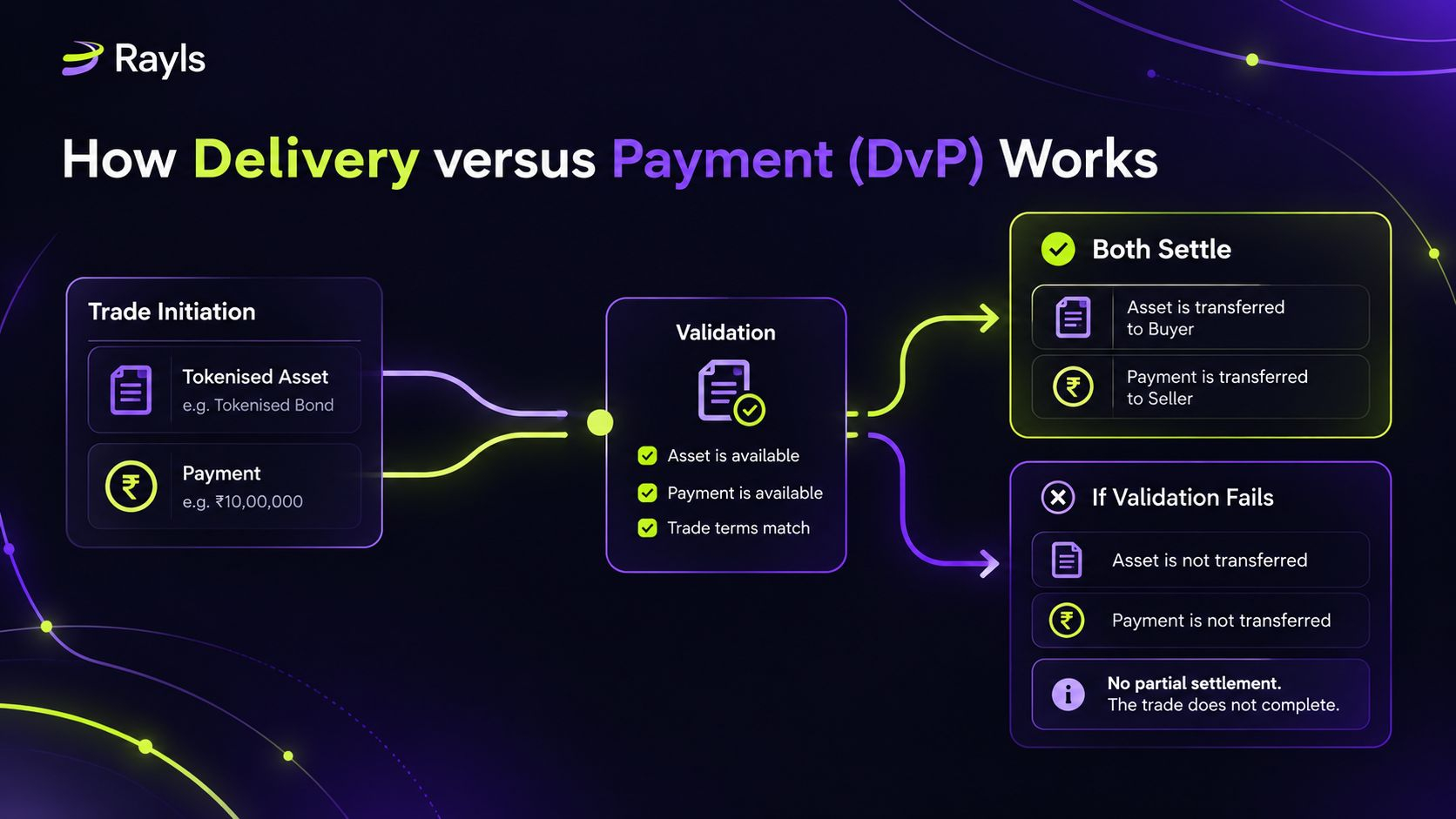
Delivery versus Payment is a settlement arrangement that links the delivery of an asset to its corresponding payment.
The basic principle is simple:
The asset is delivered if and only if the corresponding payment is made.
Instead of treating the two legs as unrelated transfers, a DvP mechanism coordinates them so that one cannot complete independently of the other.
A simplified process looks like this:
Both parties agree on the trade.
The system checks the asset, payment, and settlement conditions.
The settlement mechanism executes the exchange according to its rules.
If the conditions cannot be met, the trade does not result in an incomplete exchange where only one party receives its part.
DvP is not a new concept created specifically for blockchain. It is an established principle in securities settlement.
Blockchain systems can implement DvP using smart contracts or other coordinated settlement mechanisms.
What Does Atomic Settlement Mean?
You may have seen the term atomic settlement while reading about blockchain.
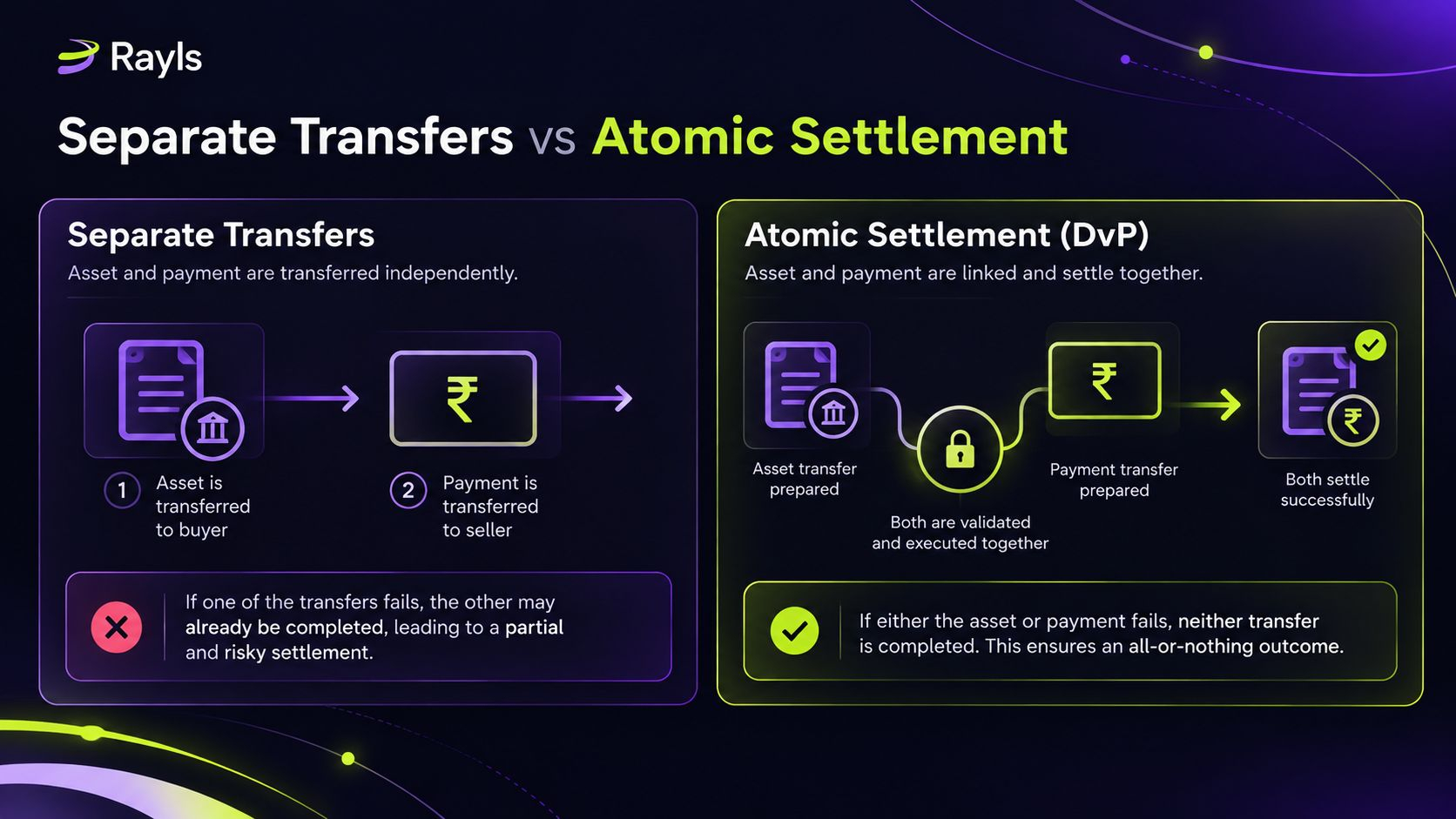
In this context, atomic settlement means that linked operations are treated as one indivisible outcome: either the required exchange completes, or it does not.
For a DvP trade, this means the asset and payment legs settle together under the mechanism's rules.
This is different from two ordinary transfers that happen close to each other.
Suppose a system first transfers the bond and then tries to transfer the payment. If the operations are not properly linked, a failure between them could leave the trade incomplete.
A correctly designed atomic mechanism prevents the transaction from ending in that partial state.
However, atomicity does not mean that every possible problem disappears. The system still needs correct contract logic, valid assets, sufficient funds, suitable permissions, and properly designed recovery procedures.
It also does not guarantee that an external banking payment will automatically succeed just because a blockchain transaction succeeds. The payment must be part of the settlement mechanism or connected through a reliable process.
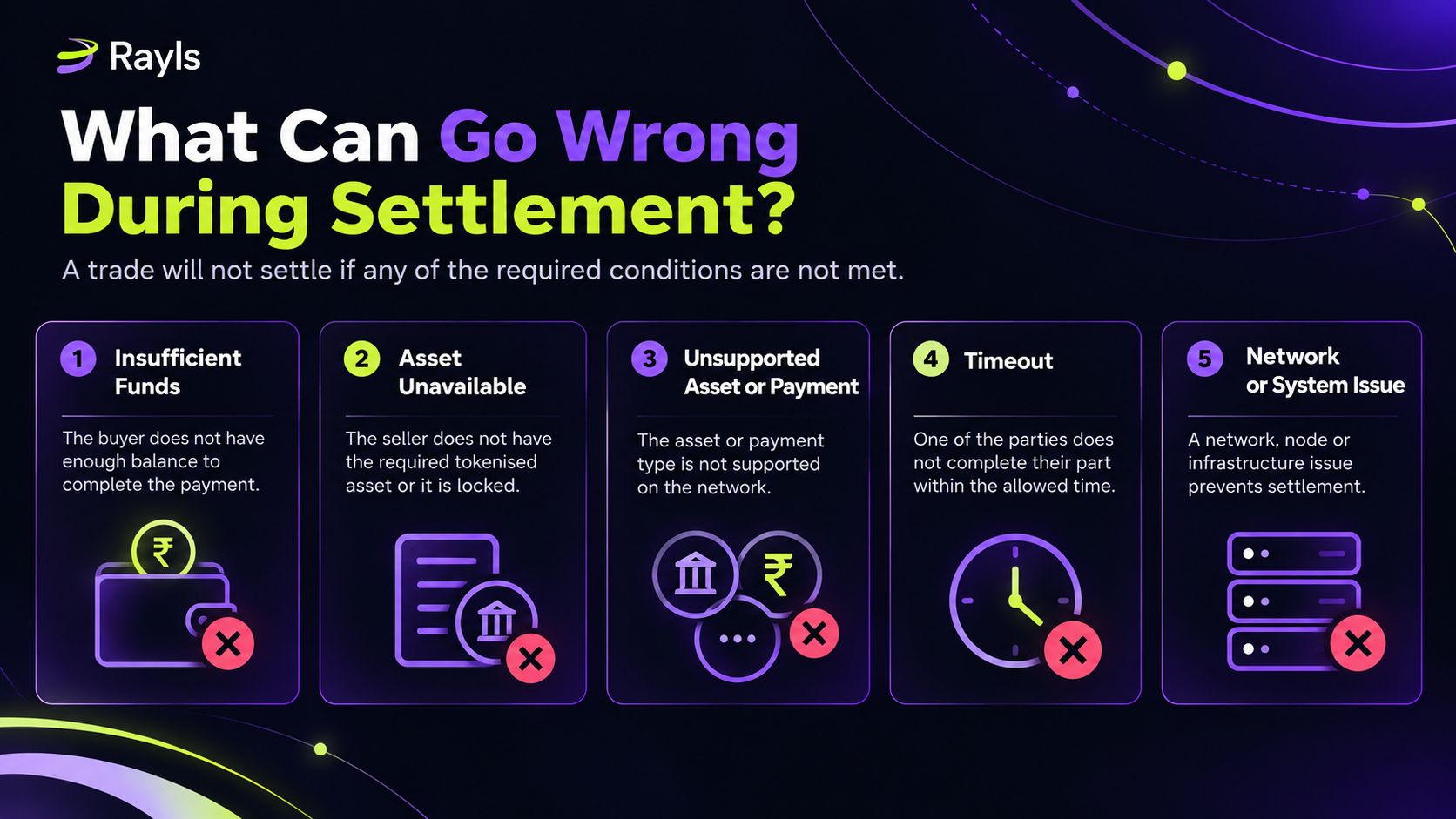
What Can Go Wrong During Settlement?
A settlement mechanism needs to account for more than the ideal transaction.
Insufficient payment
The buyer does not have the required amount available. The settlement conditions are not met, so the trade should not partially complete.
Asset unavailable
The seller does not have the eligible token, or the asset has not been deposited into the required settlement mechanism.
Invalid or unsupported asset
The token may not be approved for the settlement process. A correctly designed system should reject a trade that does not meet its requirements.
Timeout or incomplete trade
One party initiates a trade, but the other party does not complete the required steps before the validity period ends. The system needs a defined cancellation or expiry process.
Network or infrastructure problems
A participant's node or supporting service may become temporarily unavailable. The system must distinguish a pending transaction from a completed settlement and provide a reliable way to check its final status.
These examples show why settlement logic must be designed around failure cases, not only successful transactions.
The exact behaviour depends on the implementation. A timeout, for example, does not automatically mean that funds can be returned instantly. The contract and recovery process must explicitly define what happens.
How Does Rayls Approach Private DvP?
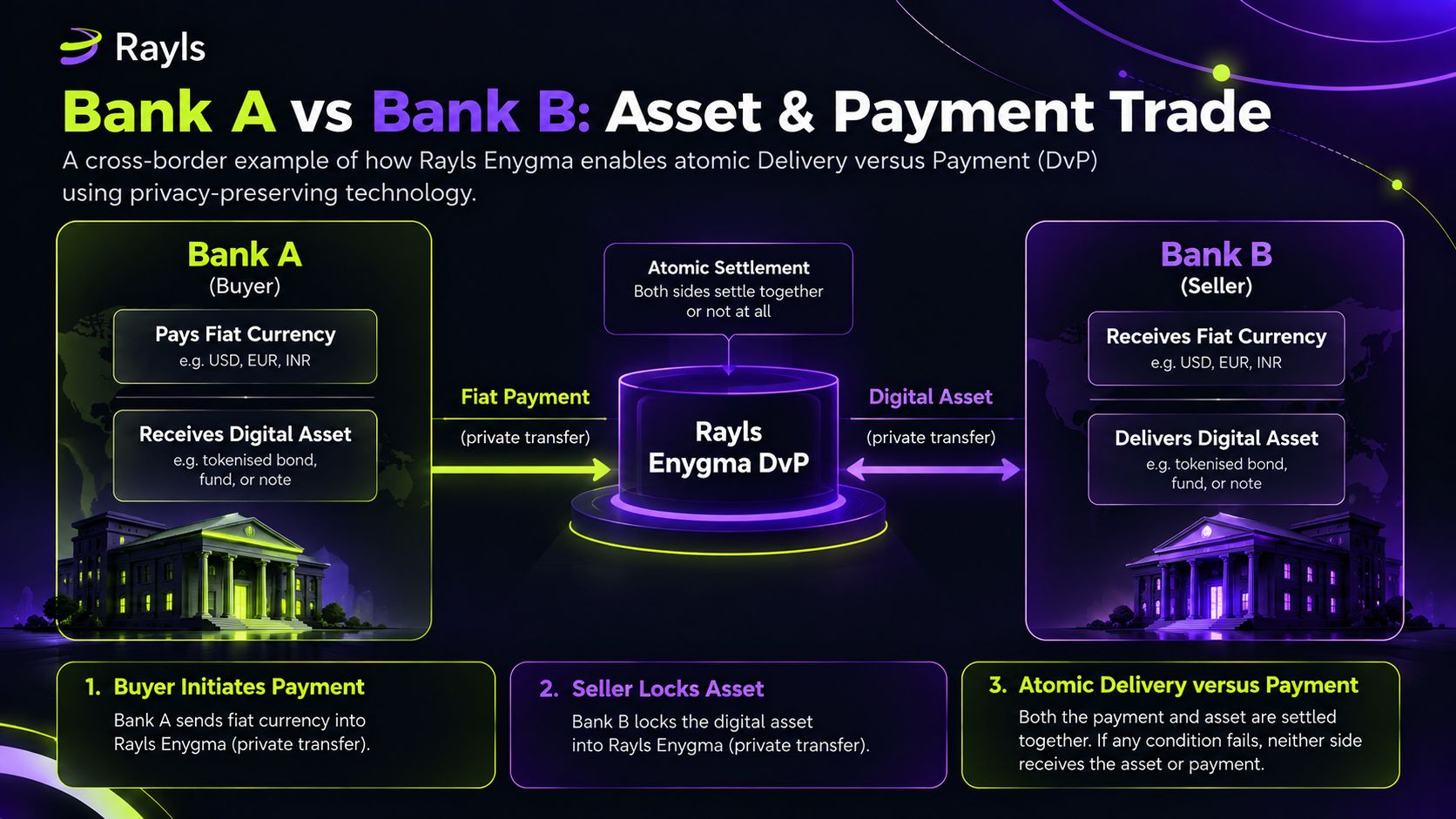
Rayls documents a private settlement mechanism called Enygma DvP, designed for institutional transactions within a Rayls Private Network.
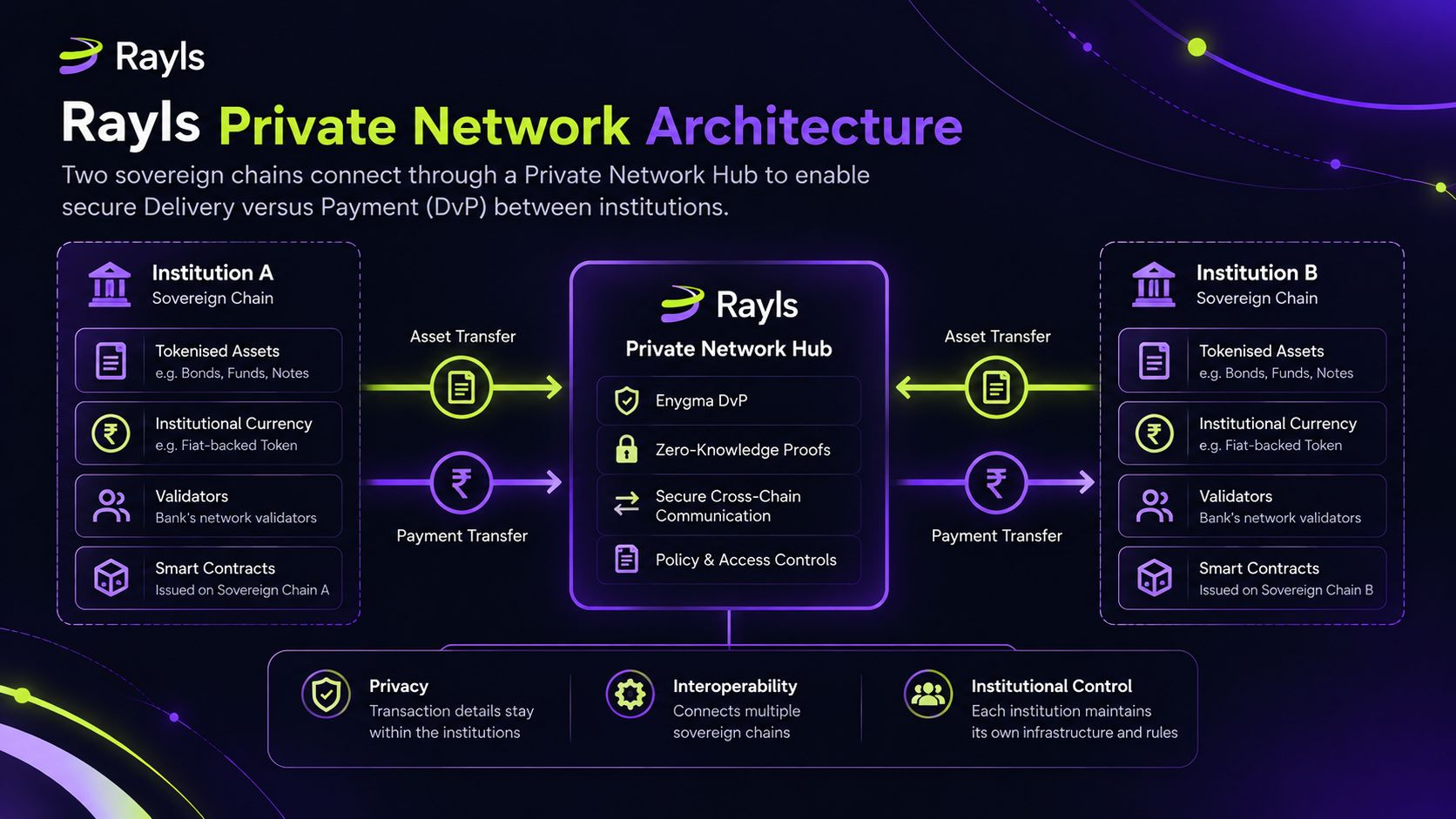
A Rayls Private Network connects multiple Rayls Sovereign chains through a central Private Network Hub. Each participating institution operates its own Sovereign chain, while the Hub coordinates interactions between institutions under the network's rules.
This architecture matters because two institutions may maintain their assets on separate chains but still need to complete a single trade.
According to the official Rayls documentation, Enygma DvP allows participants to exchange Enygma tokens for eligible tokenised assets in a single settlement on the Private Network Hub.
The documented outcome is that both legs settle, or neither does.
An important distinction: this documentation describes Enygma DvP within Rayls Private Networks. It should not be interpreted as proof that every transaction on the Rayls Public Chain automatically receives the same private DvP functionality.
What Happens Inside a Rayls Enygma DvP Trade?
Consider Alice, who wants to buy a tokenised asset from Bob.
Alice holds Enygma tokens that can be used as payment. Bob holds an eligible tokenised asset on another participating chain.
The documented process can be understood through these stages.
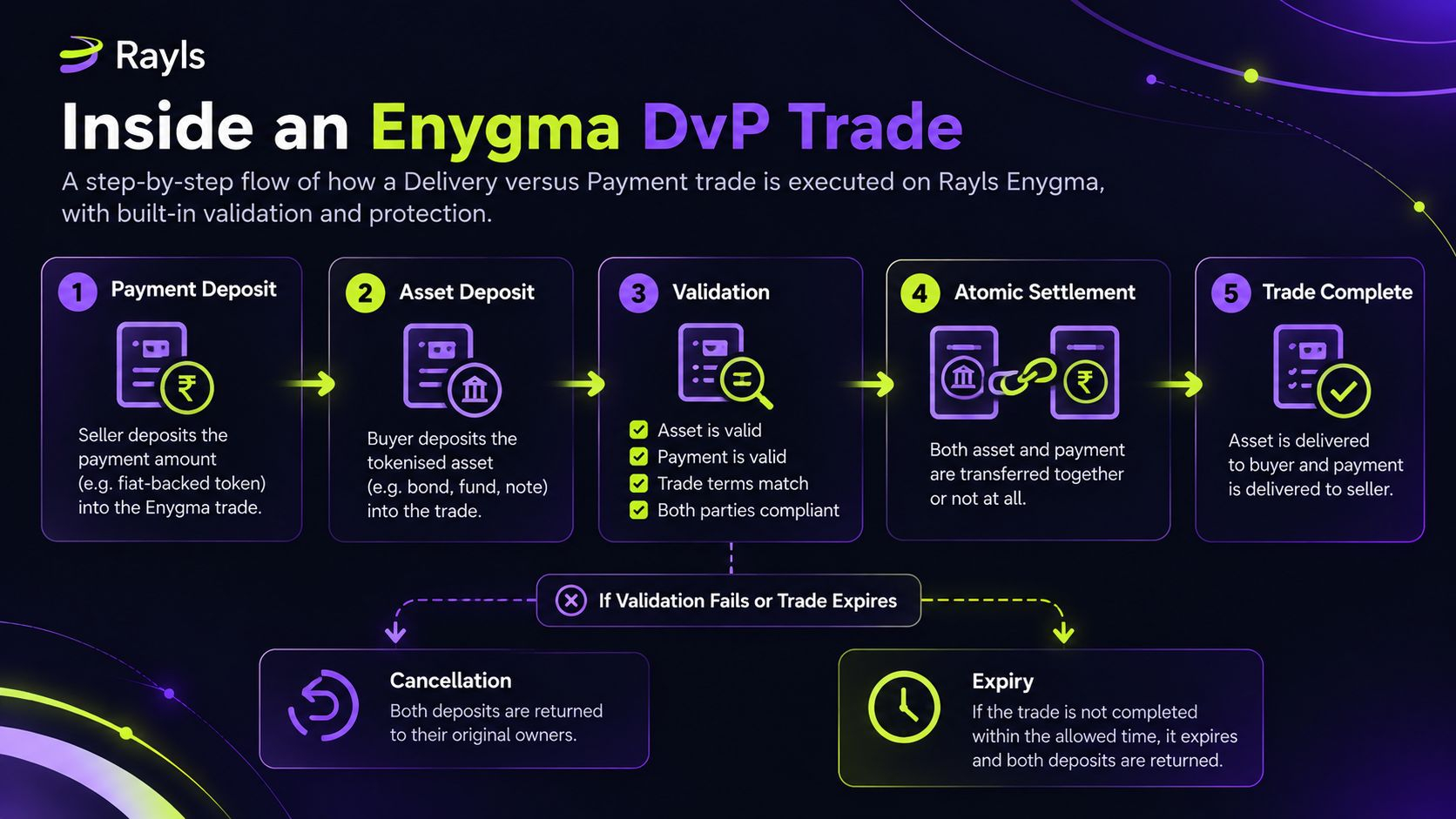
Step 1: Agree on the trade
Alice and Bob agree on the terms, including the asset, payment amount, and a shared swap identifier.
Step 2: Deposit the payment
Alice moves the required Enygma tokens into the DvP mechanism on the Private Network Hub.
Step 3: Deposit the asset
Bob deposits the eligible tokenised asset into the mechanism.
Step 4: Validate the trade
The mechanism checks the conditions required to complete the exchange. The assets and settlement arrangement must be supported by the network.
Step 5: Settle both legs
If the conditions are satisfied, the DvP mechanism exchanges the payment and asset in one Hub transaction. The payment goes to the seller, and the asset goes to the buyer.
The two legs are linked rather than being treated as independent transfers.
What if the trade remains incomplete?
Rayls' documentation describes cancellation and expiry handling for pending swaps. Either side can cancel a pending swap, and swaps expire after their validity period. Under the documented process, the initiating party's locked coin is replaced with a new coin of the same value, which the party can withdraw.
The default validity period is two days, with configured limits described in the documentation. Check the latest documentation before relying on these parameters.
This is an important detail: an incomplete trade has a defined cancellation and expiry path rather than relying only on the participants to resolve the situation manually.
Why Is the Private Network Hub Important?
The Private Network Hub is a central component of the Rayls Private Network architecture.
Each institution maintains its own Rayls Sovereign chain, which holds its tokens, client balances, and smart contracts. When a transaction needs to involve another institution, the interaction goes through the Hub.
For DvP, the Hub provides a shared place where the cross-chain settlement mechanism can coordinate the exchange.
Without a properly designed coordination mechanism, separate chains could record their own transactions without ensuring that both sides of a trade completed together.
The Hub is not simply a public blockchain explorer where every financial detail is necessarily visible to everyone. Its role and visibility depend on the Rayls Private Network's design and permissions.
This architecture is intended for institutions that need to exchange tokenised value while maintaining control over their own ledgers.
Does Private DvP Mean Every Transaction Detail Is Hidden?
No. Privacy needs to be explained carefully.
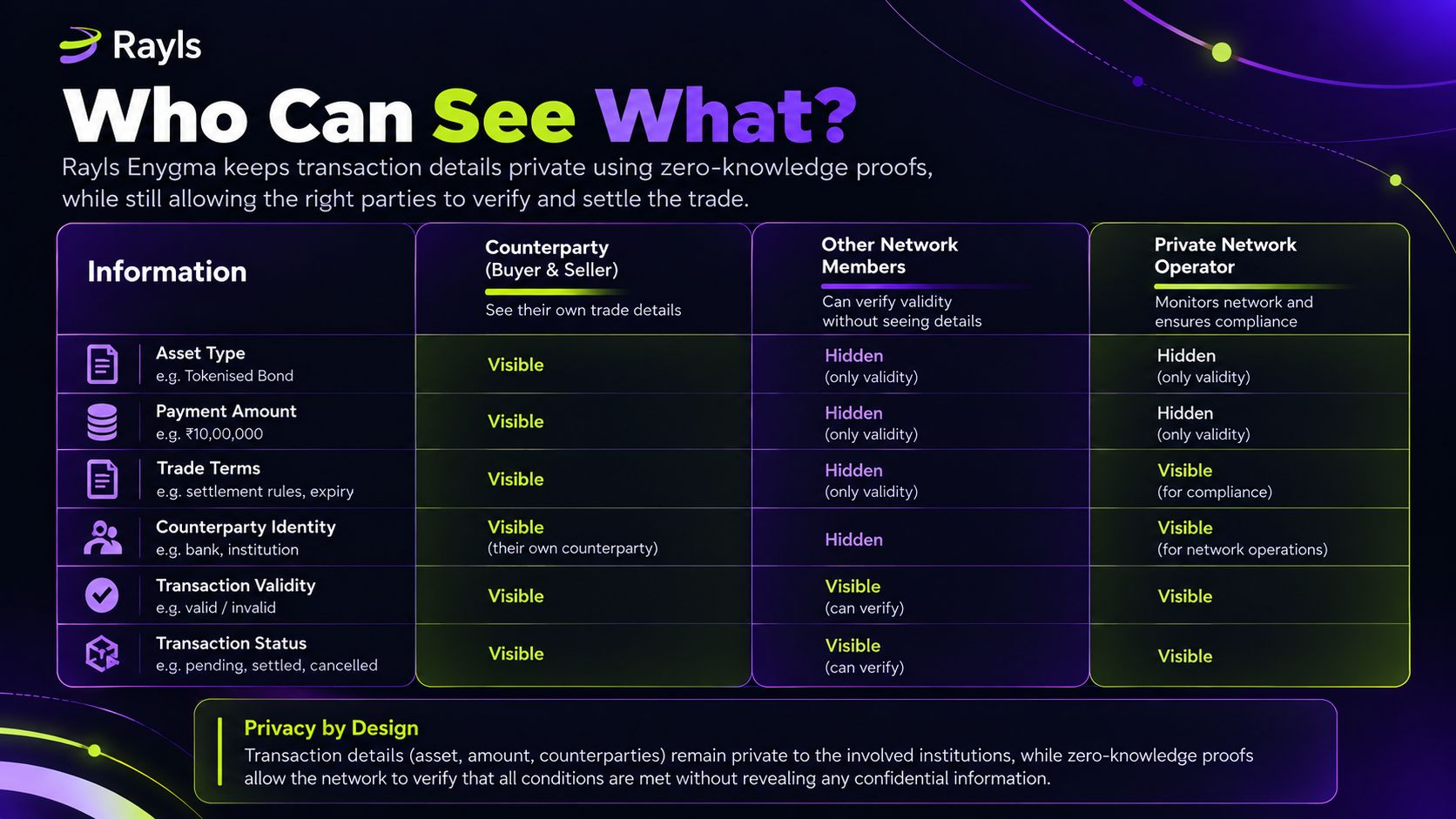
Rayls documents privacy features for Enygma DvP, but privacy does not mean that every participant and every network operator is unable to see all information.
According to the official documentation:
Trade terms are encrypted for the counterparty.
The Private Network operator, which holds participants' view keys, can read the terms.
Enygma amounts remain hidden from other members.
ERC-721 deposits and withdrawals are visible on the Hub.
The Hub emits events when a swap is initiated, completed, cancelled, or expired.
This is an important distinction. A system can protect sensitive transaction details while still exposing certain operational events or allowing authorised oversight.
For financial institutions, the goal is not necessarily to hide everything from everyone. It is to control who can access which information while preserving necessary governance and oversight.
What Is Supported, and What Should Not Be Assumed?
A technical article should distinguish documented functionality from features that may sound possible but are not currently supported.
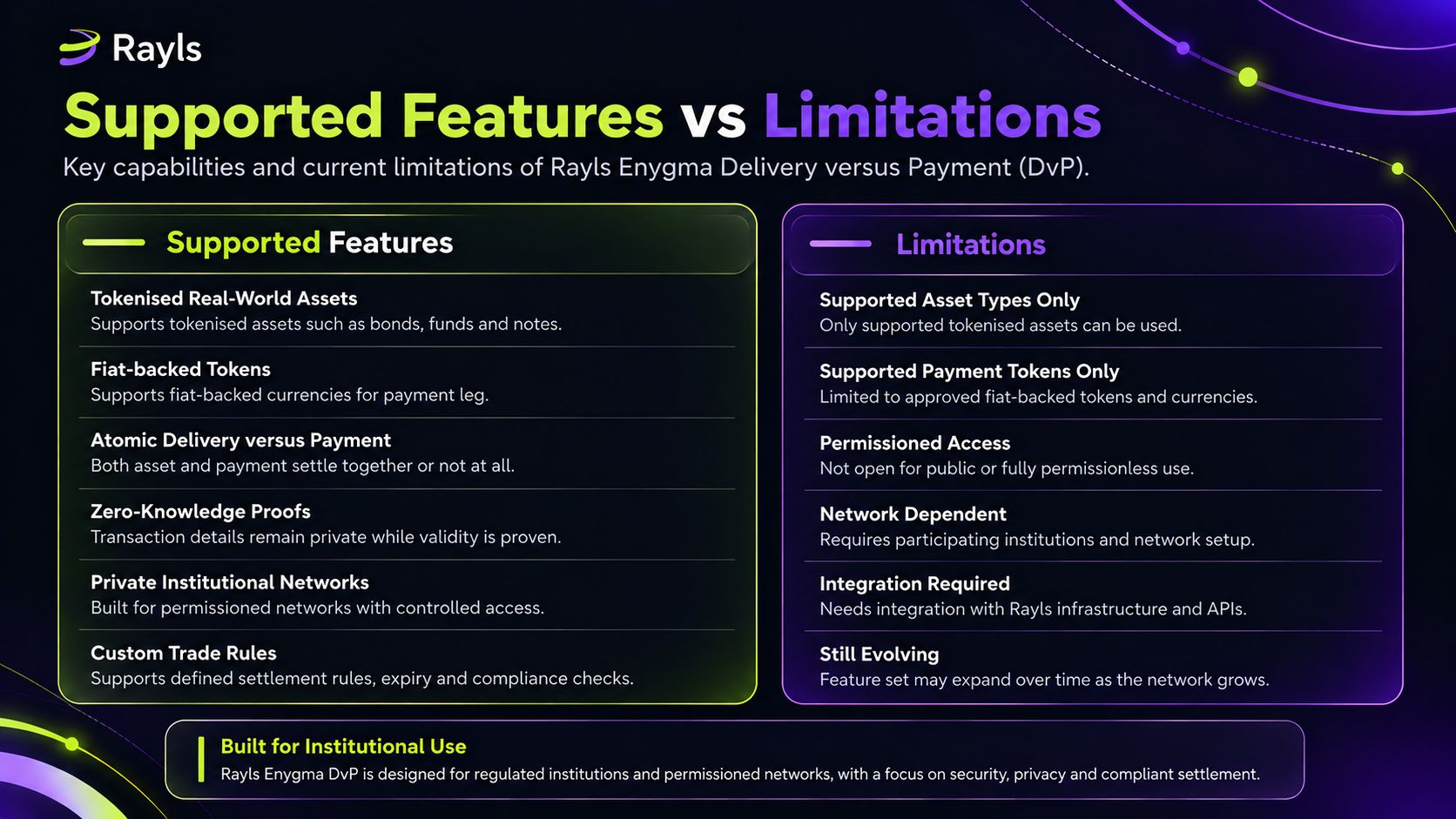
Rayls' Enygma DvP documentation lists supported exchanges such as:
Enygma tokens against ERC-721 non-fungible tokens across two chains.
Enygma tokens against fungible ERC-1155 token IDs across two chains.
The documentation also identifies limitations:
Non-fungible ERC-1155 token IDs are not supported by this DvP implementation.
Payment using a token that is not an Enygma token across chains is not supported.
Payment versus Payment (PvP) for exchanging two currencies is not supported in the documented implementation.
Some DvP-specific features and integrations are not part of the documented product, even if contract placeholders exist.
These details matter because a general description of DvP can be broader than the actual features available in a specific implementation.
For example, it would be inaccurate to conclude that every ERC-20 stablecoin can currently be exchanged for every tokenised bond across Rayls chains using Enygma DvP.
The documented asset and payment combinations have specific limits.
Always check the current official documentation before making a claim about supported assets or settlement flows.
What DvP Solves - and What It Does Not
DvP addresses a specific problem: the risk of one side completing its part of an exchange while the other side fails to complete its corresponding obligation.
It does not automatically solve every risk associated with tokenised finance.
It does not guarantee that an asset is legally valid. A token may represent an asset, but legal ownership and enforceability depend on the relevant arrangements and jurisdiction.
It does not remove every operational risk. Infrastructure failures, incorrect configurations, compromised keys, and bugs in smart contracts still need to be managed.
It does not guarantee that every asset is eligible for settlement. The network must support the asset type and approve the relevant settlement pair.
It does not automatically make every external payment atomic. If the cash leg happens in a separate banking system and is not linked to the settlement mechanism, coordination remains necessary.
It does not eliminate all market or counterparty risk. Prices can change, and a counterparty can still face other financial or operational problems.
The lesson is that atomic settlement is an important building block, not a complete replacement for risk management, legal agreements, asset controls, and operational procedures.
Why Does This Matter for Institutional Blockchain Adoption?
Financial institutions often need more than the ability to transfer tokens quickly.
They need a reliable way to exchange assets, enforce agreed conditions, control access, and settle transactions across different institutional systems.
DvP can help address one of the core challenges in that process by linking the asset and payment legs.
For tokenised bonds and other financial instruments, this can reduce the risk associated with separate settlement steps. When combined with suitable privacy and governance mechanisms, it can also support institutional workflows that require confidentiality between participants.
Rayls' documented Enygma DvP approach is one example of how a private institutional network can coordinate eligible tokenised asset exchanges across separate chains.
The important question is not simply whether a blockchain can transfer a token. It is whether the overall system can coordinate the full exchange, handle incomplete trades, and provide the right level of visibility to the right participants.
Conclusion
A tokenised asset trade is not complete just because a token moves from one wallet to another.
The payment must also reach the seller, and the settlement process must handle the possibility that one part of the trade cannot complete.
Delivery versus Payment links these two obligations so that the exchange completes together or does not complete under the mechanism's rules.
Rayls documents this approach through Enygma DvP within its Private Network architecture, with a defined settlement flow, cancellation and expiry behaviour, privacy controls, and specific limits on the assets supported.
For anyone exploring institutional blockchain infrastructure, this is an important distinction:
The real challenge is not only moving assets on-chain, but making sure the exchange itself is properly coordinated.