

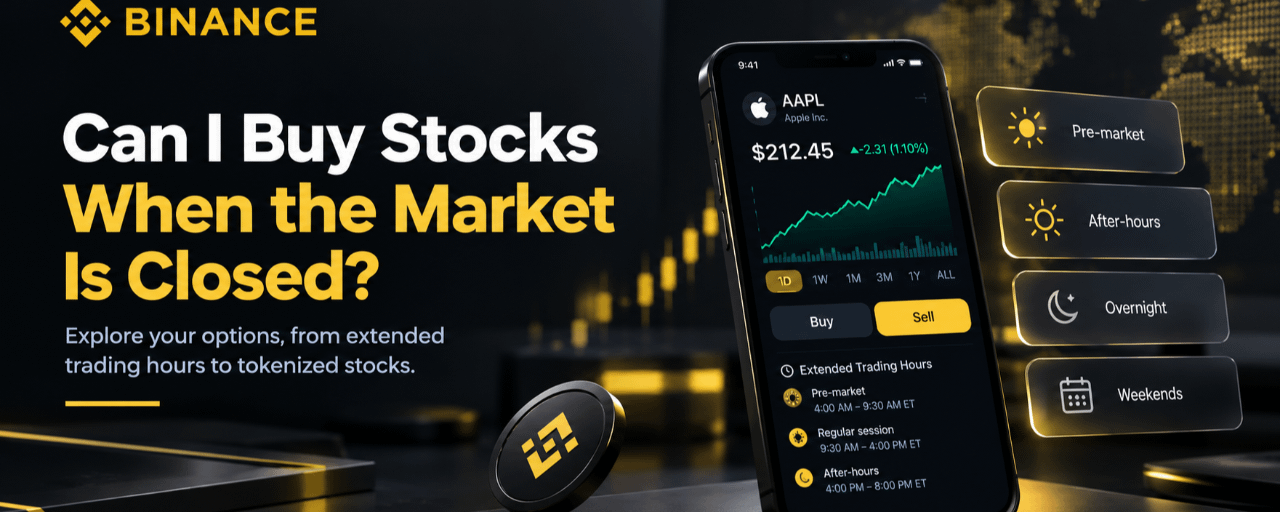

The U.S. stock market closes at 4:00 p.m. Eastern Time, but financial news doesn't stop. A company can announce earnings after the closing bell, a major economic development can emerge overnight, and investors in other time zones may not be available during regular U.S. trading hours.
So, can you buy stocks when the market is closed?
Yes, in some cases. Investors may be able to trade during pre-market or after-hours sessions, use platforms offering overnight trading, or access certain tokenized securities that trade outside traditional exchange hours. However, availability depends on the platform, the instrument, and the investor's location.
Understanding these differences matters before placing an order.
1. What Happens When the Stock Market Closes?
The regular U.S. stock-market session runs from 9:30 a.m. to 4:00 p.m. Eastern Time on weekdays, excluding market holidays.
Outside those hours, some brokers offer extended trading sessions:
Pre-market: Trading before the regular session opens.
After-hours: Trading after the regular session closes.
Overnight trading: Trading during additional overnight sessions offered by certain platforms.
These sessions can help investors respond to company announcements and other developments without waiting for the next regular market opening.
However, not every stock is available in every session. Trading volume may also be lower, making it harder to execute orders at the desired price.
2. Can You Buy Stocks at Night or on Weekends?
That depends on what you're trading.
Traditional stock exchanges generally do not operate continuously throughout the week. Some brokerage platforms extend access to selected stocks and exchange-traded funds (ETFs), but their overnight sessions have defined schedules.
For example, Robinhood's 24 Hour Market supports eligible stocks and ETFs from Sunday evening through Friday evening, Eastern Time. Despite its name, this is not unrestricted trading at every hour of every day, and it does not mean every listed stock is available.
Weekends are a separate consideration. Traditional U.S. equity trading and many overnight brokerage sessions have a weekly closing period. Other financial products, including certain blockchain-based assets, may remain tradable during that time.
The important distinction is that a product linked to a stock can have different trading hours from the underlying stock itself.
3. How Binance Fits Into 24/7 Stock Trading
Binance has introduced bStocks, a category of tokenized securities designed to provide economic exposure to selected U.S. stocks through blockchain-based tokens.
According to Binance's official bStocks guide, eligible users can trade supported bStocks on Binance's spot market 24 hours a day, seven days a week.
This means their trading availability is not limited to the regular opening hours of traditional U.S. stock exchanges.
Binance's product documentation describes each bStock as backed 1:1 by a corresponding U.S. share held by a regulated custodian. The tokens represent an interest in underlying securities, rather than direct ownership of the listed company's shares.
That distinction is important. Holding a bStock is not the same as registering as a shareholder of the underlying company, and it does not confer direct share ownership.
For eligible users, the model offers a different way to access price exposure to supported U.S. equities outside conventional exchange hours.
Before considering the product, users should review the official Binance bStocks announcement and confirm the applicable terms and jurisdictional restrictions.
4. Traditional Brokers vs. Tokenized Securities
The difference is not simply about which platform stays open longer. It is also about what the investor actually holds.
With a traditional brokerage, investors generally buy shares or eligible securities through the broker under the relevant market and custody arrangements. Extended-hours access depends on the broker and the specific security.
With tokenized securities, the investor holds a blockchain-based instrument whose legal rights depend on its issuance structure and terms. The ability to trade around the clock does not make it equivalent to direct share ownership.
The broader market is exploring this approach, too. In October 2026, Reuters reported on Securitize's launch of blockchain-based tokenized stock trading, illustrating the growing interest in bringing traditional equities onto blockchain infrastructure.
5. What Are the Risks of Trading Outside Market Hours?
Access to more trading hours does not automatically mean better execution or better returns.
Consider these factors before placing an order:
Liquidity: Fewer active buyers and sellers can make it harder to execute a trade.
Spreads: The difference between buying and selling prices may widen.
Volatility: Prices can move sharply following earnings releases or breaking news.
Price differences: Prices in an overnight venue may differ from those on the primary exchange.
Product structure: Tokenized securities carry risks associated with their issuer, legal terms, custody, and trading arrangements.
Eligibility: Products may be unavailable in certain jurisdictions, regardless of their technical availability.
A market that remains open does not guarantee that an order will execute immediately or at a preferred price. These risks apply differently across platforms and instruments, so the relevant disclosures should always be reviewed.
Final Thoughts
Can you buy stocks when the market is closed? Yes, depending on the platform, the instrument, and the trading session available.
Extended-hours brokerage trading provides access to selected traditional securities beyond regular exchange hours. Tokenized securities offer another model, with products such as Binance bStocks designed for 24/7 trading by eligible users.
The key is to understand what you're buying, when and where it can be traded, and what rights the instrument provides. Trading availability is only one part of an investment decision; liquidity, execution quality, legal structure, and risk matter just as much.
Disclaimer: This article is for educational purposes only and does not constitute financial or investment advice. Stocks and tokenized securities involve risk, including possible loss of capital. Product availability and eligibility vary by jurisdiction. Conduct your own research (DYOR) and review the applicable product terms before making financial decisions.
#BStocks #USstock