

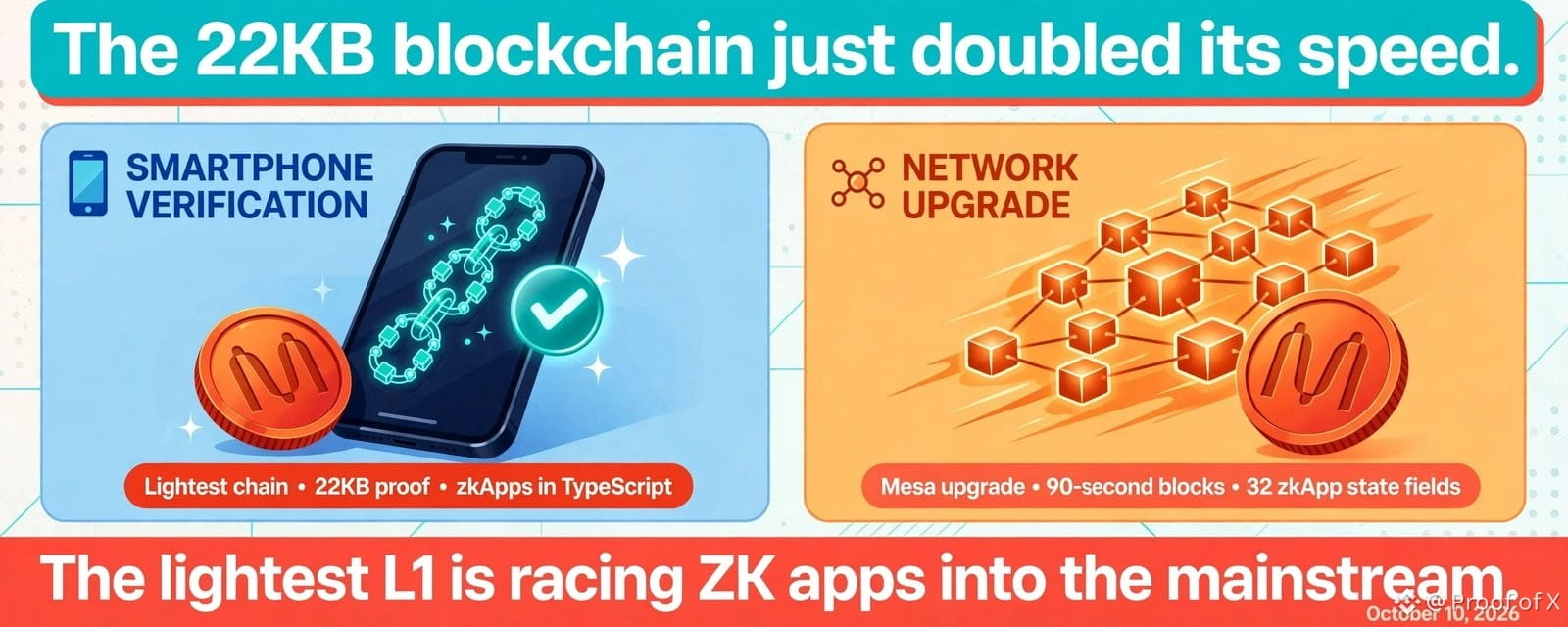
The 22KB blockchain just got its biggest speed boost: $MINA's Mesa upgrade halves block time as ZK apps mature on mainnet.
BUSINESS
Mina Protocol is a Layer 1 blockchain launched in March 2021 by o1Labs, originally O(1) Labs, founded by Evan Shapiro and Izaak Meckler.
It calls itself the world's lightest blockchain, because a recursive zero-knowledge proof lets anyone verify the chain without downloading its full history.
Its developer surface is zkApps, zero-knowledge smart contracts written in o1js, a TypeScript library that lets developers build with ZK using a familiar language.
Real projects already build on it: PunkPoll runs censorship-resistant surveys and voting, bioSNARKs targets verifiable biotech data, Hakata offers compliant privacy tooling for companies, and Paima Studios builds on-chain gaming.
Security is funded mostly by inflationary issuance rather than user fees, so the open question for $MINA holders is whether zkApp activity ever grows enough to replace that subsidy.
TECHNOLOGY
Every new Mina block carries a proof that verifies the previous proof and the latest state transition, so the verifiable chain stays around 22KB no matter how much history accumulates.
The Berkeley upgrade in June 2024 brought general zkApp programmability to mainnet with the Kimchi proof system, moving smart contract execution off-chain and leaving verification on-chain.
The Mesa upgrade, activated on September 3, 2026, bundled four Mina Improvement Proposals and is the biggest capacity change in the network's history.
MIP6 halved the slot time from 180 seconds to 90 seconds, MIP7 expanded zkApp on-chain state fields from 8 to 32, and MIPs 8 and 9 raised the event, action, and account-update limits for richer zkApp logic.
Mesa also shipped tooling to make future hard forks less manual, signaling a faster upgrade cadence ahead.
SECTOR
Zero-knowledge technology has already won its biggest battle as Ethereum's scaling stack, with zkEVM Layer 2s carrying the developer momentum.
Mina's bet is different: privacy and verifiability at the base layer of a standalone chain, where a full node runs on a phone instead of a data center.
Analysts call the ecosystem early by Layer 1 standards: liquidity, wallets, bridges, and indexers are still being built around the core cryptography.
The institutional picture is mixed: Copper added regulated custody and staking for MINA in 2026, and a Blockworks transparency filing put MINA data on over 350,000 Bloomberg Terminals in August.
In the other direction, Coinbase delisted the MINA-USDT pair in October 2025 and suspended MINA-EUR trading in August 2026, narrowing retail liquidity.
COMPETITION
Against $ALEO, another ZK-native Layer 1, Mina's advantage is a live mainnet since 2021 and a succinct architecture no competitor matches for verifier lightness.
Against $ZEC, the established privacy coin, Mina offers programmability: zkApps can encode privacy into applications instead of only into transfers.
Where Ethereum's ZK rollups already own the liquidity, Mina's builders risk isolation, but verifiability itself is Mina's product: a chain anyone can fully verify is the only credible base for privacy-preserving applications.
TOKENOMICS
MC and FDV both sit near $114.8 million per CoinGecko, with 1.29 billion $MINA circulating against 1.29 billion total supply.
There is no max supply: the token is inflationary by design, and effectively 100 percent of supply is unlocked.
No verifiable unlock schedule exists beyond the protocol's continuous issuance, so holders absorb inflation as the price of network security.
Not financial advice. DYOR.
$MINA