

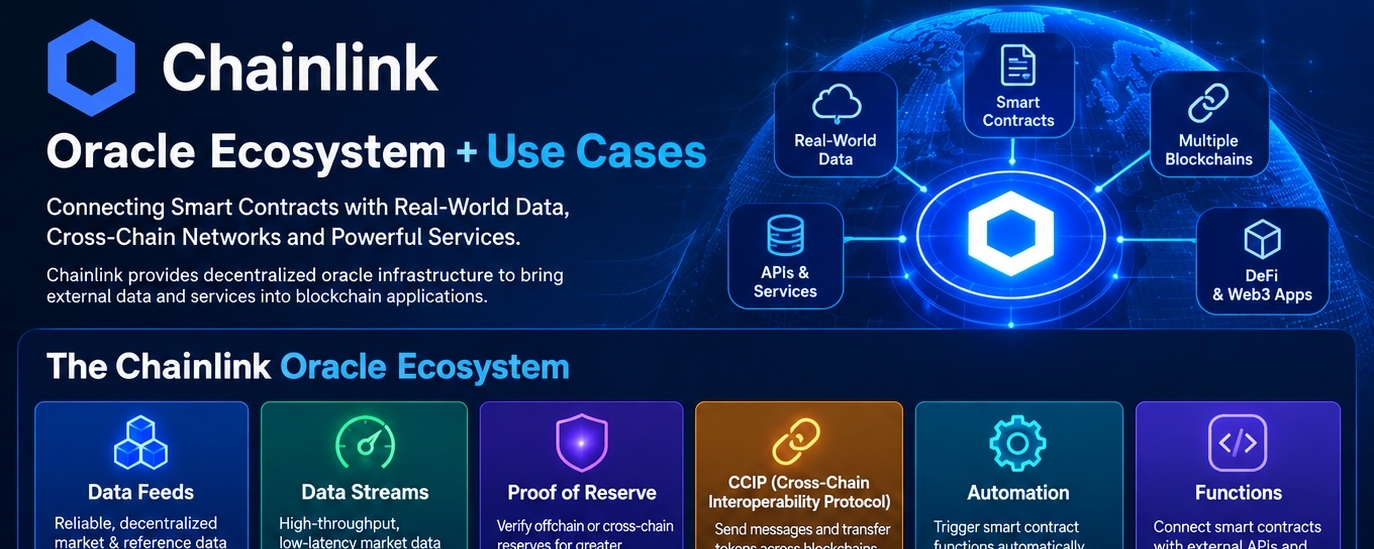

Chainlink Oracle Ecosystem: How It Connects Blockchain to the Real World
Blockchain networks are excellent at executing rules through smart contracts, but they have a major limitation: smart contracts cannot natively access reliable external data. This is where Chainlink comes in.
Chainlink provides decentralized oracle infrastructure that can bring external data and services into blockchain applications and also help applications communicate across different blockchains. Its ecosystem now includes Data Feeds, Data Streams, Proof of Reserve, Automation, Functions, CCIP, and other infrastructure.
What Is a Blockchain Oracle?
An oracle acts as a bridge between a blockchain and information outside the blockchain.
For example, imagine a DeFi lending protocol needs the current ETH/USD price:
External market data → Chainlink oracle network → verified data → smart contract → lending protocol
Without an oracle, a smart contract cannot simply ask a traditional exchange or website for the latest price.
Chainlink Data Feeds aggregate data from multiple sources and make the resulting information available onchain. They are used for asset prices, reserve information, L2 sequencer health, and other data types.
Key Parts of the Chainlink Ecosystem
1. Chainlink Data Feeds
Data Feeds provide reference data to smart contracts.
A major use case is DeFi. Lending protocols can use price feeds to determine the value of collateral, while derivatives platforms can use market data to help calculate positions and settlements. Chainlink specifically cites applications such as Aave and GMX as users of its data infrastructure.
Common uses:
Crypto prices
Forex and financial reference data
Commodity and other market data
RWA pricing
Lending and borrowing
Derivatives
Stablecoin applications
2. Chainlink Data Streams
Data Streams are designed for applications requiring high-throughput and low-latency market data.
This can be particularly relevant to perpetuals, options, and other time-sensitive DeFi markets where rapidly updated information can matter.
3. Proof of Reserve
Proof of Reserve helps smart contracts verify information about offchain or cross-chain reserves backing onchain assets.
For example, a tokenized asset or stablecoin can use reserve information to provide greater transparency around its backing.
Potential applications include:
Stablecoins
Tokenized commodities
Tokenized funds
Cross-chain assets
Other reserve-backed assets
4. Chainlink CCIP
CCIP (Cross-Chain Interoperability Protocol) allows applications to send messages and transfer tokens across supported blockchains.
Developers can use it for:
Cross-chain token transfers
Cross-chain lending
Cross-chain DeFi
Moving liquidity between networks
Cross-chain application workflows
CCIP can transfer data, tokens, or both together, allowing more complex cross-chain applications.
5. Chainlink Automation
Smart contracts sometimes need transactions to be triggered automatically.
Chainlink Automation can help execute predefined functions without requiring a user to manually initiate every transaction.
Examples include:
Automated liquidations
Interest accrual
Reward distribution
Protocol maintenance
Recurring smart-contract functions
6. Chainlink Functions
Chainlink Functions allows smart contracts to connect with external APIs and offchain computation.
This opens possibilities beyond simple price feeds, allowing developers to bring information from external systems into blockchain applications.
Major Chainlink Use Cases
Sector Example Use
DeFi Prices, lending, borrowing, derivatives
Stablecoins Reserve verification and pricing
RWA NAV, reserves, asset data
Gaming Verifiable randomness
Insurance Weather and real-world event data
Cross-chain Token and message transfers
Payments Blockchain-based settlement
Capital markets Tokenized securities and funds
Automation Automated protocol operations
Chainlink also identifies insurance, gaming, tokenized assets, payments, banking, and capital markets among the broader areas enabled by its infrastructure.
Why the Oracle Ecosystem Matters
The importance of Chainlink is not limited to providing cryptocurrency prices.
As blockchain applications become more sophisticated, they need access to accurate external information, cross-chain communication, automation, and verification mechanisms.
For example, a tokenized fund could require:
Market data → NAV information → reserve verification → cross-chain transfer → automated settlement
Different Chainlink services can support different parts of such workflows. Chainlink describes this broader direction as infrastructure for tokenization and institutional blockchain applications.
Final Thoughts
Chainlink's oracle ecosystem addresses one of blockchain's fundamental challenges: connecting deterministic smart contracts with external information and other blockchain networks.
Its ecosystem extends beyond traditional price oracles into Data Feeds, Data Streams, Proof of Reserve, Automation, Functions, and CCIP. These services can support applications ranging from DeFi and stablecoins to tokenized real-world assets and cross-chain systems.
As more financial assets and real-world processes move onchain, oracle and interoperability infrastructure cae an increasingly important part of the blockchain ecosystem.#Chainlink #Web3