

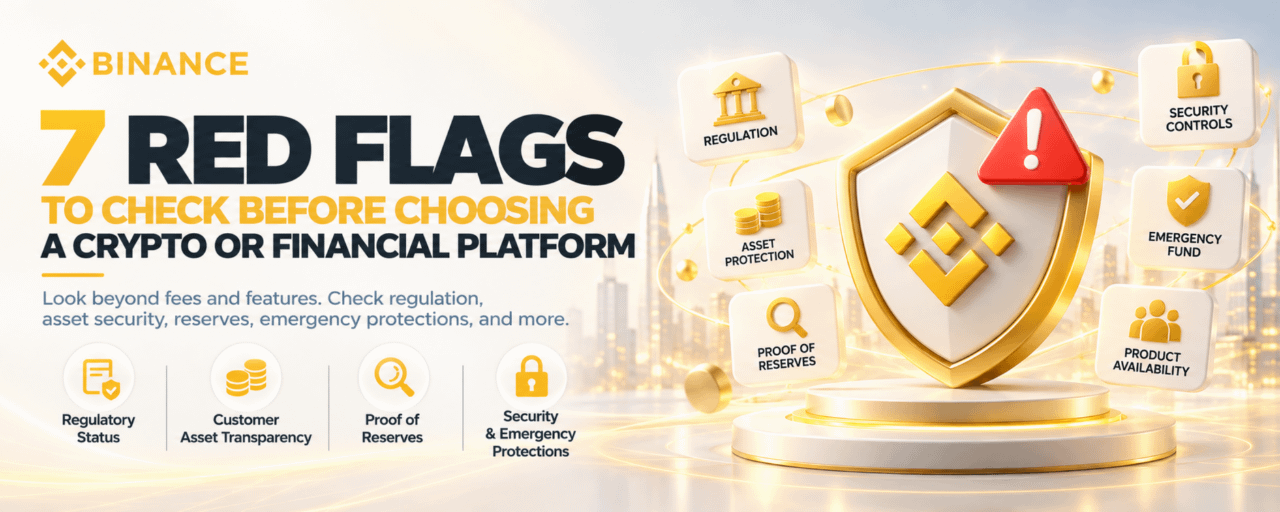

Before choosing a crypto or financial platform, check more than its fees, number of assets, or advertised features. Users should understand the platform's regulatory status, how customer assets are handled, whether reserve information can be verified, what emergency protections exist, and which security controls are available.
For users in Indonesia, one important distinction is that platform availability does not automatically mean that every product or service is locally regulated or available in every jurisdiction. Users should always check the applicable legal entity, product availability, and local requirements before using a financial platform.
Here are seven red flags to check before depositing funds.
Red Flag 1: Unclear Licensing or Regulatory Status
One of the first questions to ask is:
Which legal entity provides the service, and which regulator oversees that entity?
Global platforms may operate through different entities depending on the user's location and the product being accessed. A license or authorization in one jurisdiction does not automatically mean that every service is regulated in another.
For Indonesian users, Binance provides services subject to applicable laws, restrictions, and eligibility requirements. However, users should not interpret access to a Binance service as automatically meaning that every Binance product is locally regulated in Indonesia.
You can review the applicable Binance terms here:
https://www.binance.com/id/terms
Red flag: A platform cannot clearly explain which entity operates the service, where it is authorized, or whether the specific product is available in your jurisdiction.
Red Flag 2: No Transparency Around Customer Assets
If a platform holds your crypto assets, you should understand how those assets are accounted for and where they are held.
Important questions include:
How are customer balances recorded?
Which accounts or wallets hold the assets?
How does the platform account for customer liabilities?
Can users verify information about their assets?
Binance's Proof of Reserves system provides information about assets held in custody for users and allows users to verify that their account balances are included in the relevant calculation.
https://www.binance.com/en/proof-of-reserves
Binance also provides information about its different account and wallet structures, including custodial exchange accounts.
https://www.binance.com/en/support/faq/detail/edd09512772a48cdbca87b7b7f8e81a3
The broader lesson is simple: understand how a platform handles customer assets before depositing significant funds.
Red flag: A platform provides little or no information about how customer assets are accounted for or held.
Red Flag 3: No Proof of Reserves or Verifiable Asset Information
Another important question is whether a platform provides a way for users to verify information about assets held on their behalf.
Binance's Proof of Reserves (PoR) uses cryptographic verification methods, including Merkle Trees and zk-SNARKs, to allow users to verify that their account assets are included in the relevant PoR calculation.
https://www.binance.com/en/proof-of-reserves
Binance also provides a dedicated guide explaining how users can verify their account balance through its PoR system:
https://www.binance.com/en/support/faq/detail/815b25f0cb054bdd9d35eccc408fe981
Binance states that its account balances are fully backed 1:1, plus reserves, under its PoR methodology.
However, Proof of Reserves should not be treated as a complete assessment of every financial or operational risk. It is a verification mechanism for a particular snapshot and does not by itself answer every question about a platform.
Red flag: A platform makes claims about reserves or solvency but provides no meaningful way for users to verify the information.
Red Flag 4: No Emergency Fund
Security controls cannot eliminate every possible incident, so it is also worth asking:
What happens if an extreme security event occurs?
Binance established the Secure Asset Fund for Users (SAFU) as an emergency reserve intended to protect user assets in extreme cases such as security breaches or platform-level incidents.
As of September 2026, Binance states that SAFU holds crypto assets valued at approximately US$1 billion, with the fund held in Bitcoin. The value can change as the market value of the assets changes.
https://www.binance.com/en/academy/glossary/secure-asset-fund-for-users
Binance also provides a SAFU FAQ:
https://www.binance.com/id/support/faq/detail/028799e730294ae4a9b382d60d350116
SAFU should not be interpreted as universal insurance or a guarantee that users cannot experience losses. It is an emergency mechanism designed for extreme situations.
Red flag: A platform provides no clear information about what mechanisms exist if a major security incident affects customer assets.
Red Flag 5: Weak Account-Security Controls
A platform's security infrastructure is only one part of protecting an account. Users should also look for tools that allow them to strengthen their own account security.
Binance provides several security features, including:
Passkeys
Passkeys can be used as an authentication method for Binance accounts and can support verification across compatible devices.
https://www.binance.com/id/support/faq/detail/2aec8fe0437242f2a5fbef9cdb71d4c2
Two-factor authentication (2FA)
2FA adds an additional verification layer for important account actions.
https://www.binance.com/en/support/faq/detail/b53000f9a9c4406db5f93a8f8e7475f6
Anti-phishing codes
Users can create a personalized code that appears in legitimate Binance emails and SMS messages, helping them distinguish genuine communications from potential phishing attempts.
https://www.binance.com/id/support/faq/detail/311927d6c4b4478ba094fc6a611d5201
Withdrawal address allowlisting
Users can restrict withdrawals to addresses that have been added to their whitelist. Binance also provides a whitelist withdrawal limit that can temporarily restrict withdrawals to newly added addresses.
https://www.binance.com/id/support/faq/detail/1d08944f103b4fc78d3519913b600086
When comparing platforms, look beyond the login screen and check what controls users have over authentication, communications, and withdrawals.
Red flag: A platform provides limited security controls or makes it difficult for users to protect their own accounts.
Red Flag 6: Hidden Fees and Unclear Costs
A platform advertising a low trading fee does not necessarily mean that the total cost of a transaction will be low.
Before using a platform, check:
Trading fees
Spreads
Deposit fees
Withdrawal fees
Network fees
Conversion costs
Minimum withdrawal amounts
Withdrawal limits
The important question is not simply:
“What is the trading fee?”
Instead, ask:
“What will my total cost be for the transaction I actually want to make?”
Users should also be cautious about platforms or individuals promising guaranteed returns, guaranteed profits, or zero-risk opportunities. Such claims deserve additional scrutiny because financial products can involve different types of risk.
Red Flag 7: Withdrawal Restrictions or Poor Customer Support
The ability to withdraw assets is another important factor to understand before depositing funds.
Check whether the platform clearly explains:
Withdrawal requirements
Verification procedures
Withdrawal fees
Minimum withdrawal amounts
Processing times
Withdrawal limits
Customer-support channels
A withdrawal delay does not automatically mean that a platform is acting improperly. Security checks, compliance requirements, and additional verification can affect withdrawals.
The concern is when withdrawal conditions are unclear, unexpected, or difficult for users to understand.
Binance provides withdrawal controls such as address allowlisting and whitelist withdrawal limits as account-security features.
https://www.binance.com/id/support/faq/detail/1d08944f103b4fc78d3519913b600086
Binance also provides 24/7 customer support through its official Help Center.
https://www.binance.com/en/support
Before depositing significant funds, understand both the entry process and the exit process.
A Simple Checklist Before Choosing a Platform
Before depositing funds, ask these seven questions:
Who operates the platform and which regulator oversees the relevant entity?
How are customer assets held and accounted for?
Can the platform provide verifiable reserve information?
What happens if there is a major security incident?
Which security tools are available to protect my account?
What is the complete cost of using the platform?
Are withdrawal rules and customer-support channels clearly explained?
For users in Indonesia, also check whether the specific service or product is available to you and what requirements apply to your jurisdiction.
Relevant FAQs
Is Binance regulated in Indonesia?
Binance services are available subject to applicable laws, restrictions, and user eligibility. However, availability should not automatically be interpreted as local regulatory authorization for every Binance product in Indonesia.
Users should check the applicable Binance entity, product availability, and local requirements before using a specific service.
https://www.binance.com/id/terms
How do I know if Binance is safe?
There is no single factor that can establish that a financial platform is completely risk-free.
Instead, users can evaluate multiple areas, including regulatory structure, asset custody, Proof of Reserves, emergency mechanisms, account-security controls, fees, withdrawal policies, and customer support.
For Binance, users can independently review its Proof of Reserves and security features.
https://www.binance.com/en/proof-of-reserves
How does Binance protect customer assets?
Binance's Proof of Reserves system is designed to show that user assets held in custody are backed 1:1, plus reserves, and allows users to verify the inclusion of their account balance in the relevant calculation.
https://www.binance.com/en/proof-of-reserves
Binance also maintains SAFU as an emergency reserve mechanism for extreme cases.
https://www.binance.com/en/academy/glossary/secure-asset-fund-for-users
These mechanisms are part of Binance's broader security and transparency framework, but users should understand the purpose and limitations of each mechanism.
What is Binance Proof of Reserves?
Proof of Reserves (PoR) is a cryptographic verification system designed to provide evidence about assets held in custody for users.
Binance uses Merkle Trees and zk-SNARKs in its PoR system, allowing users to verify that their account balance was included in the relevant reserve calculation.
https://www.binance.com/en/support/faq/detail/815b25f0cb054bdd9d35eccc408fe981
Final Takeaway
Choosing a crypto or financial platform should involve more than comparing trading fees or counting available assets.
Check the regulatory status, customer-asset arrangements, Proof of Reserves, emergency mechanisms, account-security controls, fees, and withdrawal policies before depositing funds.
The goal is not to assume that any platform is completely risk-free. Instead, users should understand who operates the platform, how their assets are handled, what protection mechanisms exist, what those mechanisms cover, and what limitations they have.