When people hear “cross-chain swaps,” they often think:
“Can I swap from one network to another?”
But with Omniston, there’s another part of the question that matters just as much:
Which asset are you swapping?
Cross-chain availability is defined by both the network and the supported asset.
Here’s the current coverage:
• TON — USDT
• Ethereum / ERC20 — USDT, USDC
• TRON — USDT
• BNB Chain — USDC, USDT
• Base — USDC, USDT
• Arbitrum — USDT0, USDC
• X Layer — USDT0, USDC
• Polygon — pUSD, USDC
• Avalanche — USDC, USDT
• Robinhood Chain — USDG
So, for example, knowing that Base is supported doesn't automatically mean every token on Base can be moved cross-chain.
The asset itself has to be supported too.
There’s also another important detail:
Supported does not mean guaranteed to have a quote every second.
A network and asset combination can be part of the supported coverage, while the exact route may not have a live quote at a particular moment.
That can depend on factors such as available liquidity and resolver availability.
So how do you check?
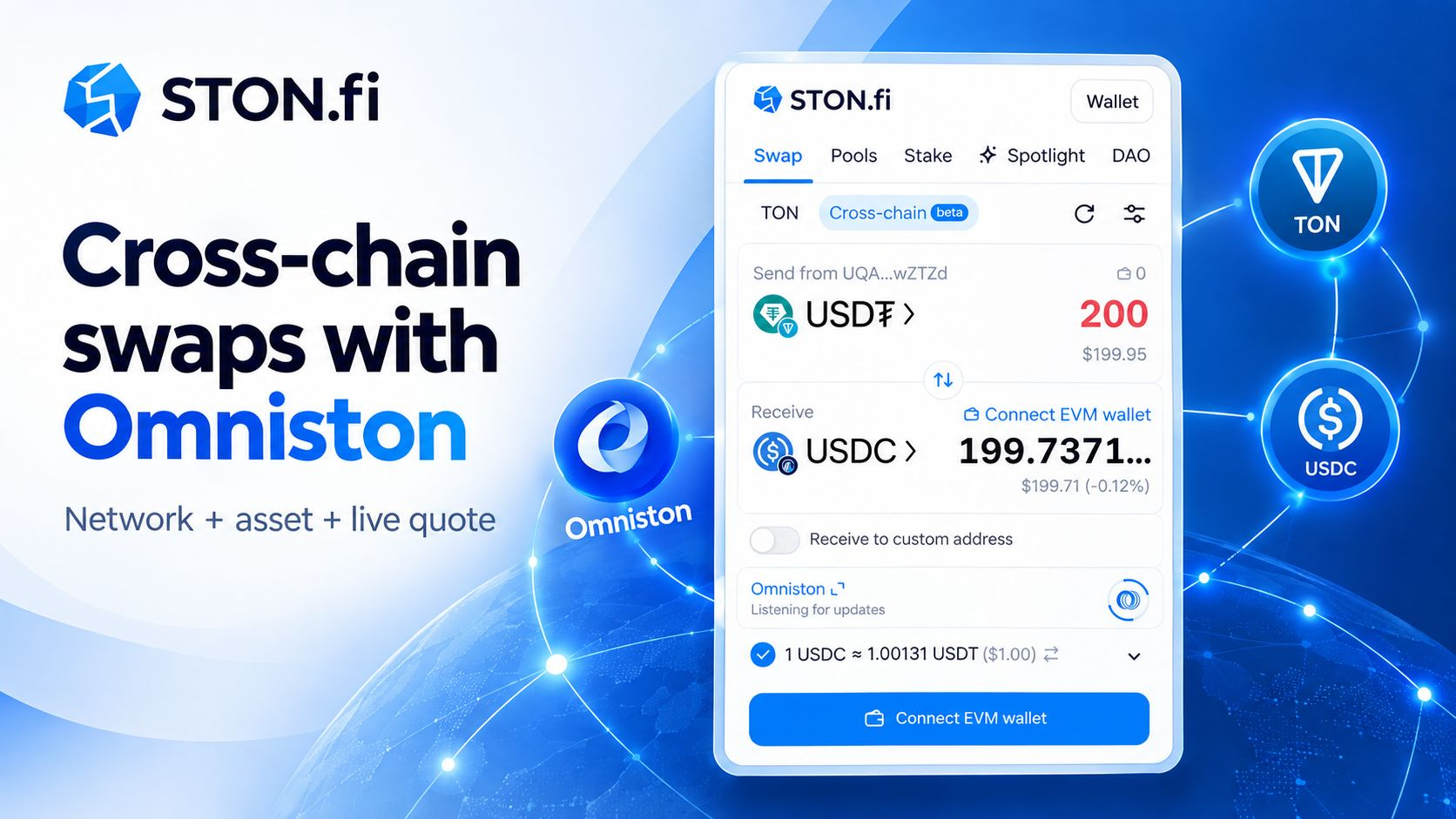
Open the STON.fi cross-chain interface.
Select:
Your source network
Your source asset
Your destination network
Your destination asset
The amount you want to swap
The interface will show whether a live route and quote are available for that specific combination.
This is also why I wouldn't rely only on a static list when planning a swap.
The coverage can expand as new networks and assets are added, while live liquidity can change from one moment to another.
So think of Omniston cross-chain support as:
Network + Asset + Live Route
The matrix tells you what is supported.
The live STON.fi interface tells you what you can actually quote right now.
That distinction becomes especially important as more chains and stablecoins become connected.
#STONfi #Omniston #DeFi #TON #Crypto
“Can I swap from one network to another?”
But with Omniston, there’s another part of the question that matters just as much:
Which asset are you swapping?
Cross-chain availability is defined by both the network and the supported asset.
Here’s the current coverage:
• TON — USDT
• Ethereum / ERC20 — USDT, USDC
• TRON — USDT
• BNB Chain — USDC, USDT
• Base — USDC, USDT
• Arbitrum — USDT0, USDC
• X Layer — USDT0, USDC
• Polygon — pUSD, USDC
• Avalanche — USDC, USDT
• Robinhood Chain — USDG
So, for example, knowing that Base is supported doesn't automatically mean every token on Base can be moved cross-chain.
The asset itself has to be supported too.
There’s also another important detail:
Supported does not mean guaranteed to have a quote every second.
A network and asset combination can be part of the supported coverage, while the exact route may not have a live quote at a particular moment.
That can depend on factors such as available liquidity and resolver availability.
So how do you check?
Open the STON.fi cross-chain interface.
Select:
Your source network
Your source asset
Your destination network
Your destination asset
The amount you want to swap
The interface will show whether a live route and quote are available for that specific combination.
This is also why I wouldn't rely only on a static list when planning a swap.
The coverage can expand as new networks and assets are added, while live liquidity can change from one moment to another.
So think of Omniston cross-chain support as:
Network + Asset + Live Route
The matrix tells you what is supported.
The live STON.fi interface tells you what you can actually quote right now.
That distinction becomes especially important as more chains and stablecoins become connected.
#STONfi #Omniston #DeFi #TON #Crypto