


AI is entering a different phase.
For years, the dominant model was simple: ask AI a question, receive an answer.
Now, AI agents are increasingly being designed to do more. They can retrieve information, use external tools, coordinate workflows, and when authorized take actions on behalf of users.
That creates a new infrastructure problem.
If an AI agent is going to interact with financial markets, it needs more than intelligence. It needs real-time market access, defined permissions, execution infrastructure, and controls around what it is allowed to do.
This is where Binance Agent OS comes in.
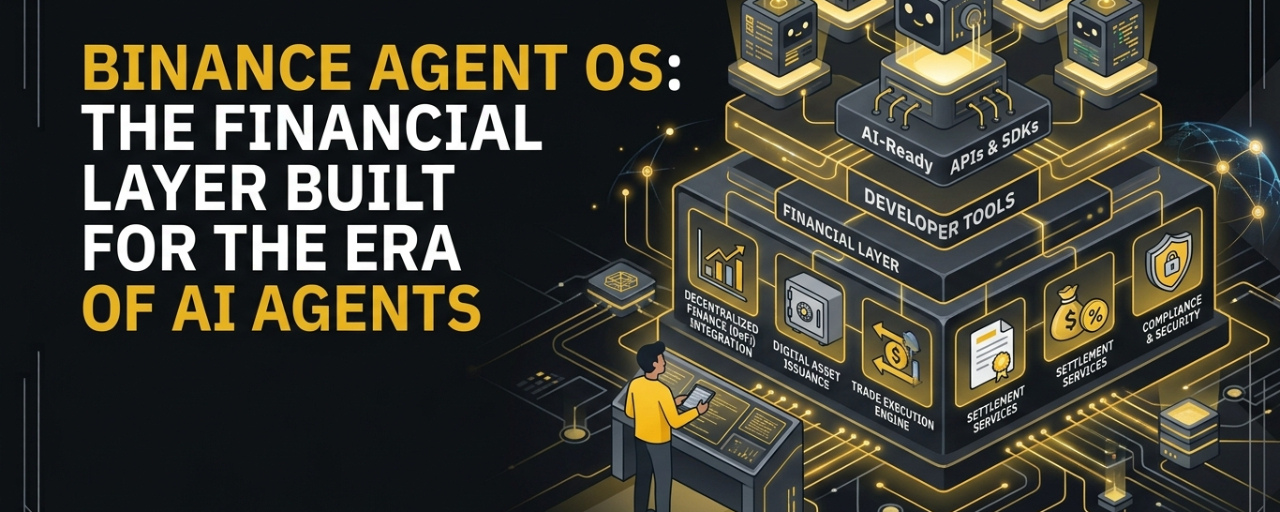
Launched in August 2026, Agent OS is a developer platform designed to connect compatible AI applications and agents with Binance capabilities through user-controlled permissions. Its architecture brings together Binance APIs, the Wallet Agentic Hub, x402, Skill Hub, and Model Context Protocol (MCP) support.
The bigger idea is straightforward:
AI can provide the intelligence. Agent OS provides a controlled path to financial infrastructure.
From AI That Answers to AI That Acts
The first generation of generative AI largely lived inside a conversation window.
You asked:
“What is Bitcoin's current price?”
The model answered.
An agentic system changes the workflow.
You might instead ask an agent to monitor a market, retrieve account information, analyze a position, or prepare a trade. With the appropriate permissions and supported functionality, the agent can interact with external systems rather than simply describing what a user could do.
That distinction matters enormously in finance.
A chatbot can tell you that an asset moved 5%.
A connected agent can retrieve the market data directly.
A chatbot can explain how an order works.
A connected agent can interact with the trading infrastructure subject to the permissions and controls established by the user.
Binance Agent OS is designed around this second model.
Its MCP integration provides a standardized way for compatible AI applications to connect with Binance. The Binance MCP Server currently supports market-data and trading functionality, while other Agent OS tools extend toward wallets, payments, and on-chain capabilities.
Why MCP Matters
The important piece underneath this architecture is Model Context Protocol, or MCP.
MCP is an open standard for connecting AI applications with external tools and services through a structured interface. Instead of every AI application having to build a completely different integration for every service, MCP provides a common way for agents to discover and use tools.
Its ecosystem has expanded rapidly.
By early 2026, MCP had reached approximately 97 million monthly SDK downloads and more than 10,000 public servers, with support across major AI ecosystems including OpenAI, Google, Microsoft and AWS. That does not mean MCP itself is a financial system. It is the connection layer.
Binance Agent OS uses that connection layer to give AI applications a standardized route into Binance-supported financial capabilities.
That is an important architectural distinction.
MCP connects the agent to the tool. Agent OS defines the Binance capabilities and permissions available through that connection.
The Financial Layer AI Agents Have Been Missing
AI agents can reason about markets, but reasoning alone does not create financial utility.
An agent needs access to the underlying infrastructure.
With Binance Agent OS, compatible agents can, depending on eligibility and permissions:
access live market information;
view balances and positions within the Agentic environment;
interact with supported trading functions;
transfer funds between wallets inside the Agentic sub-account; and
connect to other Binance tools for wallet, payment and on-chain workflows.
The Binance MCP integration does not provide a withdrawal scope to external addresses, and authorization takes place through a dedicated Agentic sub-account isolated from the main account. That architecture is important because financial automation has a fundamentally different risk profile from ordinary software automation.
An AI agent scheduling a meeting and an AI agent moving financial assets are not equivalent problems. The second requires much stronger boundaries.
AI Advises. Users Define the Perimeter.
The most important part of Agent OS may not be the AI itself.
It is the permission model around the AI.
Binance's architecture gives users control over what an agent can access and how much capital is available to it. The Agentic sub-account is separate from the main account, and users only transfer into it the assets they are willing to make available for agent activity.
This creates a concept that could become increasingly important as agentic finance develops:
controlled autonomy.
The objective is not necessarily to give an AI unlimited authority.
Instead, the user establishes the boundaries first.
The agent can then operate inside those boundaries.
For supported actions, users are asked to review the operation details before confirming submission. Binance's current Agent OS design also includes controls for disconnecting agents, while the Agentic environment prevents external withdrawals through the MCP integration.
In other words, the architecture separates intelligence from authority.
An AI model may decide what it thinks should happen.
The financial infrastructure determines what it is actually permitted to do.
That separation is critical.
Why Security Becomes More Important as AI Gains Access
Giving software access to financial infrastructure introduces a different class of security questions.
What can the agent access?
How much money can it use?
Can it withdraw?
Can the user revoke access?
Where does the activity take place?
What happens if the agent behaves unexpectedly?
Binance Agent OS addresses these questions through several layers, including permission scopes, a dedicated Agentic sub-account, funding boundaries and restrictions on external withdrawals.
There is also Binance's broader security infrastructure behind the account.
The Secure Asset Fund for Users (SAFU) exists as an emergency reserve designed to protect users in extreme circumstances. Binance's latest published information values SAFU at approximately US$1 billion, although the value and composition can change with market conditions.
SAFU should not be interpreted as making AI trading risk-free. An agent can still make a bad decision, execute an unfavorable trade, or expose a user to market losses.
The point is different:
Agentic finance needs both intelligent software and financial-grade controls.
The Agent Economy Is Becoming a Real Market
The potential market for agentic AI is also expanding rapidly, although forecasts vary depending on what researchers include in the category.
For example, Grand View Research has projected the enterprise agentic AI market at roughly $24.5 billion by 2030, while MarketsandMarkets estimates the AI agents market could reach approximately $52.6 billion over the same period. The difference illustrates how early the category still is and how differently analysts define it.
The exact number matters less than the structural change behind it.
If millions of AI agents eventually perform tasks for individuals and businesses, those agents will need access to the same infrastructure humans use today:
data → applications → payments → markets → settlement.
That is where crypto and blockchain infrastructure become particularly interesting.
Crypto markets already operate digitally and continuously. Market data is available through APIs. Assets can move programmatically. Smart contracts can execute according to predefined rules. The environment is naturally compatible with software agents.
From Financial App to Agent Infrastructure
This is why Binance Agent OS is more significant than simply adding an AI chatbot to an exchange.
The underlying proposition is different.
Instead of asking users to manually move between an AI application and a financial platform, the architecture allows an agent to become an interface between the user and financial infrastructure.
Imagine an agent that can monitor market conditions, retrieve portfolio information, explain what changed, prepare an action, and within permissions established by the user—interact with the relevant Binance functionality.
The interface becomes conversational.
The infrastructure remains financial.
And the user remains the authority defining the boundaries.
That could eventually change how people interact with exchanges.
The exchange may increasingly become less of a place users manually navigate and more of a financial infrastructure layer that software can securely interact with.
The Bigger Picture: AI Needs Markets
The AI race has largely focused on models.
Who has the best reasoning?
Who has the fastest inference?
Who has the largest context window?
But an agent economy introduces another question:
What can the agent actually do?
An intelligent agent without access to useful infrastructure is still limited to recommendations.
Give it access without controls, and the risk increases dramatically.
The emerging model is therefore somewhere in between:
intelligence + connectivity + permissions + execution + oversight.
Binance Agent OS is an attempt to build that financial layer.
MCP provides the standardized connection.
Binance provides the financial infrastructure.
The user defines the permissions.
And the agent provides the intelligence needed to navigate increasingly complex workflows.
The Next Financial Interface May Not Look Like an Exchange
The most interesting implication of Agent OS is not that AI can trade crypto.
It is that financial interaction itself may become increasingly agentic.
Instead of opening an application, searching for an asset, checking a chart, calculating an amount and manually placing an order, a user could increasingly communicate with an AI system that understands the available financial tools and operates within predefined boundaries.
That does not eliminate the need for human judgment.
It changes where that judgment happens.
The user sets the objective, permissions and limits.
The agent handles the interaction.
The infrastructure handles execution and controls.
That is the architecture required if AI is going to move from simply talking about finance to actually interacting with financial markets.
The agent economy is still being built.
But one thing is becoming clearer:
AI agents will need financial infrastructure.
Binance Agent OS is building a connection between the two.
Disclaimer
This article is for educational and informational purposes only and does not constitute financial, investment, trading, or other professional advice. Agent OS features, supported products, permissions, and availability may vary by user, jurisdiction, and eligibility. AI-generated or agent-executed actions can result in losses. Always review permissions and transaction details carefully and conduct your own research.