

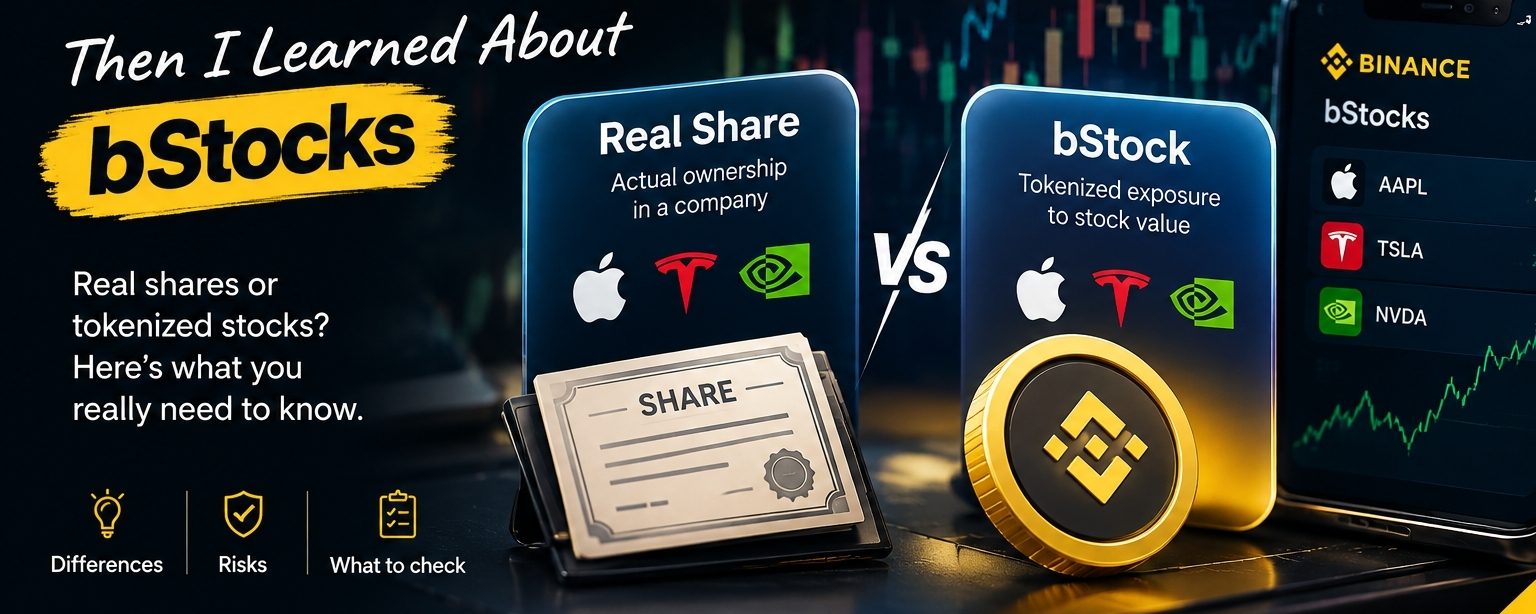

I Thought Binance Was Letting Me Buy Stocks… Then I Learned About bStocks
“Wait… can I really buy Tesla or Apple on Binance?”
That was honestly my first reaction when I came across bStocks.
At first, I thought it was simply another way to buy US stocks.
But after looking into it more carefully, I realized there’s a detail that really matters:
A tokenized stock product and a real company share are not necessarily the same thing.
And if you’re new to bStocks, I think this is the first thing worth understanding.
🧩 First: What Is a Real Stock?
Let’s use Tesla as an example.
Tesla trades under the ticker TSLA.
If you buy TSLA through a traditional stock broker, you’re buying an actual equity share in Tesla.
Depending on the share type and applicable rules, that can come with shareholder rights such as voting rights and rights related to dividends.
So, the simple version is:
Real Share = Actual equity ownership in a company.
Pretty straightforward, right?
Now comes the interesting part.
🔗 So, What Is a bStock?
A tokenized stock product is designed to give exposure to the value or economic performance of an underlying stock through a tokenized structure.
One simple way to picture it is:
Underlying Stock → Tokenized Product → Digital Platform → User
So if you buy a tokenized product linked to Tesla, it’s better not to think:
“I now directly own a Tesla share.”
The actual product structure matters.
Underlying shares may be held by a custodian as part of the structure, but that doesn't automatically mean the token holder personally owns those shares or receives every right of a traditional shareholder.
That distinction was probably the biggest thing I learned while researching bStocks.
⚖️ Real Shares vs. Tokenized Stocks
Here’s where things can get confusing.
A real share and a tokenized stock product can both be linked to the same company's price.
If Tesla's stock price rises, a Tesla-related tokenized product may also be designed to move in a similar direction.
But:
Similar price exposure ≠ identical ownership.
With a traditional TSLA share, you own the applicable equity share.
With a tokenized stock product, you own the tokenized product according to its specific terms.
That means things like:
• Voting rights
• Dividends
• Redemption
• Custody
• Other shareholder rights
shouldn't automatically be assumed to work exactly like traditional shares.
🔍 What Does “1:1 Backed” Mean?
This phrase can easily cause confusion.
If a product is described as 1:1 backed, it doesn't necessarily mean:
“1 token = 1 actual share owned directly by me.”
It can describe a structure where corresponding underlying assets are held to support the tokenized product.
So one sentence worth remembering is:
Underlying shares existing ≠ Token holder directly owning those shares.
That’s why I think it’s important to look beyond the words “backed by stocks” and understand what rights the actual token holder receives.
🌉 Why Does This Interest Me?
The part I find most interesting is the connection between traditional finance and the digital-asset world.
If you're already familiar with crypto but also want exposure to companies like Apple, Tesla, or NVIDIA, tokenized stock products can potentially provide another way to access stock-related exposure through a digital-asset environment.
And if fractional investing is supported, you may not always need enough money to buy a whole share.
But the details matter.
Minimum amounts, fees, supported assets, availability, and eligibility can vary depending on the product and your jurisdiction.
⚠️ And Yes… There Are Risks
This is the part I wouldn't skip.
A tokenized stock is not risk-free.
If the underlying stock falls, the related product can also lose value.
There can also be:
Market risk
Liquidity risk
Issuer/custody risk
Platform risk
Regulatory risk
And availability can depend on where you live.
So, seeing a product on a platform doesn't automatically mean it's available to everyone.
📝 What Would I Check Before Buying?
If I were researching a bStock today, I wouldn't start with:
“Will the price go up?”
I'd start with:
“What exactly am I buying?”
Then I'd check:
🔹 What is the underlying asset?
🔹 What exactly does the token represent?
🔹 Who holds the underlying assets?
🔹 What rights do I receive?
🔹 How are dividends handled?
🔹 What are the fees?
🔹 Is there a redemption mechanism?
🔹 Is the product available in my jurisdiction?
Once those questions are clear, the investment decision becomes much easier to understand.
💡 My Biggest Takeaway
When I first saw bStocks, I thought:
“Binance lets me buy stocks.”
Now, after learning more, I think the better question is:
“What exactly am I buying?”
A real share represents actual equity ownership in a company.
A tokenized stock product is structured to provide exposure to an underlying stock through a tokenized form.
They may follow the same stock's price, but the ownership structure, voting rights, dividends, custody, redemption, and legal rights can be different.
And honestly, that’s the part I think every beginner should understand before getting started.
Don’t just ask what the price might do.
First understand what you actually own.
Then understand the risks.
And only after that, make your own decision.