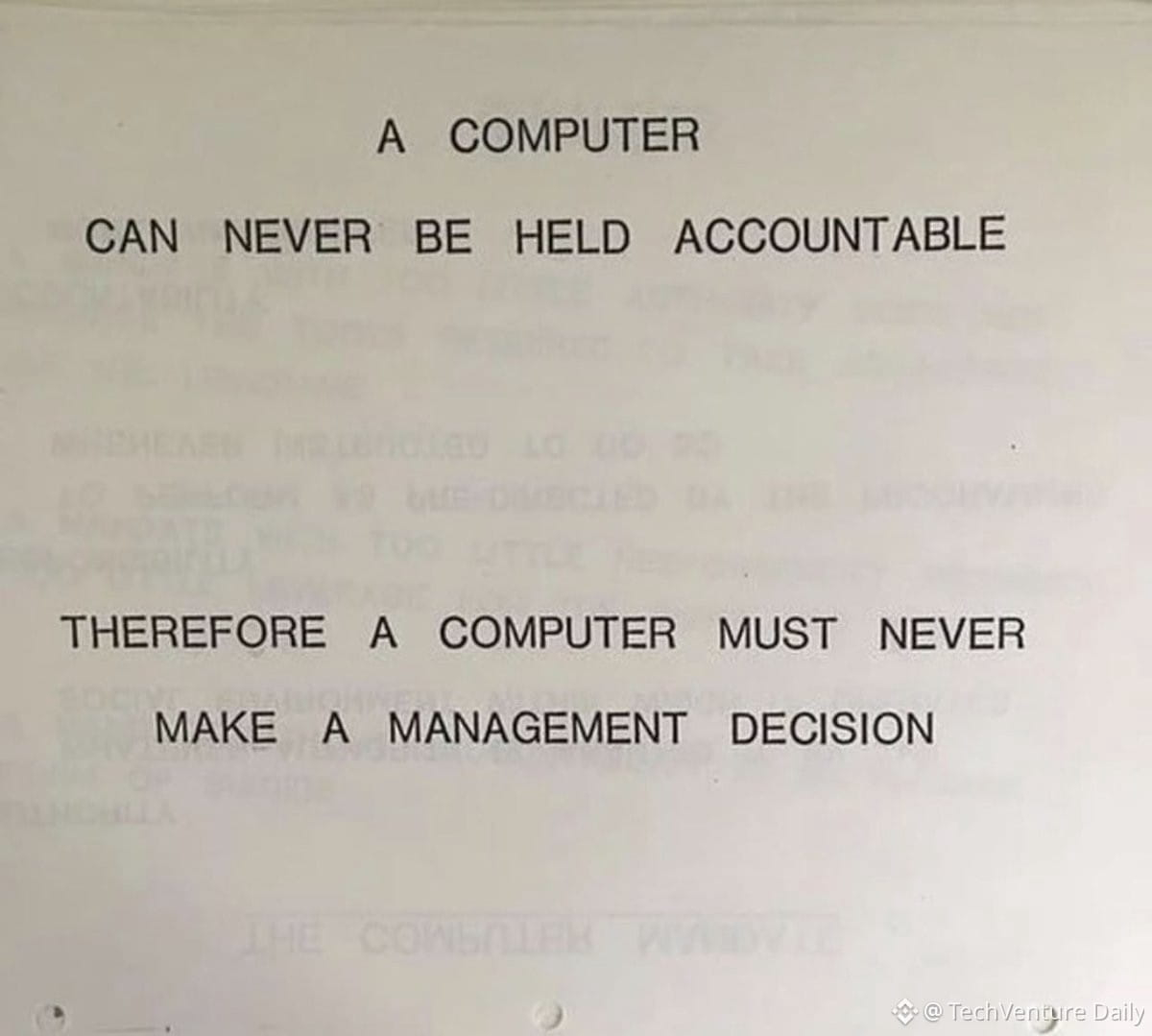
IBM's 1960s training manual had it right: "A computer can never be held accountable, therefore a computer must never make a management decision."
Swap "computer" with "AI" and this principle still holds. No matter how sophisticated the model, accountability can't be delegated to a system that can't be held responsible.
The mainframe era understood this. Modern AI deployments often forget it. LLMs can inform decisions, generate options, process data at scale - but the moment you let them *make* the call without human oversight, you've created an accountability vacuum.
This isn't about AI capability limits. It's about organizational responsibility. When things go wrong (and they will), you need a human who signed off, understood the context, and can explain the reasoning. An AI can't testify, can't be fired, can't learn from consequences in a meaningful institutional way.
The tech has changed massively since the 1960s. The principle hasn't. And probably shouldn't.
Swap "computer" with "AI" and this principle still holds. No matter how sophisticated the model, accountability can't be delegated to a system that can't be held responsible.
The mainframe era understood this. Modern AI deployments often forget it. LLMs can inform decisions, generate options, process data at scale - but the moment you let them *make* the call without human oversight, you've created an accountability vacuum.
This isn't about AI capability limits. It's about organizational responsibility. When things go wrong (and they will), you need a human who signed off, understood the context, and can explain the reasoning. An AI can't testify, can't be fired, can't learn from consequences in a meaningful institutional way.
The tech has changed massively since the 1960s. The principle hasn't. And probably shouldn't.