


$BNB (BNB): The Utility Token Powering a Major Web3 Ecosystem
BNB is more than an exchange token.
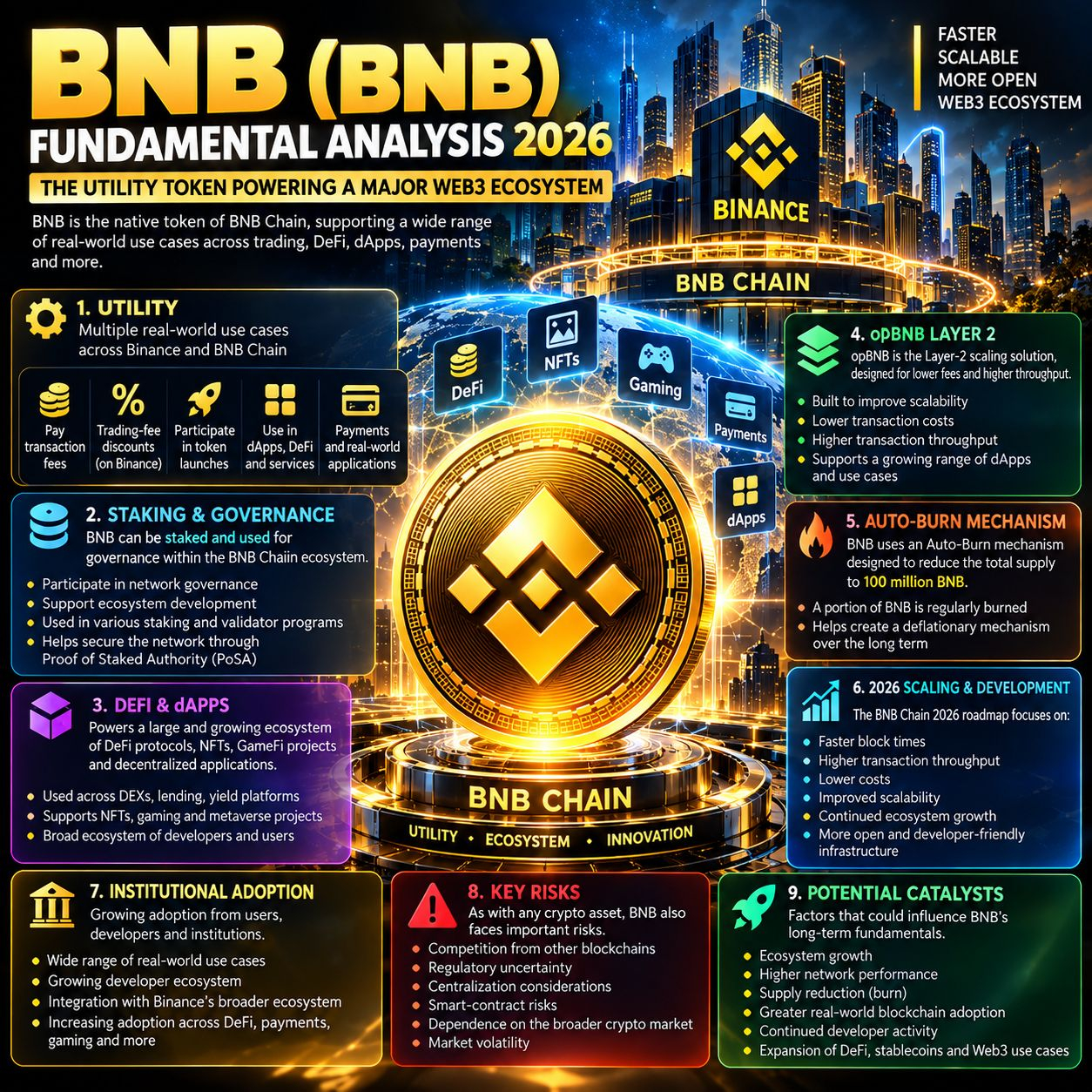
It is the native utility asset of the BNB Chain ecosystem, where it is used for transaction fees, staking, governance, DeFi applications and other blockchain services.
For fundamental analysis, the important question is not simply whether BNB's price will rise. The better question is:
Is the BNB ecosystem continuing to grow in users, activity, applications and utility?
1. What Is BNB?
BNB is the native token of BNB Chain.
Its utility extends across both the blockchain ecosystem and Binance-related services.
BNB can be used for:
Paying blockchain transaction fees
Staking
Network participation
Governance
DeFi applications
DEX transactions
Certain Binance trading-fee benefits
Token launches and ecosystem services
Payments and other applications
This broad utility is one of the main fundamental components of BNB.
2. BNB Chain — The Core Ecosystem
BNB Chain includes BNB Smart Chain (BSC) and opBNB, among other infrastructure.
BSC is an EVM-compatible smart-contract blockchain designed for relatively fast and low-cost transactions. BNB serves as the native gas and staking asset.
The ecosystem supports applications across:
DeFi
NFTs
Gaming
Payments
Social applications
Infrastructure
Real-world use cases
3. BNB's Biggest Fundamental Strength: Utility
A cryptocurrency becomes more economically interesting when its token has genuine demand from network activity.
BNB has multiple sources of utility.
Transaction fees
BNB is required to pay transaction fees on BNB Chain.
Staking
BNB can be staked to participate in securing the network and earn staking rewards.
Governance
BNB Chain has on-chain governance mechanisms through which eligible participants can propose and vote on changes affecting the network.
DeFi
BNB is used throughout BNB Chain's decentralized-finance ecosystem.
Binance ecosystem
BNB also has utility within Binance-related services, including certain trading-fee benefits and token-launch activities.
4. BNB Tokenomics
One of the most important parts of the BNB investment thesis is its supply-reduction mechanism.
BNB uses an Auto-Burn mechanism designed to reduce total supply toward 100 million BNB. BNB Chain also uses a real-time burning mechanism connected to gas fees.
This creates an important relationship:
Network activity → transaction fees → BNB burn mechanisms → lower token supply over time
However, a burn mechanism alone does not guarantee that BNB's market value will increase.
Demand, ecosystem growth and broader market conditions still matter.
5. Staking and Network Security
BNB is also part of the network's staking architecture.
BNB Chain currently reports more than 25 million BNB staked, with dozens of active validators and delegators participating in network security.
Staking creates another use for BNB beyond trading.
It also means that part of the token supply can be committed to network participation rather than being immediately available for trading.
6. opBNB and Scaling
BNB Chain's scaling strategy is another fundamental factor to watch.
opBNB is a Layer-2 solution built using the OP Stack and is designed to provide higher throughput and lower transaction costs within the BNB ecosystem.
This is important because blockchain adoption requires infrastructure that can handle large numbers of transactions economically.
7. 2026 Technology Development
BNB Chain has made network performance a major focus.
Its 2026 roadmap reports improvements in block times, finality, throughput and gas efficiency.
In its H1 2026 update, BNB Chain reported a reduction in BSC block intervals from 750 ms to 450 ms and benchmark throughput of approximately 5,200 transactions per second. The H2 roadmap targets further performance improvements.
If these improvements translate into greater real-world usage, they could strengthen the underlying ecosystem.
8. DeFi and dApp Ecosystem
BNB Chain supports a broad ecosystem of decentralized applications.
BNB is used across:
Decentralized exchanges
Lending
Yield platforms
Stablecoins
Gaming
NFTs
Payments
Other Web3 applications
The fundamental metric to watch is not simply the number of projects.
More important questions are:
How many users are active?
How much economic activity is occurring?
Are developers continuing to build?
Is liquidity increasing?
These provide a better picture of ecosystem health.
9. Major Catalysts for BNB
Several factors could influence BNB's long-term fundamentals.
🚀 Ecosystem growth
More users and applications can increase demand for BNB-related infrastructure.
⚡ Higher network performance
Faster and cheaper transactions can make blockchain applications more practical.
🔥 Supply reduction
BNB burns reduce the token supply over time.
🏦 Institutional and enterprise blockchain adoption
Increasing use of blockchain infrastructure by businesses and financial institutions could create additional ecosystem activity.
🌐 Web3 adoption
Growth in DeFi, stablecoins, gaming and other applications could increase BNB Chain activity.
10. Key Risks
BNB also carries significant risks.
Competition
BNB Chain competes with Ethereum, Solana and other smart-contract platforms for developers, users and liquidity.
Regulatory risk
Cryptocurrency regulation can affect exchanges, tokens and blockchain businesses across different jurisdictions.
Ecosystem concentration
BNB has a close relationship with Binance and the wider Binance ecosystem. Changes affecting Binance can therefore be relevant to BNB.
Validator and decentralization considerations
BNB Smart Chain uses a comparatively limited validator structure. BNB Chain itself describes its validator-based PoSA design, while noting the trade-offs between efficiency and decentralization.
Smart-contract risk
Applications built on BNB Chain can contain vulnerabilities even when the underlying blockchain remains operational.
Crypto-market risk
BNB remains exposed to broad cryptocurrency market cycles and liquidity conditions.
11. Bullish Fundamental Scenario
A constructive fundamental environment for BNB could involve:
Increasing BNB Chain users
Higher genuine network activity
Continued DeFi growth
Expansion of stablecoin usage
Successful scaling upgrades
Continued BNB burns
Growing developer activity
Greater real-world blockchain adoption
These factors could strengthen the ecosystem's underlying fundamentals.
They do not, however, guarantee a particular BNB price.
12. Bearish Fundamental Scenario
The fundamental environment could weaken if:
Users migrate to competing chains
BNB Chain activity declines
Regulatory restrictions increase
Major ecosystem applications lose users
Security incidents damage confidence
Binance-related risks negatively affect sentiment
Global crypto liquidity deteriorates
13. BNB Fundamental Dashboard
For serious research, monitor these metrics rather than relying only on the BNB price chart:
MetricWhat it tells youBNB priceMarket valuationBNB market capOverall token valuationBNB burnSupply reductionBNB stakingNetwork participationBSC transactionsNetwork activityActive addressesUser activityDeFi TVLCapital deployed in DeFiStablecoin activityDigital-dollar ecosystem activityopBNB activityLayer-2 adoptionDeveloper activityEcosystem developmentBinance ecosystem activityDemand-related context
14. BNB vs ETH vs SOL
These networks have different fundamental models.
BNB:
Exchange ecosystem + smart-contract infrastructure + DeFi + low-cost transactions + BNB utility
Ethereum:
Smart contracts + settlement infrastructure + DeFi + staking + Layer-2 ecosystem
Solana:
High-performance blockchain + low-cost transactions + applications + consumer/Web3 ecosystem
Instead of asking which coin is "best," investors can compare network usage, token economics, developer activity, adoption and risks.
🔥 Final Thoughts
BNB's fundamental story is built around a combination of utility, ecosystem activity, staking, supply reduction and BNB Chain growth.
Its biggest potential strength is that BNB is connected to a large ecosystem rather than depending on a single use case.
At the same time, investors should not ignore the risks: competition, regulation, ecosystem concentration, decentralization considerations and cryptocurrency-wide volatility remain important.
The most useful question for analyzing BNB in 2026 is therefore:
"Is BNB Chain continuing to generate real economic activity while BNB's utility and supply dynamics remain supportive?"
That is a much stronger fundamental framework than simply looking at whether the BNB price is moving up or down.
Disclaimer
This article is for educational and informational purposes only. It is not financial advice or a recommendation to buy or sell BNB. Cryptocurrency markets are highly volatile, and investors should conduct their own research and consider their risk tolerance before making financial decisions.
#BNBLUNCPOOL #BNB_Market_Update #bnblauncpool $BNB
