



Why Cross-DEX Aggregation Can Create Routes You Wouldn't Build Manually
Aggregators like Omniston sometimes route a swap through paths no human trader would ever think to construct by hand — and understanding why reveals something genuinely interesting about how fragmented liquidity actually behaves.
If you asked most people how a swap gets from Token A to Token B, they'd describe something intuitive: find the pool with A and B in it, trade directly, done. That mental model works fine for major pairs with deep liquidity. It breaks down completely the moment you're dealing with a less common token, a large trade size, or a moment when liquidity across the ecosystem happens to be unevenly distributed — and that's exactly the situation where aggregation stops being a nice-to-have and starts producing routes that look, at first glance, almost irrational. STON.fi, through its Omniston aggregation layer, is a genuinely good place to watch this happen, because it doesn't just route across its own pools — it pulls in liquidity and competing quotes from across the wider TON ecosystem.
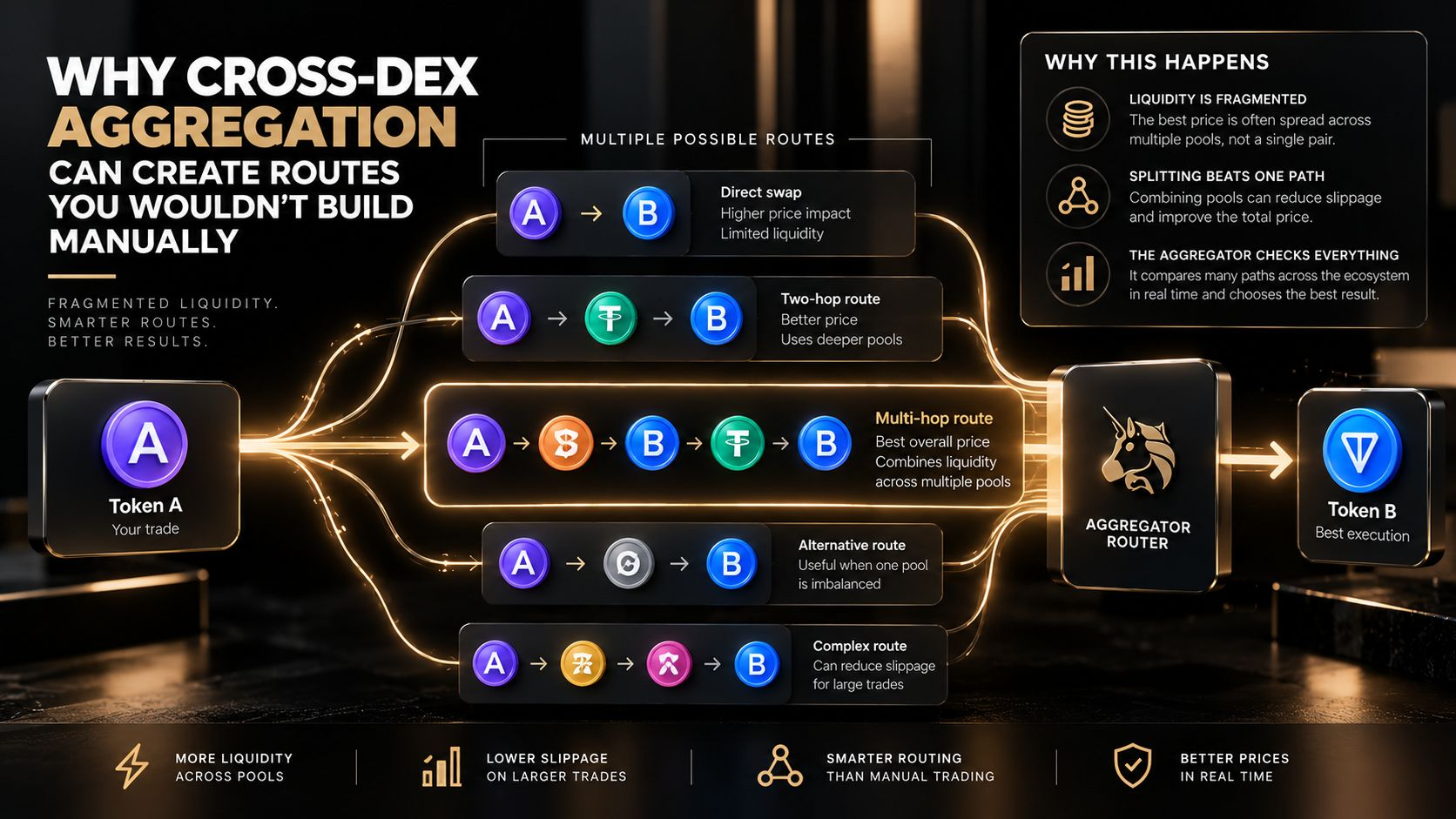
I want to actually dig into why that happens, because "the aggregator found a better route" is the kind of explanation that sounds satisfying without actually explaining anything. The real answer involves a handful of genuinely elegant ideas about how fragmented liquidity behaves, why splitting a trade can beat any single path, and why a route that looks needlessly complicated on paper can still be the mathematically correct answer.
The first time I saw a route go through three hops instead of the obvious direct pool, my gut reaction was "that seems inefficient." Then I actually checked the output number, and it wasn't inefficient at all. My intuition was just wrong.
🧩 Why Liquidity Is Fragmented in the First Place
Before getting into how aggregation solves the problem, it's worth being clear about what the problem actually is, because "liquidity fragmentation" gets thrown around as a buzzword without much explanation of the mechanism underneath it.
On any active DeFi ecosystem, liquidity for a given token pair doesn't live in one single, unified place. It's spread across multiple pools — different DEXs, different fee tiers, different pool designs — each holding its own separate reserves, each pricing trades independently based purely on its own local supply and demand. A token might have deep liquidity against USDT on one DEX and almost none on another, while a completely different token has the opposite pattern. Nothing coordinates these pools with each other; each one simply reflects whatever capital has been deposited into it specifically.

This fragmentation isn't a bug or a failure of the ecosystem — it's the natural, expected outcome of an open, permissionless system where anyone can create a pool for any pair at any time. But it does mean that "the best price for this trade" is rarely sitting in one obvious place, and finding it manually would require checking every pool individually, a task that scales badly the moment you're dealing with anything beyond the two or three most obvious venues.
Liquidity for the same pair can differ enormously between pools, even within the same ecosystem
No single pool has visibility into what any other pool is currently offering
A trader checking pools manually is realistically limited to checking a small handful before giving up and picking one
This is precisely the landscape STON.fi's own pools sit inside of. Even limiting the question to STON.fi's own liquidity, dozens of pools with wildly different depths coexist side by side — which is exactly why STON.fi routes swap requests through Omniston rather than assuming the "obvious" pool for a pair is automatically the best one.
🔀 Why Splitting a Trade Beats Any Single Path
Here's the first genuinely counterintuitive idea worth sitting with: for a sufficiently large trade, splitting it across multiple pools can produce a better total output than routing the entire amount through even the single best-priced pool available. This is the mechanism most responsible for routes that look strange to a manual trader.
The reason comes down to how AMM pricing actually works. Every pool experiences price impact as a function of trade size relative to its own depth — the bigger your trade relative to a pool's reserves, the worse your effective price gets as you consume more of the available liquidity on that specific curve. A pool that offers a great price for a $100 trade might offer a noticeably worse price for a $10,000 trade, purely because you're now moving further along its pricing curve.
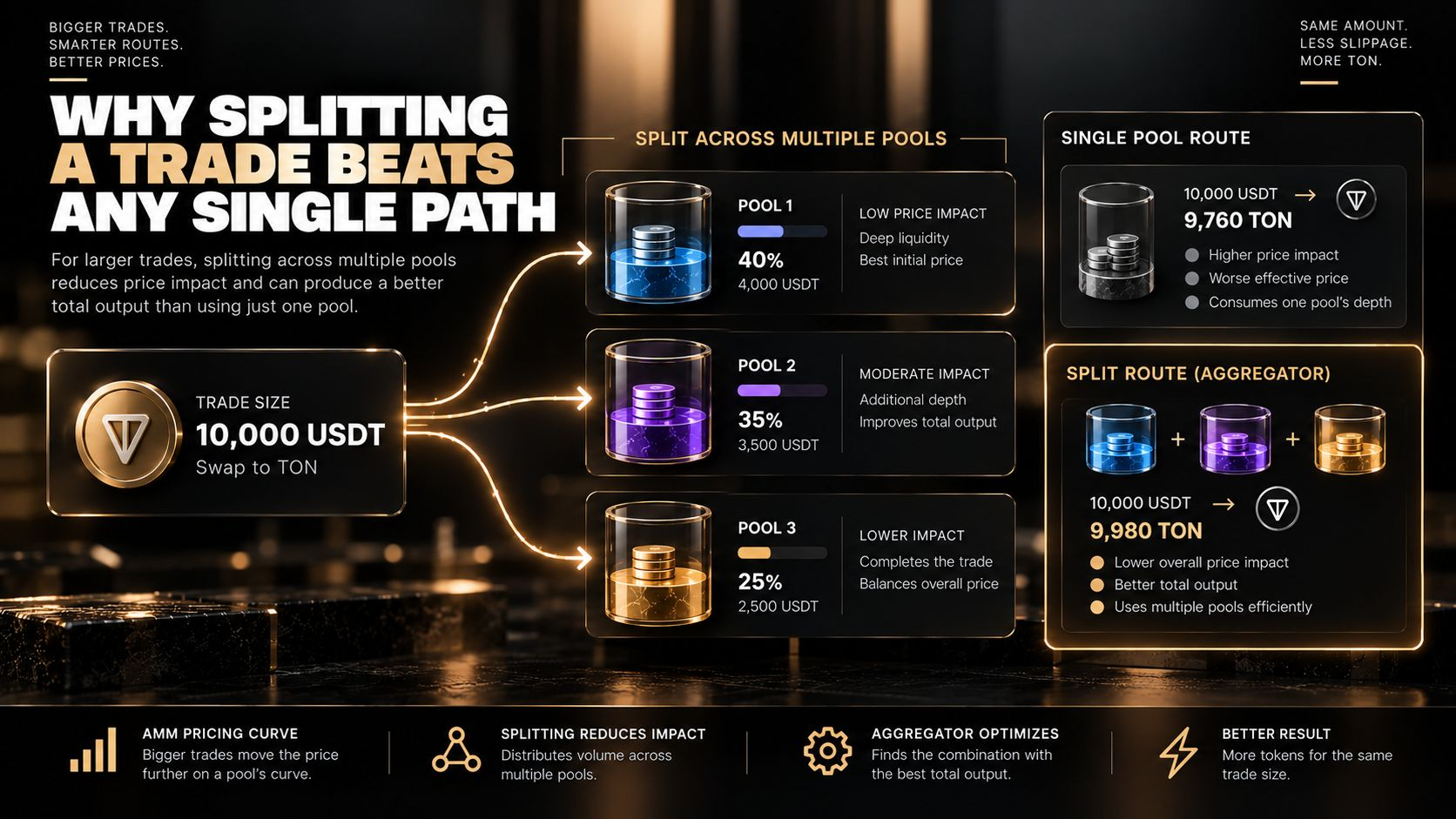
An aggregator solves this by treating "route" as a portfolio problem rather than a single-path problem. Instead of asking "which single pool has the best price," it asks "what combination of partial trades across multiple pools minimizes total price impact for this specific size." The math behind this is genuinely elegant: as you push more volume through any one pool, the marginal price gets worse, so at some point it becomes mathematically better to redirect the next portion of your trade to a second, slightly worse-priced pool rather than continuing to eat deeper into the first pool's curve.
Splitting felt like unnecessary complexity to me at first — more transactions, more moving parts, why not just pick the best pool and be done with it? Then I actually modeled a large trade against a single deep pool versus splitting it three ways, and the split version came out ahead by a margin that was too big to just be a rounding error.
A human manually trying to replicate this would need to know the exact depth curves of every relevant pool simultaneously and solve an optimization problem in their head — which nobody does, because nobody can. That's precisely the kind of calculation STON.fi's routing exists to automate on the trader's behalf.
🌉 Why Multi-Hop Routes Sometimes Beat Direct Pairs
The second counterintuitive pattern: a route that goes Token A → Token C → Token B can sometimes deliver a better result than a direct A → B pool, even when that direct pool exists and looks perfectly functional on the surface.
This happens because liquidity depth isn't evenly distributed across every possible pair. A direct A/B pool might be thin — maybe it's a newer pool, or simply less popular — while A/C and C/B pools are both deep and heavily traded, often because C is a major asset like a stablecoin or TON itself that naturally accumulates liquidity across many pairs. Routing through that well-liquidated intermediate asset can produce less cumulative price impact than forcing the entire trade through one thin direct pool, even though the multi-hop path involves more individual steps.
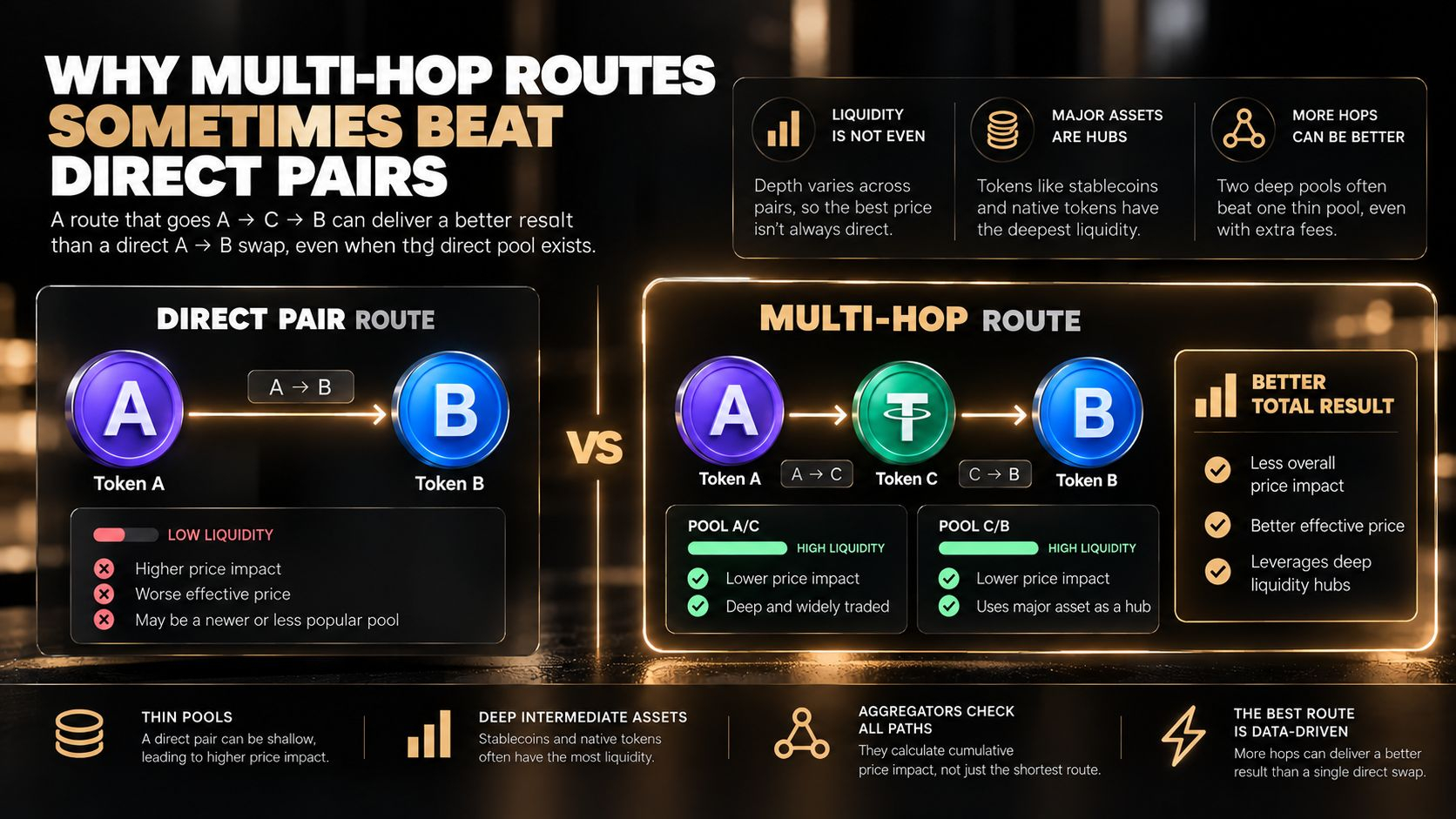
A thin direct pool can have outsized price impact for a trade size that would barely register in a deep intermediate pool
Major, widely-paired assets (stablecoins, native tokens) tend to accumulate the deepest liquidity across the most pairs, making them natural routing hubs
Two hops through deep pools frequently beats one hop through a shallow pool, even accounting for the additional fee taken at each hop
This is genuinely unintuitive if you're thinking like a human trader looking at a map of available pools and instinctively preferring the shortest path. STON.fi's routing logic doesn't have that instinct — it has actual depth data for every relevant pool and calculates cumulative price impact along every viable path, rather than defaulting to "fewest hops" as a proxy for "best outcome."
⚔️ Why Competing Sources Change the Calculation Entirely
STON.fi's Omniston layer adds a further layer on top of pure pool-routing logic: instead of only calculating routes across STON.fi's own pools, it broadcasts the request to a wider set of resolvers and liquidity sources who compete directly with executable offers. This turns route selection from "solve an optimization problem across known, static pool data" into "solve an optimization problem across pool data plus live, competing bids from independent market participants."
That distinction matters because resolvers aren't limited to simply quoting whatever a public pool's current curve says. A resolver might have access to inventory, cross-protocol paths, or pricing relationships that aren't fully reflected in any single pool's visible depth — meaning the best available offer sometimes comes from a source whose internal logic isn't even fully visible from the outside, only its final competitive quote. The resulting route can therefore reflect information a purely pool-based routing algorithm wouldn't have access to at all, let alone a human manually comparing a few DEX interfaces.
This is the part that genuinely surprised me: it's not just that the algorithm is better at math than a person. Sometimes it has access to pricing information that simply isn't visible anywhere a human could go look for it directly.
📊 A Concrete Illustration of Non-Obvious Routing
Let's walk through a simplified, illustrative example to make this concrete rather than abstract. Suppose you want to swap a meaningful amount of Token X for USDT on STON.fi, and here's what the fragmented liquidity landscape might look like:
Direct X/USDT pool: moderate depth, decent price for small trades, but noticeable price impact once your trade size grows
X/TON pool: quite deep, heavily traded, minimal price impact even for larger trades
TON/USDT pool: extremely deep, arguably the most liquid pair in the entire ecosystem, negligible price impact
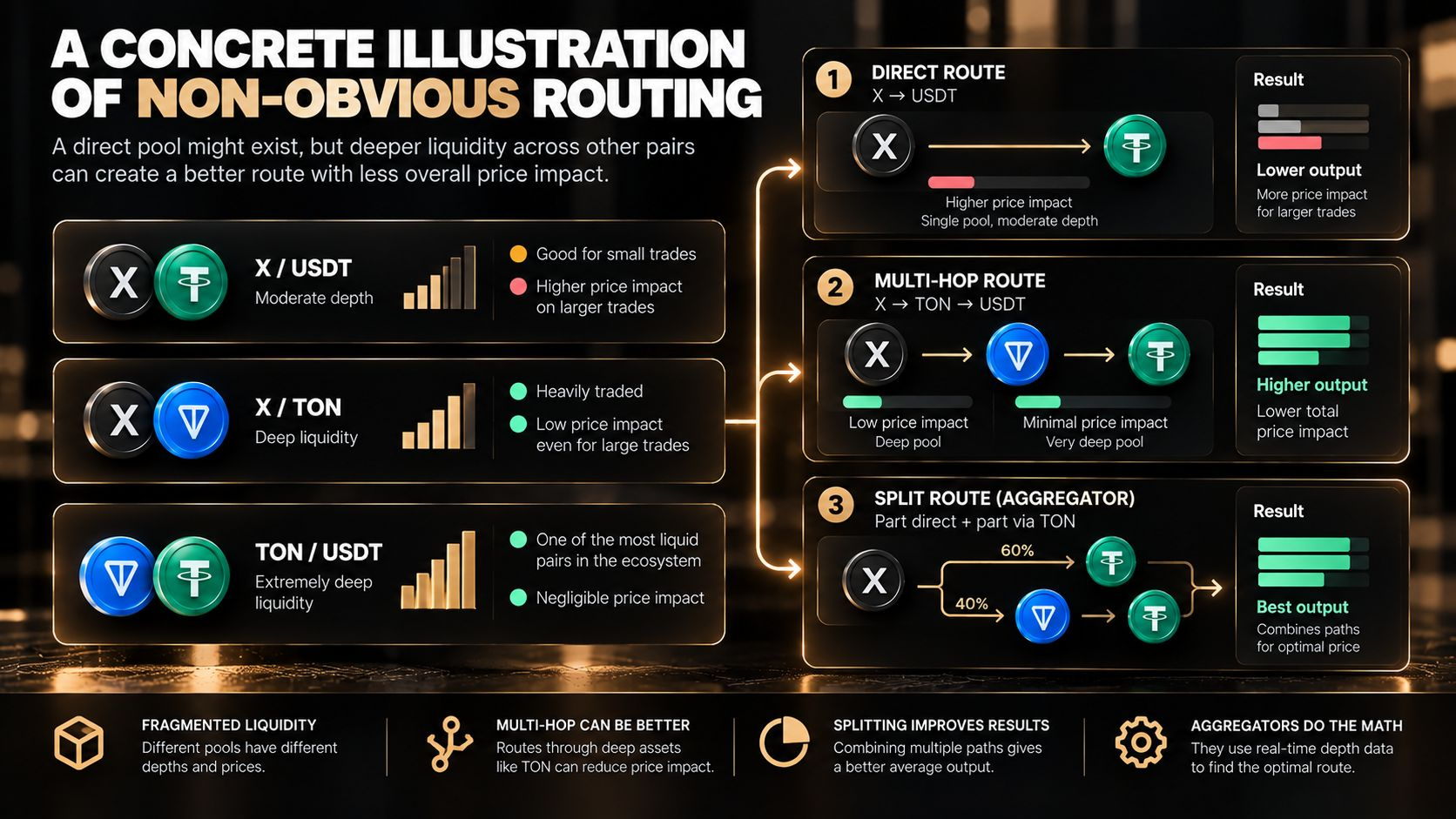
A manual trader, seeing a direct X/USDT pool exists, would likely just use it — why complicate things when a direct route is right there. But an aggregator evaluating actual depth data might determine that routing X → TON → USDT, despite requiring two hops and two separate fee payments, produces meaningfully less cumulative price impact than forcing the entire trade through the shallower direct pool. For a large enough trade, the fee cost of the extra hop can be smaller than the price impact saved by avoiding the direct pool's shallow depth — and the aggregator can further split the trade across a portion going direct and a portion going through TON, blending both paths for an even better blended average.
None of this is something a trader checking two interfaces and eyeballing prices would ever construct manually, not because they're bad at math, but because doing it properly requires live depth data across every relevant pool simultaneously plus a genuine optimization calculation — exactly the kind of thing computers are built for and humans structurally aren't.
⚠️ Where This Complexity Genuinely Has Trade-Offs
It would be dishonest to present multi-hop, split routing as a pure, costless upgrade over simple direct swaps, because it does introduce real trade-offs worth understanding rather than glossing over.
Every additional hop in a route means an additional fee charged along that leg, and an additional point where slippage could theoretically occur between quote and execution. A genuinely optimized route accounts for this — the aggregator isn't choosing more hops for their own sake, it's choosing them because the net result, after all fees and impact are factored in, still comes out ahead. But it does mean a route with more steps is not automatically simpler to reason about or verify manually, and that added complexity is exactly why checking the final quoted output, not just admiring the cleverness of the path, remains the metric that actually matters.
More hops mean more individual fee charges along the route
Each additional hop is another point where execution could theoretically diverge from the quote
The only number that actually matters at the end is total delivered output after all costs, not the elegance of the path itself
I'll admit the complexity makes we want to actually verify the output rather than just trust "the algorithm probably knows best." It usually does. But "usually" is exactly the word that means checking still matters.
🧭 What This Actually Means for How You Should Trade
None of this requires you to personally understand routing algorithms to benefit from them — that's rather the point of aggregation existing in the first place. But understanding why a route looks the way it does changes how you should evaluate a quote, and shifts what's actually worth double-checking before you sign.
Don't judge a route by hop count alone — a three-hop route beating a one-hop route isn't a bug, it's frequently the mathematically correct answer for that specific trade size and liquidity landscape
Focus on the final delivered output relative to fees, not the visual simplicity of the path taken to get there
For genuinely large trades, expect splitting and multi-hop routing to matter more, since price impact on any single pool grows disproportionately with trade size
Trust the competitive process more than any single visible pool's advertised price, since the actual best price might be coming from a source you'd never have checked manually
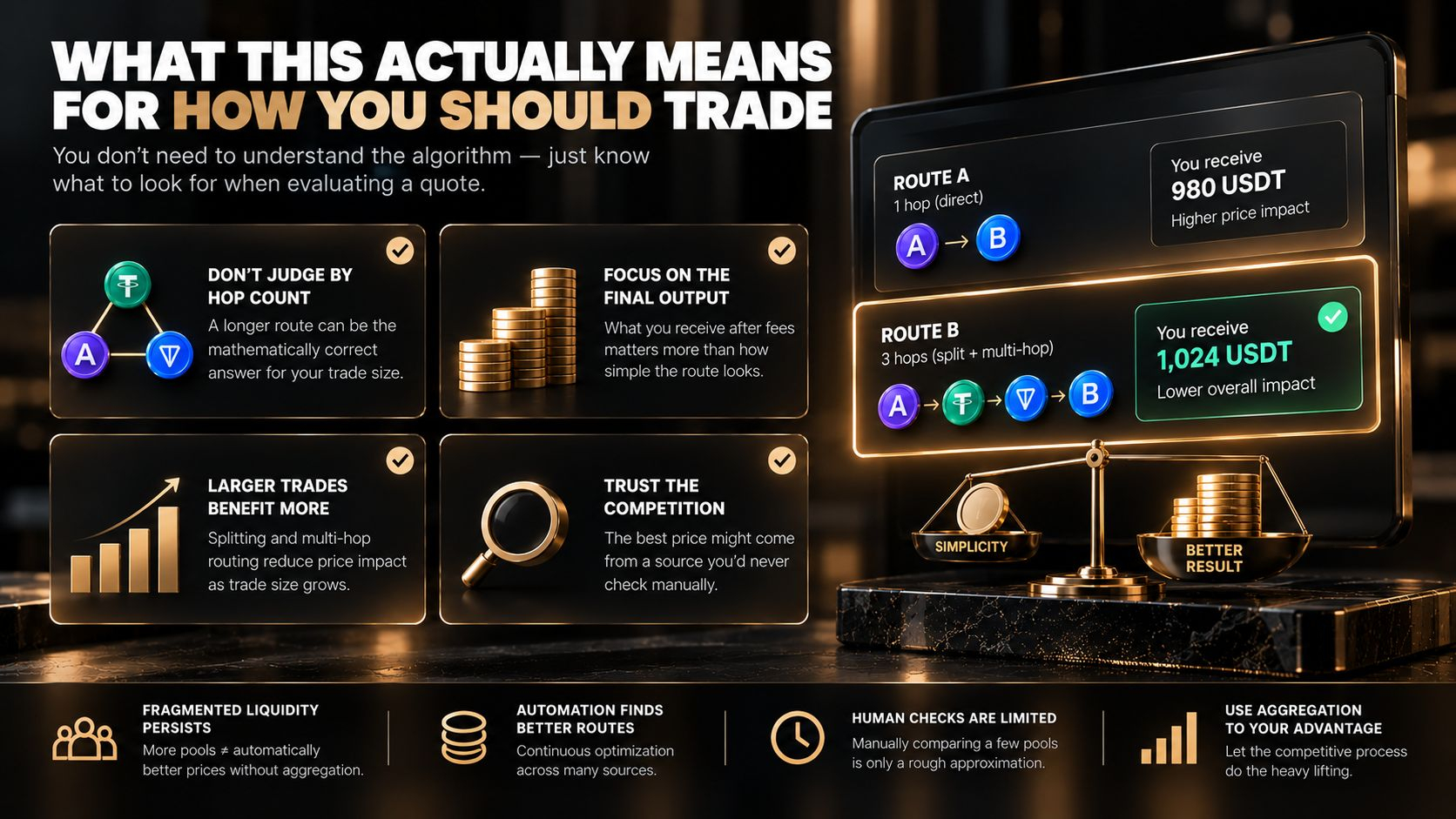
The broader lesson sitting underneath all of this is that fragmented liquidity isn't actually a solved problem the moment enough pools exist — it's an ongoing optimization problem that benefits enormously from automated, continuously-updating routing rather than static, manually-checked comparisons. A human comparing two or three DEX interfaces is doing a rough approximation of what a proper aggregator does mathematically and continuously, across far more sources than anyone could reasonably check by hand.
🧩 Final Thought
The routes that look strange at first glance — the multi-hop paths, the split trades across several pools, the path that skips an obvious direct pool entirely — usually aren't strange at all once you understand what problem they're actually solving. On STON.fi specifically, that's the entire job Omniston is doing behind the interface: finding the mathematically sound answer to a genuinely complex optimization question that fragmented liquidity creates by its very nature, one that no manual trader checking a handful of interfaces could realistically solve as well, simply because the scale of the calculation exceeds what's practical to do by hand. The complexity isn't decoration. It's the actual work of finding the best price in a landscape where the best price was never going to sit in one obvious, convenient place to begin with.
❓ Frequently Asked Questions
Why would an aggregator route my swap through more hops instead of a direct pool? Because liquidity depth varies significantly across pools, a multi-hop route through deeper intermediate pools can produce less cumulative price impact than forcing a trade through a shallower direct pool, even after accounting for the additional fees at each hop.
Is a route with more steps automatically worse? No. The number of hops isn't the relevant metric — the total delivered output after all fees and price impact is. A route with more steps can still outperform a simpler one if it avoids significant price impact on a thin pool.
Why does splitting a trade across multiple pools sometimes produce a better result? Because price impact within a single pool grows disproportionately with trade size. Splitting a large trade across several pools can keep each portion within a range where price impact stays lower, producing a better blended average than routing everything through one pool.
Should I manually check prices across multiple DEXs before trading? For small trades on major pairs, manual comparison is often sufficient. For larger trades or less common tokens, an aggregator like Omniston can access far more routing combinations and competitive quotes than manual checking realistically allows.
$SOL
