


Introduction: The "Where" vs. The "Why"
The chronic frustration of the retail trader often stems from a fundamental misunderstanding of chart mechanics. Most participants focus obsessively on "where" price is—pinning hopes on arbitrary levels—without ever grasping "why" price is moving. In the digital asset markets, price action is not a series of random fluctuations; it is a sophisticated narrative of liquidity and structure. To achieve consistent results, one must stop chasing the candle and start decoding the underlying market story.
Takeaway 1: Liquidity is a Narrative, Not an Entry
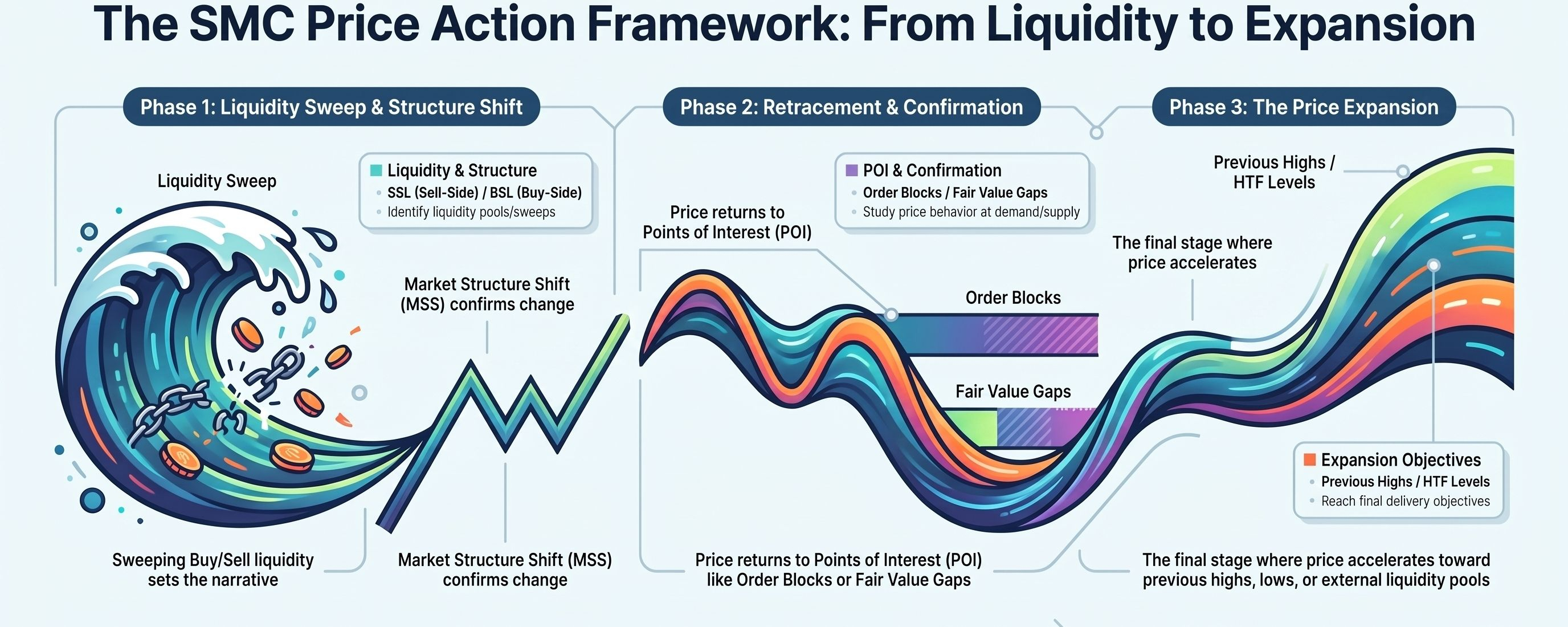
The opening chapter of any meaningful move begins with a liquidity sweep. To a professional strategist, Sell-Side Liquidity (SSL) and Buy-Side Liquidity (BSL) at previous highs and lows are more than just lines on a screen; they represent dense clusters of stop-loss orders. These clusters provide the necessary "counter-party liquidity" that allows large-scale institutional players to initiate exposure or exit significant positions without slippage.
"The sweep is not treated as an entry by itself. It is the first piece of the market narrative."
A sweep is a signal to begin the study, not a prompt for immediate capital allocation. It establishes the context, revealing that the market has sourced the "fuel" required for its next leg.
Takeaway 2: The MSS—Distinguishing Liquidity Traps from Order Flow Shifts
Following a liquidity event, the priority shifts to the Market Structure Shift (MSS). This is the filter that separates a simple liquidity trap—where price briefly deviates beyond a level before continuing its original path—from a genuine change in short-term Order Flow.
The MSS marks the transition in the market’s intent. By demanding a clear structural break after a liquidity sweep, the strategist avoids the "fake-outs" that plague reactive traders. This step confirms that the narrative has moved from a search for liquidity to a concrete change in market direction.
Takeaway 3: Optimizing Asymmetry—Stop Chasing the Displacement
A valid MSS is typically followed by displacement—a rapid price move that leaves the late-comer behind. The retail instinct is to chase this momentum out of a fear of missing the expansion. Conversely, the professional strategist waits for a retracement into a Point of Interest (POI) to optimize the risk-to-reward ratio.
Key POIs to monitor for structural discount or premium entries include:
Order Blocks: Zones where institutional buying or selling was previously concentrated.
Fair Value Gaps (FVG): Areas of inefficient price delivery.
Demand / Supply Zones: Anchors of significant structural shifts.
The objective is to avoid the emotional trap of the chase and instead wait for price to return to a level that offers a superior asymmetric profile.
Takeaway 4: CISD and Expansion—The Mechanics of Price Delivery
Before the final move, we look for the Change In State of Delivery (CISD). This is a critical confirmation layer where we observe if price delivery is actually shifting from a state of retracement back to a state of efficient expansion.
The Expansion phase is the finish line, not the start. It is the stage where price moves aggressively toward External Liquidity objectives—previous highs, lows, or High Timeframe (HTF) levels. For the sophisticated trader, expansion is the zone for profit-taking. If you are initiating a position during expansion, you are providing the liquidity for those who understood the narrative at its inception.
Takeaway 5: The "Bigger Picture" Filter
No sequence exists in isolation. The most potent trade setups occur when lower-timeframe sequences are "nested" within a High Timeframe (HTF) environment. Context acts as the ultimate filter for market noise; a 5-minute MSS is only as strong as the HTF narrative supporting it. By distinguishing between HTF Context and Structure Detail, you ensure your capital is aligned with the broader market's primary objective.
"Don't just look at where price is. Understand why price moved there."
Summary Table: The Framework at a Glance
Stage
Purpose
Liquidity Sweep
Context: Identifying the counter-party fuel for the move.
Market Structure Shift (MSS)
Structure: Confirming a genuine change in Order Flow.
Retracement / POI
Area to Study: Identifying a structural discount/premium.
Confirmation (CISD)
Validation: Observing a Change In State of Delivery.
Expansion
Result: Efficient delivery toward External Liquidity.
Conclusion: Moving Beyond the Formula
While this five-step framework provides a robust logic for interpreting price behavior, it is not a "guaranteed formula." Markets are dynamic and require a disciplined mind to interpret correctly. The transition from a retail mindset to a strategic one requires a commitment to understanding the mechanics behind the candles.
The question remains: Are you providing the liquidity, or are you trading it?
Study the structure. Mark the liquidity. Wait for confirmation. Manage the risk.