
One of the things that has always attracted me to crypto is access.
Not just access to Bitcoin.
Access to markets, financial tools, new forms of ownership and new ways of moving value. That is why the development of tokenized securities on Binance caught my attention.
Because suddenly the conversation isn't only:
“Can I trade crypto?”
It's becoming:
“How many different types of financial assets can I access through the same digital infrastructure?”
1. I don't want my financial world scattered everywhere
Think about a normal digital-asset workflow.
One application for crypto.
Another platform for stocks.
Another application for payments.
Another wallet.
Another place for yield products.
Another account for derivatives.
Another interface for research.
And then you spend half your time moving between platforms rather than actually managing your strategy.
That's one of the reasons I value the direction Binance is taking.
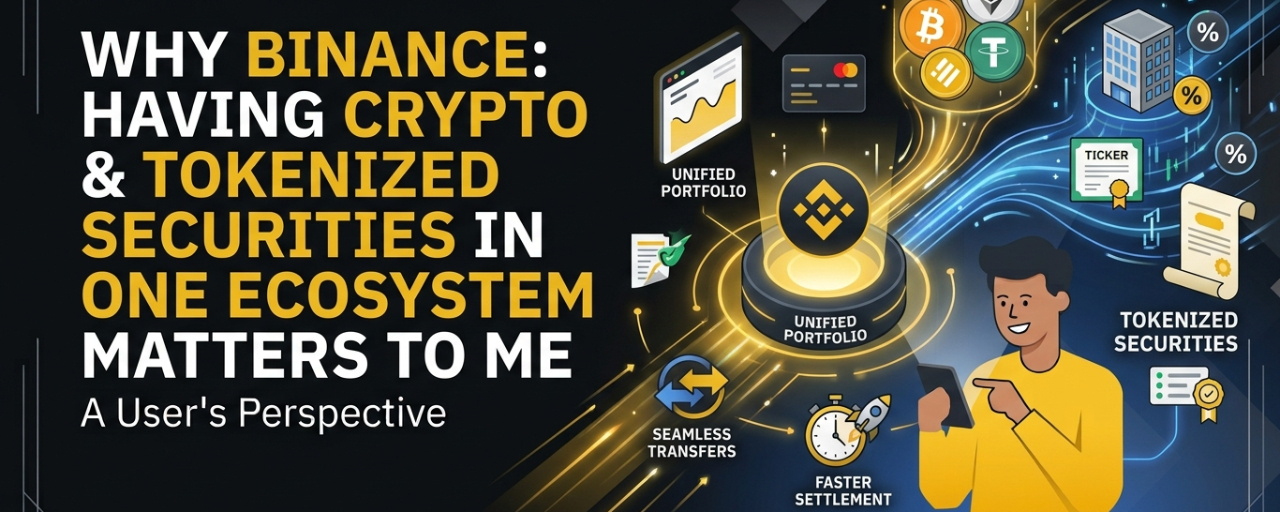
The attraction isn't simply “more products.” It's the possibility of one ecosystem connecting different financial activities.
2. This is where bStocks become interesting
Binance introduced bStocks as tokenized securities backed 1:1 by underlying securities held with a regulated custodian. Importantly, Binance's own documentation says bStocks are tokenized securities/certificates and do not represent direct ownership of the underlying listed shares. Availability is also limited to eligible users and permitted jurisdictions.
That distinction is extremely important.
If someone sees something like “Apple bStock,” they shouldn't automatically interpret that as identical to owning an Apple share through a traditional brokerage account.
The structure matters.
The jurisdiction matters.
The product terms matter.
Eligibility matters.
That's exactly why I think education around tokenized securities is just as important as the technology itself.
3. What interests me is the combination
Imagine having crypto assets and tokenized securities accessible within the same broader digital ecosystem.
That's interesting because crypto markets don't exist in isolation anymore.
A user might hold BTC.
They might hold stablecoins.
They might interact with DeFi.
They might use payment infrastructure.
They might want exposure to tokenized versions of traditional assets.
And eventually, they may want tools that allow them to manage these different categories more efficiently.
Binance has continued expanding its bStocks offering. In August 2026, Binance added additional bStocks trading pairs, while also expanding bStocks into trading-bot services.
It has also expanded the ways eligible third-party tokenized securities can be converted into bStocks, with Binance describing 1:1 backing by the underlying securities.
That doesn't mean everyone needs to use bStocks. It means the boundary between “crypto platform” and “broader digital financial platform” is becoming more interesting.
4. This matters to me because of where I live
Coming from Ethiopia and being involved in crypto communities in Africa, I pay attention to accessibility. A lot of discussions about financial products assume that everyone lives in a market where opening a brokerage account, accessing international securities or moving money internationally is straightforward.
That's not necessarily everyone's reality.
Crypto has already demonstrated that internet based financial networks can create access to markets that were previously difficult for some users to reach.
Tokenization could take that idea further. But accessibility shouldn't be confused with universal availability.
Binance explicitly states that bStocks are not available in every jurisdiction and are restricted to eligible users in permitted jurisdictions.
So for me, the interesting question isn't:
“Can everyone suddenly buy every stock?”
The answer is obviously no.
The interesting question is:
“Could tokenization gradually make different asset classes more interoperable?”
That's the bigger story.
5. I like the idea of fewer walls between asset classes
Crypto users have spent years watching traditional finance and digital assets develop in parallel. Now those worlds are increasingly interacting.
Tokenized securities are one example.
Stablecoins are another.
AI-driven financial tools are another.
The long-term direction is what interests me: instead of thinking about crypto, stocks, payments and financial tools as completely separate worlds, we may increasingly interact with them through connected digital infrastructure. That's a very different vision from the exchange I knew when I first started learning about crypto.
One important distinction
I'm not saying:
“Everyone should buy bStocks.”
That's not the point.
I'm saying that I find the infrastructure interesting.
A tokenized security is not automatically equivalent to the traditional asset it references.
The legal structure, rights, custody arrangements, liquidity, jurisdiction and product terms all matter.
That is why DYOR isn't just something we put at the end of a post.
It should be part of the process.
Why this becomes one of my reasons for choosing Binance
My reason isn't simply:
“Binance has stocks.”
It's:
“I like the direction toward having different financial tools accessible through one connected digital ecosystem.”
For someone who started with crypto, that's a significant evolution. I don't want to spend my entire financial life moving between isolated platforms if technology can eventually make those experiences more connected.
And that's why bStocks are interesting to me not as a shortcut to traditional investing, but as an example of how blockchain infrastructure can interact with traditional financial markets.
The future of finance may not be purely crypto or purely traditional. It may be increasingly interconnected. And I want to understand that transition as it happens.
DYOR. bStocks are tokenized securities, not direct ownership of the underlying shares, and availability is restricted by jurisdiction and eligibility. This is personal commentary and educational content, not financial advice.