

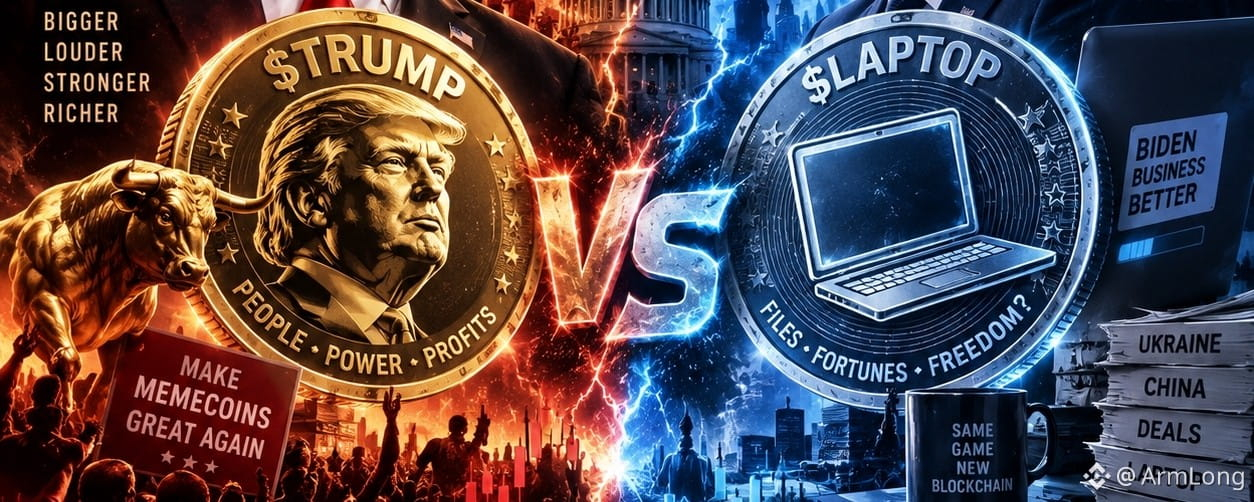

On September 9, 2026, $LAPTOP — a token associated with Hunter Biden — launched on Base.
Within about 2 minutes, it crashed from $190.81 to $3.71.
Nearly 98% wiped out.
But the crash is only half the story.
The real story is the narrative.
$LAPTOP reportedly reached an FDV near $144 BILLION, while initial liquidity was only around $48,000.
That means:
Huge valuation.
Tiny liquidity.
Massive structural weakness.
And the market exposed it immediately.
But here’s the paradox:
Hunter Biden had criticized $TRUMP as a “grift.”
$LAPTOP was positioned differently:
$TRUMP → political profiteering
$LAPTOP → redemption / recovery / reclaim
Even more striking:
Part of the $LAPTOP airdrop was reportedly aimed at people who lost money on $TRUMP.
The implied message was simple:
“$TRUMP made you lose money? $LAPTOP gives you another chance.”
Then $LAPTOP itself collapsed.
That destroys the moral boundary the project was trying to build.
Because once both projects enter the same machine:
Narrative → Token → Market Maker → Liquidity → Speculation
the market stops caring about the political label.
$TRUMP runs on brand, political identity and community liquidity.
$LAPTOP tried to turn the Hunter Biden laptop scandal into a redemption narrative.
Different story.
Same battlefield.
And this may be the real significance of $LAPTOP
Political memecoins are no longer just about profit.
They are becoming tools for narrative warfare.
The question is no longer only:
Which token pumps harder?
The bigger question is:
Who controls the narrative?
$TRUMP vs $LAPTOP may be less about price — and more about political power moving on-chain.