


The U.S. Treasury has expanded its Iran sanctions campaign to the country’s digital-asset sector saying cryptocurrency has increasingly become a tool of choice for Tehran and its networks to evade sanctions and move oil revenues.
Dubbed ‘Operation Economic Outcast,’ the goal is to ‘sever the economic lifelines that sustain the Iranian regime and the Islamic Revolutionary Guard Corps (IRGC)’ through ‘a sustained and systematic campaign to close every financial resource that supports the leading state sponsor of terror.’
Treasury says it has mapped the networks, facilitators, and financial channels that Iran uses to smuggle oil, evade sanctions, and fund terror.
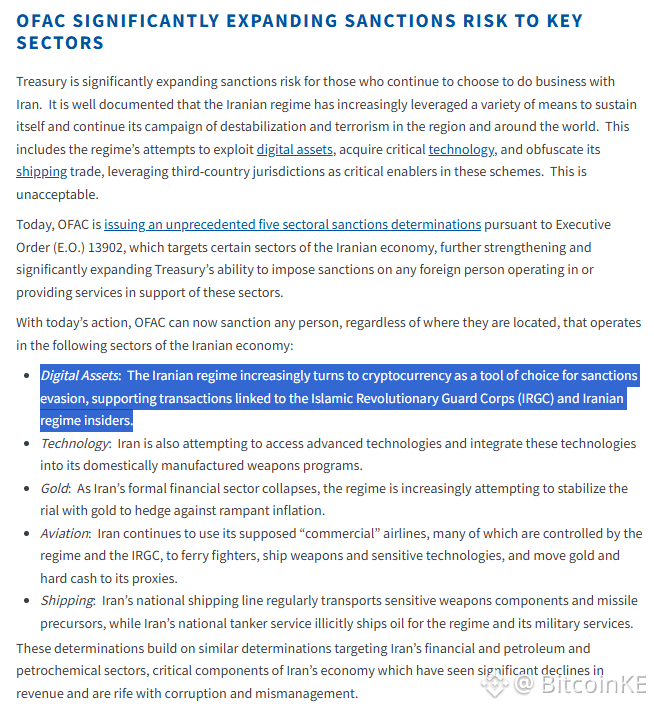
The Treasury warned:
Any entity that facilitates money laundering or sanctions evasion on behalf of Iran risks being cut off from the U.S. financial system. Today’s announcement also expands secondary sanctions exposure for those who continue doing business with the Iranian regime and will accelerate the pace of U.S. enforcement.
Treasury said UAE-based broker, Ivan Obukhov, processed more than $100 million in cryptocurrency payments since 2023 to facilitate oil sales on behalf of Iran’s Islamic Revolutionary Guard Corps-Qods Force.
REGULATION | U.S. Targets Iran’s Largest Crypto Exchange in Escalation of Financial Pressure Campaign
The move marks the first time Washington has applied a sectoral sanctions determination specifically to Iran’s digital-asset sector potentially exposing foreign crypto firms that support Iran’s crypto economy to secondary sanctions.
Treasury Secretary, Scott Bessent, said Iran had ‘chosen to co-opt digital asset technologies’ to evade sanctions and transfer wealth out of the country, adding that Treasury would ‘follow the money’ through both traditional banking channels and digital assets.
MILESTONE | Iran’s Move to Charge Strait of Hormuz Crypto Tolls a ‘Significant Milestone’ for State Level Adoption, Says Chainalysis
The action builds on Treasury’s earlier targeting of Iranian exchanges, including Nobitex, which it said processed more than 50% of Iranian digital-asset inflows in 2025 and facilitated transactions linked to sanctions evasion and the IRGC.
GEOPOLITICS | Iran’s Largest Crypto Exchange Has Processed Over $100 Million During the Wartime Period
The broader message from Washington is increasingly clear:
Crypto is no longer being treated simply as an alternative financial rail, but as a significant channel through which sanctioned states can move money outside traditional banking networks.
For global exchanges, OTC desks, brokers, and crypto infrastructure providers, the Iran case could therefore raise the cost of doing business with jurisdictions and counterparties exposed to sanctioned flows.
REGULATION | U.S. Sanctions 2 Crypto Exchanges for Facilitating Iran Transactions
Stay tuned to BitKE on crypto developments in the Middle East.
Join our WhatsApp channel here.
Follow us on X for the latest posts and updates
Join and interact with our Telegram community
_______________