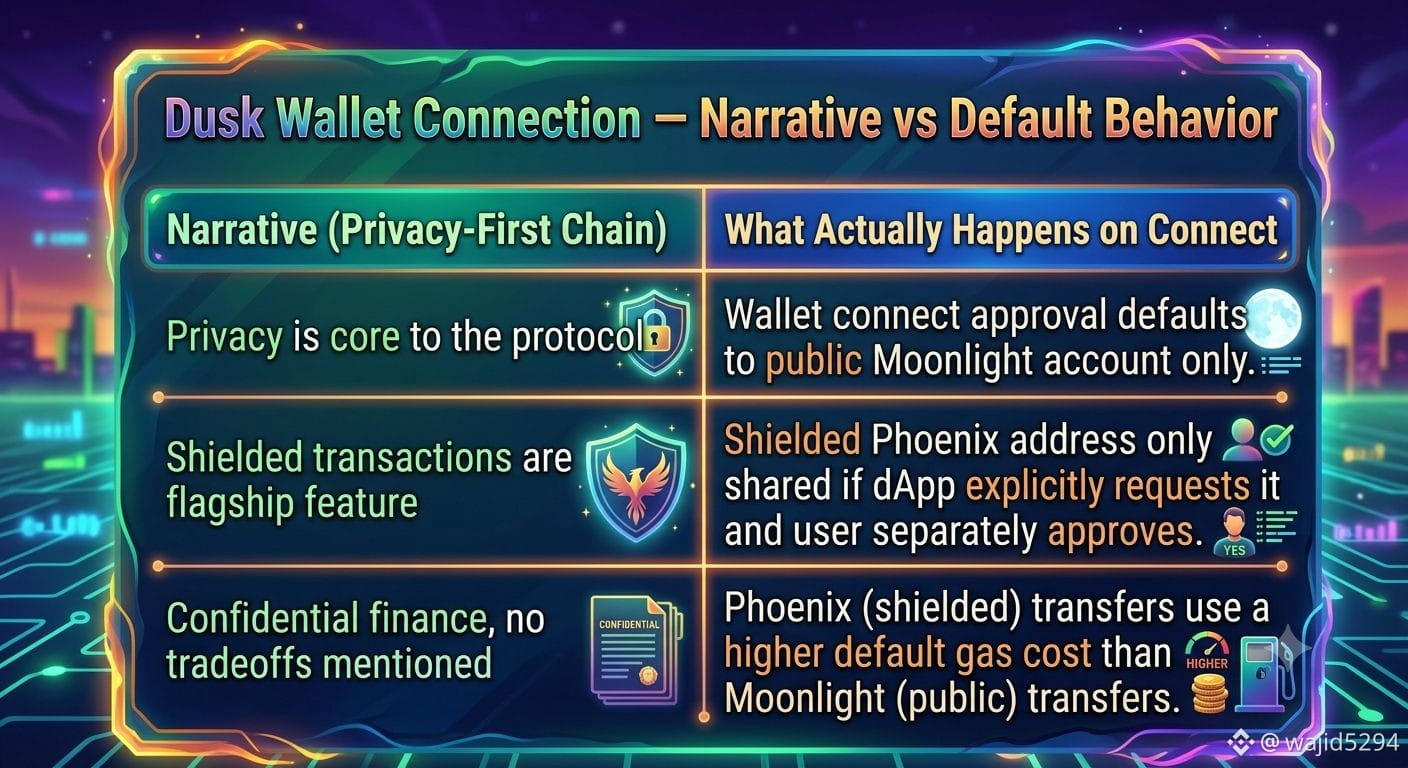
@Dusk #dusk $DUSK What caught me wasn't the whitepaper language about privacy-by-design, it was the connection prompt itself. When a dApp asks to connect to a Dusk wallet, #Dusk's $DUSK provider defaults to sharing the public Moonlight account only — the shielded Phoenix address is a separate, explicit request the site has to ask for and the user has to approve on top of the base connection. Privacy isn't the resting state, it's an added permission. Then there's the fee layer: shielded transfers carry a meaningfully higher default gas cost than public ones, baked into the wallet's own defaults, not hidden in fine print. So the two paths aren't just technically different, one is priced and gated as the "extra" option and one is the frictionless default. That's a strange inversion for a chain that markets itself on confidentiality — the transparent rail is the one that's cheap and automatic, while the private rail asks you to opt in twice, once for disclosure and once for cost. I keep wondering whether that's a deliberate compliance-first sequencing decision or just where the engineering happened to land first, and whether usage data would show most transfers quietly staying on Moonlight by default.


Посты
Отказ от ответственности. Содержит мнения третьих сторон. Не является рекомендацией. Binance AI не предоставляет гарантий. См. Правила и условия.