
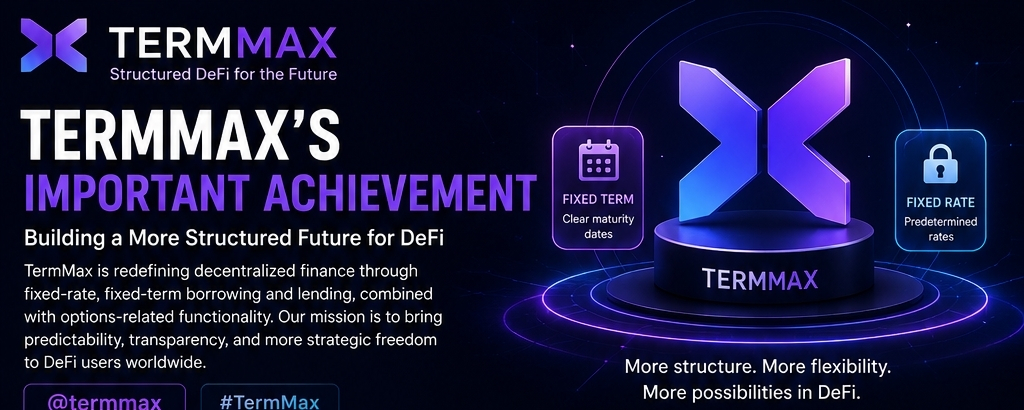

Decentralized finance continues to evolve as users look for financial products that provide greater flexibility, transparency, and control. In this changing environment, @TermMax is taking a different approach by focusing on structured borrowing and lending solutions designed around fixed rates and fixed terms. Its model aims to bring more predictability to DeFi while giving users additional ways to organize their on-chain financial strategies.
A Different Approach to DeFi
One of the challenges in decentralized lending is dealing with changing market conditions. Interest rates can move as supply, demand, liquidity, and market sentiment change. For users trying to plan their finances over a defined period, this uncertainty can make long-term strategy management more difficult.
@TermMax focuses on fixed-rate and fixed-term financial products. With a defined maturity period and predetermined borrowing or lending conditions, users can approach their strategies with a clearer understanding of the terms involved.
For borrowers, a fixed-rate structure can provide greater clarity around financing costs during the agreed period. Instead of constantly adjusting a strategy based on changing rates, borrowers can plan around established terms.
For lenders, fixed-term products can provide a more structured framework for managing capital and planning expected outcomes. This approach can be particularly interesting for users who prefer defined time horizons rather than continuously changing lending conditions.
The Importance of Fixed Terms
Maturity is an important concept in traditional financial markets, and bringing more structured maturity-based products into DeFi can create new possibilities for users.
With fixed-term products, the beginning and ending points of a financial position are clearly defined. This can make it easier to organize capital around specific objectives and time periods.
For example, a user planning a strategy for a particular period may find a defined maturity more convenient than an open-ended position whose conditions can change over time. The fixed-term concept can therefore contribute to a more organized approach to decentralized finance.
This does not eliminate market risk, and users should still understand the risks associated with any DeFi product. However, having clearly defined terms can provide a different framework for strategy planning.
Fixed Rates and Better Planning
Another important aspect of the @TermMax model is fixed-rate functionality. Rate predictability can be valuable because it allows users to understand the agreed financing conditions before entering a position.
For borrowers, knowing the applicable rate in advance can make financial planning easier. For lenders, predetermined conditions can provide a clearer framework for evaluating a potential lending strategy.
This creates an interesting contrast with variable-rate markets. Instead of focusing entirely on predicting where rates might move next, users can consider strategies based on predefined terms.
The result is a DeFi experience that emphasizes structure alongside flexibility.
Market Innovation
DeFi innovation is not only about creating new tokens or applications. It is also about developing better financial mechanisms and giving users more ways to manage capital.
@TermMax is exploring how fixed-term financial products can contribute to this evolution. By combining structured borrowing and lending with additional financial functionality, the platform is working toward a broader ecosystem for on-chain strategies.
The inclusion of options-related functionality is another interesting part of this direction. Options can introduce additional strategic possibilities, allowing sophisticated users to think about exposure, risk management, and market opportunities in different ways.
Together, these components can create a more comprehensive environment where borrowing, lending, and other financial strategies can interact.
Why Structure Matters in DeFi
DeFi has traditionally offered open and flexible markets, but flexibility can sometimes come with complexity. Users may need to monitor rates, liquidity conditions, collateral requirements, and other market variables continuously.
Structured products can provide an alternative approach.
Instead of treating every position as an constantly changing opportunity, users can design strategies around specific parameters such as:
Fixed interest rates
Defined maturity dates
Planned borrowing periods
Structured lending positions
Different market strategies
Options-related functionality
These features can help users think about DeFi in a more organized way.
Expanding Opportunities for Borrowers
Borrowing is an important part of decentralized finance. Users may borrow assets for liquidity management, portfolio strategies, or other purposes.
A fixed-rate, fixed-term model can give borrowers a clearer framework for evaluating a position. Before entering a transaction, they can consider the rate, duration, collateral requirements, and overall strategy.
This type of predictability may be particularly useful for users who prefer to plan rather than continuously react to market changes.
Of course, borrowing in DeFi still involves risks, including collateral and market risks. Users should carefully understand the specific terms of any position before participating.
New Possibilities for Lenders
Lenders are equally important to the DeFi ecosystem because liquidity enables borrowing and other financial activity.
For lenders, fixed-term structures can offer a defined time horizon. Rather than relying entirely on continuously changing market rates, lenders can evaluate opportunities based on predetermined terms.
This can make yield planning more structured, although actual outcomes can still depend on protocol conditions, market dynamics, smart-contract risks, and other factors.
The key idea is that predictability and flexibility do not have to be opposites. A well-designed financial product can provide defined parameters while still supporting different strategies.
Looking Toward the Future
The evolution of DeFi will likely involve more than simply increasing liquidity. The next stage can also involve creating financial products that provide users with greater choice in how they manage time, risk, rates, and capital.
This is where the direction of @TermMax becomes interesting.
By focusing on fixed-rate and fixed-term borrowing and lending, while also exploring options-related functionality, TermMax is contributing to a broader conversation about how decentralized financial markets can become more structured.
Its approach highlights an important principle: DeFi can remain decentralized and innovative while also providing financial tools with clearer terms and defined structures.
Conclusion
@TermMax represents an interesting direction in the development of structured DeFi. Its focus on fixed-rate, fixed-term borrowing and lending aims to give users more predictable parameters for planning financial strategies.
At the same time, its exploration of options-related functionality expands the potential range of tools available for on-chain financial activity.
As DeFi continues to mature, products that combine flexibility with structure may become increasingly important. TermMax’s approach demonstrates how decentralized finance can continue experimenting with new financial models while addressing the practical need for clearer terms, defined maturity periods, and more organized strategy management.
The future of DeFi will depend on innovation, responsible development, transparency, and user awareness. In that journey, @TermMax is building toward a vision where structured financial products can play a meaningful role in the next generation of decentralized markets.
More structure. More flexibility. More possibilities for DeFi.