
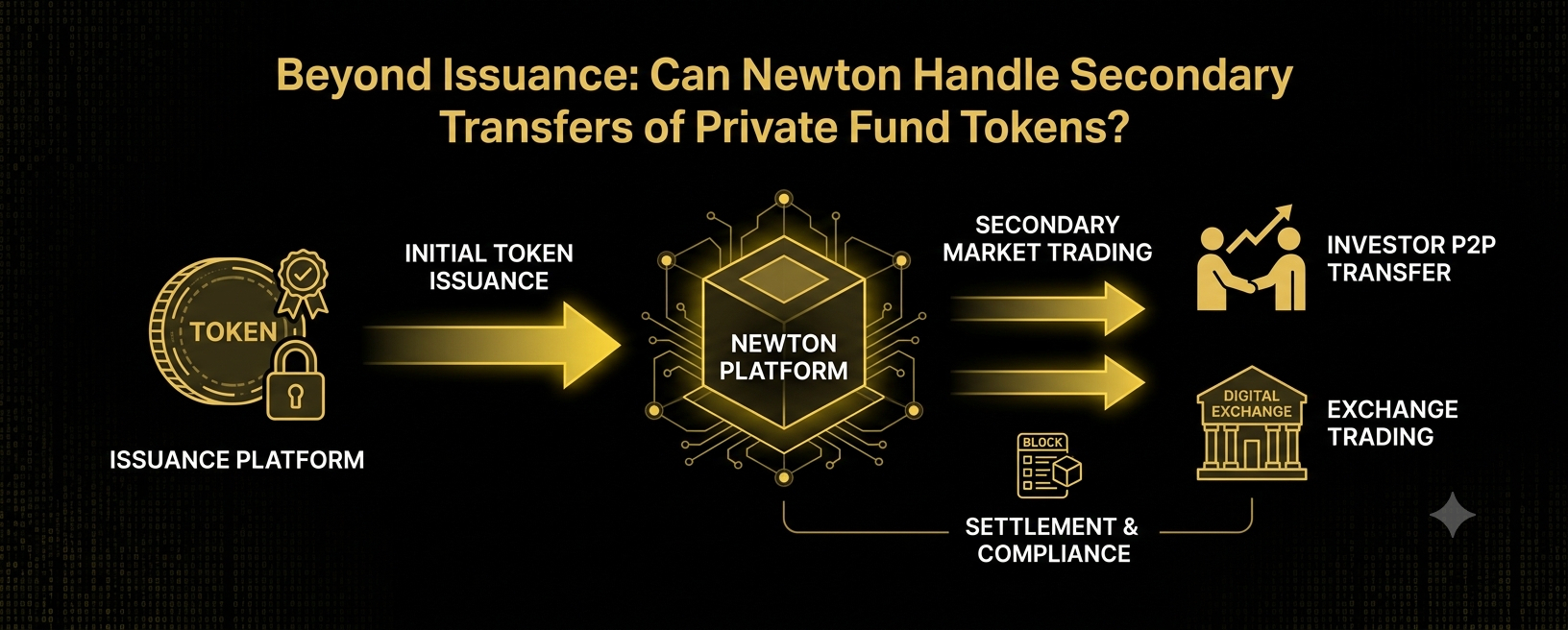

A-Yong works in LP relations at an asset management firm and is exploring the tokenization of private fund interests, so that LP positions can be represented as tokens and traded in secondary markets. The real barrier is not the underlying technology, but compliance: private fund interests can only be transferred to qualified investors, and every secondary-market transfer must verify the buyer’s eligibility. At present, this process depends on manual review, which is both inefficient and legally risky.
My view is that Newton can support this requirement at the technical level. However, the discussion has to separate first-tier and second-tier use cases, because they are not equally difficult.
Primary issuance is relatively straightforward. At the point of subscription, the system can run a strategy check, verify the investor’s verifiable credentials, and, if the requirements are met, approve the allocation. Newton’s current architecture already appears capable of supporting this flow, since verifiable credentials, Rego-based policy logic, and BLS authentication together form a complete verification chain.
Secondary circulation is much more demanding. Every transfer of tokenized private fund shares requires the buyer’s eligibility to be verified again in real time. This is not a one-time check at issuance; it is a continuous compliance requirement each time ownership changes. That creates three major challenges for Newton’s operator network.
First, there is the issue of performance. Secondary trading windows are far shorter and more time-sensitive than primary subscription windows, so the system must respond quickly enough for active market use. Second, credential validity must be checked continuously, because a buyer’s qualified-investor status may expire or change over time, which means the strategy layer cannot rely on cached results and must query fresh data. Third, there are cross-jurisdictional complications. Private fund buyers may come from different countries, and each jurisdiction defines “qualified investor” differently, making strategy composition considerably more complex.
Newton does appear to have technical paths for all three problems, including real-time data integration, credential validity checks, and jurisdiction-specific policy composition. However, I have not seen public evidence confirming that these paths have been stress-tested on mainnet.
My recommendation to A-Yong is to treat this as a serious opportunity, but to begin with a small pilot focused on primary issuance compliance first. Once that works reliably, the system can be extended to secondary circulation. Since secondary trading is materially more complex than primary issuance, proving the simpler case first is the safer approach.
From an investment perspective, tokenizing private fund shares is one of the fastest-growing use cases in the RWA sector. If Newton can win even a few asset management firms with clearly identifiable assets in this category, it would be a meaningful boost to the project’s credibility.
One open question remains: are there any publicly announced regulated private fund managers or asset management firms that have already used Newton’s authorization layer for compliant share transfers? If such a case emerges, I would treat it as a strong signal and revisit my view accordingly.
