
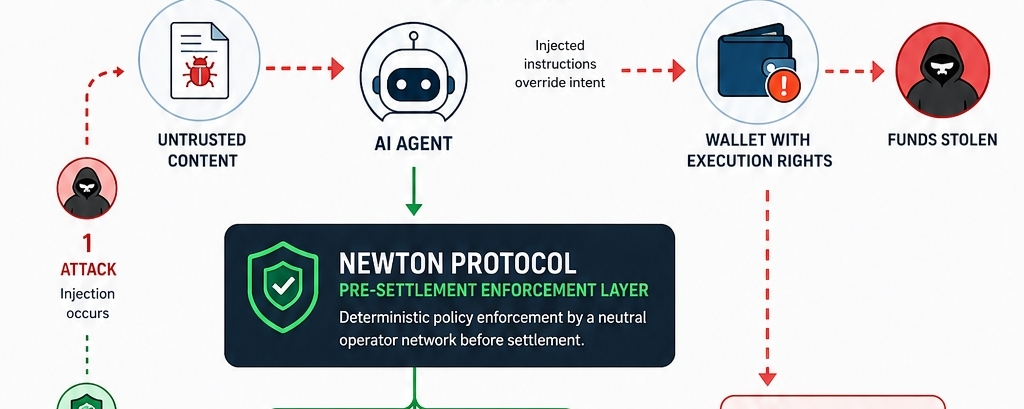

I was reading through the OWASP Top 10 for large language model applications a few evenings ago, the updated list that came out late last year, and something on it pulled my attention immediately because of how directly it maps onto a problem Newton Protocol is quietly trying to solve. Prompt injection held the number one position, not as a theoretical concern but as the most critical vulnerability actively affecting production Al systems right now, from enterprise copilots to coding assistants to autonomous agents managing real workflows. The security community's description of it is almost uncomfortably simple: an attacker places malicious instructions inside content the agent is supposed to read as data, the agent cannot reliably distinguish instruction from information, and the malicious payload overrides whatever the agent was originally supposed to do. In most software contexts that produces a bad answer or a leaked document. In an onchain financial agent with a funded wallet and transaction execution rights, it produces something considerably worse.
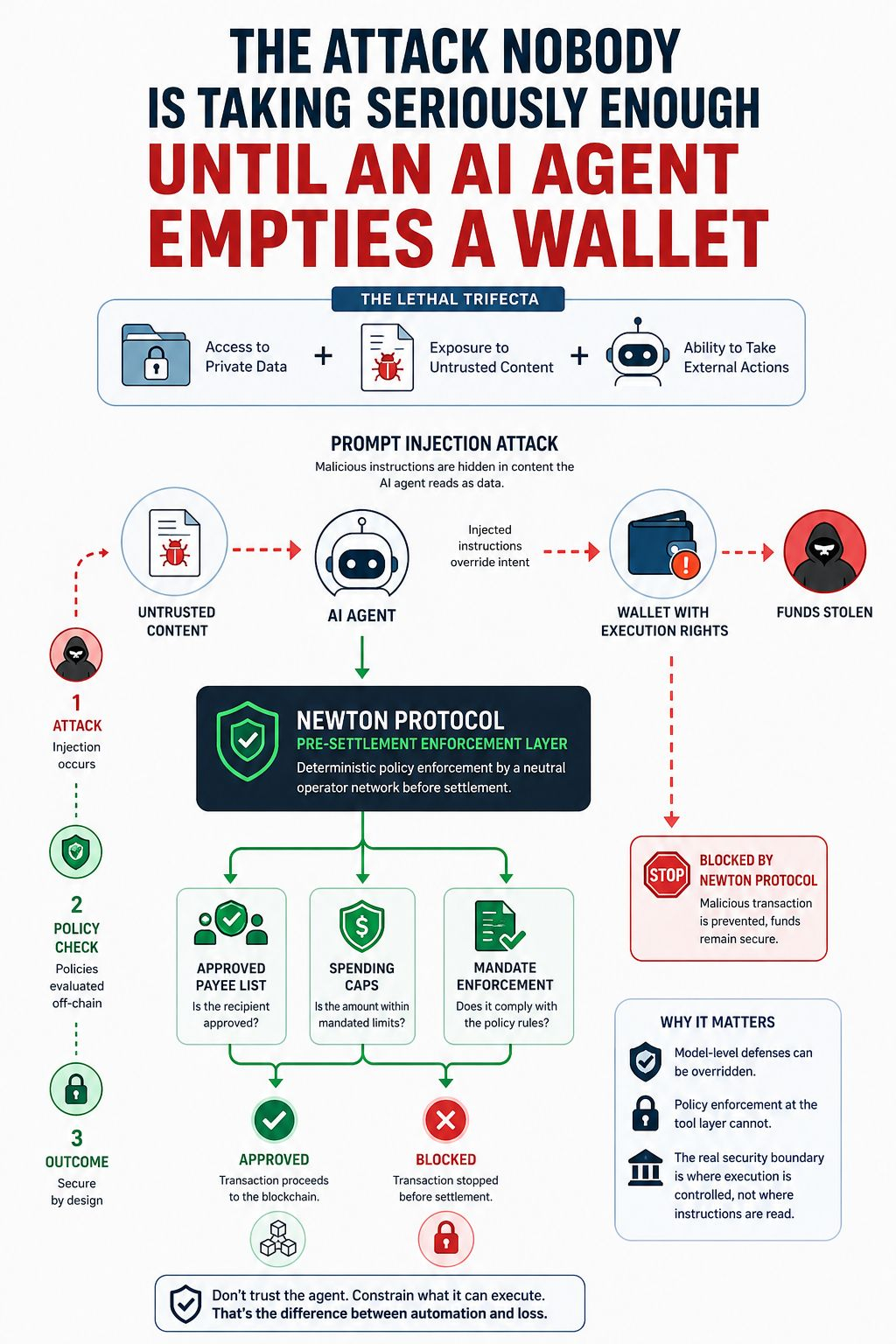
What seems genuinely interesting to me is how precisely the security research community's description of the problem maps onto the architectural gap Newton is designed to fill, even though the two conversations rarely reference each other directly. Security researchers have been converging on what one analyst described as the lethal trifecta: the combination of access to private data, exposure to untrusted content, and the ability to take external actions. When all three are present simultaneously in a single agent, the attack surface stops being theoretical and becomes a near-certainty given enough adversarial pressure. For a DeFi automation agent, those three properties are not edge cases, they are the basic job description. The agent reads market data and external feeds, holds session key permissions over a funded wallet, and executes transactions autonomously. OpenAl, Anthropic, and Google DeepMind all acknowledged in 2025 publications that prompt injection cannot be fully solved within current large language model architectures because any defense expressed as a prompt instruction can itself be overridden by a sufficiently crafted attack. I sometimes wonder if the people deploying Al agents for onchain treasury operations have actually read that sentence carefully enough, because it effectively says the model itself cannot be the last line of defense.
The part that I keep returning to is what this means for where the actual security boundary needs to sit, and why Newton's pre-settlement enforcement layer addresses something that pure model-level defenses structurally cannot. The consensus emerging from security research is that the right approach is not better prompt filtering but deterministic policy enforcement at the tool layer, constraining what the agent can do with its execution rights regardless of what instructions it received or from whom. Newton's approved payee lists, spending caps, and mandate enforcement policies are not features the agent itself enforces, they are external constraints evaluated by a neutral operator network before the transaction reaches the chain. A compromised agent that has been injected with instructions to transfer funds to an attacker's address still hits Newton's policy check before that transfer settles, and if the destination address falls outside the approved payee list, the transaction is blocked independently of what the agent believes it was authorized to do. The question that comes to mind is whether this distinction, between trusting the agent and constraining what the agent can actually execute, is being understood clearly enough by the developers currently building production onchain automation systems.
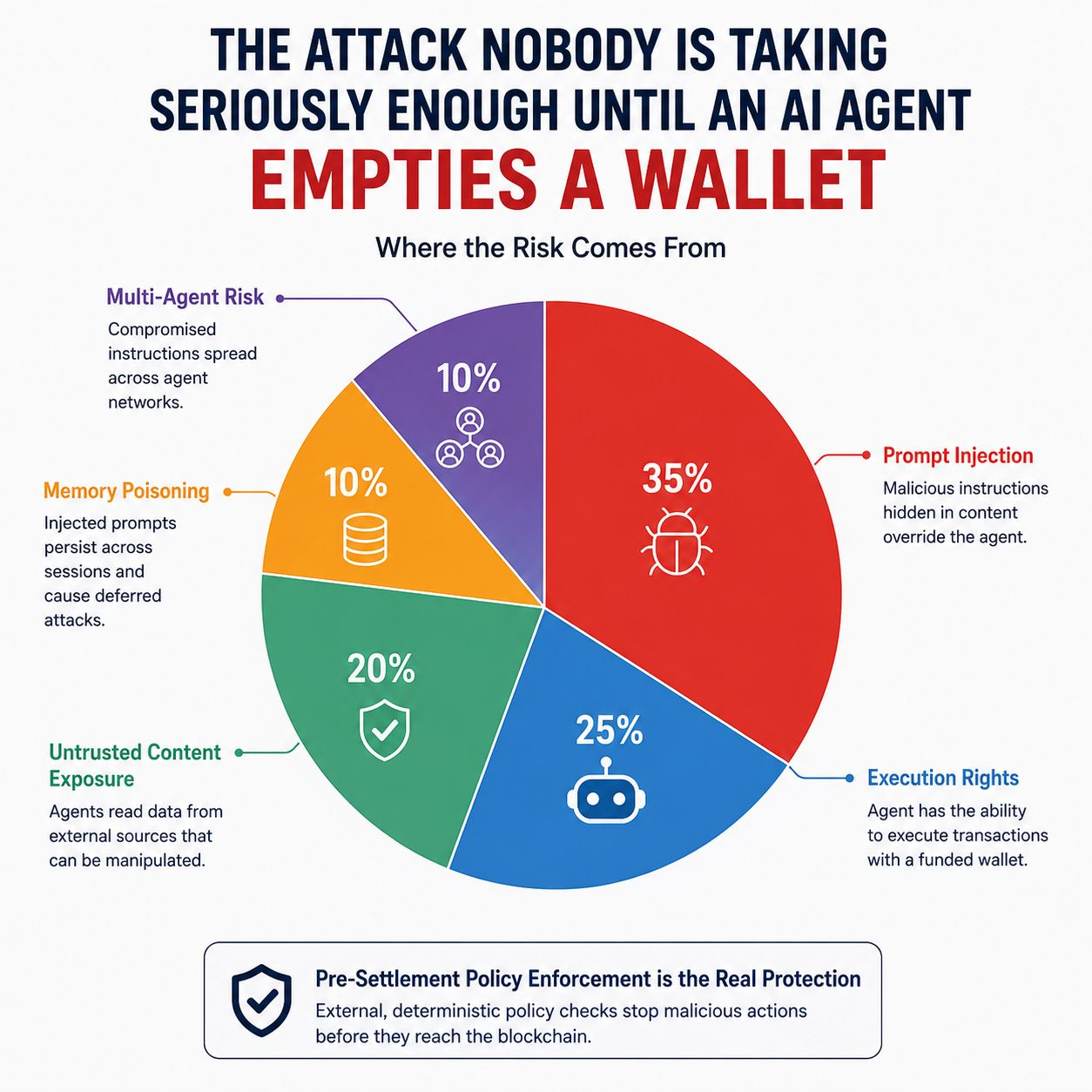
Looking from the outside at where this conversation is heading, there's a timing dimension that feels important and underappreciated. The security research community is actively documenting attacks where a single injected document in a vector database achieves a ninety percent attack success rate, where memory poisoning creates deferred attacks that persist across sessions, and where multi-agent systems pass compromised instructions between themselves in ways that make the original injection point nearly impossible to trace after the fact. All of that research is maturing at exactly the same moment that onchain Al agents are moving from small experimental deployments to systems managing meaningful capital across real protocols. Newton's mainnet beta arriving during this specific window feels less like coincidence and more like the protocol found the seam between two fields, Al security and onchain finance, that have been developing in parallel without quite acknowledging how directly they intersect. Whether developers building the next generation of financial agents treat pre-settlement policy enforcement as a foundational requirement or discover its necessity the hard way is a question I genuinely don't know the answer to yet - anyway, time will tell...