
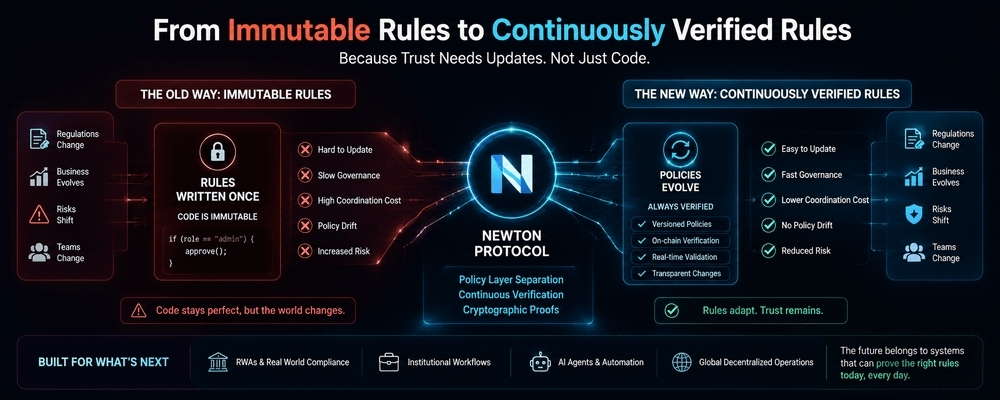

Today I was working through a set of policy notes, and at some point I caught myself thinking about how much modern systems depend on rules that were written for a moment that has already passed.
The more I looked at it, the more obvious it became that the real issue is not whether a rule exists. The real issue is whether that rule still makes sense when the situation around it has changed.
That thought stayed with me because so many organizations still treat policy like a finished object. A rule gets written, approved, and locked into a system as if the job is done. But anyone who has worked inside a bank, a hospital, or even a growing company knows that nothing important stays still for long.
Regulations change.
Teams change.
Risk changes.
The assumptions behind yesterday’s approval process can become weak very quickly.What makes this even more complicated is the way humans translate language into action.
People can agree on the same sentence and still imagine two different realities.
A word like “access,” “profit,” or “approval” can sound clear until someone has to turn it into a system that must behave in one exact way.
At that point, meaning stops being abstract and becomes operational. One interpretation wins, and the rest disappear.
That is where many systems quietly become fragile. Not because the code is bad, but because the meaning behind the code was never as fixed as everyone assumed.
The system may still run perfectly, yet it may be enforcing an idea that no longer fits the actual business or legal environment. That kind of failure is harder to notice because it does not look like a technical crash. It looks like normal operation.
This is why I think the next serious infrastructure layer will not just be about preserving rules.
It will be about proving that rules are still valid. There is a difference between something being immutable and something being trustworthy.
Immutability protects yesterday.
Verification protects the present.
That distinction matters more as software begins making decisions that used to require human judgment. If a system is going to authorize payments, manage access, or support automated agents, then the rule itself must remain visible, reviewable, and current.
Otherwise, the organization ends up trusting a frozen version of its own memory.
And that is the part people often miss. The goal is not to remove stability.
The goal is to make stability intelligent enough to survive change.By the end of the day, I was left with a simpler idea than the one I started with.
The strongest systems may not be the ones that never change.
They may be the ones that can keep proving, again and again, that the change was understood before it mattered.
