Honestly... I didn't expect to feel this specific kind of attention reading through how Pixels describes its evolution from a single farming game into a multi-game publishing platform.
Not skepticism. not alarm. something closer to the feeling you get when a strategic vision that reads like an ambitious roadmap slide turns out to be already partially operational, and the mechanism connecting it all is something most players are interacting with daily without thinking of it in those terms.
because there's a pattern in how Web3 gaming projects describe expansion that this space accepts without examining what expansion actually means for the token at the center of it. the standard framing describes more games as more utility. more games means more places to spend the token, more reasons to hold it, more demand pressure against a fixed supply. the logic is straightforward and it is not wrong.
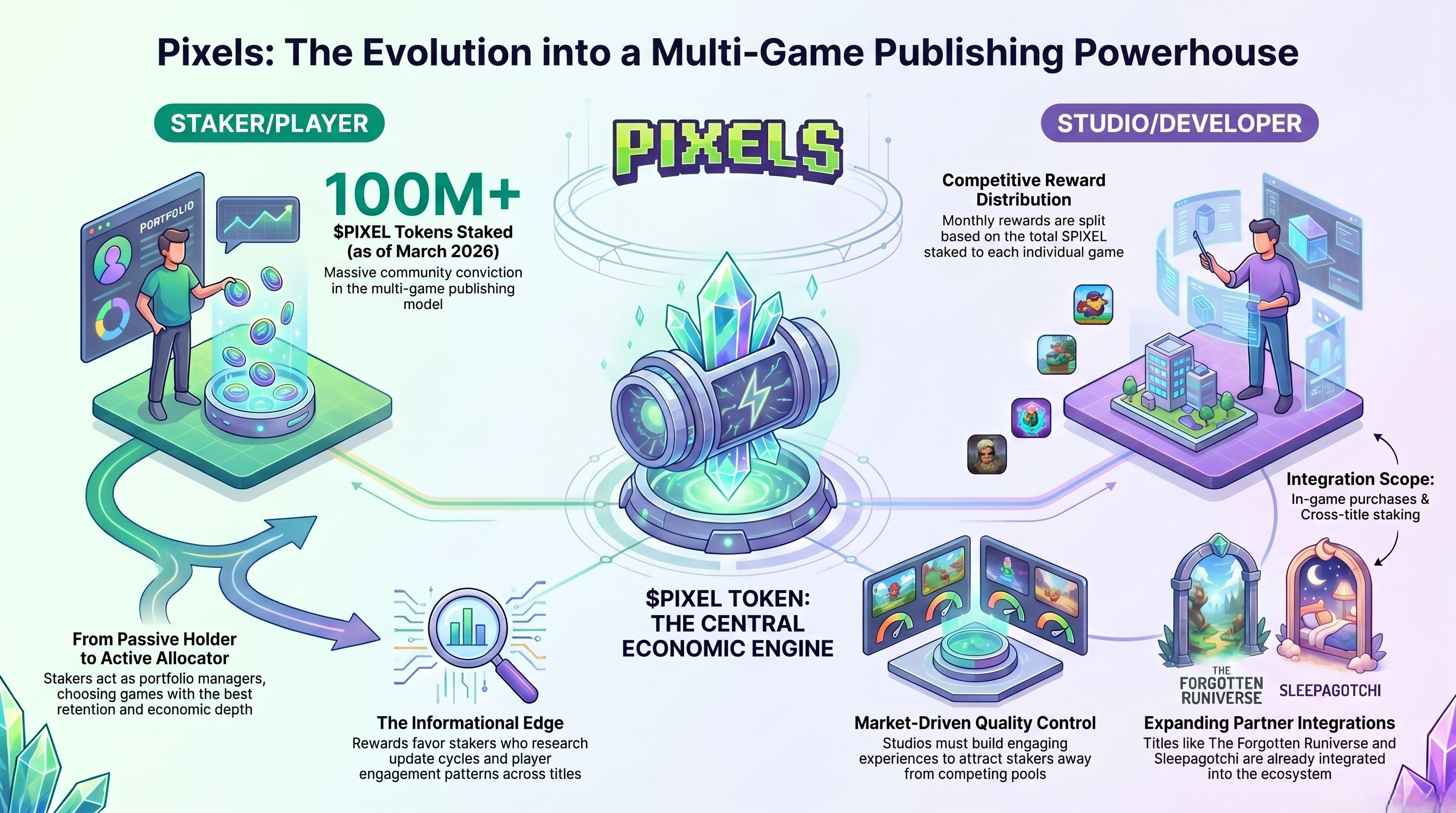
but Pixels built something more specific than additional utility surfaces. the multi-game staking architecture is designed so that PIXEL stakers are not just holding a token that happens to work across multiple games. they are allocating economic weight to specific games within the ecosystem, and that allocation determines how monthly staking rewards are distributed across the entire platform.
because the architecture they are describing is real. PIXEL staking rewards are split based on total PIXEL staked to each individual game, encouraging studios to build high-quality experiences capable of attracting stakers away from competing pools. as of March 2026, Pixels has integrated partner games including The Forgotten Runiverse and Sleepagotchi, with PIXEL usable for in-game purchases and staking across titles. over 100 million PIXEL tokens are staked across the ecosystem, a figure that reflects genuine conviction from a player base that has understood what the multi-game model is actually building toward.
so yeah... the publishing platform vision is real and operational.
but multi-game integration has never been the hard part of building a token ecosystem around multiple titles.
the hard part is what happens to staker behavior when the games competing for staked PIXEL are genuinely different in quality, retention, and economic depth.
because here's what I keep coming back to. in a single-game staking model, every staker is making the same basic decision: do I believe in this game enough to lock capital here. in a multi-game model, every staker is making a comparative allocation decision across multiple live titles simultaneously. which game's economic activity will generate the most reward for my staked position. which studio is building the kind of retention that will keep its player base engaged enough to drive the in-game spending that flows back to stakers.
that is not a simpler decision than single-game staking. it is a portfolio management decision that rewards stakers who understand the underlying games well enough to evaluate their relative quality and trajectory.
the stakers who treat multi-game allocation as a passive decision are leaving information on the table. the stakers who track chapter update cycles, player retention patterns, and in-game economic activity across titles are operating with an informational edge that the architecture rewards directly.
then comes the studio incentive question. because of course.
and here's where the publishing model gets genuinely compelling to examine. if staking rewards are split based on PIXEL staked to each game, then studios building on the Pixels platform have a direct financial incentive to attract stakers, which means a direct incentive to build experiences that generate enough genuine player engagement to make their staking pool competitive.
the publishing platform is not just giving studios access to an existing player base. it is putting studios in direct competition for the capital allocation of players who understand the economics well enough to stake meaningfully. that competitive pressure is a quality filter the platform is applying through its economic architecture rather than through a centralized approval process.
a studio that builds a shallow game will struggle to compete for staked PIXEL against a studio that builds something players genuinely want to spend time inside. the market is doing the curation.
there's also a dimension nobody talks about enough.
Pixels founder Luke Barwikowski has publicly positioned Web3 gaming as a space where everyday participants can still find significant economic upside, contrasting it with investment opportunities that are typically restricted to institutional capital. the multi-game publishing model is the structural expression of that positioning. a player who understands the staking allocation mechanism well enough to identify which games in the ecosystem are undervalued by current staking distribution is not just a player. they are an early allocator in an emerging publishing market whose pricing is still being discovered by a player base that is only beginning to think in those terms.
the information advantage available to players who engage with the publishing layer seriously is real, and it is available to anyone willing to do the work of understanding the games competing for their staked position.
still... I'll say this.
the decision to build reward distribution around competitive staking pools rather than flat allocation across all titles reflects a genuine understanding of what creates sustained quality incentives in a publishing ecosystem. a model that rewards the best games with the most capital and exposes weaker titles to competitive pressure from better alternatives is more self-correcting than one where every studio receives equal support regardless of what they build.
the question is whether PIXEL stakers are engaging with the multi-game allocation decision as the economically meaningful choice it actually is, or whether they are treating staking as a single decision made once and reconsidered only when rewards drop below a threshold that finally gets their attention.
and in this world, the stakers who treat allocation as an ongoing research question are consistently positioned better than the ones who set it once and move on.