

Infinite Zero
11 Публикации

Infinite Zero
Отправить жалобу
Заблокировать пользователя
better better Best
Открытая сделка

Владелец LTC
Трейдер с регулярными сделками
2.1 г
0 подписок(и/а)
0 подписчиков(а)
0 понравилось
Посты
Портфель
Все
Видео
Статья
Crypto Phishing Scams: How to Spot the Bait and Keep Your Wallet SafeThe market is trembling under a Fear index of 30, and that nervous energy makes scammers bolder than ever. I've seen friends lose $BTC and $ETH because a single click felt harmless. Let's turn that fear into a clear set of actions you can take right now.
What the Scam Looks Like
A fake app or website promises "instant $BTC earnings" or "secure $ETH storage." The design mirrors official wallets, and the URL may contain a tiny typo. Once you enter your seed phrase, the thief walks away with your funds. I once opened an "$SOL wallet" that asked for my private key, the moment I typed it, the balance vanished.
Red Flags to Watch
- The site asks for your seed phrase, private key, or password. Legitimate services never do.
- URLs that end in .net.info, or have extra characters like "wallet-secure.com-login."
- Promises of guaranteed returns, especially when the market shows a 24h +0.31% move for $BTC and a 24h +0.68% rise for $ETH, real assets are volatile, not certain.
- Poor grammar or rushed language. Scammers rely on urgency, not professionalism.
How to Protect Yourself
1. Bookmark the official wallet page and use that link every time.
2. Enable two-factor authentication on every exchange and wallet that offers it.
3. Keep your seed phrase offline, write it on paper and store it in a safe place.
4. Verify the app's publisher on the official app store; don't download from third-party links.
Quick Checklist
- [ ] Did I enter my seed phrase on a site that asked for it?
- [ ] Is the URL exactly what I expect, with no extra characters?
- [ ] Have I enabled 2FA on the platform?
- [ ] Is the claim of guaranteed profit realistic given the current market volatility?
What's the most convincing phishing message you've ever received, and how did you handle it?
Not financial advice
#crypto #security #phishing #wallets
Crypto Phishing Scams: How to Spot the Bait and Keep Your Wallet Safe
The market is trembling under a Fear index of 30, and that nervous energy makes scammers bolder than ever. I've seen friends lose $BTC and $ETH because a single click felt harmless. Let's turn that fear into a clear set of actions you can take right now.
What the Scam Looks Like
A fake app or website promises "instant $BTC earnings" or "secure $ETH storage." The design mirrors official wallets, and the URL may contain a tiny typo. Once you enter your seed phrase, the thief walks away with your funds. I once opened an "$SOL wallet" that asked for my private key, the moment I typed it, the balance vanished.
Red Flags to Watch
- The site asks for your seed phrase, private key, or password. Legitimate services never do.
- URLs that end in .net.info, or have extra characters like "wallet-secure.com-login."
- Promises of guaranteed returns, especially when the market shows a 24h +0.31% move for $BTC and a 24h +0.68% rise for $ETH , real assets are volatile, not certain.
- Poor grammar or rushed language. Scammers rely on urgency, not professionalism.
How to Protect Yourself
1. Bookmark the official wallet page and use that link every time.
2. Enable two-factor authentication on every exchange and wallet that offers it.
3. Keep your seed phrase offline, write it on paper and store it in a safe place.
4. Verify the app's publisher on the official app store; don't download from third-party links.
Quick Checklist
- [ ] Did I enter my seed phrase on a site that asked for it?
- [ ] Is the URL exactly what I expect, with no extra characters?
- [ ] Have I enabled 2FA on the platform?
- [ ] Is the claim of guaranteed profit realistic given the current market volatility?
What's the most convincing phishing message you've ever received, and how did you handle it?
Not financial advice
#crypto #security #phishing #wallets
87
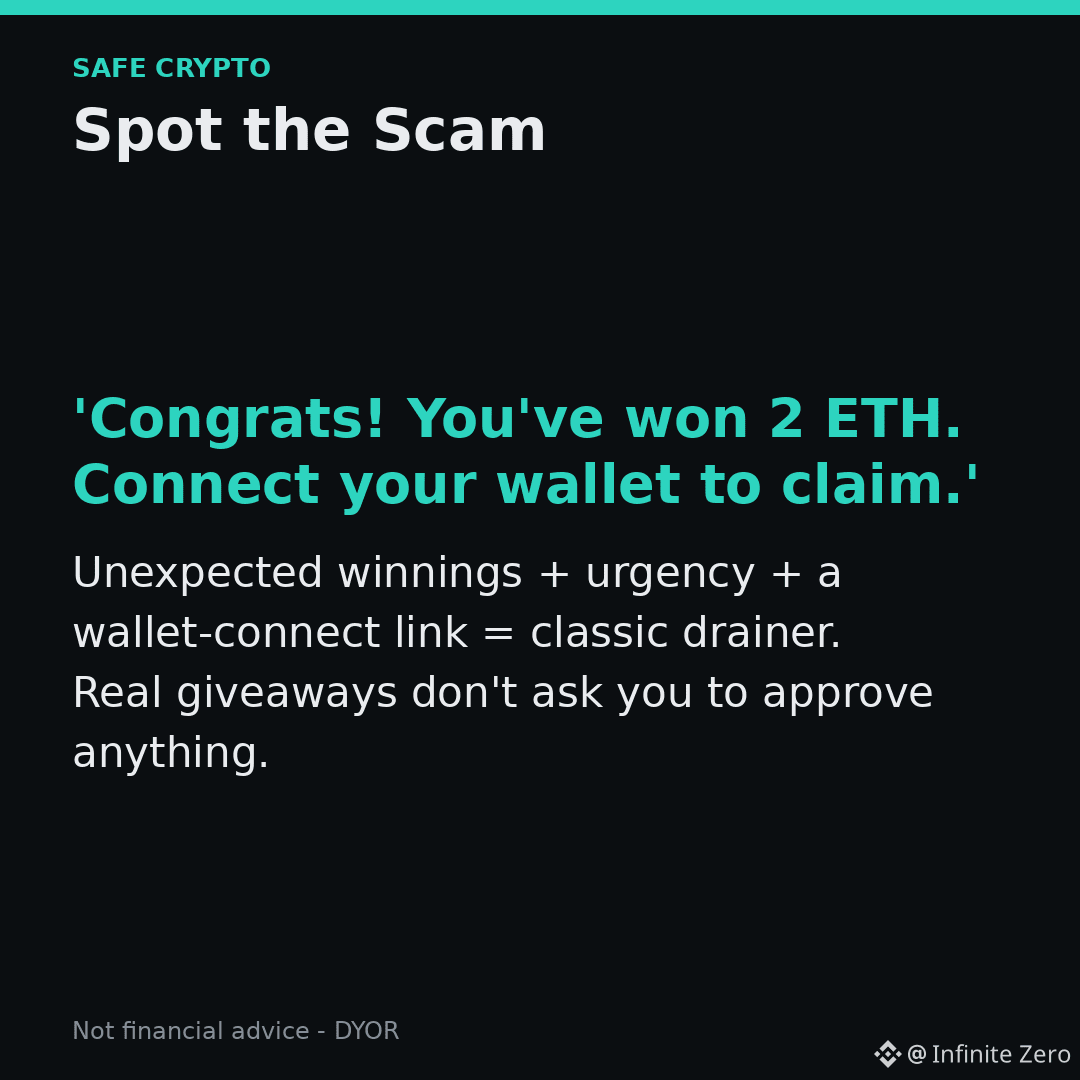
Just saw that message again, "Congrats! You've won 2 ETH. Connect your wallet to claim." It screams scam: unexpected prize, urgency and a wallet-connect link. Real giveaways never ask you to approve anything.
I'm always scanning my DMs for this kind of thing. For context, $BTC $77,336 down 0.80% and $BNB $700.14 down 0.76%.
What weird offers have you spotted lately?
#ScamAlert #CryptoSafety
I'm always scanning my DMs for this kind of thing. For context, $BTC $77,336 down 0.80% and $BNB $700.14 down 0.76%.
What weird offers have you spotted lately?
#ScamAlert #CryptoSafety
210
Down 8.49% over the past month, $BNB slipped from a high of $795.43 • Low $698.46 • Now $703.04.
I'm watching the swing and wondering if we're seeing a fresh bullish move, a bearish pull, or just a sideways pause. One word in the comments below.
NFA, always DYOR.
#BNB #Chart
Down 8.49% over the past month, $BNB slipped from a high of $795.43 • Low $698.46 • Now $703.04.
I'm watching the swing and wondering if we're seeing a fresh bullish move, a bearish pull, or just a sideways pause. One word in the comments below.
NFA, always DYOR.
#BNB #Chart
I'm watching the swing and wondering if we're seeing a fresh bullish move, a bearish pull, or just a sideways pause. One word in the comments below.
NFA, always DYOR.
#BNB #Chart
80
Honestly, that question feels too easy. 🧠 An order that fills instantly at market price is a...
A. Limit order
B. Market order
C. Stop order
By the way, $BTC $77,536 (-3.16%) and $SOL $96.76 (-3.61%). Which one do you pick?
#CryptoQuiz #LearnCrypto
Honestly, that question feels too easy. 🧠 An order that fills instantly at market price is a...
A. Limit order
B. Market order
C. Stop order
By the way, $BTC $77,536 (-3.16%) and $SOL $96.76 (-3.61%). Which one do you pick?
#CryptoQuiz #LearnCrypto
A. Limit order
B. Market order
C. Stop order
By the way, $BTC $77,536 (-3.16%) and $SOL $96.76 (-3.61%). Which one do you pick?
#CryptoQuiz #LearnCrypto

57
just checked $ETH, it's at $2,224 right now.
which level will hit first?
🅰️ $2,325
🅱️ $2,125
reply A or B with a one-line reason, I'll post the results in the next poll 😄
what do you think?
#ETH #Poll
just checked $ETH , it's at $2,224 right now.
which level will hit first?
🅰️ $2,325
🅱️ $2,125
reply A or B with a one-line reason, I'll post the results in the next poll 😄
what do you think?
#ETH #Poll
which level will hit first?
🅰️ $2,325
🅱️ $2,125
reply A or B with a one-line reason, I'll post the results in the next poll 😄
what do you think?
#ETH #Poll
57
Seeing $SOL dip made me pause and check the chart.
$SOL is down 17.27% over the last 30 days, now at $97.96 after a high of $121.60 and a low of $95.64.
Where is the nearest support in your view? Drop a number 👇
Not financial advice. DYOR 🙏
#SOL #Chart
Seeing $SOL dip made me pause and check the chart.
$SOL is down 17.27% over the last 30 days, now at $97.96 after a high of $121.60 and a low of $95.64.
Where is the nearest support in your view? Drop a number 👇
Not financial advice. DYOR 🙏
#SOL #Chart
$SOL is down 17.27% over the last 30 days, now at $97.96 after a high of $121.60 and a low of $95.64.
Where is the nearest support in your view? Drop a number 👇
Not financial advice. DYOR 🙏
#SOL #Chart
104
Just a quick heads up, I'm watching $BTC $77,398 (-3.23%) and $SOL $95.47 (-4.62%) right now.
🔐 Simple safety steps: 1) hardware wallet for big sums. 2) write your seed on paper, not phone. 3) keep that paper safe from fire. 4) never share the seed.
What habit will you add today?
#CryptoTips #BinanceSquare
🔐 Simple safety steps: 1) hardware wallet for big sums. 2) write your seed on paper, not phone. 3) keep that paper safe from fire. 4) never share the seed.
What habit will you add today?
#CryptoTips #BinanceSquare
140
🔍 Let’s clear up a common worry about blockchain privacy.
❌ Myth: Crypto transactions are anonymous and untraceable
✅ Fact: Every transaction lives on a public ledger. With the right tools you can trace the flow, even though addresses don’t reveal your name.
📊 Today’s prices
$BTC $80,426 (-0.11%)
$ETH $2,329 (+0.07%)
🛡️ As your security coach, I suggest a simple checklist: use a new address for each transfer, consider mixing coins when needed, and keep on‑chain activity separate from personal info. What privacy steps do you include in your crypto routine?
#MythVsFact #Crypto
67
Статья
How to Outsmart Crypto Phishing Scams: A Simple Safety ChecklistThe market is sitting at a neutral tone today with the Fear & Greed Index at 51, while $BTC trades around $80,177 and $ETH hovers near $2,324. Even as top gainers like $INIT surge +7.98% to $0.2342, scammers are sharpening their hooks. Below is a protective playbook that turns the fear of phishing into a clear, actionable checklist.
Understanding the Threat
Phishing attacks masquerade as legitimate wallet apps, exchange emails, or social media messages. They lure you with promises of fast gains—think the recent HYPE rally at $87.07—or urgent “security alerts.” The goal is simple: steal your private keys or trick you into sending funds to a fraudulent address.
Red Flags to Spot
- **Unusual URLs or Misspelled Names** – Fake sites often replace a single letter (e.g., “binancee.com”).
- **Pressure Tactics** – Messages that demand immediate action, especially when BNB is dipping –2.44% in the last 24 hours.
- **Unexpected Attachments** – PDFs or ZIP files that claim to be “transaction receipts” but contain malicious code.
Secure Your Wallet
Always download the official app from the verified store and verify the developer’s name. Enable two‑factor authentication on SOL, $BTC, and any exchange you use. Keep your recovery phrase offline, never in a cloud note or screenshot.
Checklist for Everyday Safety
1. Verify the source: check the sender’s address against official channels.
2. Hover over links: confirm the domain matches the official site (e.g., “binance.com”).
3. Use hardware wallets for large balances: they keep private keys isolated from internet threats.
4. Update software regularly: patches often close known phishing exploits.
5. Report suspicious activity: forward phishing emails to the platform’s security team.
Stay Informed
Market data changes quickly—today SOL sits at $100.56 with a 24h range of $99.26 - $103.85. Regularly review price alerts and official announcements, but never act on unsolicited messages.
What phishing tactic has caught you off guard, and how did you respond?
Not financial advice.
#CryptoSecurity #PhishingPrevention #StaySafe #CryptoTips
How to Outsmart Crypto Phishing Scams: A Simple Safety Checklist
The market is sitting at a neutral tone today with the Fear & Greed Index at 51, while $BTC trades around $80,177 and $ETH hovers near $2,324. Even as top gainers like $INIT surge +7.98% to $0.2342, scammers are sharpening their hooks. Below is a protective playbook that turns the fear of phishing into a clear, actionable checklist.
Understanding the Threat
Phishing attacks masquerade as legitimate wallet apps, exchange emails, or social media messages. They lure you with promises of fast gains—think the recent HYPE rally at $87.07—or urgent “security alerts.” The goal is simple: steal your private keys or trick you into sending funds to a fraudulent address.
Red Flags to Spot
- **Unusual URLs or Misspelled Names** – Fake sites often replace a single letter (e.g., “binancee.com”).
- **Pressure Tactics** – Messages that demand immediate action, especially when BNB is dipping –2.44% in the last 24 hours.
- **Unexpected Attachments** – PDFs or ZIP files that claim to be “transaction receipts” but contain malicious code.
Secure Your Wallet
Always download the official app from the verified store and verify the developer’s name. Enable two‑factor authentication on SOL, $BTC , and any exchange you use. Keep your recovery phrase offline, never in a cloud note or screenshot.
Checklist for Everyday Safety
1. Verify the source: check the sender’s address against official channels.
2. Hover over links: confirm the domain matches the official site (e.g., “binance.com”).
3. Use hardware wallets for large balances: they keep private keys isolated from internet threats.
4. Update software regularly: patches often close known phishing exploits.
5. Report suspicious activity: forward phishing emails to the platform’s security team.
Stay Informed
Market data changes quickly—today SOL sits at $100.56 with a 24h range of $99.26 - $103.85. Regularly review price alerts and official announcements, but never act on unsolicited messages.
What phishing tactic has caught you off guard, and how did you respond?
Not financial advice.
#CryptoSecurity #PhishingPrevention #StaySafe #CryptoTips
112
🚨 Spot the scam
You receive a message titled “Immediate action required – your Binance account is at risk.” It asks you to click a link, verify your identity, and even give your password.
🔴 Red flags:
- Urgent, pressure‑filled tone
- Generic greeting, no personal details
- Unofficial email address
- Spelling or grammar mistakes
- Link that isn’t the official Binance domain
Stay safe by double‑checking the sender and never entering credentials on a pop‑up page.
📊 Today:
$BTC $80,051 (-1.89%)
$SOL $99.96 (-3.12%)
What’s the one warning sign you always look for in phishing emails?
#ScamAlert #CryptoSafety
106
Войдите, чтобы посмотреть больше материала
Присоединяйтесь к пользователям криптовалют по всему миру на Binance Square
⚡️ Получайте новейшую и полезную информацию о криптоактивах.
💬 Нам доверяет крупнейшая в мире криптобиржа.
👍 Получите достоверные аналитические данные от верифицированных создателей контента.
Эл. почта/номер телефона
В тренде
BinanceSAFUFundTransferCompleted7499BTC
Просмотров: 5,248
240 обсуждают
BREAKING: Binance Recovers 90% of $6.3B - My Take
Guys, biggest recovery in crypto history just happened.
Binance just confirmed in its 3rd security update on Oct 31:
90% of the stolen assets have been replenished - up from 80% yesterday.
What happened?
Total breach: ∼$6.3B on Oct 29 (hot wallets)Binance set aside $6.34B from company funds to cover itSources used: Corporate Treasury + SAFU Fund ($1B fund) + Futures Insurance FundResult: 10 major tokens now 100% backed: $BTC, $ETH, $USDT, $BNB, $SOL, $USDC, $XRP, $USD1, $RLUSD, $ZECRemaining 10% are less liquid tokens, will take more time to sourceWithdrawals expected to resume Nov 1
My analysis: This is why Binance is still #1. No other exchange could cover $6.3B from its own pocket in 2 days. This shows SAFU actually works.
Is this enough to bring back trust? Or you are still worried?
Drop your opinion below - I will read all comments.
Binance #SAFU #CryptoRecovery #BinanceSecurity #BTC#binancesafufundtransfercompleted7499btc
True News
·Лайков: 13
·Просмотров: 5.6k
BinanceRecovery90% of stolen assets
Просмотров: 38,757
94 обсуждают
YiHe:ProofOfReserves:10TokensAt100%Backing
Просмотров: 76,490
414 обсуждают