

2xnmore
721 Публикации

2xnmore
Отправить жалобу
Заблокировать пользователя
MSc | Altcoin Analyst • AI • RWA | Seeing what the market hasn’t priced in yet
16 подписок(и/а)
1.0K+ подписчиков(а)
1.5K+ понравилось
Посты
Все
Цитирования
Видео
PINNED
·
--
Half of you are holding the wrong basket and will not find out until it is too late to switch.
Decentralized AI:
$TAO
$RENDER
$FET
$QUBIC
RWA tokenisation:
$ONDO
$LINK
$INJ
$PLUME
One of them will get the headlines.
The other will get the bid while nobody is paying attention.
By the time the timeline agrees which is which, the trade is already over.
Which basket are you holding into 2027?
Half of you are holding the wrong basket and will not find out until it is too late to switch.
Decentralized AI:
$TAO $RENDER $FET $QUBIC
RWA tokenisation:
$ONDO $LINK $INJ $PLUME
One of them will get the headlines.
The other will get the bid while nobody is paying attention.
By the time the timeline agrees which is which, the trade is already over.
Which basket are you holding into 2027?
Decentralized AI:
$TAO $RENDER $FET $QUBIC
RWA tokenisation:
$ONDO $LINK $INJ $PLUME
One of them will get the headlines.
The other will get the bid while nobody is paying attention.
By the time the timeline agrees which is which, the trade is already over.
Which basket are you holding into 2027?
6
31
58.7k
PINNED
·
--
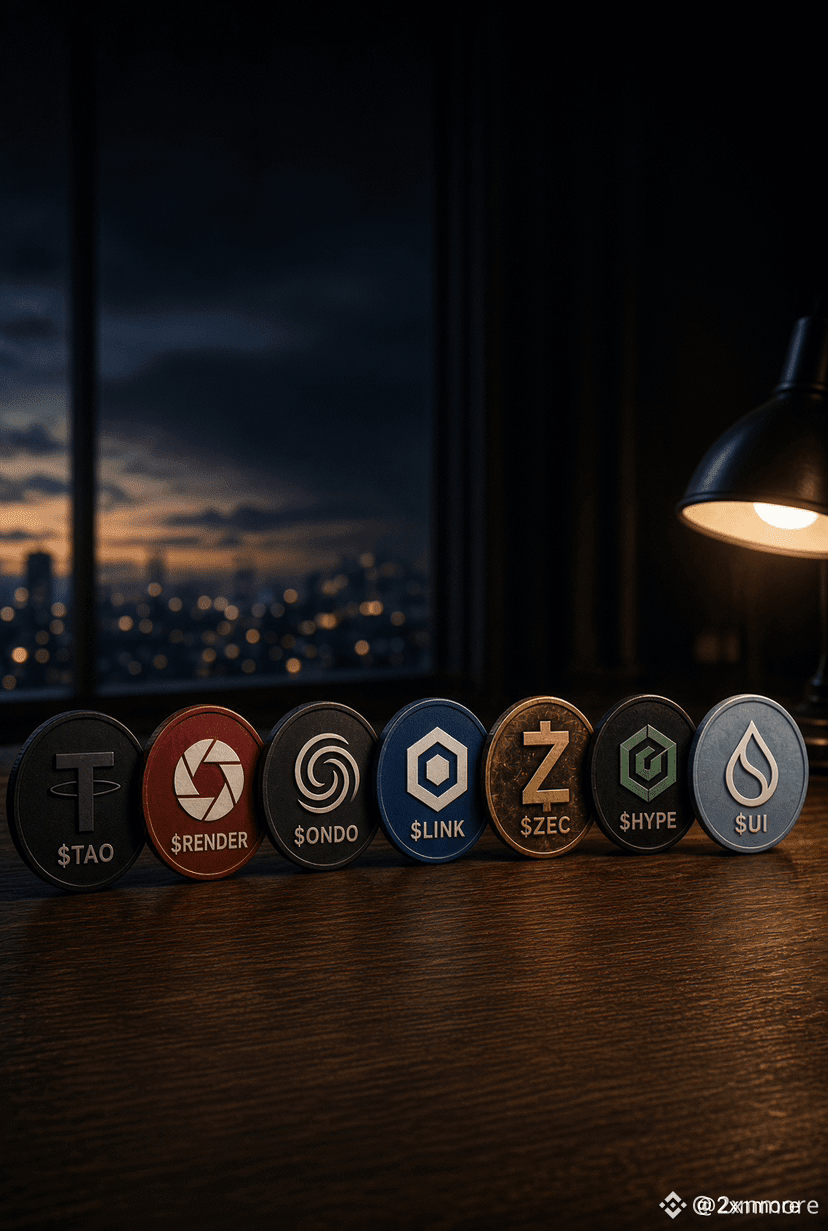
Most people will pick the wrong coin from this list.
$TAO $RENDER $ONDO $LINK $ZEC $HYPE $SUI
Only a few will lead the next rotation.
Which one are you holding when it starts?
Most people will pick the wrong coin from this list.
$TAO $RENDER $ONDO $LINK $ZEC $HYPE $SUI
Only a few will lead the next rotation.
Which one are you holding when it starts?
$TAO $RENDER $ONDO $LINK $ZEC $HYPE $SUI
Only a few will lead the next rotation.
Which one are you holding when it starts?
50
3
62
76.5k
·
--
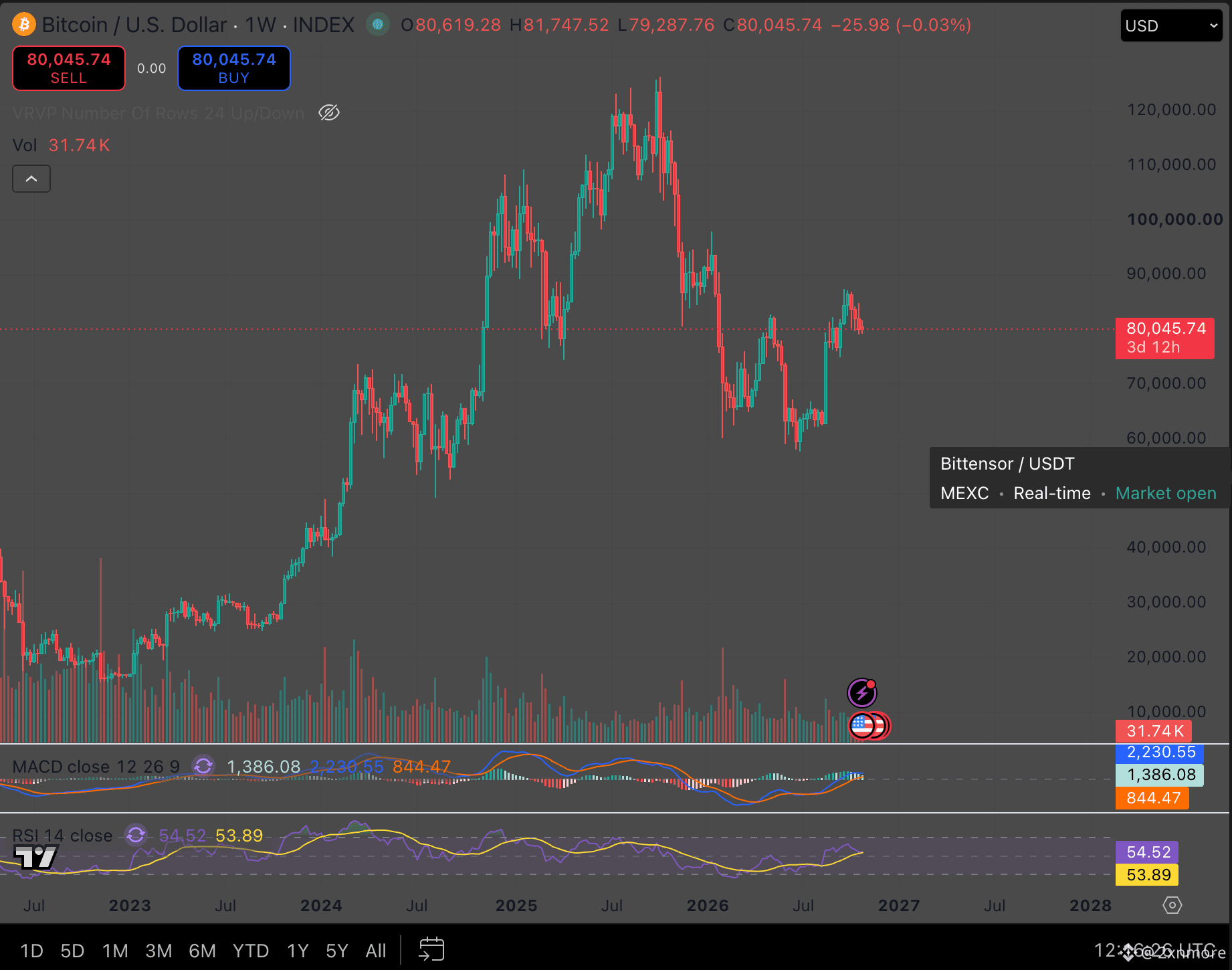
Bitcoin is flat this week, and the timeline is bored. The weekly chart is the opposite of boring.
$BTC weekly, zoomed out.
After the $126K top, price fell into two lows six months apart.
Around $60K in February.
Around $58K in summer.
That is a double bottom forming over half a year.
The neckline of that pattern sits near $82K, the spring high. In September, price broke above it and ran to roughly $88K.
Now it is back at $80K, retesting that neckline from above.
The momentum picture has flipped.
• Weekly MACD is above its signal line and both are back above zero for the first time since the breakdown
• Weekly RSI sits near 54.5, back above 50 and above its own average
Neither is overheated. There is room to run if buyers show up.
Now the math most people skip.
Neckline near $82K minus the low near $58K is about $24K. Add that to the neckline and the textbook target lands near $106K.
That is a projection, not a promise. Patterns fail all the time.
The map from here:
• Hold $78K to $80K on a weekly close: the retest holds, and $88K is next
• Reclaim $88K: the pattern is confirmed, and $97K comes into view
• Lose $75K on a weekly close: the breakout fails, and the $58K to $60K floor is back in play
The daily chart shows a pullback. The weekly chart shows a base that took six months to build.
Which one are you trading?
548
·
--
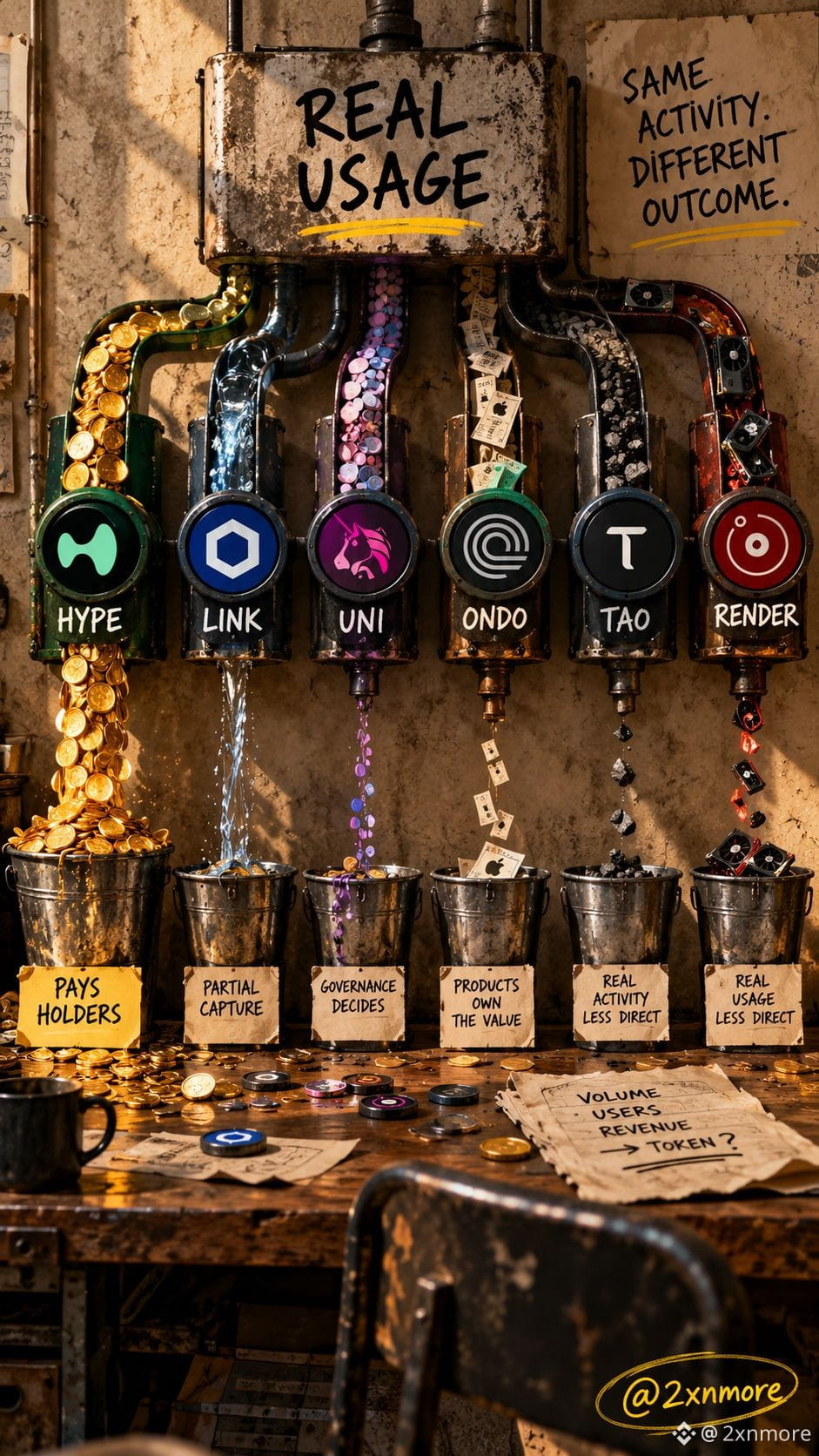
Most of these tokens are popular. Almost none of them get paid when people use the product.
That gap is about to matter.
These six tokens all touch real activity. Most people still group them by narrative.
The sharper split is how directly that activity hits the token.
🟢 Tightest value capture
$HYPE is the outlier. Hyperliquid turns a large share of trading fees into buybacks and burns.
Revenue and token demand are mechanically linked. Unlocks still outpace the burn for now, but no other name here has a loop this direct.
🟡 Strong usage, weaker capture
$LINK has the biggest real world footprint. Oracles and cross chain messaging keep expanding, and some revenue now flows into a reserve.
The infrastructure is winning. The token is still catching up.
$UNI has deep liquidity and volume, but governance decides how much of that value reaches holders.
High activity does not automatically equal strong token demand.
🔴 Narrative with a longer path
$ONDO sits on tokenized treasuries and RWA products. The assets can grow even if the token does not, because most of the demand lives in the products, not in ONDO itself.
$TAO and $RENDER both have real infrastructure use.
• TAO rewards useful AI work across subnets
• RENDER matches GPU supply with demand
Both generate activity. Neither has the clean link between fees and token demand that HYPE shows.
The scoreboard, in one glance:
• $HYPE: tightest loop
• $LINK: strongest pipeline, weaker capture
• $UNI, $ONDO, $TAO, $RENDER: real usage, less direct path to the token
The market still prices most of these on narrative.
In a more selective market, the tokens that turn usage into demand are the ones that hold up when the story cools off.
Which of these has the most durable value capture, not just the strongest story?
Most of these tokens are popular. Almost none of them get paid when people use the product.
That gap is about to matter.
These six tokens all touch real activity. Most people still group them by narrative.
The sharper split is how directly that activity hits the token.
🟢 Tightest value capture
$HYPE is the outlier. Hyperliquid turns a large share of trading fees into buybacks and burns.
Revenue and token demand are mechanically linked. Unlocks still outpace the burn for now, but no other name here has a loop this direct.
🟡 Strong usage, weaker capture
$LINK has the biggest real world footprint. Oracles and cross chain messaging keep expanding, and some revenue now flows into a reserve.
The infrastructure is winning. The token is still catching up.
$UNI has deep liquidity and volume, but governance decides how much of that value reaches holders.
High activity does not automatically equal strong token demand.
🔴 Narrative with a longer path
$ONDO sits on tokenized treasuries and RWA products. The assets can grow even if the token does not, because most of the demand lives in the products, not in ONDO itself.
$TAO and $RENDER both have real infrastructure use.
• TAO rewards useful AI work across subnets
• RENDER matches GPU supply with demand
Both generate activity. Neither has the clean link between fees and token demand that HYPE shows.
The scoreboard, in one glance:
• $HYPE : tightest loop
• $LINK : strongest pipeline, weaker capture
• $UNI , $ONDO, $TAO, $RENDER: real usage, less direct path to the token
The market still prices most of these on narrative.
In a more selective market, the tokens that turn usage into demand are the ones that hold up when the story cools off.
Which of these has the most durable value capture, not just the strongest story?
1
2
1.9k
·
--
Me when $BTC sets a new all time high and $TAO finally pays me back for every red candle I sat through
Me when $BTC sets a new all time high and $TAO finally pays me back for every red candle I sat through
1
399
·
--
Частичная правда
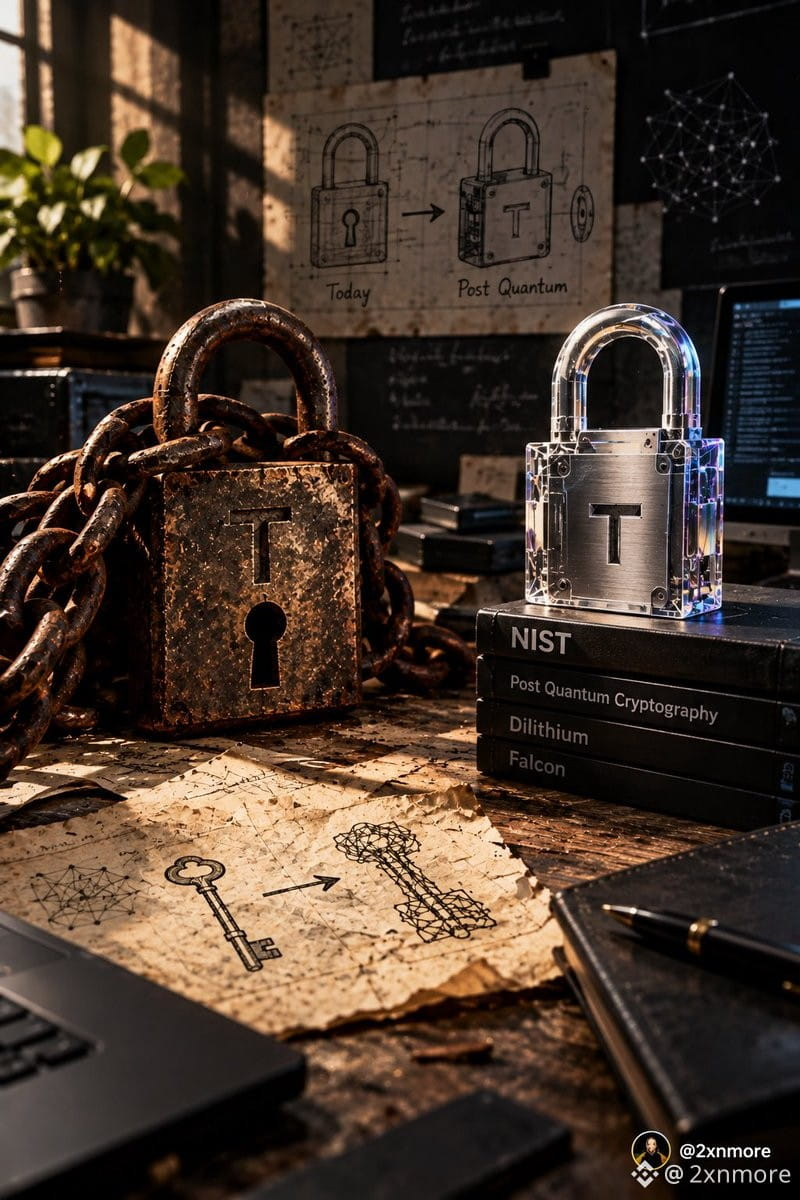
Your $TAO sits behind a lock that a future quantum computer could one day pick.
Bittensor just started changing the lock before anyone has built the key.
Subtensor has merged support for quantum resistant wallets. They are live on testnet now, not on mainnet yet.
Today, Bittensor wallets sign with SR25519 or Ed25519 keys. A large enough quantum computer could, in theory, break that math and forge your signature.
That machine does not exist yet. But blockchains are permanent, so you prepare before the threat arrives.
What Bittensor added, both selected by NIST:
• ML DSA 65 (Dilithium): heavily studied, larger signatures
• Falcon 512 and 1024: more compact, easier on block space
One trap: rotating the key on an old wallet does not make it quantum resistant. You need a new quantum style wallet for that.
What $TAO holders should do right now:
• Nothing at all, your balances, stake and wallets are untouched
• Ignore anyone pushing you to migrate, there is no forced migration
• Wait for mainnet activation and updated wallets before touching anything
Plenty of chains are still talking about the quantum problem. Bittensor is already testing code for it.
A network that protects your keys before it has to is built to outlast the cycle.
1
2
1.3k
·
--
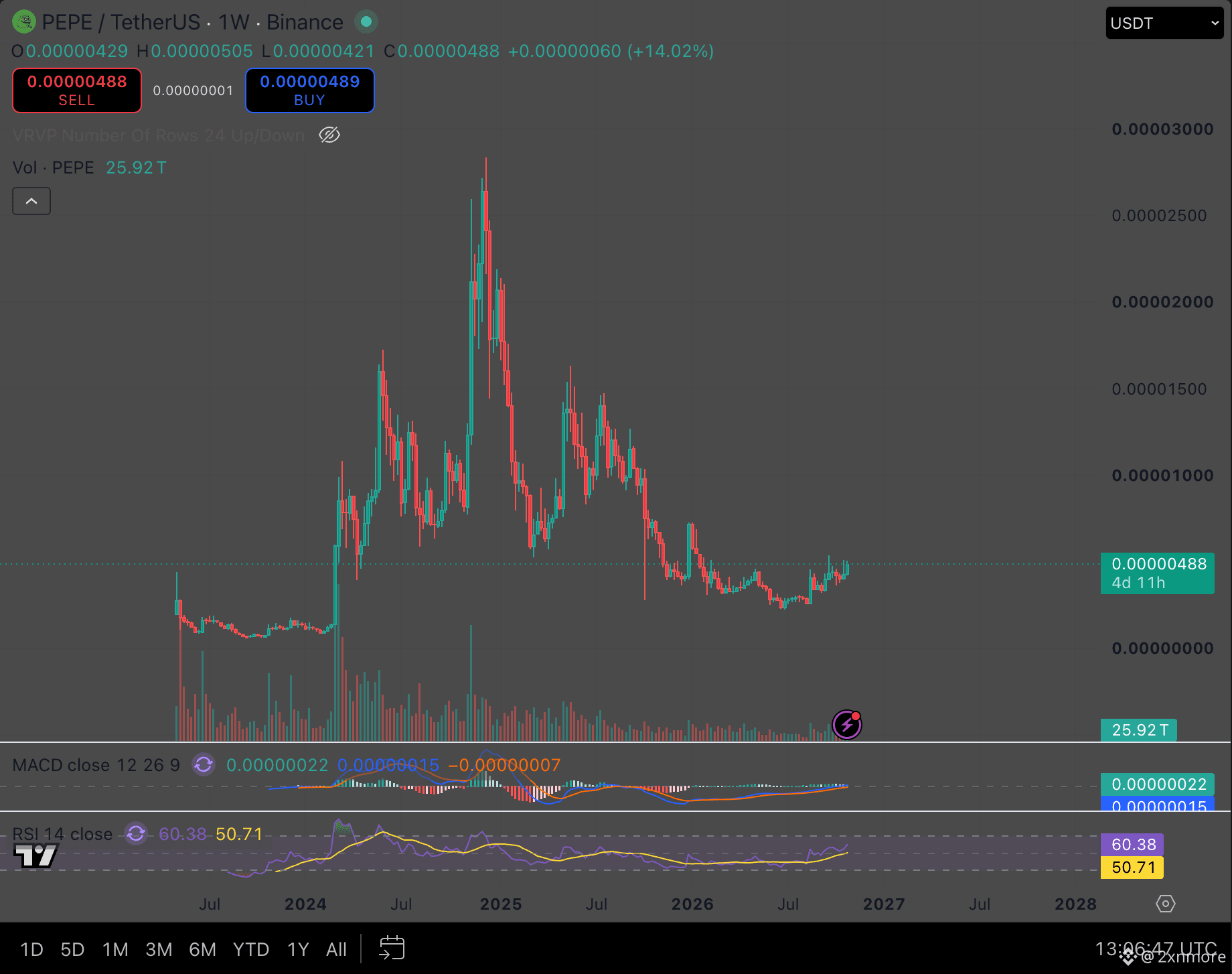
Your $PEPE bag is up 14% this week. It still needs a 5.7x just to get back to the peak.
The green candle is not the story. What is happening underneath it is.
PEPE weekly, zoomed out.
Since peaking near $0.000028 in December 2024, it has been trapped in a brutal downtrend. Lower highs, lower lows, and every rally sold.
At $0.00000488, it is still roughly 83% below that peak.
But the indicators are starting to say something different.
RSI: 60.38
Weekly RSI has climbed above 50 and sits over its own average near 50.7. Buyers are showing more conviction than in any of the weak rebounds before this.
Above 60 is strength, not a guaranteed breakout.
MACD: turning up
The MACD line is above its signal line with a positive histogram. That is an early bullish momentum signal.
The real test is whether it keeps expanding as price hits resistance.
Structure: building a base
After months near the lows, the candles are improving. The larger downtrend is still intact.
Levels I am watching:
• $0.0000050 to $0.0000055: immediate resistance, needs a convincing weekly close above
• $0.0000065 to $0.0000075: next supply zone if the breakout holds
• $0.0000040 to $0.0000042: near term support, losing it weakens the recovery case
• $0.0000030 to $0.0000035: deeper support if sellers take back control
Volume: the missing piece
This recovery has not produced anything close to the volume of the 2024 expansion phases.
Rallies can start on modest volume. Breakouts that last need participation, and that is still missing.
My read: $PEPE looks healthier than it has in months. RSI is bullish, MACD is improving, and price is trying to build a base.
But improving momentum is not a confirmed trend reversal.
The first real test is $0.0000055.
Clear it with sustained buying, and the recovery case gets serious. Get rejected, and this becomes another lower high in a much bigger downtrend.
The question is not whether $PEPE can pump. It is whether buyers can finally change the structure.
Genuine reversal, or just another rally inside a bear trend?
1
873
·
--
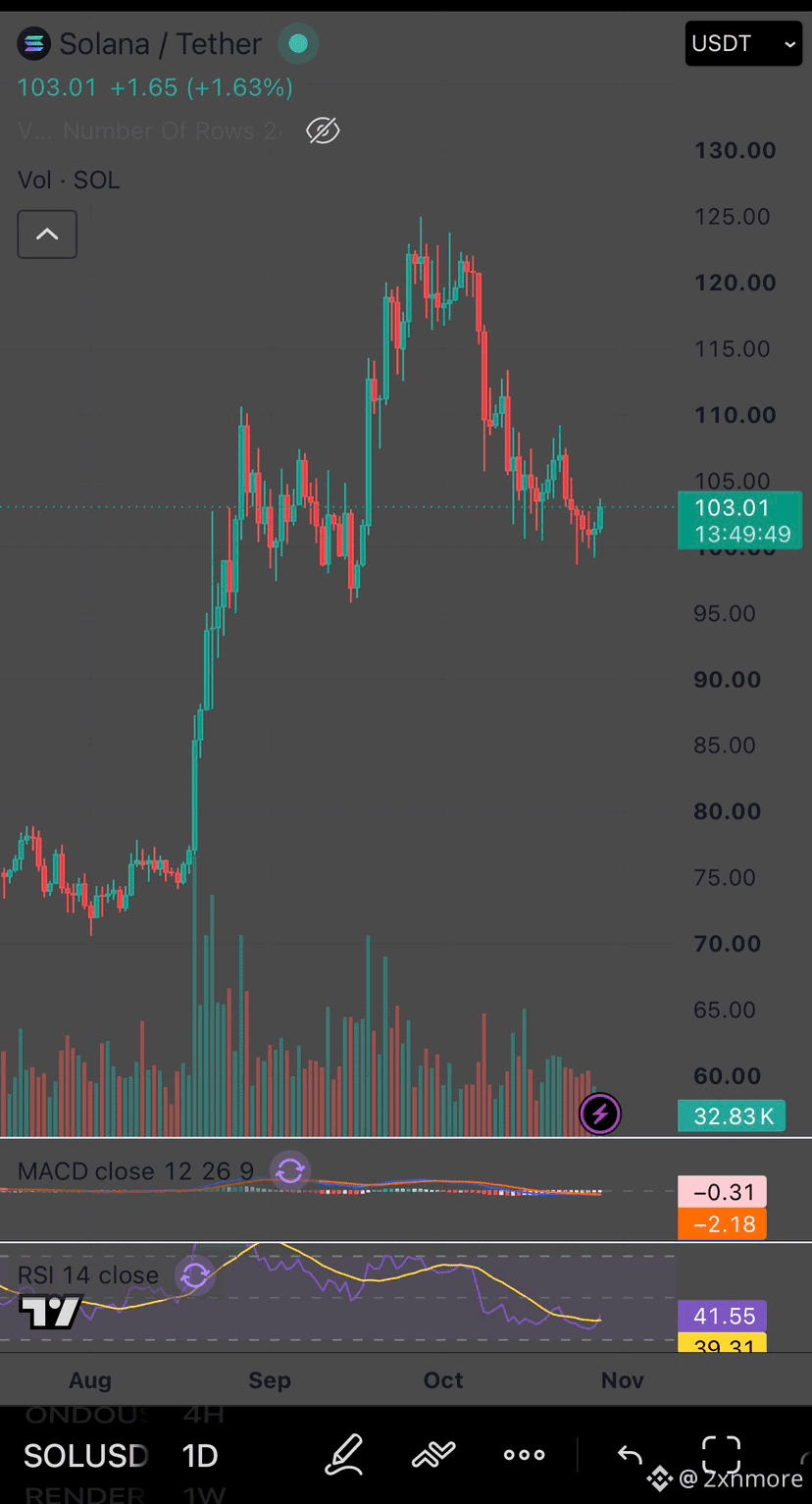
You bought $SOL above $120 because September looked unstoppable.
Now it trades near $103 and the timeline has gone quiet.
One level decides whether that was the top or the reload.
The September impulse ran from the August base near $72 all the way to $125.
Price has already handed back about 40% of that move.
Here is the map that matters now.
Resistance to reclaim:
$110
That was the September range ceiling, and it is exactly where the mid October bounce stalled.
Support to defend:
$97 to $99
The 50% retracement of the whole move sits near $98.50, right on the mid September range floor that held every test. Two tools are pointing at the same level.
Invalidation:
A daily close below $92
That is the 61.8% retracement. Lose it and the September breakout starts to look like a failed move instead of a base.
Now the part the price is hiding.
RSI cooled to 41 without ever reaching oversold, and it just curled back above its own average.
Selling volume on this drop is lighter than the buying volume that launched September.
MACD is flat near zero, which reads as a reset rather than a breakdown.
My stance: hold $98 and a reclaim of $110 reopens the path back to $125.
Lose $92 and I step aside without arguing with the chart.
Pullbacks to old resistance are where conviction gets tested, and most people fail the test one candle before it passes.
3
2.2k
·
--
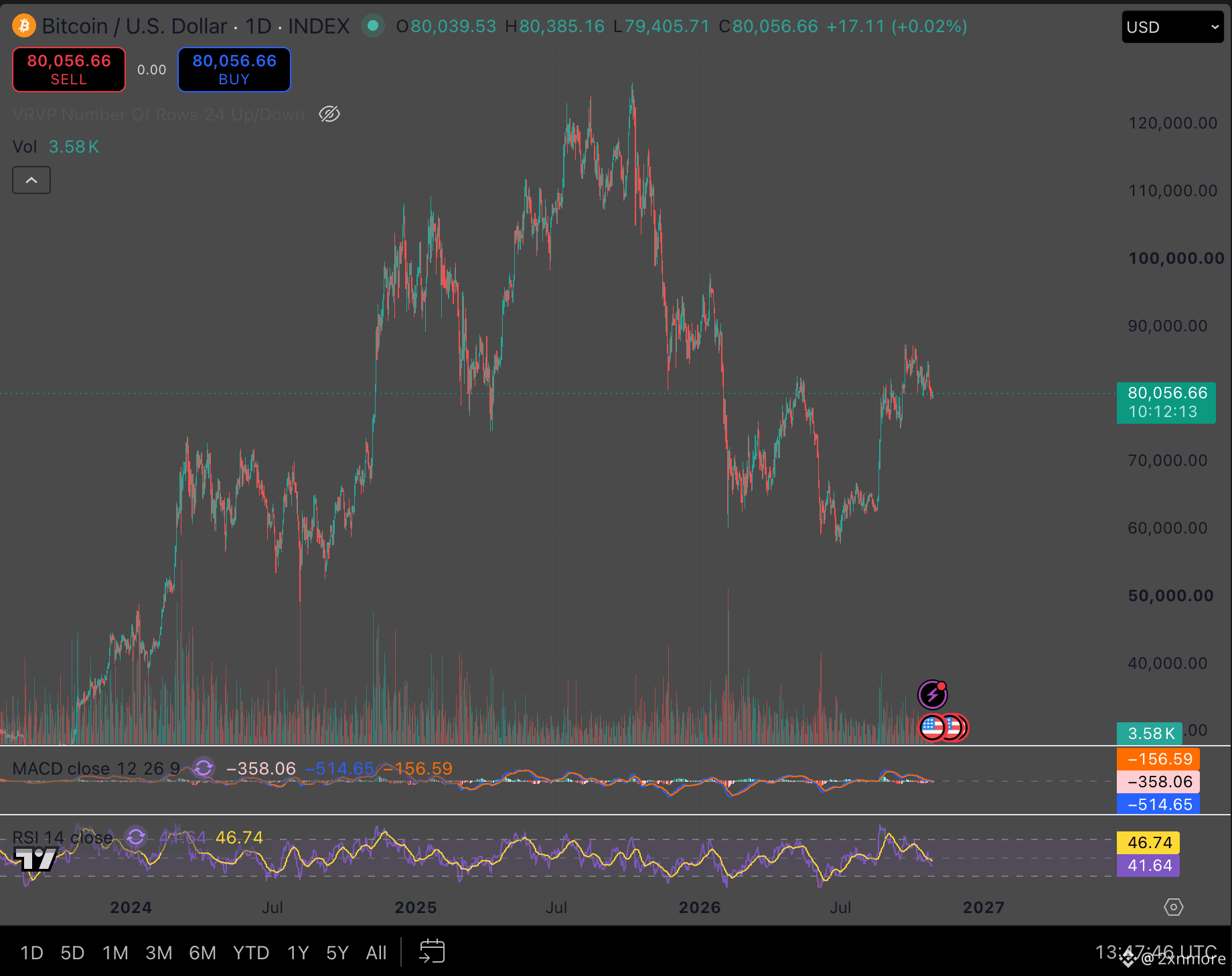
Everyone is calling Bitcoin dead at $80K. The chart is quietly doing something it has not done since the top.
$BTC daily, zoomed out.
From the $126K peak, every bounce made a lower high. The spring rally died near $82K.
Then price broke down to a $58K low in summer.
August changed that.
The rally to roughly $88K took out the spring high. That is the first higher high since the top.
Now price is pulling back into the exact zone that capped it before.
$80K to $82K
Old resistance, now being tested as support. This is where you find out if the trend shift is real.
The indicators are cooling, not breaking.
• RSI near 42, below its own average
• MACD under its signal line, momentum fading
• Volume quiet on the pullback, no panic
The map from here:
Hold $80K: a textbook retest, and $88K comes back into play
Reclaim $88K: the door opens toward $90K and above
Lose $75K on a daily close: the higher high fails, and the summer lows are back on the table
Down roughly 36% from the top, with the structure just starting to turn.
That does not look like a dead network. It looks like a market most people stopped watching.
1.7k
·
--
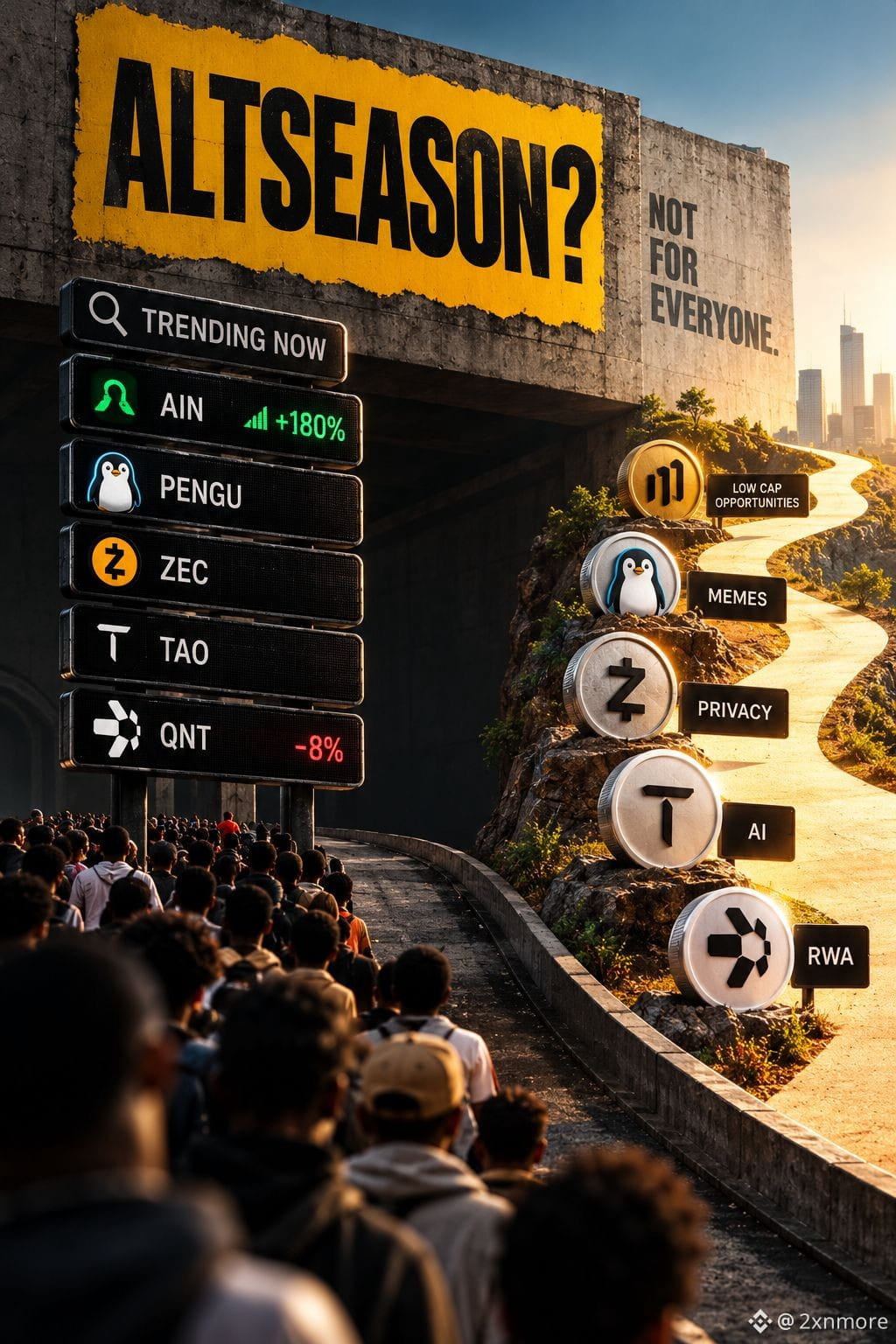
You are waiting for altseason. The market already decided it is not coming for everyone.
Look at what people searched most today:
• $AIN, a low cap up over 180%
• $PENGU, a meme coin
• $ZEC , a privacy coin
• $TAO , an AI token
• $QNT, an RWA token bleeding red
That is not a broad alt rally. That is a market picking winners one by one.
Bitcoin dominance still sits near 60%.
Altseason indices are stuck between 49 and 62.
The money is moving, just not to every bag at once.
The part most people miss: attention is not strength.
$QNT was one of the most searched coins today while down about 8%. People search a coin when it is pumping, and they search it just as hard when it is hurting.
Before you chase anything trending, run it through three questions.
• Is there a real catalyst, or just a chart?
• Does the token actually capture value from that catalyst?
• Is the move backed by volume, or only by noise?
If you cannot answer all three, you are not early. You are exit liquidity with good intentions.
This cycle will not lift every alt. It will reward the ones with a reason to exist.
You are waiting for altseason. The market already decided it is not coming for everyone.
Look at what people searched most today:
• $AIN, a low cap up over 180%
• $PENGU, a meme coin
• $ZEC , a privacy coin
• $TAO , an AI token
• $QNT , an RWA token bleeding red
That is not a broad alt rally. That is a market picking winners one by one.
Bitcoin dominance still sits near 60%.
Altseason indices are stuck between 49 and 62.
The money is moving, just not to every bag at once.
The part most people miss: attention is not strength.
$QNT was one of the most searched coins today while down about 8%. People search a coin when it is pumping, and they search it just as hard when it is hurting.
Before you chase anything trending, run it through three questions.
• Is there a real catalyst, or just a chart?
• Does the token actually capture value from that catalyst?
• Is the move backed by volume, or only by noise?
If you cannot answer all three, you are not early. You are exit liquidity with good intentions.
This cycle will not lift every alt. It will reward the ones with a reason to exist.
1
2.3k
·
--
This is not a call. But if $BTC ever slips below $80K, every alt bag gets tested at once.
Some will stand tall. Others will find out where their real floor is.
Where do these five land if it happens?
$TAO
$ONDO
$UNI
$LINK
$QUBIC
Real revenue usually holds up best. Pure narrative usually finds its floor last.
Rank them strongest to weakest, and drop the level where you think each one settles.
Conviction is easy above $80K. The real test is what you would still hold below it.
550
·
--
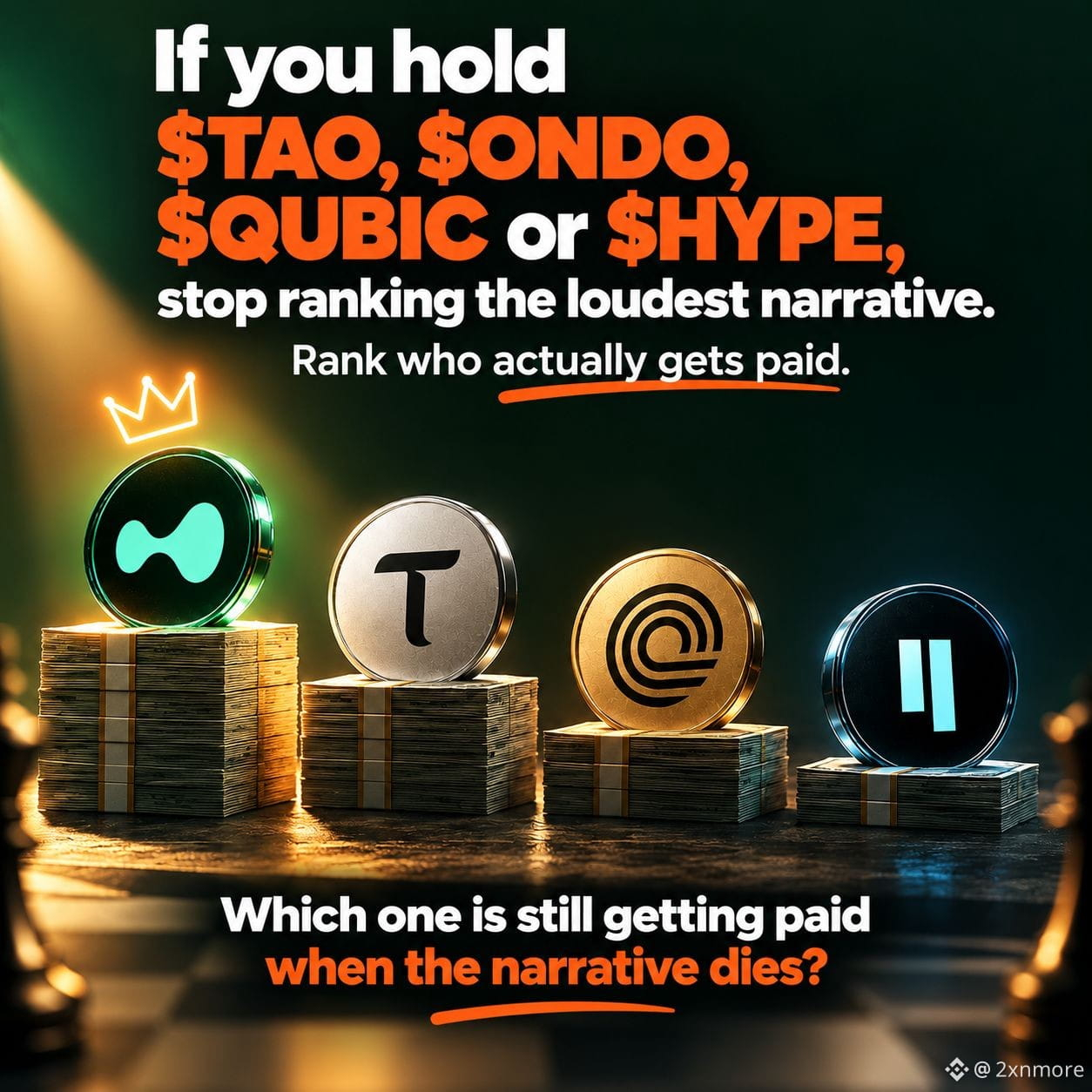
If you hold $TAO, $ONDO, $QUBIC or $HYPE, stop ranking the loudest narrative.
Rank who actually gets paid.
Here is the scorecard on the questions holders keep asking.
$HYPE
Fees already flow into buybacks.
The real question is whether that volume survives unlocks and every new venue copying the same book.
$TAO
Some subnets already earn outside revenue.
The real question is whether staking demand keeps growing after the next emissions cut.
$ONDO
Tokenised treasuries and stocks are live and growing.
The real question is whether the fee switch ever turns on, and how much of that revenue reaches holders.
$QUBIC
Useful proof of work is the pitch.
The real question is whether real AI demand replaces the narrative before the next stress test arrives.
Cash flow decides 2031.
Narratives decide this week.
Which one is still getting paid when the narrative dies?
If you hold $TAO , $ONDO , $QUBIC or $HYPE , stop ranking the loudest narrative.
Rank who actually gets paid.
Here is the scorecard on the questions holders keep asking.
$HYPE
Fees already flow into buybacks.
The real question is whether that volume survives unlocks and every new venue copying the same book.
$TAO
Some subnets already earn outside revenue.
The real question is whether staking demand keeps growing after the next emissions cut.
$ONDO
Tokenised treasuries and stocks are live and growing.
The real question is whether the fee switch ever turns on, and how much of that revenue reaches holders.
$QUBIC
Useful proof of work is the pitch.
The real question is whether real AI demand replaces the narrative before the next stress test arrives.
Cash flow decides 2031.
Narratives decide this week.
Which one is still getting paid when the narrative dies?
2
1.4k
·
--
You felt bullish at the end of September.
Four weeks later, you probably feel nothing.
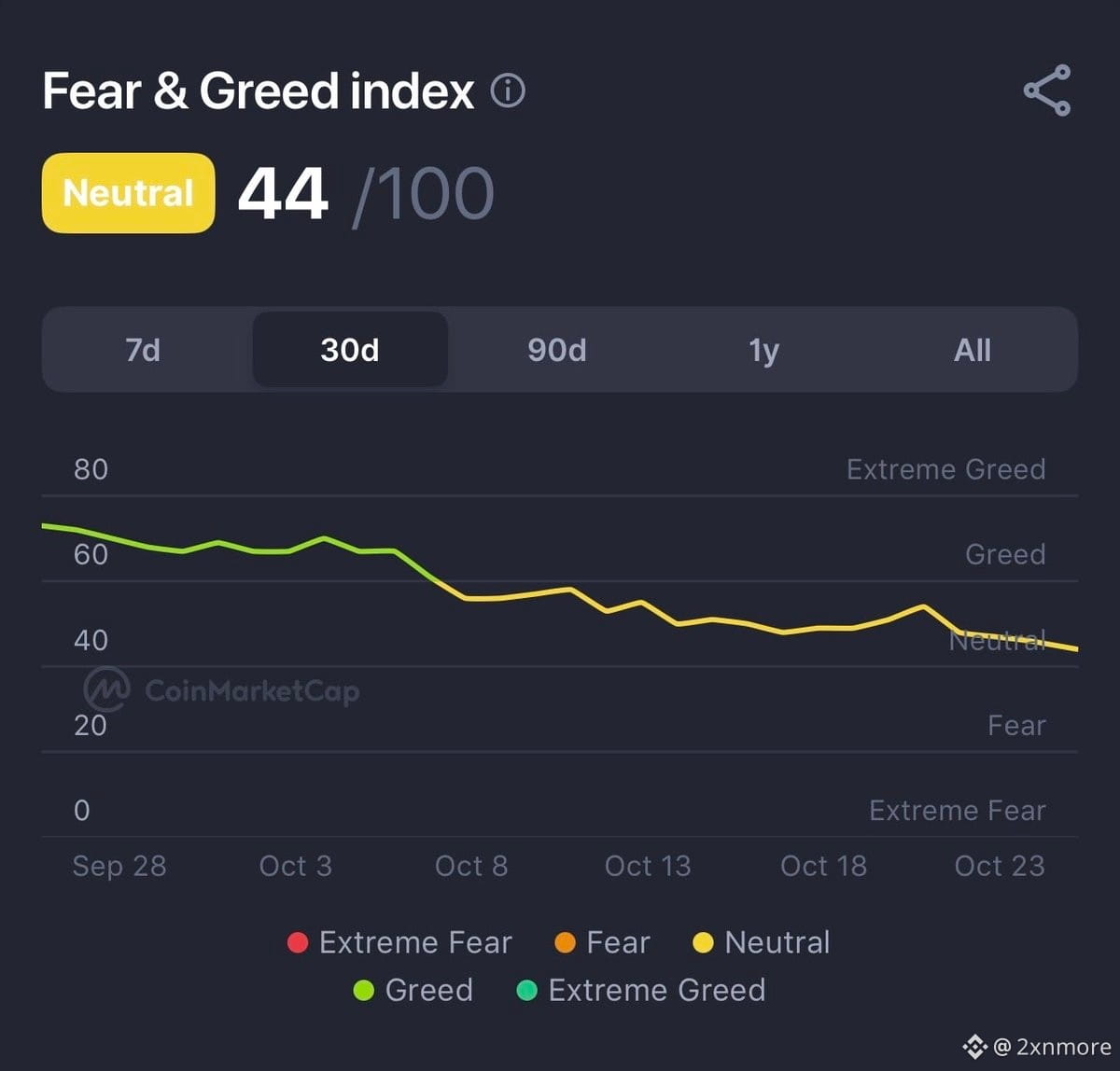
The Fear & Greed index shows exactly how that happened.
Late September:
Mid 60s, solidly in Greed
Today:
44, Neutral, just above the Fear zone
That is a slide of more than 20 points in market mood in one month.
Here is where the market stands this morning:
Total crypto market cap: $2.68T
$BTC : $80,090
$ETH : $2,323
Fear & Greed: 44
Yesterday's drop toward $2.65T got bought back within hours.
And the top headline on the board?
The US OCC is finalising its rules for the GENIUS Act, America's stablecoin law.
Read those two facts together.
The crowd is getting bored on the same morning the stablecoin rulebook moves forward.
Stablecoins are the settlement rail for tokenised treasuries and real world assets.
Clear rules are what institutions need before they move size onto that rail.
A sentiment index measures how the crowd feels.
Regulation decides what capital is allowed to do.
The crowd is reading the mood. Institutions are reading the rulebook.
362
·
--
You're still waiting for Bitcoin to "confirm" the bull run.
September already showed you who the market bids when it gets selective.
The next leg doesn't need a BTC breakout to start. It starts when coins with real catalysts stop getting faded.
8 coins I cover that ran in September while most of the market stayed cautious:
The AI compute trade
1. $TAO +30.6%
Demand for decentralized AI compute never cooled.
2. $FET
Moved with every AI sector rally the leaders sparked.
3. $RENDER
Caught the same compute rotation that lifted $TAO.
The tokenization trade
4. $ONDO
Broke out on institutional tokenization headlines, BlackRock included.
5. $LINK roughly +27%
Pushed to 2026 highs on CCIP adoption and whale accumulation.
The risk appetite trade
6. $SUI
Printed repeated strong weekly candles as capital rotated into high beta L1s.
7. $UNI roughly +53%
One of the strongest large cap performers of the month.
8. $HYPE new ATH near $96
Set a fresh record high during the risk on stretch.
September wasn't random. It was the market quietly ranking which narratives still have buyers.
Bitcoin confirming the bull run is the last signal, not the first.
817
·
--
You felt bullish at the end of September.
Four weeks later, you probably feel nothing.
The Fear & Greed index shows exactly how that happened.
Late September:
Mid 60s, solidly in Greed
Today:
44, Neutral, just above the Fear zone
That is a slide of more than 20 points in market mood in one month.
Here is where the market stands this morning:
Total crypto market cap: $2.68T
$BTC: $80,090
$ETH: $2,323
Fear & Greed: 44
Yesterday's drop toward $2.65T got bought back within hours.
And the top headline on the board?
The US OCC finalizing its rules for the GENIUS Act, America's stablecoin law.
Read those two facts together.
The crowd is getting bored on the same morning the stablecoin rulebook moves forward.
Stablecoins are the settlement rail for tokenized treasuries and real world assets.
Clear rules are what institutions need before they move size onto that rail.
A sentiment index measures how the crowd feels.
Regulation decides what capital is allowed to do.
The crowd is reading the mood. Institutions are reading the rulebook.
264
·
--
Проверено
Your parents' financial advisor may soon be able to buy the same $TAO you hold. No wallet, no seed phrase, no friction.
On October 23, Grayscale filed Amendment No. 2 to the registration statement for the Grayscale Bittensor Trust.
Once it becomes effective and shares list on NYSE Arca, Grayscale intends to rename it:
Grayscale Bittensor ETF
Ticker: GTAO
What the product would hold and how it would work:
1. Actual $TAO, held directly
2. Institutional custody with BitGo and Coinbase
3. Creations and redemptions both in kind and in cash
What this is not:
This is not an approval and not a launch date.
Shares of the trust already trade OTC under GTAO.
Staking is prohibited for now, only contemplated if certain conditions are met, with no guarantee it ever happens.
Why it matters is simple.
A regular brokerage account gets a clean path into the decentralized AI network. The buyer base stops being only people already deep in crypto.
The holders who sat through the noise may soon have company they never had to convince.
566
·
--
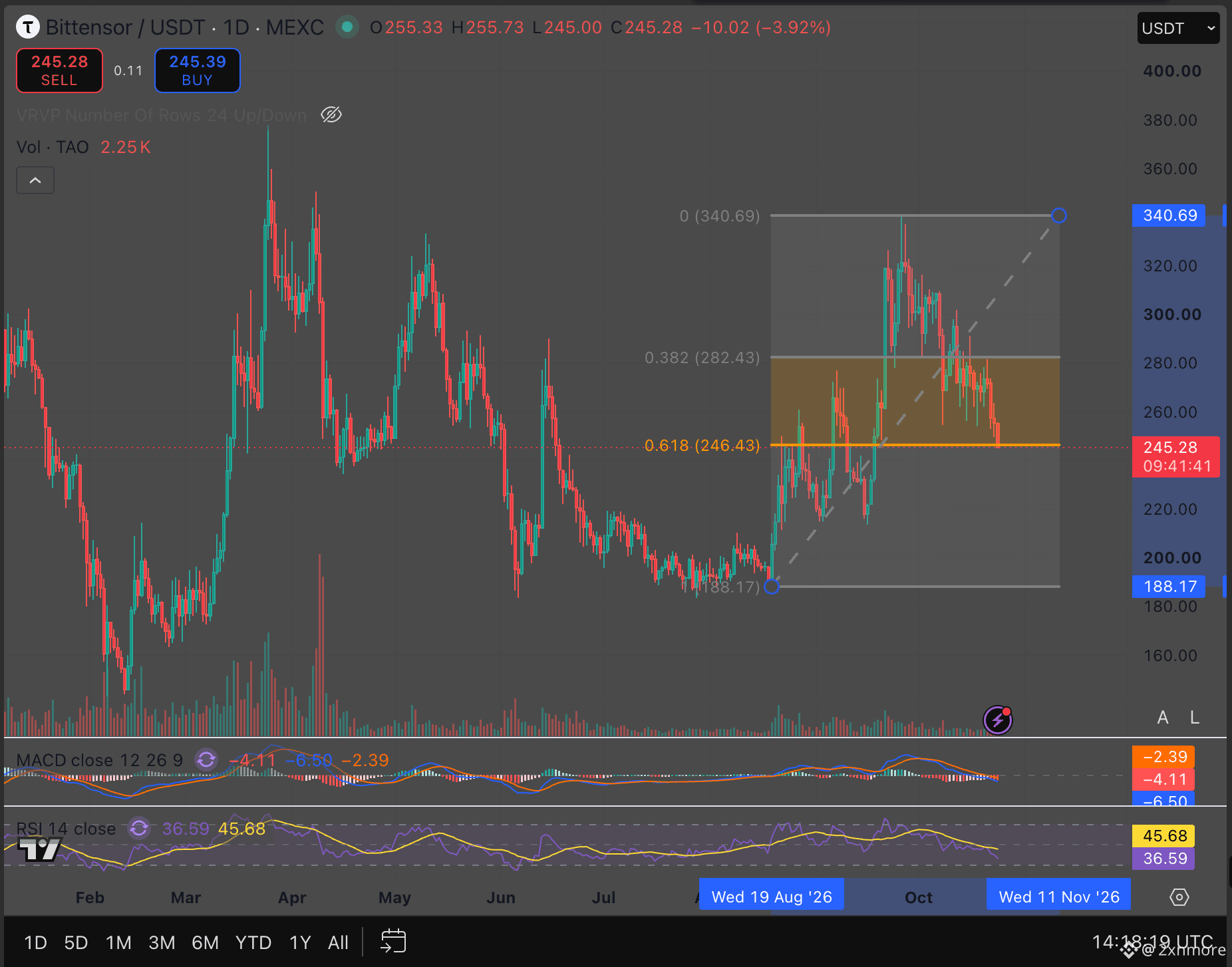
$TAO just touched the exact floor I have been flagging for a week.
The next 10 hours decide which version of this year you get.
Price now:
about $245
Today's low:
$245.00
That is not a random number. Three separate signals meet right here.
The 61.8% Fibonacci level of the August to October rally:
about $246
The 200 day average, the long term trend line:
about $245
And the September breakout zone, where this whole leg started.
When three signals stack on one price, the market usually makes a decision there, not a few dollars later.
Here is why it matters so much.
Every pullback this year has stopped higher than the last.
February low:
about $148
August low:
about $188
September low:
about $215
This is the level that keeps that staircase alive or breaks it.
Momentum is still heavy. Daily MACD keeps sinking and daily RSI has dropped to about 37.
But RSI is now close to the oversold zone near 30, where selling often runs out of fuel. Sellers are strong, and they are also getting tired.
The daily candle closes in under 10 hours, and the close is what counts, not the wick.
If $TAO closes above $245, the golden pocket held. The first targets are $266, the busiest price on the chart, then $283.
If it closes below $245, the staircase cracks. The next real supports are $215, the September low, then the heavy volume zone near $200, with the August low at $188 behind it.
That is the entire trade.
Floor holds, or floor breaks?
You do not need to guess. You need to wait for the close and let the chart tell you which side to stand on.
6
2.1k
·
--
In AI and crypto, that conviction is the real moat.
So here is the only question that actually matters this cycle.
Strongest community in AI and crypto. Pick one.
$TAO
$RENDER
$NEAR
$QUBIC
Price tells you who is winning today.
Community tells you who is still standing in two years.
Which one are you riding, and who did you leave off the list?
So here is the only question that actually matters this cycle.
Strongest community in AI and crypto. Pick one.
$TAO
$RENDER
$NEAR
$QUBIC
Price tells you who is winning today.
Community tells you who is still standing in two years.
Which one are you riding, and who did you leave off the list?
1
2
1.5k
·
--
If you hold $TAO, $ONDO, $QUBIC or $HYPE, you probably think you picked a side in one race.
You did not. You bought a seat in four different races.
Each token is long a different problem. Over five years, the only question that matters is whether the token gets paid when that problem is solved.
Here is what a five year hold on each one actually means.
$TAO is a bet on the market for intelligence itself. Some subnets already earn outside revenue, and supply is capped at 21M with emissions now halved to 3,600 TAO a day.
$ONDO is a bet on real world assets moving onchain. Tokenized treasuries and stocks are live and growing, but the fee switch is still a governance thesis, not a live mechanism.
$QUBIC is a bet on useful proof of work. It has the furthest to go and the most to prove, because mining power has to become real AI demand instead of headlines.
$HYPE is a bet on onchain perpetual futures taking volume from centralized exchanges. Revenue is large and visible, and protocol fees flow into buybacks.
Competition is the risk that never sleeps, because every new venue is fighting for the same traders.
Now the scorecard that actually separates them.
Does the token get paid today?
$HYPE: yes, through fee buybacks
$TAO: partly, through demand to stake into subnets
$ONDO: not yet, it is waiting on the fee switch
$QUBIC: not yet, it is waiting on proof of AI demand
The two "not yet" names carry the most upside and the most risk. That gap is the entire five year trade.
Most people will pick the loudest narrative this week. Narratives win a cycle, but cash flow wins five years.
Which of these four is still getting paid in 2031?
1
1
1.7k
·
--
Most of your crypto bag pays you nothing. It runs on narrative, and narrative bleeds out slowly.
A handful of tokens work differently. They send real protocol revenue back to holders, and the numbers are public.
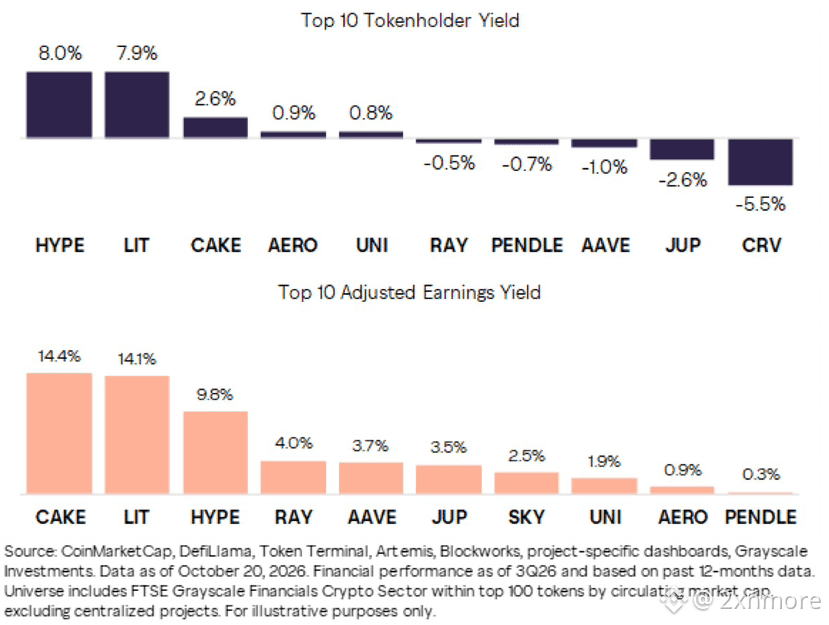
Grayscale ranked the leaders on two metrics.
Tokenholder yield: the share of market cap returned to holders each year through buybacks, burns and distributions.
$HYPE 8.0%
$LIT 7.9%
$CAKE 2.6%
$AERO 0.9%
$UNI 0.8%
Adjusted earnings yield: what the protocol keeps after costs and token incentives, as a share of market cap.
$CAKE 14.4%
$LIT 14.1%
$HYPE 9.8%
$RAY 4.0%
$AAVE 3.7%
Now read the two lists together.
Earnings show what a protocol could return. Tokenholder yield shows what it actually hands back.
$HYPE earns 9.8% and returns 8.0%.
$CAKE earns 14.4% and returns only 2.6%.
That gap is the whole story. Which protocol closes it first?
Cash flow is the only crypto narrative that does not need a new buyer to stay true.
1
1.2k
Войдите, чтобы посмотреть больше материала
Присоединяйтесь к пользователям криптовалют по всему миру на Binance Square
⚡️ Получайте новейшую и полезную информацию о криптоактивах.
💬 Нам доверяет крупнейшая в мире криптобиржа.
👍 Получите достоверные аналитические данные от верифицированных создателей контента.
Эл. почта/номер телефона
В тренде
FedWatch
Просмотров: 16.3M
39,182 обсуждают
🚨 THE ALARM BELLS ARE RINGING LOUDLY AGAIN!
As you know, the FED announced its interest rate decision last night, keeping rates unchanged. Here is the situation regarding the other data that followed #FedWatch
Annual inflation rose to 3.6%, while monthly inflation climbed to 0.5%. The core PCE Personal Consumption Expenditures Price Index also reached 3.1% on an annual basis.
Although these figures align with expectations, the truly concerning aspect is that inflation has begun to accelerate once again. The FED’s 2% target still seems quite far off.
In my view, this makes it difficult to justify any interest rate cuts in the near term. If high interest rates persist for a longer period, it could create additional selling pressure on $BTC and altcoins.
Do you think crypto assets will be able to hold their ground?
Kripto Kurdu
·Лайков: 20
·Просмотров: 3.8k
EarningsSeason
Просмотров: 6.4M
31,900 обсуждают
USMidtermElections
Просмотров: 26,759
524 обсуждают