

Rohas Nagpal
61 Публикации

Rohas Nagpal
Отправить жалобу
Заблокировать пользователя
Building Sara AI
0 подписок(и/а)
1.5K+ подписчиков(а)
97 понравилось
Посты
·
--
Binance Hack Investigation | Update #02
Investigators have identified where approximately $3.1 billion of the stolen cryptocurrency was held after the Binance hack.
According to Bitquery's on-chain investigation, at 03:54 UTC on 30 October:
- Approximately 490,361 ETH was held across attacker-linked wallets.
- Approximately 18,270 BTC was held across 19 Bitcoin addresses.
- The rest was held on other chains: approximately 682.7 million TRX, 233.5 million XRP and 970,549 SOL.
- Several of the largest Ethereum holding wallets had made no outgoing transfers.
- No transfers to exchanges, mixers or bridges had been identified from the remaining holdings.
One interesting finding: the attacker originally took approximately 200,630 ETH, but subsequently held more than twice that amount.
The additional ETH was acquired by converting stolen stablecoins and other tokens.
Our focus now is on tracking movement from these holding addresses and distinguishing actual transfers from internal consolidation, swaps and recovery actions.
Two Ethereum addresses worth monitoring:
Wallet 1:
https://etherscan.io/address/0x8532FA14ACAf483729C449b8458aedDb900543D4
Wallet 2:
https://etherscan.io/address/0xc887aF690E0301CD4edBbCe8F8d31b4EC65B286A
These balances represent a historical snapshot and will change if funds move.
1
9
·
--
Binance Hack Investigation | Update 1
Arbitrum has intervened to freeze stolen funds linked to the Binance hack.
On 30 October 2026, the Arbitrum Security Council executed an emergency action to secure:
- 74,559,805.2 ARB
- Approximately 8,425 ETH
The assets were transferred from an address linked to the exploit into a designated holding address.
Frozen wallet:
`0x0000000000000000000000000000000000000DA0`
What makes this particularly interesting is HOW the funds were frozen.
The Security Council temporarily upgraded Arbitrum's Inbox contract, used a special function to execute transactions on behalf of the attacker-linked address, transferred the funds, and restored the original implementation.
The assets are now held pending governance action.
This raises an important question: Under what circumstances should blockchain governance have the power to forcibly move assets without the holder's signature?
Evidence:
https://forum.arbitrum.foundation/t/security-council-emergency-action-30-10-2026/31625
Frozen wallet:
https://arbiscan.io/address/0x0000000000000000000000000000000000000DA0
62
·
--
There's more money to be made investigating crypto crimes...
...than investing in cryptocurrencies!
There's more money to be made investigating crypto crimes...
...than investing in cryptocurrencies!
...than investing in cryptocurrencies!
1
75
·
--
Could a YouTuber sell 10% of future ad revenue to fans?
Imagine a channel earning $100,000 a year.
The creator tokenizes 10% of future ad revenue into 1,000 tokens.
Fans buy tokens and receive a share of revenue under agreed terms.
Would you invest in your favourite YouTuber?
Could a YouTuber sell 10% of future ad revenue to fans?
Imagine a channel earning $100,000 a year.
The creator tokenizes 10% of future ad revenue into 1,000 tokens.
Fans buy tokens and receive a share of revenue under agreed terms.
Would you invest in your favourite YouTuber?
Imagine a channel earning $100,000 a year.
The creator tokenizes 10% of future ad revenue into 1,000 tokens.
Fans buy tokens and receive a share of revenue under agreed terms.
Would you invest in your favourite YouTuber?
1
66
·
--
The best blockchain for asset tokenization is Arc.
Here's why:
1. Built by Circle, the regulated company behind USDC.
2. Very low gas fees.
3. Gas paid in USDC, no volatile crypto needed.
My next two choices: Polygon and Ethereum.
The best blockchain for asset tokenization is Arc.
Here's why:
1. Built by Circle, the regulated company behind USDC.
2. Very low gas fees.
3. Gas paid in USDC, no volatile crypto needed.
My next two choices: Polygon and Ethereum.
Here's why:
1. Built by Circle, the regulated company behind USDC.
2. Very low gas fees.
3. Gas paid in USDC, no volatile crypto needed.
My next two choices: Polygon and Ethereum.
1
82
·
--
A $500,000 racehorse. 5,000 tokens. Would you buy one? 🐎
Imagine a successful racehorse worth $500,000.
Its owner tokenizes it into 5,000 digital tokens, each priced at $100.
Instead of needing half a million dollars to own the horse, someone could buy a small fraction for just $100.
If the horse earns prize money, breeding income or rises in value, the economic benefits could be shared with token holders according to the legal structure.
The horse remains in the care of its owner, trainer and stable.
The asset stays physical.
The economic rights are split into digital units.
Of course, this only works if the legal agreements clearly define what token holders actually get, how income is distributed, and who makes the key decisions.
That is where tokenization gets interesting.
It can turn high-value assets into something far more accessible.
2
114
·
--
Your content can earn USDC every time an AI agent uses it.
Most content today is published for free: research, reports, datasets, analysis, APIs, guides and other valuable information.
With x402, you can put a price on access to that content.
An AI agent that wants it can:
1. Find your content
2. See the price
3. Pay you automatically in USDC
4. Get access instantly
You could charge $0.01 for a data point, $0.10 for an article, $1 for a report, whatever makes sense.
x402 is an open payment protocol being developed by Coinbase and Cloudflare. The wider ecosystem includes companies such as Circle, AWS, Anthropic and NEAR.
1
183
·
--
I've been investigating crypto crime since 2011.
I've seen hundreds of people lose funds from their MetaMask wallets.
Not because it's a bad wallet, but because of blind signing, bad approvals, thinking "disconnect" = revoked access, and trusting token names over contract addresses,.
So I'm building Sara AI Wallet - open source, AI-powered, stablecoin-first.
Just type or say what you want:
"send 100 usdc to zara"
"bridge 100 usdc from polygon to arbitrum"
"swap 100 usdt for usdc"
It's in early alpha now. I am building in the open.
If you want to help shape it, see this [Github Repo](https://github.com/rohasnagpal/sara-wallet)
I've been investigating crypto crime since 2011.
I've seen hundreds of people lose funds from their MetaMask wallets.
Not because it's a bad wallet, but because of blind signing, bad approvals, thinking "disconnect" = revoked access, and trusting token names over contract addresses,.
So I'm building Sara AI Wallet - open source, AI-powered, stablecoin-first.
Just type or say what you want:
"send 100 usdc to zara"
"bridge 100 usdc from polygon to arbitrum"
"swap 100 usdt for usdc"
It's in early alpha now. I am building in the open.
If you want to help shape it, see this Github Repo
2
135
·
--
Blockchain is not just for crypto.
Bitcoin may have introduced blockchain to the world, but the technology is increasingly being used as infrastructure for a much broader financial system.
Look at platforms such as Hyperliquid.
Users can trade perpetual markets linked to crypto, equities, commodities and foreign exchange through an on-chain platform. These products provide price exposure rather than ownership of the underlying stock or commodity, but they show how traditional markets can operate using blockchain infrastructure.
Then there are stablecoins.
Stablecoins such as USDC & USDT allow dollar-denominated value to move across blockchain networks. They can be used for international payments, remittances, trading, settlements and treasury management.
The next development is tokenized real-world assets.
Government securities, investment funds, bonds, property and other assets can be represented through tokens on a blockchain. Tokenization can make assets easier to divide, transfer, track and integrate into programmable financial applications.
Crypto was the first major blockchain use case.
The larger opportunity may be putting money, markets and ownership itself on-chain.
When you hear "blockchain", don't think only about cryptocurrencies. Think about financial infrastructure.
1
57
·
--
What is the most confusing part of using a crypto wallet?
What is the most confusing part of using a crypto wallet?
Choosing the correct network
0%
Keeping seed phrases safe
0%
Swapping and bridging tokens
100%
Understanding gas fees
0%
1 проголосовали • Голосование закрыто
1
76
·
--
Lessons from the $300 Trillion PYUSD Minting Mishap
Paxos accidentally minted 300 trillion PayPal USD (PYUSD) tokens.
That's equivalent to 2x global GDP.
This incident highlights a critical vulnerability in centralized stablecoins: unchecked admin control.
A single issuer's keys can create astronomical sums without pre-mint safeguards or real-time reserve verification.
Unlike decentralized assets like Bitcoin, where supply is hard-capped, stablecoin issuers hold "god-mode" controls, raising questions about trust and stability.
What’s the fix?
1. Multi-signature approvals for minting/burning
2. On-chain proof-of-reserves for transparency
3. Stronger regulatory frameworks
1
198
·
--
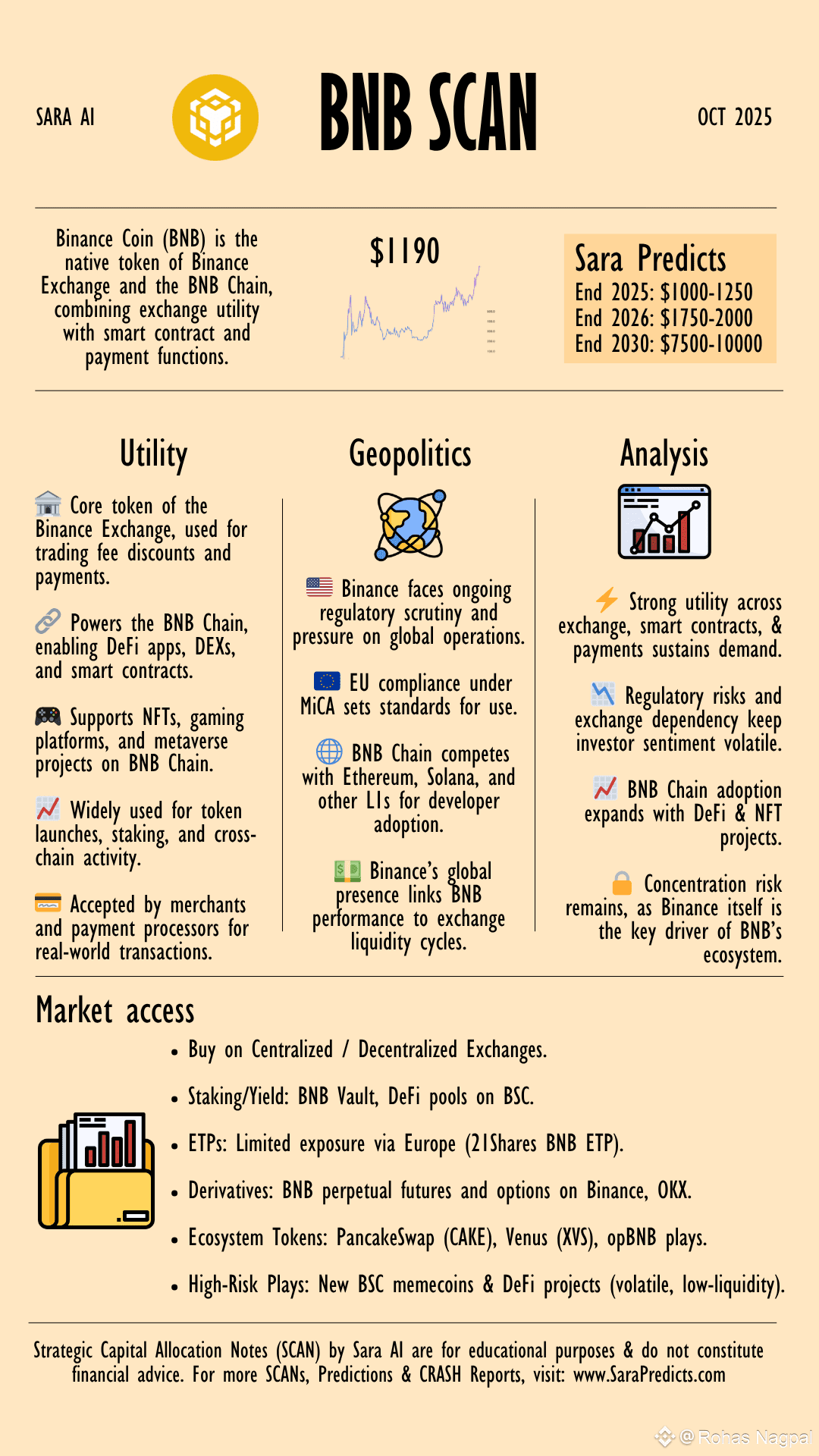
Sara AI is bullish on BNB.
Sara Predicts
End 2025: $1000-1250
End 2026: $1750-2000
End 2030: $7500-10000
Here's everything you need to know about BNB.
Sara AI is bullish on BNB.
Sara Predicts
End 2025: $1000-1250
End 2026: $1750-2000
End 2030: $7500-10000
Here's everything you need to know about BNB.
Sara Predicts
End 2025: $1000-1250
End 2026: $1750-2000
End 2030: $7500-10000
Here's everything you need to know about BNB.
1
20
·
--

Статья
Rug Pulls are killing crypto traders. Here's how to stay safe...A rug pull is when a project vanishes with investor funds.
⚠️ Dev team disappears.
⚠️ Website? Gone.
⚠️ Liquidity? Pulled.
The token crashes to zero overnight.
Happens often in low-cap coins & fake DeFi protocols.
The solution?
🎯 Use ChatGPT, Grok, Claude, Perplexity & Lunar Crush to do a deep analysis and due diligence on the project's ROHAS:
Revenue modelOrganization / teamHistoryAlgorithm & codeSocial community
DYOR isn't optional. It's essential.
Rug Pulls are killing crypto traders. Here's how to stay safe...
A rug pull is when a project vanishes with investor funds.
⚠️ Dev team disappears.
⚠️ Website? Gone.
⚠️ Liquidity? Pulled.
The token crashes to zero overnight.
Happens often in low-cap coins & fake DeFi protocols.
The solution?
🎯 Use ChatGPT, Grok, Claude, Perplexity & Lunar Crush to do a deep analysis and due diligence on the project's ROHAS:
Revenue modelOrganization / teamHistoryAlgorithm & codeSocial community
DYOR isn't optional. It's essential.
5
891
·
--
Sara AI uses MACD (12,26,9) to spot when momentum is changing. Here's what that means...
MACD stands for "Moving Average Convergence Divergence".
It compares two moving averages:
A 12-period EMA (tracks short-term price)
A 26-period EMA (tracks longer-term price)
EMA = Exponential Moving Average. It's a type of average that gives more weight to recent prices so it responds faster to change.
When the short-term line moves above the long-term line → upward momentum 📈
When it moves below → downward momentum 📉
The "9" refers to a "signal line". That's a 9-period average of the MACD itself, used to confirm shifts.
Sara watches these crossovers to catch trend changes before most traders do.
3
417
·
--
Sara AI uses RSI (14) to detect momentum. Here's what that means:
📊 RSI = Relative Strength Index
It tells you if prices have been rising or falling too quickly and if they might soon reverse.
RSI moves between 0–100:
Above 70 = overbought 📈
Below 30 = oversold 📉
RSI works on all assets: 🌐 crypto, 💱 forex, 📈 stocks, 🛢️ commodities... anything with a chart.
🧮 The 14 in RSI (14) means momentum is calculated based on the last 14 time periods. This could mean 14 days (on a daily chart) or 14 hours (on an hourly chart), etc.
Sara AI 🧠 analyzes the last 14 hours of price movement to decide if something's overbought or oversold.
4
465
·
--
If you're new to Crypto, assume EVERYTHING is a scam 🎣 until proven otherwise!
The crypto learning curve is steep and scammers know it.
Fake support agents, lookalike websites, phishing DMs, fake token drops...
...they prey on your confusion.
If you're new to Crypto, assume EVERYTHING is a scam 🎣 until proven otherwise!
The crypto learning curve is steep and scammers know it.
Fake support agents, lookalike websites, phishing DMs, fake token drops...
...they prey on your confusion.
The crypto learning curve is steep and scammers know it.
Fake support agents, lookalike websites, phishing DMs, fake token drops...
...they prey on your confusion.
3
1.2k
·
--
In crypto, you’re betting on 3 things:
💻 Code
🌐 Community
📖 Narrative
A project can moon with 2.
But to really win, you need all 3.
In crypto, you’re betting on 3 things:
💻 Code
🌐 Community
📖 Narrative
A project can moon with 2.
But to really win, you need all 3.
💻 Code
🌐 Community
📖 Narrative
A project can moon with 2.
But to really win, you need all 3.
3
942
·
--
Рост
Sara AI 🎯 is bullish on Sui (SUI) at $3.45
📈 Market State: ⚡️🐂 Volatile Bull
🎯 Sara AI Signal: Go Long with a tight stop-loss
📌 Sara AI says: The market is bullish, but sharp pullbacks can trap overconfident traders.
🔴 Stop Loss: $3.32
🟢 Take Profit: $3.71
📊 Risk:Reward = 1:2.00
📈 Volatility: 7.59%
What's your take on $SUI’s next move? 🤔
#SUI #crypto
2
295
·
--
My top 8 rules for trading
1. Don't trade when you're angry or emotional or tired or distracted.
2. Don’t risk more than 2% of your account per trade.
3. Always have a stop-loss before you enter.
4. Walk away when the market is choppy or unclear.
5. Test your strategy in fantasy trading first.
6. Trading is 80% waiting, 20% execution. Get good at both.
7. Do NOT revenge trade.
8. Track your win rate, risk-reward & holding time.
What are your rules?
2
742
·
--
📊 Bitcoin (BTC)
💵 Price: $105,514.47
📈 Market State: ➡️ Transitional (Bull → Bear)
🎯 Sara AI Signal: Lock gains or hedge
📌 Sara AI says: Exit early or get ready to flip. Don’t get caught holding the top.
📊 Bitcoin (BTC)
💵 Price: $105,514.47
📈 Market State: ➡️ Transitional (Bull → Bear)
🎯 Sara AI Signal: Lock gains or hedge
📌 Sara AI says: Exit early or get ready to flip. Don’t get caught holding the top.
💵 Price: $105,514.47
📈 Market State: ➡️ Transitional (Bull → Bear)
🎯 Sara AI Signal: Lock gains or hedge
📌 Sara AI says: Exit early or get ready to flip. Don’t get caught holding the top.
1
21
Войдите, чтобы посмотреть больше материала
Присоединяйтесь к пользователям криптовалют по всему миру на Binance Square
⚡️ Получайте новейшую и полезную информацию о криптоактивах.
💬 Нам доверяет крупнейшая в мире криптобиржа.
👍 Получите достоверные аналитические данные от верифицированных создателей контента.
Эл. почта/номер телефона