

Asif The Trader
457 Публикации

Asif The Trader
Отправить жалобу
Заблокировать пользователя
The Ultimate Trader
Открытая сделка
Трейдер с регулярными сделками
1.4 г
578 подписок(и/а)
180 подписчиков(а)
450 понравилось
Посты
Портфель
Все
Цитирования
$DNA has an AI-agent narrative. But can the token hold up when hype cools down? 👀
NeoSoul is building around AI agents that learn from outcomes and operate within defined limits. That’s an interesting use case—but a strong narrative alone doesn’t guarantee sustainable token demand.
📊 Here’s the trading angle I’m watching:
🔹 Support test: DNA’s recent 24-hour low was around $0.1765. Can buyers defend this area, or will selling pressure push price lower?
🔹 Recovery signal: A reclaim of the recent $0.2058 high would need strong volume and follow-through before I’d consider a bullish setup.
🔹 Volume quality: High activity can mean opportunity, but it can also mean aggressive profit-taking. Watch how price reacts, not volume alone.
💡 Trading tip: Don’t buy just because DNA has already dropped. Wait for a confirmed reversal, define your invalidation level, and calculate your risk before entering. If support breaks without recovery, staying out is also a strategy.
My question: Would you trade DNA based on its AI-agent utility, or wait until its price action proves buyers are back in control? 👇
$DNA #BinanceAlpha #cryptotrading
351
Most SOL traders focus on where price is going. I’m watching where liquidity gets trapped. 👀
A quick move above resistance can attract breakout buyers, only for price to reverse and trigger their stop-losses. That’s why I don’t treat every breakout as a trade opportunity.
📊 My SOL trading checklist:
🔹 Liquidity sweep: Does SOL briefly break a recent high before falling back below it?
🔹 Confirmation: Does price reclaim the level and hold it, or do sellers maintain control?
🔹 Entry trigger: I’d wait for a clear bullish reaction and a higher low before considering a long entry.
💡 Trading tip: Mark your invalidation level first. If the setup fails, exit according to your plan. Never increase position size just to recover a loss.
The best entry isn’t always the earliest one. Sometimes, waiting for confirmation is the real edge.
Question for SOL traders: Would you buy a breakout immediately, or wait for a liquidity sweep and confirmation—even if you enter later? 👇
$SOL #solana #cryptotrading
106
#BinancePick The most interesting part of prediction markets is watching uncertainty turn into measurable probabilities. Every new piece of information can change the picture. Binance Pick makes following these changing perspectives an engaging experience.
#BinancePick The most interesting part of prediction markets is watching uncertainty turn into measurable probabilities. Every new piece of information can change the picture. Binance Pick makes following these changing perspectives an engaging experience.
1
$CELO is approaching a decision zone. The next move matters less than how you trade it. 🎯
CELO is hovering near $0.080, with the $0.0834 area acting as a key resistance reference and $0.0791 as nearby support in the latest technical snapshot. These levels need confirmation, not blind entries. citeturn566740search11turn566740search3
📈 My trading plan:
🔹 Bullish setup: Wait for a convincing close above $0.0834, then watch whether a retest holds.
🔹 Bearish warning: If $0.0791 breaks on a confirmed close, watch for further weakness rather than catching the dip blindly.
🔹 Risk management: Define your invalidation level before entering. If the potential reward doesn’t justify the risk, skip the trade.
💡 The edge isn’t predicting the candle. It’s planning both outcomes before the market chooses one.
One question: If CELO breaks resistance but immediately falls back below it, would you trust the breakout—or treat it as a bull trap? 👇
#CELO #cryptotrading
231
·
--
Рост
$XRP ’s next breakout could be a trap. Would you spot the warning sign? 👀
A rising price doesn’t always mean strong buyers are in control. Before trading XRP, I’d focus on confirmation rather than excitement.
📊 3 things worth watching:
🔹 Volume: Is trading activity increasing with the move?
🔹 Retest: After breaking resistance, can XRP hold that level as support?
🔹 Market structure: Are higher highs and higher lows forming, or is momentum fading?
💡 Trading Tip: Don’t chase the first breakout candle. Wait for a candle close above resistance and look for a successful retest before considering an entry. Keep your stop-loss at a level that invalidates your setup, and size the position according to your risk.
The goal isn’t to catch every move. It’s to avoid trades that haven’t confirmed their strength.
Your take: If XRP breaks resistance but fails to hold it on the retest, would you exit quickly or wait for another confirmation? 🤔
$XRP #xrp
160
#BinancePick If everyone agrees on one outcome, does that automatically make it the right choice? Not necessarily. 🧠 I prefer questioning assumptions and considering the other side before making a prediction. Independent thinking matters on Binance Pick!
#BinancePick If everyone agrees on one outcome, does that automatically make it the right choice? Not necessarily. 🧠 I prefer questioning assumptions and considering the other side before making a prediction. Independent thinking matters on Binance Pick!
#BinancePick Not every trending prediction deserves an instant decision. 👀 I'd rather take a moment to consider the possibilities than follow the crowd blindly. Binance Pick makes following different market outcomes more engaging.
#BinancePick Not every trending prediction deserves an instant decision. 👀 I'd rather take a moment to consider the possibilities than follow the crowd blindly. Binance Pick makes following different market outcomes more engaging.
#BinancePick 💛 One more market, one more step toward my goal! I’m continuing my Binance Pick challenge and aiming to unlock more Earn Scores. Consistency matters, and the journey continues! 🎯
#BinancePick 💛 One more market, one more step toward my goal! I’m continuing my Binance Pick challenge and aiming to unlock more Earn Scores. Consistency matters, and the journey continues! 🎯
#BinancePick 📊 The best part of prediction markets is seeing how your expectations compare with real outcomes. Exploring more markets and learning along the way with Binance Pick! 💛
#BinancePick 📊 The best part of prediction markets is seeing how your expectations compare with real outcomes. Exploring more markets and learning along the way with Binance Pick! 💛
124
#BinancePick 🏁 Small steps can lead to bigger milestones! My Binance Pick challenge continues as I explore more markets and work toward earning extra Scores. Let’s go! 💛
#BinancePick 🏁 Small steps can lead to bigger milestones! My Binance Pick challenge continues as I explore more markets and work toward earning extra Scores. Let’s go! 💛
127
Проверено
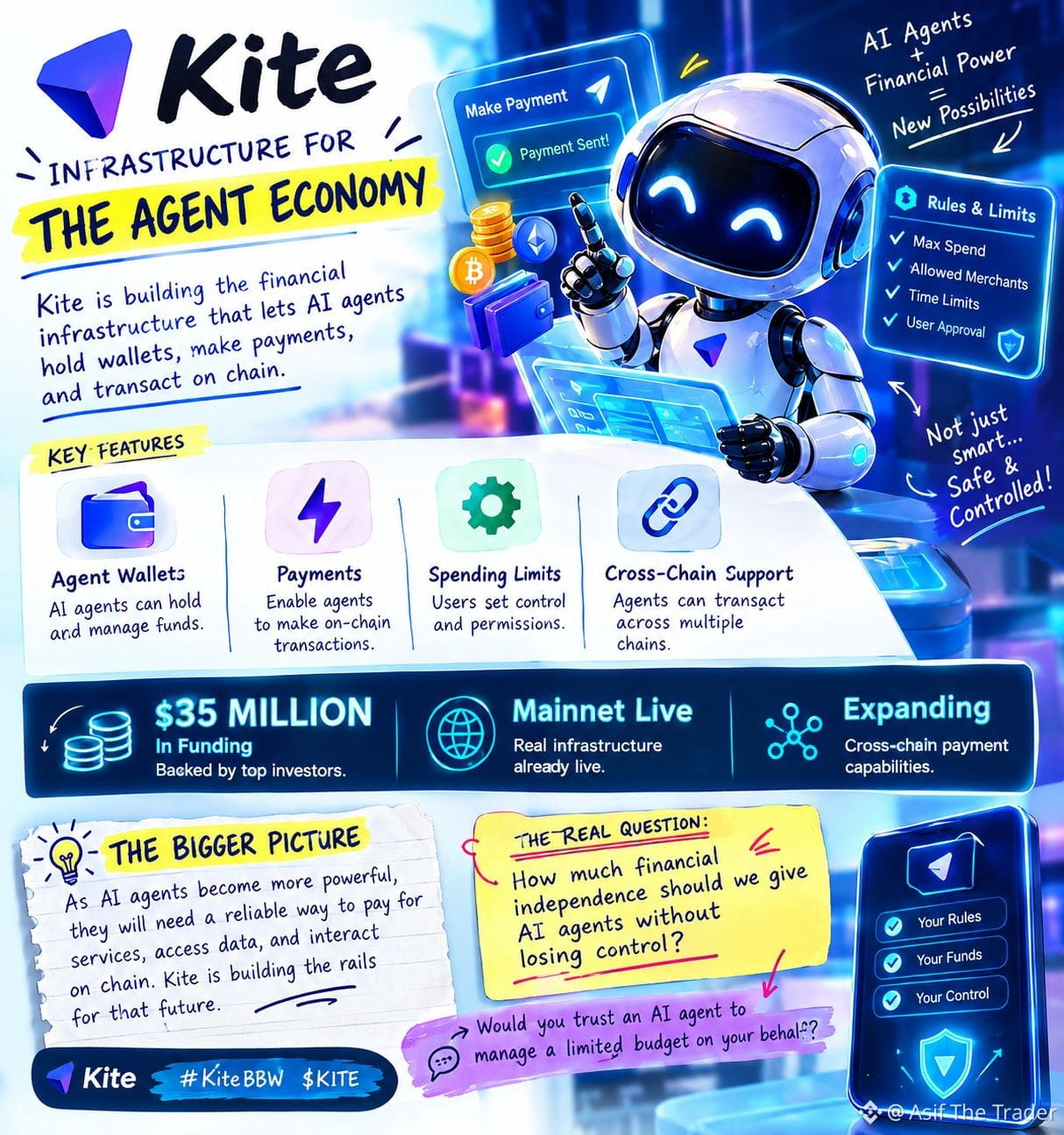
An AI agent making a payment is one thing. Knowing who authorized it, how much it can spend, and where its limits end is a much bigger challenge.
As AI agents become more capable, financial autonomy needs more than intelligence. It needs clear permissions, controlled spending, and reliable payment infrastructure.
That’s the part of @GoKiteAI KiteAI I find worth watching. Kite is working toward a financial system where AI agents can transact while operating within rules defined by users.
The real question is: how much financial independence should we give AI agents without losing control?
Would you trust an AI agent to manage a limited budget on your behalf?
#KiteBBW $KITE
{future}(KITEUSDT)
An AI agent making a payment is one thing. Knowing who authorized it, how much it can spend, and where its limits end is a much bigger challenge.
As AI agents become more capable, financial autonomy needs more than intelligence. It needs clear permissions, controlled spending, and reliable payment infrastructure.
That’s the part of @KITE AI 中文 KiteAI I find worth watching. Kite is working toward a financial system where AI agents can transact while operating within rules defined by users.
The real question is: how much financial independence should we give AI agents without losing control?
Would you trust an AI agent to manage a limited budget on your behalf?
#KiteBBW $KITE
71
Проверено
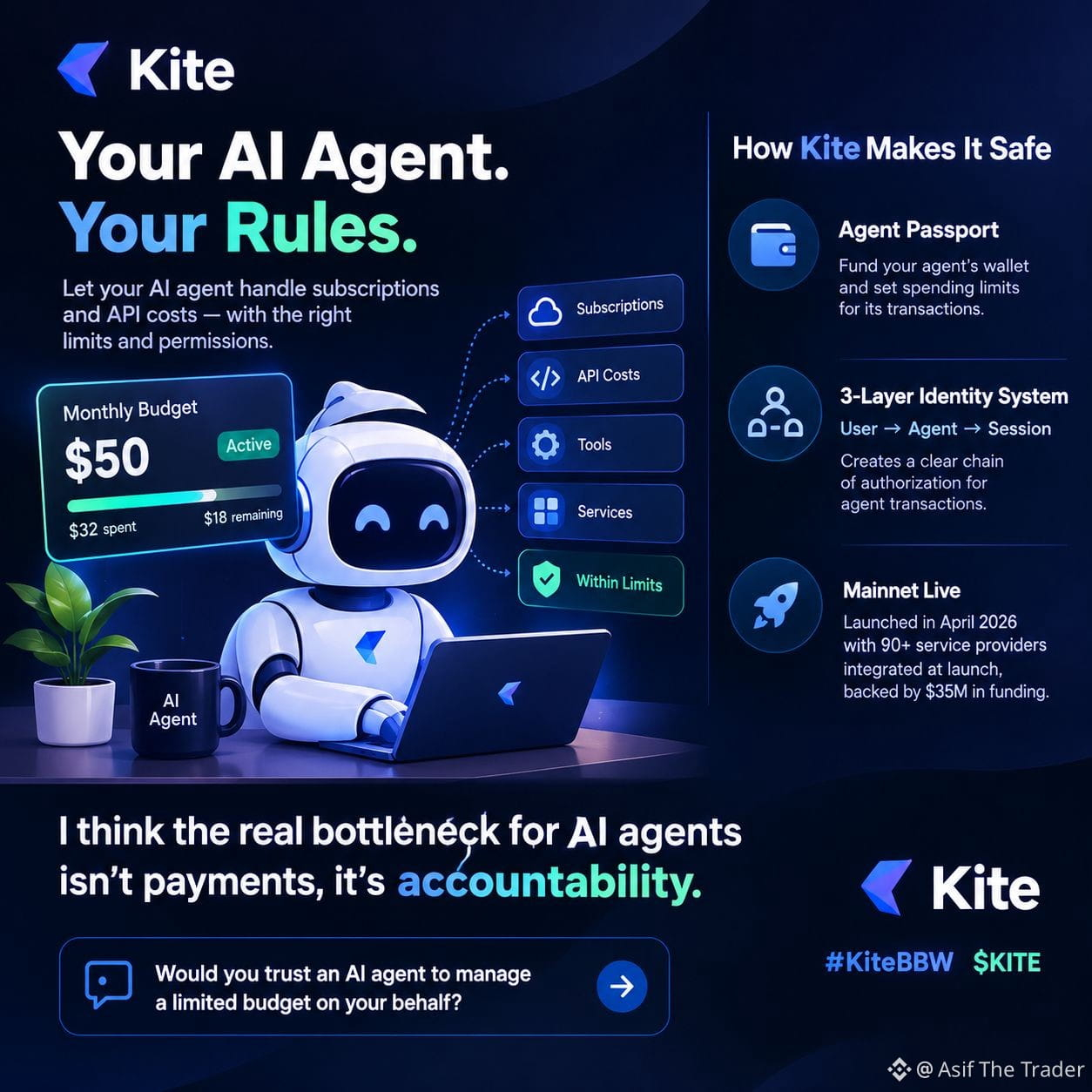
Imagine your AI agent handling your subscriptions and API cost every month on a fixed $50 budget.
The question is not wheter an agent can pay, it already can. The real questions are :
🔹 Who authorized it?
🔹 How much can it spend?
🔹 Where do its limits end?
That's the problem @GoKiteAI is tackling.
Its Agent Passport lets users fund an agent's wallet and set spending limits for its transactions.
Kite's 3-layer identity system (user → agent → session) helps establish a clear chain of authorization for agent transactions.
Mainnet launched in April 2026 with 90+ service providers integrated at launch, backed by $35M in funding.
I think the real bottleneck for AI agents isn't payments, it's accountability.
👉 Would you trust an AI agent to manage a limited budget on your behalf?
#KiteBBW $KITE
Imagine your AI agent handling your subscriptions and API cost every month on a fixed $50 budget.
The question is not wheter an agent can pay, it already can. The real questions are :
🔹 Who authorized it?
🔹 How much can it spend?
🔹 Where do its limits end?
That's the problem @KITE AI 中文 is tackling.
Its Agent Passport lets users fund an agent's wallet and set spending limits for its transactions.
Kite's 3-layer identity system (user → agent → session) helps establish a clear chain of authorization for agent transactions.
Mainnet launched in April 2026 with 90+ service providers integrated at launch, backed by $35M in funding.
I think the real bottleneck for AI agents isn't payments, it's accountability.
👉 Would you trust an AI agent to manage a limited budget on your behalf?
#KiteBBW $KITE
77
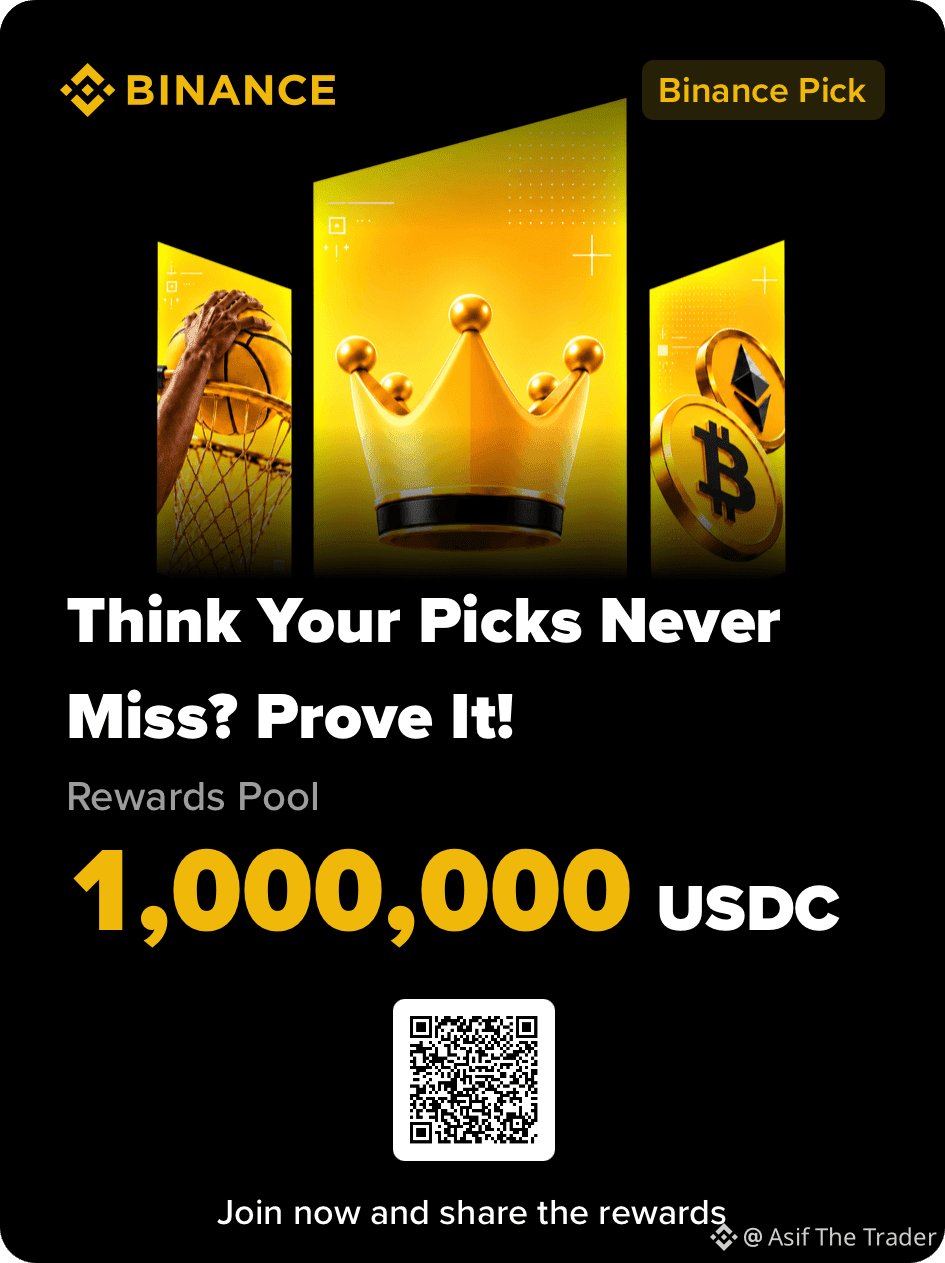
#BinancePick 🎯 Prediction is more than a guess — it’s about understanding the market and testing your judgment.
I’m exploring Binance Pick, making my picks, and working toward more Earn Scores. Let’s see how these predictions turn out! 📊
#BinancePick 🎯 Prediction is more than a guess — it’s about understanding the market and testing your judgment.
I’m exploring Binance Pick, making my picks, and working toward more Earn Scores. Let’s see how these predictions turn out! 📊
I’m exploring Binance Pick, making my picks, and working toward more Earn Scores. Let’s see how these predictions turn out! 📊
68
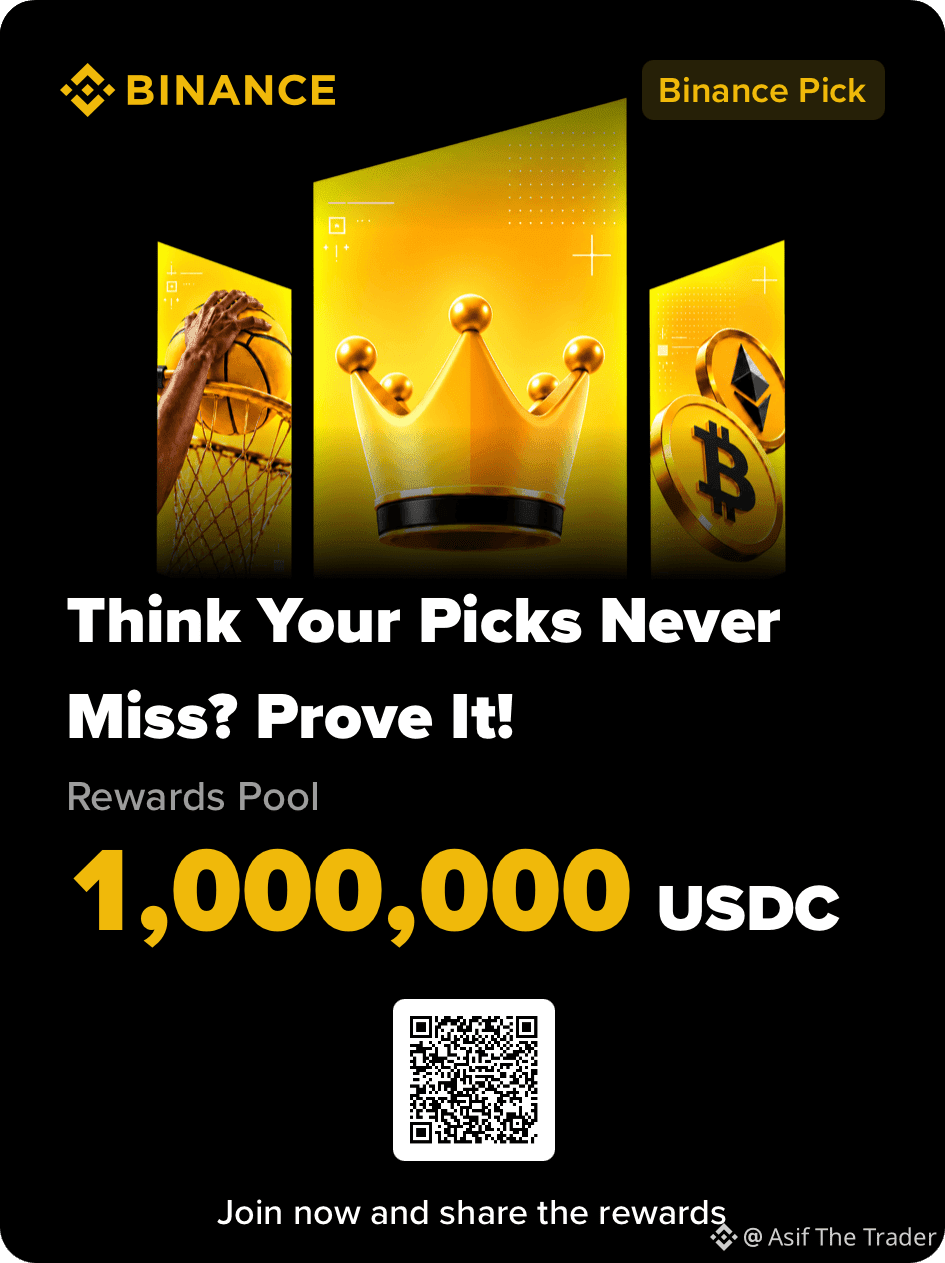
#BinancePick More markets, more participation, more Scores! 💛 Working toward the 300 Score milestone on Binance Pick. Who else is joining the challenge? 🔥
#BinancePick More markets, more participation, more Scores! 💛 Working toward the 300 Score milestone on Binance Pick. Who else is joining the challenge? 🔥
61
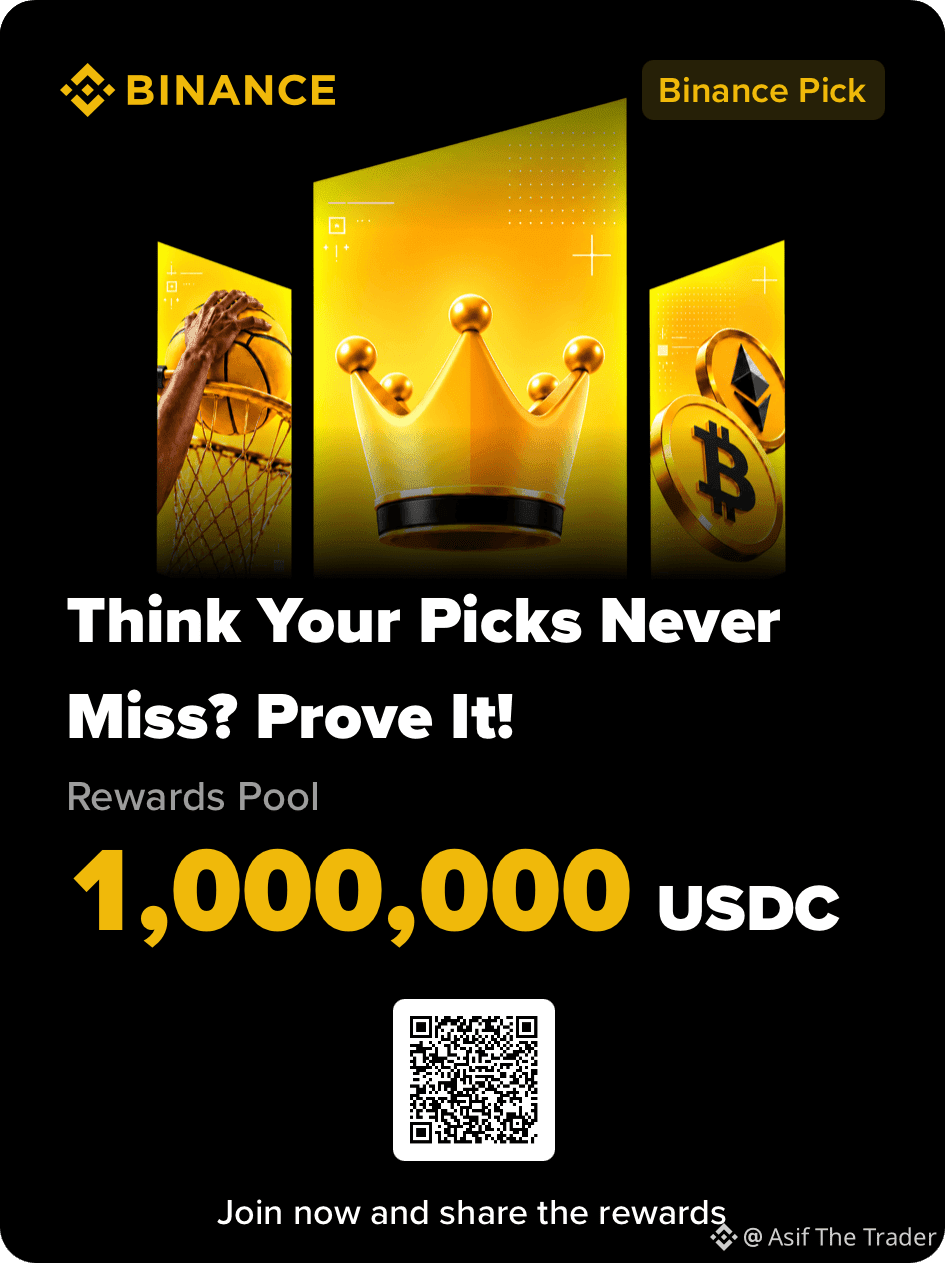
Binance Pick makes market predictions more interesting by turning your picks into a chance to earn rewards. 🎯
I’m exploring the markets, making my predictions, and aiming to unlock more Binance Pick Scores. Every pick is another opportunity to test my market insight!
What are you predicting today? 👀
#BinancePick
I’m exploring the markets, making my predictions, and aiming to unlock more Binance Pick Scores. Every pick is another opportunity to test my market insight!
What are you predicting today? 👀
#BinancePick
71
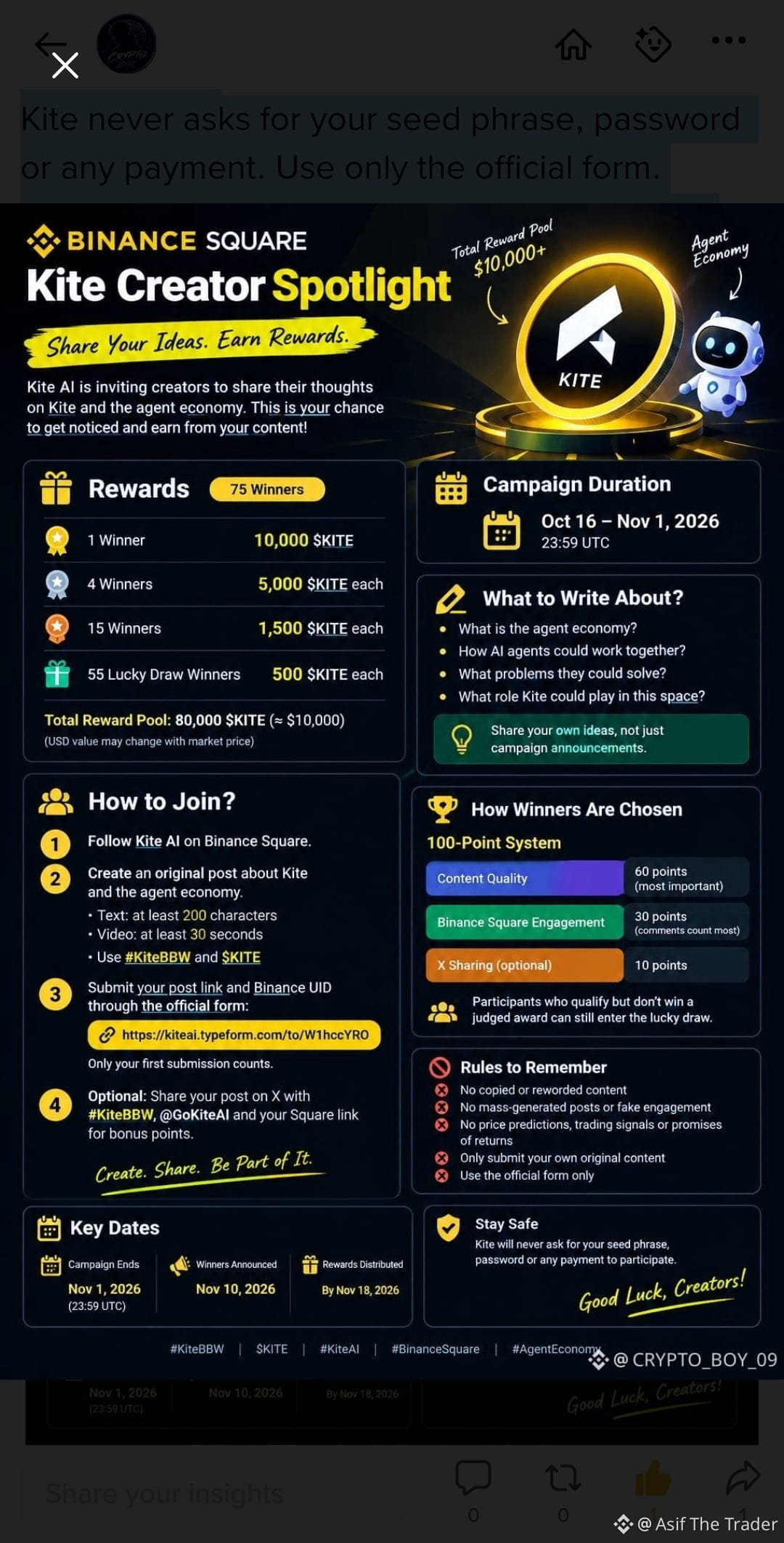
Write one post. Win up to 10,000 $KITE.
Kite Creator Spotlight is live on Binance Square
Kite AI is rewarding creators who share their own ideas on the agent economy: AI agents that can complete tasks and work together on their own.
🎁 Reward Pool
• 80,000 $KITE (≈ $10,000, value changes with market price)
• 75 winners in total
🏆 Prizes
• 1 winner: 10,000 $KITE
• 4 winners: 5,000 $KITE each
• 15 winners: 1,500 $KITE each
• 55 lucky draw winners: 500 $KITE each
📅 Campaign Period
• Oct 16 – Nov 1, 2026 (23:59 UTC)
✅ How to Join
• Follow Kite AI on Binance Square
• Publish an original post with #KiteBBW and $KITE
Text: 200+ characters | Video: 30+ seconds
• Submit your post link and Binance UID
: https://kiteai.typeform.com/to/W1hccYRO
• Only your first submission counts
• Optional: share on X with #KiteBBW, @GoKiteAI and your post link
📊 Scoring (out of 100)
• Content quality: 60
• Square engagement: 30 (comments count the most)
• X sharing: 10
• Non-winners of judged awards still enter the lucky draw
🚫 Not Allowed
• Copied or reworded content
• Mass-generated posts
• Price calls, trading signals, return promises
• Fake engagement
⏳ Key Dates
• Winners announced: Nov 10
• Rewards sent: by Nov 18
🔐 Stay Safe
Kite never asks for your seed phrase, password or any payment. Use only the official form.
Write your own original take. Quality and real discussion matter most. Good luck! 🍀
#CreatorPad_Campaign #Write2Earn!
2
3
Проверено
There's a frosted glass partition at my accountant's office. From the waiting room you can see shapes moving, hear murmurs through the wall - but nothing readable. Only the person behind the desk, holding the right file, ever gets to see the actual numbers.
I kept thinking about that partition while reading how Hedger works on @Dusk_Foundation DuskEVM. Most people hear "confidential smart contracts" and picture something sealed shut entirely - a vault nobody gets into, not even the people who'd need to.
That's the part that sat with me longer than I expected. Hedger isn't one wall, it's the partition doing three jobs at once: a fund's rebalancing trade clears without broadcasting its size to competitors, an issuer's cap table updates without exposing every holder's position, an auditor pulls the one file they're authorized to see without touching the rest. Homomorphic encryption plus zero-knowledge proofs, running on rails a Solidity developer already knows. Privacy and audit aren't fighting each other here. They're routed through the same door.
What's easy to skip past is how early this still is. DuskEVM mainnet is arriving, Hedger is the pitch - but a pitch isn't the same as volume. Nobody's published how many contracts are actually live through it yet, or whether any regulated desk has routed real flow through the confidential path versus just testing it in a sandbox. "Reviewable privacy" is a strong claim to make before anyone's reviewed anything.
So is the partition actually load-bearing, or is it just glass hung on a frame, waiting for someone on the other side to show up? $DUSK usage says nothing until builders actually walk through that door. Not yet.
#dusk
{spot}(AAVEUSDT)
{spot}(BTCUSDT)
There's a frosted glass partition at my accountant's office. From the waiting room you can see shapes moving, hear murmurs through the wall - but nothing readable. Only the person behind the desk, holding the right file, ever gets to see the actual numbers.
I kept thinking about that partition while reading how Hedger works on @Dusk DuskEVM. Most people hear "confidential smart contracts" and picture something sealed shut entirely - a vault nobody gets into, not even the people who'd need to.
That's the part that sat with me longer than I expected. Hedger isn't one wall, it's the partition doing three jobs at once: a fund's rebalancing trade clears without broadcasting its size to competitors, an issuer's cap table updates without exposing every holder's position, an auditor pulls the one file they're authorized to see without touching the rest. Homomorphic encryption plus zero-knowledge proofs, running on rails a Solidity developer already knows. Privacy and audit aren't fighting each other here. They're routed through the same door.
What's easy to skip past is how early this still is. DuskEVM mainnet is arriving, Hedger is the pitch - but a pitch isn't the same as volume. Nobody's published how many contracts are actually live through it yet, or whether any regulated desk has routed real flow through the confidential path versus just testing it in a sandbox. "Reviewable privacy" is a strong claim to make before anyone's reviewed anything.
So is the partition actually load-bearing, or is it just glass hung on a frame, waiting for someone on the other side to show up? $DUSK usage says nothing until builders actually walk through that door. Not yet.
#dusk
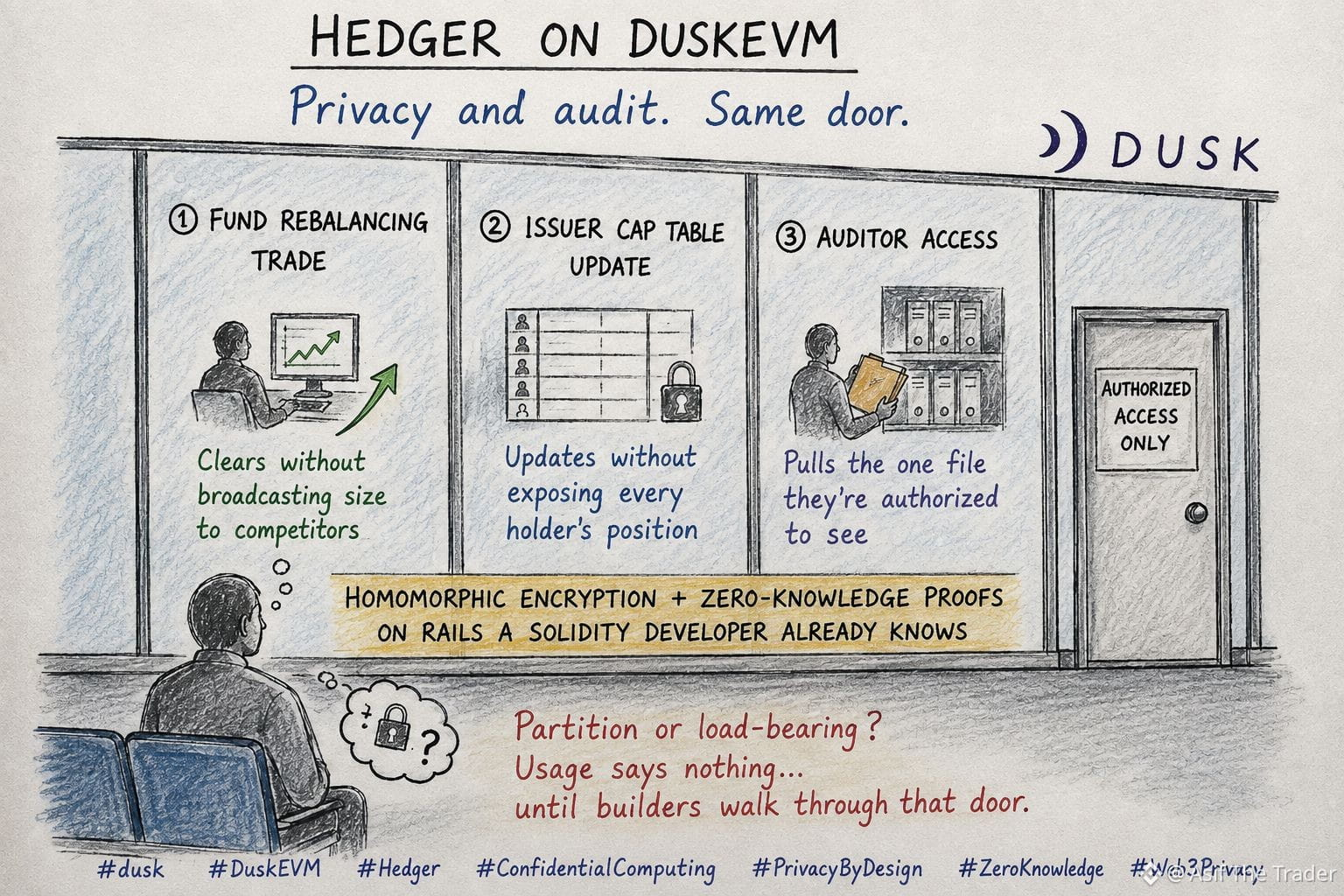
116
Частичная правда
#dusk $DUSK @Dusk_Foundation
I went back into Citadel's docs after noticing NPEX already has $300M+ of real, tokenized assets live on Dusk. That's not a testnet example anymore, so it made me want to check whether the privacy claim actually holds up under a real regulated venue, not just a whitepaper diagram.
Turns out the protocol is really two separate flows, not one.
First, a user requests a license from a License Provider, using a stealth address, so the issued license can't be linked back to the request.
Second, when the user wants to use a service, they don't resend the license. They send a zero-knowledge proof that they hold a valid one. The Service Provider only ever sees that proof, and it's the SP's own policy that decides what counts as sufficient.
Here's the part that made me pause. That proof isn't free. Citadel's own circuit for proving license ownership runs at roughly 34,800 constraints, and about half of that is just walking a Merkle tree 17 levels deep to confirm the license is actually registered.
So "prove without revealing" has a real computational cost baked into every single service request, not just a design principle on a slide.
That's a different model from "show your ID, let the platform verify everything."
It's closer to: pay a fixed proving cost once per interaction, in exchange for the venue never seeing anything but a yes or no.
What I still can't tell is whether that cost is invisible to an actual NPEX user today, wallet handles it in the background, or whether it's a real, felt delay standing between someone and a regulated trade.
{spot}(MORPHOUSDT)
{spot}(BNBUSDT)
{spot}(AAVEUSDT)
#dusk $DUSK @Dusk
I went back into Citadel's docs after noticing NPEX already has $300M+ of real, tokenized assets live on Dusk. That's not a testnet example anymore, so it made me want to check whether the privacy claim actually holds up under a real regulated venue, not just a whitepaper diagram.
Turns out the protocol is really two separate flows, not one.
First, a user requests a license from a License Provider, using a stealth address, so the issued license can't be linked back to the request.
Second, when the user wants to use a service, they don't resend the license. They send a zero-knowledge proof that they hold a valid one. The Service Provider only ever sees that proof, and it's the SP's own policy that decides what counts as sufficient.
Here's the part that made me pause. That proof isn't free. Citadel's own circuit for proving license ownership runs at roughly 34,800 constraints, and about half of that is just walking a Merkle tree 17 levels deep to confirm the license is actually registered.
So "prove without revealing" has a real computational cost baked into every single service request, not just a design principle on a slide.
That's a different model from "show your ID, let the platform verify everything."
It's closer to: pay a fixed proving cost once per interaction, in exchange for the venue never seeing anything but a yes or no.
What I still can't tell is whether that cost is invisible to an actual NPEX user today, wallet handles it in the background, or whether it's a real, felt delay standing between someone and a regulated trade.
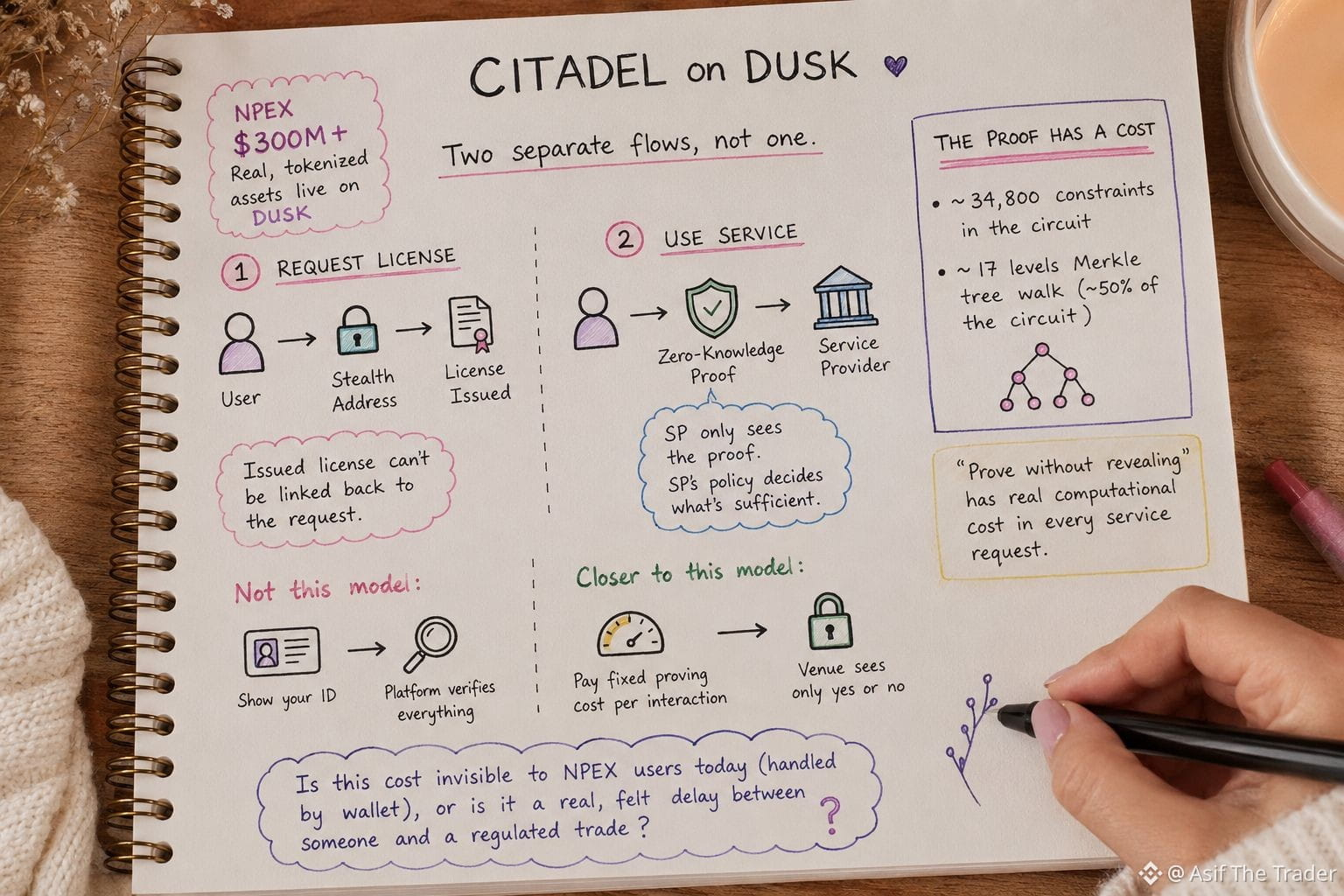
2
2
188
@Dusk_Foundation #dusk $DUSK
The Aug 16 bridge incident made me look at Dusk differently.
Not because of the blocklist.
Because it made me wonder:
After an onchain action is approved, who actually needs to see the data behind it?
For regulated finance, you may need to prove:
eligibility.
ownership.
transfer conditions.
My first assumption was simple:
if something has to be verified, more of the underlying data probably has to be visible.
Then I went back into the Dusk docs and the actual citadel paper.
Citadel's proof of ownership does not put personal data onchain. The user proves inside a circuit that they hold a validly signed credential; the verifier only learns that the statement is true.
The number that stuck with me: verifying that proof takes 0.007 seconds. Generating it takes around 16 seconds on a laptop-grade chip. The expensive part proving happens once, offline, on the user's side. The part a verifier actually does, at the moment someone needs access, is near-instant and reveals nothing beyond "valid."
That split matters for regulated assets.
An institution needs to confirm eligibility. It doesn't need the applicant's full KYC file to do that it needs a proof that resolves to true or false, and Citadel lets the service provider define exactly which attributes that proof has to cover.
So the interesting question isn't " is the blockchain private? "
It's: of everything sitting in a typical KYC payload, how much of it actually needs to touch a verifier once the proof not the data is the thing being checked ?
{spot}(AAVEUSDT)
{spot}(MORPHOUSDT)
For regulated onchain finance, what matters more?
@Dusk #dusk $DUSK
The Aug 16 bridge incident made me look at Dusk differently.
Not because of the blocklist.
Because it made me wonder:
After an onchain action is approved, who actually needs to see the data behind it?
For regulated finance, you may need to prove:
eligibility.
ownership.
transfer conditions.
My first assumption was simple:
if something has to be verified, more of the underlying data probably has to be visible.
Then I went back into the Dusk docs and the actual citadel paper.
Citadel's proof of ownership does not put personal data onchain. The user proves inside a circuit that they hold a validly signed credential; the verifier only learns that the statement is true.
The number that stuck with me: verifying that proof takes 0.007 seconds. Generating it takes around 16 seconds on a laptop-grade chip. The expensive part proving happens once, offline, on the user's side. The part a verifier actually does, at the moment someone needs access, is near-instant and reveals nothing beyond "valid."
That split matters for regulated assets.
An institution needs to confirm eligibility. It doesn't need the applicant's full KYC file to do that it needs a proof that resolves to true or false, and Citadel lets the service provider define exactly which attributes that proof has to cover.
So the interesting question isn't " is the blockchain private? "
It's: of everything sitting in a typical KYC payload, how much of it actually needs to touch a verifier once the proof not the data is the thing being checked ?
For regulated onchain finance, what matters more?
Prove without revealing data
0%
Verify it by seeing the data
100%
1 проголосовали • Голосование закрыто
2
1
78
·
--
Падение
#dusk $DUSK @Dusk_Foundation
I used to think that putting a financial asset onchain automatically meant making the whole financial process better.
Then I tried looking at it from the perspective of a bank or investment fund.
Imagine putting a bond or fund onchain.
It sounds like the problem is solved.
But then I started wondering:
What if the token is onchain, but the financial process around it still isn't?
The institution still has to decide who can own it, how it can be traded, how payments move, and how settlement remains compliant.
That made me rethink what “tokenization” actually means.
Is tokenizing the asset enough, or should the financial lifecycle move with it too?
That question is what drew me toward Dusk.
What interested me about Dusk Trade was seeing the problem approached from the workflow side, not just the token side.
Dusk is working toward bringing assets such as MMFs, ETFs, bonds and other RWAs into an onchain environment.
The way I now think about tokenization is:
ownership → eligibility → trading → payment → settlement
Maybe the real question isn't:
“How many assets can we put onchain?”
Maybe it's:
“How much of the financial process can actually work there?”
Because if only the representation moves onchain, can we really say the market moved with it?
That distinction is what makes Dusk interesting to me.
{spot}(DUSKUSDT)
What matters most when bringing real-world assets onchain?
#dusk $DUSK @Dusk
I used to think that putting a financial asset onchain automatically meant making the whole financial process better.
Then I tried looking at it from the perspective of a bank or investment fund.
Imagine putting a bond or fund onchain.
It sounds like the problem is solved.
But then I started wondering:
What if the token is onchain, but the financial process around it still isn't?
The institution still has to decide who can own it, how it can be traded, how payments move, and how settlement remains compliant.
That made me rethink what “tokenization” actually means.
Is tokenizing the asset enough, or should the financial lifecycle move with it too?
That question is what drew me toward Dusk.
What interested me about Dusk Trade was seeing the problem approached from the workflow side, not just the token side.
Dusk is working toward bringing assets such as MMFs, ETFs, bonds and other RWAs into an onchain environment.
The way I now think about tokenization is:
ownership → eligibility → trading → payment → settlement
Maybe the real question isn't:
“How many assets can we put onchain?”
Maybe it's:
“How much of the financial process can actually work there?”
Because if only the representation moves onchain, can we really say the market moved with it?
That distinction is what makes Dusk interesting to me.
What matters most when bringing real-world assets onchain?
Tokenizing the asset
0%
Ownership & eligibility
25%
Trading + settlement
0%
The full financial lifecycle
75%
4 проголосовали • Голосование закрыто
9
5
78
Войдите, чтобы посмотреть больше материала
Присоединяйтесь к пользователям криптовалют по всему миру на Binance Square
⚡️ Получайте новейшую и полезную информацию о криптоактивах.
💬 Нам доверяет крупнейшая в мире криптобиржа.
👍 Получите достоверные аналитические данные от верифицированных создателей контента.
Эл. почта/номер телефона
В тренде
FedWatch
Просмотров: 16.3M
39,348 обсуждают
🚨 🇺🇸 PETER SCHIFF JUST THREW A BIG WARNING AT THE FED!
Peter Schiff is calling Kevin Warsh’s tough talk on inflation a “bluff,” and his prediction could have major implications for the markets.
Schiff believes the Fed could eventually return to money printing through quantitative easing (QE) and even cut interest rates next year, despite inflation continuing to rise.
Think about that for a moment.
🔥 Inflation could remain a problem. 🔥 The Fed could still move toward easier monetary policy. 🔥 More liquidity could flow into financial markets.
If this scenario plays out, it could create a very different market environment for stocks, gold, Bitcoin, and the wider crypto market.
But there’s a catch: if inflation stays high, the Fed could face a difficult choice between fighting rising prices and supporting the economy.
Will Warsh stick to a tough inflation policy, or will the Fed eventually change direction?
The next move could matter a lot for investors.
#FedWatch #EarningsSeason #USMidtermElections #BrazilCryptoExchangesMustApplyForLicensesByFriday #StanDruckenmillerBecomesInvestorInTradeXYZ
Jackson Liam
·Лайков: 3
·Просмотров: 8.2k
EarningsSeason
Просмотров: 6.4M
32,053 обсуждают
USMidtermElections
Просмотров: 37,090
599 обсуждают