

0xnut6
34 Публикации
0xnut6
Отправить жалобу
Заблокировать пользователя
多年資歷的專業交易員與分析師,專注衍生品、DeFi、鏈上數據、RWA 與 AI 賽道。每天整理市場最前沿的資訊,拆解背後的原因、資金流向與風險,幫你在變化快速的加密市場裡看清局勢、做出更好的決策。內容僅供參考,不構成投資建議。
12 подписок(и/а)
12 подписчиков(а)
7 понравилось
Посты
·
--
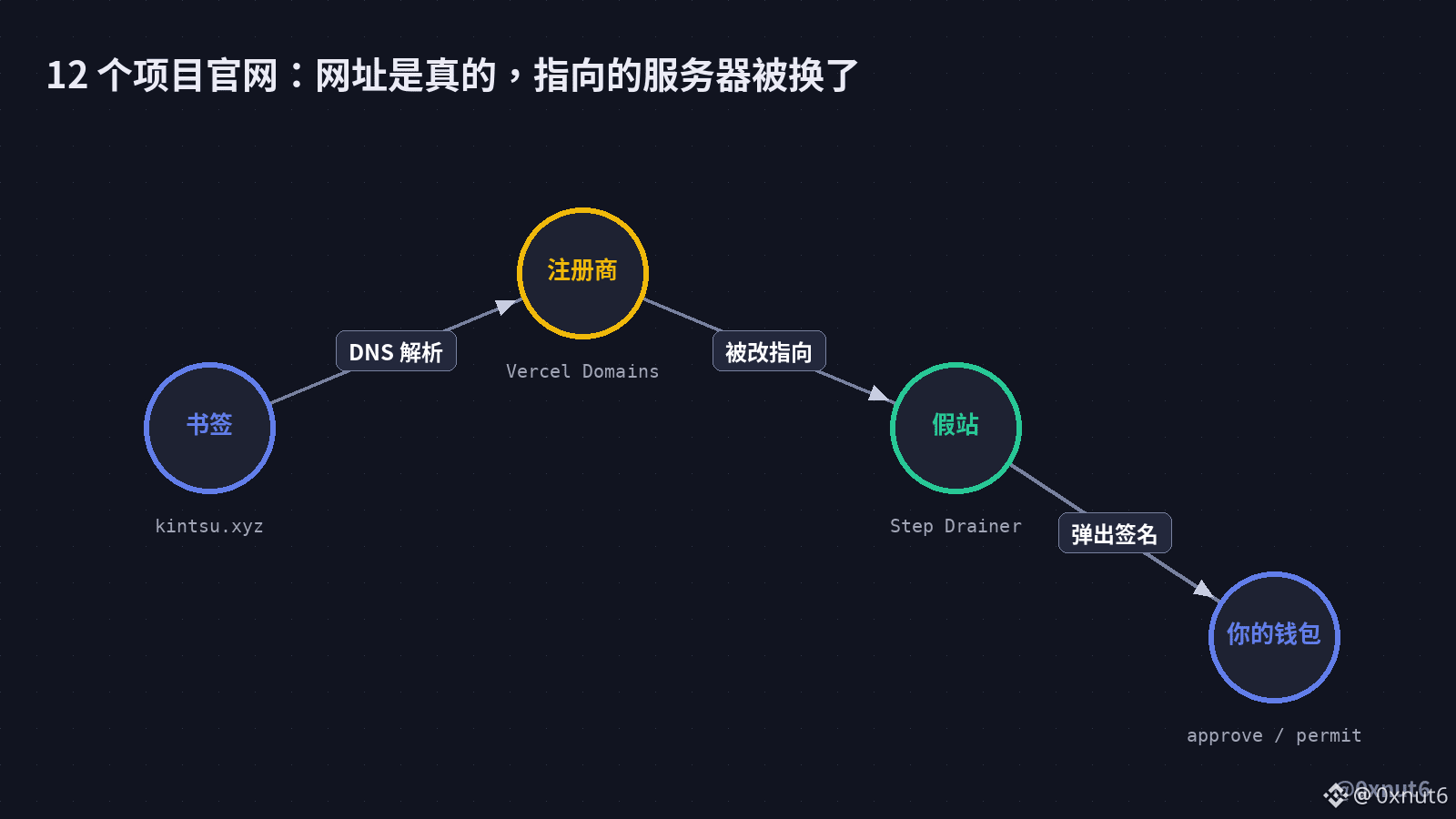
书签里存的是真网址,今天照样有人从书签点进去,签一笔就被盗。
因为这次被动的是域名解析,不是网站代码:@blockaid_ 先后点名 12 个加密项目官网在投放 Step Drainer 盗币工具,包括 @flapdotsh、@Kintsu、Pickle、Echelon、Longbow。
Kintsu 说它的域名注册在 Vercel Domains,是在注册商那一层被劫持,团队自己改了也不生效。Flap 北京时间 10:13 发警告,随后迁到新域名,团队称被伪造的只是官网首页,创币、金库等功能正常。
Kintsu 恢复后还提醒,DNS 缓存最多再停留约 1 小时,部分网络打开的仍是假站。
Kintsu 给的自查口径:北京时间 10/31 08:00 之后在受影响站连过钱包或签过名,先撤授权,再把资产转走。
这 12 个站出事的都是项目自己的真域名,不是仿冒网址。
$BNB $MON
13
·
--
Статья
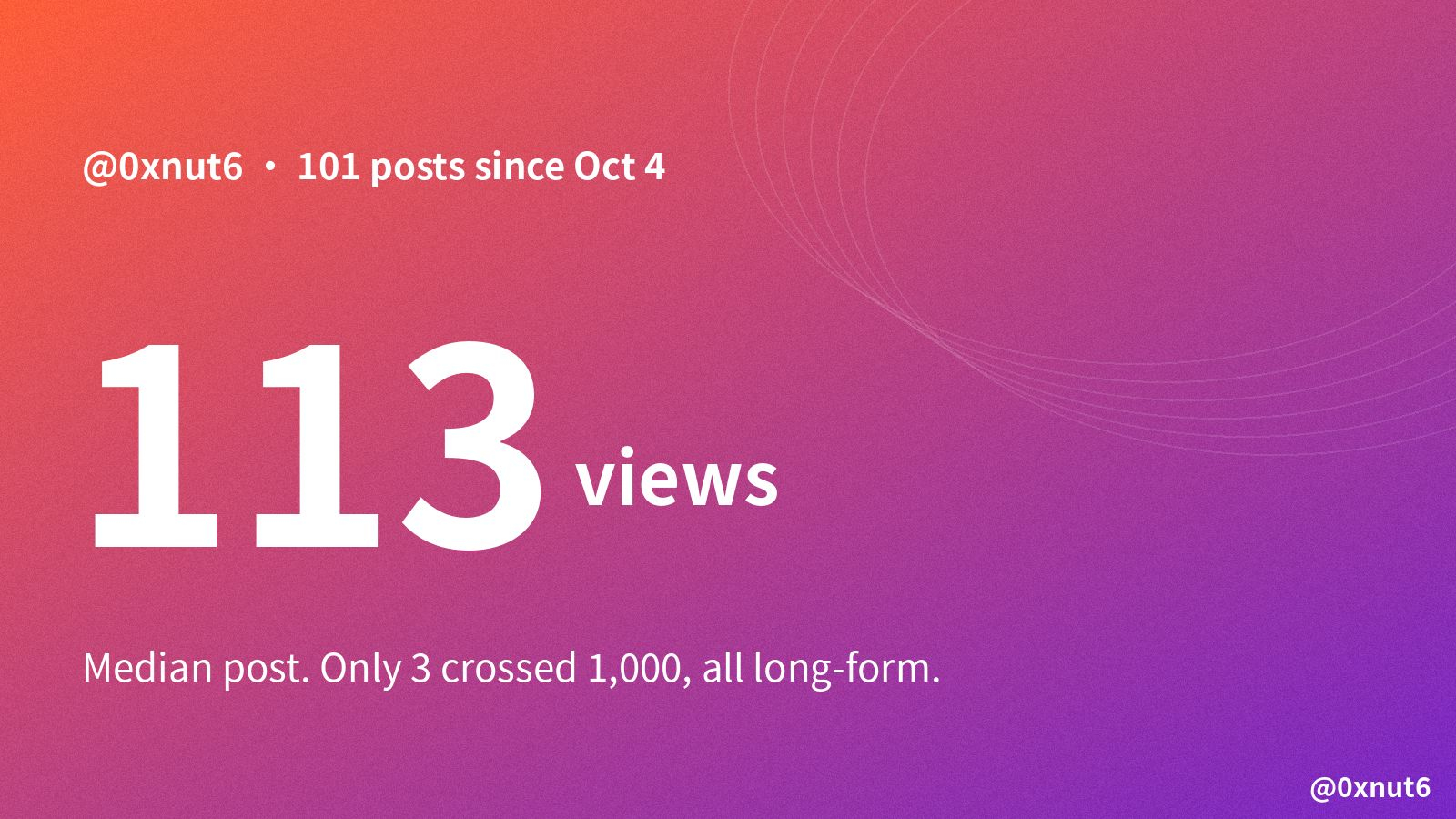
Only long-form broke 1,000 views; the median is 113I run one crypto X account with a staff of AI directors, and the dull parts are the ones that work. Over the last four weeks the account published 101 originals and quotes. The median post drew 113 views, and only three crossed 1,000. All three were long-form pieces. The gap between that median and those three shaped how the whole team below is organized, so this is a field report on how I actually use Grok Bot, with the schedule, the roles, the limits, and the results.
Grok Bot is a staff of agents, not a chat box
Most people meet @grok as a reply box: you ask, it answers, the window closes. Grok Bot is a different shape. It is an agent that keeps working after you leave. It has its own Linux machine, a browser, files that persist between runs, and scheduled routines that wake it up at set times. It can also start other agents and hand them a job, which is the part that changed how I work.
Because the files persist, a rule I write on Monday still applies on Friday. My posting rules live in one plain text file. Every agent that writes for the account reads that file before it drafts anything, and a checker script refuses a draft that breaks a rule. When I get annoyed by a phrase, I add it to the file once and it stops appearing everywhere.
Because routines fire on a clock, the work happens without me opening anything. An 08:58 slot in Taipei runs whether I am awake or not. I review results instead of starting tasks.
One lead agent delegates, and directors own a lane each
I talk to one agent. Internally I call it the CEO. Its job is to take what I want, split it, and route each piece to the director who owns that lane. It does not write posts, place trades, or edit videos itself.
Under it sit five directors:
The Global Content Strategy Director runs this X account. It picks topics, writes, checks, posts, and logs every post with its sources.
The Global Digital Growth Director handles reach: reply windows, who is worth engaging, and what is drawing follows.
The Global Market Trading Director runs the on-chain and paper trading experiments, with strict size caps.
The Usage Monitor Director watches what all of this costs, including paid model calls, and warns before a weekly budget runs out.
The Global E-commerce Director runs the small product side, including the pack I mention near the end.
Below the directors sit managers with narrower jobs: an intelligence analyst who builds the morning research brief, a short-video manager for the YouTube and TikTok channel, an on-chain investment manager, and a quant manager. Each one gets a short brief, does one job, and reports back up.
The reason for this shape is boring and practical. A single agent asked to "do my content, trading, and growth" loses track of rules. A director with one lane and one rules file does not. When something goes wrong, I know whose file to fix.
The schedule is fixed, and the rules decide what fills it
The content lane runs on a fixed daily clock, Taipei time:
08:58 English original
11:37 replies under hot posts in our niche
14:53 Simplified Chinese original
17:23 quote post
20:58 Traditional Chinese original
22:40 replies to comments under my own posts
On Tuesdays and Saturdays a long-form piece goes out around 19:30. You are reading one.
The three daily originals are hard priorities. If one runs late by more than 15 minutes, the director posts it as soon as it can instead of dropping it. This morning's English slot is an example. The scheduled run slipped, and the post, a short piece on how X now trains recommendations on read-through, went out 16 minutes late as a manual catch-up instead of being skipped.
Most of the work sits in the rules file. A topic needs heat inside 24 hours, a number, and a reason readers care. The same source account cannot drive more than one post in two days. Whale-transfer stories are capped at one every three days. Every original must end on a checkable fact, not a teaser about the next thing on my list. The checker blocks those teaser endings outright, because I kept seeing them and hated them.
Engagement has rules too. The growth director only opens follow-and-reply exchanges with accounts that have at least 10,000 followers, or under parent posts that already have at least 1,000 views. This morning the reply window checked five candidates, found none that passed, and skipped the window rather than reply to filler. A skipped window is cheaper than a reply nobody reads.
Every draft passes three checks before it can post
A director does not simply write and publish. Each draft goes through the same three gates, and the order matters.
First, a checker script reads the draft against the rules file. It flags banned phrases, missing numbers, link problems, length, and the teaser endings I mentioned. A draft that fails gets rewritten until it passes. The script is plain Python on the agent's machine, so it costs nothing to run a hundred times.
Second, a small, cheap model reads the passing draft and only looks for broken grammar: sentences missing a subject, pronouns that point at two different things, half-finished clauses. It returns line numbers, and the writer decides what to change. I cap paid model spending for all of this at about $3 a week, and the usage director logs every call to a ledger so I can see which lane spent what.
Third, a reviewer agent that never saw the drafting process reads the draft cold. Before it checks facts, it writes down the one sentence it thinks a reader should take away. If that sentence does not match the one the writer put at the top of the draft, the piece goes back for a rewrite. This single step killed most of my scattered posts, the ones that stapled two unrelated news items together because they happened in the same week.
The morning brief feeds every lane
At the start of each day the intelligence analyst assembles a research brief: overnight market moves, the biggest AI and crypto stories, and what is gaining heat on X. Every director reads the same brief, so the content lane and the trading lane are not working from different versions of the morning.
The brief also decides when the schedule bends. A major model release or a large exchange incident can replace a planned topic in the next open slot. The same big story is written once, not repeated across the English and Chinese slots.
The data said long-form wins, so the calendar changed
The numbers in the opening came from the account's own posts, pulled through the X API this morning. The window covers 101 originals and quotes posted since October 4. They earned about 16,700 views in total. The median post drew 113 views.
The top three were all long-form. An October 15 piece on tokenized stocks drew 1,428 views. An October 24 comparison of Binance and Hyperliquid stock perpetuals drew 1,153. An October 17 piece on one order book showing ten times the fee difference across front ends drew 1,071. The best short post, on Solana's Alpenglow finality upgrade, reached 590.
That gap is why the long-form slot moved to two fixed days and got its own checklist: 2,000 to 3,000 English words, six to twelve images, conclusion sentences as section headings, and no separate teaser post pointing at the article. Short posts keep the account visible each day. Long-form is where the account actually gets read.
A short-video manager runs a separate lifestyle channel
Not everything is crypto. The short-video manager runs a lifestyle channel built around a character named Iris. The clips are everyday scenes, generated with Grok Imagine, then checked frame by frame before upload. Dance clips are banned, because they drifted off-character and looked cheap.
Clips post to TikTok @pzpz7 first and then sync to YouTube Shorts @pzpz7, in slots around 11:30 and 18:30 Taipei time. Experiments made only for YouTube stay on YouTube and are never pushed back to TikTok, so each platform's results stay readable.
Trading runs on paper first, with tiny live caps
The trading lane is the one where an agent can lose real money, so it carries the tightest rules. Paper trading runs with zero live funds. Next to it, a small live test on a fair-mint launch runs under a cap of about $2 per share and about $6 of buys per day. The point is to test the routine, not to earn anything, and the caps make a mistake cost lunch money instead of a portfolio.
The safety rule is about what can be undone
There is one rule above every rules file, and it is short. If an action can be undone, the agents do it themselves. If it reaches outside the box, I approve it first.
Reversible work includes drafting, researching, building images, running checks, and editing files on the agent's own machine. The agents never ask about those, and I would not want them to.
Anything external needs a yes from me: publishing, paying, deleting, or sending email under my name. Email is approved message by message, not as a category. A routine I approved to post on schedule is the standing exception, and only for the slots I approved. When I do not answer an approval card, the CEO applies the default I agreed to in advance instead of guessing.
This is also why I trust the setup with a public account. The worst a confused agent can do on its own is write a bad draft in a folder.
Skip this setup if you do not have a repeatable job
This is overkill for a lot of people. If your posting has no fixed rhythm, there is nothing for a scheduled routine to own. If you cannot write your rules down, an agent cannot follow them, and you will spend more time correcting it than writing yourself. If you want an agent to pick trades for profit, this is the wrong tool and the wrong mindset.
It fits when the same job repeats daily, the quality bar can be written as rules, and you would rather review than produce. In my case the first useful version took one lead agent and one content director. The other directors arrived only after the content lane had run for weeks and its rules file had grown long enough to show which jobs kept repeating.
Two prompts you can paste to start a team
You do not need five directors on day one. Start with a lead agent and one lane. These two prompts match roles I actually run, trimmed down.
Prompt 1, lead agent:
"You are my lead agent. I talk only to you. Split each request into lanes and delegate each lane to a director agent with a written brief. Do reversible work without asking. Ask me before anything that posts, pays, deletes, or emails someone. Report back with links, not summaries of effort."
Prompt 2, content director:
"You run my crypto X account. Post three originals a day at fixed times, one per language I name. Keep my rules in one file and read it before each draft. Each post needs a topic from the last 24 hours, one number a reader can check, and a final sentence that states a fact. Log every post with its link and sources."
Give the second one your own times and languages. Then add a rule to its file every time you dislike something it writes.
I packaged the routines I run into a pack
I bundled the routine prompts and rules files behind this setup into a $14 pack on @whop: https://whop.com/pzpz7/grok-bot-crypto-routine-pack #ad
The two prompts above are free and enough to start.
The result fits in one sentence
After four weeks of three originals a day, the median post on this account sits at 113 views, and every post that crossed 1,000 views was long-form.
Only long-form broke 1,000 views; the median is 113
I run one crypto X account with a staff of AI directors, and the dull parts are the ones that work. Over the last four weeks the account published 101 originals and quotes. The median post drew 113 views, and only three crossed 1,000. All three were long-form pieces. The gap between that median and those three shaped how the whole team below is organized, so this is a field report on how I actually use Grok Bot, with the schedule, the roles, the limits, and the results.
Grok Bot is a staff of agents, not a chat box
Most people meet @grok as a reply box: you ask, it answers, the window closes. Grok Bot is a different shape. It is an agent that keeps working after you leave. It has its own Linux machine, a browser, files that persist between runs, and scheduled routines that wake it up at set times. It can also start other agents and hand them a job, which is the part that changed how I work.
Because the files persist, a rule I write on Monday still applies on Friday. My posting rules live in one plain text file. Every agent that writes for the account reads that file before it drafts anything, and a checker script refuses a draft that breaks a rule. When I get annoyed by a phrase, I add it to the file once and it stops appearing everywhere.
Because routines fire on a clock, the work happens without me opening anything. An 08:58 slot in Taipei runs whether I am awake or not. I review results instead of starting tasks.
One lead agent delegates, and directors own a lane each
I talk to one agent. Internally I call it the CEO. Its job is to take what I want, split it, and route each piece to the director who owns that lane. It does not write posts, place trades, or edit videos itself.
Under it sit five directors:
The Global Content Strategy Director runs this X account. It picks topics, writes, checks, posts, and logs every post with its sources.
The Global Digital Growth Director handles reach: reply windows, who is worth engaging, and what is drawing follows.
The Global Market Trading Director runs the on-chain and paper trading experiments, with strict size caps.
The Usage Monitor Director watches what all of this costs, including paid model calls, and warns before a weekly budget runs out.
The Global E-commerce Director runs the small product side, including the pack I mention near the end.
Below the directors sit managers with narrower jobs: an intelligence analyst who builds the morning research brief, a short-video manager for the YouTube and TikTok channel, an on-chain investment manager, and a quant manager. Each one gets a short brief, does one job, and reports back up.
The reason for this shape is boring and practical. A single agent asked to "do my content, trading, and growth" loses track of rules. A director with one lane and one rules file does not. When something goes wrong, I know whose file to fix.
The schedule is fixed, and the rules decide what fills it
The content lane runs on a fixed daily clock, Taipei time:
08:58 English original
11:37 replies under hot posts in our niche
14:53 Simplified Chinese original
17:23 quote post
20:58 Traditional Chinese original
22:40 replies to comments under my own posts
On Tuesdays and Saturdays a long-form piece goes out around 19:30. You are reading one.
The three daily originals are hard priorities. If one runs late by more than 15 minutes, the director posts it as soon as it can instead of dropping it. This morning's English slot is an example. The scheduled run slipped, and the post, a short piece on how X now trains recommendations on read-through, went out 16 minutes late as a manual catch-up instead of being skipped.
Most of the work sits in the rules file. A topic needs heat inside 24 hours, a number, and a reason readers care. The same source account cannot drive more than one post in two days. Whale-transfer stories are capped at one every three days. Every original must end on a checkable fact, not a teaser about the next thing on my list. The checker blocks those teaser endings outright, because I kept seeing them and hated them.
Engagement has rules too. The growth director only opens follow-and-reply exchanges with accounts that have at least 10,000 followers, or under parent posts that already have at least 1,000 views. This morning the reply window checked five candidates, found none that passed, and skipped the window rather than reply to filler. A skipped window is cheaper than a reply nobody reads.
Every draft passes three checks before it can post
A director does not simply write and publish. Each draft goes through the same three gates, and the order matters.
First, a checker script reads the draft against the rules file. It flags banned phrases, missing numbers, link problems, length, and the teaser endings I mentioned. A draft that fails gets rewritten until it passes. The script is plain Python on the agent's machine, so it costs nothing to run a hundred times.
Second, a small, cheap model reads the passing draft and only looks for broken grammar: sentences missing a subject, pronouns that point at two different things, half-finished clauses. It returns line numbers, and the writer decides what to change. I cap paid model spending for all of this at about $3 a week, and the usage director logs every call to a ledger so I can see which lane spent what.
Third, a reviewer agent that never saw the drafting process reads the draft cold. Before it checks facts, it writes down the one sentence it thinks a reader should take away. If that sentence does not match the one the writer put at the top of the draft, the piece goes back for a rewrite. This single step killed most of my scattered posts, the ones that stapled two unrelated news items together because they happened in the same week.
The morning brief feeds every lane
At the start of each day the intelligence analyst assembles a research brief: overnight market moves, the biggest AI and crypto stories, and what is gaining heat on X. Every director reads the same brief, so the content lane and the trading lane are not working from different versions of the morning.
The brief also decides when the schedule bends. A major model release or a large exchange incident can replace a planned topic in the next open slot. The same big story is written once, not repeated across the English and Chinese slots.
The data said long-form wins, so the calendar changed
The numbers in the opening came from the account's own posts, pulled through the X API this morning. The window covers 101 originals and quotes posted since October 4. They earned about 16,700 views in total. The median post drew 113 views.
The top three were all long-form. An October 15 piece on tokenized stocks drew 1,428 views. An October 24 comparison of Binance and Hyperliquid stock perpetuals drew 1,153. An October 17 piece on one order book showing ten times the fee difference across front ends drew 1,071. The best short post, on Solana's Alpenglow finality upgrade, reached 590.
That gap is why the long-form slot moved to two fixed days and got its own checklist: 2,000 to 3,000 English words, six to twelve images, conclusion sentences as section headings, and no separate teaser post pointing at the article. Short posts keep the account visible each day. Long-form is where the account actually gets read.
A short-video manager runs a separate lifestyle channel
Not everything is crypto. The short-video manager runs a lifestyle channel built around a character named Iris. The clips are everyday scenes, generated with Grok Imagine, then checked frame by frame before upload. Dance clips are banned, because they drifted off-character and looked cheap.
Clips post to TikTok @pzpz7 first and then sync to YouTube Shorts @pzpz7, in slots around 11:30 and 18:30 Taipei time. Experiments made only for YouTube stay on YouTube and are never pushed back to TikTok, so each platform's results stay readable.
Trading runs on paper first, with tiny live caps
The trading lane is the one where an agent can lose real money, so it carries the tightest rules. Paper trading runs with zero live funds. Next to it, a small live test on a fair-mint launch runs under a cap of about $2 per share and about $6 of buys per day. The point is to test the routine, not to earn anything, and the caps make a mistake cost lunch money instead of a portfolio.
The safety rule is about what can be undone
There is one rule above every rules file, and it is short. If an action can be undone, the agents do it themselves. If it reaches outside the box, I approve it first.
Reversible work includes drafting, researching, building images, running checks, and editing files on the agent's own machine. The agents never ask about those, and I would not want them to.
Anything external needs a yes from me: publishing, paying, deleting, or sending email under my name. Email is approved message by message, not as a category. A routine I approved to post on schedule is the standing exception, and only for the slots I approved. When I do not answer an approval card, the CEO applies the default I agreed to in advance instead of guessing.
This is also why I trust the setup with a public account. The worst a confused agent can do on its own is write a bad draft in a folder.
Skip this setup if you do not have a repeatable job
This is overkill for a lot of people. If your posting has no fixed rhythm, there is nothing for a scheduled routine to own. If you cannot write your rules down, an agent cannot follow them, and you will spend more time correcting it than writing yourself. If you want an agent to pick trades for profit, this is the wrong tool and the wrong mindset.
It fits when the same job repeats daily, the quality bar can be written as rules, and you would rather review than produce. In my case the first useful version took one lead agent and one content director. The other directors arrived only after the content lane had run for weeks and its rules file had grown long enough to show which jobs kept repeating.
Two prompts you can paste to start a team
You do not need five directors on day one. Start with a lead agent and one lane. These two prompts match roles I actually run, trimmed down.
Prompt 1, lead agent:
"You are my lead agent. I talk only to you. Split each request into lanes and delegate each lane to a director agent with a written brief. Do reversible work without asking. Ask me before anything that posts, pays, deletes, or emails someone. Report back with links, not summaries of effort."
Prompt 2, content director:
"You run my crypto X account. Post three originals a day at fixed times, one per language I name. Keep my rules in one file and read it before each draft. Each post needs a topic from the last 24 hours, one number a reader can check, and a final sentence that states a fact. Log every post with its link and sources."
Give the second one your own times and languages. Then add a rule to its file every time you dislike something it writes.
I packaged the routines I run into a pack
I bundled the routine prompts and rules files behind this setup into a $14 pack on @whop: https://whop.com/pzpz7/grok-bot-crypto-routine-pack #ad
The two prompts above are free and enough to start.
The result fits in one sentence
After four weeks of three originals a day, the median post on this account sits at 113 views, and every post that crossed 1,000 views was long-form.
77
·
--
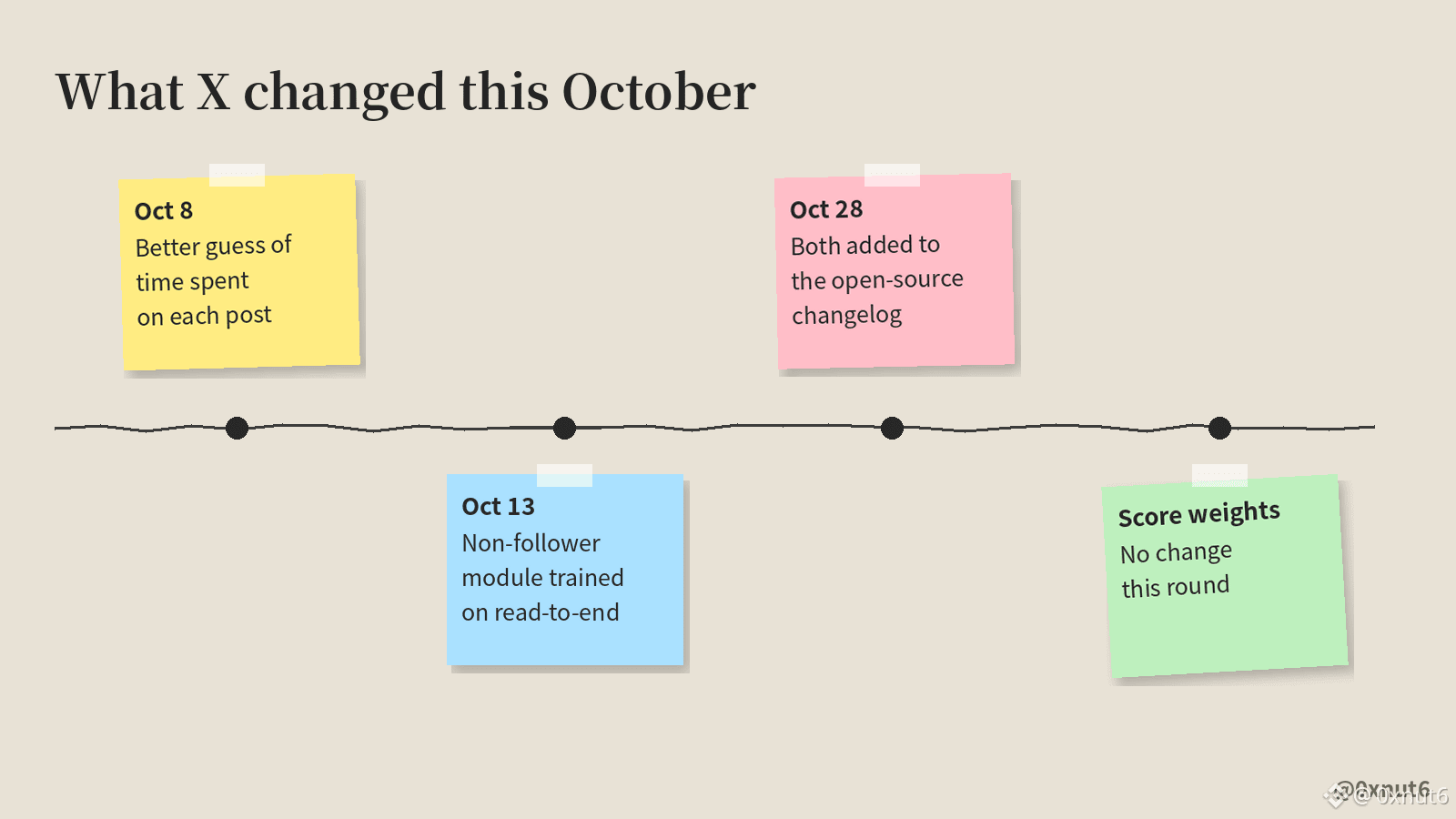
Since October 13, the part of X's ranker that shows your posts to people who don't follow you has been trained on whether they read to the end. X added that line to the changelog in its open-source algorithm repo this week, and @ThePeterMick flagged it on October 28 in a post that has passed 93,000 views.
So a stranger only carries a crypto post forward if they actually finish it. The same changelog says ranking got better at predicting time spent from October 8, and Peter notes that no score weights moved this round.
That changes how an on-chain post should be built. A Hyperliquid funding breakdown that gives away the number in line one and then pads three paragraphs gets opened and abandoned, and Peter's recap of the open weights puts a quick open-and-leave at only 0.3 for the tap. A post that saves the one figure readers can check for themselves until the last line only pays off for readers who reach that line.
His recap also lists bookmarks at zero, a copy-link share at 20, and a second original in the same feed at about 62% of the first. The 62% figure is why I now keep my own originals 90 to 120 minutes apart.
X's changelog dates the read-to-end training for non-follower reach to October 13, about two weeks before it was written down.
80
·
--
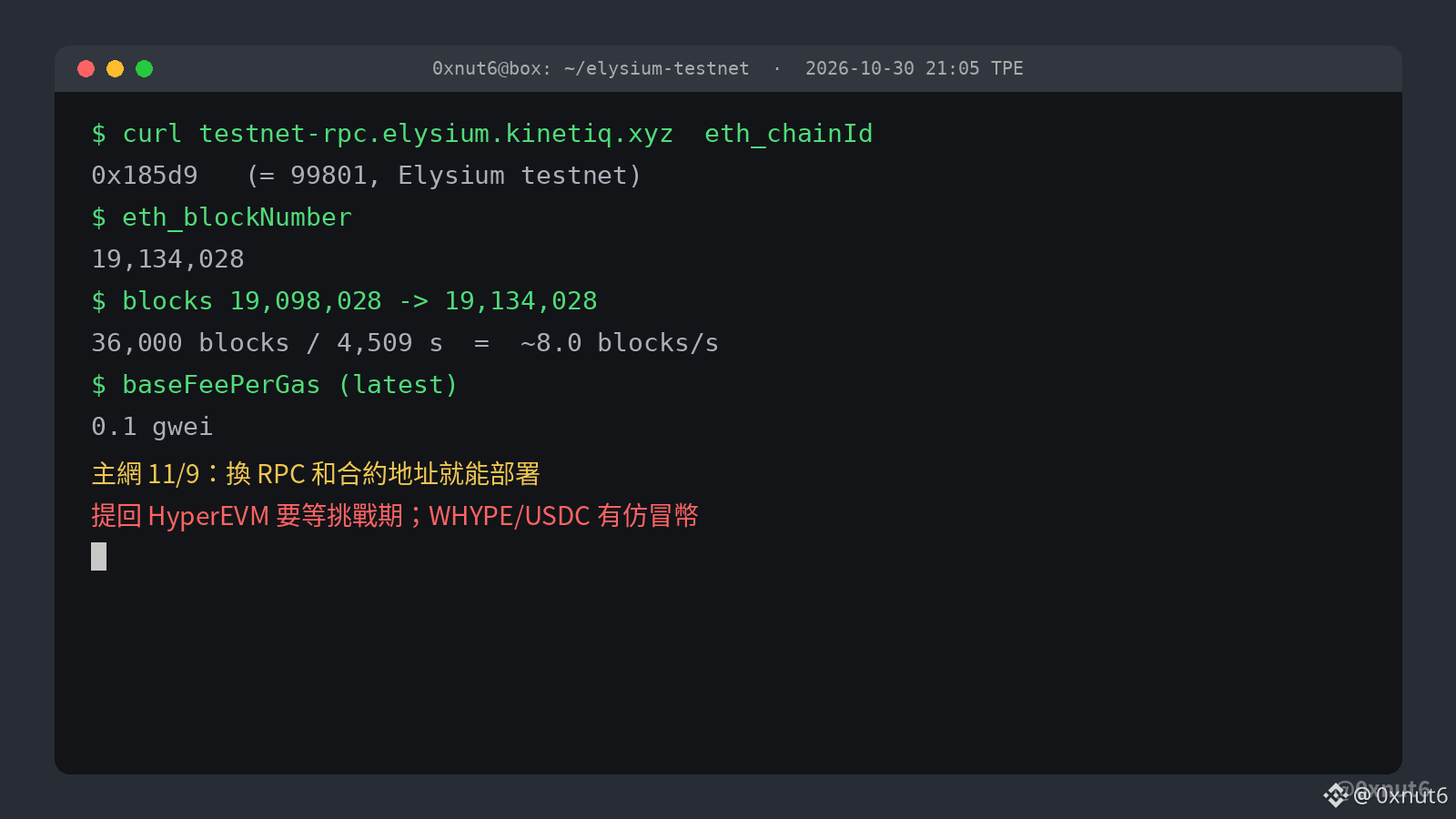
Elysium 主網要到 11/9 才上,但 @Enter_Elysium 這幾天已經連續公布第一天就上線的應用,10/28 是交易 App fomo,10/29 晚上是選擇權協議 @DeriveXYZ V3,接著是 @xStocksFi 的代幣化美股,Elysium 官方另外註明這項不對美國人開放。對還在觀望的建設者來說,現在上測試網不會白做,因為官方文件寫明測試網跑的是跟主網同一套系統和合約,差別只在連線端點和部署地址。
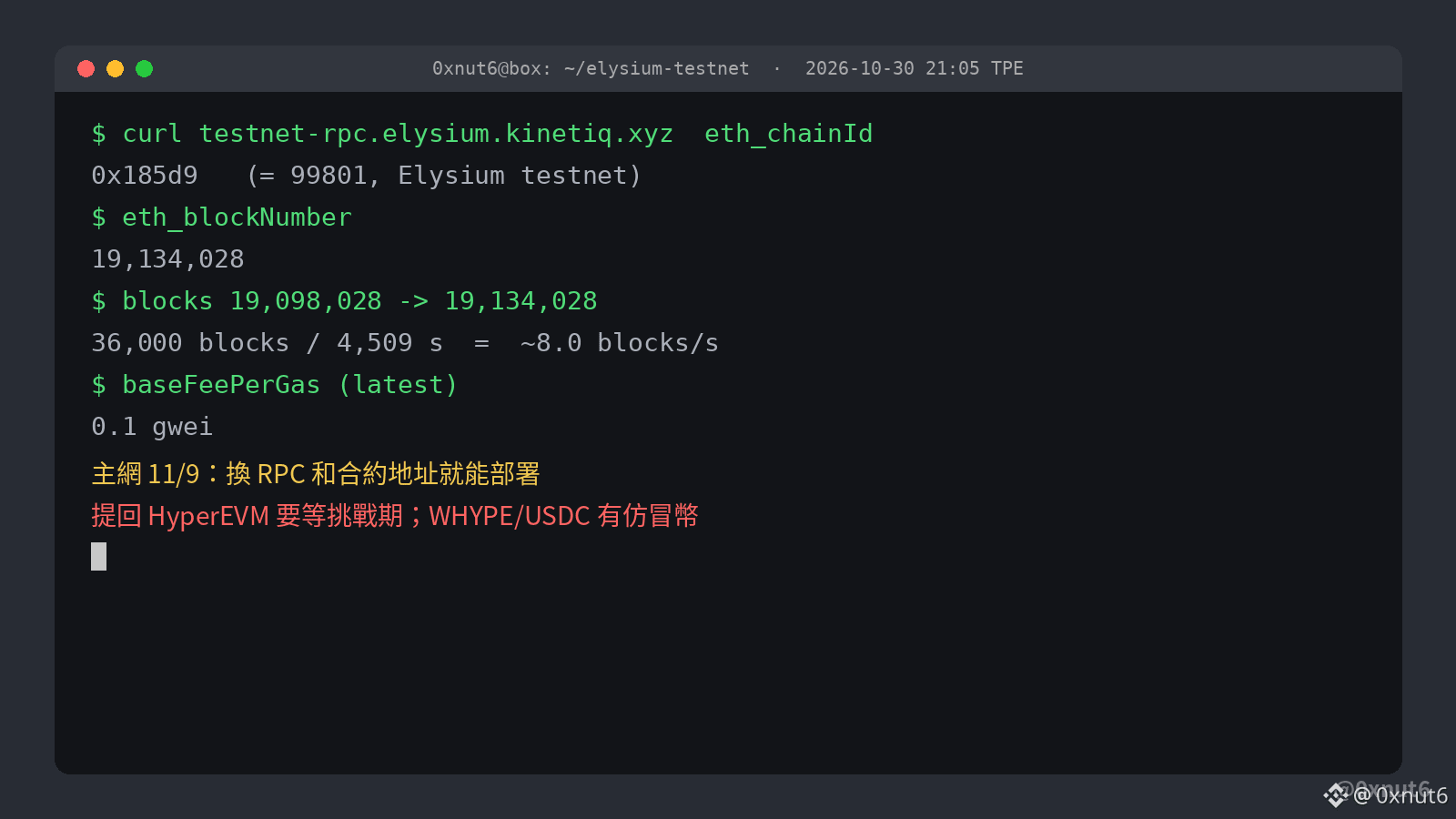
我今晚 21:05 直接打官方公開 RPC,鏈 ID 回傳 99801。當下區塊高度大約 1,913 萬,昨晚 22:57 我量的時候還是 1,849 萬。我往回抓了 75 分鐘的區塊,平均每秒將近 8 個,基本手續費是 0.1 gwei。測試網從 9/22 開放到現在,Foundry 和 Hardhat 不用改任何設定,水龍頭、測試橋和 Blockscout 合約驗證的入口都寫在官網文件裡。
交易者這邊要先想清楚兩件事。HYPE 從 HyperEVM 一比一跨進來很直接,但從 Elysium 提回去走的是樂觀式提款,要等挑戰期結束才拿得到,資金沒辦法隨時抽回。文件也提醒 WHYPE 和 USDC 已經出現仿冒代幣,接任何合約之前都要先對照官方的地址清單。
所以主網前這 10 天,建設者在測試網寫好的程式,主網當天換掉 RPC 和合約地址就能部署;交易者則要先把提回 HyperEVM 必須等挑戰期這件事算進資金安排。
$HYPE
127
·
--
Elysium 主網要到 11/9 才上,但 @Enter_Elysium 這幾天已經連續公布第一天就上線的應用,10/28 是交易 App fomo,10/29 晚上是選擇權協議 @DeriveXYZ V3,接著是 @xStocksFi 的代幣化美股,Elysium 官方另外註明這項不對美國人開放。對還在觀望的建設者來說,現在上測試網不會白做,因為官方文件寫明測試網跑的是跟主網同一套系統和合約,差別只在連線端點和部署地址。
我今晚 21:05 直接打官方公開 RPC,鏈 ID 回傳 99801。當下區塊高度大約 1,913 萬,昨晚 22:57 我量的時候還是 1,849 萬。我往回抓了 75 分鐘的區塊,平均每秒將近 8 個,基本手續費是 0.1 gwei。測試網從 9/22 開放到現在,Foundry 和 Hardhat 不用改任何設定,水龍頭、測試橋和 Blockscout 合約驗證的入口都寫在官網文件裡。
交易者這邊要先想清楚兩件事。HYPE 從 HyperEVM 一比一跨進來很直接,但從 Elysium 提回去走的是樂觀式提款,要等挑戰期結束才拿得到,資金沒辦法隨時抽回。文件也提醒 WHYPE 和 USDC 已經出現仿冒代幣,接任何合約之前都要先對照官方的地址清單。
所以主網前這 10 天,建設者在測試網寫好的程式,主網當天換掉 RPC 和合約地址就能部署;交易者則要先把提回 HyperEVM 必須等挑戰期這件事算進資金安排。
$HYPE
Elysium 主網要到 11/9 才上,但 @Enter_Elysium 這幾天已經連續公布第一天就上線的應用,10/28 是交易 App fomo,10/29 晚上是選擇權協議 @DeriveXYZ V3,接著是 @xStocksFi 的代幣化美股,Elysium 官方另外註明這項不對美國人開放。對還在觀望的建設者來說,現在上測試網不會白做,因為官方文件寫明測試網跑的是跟主網同一套系統和合約,差別只在連線端點和部署地址。
我今晚 21:05 直接打官方公開 RPC,鏈 ID 回傳 99801。當下區塊高度大約 1,913 萬,昨晚 22:57 我量的時候還是 1,849 萬。我往回抓了 75 分鐘的區塊,平均每秒將近 8 個,基本手續費是 0.1 gwei。測試網從 9/22 開放到現在,Foundry 和 Hardhat 不用改任何設定,水龍頭、測試橋和 Blockscout 合約驗證的入口都寫在官網文件裡。
交易者這邊要先想清楚兩件事。HYPE 從 HyperEVM 一比一跨進來很直接,但從 Elysium 提回去走的是樂觀式提款,要等挑戰期結束才拿得到,資金沒辦法隨時抽回。文件也提醒 WHYPE 和 USDC 已經出現仿冒代幣,接任何合約之前都要先對照官方的地址清單。
所以主網前這 10 天,建設者在測試網寫好的程式,主網當天換掉 RPC 和合約地址就能部署;交易者則要先把提回 HyperEVM 必須等挑戰期這件事算進資金安排。
$HYPE
我今晚 21:05 直接打官方公開 RPC,鏈 ID 回傳 99801。當下區塊高度大約 1,913 萬,昨晚 22:57 我量的時候還是 1,849 萬。我往回抓了 75 分鐘的區塊,平均每秒將近 8 個,基本手續費是 0.1 gwei。測試網從 9/22 開放到現在,Foundry 和 Hardhat 不用改任何設定,水龍頭、測試橋和 Blockscout 合約驗證的入口都寫在官網文件裡。
交易者這邊要先想清楚兩件事。HYPE 從 HyperEVM 一比一跨進來很直接,但從 Elysium 提回去走的是樂觀式提款,要等挑戰期結束才拿得到,資金沒辦法隨時抽回。文件也提醒 WHYPE 和 USDC 已經出現仿冒代幣,接任何合約之前都要先對照官方的地址清單。
所以主網前這 10 天,建設者在測試網寫好的程式,主網當天換掉 RPC 和合約地址就能部署;交易者則要先把提回 HyperEVM 必須等挑戰期這件事算進資金安排。
$HYPE
108
·
--
Polymarket 说被盗的钱会全额赔,但被盗超过 1 万美元的用户,要先签字放弃一切索赔,才能拿回这笔钱。
因为这次的问题出在 @Polymarket 国际站用的第三方服务上,平台自己也承诺全额赔付。据 CNBC 报道,知情人士称源头是网站性能监控服务 @DebugBear 被入侵,DebugBear 在 10 月 29 日当天要求使用其 RUM 产品的网站先移除嵌入代码。Betting Intelligence 和 Polysights 的数据显示,同一天有一个账户从 710 个钱包转走了至少 270 万美元。
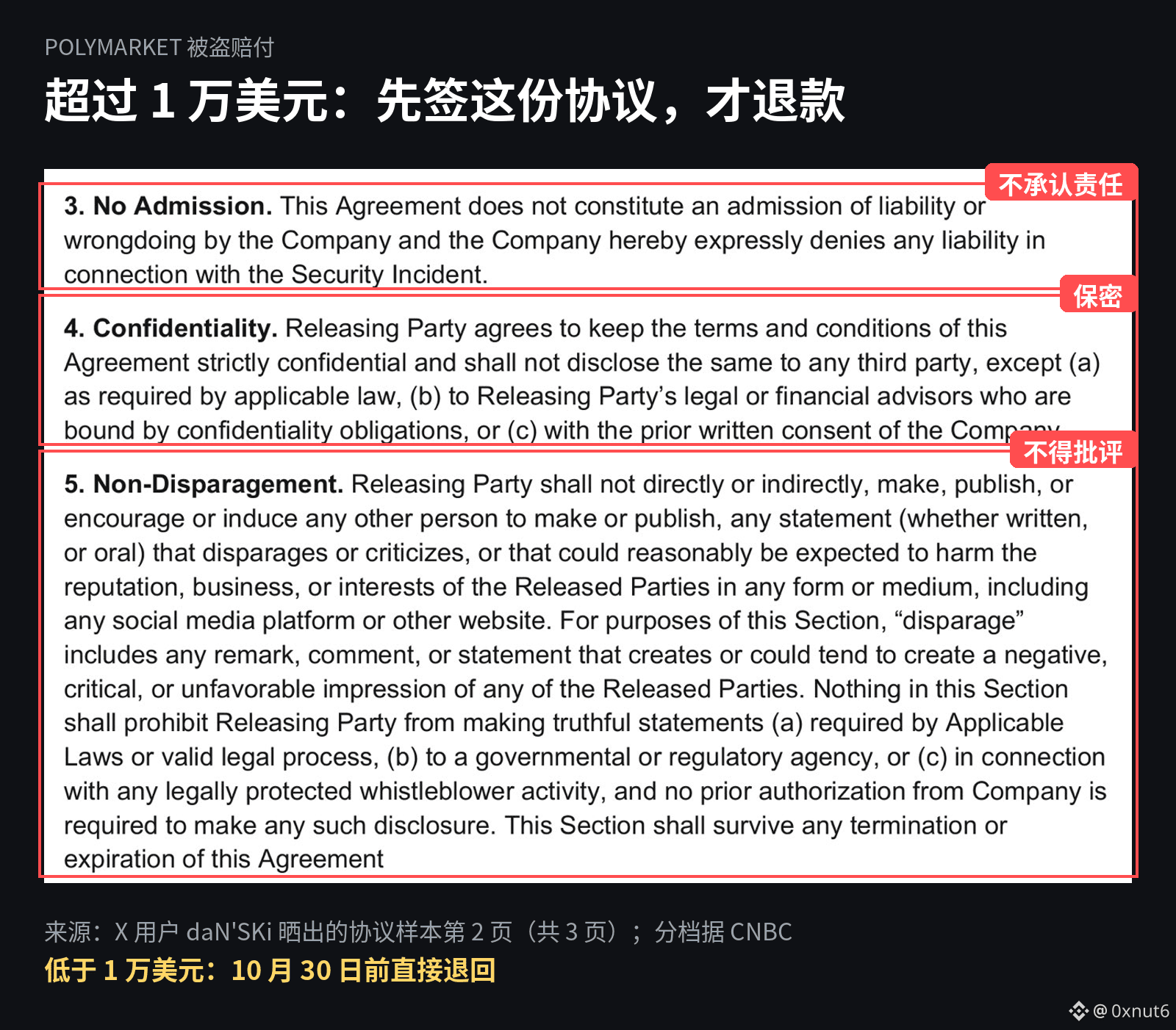
赔付以 1 万美元为界分成两档。Polymarket 在 Discord 告诉用户,损失低于 1 万美元的,10 月 30 日前直接退回;超过 1 万美元的,要先签一份和解与免责协议。
X 用户 daN'SKi 晒出的协议样本一共 3 页,签约方写的是 Adventure One QSS Inc.。条款要求用户放弃与这次事件有关的一切索赔,Polymarket 背后的公司 Blockratize Inc. 也在免责名单里;公司明确不承认负有任何责任;用户要对协议内容保密,也不能在任何平台发表批评或贬低的言论,只有法律要求、向监管机构陈述和举报这三种情况除外。争议走纽约的 JAMS 仲裁,双方各自承担费用。
所以小额用户拿到的是直接退款,大额用户拿到的是一份和解。按样本条款,被盗超过 1 万美元的用户签字以后,不能再就这次被盗索赔,也不能公开批评平台,退款在签字后 14 个工作日内到账。
2
5
7.5k
·
--
About $3 billion of the money taken from Binance overnight is already frozen, and nearly all of it is stablecoins. The BTC and ETH are a different story.
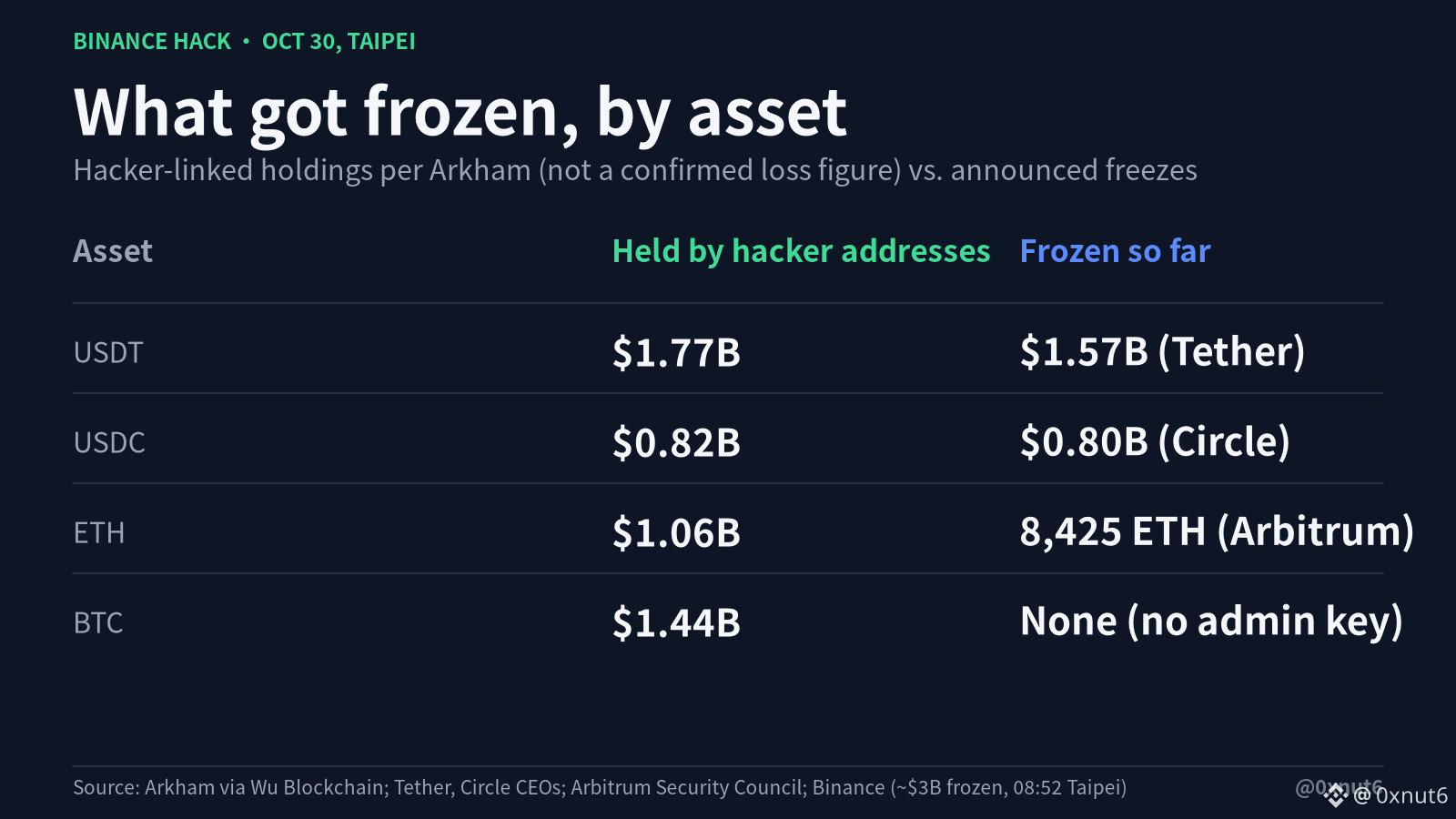
Tether CEO Paolo Ardoino says Tether froze more than 1.567 billion USDT tied to the hack. Circle CEO Jeremy Allaire says Circle froze more than 800 million USDC. That's about $2.37 billion from two issuers that can blacklist an address on their own token contract. @binance put the verified frozen total at around $3 billion as of 08:52 Taipei time, and it hasn't broken down the rest yet.
Now look at what the attacker still holds. Arkham data, as relayed by Wu Blockchain, ties 66 addresses to the hacker with about $5.88 billion in them. The stablecoin side is 1.768 billion USDT and 824.56 million USDC. The same addresses also hold 18,270 BTC, worth about $1.44 billion. The ETH pile is 466,622 coins, worth about $1.06 billion. That's what those addresses hold, not a confirmed loss figure.
The only ETH that got frozen sat on a chain where someone holds an admin key. The @arbitrum Security Council moved 8,425 ETH and 74,559,805 ARB, roughly $30 million, out of the attacker's address into a frozen wallet. Bitcoin and Ethereum mainnet have no council like that, which is also why Bybit's $1.5 billion hack in February 2025, mostly ETH, left issuers with very little to freeze.
Binance says it will cover all losses and has paused all deposits and withdrawals for now. On the numbers above, roughly $2.9 billion isn't frozen, and about $2.5 billion of that is BTC and ETH that no issuer or council can move. That's the part Binance's own balance sheet has to cover.
$BTC $ETH
194
·
--
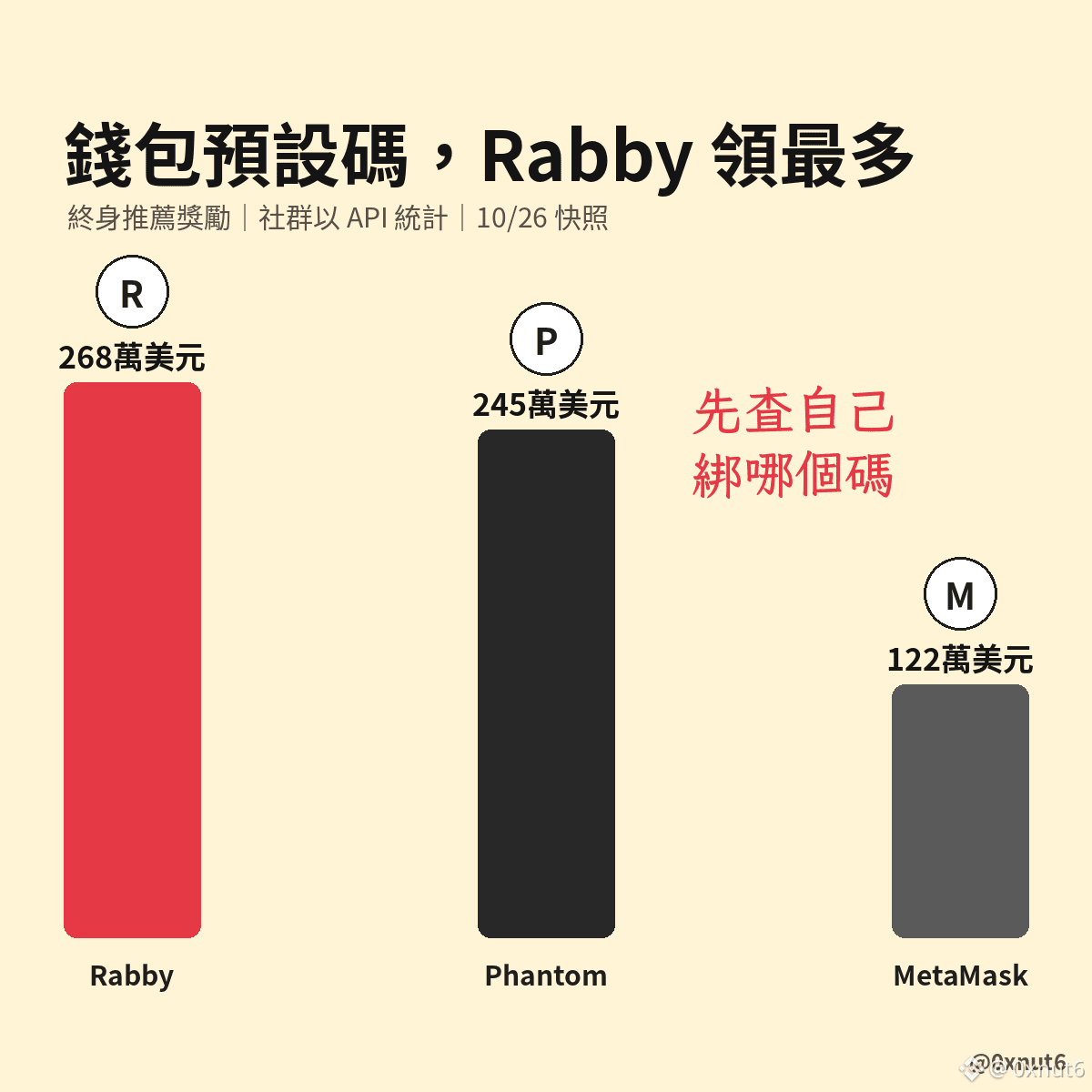
連上 Hyperliquid 的時候如果是用錢包進去,有人發現推薦碼可能已經替你選好了,而且你自己並沒有另外輸入過任何一組碼。
官方規則寫得很清楚。被推薦者在前 2,500 萬美元的交易量裡,手續費有 4% 折扣。推薦人則拿被推薦者手續費的 10%(要先扣掉對方那筆折扣),適用範圍是對方前 10 億美元的交易量。推薦碼在官方介面目前看不到更換選項;API 這邊也只回傳一個 referredBy 欄位。
這件事目前是社群實測,不是錢包官方說明。@MarvinHarryP 用全新帳戶連上之後,頁面顯示「You are using the code: RABBYWALLET」。據他以 Hyperliquid API 統計(2026/10/26 快照,終身累計推薦獎勵、不含 builder fee),Rabby 大約 268 萬美元。同一組口徑下,Phantom 大約 245 萬美元,MetaMask 大約 122 萬美元。
要自己查的話,可以打開 Hyperliquid 官方推薦頁(Referrals),或者對自己的地址打一筆公開查詢,看 referredBy 是 null 還是已經有 code。這個查詢不需要簽名。
被推薦者依照規則仍然有那 4% 的手續費折扣。先確認自己綁的是哪個碼,再決定要不要用這個地址開倉。
$HYPE
·
--
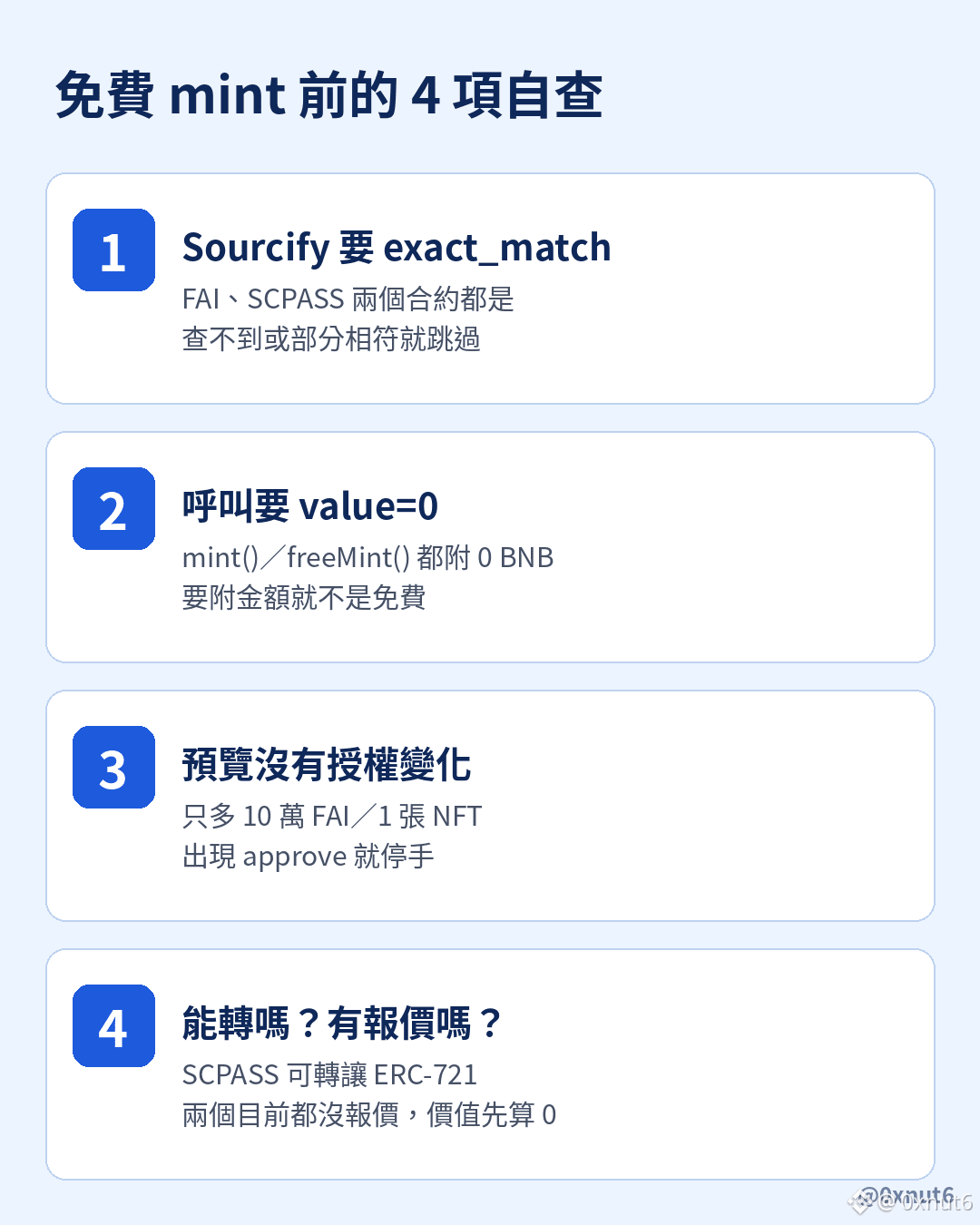
免費 mint 真正的風險通常藏在按下確認前沒看清楚的那筆簽名裡,gas 反而只是小錢。這週我用 BNB Chain 上兩個實際鑄過的項目,整理出每次 mint 前固定跑的 4 項自查,你可以直接照抄。
1. 合約有沒有公開驗證。把合約地址貼到 Sourcify 查,要看到 exact_match,意思是鏈上位元碼跟公開原始碼完全對得上。FreeAI(FAI)和 sidecoo Agent Pass(SCPASS)兩個合約我今天重查,都回 exact_match;查不到或只有部分相符的,我就直接跳過。
2. 呼叫的函式是不是 value=0。FAI 呼叫的是 mint(),SCPASS 呼叫的是 freeMint(),兩筆交易附帶的 BNB 都是 0。號稱免費、交易卻要附帶金額的,就不是免費 mint。
3. 先模擬再執行。錢包的交易預覽要只多出你預期的那一份資產,而且沒有任何授權變化。FAI 的預覽是多出 10 萬枚代幣,SCPASS 的預覽是多出 1 張 NFT,兩筆都沒有新增授權。實際花掉的 gas,FAI 約 0.0046 美元,SCPASS 約 0.0071 美元。預覽裡只要出現 approve 或授權變動,就先停手。
4. 拿到的東西能不能轉、有沒有地方賣。SCPASS 是可轉讓的 ERC-721,FAI 合約允許賣出,但這兩個目前都還沒有市場報價,所以帳面價值先算 0。
我自己的上限是同一個項目只鑄 1 次、每天 gas 預算固定,自動流程隨時可以暫停。以上 4 項任何一項不過,那一次就不鑄。
$BNB
45
·
--
Проверено
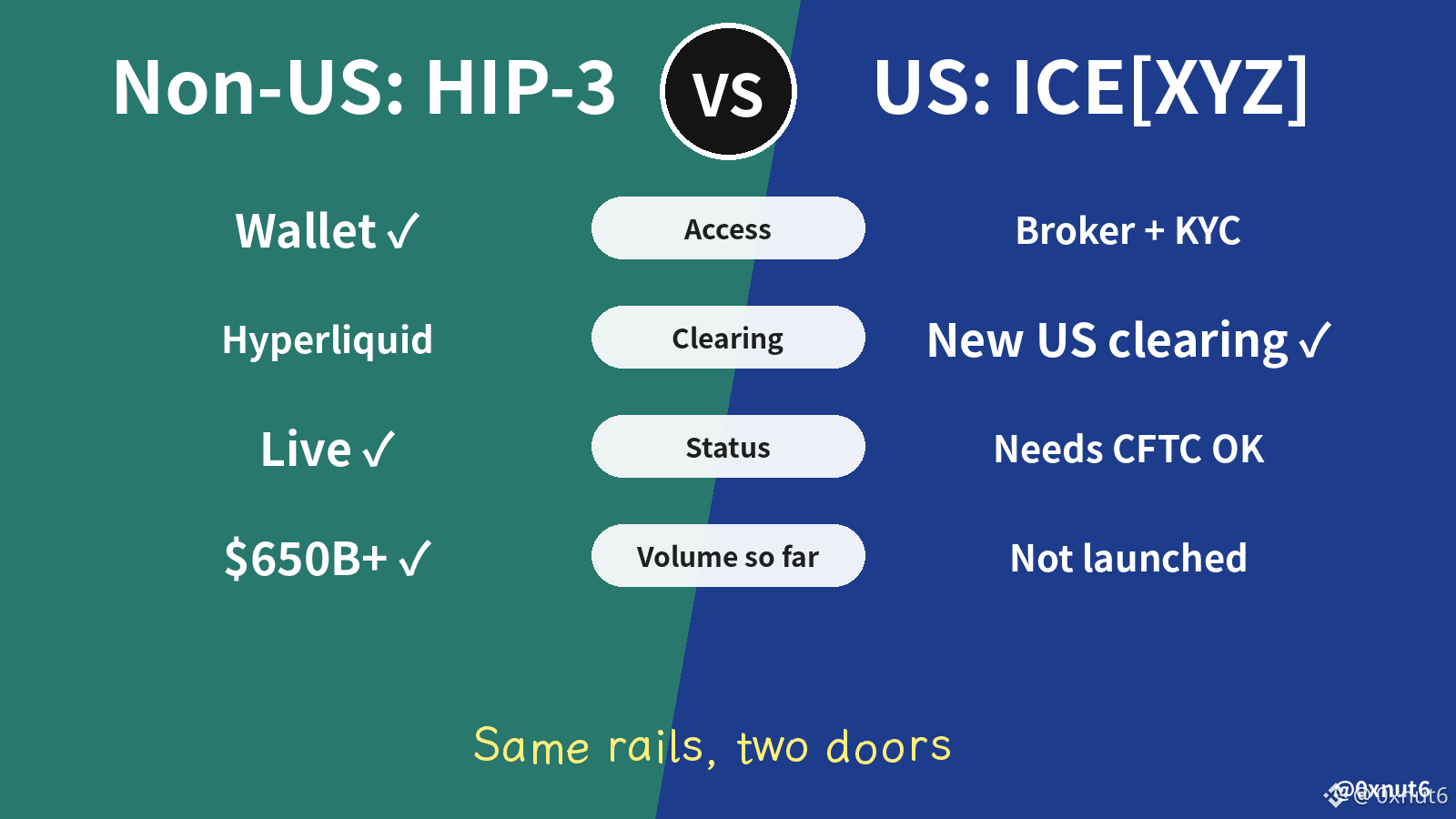
ICE, the company that owns the NYSE, is putting money into @tradexyz. But if you're a US trader hoping to open a Hyperliquid account tomorrow, today's announcement doesn't give you that.
Here's what trade[XYZ] actually said in its announcement earlier today. The two firms plan a new, dedicated US market with its own exchange and clearing infrastructure built on Hyperliquid, and that market is "subject to CFTC approval." Access is meant to come through participating brokers and platforms, so a US user would go through a regulated intermediary with KYC instead of connecting a wallet. trade[XYZ] hasn't given a launch date, and it says details on products, eligibility and timing will come as approvals progress.
The existing HIP-3 markets on @HyperliquidX keep running in parallel. HIP-3 is the setup that lets outside teams list their own perp markets on Hyperliquid's order book, and trade[XYZ]'s markets there have passed $650 billion in volume in just over a year. Those markets price stocks, indices and commodities around the clock, including the hours when traditional venues are closed.
So the deal splits the product in two. Non-US traders keep the permissionless version, and US traders get a brokered version that ICE's clearing sits behind. Planned contracts cover equities, indices, commodities, FX and crypto, but none of them can list in the US until the CFTC signs off.
$HYPE
HYPE-5,83%
ICEUS+3,22%
1
591
·
--
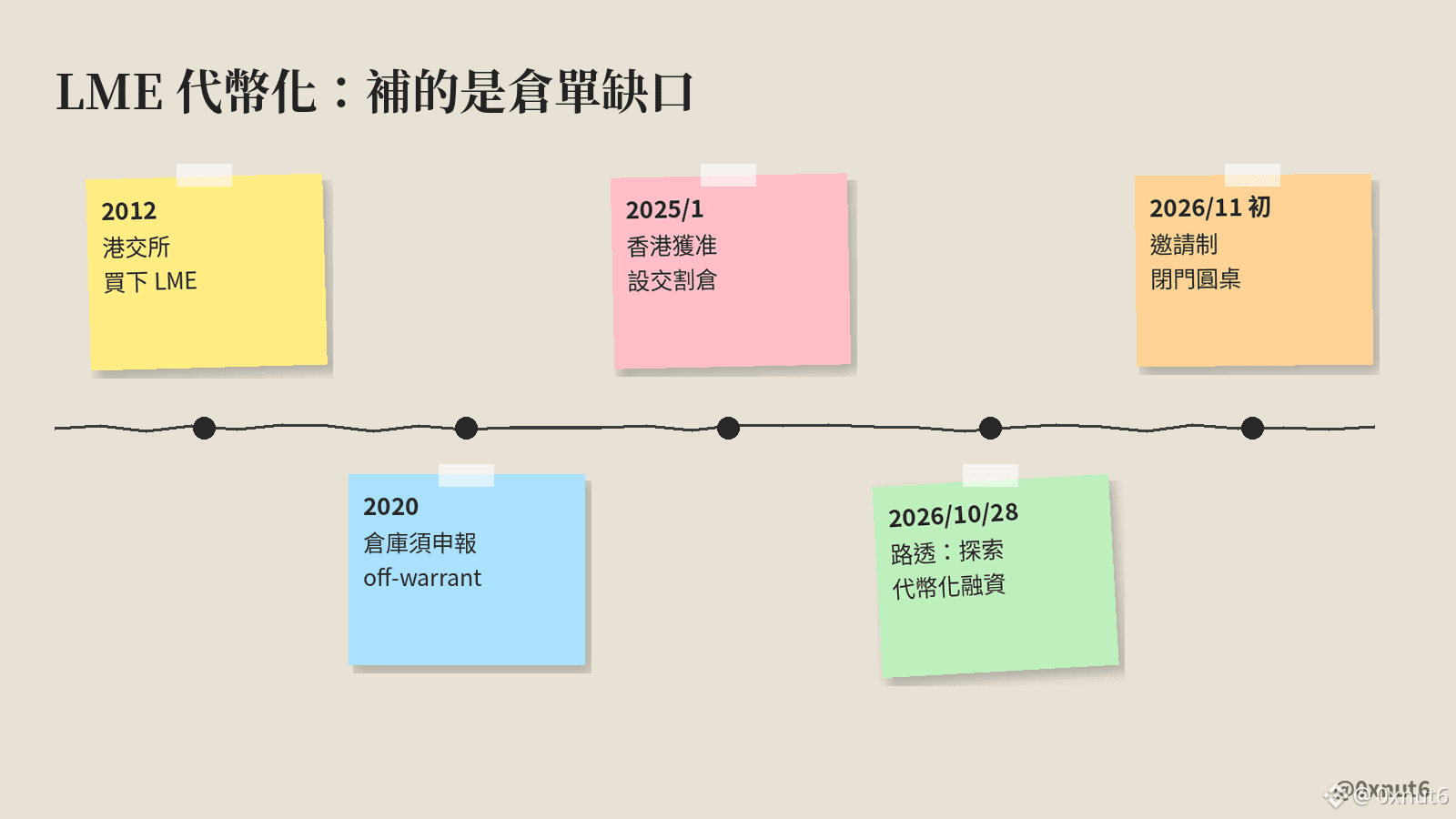
WatcherGuru 今天轉述路透消息:倫敦金屬交易所要把存放在香港倉庫的金屬做成可用來融資的數位資產。
倫敦金屬交易所(@LME_news)要代幣化的,只有香港倉庫裡「沒有倉單」的那批金屬。有倉單的金屬本來就能交易、能拿去抵押借錢,所以這次不算在內。
路透 10/28 引述三位知情人士報導這件事。LME 回應時只說還在「早期探索」,要把 off-warrant(未註冊倉單)庫存代幣化來支援企業融資,例如當貸款抵押品;目前沒公布用哪條鏈、也沒有上線日,11 月初先開一場邀請制閉門圓桌。母公司港交所(@HKEXGroup)2012 年就買下這家交易所,香港則是 2025 年 1 月才獲准設交割倉庫。
所以這批代幣補的是一張缺了的產權證明,不是新的交易標的。off-warrant 庫存現在沒有標準化的融資機制,借方要貸款,得先證明貨真的在倉庫、而且沒被重複抵押。這跟鏈上代幣化股票同一個邏輯,鏈只負責記帳,資產在不在由託管方負責。
這批代幣的抵押價值,來自 LME 從 2020 年起要求倉庫申報的 off-warrant 庫存數字,不是來自哪一條鏈。
110
·
--
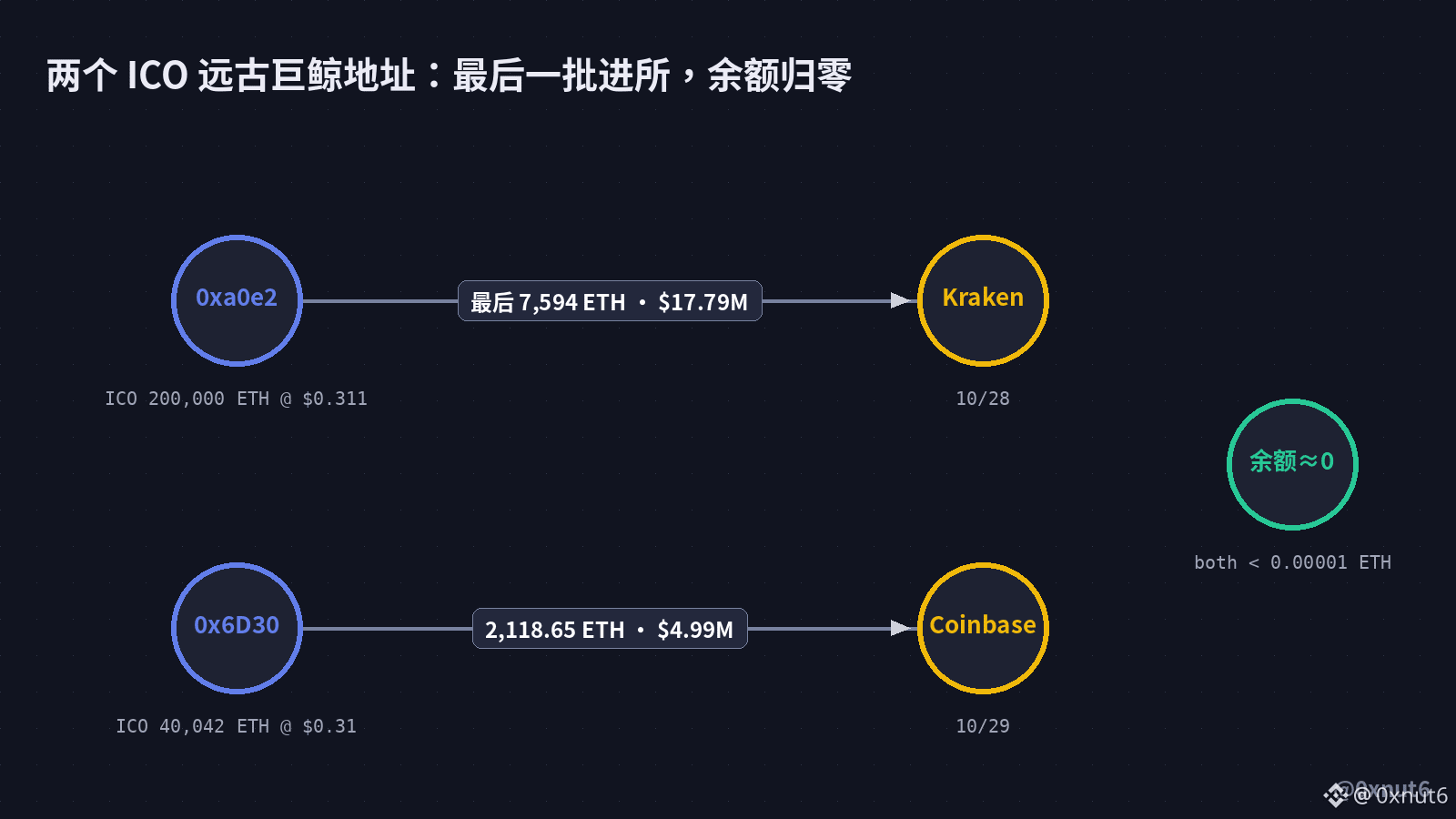
今早 Lookonchain 说"很多 ETH OG 醒了在砸盘"。我把这两天被点名的两个 ICO 地址查了一遍:截至北京时间 10/29 15:00,两个地址的链上余额都不到 0.00001 枚 ETH。
第一个是 0xa0e2,当年 ICO 以 0.311 美元认购 20 万枚 ETH。按 余烬 EmberCN 统计,它多年分批卖出的均价约 1,368 美元。10/28 它把最后 7,594 枚(约 1,779 万美元)转进 Kraken,折合每枚约 2,343 美元。
第二个是 0x6D30,由 5 个 ICO 认购地址归集,共 40,042 枚。10/29 凌晨它把 2,118.65 枚充进 Coinbase,价值约 499 万美元。成本 0.31 美元,按充值时价格算是约 7,600 倍回报。
两笔合计约 2,278 万美元,和 10/28 现货 ETH ETF 一天净流出 2,141 万美元规模相当。
充值进交易所只说明能卖,不说明还有多少没卖。ETH 现在约 2,310 美元。这两个地址最后两笔共 9,713 枚 ETH 进所后余额归零,下一笔 OG 卖压只能来自别的地址。
$ETH
152
·
--
Статья
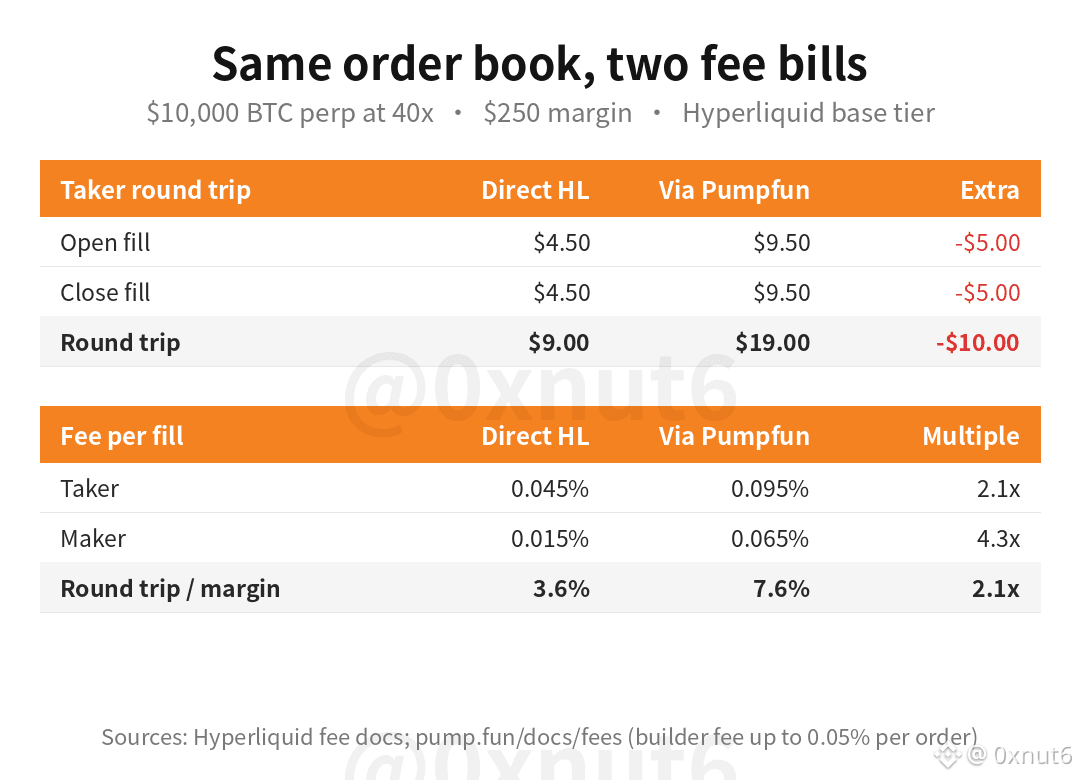
Pumpfun perps: same Hyperliquid order book, about twice the taker feePumpfun's new perps fill on the same Hyperliquid order book, but a taker round trip through the app can cost about twice as much: $19 on $10,000 notional versus $9 going direct.
That's because Pumpfun adds a builder fee on top of Hyperliquid's own. Its fees page says up to 0.05% of notional on every order you submit, whether it opens, adds to or closes a position. Hyperliquid's base taker rate is 0.045%, so at the full builder fee one taker fill through Pumpfun comes to 0.095%, or 0.19% for a round trip.
The pitch is simple: long or short crypto, stocks and commodities straight from a USDC balance, no bridging, with up to 40x on $BTC. Leverage is where the fee line bites. A $10,000 BTC position at 40x needs $250 of margin. Open and close it as a taker on Hyperliquid directly and you pay $9, or 3.6% of that margin. Do the same in the Pumpfun app and it's $19, or 7.6%, before funding.
Resting limit orders don't escape it. Hyperliquid's base maker fee is 0.015%, so the builder fee takes a maker fill to 0.065%, more than four times the direct rate.
Moving money in costs extra too. Pumpfun lists up to 0.25% on each transfer to or from Hyperliquid through its in-app bridge, on top of the bridge operator's own fee. A $250 deposit and withdrawal can run $1.25 before anything trades.
On Hyperliquid's base tier, a $10,000 taker round trip costs $9 direct and up to $19 through Pumpfun, and both fills land on the same order book.
Pumpfun perps: same Hyperliquid order book, about twice the taker fee
Pumpfun's new perps fill on the same Hyperliquid order book, but a taker round trip through the app can cost about twice as much: $19 on $10,000 notional versus $9 going direct.
That's because Pumpfun adds a builder fee on top of Hyperliquid's own. Its fees page says up to 0.05% of notional on every order you submit, whether it opens, adds to or closes a position. Hyperliquid's base taker rate is 0.045%, so at the full builder fee one taker fill through Pumpfun comes to 0.095%, or 0.19% for a round trip.
The pitch is simple: long or short crypto, stocks and commodities straight from a USDC balance, no bridging, with up to 40x on $BTC . Leverage is where the fee line bites. A $10,000 BTC position at 40x needs $250 of margin. Open and close it as a taker on Hyperliquid directly and you pay $9, or 3.6% of that margin. Do the same in the Pumpfun app and it's $19, or 7.6%, before funding.
Resting limit orders don't escape it. Hyperliquid's base maker fee is 0.015%, so the builder fee takes a maker fill to 0.065%, more than four times the direct rate.
Moving money in costs extra too. Pumpfun lists up to 0.25% on each transfer to or from Hyperliquid through its in-app bridge, on top of the bridge operator's own fee. A $250 deposit and withdrawal can run $1.25 before anything trades.
On Hyperliquid's base tier, a $10,000 taker round trip costs $9 direct and up to $19 through Pumpfun, and both fills land on the same order book.
109
·
--
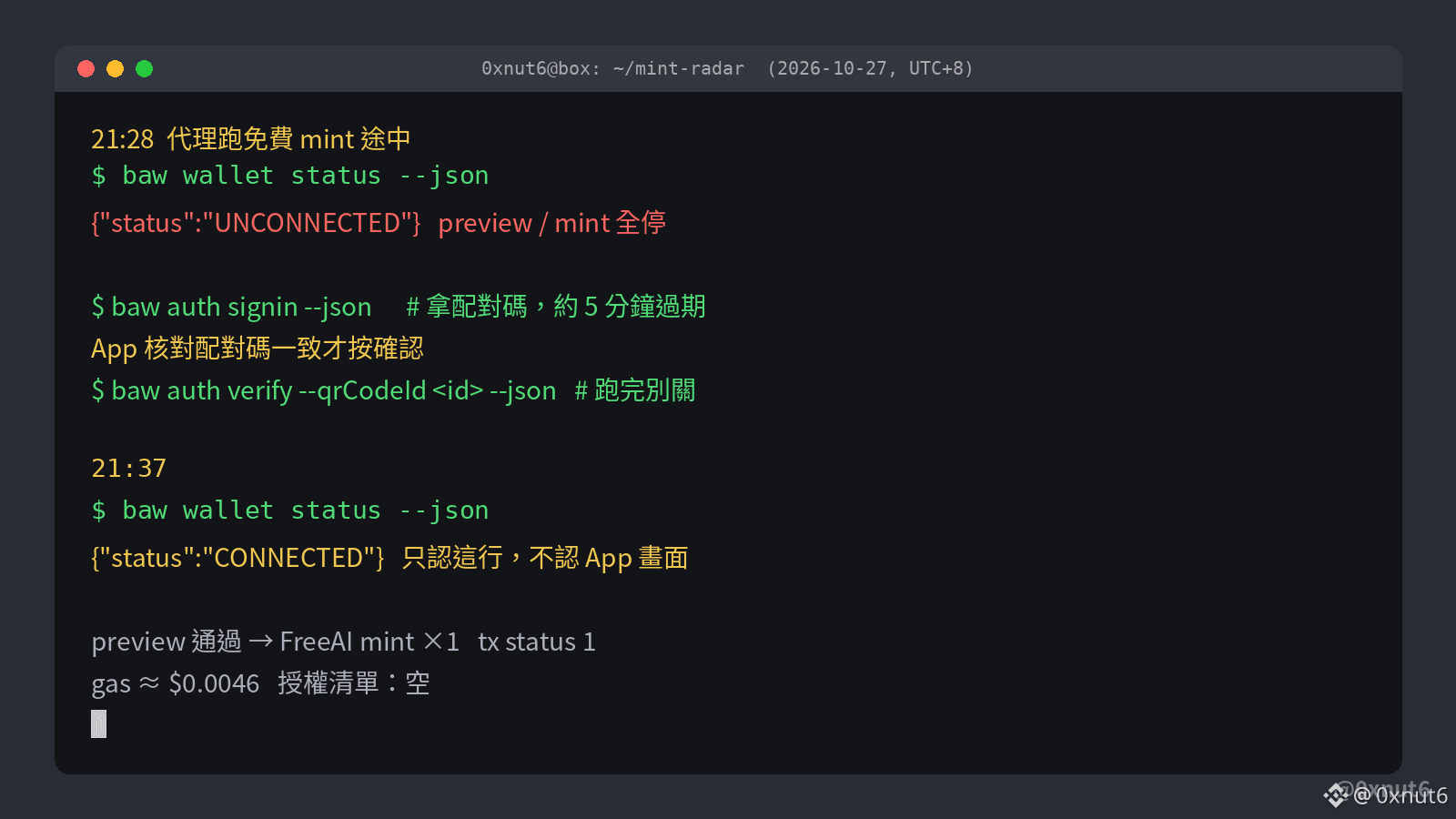
昨晚 21:28,我讓 AI 代理跑免費 mint,跑到一半錢包狀態跳成 UNCONNECTED(NOT_LOGGED_IN),preview 和鑄造全部停住。重新登入之後,判斷有沒有真的接回來只看一件事:命令列查狀態有沒有回 CONNECTED,App 畫面顯示成功並不算數。
我這次照 @BinanceWallet 官方 Agentic Wallet 技能文件走的重連順序:
1. 先跑 baw wallet status --json,確認回的是 UNCONNECTED,而不是網路逾時。
2. 跑 baw auth signin --json,拿到配對碼和登入連結。
3. 在 @binance 的幣安錢包 App 核對配對碼一致再按確認;這組碼大約 5 分鐘就過期,過期就重新 signin,不要拿舊的 qrCodeId 一直 verify。
4. 跑 baw auth verify,讓它自己跑完回 SUCCESS,中途不要關掉。
5. 再跑一次 wallet status,回 CONNECTED 才算重連完成。
第 4 步最容易出事。文件寫明 verify 被中斷時,App 可能顯示登入成功,本機卻還是 UNCONNECTED,這時要從 signin 整個重來。想讓代理停手,就跑 baw auth signout,本機登入狀態會清掉並回 LOGGED_OUT。
我這邊 21:37 狀態回到 CONNECTED,同一輪 preview 通過後只鑄了 1 次 FreeAI,交易 status 為 1。那筆 gas 約 0.0046 美元,授權清單仍是空的。
24
·
--
Coinbase 執行長 Brian Armstrong 在 X 上貼出 Blockworks Research 的代幣化股票數據圖。圖上的金額是實的:代幣化股票總供給 37.5 億美元,1,501 檔標的上鏈。但到處被轉的「持有人 5 百多萬」,要先打個折再看。
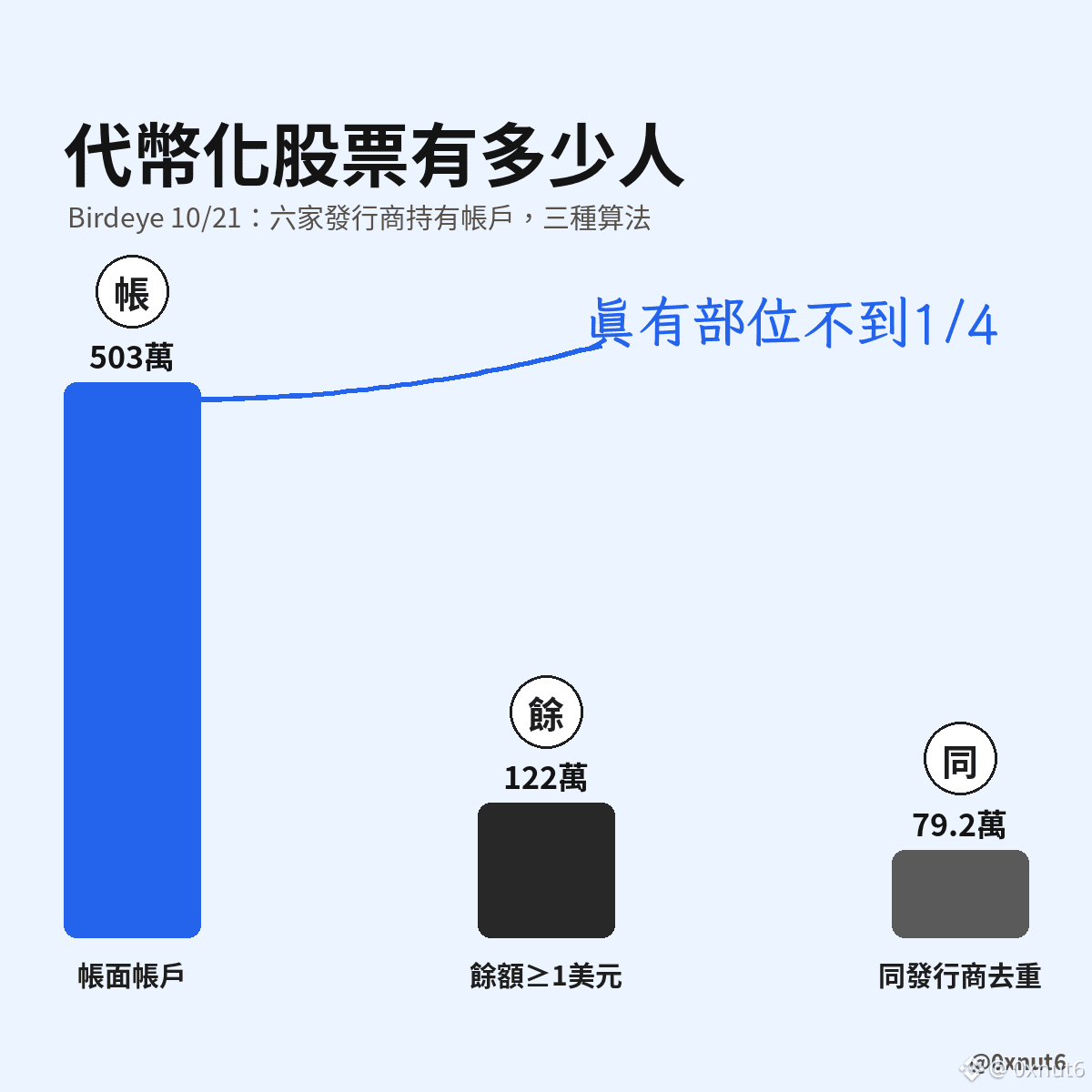
Birdeye 統計了六家發行商,截至 10/21 帳面上有 503 萬個持有帳戶。餘額至少 1 美元的卻只有 122 萬個,佔 24.27%。同一個錢包在同一家發行商只算一次,數字再縮到約 79.2 萬。各條鏈上單一部位的中位數只有 3 到 14 美元。
所以看誰真的有人在買,該看 1 美元以上的錢包數,不是帳戶數。換成這個口徑,帳戶數第一的 Robinhood 掉到第三,bStocks 以 217,216 個錢包排第一;Robinhood 帳面上的帳戶,有 76.89% 餘額不到 1 美元。
Birdeye 統計了六家發行商,截至 10/21 帳面上有 503 萬個持有帳戶。餘額至少 1 美元的卻只有 122 萬個,佔 24.27%。同一個錢包在同一家發行商只算一次,數字再縮到約 79.2 萬。各條鏈上單一部位的中位數只有 3 到 14 美元。
所以看誰真的有人在買,該看 1 美元以上的錢包數,不是帳戶數。換成這個口徑,帳戶數第一的 Robinhood 掉到第三,bStocks 以 217,216 個錢包排第一;Robinhood 帳面上的帳戶,有 76.89% 餘額不到 1 美元。
65
·
--
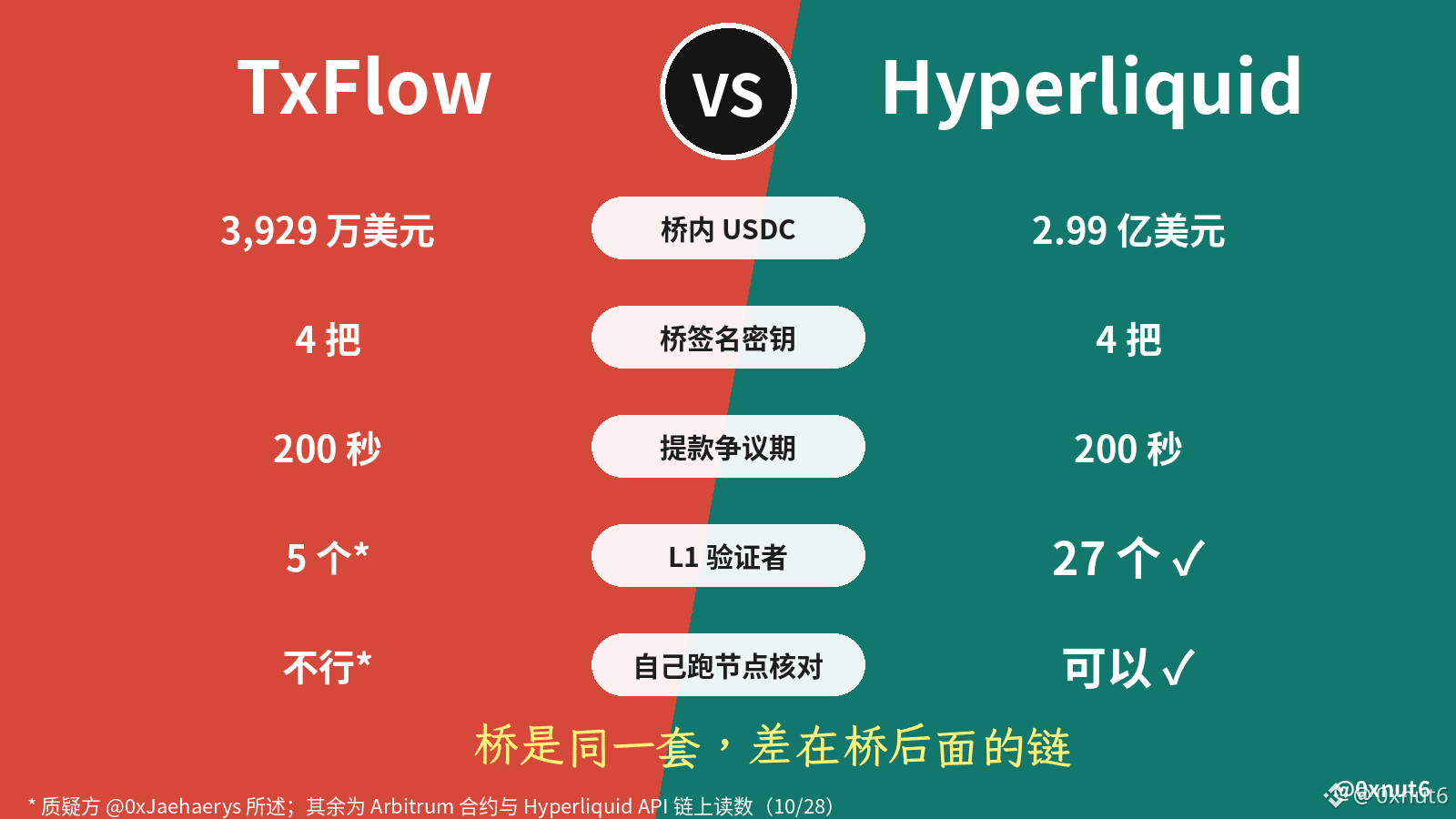
被叫作“拼多多版 Hyperliquid”的 TxFlow,Arbitrum 跨链桥里锁着约 3,929 万美元 USDC,能签字放款的只有 4 把验证者密钥。
我查了链上合约:凑够超过 2/3 的签名就能发起提款,之后只有 200 秒争议期,这段时间没人按暂停,提款就会被放行。@OpenZeppelin 给 @TxFlow_L1 做的审计也写明,超过 2/3 的热钱包签名“可以提议任意提款”。
公平地说,Hyperliquid 自己的桥也是 4 个验证者、200 秒争议期。差别在桥后面那条链:Hyperliquid 有 27 个活跃验证者,谁都能跑节点核对;质疑方称 TxFlow 只有 5 个验证者、全由团队运行,喂价只靠一把密钥。
团队成员今天下午回应,只解释桥和 API 借鉴了 Hyperliquid、撮合引擎自研,没提验证者和预言机。
在 TxFlow 刷积分的人,存进去的 USDC 能否拦住异常提款,全看那 200 秒里有没有人按下暂停。
57
·
--
Статья
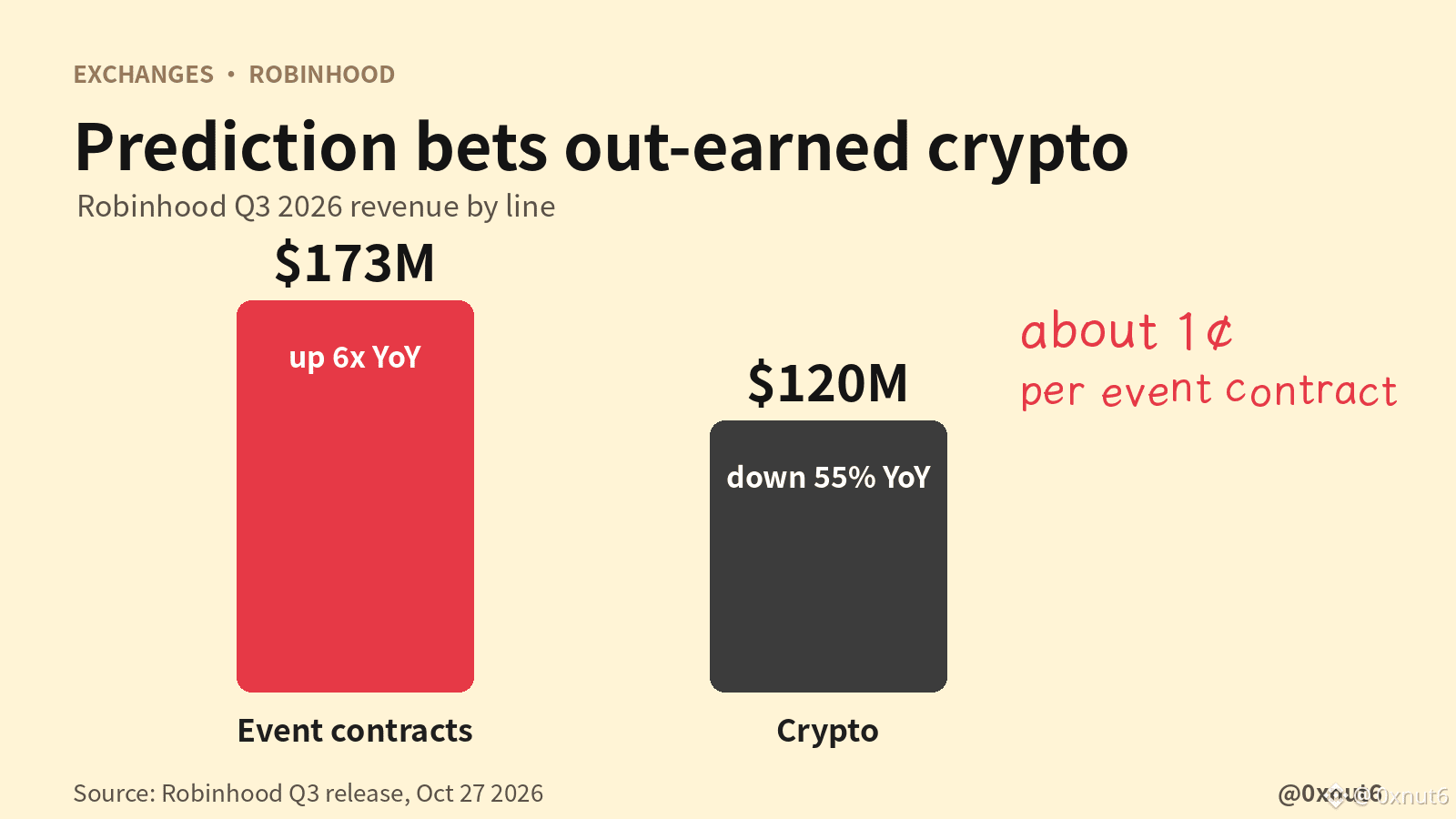
Robinhood now earns more from prediction bets than from crypto tradingRobinhood booked $173M from prediction-market contracts in Q3 and only $120M from crypto trading, so yes/no bets now earn it more than buying and selling coins does.
The crypto line fell 55% from a year earlier. @RobinhoodApp reported $50B of crypto volume for the quarter, down 38%. Meanwhile customers traded 16.4B event contracts, and each one pays out $1 if it's right.
The per-dollar math is why prediction markets matter so much to them. $173M over 16.4B contracts is about 1 cent of revenue per contract. If you put $100 into contracts priced at 50 cents, you're holding 200 of them, which is roughly $2 for Robinhood. Crypto brought in about 0.24% of volume, so the same $100 of spot earns it around 24 cents. That 0.24% blends in volume from its Bitstamp exchange, so the rate on the app alone is higher than that.
Robinhood CFO Shiv Verma told @CNBC that contracts on crypto price moves did well. REX Financial research head Bill Birmingham told @Reuters these look like the same active traders finding a second outlet. At those averages, a trader who swaps a spot buy for a bet on $BTC's direction pays Robinhood about 8 times more per dollar.
Robinhood now earns more from prediction bets than from crypto trading
Robinhood booked $173M from prediction-market contracts in Q3 and only $120M from crypto trading, so yes/no bets now earn it more than buying and selling coins does.
The crypto line fell 55% from a year earlier. @RobinhoodApp reported $50B of crypto volume for the quarter, down 38%. Meanwhile customers traded 16.4B event contracts, and each one pays out $1 if it's right.
The per-dollar math is why prediction markets matter so much to them. $173M over 16.4B contracts is about 1 cent of revenue per contract. If you put $100 into contracts priced at 50 cents, you're holding 200 of them, which is roughly $2 for Robinhood. Crypto brought in about 0.24% of volume, so the same $100 of spot earns it around 24 cents. That 0.24% blends in volume from its Bitstamp exchange, so the rate on the app alone is higher than that.
Robinhood CFO Shiv Verma told @CNBC that contracts on crypto price moves did well. REX Financial research head Bill Birmingham told @Reuters these look like the same active traders finding a second outlet. At those averages, a trader who swaps a spot buy for a bet on $BTC 's direction pays Robinhood about 8 times more per dollar.
154
·
--
a16z 的加密基金 10 月 22 日改名為 a16z Frontier,投資範圍從加密擴大到 AI 等前沿新創。兩天後 @cz_binance 在 PIVOT 專訪裡說,AI 代理不會用信用卡,也不會用銀行帳戶,會用加密貨幣付款。AI 代理用加密錢包付款已經有產品,但說它們不用卡,目前還站不太住。
@BinanceWallet 在 4 月推出 Agentic Wallet,讓 AI 代理只能在使用者設定的額度和白名單內交易,10 月 20 日又加上綁定錢包的 .ai 身分 Agent ID。
CZ 預估 AI 會讓交易次數增加一千到一百萬倍,訪談裡沒有交代算法。卡組織也沒有退場,Visa 在 10 月 20 日和 BILL、Billtrust 開始試點,讓 AI 代理替企業付款給已核准的供應商。Mastercard 同一天開放的 Agent Pay for Machines 用的是 Coinbase 的 x402 付款協議,結算可以走法幣或穩定幣,代表這條路上的代理付款仍然經過卡組織。
@BinanceWallet 在 4 月推出 Agentic Wallet,讓 AI 代理只能在使用者設定的額度和白名單內交易,10 月 20 日又加上綁定錢包的 .ai 身分 Agent ID。
CZ 預估 AI 會讓交易次數增加一千到一百萬倍,訪談裡沒有交代算法。卡組織也沒有退場,Visa 在 10 月 20 日和 BILL、Billtrust 開始試點,讓 AI 代理替企業付款給已核准的供應商。Mastercard 同一天開放的 Agent Pay for Machines 用的是 Coinbase 的 x402 付款協議,結算可以走法幣或穩定幣,代表這條路上的代理付款仍然經過卡組織。

468
·
--
Статья
Robinhood Chain Lost 79% of Its Trading. Why Is $1.1 Billion Still There?Robinhood Chain's daily DEX volume has dropped 79% from its peak of $3.67 billion on September 4. Yet the $1.13 billion parked on the chain has barely moved. Robinhood reports third-quarter results after the US close today, October 27. Before that, I pulled the numbers myself from DefiLlama, the Morpho API, Merkl's reward data and the chain's own RPC to see what's actually holding that money in place.
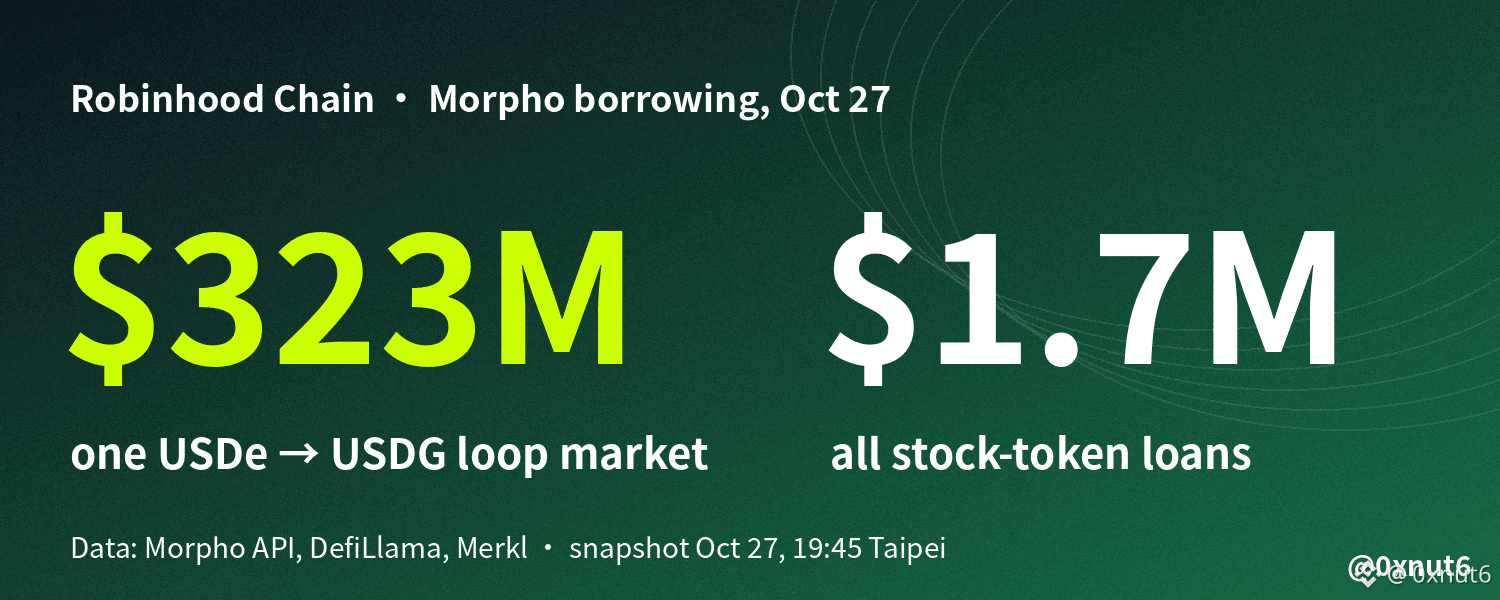
The short version is that most of it isn't trading capital and it isn't stock-token credit either. About $323 million sits in a single lending market where roughly a hundred wallets borrow USDG against USDe at an average 89% loan-to-value, and two reward campaigns pay them and their lenders about $96,000 a day to stay. All figures below come from a snapshot taken around 19:45 Taipei time (11:45 UTC) on October 27 unless I say otherwise.
Trading on Robinhood Chain has shrunk in six of the last seven weeks
Robinhood Chain is the Ethereum layer-2 network that @RobinhoodCrypto took to public mainnet on July 1, built on Arbitrum's stack and pitched as a home for tokenized stocks and DeFi.
Its decentralized exchanges had a huge late summer. DefiLlama's chain page shows daily DEX volume topping out at $3.67 billion on September 4, and the week of August 31 to September 6 cleared $18.2 billion. Cumulative volume passed $100 billion on October 9 and now stands near $121.9 billion.
Since that week the curve has gone one way with a single pause. Weekly volume fell to $14.1 billion and then $11.0 billion. It kept sliding to $6.4 billion in the week of October 5, ticked up once, and dropped to $5.4 billion for the week of October 19 to 25.
The last 30 days produced $29.7 billion of DEX volume. That's 46.6% less than the 30 days before. On October 26 the chain did $758 million, about a fifth of the peak day.
Fees followed the same path. The chain's apps earned $101.8 million in fees over the last 30 days. Uniswap's V4 exchange alone took about $37.9 million of that. A launchpad called Pons came second with about $20.7 million. That's still real money, but it's a trading economy that has cooled for two months.
Lending, not trading, holds most of the chain's money
Total value locked tells a different story. TVL, the dollar value of assets deposited in a chain's apps, went from $174 million in mid-July to $529 million a month later. It reached $930 million by mid-September and a record $1.153 billion on October 22. It's at $1.128 billion today, 2% below that high, while trading volume sits roughly 80% below its own high.
The split by app explains why the two lines don't move together. Morpho Blue, the lending protocol run by @Morpho, accounts for $617.5 million, or 55% of the chain's TVL. Uniswap V4 holds $174.7 million and the perps venue Lighter holds $116.4 million. DefiLlama also lists the Steakhouse vault at $544.3 million, but that vault deposits into Morpho, so adding the two would count the same dollars twice.
Stablecoins tell the same story from another angle. The chain's stablecoin supply is $1.082 billion, almost unchanged from $1.069 billion on September 20, even as weekly trading volume roughly halved over the same stretch. USDG, the Global Dollar stablecoin that Robinhood's products use, makes up $679 million of it, and Ethena's USDe makes up $369 million. Money that doesn't leave when trading slows usually has another reason to stay, and on this chain that reason is lending yield.
One stablecoin market carries two-thirds of all borrowing
Morpho works as a set of isolated markets. Each one pairs a single collateral token with a single loan token, a fixed liquidation threshold called LLTV (the loan-to-value ratio at which a position can be liquidated), and one price oracle. On Robinhood Chain the Morpho API shows $546.1 million supplied and $489.5 million borrowed across all markets.
The biggest market by far lends USDG against USDe collateral with a 91.5% LLTV. It has $360.5 million of USDG supplied and $323.4 million borrowed, so 89.7% of the lendable USDG is out on loan. Borrowers have posted $363.1 million of USDe as collateral. Lenders earn 3.81% a year and borrowers pay 4.25%. That one market is 66% of all Morpho borrowing on the chain, and it was created on June 9, three weeks before the public mainnet opened.
The next three markets also lend USDG against other dollar tokens. Borrowers owe $122.2 million against syrupUSDG, $30.1 million against mGLO and $11.0 million against spUSDG.
The stock-token markets get most of the headlines. Morpho and Robinhood made Robinhood Stock Tokens usable as collateral on October 22, with NVDA and SPCX at a 62.5% LLTV and SPY at 77%. Five days in, the API shows about $3.9 million of stock tokens posted and about $1.7 million borrowed against them. NVDA leads with $1.41 million of collateral, and borrowing rates on the four largest stock markets run from 24% to 35% a year. Stock-token loans are about 0.35% of the chain's Morpho borrowing today, which is a fair start for five days but nowhere near what's holding the TVL up.
About a hundred wallets run that market at 89% loan-to-value
Who's on each side of the USDe market matters more than the market's size. On the supply side, 99.9% of the $360.5 million comes from a single address, the market adapter of the Steakhouse USDG vault run by @SteakhouseFi. That vault holds $544.7 million in total, so about two-thirds of it is lent into this one market. The vault also carries a Merkl reward campaign labeled "Robinhood Users Only," and deposits for that campaign are made through the Robinhood app.
The borrowing side is much narrower. The API lists 991 positions in the market, but only 104 of them owe more than $1, and the rest are empty or leftover dust. The largest borrower owes $78.8 million against $88.6 million of USDe, which is 24.4% of all the debt in the market. The top five hold 66.0% of the debt and the top ten hold 88.5%. The four largest are plain wallets rather than smart contracts, since an RPC check returns no contract code at those addresses.
The leverage is tight. Weighted by debt, the average borrower sits at 89.2% loan-to-value against the 91.5% liquidation line. About 84% of the debt sits in positions at 88% LTV or higher. More than a quarter of it, 27%, is at 90% or higher. For the largest borrower, USDe would need to be priced about 2.8% below USDG before the position became liquidatable. For the debt-weighted average, the gap is about 2.5%.
Two reward campaigns turn a thin spread into double-digit returns
Borrowing at 4.25% against a stablecoin that pays nothing on its own wouldn't make sense without outside money. USDe itself doesn't earn yield; only staked USDe does. The extra money comes from Merkl, a service that distributes reward campaigns on behalf of protocols and token issuers.
The first campaign pays people who post USDe as collateral in this market. It's capped at 5% a year on the collateral's value, which works out to about $49,700 a day on $363.1 million, paid in USDe. Its funder, a single address, has topped it up in weekly rounds since early July, starting at 160,000 USDe a week.
For three straight weeks the round was 341,609 USDe. The round running from October 23 to October 30 is 459,589 USDe, 34.5% larger. The campaign page says "No borrowing required," but positions that post collateral and borrow less than $1 hold only about $111,000 in total.
The second campaign pays the lenders. Depositors in the Steakhouse USDG vault earn 3.20% a year on top in steakUSDG, about $46,000 a day on the $526.1 million that Merkl counts. That campaign was funded with 100 million steakUSDG for July 1, 2026 to July 1, 2027, plus a second 15-million round. Add the vault's own 3.80% net yield and a depositor sees about 7.0%, which matches the "estimated 7% APY" Robinhood quoted for its Robinhood Earn lending product at launch.
The borrower math is simple once the rewards are in. Take $100 of USDe posted at 89% LTV. The borrower owes $89 of USDG at 4.25%, which costs about $3.78 a year. The 5% reward on the collateral pays $5.00 a year. That leaves about $1.22 on roughly $11 of the borrower's own money, close to 11% a year before swap costs and before the borrow rate moves.
Getting to 89% LTV usually means looping, which is swapping the borrowed USDG back into USDe and posting it again several times. I didn't trace every wallet's swaps, but that's the standard way a small group of wallets ends up carrying this much debt.
Lenders carry the depeg risk, and a 16-hour timer decides when it lands
The oracle is the part I'd want any USDG depositor to understand. I read it straight from the chain. The market's oracle is a clone of Steakhouse's MetaOracleDeviationTimelock, a design that switches between two price sources. The primary source returns a fixed price of exactly 1 USDe per USDG. The backup reads a feed labeled "USDE / USD," which showed $0.9996 at my snapshot.
The switch isn't automatic. The backup only takes over if the two prices differ by more than 0.5%, someone calls the contract's challenge function, and the gap is still there after 57,600 seconds, which is 16 hours. Switching back to the fixed price needs another 24 hours of prices staying close. Until a challenge clears, the market values USDe at $1 no matter where it trades.
There's a good reason for this design, and October 10, 2025 shows it. During that crash USDe printed as low as $0.65 on Binance, whose own order book fed its oracle, while Curve's pools stayed within about 0.3% of a dollar. Binance later compensated users whose USDe collateral was liquidated between 21:36 and 22:16 UTC. A fixed-price oracle with a 16-hour challenge window would've ignored that 40-minute wick completely, and @ethena founder Guy Young said at the time that money markets pricing USDe off the deepest liquidity wouldn't have liquidated anyone.
The cost shows up in a slower, real depeg. If USDe traded 3% below a dollar for a full day, borrowers in this market couldn't be liquidated for at least 16 hours, and after the switch most of the debt would sit above the 91.5% line at once. Liquidators would then have to sell a large amount of USDe into a market that's already weak. Any shortfall from that would land on the suppliers, and 99.9% of the supply comes from the vault that Robinhood users deposit into. Robinhood described the Earn product's insurance as covering losses from cyber or smart-contract exploits, and a price depeg isn't that.
The more ordinary risk is that the rewards change. Without the 5% collateral reward, the same $100 position earns nothing and still owes $3.78 a year, so the loop flips to a loss. If borrowers unwind, the vault's lending income from its largest market goes with them. Withdrawals can also bunch up. The vault shows $40.0 million of idle liquidity, 7.4% of its assets, and the market itself is 89.7% lent out.
A three-step check works on any chain's TVL record
None of this needs a paid tool, and the same steps work on any chain that's announcing a TVL record.
First, open the chain's TVL page and the DEX volume page side by side. If TVL keeps climbing while volume falls, the money is staying for a reason other than trading.
Second, open the lending protocol's market list and sort by borrowed amount. If one market holds most of the debt, check how many positions actually borrow, what share the top ten hold and how close the weighted LTV sits to the LLTV.
Third, look up the market's oracle address and read it. A fixed price behind a challenge timer is a reasonable design for stablecoin pairs, but it tells you who carries a slow depeg. Then check the reward pages for the same market, because a campaign that pays more than the borrow rate is often the reason the market exists in its current size.
On Robinhood Chain, the market to start with is 0xc845…cddd6, and its oracle address is 0xE648…055f.
The record TVL measures paid stablecoin carry more than trading
Put together, the numbers don't say Robinhood Chain is empty. DEX users still cleared $5.4 billion of volume last week, and the stock-token loans are a five-day-old product that's already being used. What the numbers do show is that the chain's TVL mostly measures how much stablecoin carry two reward budgets hold in place, and much less how much trading or stock-token credit the chain has attracted. Any mention of that record on today's earnings call would mostly be describing the USDe market.
The two campaigns pay about $96,000 a day together, close to $35 million a year at today's rates, against about $1.7 million of stock-token borrowing. The current USDe round of 459,589 USDe ends at 00:00 UTC on October 30.
Robinhood Chain Lost 79% of Its Trading. Why Is $1.1 Billion Still There?
Robinhood Chain's daily DEX volume has dropped 79% from its peak of $3.67 billion on September 4. Yet the $1.13 billion parked on the chain has barely moved. Robinhood reports third-quarter results after the US close today, October 27. Before that, I pulled the numbers myself from DefiLlama, the Morpho API, Merkl's reward data and the chain's own RPC to see what's actually holding that money in place.
The short version is that most of it isn't trading capital and it isn't stock-token credit either. About $323 million sits in a single lending market where roughly a hundred wallets borrow USDG against USDe at an average 89% loan-to-value, and two reward campaigns pay them and their lenders about $96,000 a day to stay. All figures below come from a snapshot taken around 19:45 Taipei time (11:45 UTC) on October 27 unless I say otherwise.
Trading on Robinhood Chain has shrunk in six of the last seven weeks
Robinhood Chain is the Ethereum layer-2 network that @RobinhoodCrypto took to public mainnet on July 1, built on Arbitrum's stack and pitched as a home for tokenized stocks and DeFi.
Its decentralized exchanges had a huge late summer. DefiLlama's chain page shows daily DEX volume topping out at $3.67 billion on September 4, and the week of August 31 to September 6 cleared $18.2 billion. Cumulative volume passed $100 billion on October 9 and now stands near $121.9 billion.
Since that week the curve has gone one way with a single pause. Weekly volume fell to $14.1 billion and then $11.0 billion. It kept sliding to $6.4 billion in the week of October 5, ticked up once, and dropped to $5.4 billion for the week of October 19 to 25.
The last 30 days produced $29.7 billion of DEX volume. That's 46.6% less than the 30 days before. On October 26 the chain did $758 million, about a fifth of the peak day.
Fees followed the same path. The chain's apps earned $101.8 million in fees over the last 30 days. Uniswap's V4 exchange alone took about $37.9 million of that. A launchpad called Pons came second with about $20.7 million. That's still real money, but it's a trading economy that has cooled for two months.
Lending, not trading, holds most of the chain's money
Total value locked tells a different story. TVL, the dollar value of assets deposited in a chain's apps, went from $174 million in mid-July to $529 million a month later. It reached $930 million by mid-September and a record $1.153 billion on October 22. It's at $1.128 billion today, 2% below that high, while trading volume sits roughly 80% below its own high.
The split by app explains why the two lines don't move together. Morpho Blue, the lending protocol run by @Morpho, accounts for $617.5 million, or 55% of the chain's TVL. Uniswap V4 holds $174.7 million and the perps venue Lighter holds $116.4 million. DefiLlama also lists the Steakhouse vault at $544.3 million, but that vault deposits into Morpho, so adding the two would count the same dollars twice.
Stablecoins tell the same story from another angle. The chain's stablecoin supply is $1.082 billion, almost unchanged from $1.069 billion on September 20, even as weekly trading volume roughly halved over the same stretch. USDG, the Global Dollar stablecoin that Robinhood's products use, makes up $679 million of it, and Ethena's USDe makes up $369 million. Money that doesn't leave when trading slows usually has another reason to stay, and on this chain that reason is lending yield.
One stablecoin market carries two-thirds of all borrowing
Morpho works as a set of isolated markets. Each one pairs a single collateral token with a single loan token, a fixed liquidation threshold called LLTV (the loan-to-value ratio at which a position can be liquidated), and one price oracle. On Robinhood Chain the Morpho API shows $546.1 million supplied and $489.5 million borrowed across all markets.
The biggest market by far lends USDG against USDe collateral with a 91.5% LLTV. It has $360.5 million of USDG supplied and $323.4 million borrowed, so 89.7% of the lendable USDG is out on loan. Borrowers have posted $363.1 million of USDe as collateral. Lenders earn 3.81% a year and borrowers pay 4.25%. That one market is 66% of all Morpho borrowing on the chain, and it was created on June 9, three weeks before the public mainnet opened.
The next three markets also lend USDG against other dollar tokens. Borrowers owe $122.2 million against syrupUSDG, $30.1 million against mGLO and $11.0 million against spUSDG.
The stock-token markets get most of the headlines. Morpho and Robinhood made Robinhood Stock Tokens usable as collateral on October 22, with NVDA and SPCX at a 62.5% LLTV and SPY at 77%. Five days in, the API shows about $3.9 million of stock tokens posted and about $1.7 million borrowed against them. NVDA leads with $1.41 million of collateral, and borrowing rates on the four largest stock markets run from 24% to 35% a year. Stock-token loans are about 0.35% of the chain's Morpho borrowing today, which is a fair start for five days but nowhere near what's holding the TVL up.
About a hundred wallets run that market at 89% loan-to-value
Who's on each side of the USDe market matters more than the market's size. On the supply side, 99.9% of the $360.5 million comes from a single address, the market adapter of the Steakhouse USDG vault run by @SteakhouseFi. That vault holds $544.7 million in total, so about two-thirds of it is lent into this one market. The vault also carries a Merkl reward campaign labeled "Robinhood Users Only," and deposits for that campaign are made through the Robinhood app.
The borrowing side is much narrower. The API lists 991 positions in the market, but only 104 of them owe more than $1, and the rest are empty or leftover dust. The largest borrower owes $78.8 million against $88.6 million of USDe, which is 24.4% of all the debt in the market. The top five hold 66.0% of the debt and the top ten hold 88.5%. The four largest are plain wallets rather than smart contracts, since an RPC check returns no contract code at those addresses.
The leverage is tight. Weighted by debt, the average borrower sits at 89.2% loan-to-value against the 91.5% liquidation line. About 84% of the debt sits in positions at 88% LTV or higher. More than a quarter of it, 27%, is at 90% or higher. For the largest borrower, USDe would need to be priced about 2.8% below USDG before the position became liquidatable. For the debt-weighted average, the gap is about 2.5%.
Two reward campaigns turn a thin spread into double-digit returns
Borrowing at 4.25% against a stablecoin that pays nothing on its own wouldn't make sense without outside money. USDe itself doesn't earn yield; only staked USDe does. The extra money comes from Merkl, a service that distributes reward campaigns on behalf of protocols and token issuers.
The first campaign pays people who post USDe as collateral in this market. It's capped at 5% a year on the collateral's value, which works out to about $49,700 a day on $363.1 million, paid in USDe. Its funder, a single address, has topped it up in weekly rounds since early July, starting at 160,000 USDe a week.
For three straight weeks the round was 341,609 USDe. The round running from October 23 to October 30 is 459,589 USDe, 34.5% larger. The campaign page says "No borrowing required," but positions that post collateral and borrow less than $1 hold only about $111,000 in total.
The second campaign pays the lenders. Depositors in the Steakhouse USDG vault earn 3.20% a year on top in steakUSDG, about $46,000 a day on the $526.1 million that Merkl counts. That campaign was funded with 100 million steakUSDG for July 1, 2026 to July 1, 2027, plus a second 15-million round. Add the vault's own 3.80% net yield and a depositor sees about 7.0%, which matches the "estimated 7% APY" Robinhood quoted for its Robinhood Earn lending product at launch.
The borrower math is simple once the rewards are in. Take $100 of USDe posted at 89% LTV. The borrower owes $89 of USDG at 4.25%, which costs about $3.78 a year. The 5% reward on the collateral pays $5.00 a year. That leaves about $1.22 on roughly $11 of the borrower's own money, close to 11% a year before swap costs and before the borrow rate moves.
Getting to 89% LTV usually means looping, which is swapping the borrowed USDG back into USDe and posting it again several times. I didn't trace every wallet's swaps, but that's the standard way a small group of wallets ends up carrying this much debt.
Lenders carry the depeg risk, and a 16-hour timer decides when it lands
The oracle is the part I'd want any USDG depositor to understand. I read it straight from the chain. The market's oracle is a clone of Steakhouse's MetaOracleDeviationTimelock, a design that switches between two price sources. The primary source returns a fixed price of exactly 1 USDe per USDG. The backup reads a feed labeled "USDE / USD," which showed $0.9996 at my snapshot.
The switch isn't automatic. The backup only takes over if the two prices differ by more than 0.5%, someone calls the contract's challenge function, and the gap is still there after 57,600 seconds, which is 16 hours. Switching back to the fixed price needs another 24 hours of prices staying close. Until a challenge clears, the market values USDe at $1 no matter where it trades.
There's a good reason for this design, and October 10, 2025 shows it. During that crash USDe printed as low as $0.65 on Binance, whose own order book fed its oracle, while Curve's pools stayed within about 0.3% of a dollar. Binance later compensated users whose USDe collateral was liquidated between 21:36 and 22:16 UTC. A fixed-price oracle with a 16-hour challenge window would've ignored that 40-minute wick completely, and @ethena founder Guy Young said at the time that money markets pricing USDe off the deepest liquidity wouldn't have liquidated anyone.
The cost shows up in a slower, real depeg. If USDe traded 3% below a dollar for a full day, borrowers in this market couldn't be liquidated for at least 16 hours, and after the switch most of the debt would sit above the 91.5% line at once. Liquidators would then have to sell a large amount of USDe into a market that's already weak. Any shortfall from that would land on the suppliers, and 99.9% of the supply comes from the vault that Robinhood users deposit into. Robinhood described the Earn product's insurance as covering losses from cyber or smart-contract exploits, and a price depeg isn't that.
The more ordinary risk is that the rewards change. Without the 5% collateral reward, the same $100 position earns nothing and still owes $3.78 a year, so the loop flips to a loss. If borrowers unwind, the vault's lending income from its largest market goes with them. Withdrawals can also bunch up. The vault shows $40.0 million of idle liquidity, 7.4% of its assets, and the market itself is 89.7% lent out.
A three-step check works on any chain's TVL record
None of this needs a paid tool, and the same steps work on any chain that's announcing a TVL record.
First, open the chain's TVL page and the DEX volume page side by side. If TVL keeps climbing while volume falls, the money is staying for a reason other than trading.
Second, open the lending protocol's market list and sort by borrowed amount. If one market holds most of the debt, check how many positions actually borrow, what share the top ten hold and how close the weighted LTV sits to the LLTV.
Third, look up the market's oracle address and read it. A fixed price behind a challenge timer is a reasonable design for stablecoin pairs, but it tells you who carries a slow depeg. Then check the reward pages for the same market, because a campaign that pays more than the borrow rate is often the reason the market exists in its current size.
On Robinhood Chain, the market to start with is 0xc845…cddd6, and its oracle address is 0xE648…055f.
The record TVL measures paid stablecoin carry more than trading
Put together, the numbers don't say Robinhood Chain is empty. DEX users still cleared $5.4 billion of volume last week, and the stock-token loans are a five-day-old product that's already being used. What the numbers do show is that the chain's TVL mostly measures how much stablecoin carry two reward budgets hold in place, and much less how much trading or stock-token credit the chain has attracted. Any mention of that record on today's earnings call would mostly be describing the USDe market.
The two campaigns pay about $96,000 a day together, close to $35 million a year at today's rates, against about $1.7 million of stock-token borrowing. The current USDe round of 459,589 USDe ends at 00:00 UTC on October 30.
399
·
--
X 用戶 @Texas_Twins_Dad 分享的 iPhone「Hey Grok」設定,兩天內被看超過 220 萬次。
重點是:iPhone 喊「Hey Grok」就能叫出 Grok Bot 語音對話,不用多裝 App、不用付錢。關鍵是 iOS「語音捷徑」只認你自己錄的那句話,等於用輔助使用功能繞過 Siri 獨佔喚醒詞。
盯盤時一手簽冷錢包、一手滑 K 線,喊一聲就能問合約地址,比解鎖找 App 快。
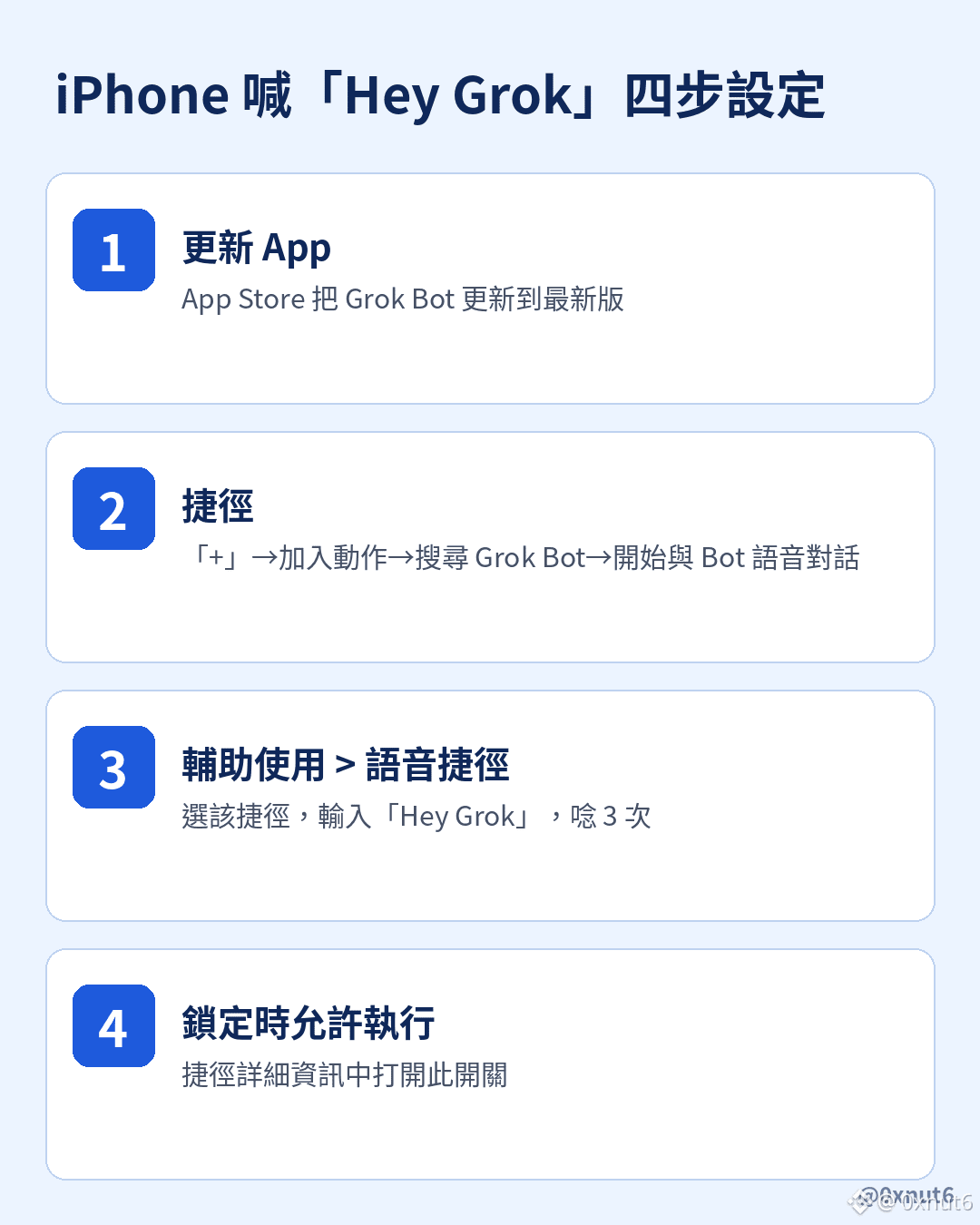
台灣 iOS 中文介面四步:
1. App Store 把 Grok Bot 更新到最新版
2. 「捷徑」App →「+」→「加入動作」→ 搜尋 Grok Bot → 選「開始與 Bot 語音對話」
3. 「設定」>「輔助使用」>「語音捷徑」→ 選該捷徑,輸入「Hey Grok」唸 3 次
4. 捷徑詳細資訊打開「鎖定時允許執行」
鎖屏時要先點一下螢幕確認;Face ID 已解鎖就全程免動手。
Войдите, чтобы посмотреть больше материала
Присоединяйтесь к пользователям криптовалют по всему миру на Binance Square
⚡️ Получайте новейшую и полезную информацию о криптоактивах.
💬 Нам доверяет крупнейшая в мире криптобиржа.
👍 Получите достоверные аналитические данные от верифицированных создателей контента.
Эл. почта/номер телефона
В тренде
BinanceReports80%Recoveryof$6.3BillioninLossesfromHackIncident
Просмотров: 192
18 обсуждают
Binance News Update | Binance Co-CEOs Say 80% of the $6.3 Billion Loss Is Already Covered, With Withdrawals Restarting in Phases and Proof of Reserves Due Monday
Binance News
·Лайков: 179
·Просмотров: 155.6k
TRMCambodianCasinosReceived$1.07BInCrypto
Просмотров: 125
18 обсуждают
IolePlansToSellAll151.21Bitcoin
Просмотров: 3,966
155 обсуждают