

Cryptopolitan
58.4k Публикации

Cryptopolitan
 Square Verified+
Отправить жалобу
Заблокировать пользователя
Crypto news that doesn't waste your time. Breaking updates, market analysis, on-chain insights. Building the smartest crypto community.

Creator of the Year
1 подписок(и/а)
161.5K+ подписчиков(а)
573.4K+ понравилось
1 Значки
Посты
PINNED
At Cryptopolitan, we research, analyze, and deliver news—daily.
From breaking updates to in-depth analysis, educational guides, and market insights, we’re here to keep you informed with neutral and authentic news.
Thank you for trusting us to be your go-to source!
At Cryptopolitan, we research, analyze, and deliver news—daily.
From breaking updates to in-depth analysis, educational guides, and market insights, we’re here to keep you informed with neutral and authentic news.
Thank you for trusting us to be your go-to source!
From breaking updates to in-depth analysis, educational guides, and market insights, we’re here to keep you informed with neutral and authentic news.
Thank you for trusting us to be your go-to source!

120
68
343
1.8k
BNB Chain’s Jenner Hardfork Goes Live on BSC Testnet With Dedicated Payment LaneBNB Chain has activated its Jenner hardfork on the BNB Smart Chain (BSC) Testnet today. The Jenner hard fork brings three key upgrades to the chain that together improves payments, RWA and DeFi on the network.
The headline upgrade is Payment Lane, which reserves a slice of every block for payments, such as simple BNB transfers between wallets, so they don’t get squeezed out when activity on the network ramps up. Jenner also lets smart contracts read block times to the millisecond and lays the foundation for CAS20, which is a new token standard for stablecoins and tokenized real-world assets.
BNB Chain stated that the timing of the upgrade reaching mainnet will be announced separately, while two of the three features require further governance activation.
Payment Lane Holds Back 5% of Every Block
Every single block on the Binance Smart Chain has a gas limit, which is a cap and determines how much computing work it can process. Say a memecoin launches and there’s a burst of activity, the number of transactions begin to snowball and fight for that space. In this instance, a merchant collecting a stablecoin payment ends up in the same queue as a bot firing off swaps.
Payment Lane, introduced under BEP-703, reserves 5% of each block’s gas for eligible payments by default. This means general transactions can’t use that space even when payment demand is low. Payments can still compete for the other 95% of block capacity. Governance can raise the reservation up to a protocol maximum of 10%.
What counts as payments is where the catch lies for now and BNB Chain was very clear about which transactions qualify in their blog about Payment Lane. Sending BNB from one wallet to another qualifies as payments automatically. On the other hand, stablecoins like USDT and UDSC don’t qualify, at least not yet. They will only qualify once governance adds them to an approved list, which currently has no entries.
Smart Contracts Can Now Read Time in Milliseconds
Every block on the BSC network has a timestamp or a record on when it was made. Until the Jenner hard fork, smart contracts could only read that time in whole seconds. Now there is a built in tool, under BEP-706, that strips this down to the millisecond.
This greatly helps apps where a fraction of a second can make all the difference. For instance a trading app might offer a price that’s valid only for a short window. With a seconds-only clock, the contract can’t enforce anything shorter than a full second, so a quote could stay usable after it should have expired.
Developers have to opt in to the new tool and contracts that use the old seconds-based clock will keep working as they do now. This change does not make block times any faster but rather just gives contracts a more precise reading of the time.
CAS20 is Built in but Still Switched Off
The third piece is CAS20, short for Compliant Asset Standard, under BEP-702. It is a token framework for issuers who need controls that a regular BEP-20 token doesn’t offer natively. Issuers get allowlists and blocklists, the ability to pause transfers, and separate roles for minting, burning and seizing tokens.
Jenner ships the underlying code, though nobody can create CAS20 tokens yet. That step needs separate activation by an administrator appointed through governance. BNB Chain also noted that the technical controls don’t on their own make a token legally compliant. CAS20 keeps compatibility with BEP-20 tooling, so existing wallets and apps should be able to read these tokens.
Block builders now have to respect the payment reservation when assembling blocks on testnet. The first governance votes on the payment list will show how quickly stablecoins actually get access to the lane.
The smartest crypto minds already read our newsletter. Want in? Join them.
BNB Chain’s Jenner Hardfork Goes Live on BSC Testnet With Dedicated Payment Lane
BNB Chain has activated its Jenner hardfork on the BNB Smart Chain (BSC) Testnet today. The Jenner hard fork brings three key upgrades to the chain that together improves payments, RWA and DeFi on the network.
The headline upgrade is Payment Lane, which reserves a slice of every block for payments, such as simple BNB transfers between wallets, so they don’t get squeezed out when activity on the network ramps up. Jenner also lets smart contracts read block times to the millisecond and lays the foundation for CAS20, which is a new token standard for stablecoins and tokenized real-world assets.
BNB Chain stated that the timing of the upgrade reaching mainnet will be announced separately, while two of the three features require further governance activation.
Payment Lane Holds Back 5% of Every Block
Every single block on the Binance Smart Chain has a gas limit, which is a cap and determines how much computing work it can process. Say a memecoin launches and there’s a burst of activity, the number of transactions begin to snowball and fight for that space. In this instance, a merchant collecting a stablecoin payment ends up in the same queue as a bot firing off swaps.
Payment Lane, introduced under BEP-703, reserves 5% of each block’s gas for eligible payments by default. This means general transactions can’t use that space even when payment demand is low. Payments can still compete for the other 95% of block capacity. Governance can raise the reservation up to a protocol maximum of 10%.
What counts as payments is where the catch lies for now and BNB Chain was very clear about which transactions qualify in their blog about Payment Lane. Sending BNB from one wallet to another qualifies as payments automatically. On the other hand, stablecoins like USDT and UDSC don’t qualify, at least not yet. They will only qualify once governance adds them to an approved list, which currently has no entries.
Smart Contracts Can Now Read Time in Milliseconds
Every block on the BSC network has a timestamp or a record on when it was made. Until the Jenner hard fork, smart contracts could only read that time in whole seconds. Now there is a built in tool, under BEP-706, that strips this down to the millisecond.
This greatly helps apps where a fraction of a second can make all the difference. For instance a trading app might offer a price that’s valid only for a short window. With a seconds-only clock, the contract can’t enforce anything shorter than a full second, so a quote could stay usable after it should have expired.
Developers have to opt in to the new tool and contracts that use the old seconds-based clock will keep working as they do now. This change does not make block times any faster but rather just gives contracts a more precise reading of the time.
CAS20 is Built in but Still Switched Off
The third piece is CAS20, short for Compliant Asset Standard, under BEP-702. It is a token framework for issuers who need controls that a regular BEP-20 token doesn’t offer natively. Issuers get allowlists and blocklists, the ability to pause transfers, and separate roles for minting, burning and seizing tokens.
Jenner ships the underlying code, though nobody can create CAS20 tokens yet. That step needs separate activation by an administrator appointed through governance. BNB Chain also noted that the technical controls don’t on their own make a token legally compliant. CAS20 keeps compatibility with BEP-20 tooling, so existing wallets and apps should be able to read these tokens.
Block builders now have to respect the payment reservation when assembling blocks on testnet. The first governance votes on the payment list will show how quickly stablecoins actually get access to the lane.
The smartest crypto minds already read our newsletter. Want in? Join them.
87
Solana co-founder warns firms opposing tokenized stocks to go privateThe co-founder of Solana, Anatoly Yakovenko, contends that U.S. public corporations must evolve alongside digital assets. Those that refuse to allow their shares to be traded on-chain should withdraw from public markets entirely, he said.
At the moment, tokenized stock trading is absolutely booming, but a growing list of household-name companies want absolutely nothing to do with it. Goldman Sachs, Microsoft, Qualcomm, Caterpillar, McDonald’s, Apple, Western Digital, and Alphabet are just some of the firms that have declined to have their equities tokenized on OKXICE, the joint venture between OKX and Intercontinental Exchange.
More than 30 companies are against the stock trading on OKXICE
About 33 major public companies are drawing a hard line against crypto-native stock trading. Heavyweights from Wells Fargo, Coca-Cola and JPMorgan to tech giants like Dell, Advanced Micro Devices, Intel, AppLovin, and CoreWeave are opting out of the OKXICE TSV.
The SEC’s Innovation Exemption Order, enacted in September, formally mandates that tokenized securities venues must provide advance notice to unaffiliated issuers. The companies have only 30 days to raise any written objection regarding trading on a specific platform.
According to Dave Hendricks, CEO of SEC-registered digital transfer agent Vertalo, the current wave of objections indicates that the regulatory guardrails are functional. He explained that the 30-day window was explicitly engineered by the SEC to preserve issuer agency, and corporations are actively exercising that right.
The SEC’s exemption provides a limited framework for testing tokenized securities, but doesn’t eliminate all regulatory requirements. Its five-year lifespan provides market participants with a chance to test blockchain-based trading under the new framework.
But the issuer objection mechanism is a major obstacle for venues looking to list U.S. stocks. Even if investors want access to a company’s tokenized shares, the platform cannot proceed under this framework if the issuer objects.
Although most firms have yet to disclose their reasons for opposing OKXICE. Mirza Uddin, chief operating officer of Injective, nonetheless says firms like Goldman Sachs and Microsoft see more problems than benefits in a token beyond their control, especially one that operates around the clock with ambiguous voting rights.
He maintained that industry needs to convince issuers that tokenization offers real advantages, because without that, progress will continue outside the U.S. while regulators debate whether to allow it.
Similarly, ClearStreet analyst Owen Lau also said companies just don’t see the full value of tokenization yet, though he anticipates eventual corporate adoption. “Some companies will say yes or will not object to this because of the benefits … the expanded investor base, 24/7 [access], increased distribution channel. Some of the beaten-down stocks with low trading volume could be good candidates,” he said.
On the other hand, Carlos Domingo, CEO of the tokenization company Securitise, pointed out that issuers’ concerns were justified, as it was quite natural for corporations to worry about pricing, investor protection, and shareholders’ rights in these new markets.
“There’s an important education process underway, and issuers should understand that they have different options for participating in tokenization, including issuer-sponsored approaches,” he said.
OKXICE, too, has so far characterised the opt-outs as quite natural. Its co-chairman, Andrew Cuomo, has said they had expected many companies to observe and wait until the initiative progressed further.
Aside from OKXICE, TSV LLC, and Perpetuals.com have also submitted notices of intent to launch blockchain-based Tokenized Securities Venues (TSVs) under the U.S. SEC Innovation Exemption.
Tokenization volumes rose to $11.31 billion in September on Robinhood Chain
Yakovenko’s view is that firms should embrace the advantages of a public listing and the obligations that come with it. He asserted that opposition to the way their stocks are traded contradicts their decision to list them.
Although he believes the issuer objections do not imply any problem with tokenization, but just that issuers want the benefits of listing without making some changes that come with the evolving trading system.
Nevertheless, the corporate resistance did little to curb the investor enthusiasm. The volume of tokenized equity trades on Robinhood Chain grew from $526 million in July to $2.21 billion in August, and finally exploded to $11.31 billion in September.
Non-crypto markets also represented 36.5% of Hyperliquid’s perpetuals volume in the quarter, up from 32.7% a quarter earlier. At the same time, tokenized stocks recorded the fastest growth among asset categories on Solana.
The growing divide raises questions about whether traditional companies will eventually embrace blockchain-based trading or continue to restrict unaffiliated platforms from offering tokens linked to their shares.
The crypto industry broadly calls for open financial markets, and Yakovenko’s words also suggest it will likely be a long time before tokenization platforms can address issuers’ concerns about shareholder rights, market oversight and investor protection.
If you're reading this, you’re already ahead. Stay there with our newsletter.
Solana co-founder warns firms opposing tokenized stocks to go private
The co-founder of Solana, Anatoly Yakovenko, contends that U.S. public corporations must evolve alongside digital assets. Those that refuse to allow their shares to be traded on-chain should withdraw from public markets entirely, he said.
At the moment, tokenized stock trading is absolutely booming, but a growing list of household-name companies want absolutely nothing to do with it. Goldman Sachs, Microsoft, Qualcomm, Caterpillar, McDonald’s, Apple, Western Digital, and Alphabet are just some of the firms that have declined to have their equities tokenized on OKXICE, the joint venture between OKX and Intercontinental Exchange.
More than 30 companies are against the stock trading on OKXICE
About 33 major public companies are drawing a hard line against crypto-native stock trading. Heavyweights from Wells Fargo, Coca-Cola and JPMorgan to tech giants like Dell, Advanced Micro Devices, Intel, AppLovin, and CoreWeave are opting out of the OKXICE TSV.
The SEC’s Innovation Exemption Order, enacted in September, formally mandates that tokenized securities venues must provide advance notice to unaffiliated issuers. The companies have only 30 days to raise any written objection regarding trading on a specific platform.
According to Dave Hendricks, CEO of SEC-registered digital transfer agent Vertalo, the current wave of objections indicates that the regulatory guardrails are functional. He explained that the 30-day window was explicitly engineered by the SEC to preserve issuer agency, and corporations are actively exercising that right.
The SEC’s exemption provides a limited framework for testing tokenized securities, but doesn’t eliminate all regulatory requirements. Its five-year lifespan provides market participants with a chance to test blockchain-based trading under the new framework.
But the issuer objection mechanism is a major obstacle for venues looking to list U.S. stocks. Even if investors want access to a company’s tokenized shares, the platform cannot proceed under this framework if the issuer objects.
Although most firms have yet to disclose their reasons for opposing OKXICE. Mirza Uddin, chief operating officer of Injective, nonetheless says firms like Goldman Sachs and Microsoft see more problems than benefits in a token beyond their control, especially one that operates around the clock with ambiguous voting rights.
He maintained that industry needs to convince issuers that tokenization offers real advantages, because without that, progress will continue outside the U.S. while regulators debate whether to allow it.
Similarly, ClearStreet analyst Owen Lau also said companies just don’t see the full value of tokenization yet, though he anticipates eventual corporate adoption. “Some companies will say yes or will not object to this because of the benefits … the expanded investor base, 24/7 [access], increased distribution channel. Some of the beaten-down stocks with low trading volume could be good candidates,” he said.
On the other hand, Carlos Domingo, CEO of the tokenization company Securitise, pointed out that issuers’ concerns were justified, as it was quite natural for corporations to worry about pricing, investor protection, and shareholders’ rights in these new markets.
“There’s an important education process underway, and issuers should understand that they have different options for participating in tokenization, including issuer-sponsored approaches,” he said.
OKXICE, too, has so far characterised the opt-outs as quite natural. Its co-chairman, Andrew Cuomo, has said they had expected many companies to observe and wait until the initiative progressed further.
Aside from OKXICE, TSV LLC, and Perpetuals.com have also submitted notices of intent to launch blockchain-based Tokenized Securities Venues (TSVs) under the U.S. SEC Innovation Exemption.
Tokenization volumes rose to $11.31 billion in September on Robinhood Chain
Yakovenko’s view is that firms should embrace the advantages of a public listing and the obligations that come with it. He asserted that opposition to the way their stocks are traded contradicts their decision to list them.
Although he believes the issuer objections do not imply any problem with tokenization, but just that issuers want the benefits of listing without making some changes that come with the evolving trading system.
Nevertheless, the corporate resistance did little to curb the investor enthusiasm. The volume of tokenized equity trades on Robinhood Chain grew from $526 million in July to $2.21 billion in August, and finally exploded to $11.31 billion in September.
Non-crypto markets also represented 36.5% of Hyperliquid’s perpetuals volume in the quarter, up from 32.7% a quarter earlier. At the same time, tokenized stocks recorded the fastest growth among asset categories on Solana.
The growing divide raises questions about whether traditional companies will eventually embrace blockchain-based trading or continue to restrict unaffiliated platforms from offering tokens linked to their shares.
The crypto industry broadly calls for open financial markets, and Yakovenko’s words also suggest it will likely be a long time before tokenization platforms can address issuers’ concerns about shareholder rights, market oversight and investor protection.
If you're reading this, you’re already ahead. Stay there with our newsletter.
84
Google stock plunges 10% after Alphabet’s $127.6 billion quarter disappoints Wall StreetGoogle stock dropped more than 10% after Alphabet (GOOGL) delivered a $127.58 billion third quarter that fell short of Wall Street’s expectations. Revenue grew 25%, but spending on artificial intelligence left investors worried about cash.
Alphabet’s AI bill keeps getting bigger
Analysts surveyed by LSEG had expected $128.22 billion in sales and adjusted earnings of $3.02 per share. Alphabet reported just $2.67 in adjusted earnings per share. It was the company’s first double miss in almost four years.
Net income fell to $26.17 billion, or $2.12 per share, from $34.98 billion, or $2.87 per share, a year ago. Operating income reached $40.58 billion, below the $43.19 billion forecast compiled by FactSet.
But the number that really got investors talking was free cash flow. Alphabet recorded a negative $9.07 billion, compared with the $2.70 billion deficit analysts had penciled in. That raises questions about the payoff from AI.
Pure capital expenditures were estimated at $51.36 billion in the quarter, while forecasts suggested that they would be at $55.09 billion. However, the yearly budget will still remain very large. Alphabet maintains its budget estimate between $195 billion and $205 billion, revised up from its previous $190 billion target in the second quarter.
The budget is projected to exceed $200 billion for this year and is estimated to top $300 billion by 2027.
Finance chief Anat Ashkenazi told analysts, “We continue to expect our capex to increase significantly in 2027, and will provide further details on our Q4 call.”
There is also a growing debt tab. Alphabet’s long-term borrowing jumped from $21.6 billion a year ago to $125.1 billion, an increase of roughly 479%.
And the investment portfolio wasn’t much help. Equity holdings linked to companies including SpaceX and Anthropic helped produce a $99.03 billion gain in the second quarter. This time, that category registered an $8.66 billion loss.
Google Cloud delivers, but Search misses its target
The interesting part is that Alphabet’s AI business isn’t struggling to find customers. Google Cloud revenue more than doubled to $30.7 billion, comfortably beating the $28.7 billion analysts had expected.
Growth reached 103% as businesses rushed to buy computing power and AI tools. Google is gaining ground against Amazon Web Services and Microsoft Azure.
Google Cloud CEO Thomas Kurian told investors, “We are seeing extraordinary demand and strong growth from both AI labs, capital markets, financial service institutions, and enterprises.” It was his earnings-call debut.
The older money machine, Google Search, had a less convincing quarter. Revenue rose 12% to $63.35 billion but missed the $64.96 billion estimate. CEO Sundar Pichai said AI features are bringing in more searches, including commercial queries, and that annual query growth is now its strongest in five years.
Sundar told analysts:
“We had a strong quarter and are now on a half-trillion dollar revenue run rate. Our deep full stack approach is driving momentum across the business, with Alphabet revenues growing 25% year-over-year.”
There are plenty of usage numbers behind that push. The Gemini app now has one billion users, which Alphabet says makes it Google’s fastest-growing product ever.
YouTube Music and Premium have passed 150 million subscribers worldwide, including trials. Google’s own AI model interfaces are handling nearly 32 billion tokens a minute, more than four times last year’s volume, while demand for its custom TPU chips is rising.
Moreover, Sundar provided details about upcoming releases in AI. As Sundar mentioned, the new release Gemini 4 Argon has attracted many users but the even more advanced version of Carbon outperforms its predecessor in nearly all the tested categories, including programming, multimodal capabilities, scientific reasoning and deep knowledge.
The rating for Carbon was 59 on the upgraded Artificial Analysis Intelligence Index, which puts Carbon on the first place. Google provides the first preview of the product to the trustworthy security experts and the U.S. government.
Then there’s Genie 4, Google’s latest world model, which creates interactive, realistic digital environments with live audio. Google wants to use them to train robots and AI agents.
Sundar expects model development to speed up over the next year as AI helps improve AI research itself, a process he referred to as RSI. Smaller, cheaper and faster models are also on the way for developers and Google’s billions of users.
The smartest crypto minds already read our newsletter. Want in? Join them.
Google stock plunges 10% after Alphabet’s $127.6 billion quarter disappoints Wall Street
Google stock dropped more than 10% after Alphabet (GOOGL) delivered a $127.58 billion third quarter that fell short of Wall Street’s expectations. Revenue grew 25%, but spending on artificial intelligence left investors worried about cash.
Alphabet’s AI bill keeps getting bigger
Analysts surveyed by LSEG had expected $128.22 billion in sales and adjusted earnings of $3.02 per share. Alphabet reported just $2.67 in adjusted earnings per share. It was the company’s first double miss in almost four years.
Net income fell to $26.17 billion, or $2.12 per share, from $34.98 billion, or $2.87 per share, a year ago. Operating income reached $40.58 billion, below the $43.19 billion forecast compiled by FactSet.
But the number that really got investors talking was free cash flow. Alphabet recorded a negative $9.07 billion, compared with the $2.70 billion deficit analysts had penciled in. That raises questions about the payoff from AI.
Pure capital expenditures were estimated at $51.36 billion in the quarter, while forecasts suggested that they would be at $55.09 billion. However, the yearly budget will still remain very large. Alphabet maintains its budget estimate between $195 billion and $205 billion, revised up from its previous $190 billion target in the second quarter.
The budget is projected to exceed $200 billion for this year and is estimated to top $300 billion by 2027.
Finance chief Anat Ashkenazi told analysts, “We continue to expect our capex to increase significantly in 2027, and will provide further details on our Q4 call.”
There is also a growing debt tab. Alphabet’s long-term borrowing jumped from $21.6 billion a year ago to $125.1 billion, an increase of roughly 479%.
And the investment portfolio wasn’t much help. Equity holdings linked to companies including SpaceX and Anthropic helped produce a $99.03 billion gain in the second quarter. This time, that category registered an $8.66 billion loss.
Google Cloud delivers, but Search misses its target
The interesting part is that Alphabet’s AI business isn’t struggling to find customers. Google Cloud revenue more than doubled to $30.7 billion, comfortably beating the $28.7 billion analysts had expected.
Growth reached 103% as businesses rushed to buy computing power and AI tools. Google is gaining ground against Amazon Web Services and Microsoft Azure.
Google Cloud CEO Thomas Kurian told investors, “We are seeing extraordinary demand and strong growth from both AI labs, capital markets, financial service institutions, and enterprises.” It was his earnings-call debut.
The older money machine, Google Search, had a less convincing quarter. Revenue rose 12% to $63.35 billion but missed the $64.96 billion estimate. CEO Sundar Pichai said AI features are bringing in more searches, including commercial queries, and that annual query growth is now its strongest in five years.
Sundar told analysts:
“We had a strong quarter and are now on a half-trillion dollar revenue run rate. Our deep full stack approach is driving momentum across the business, with Alphabet revenues growing 25% year-over-year.”
There are plenty of usage numbers behind that push. The Gemini app now has one billion users, which Alphabet says makes it Google’s fastest-growing product ever.
YouTube Music and Premium have passed 150 million subscribers worldwide, including trials. Google’s own AI model interfaces are handling nearly 32 billion tokens a minute, more than four times last year’s volume, while demand for its custom TPU chips is rising.
Moreover, Sundar provided details about upcoming releases in AI. As Sundar mentioned, the new release Gemini 4 Argon has attracted many users but the even more advanced version of Carbon outperforms its predecessor in nearly all the tested categories, including programming, multimodal capabilities, scientific reasoning and deep knowledge.
The rating for Carbon was 59 on the upgraded Artificial Analysis Intelligence Index, which puts Carbon on the first place. Google provides the first preview of the product to the trustworthy security experts and the U.S. government.
Then there’s Genie 4, Google’s latest world model, which creates interactive, realistic digital environments with live audio. Google wants to use them to train robots and AI agents.
Sundar expects model development to speed up over the next year as AI helps improve AI research itself, a process he referred to as RSI. Smaller, cheaper and faster models are also on the way for developers and Google’s billions of users.
The smartest crypto minds already read our newsletter. Want in? Join them.
157
Статья
Former DOJ antitrust chiefs launch FluxCap to bring AI to plaintiffsBig lawsuits often require big budgets, putting smaller legal teams at a disadvantage. Jonathan Kanter and Doha Mekki, the former heads of the antitrust division of the US Justice Department, think that AI can help get around this disadvantage.
Hence, FluxCap was born, a legal AI startup specifically for the use of plaintiffs’ lawyers and government enforcers, on October 28, 2026.
Kanter commented to Reuters that plaintiffs’ lawyers and government enforcers are still “highly underserved,” while a number of AI developers are providing services to law firms. FluxCap aims to get this rectified by giving smaller legal teams the tools to pursue complex cases against opponents with more resources.
Three engines for facts, law and strategy
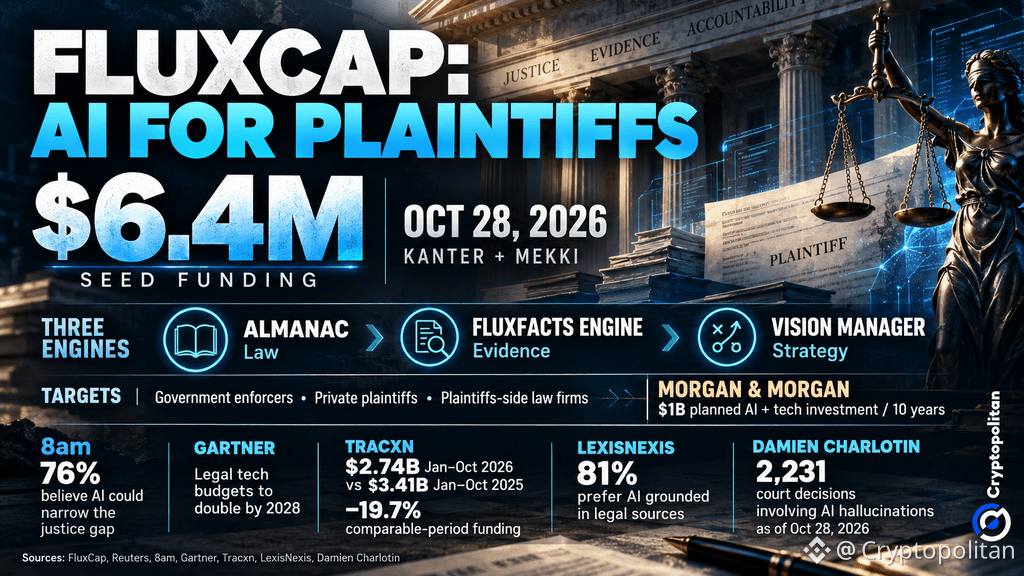
FluxCap launched with $6.4 million in seed funding, including backing from Y Combinator, Bloomberg Beta and Burford Capital. Former Palantir lead engineer Marshall Seid is its chief technology officer.
Three connected engines do the heavy lifting: Almanac organizes legal precedents, FluxFacts Engine ties claims to evidence, and Vision Manager helps lawyers refine their strategy.
Mekki explained the stakes in the launch announcement:
Too often, meritorious cases never get brought because of the time, expense, and resources required to investigate and litigate well.
FluxCap is starting with antitrust, with other specialties planned. Its promised efficiency gains have yet to be independently demonstrated in court.
An underserved plaintiffs’ market, and deep-pocketed rivals
FluxCap won’t have the field to itself. Morgan & Morgan announced plans in September to invest at least $1 billion in AI and technology over ten years. It aims to sell its platform to other firms in 2027.
Many legal professionals believe AI could make justice more accessible. A survey of more than 1,300 legal professionals by professional business platform 8am found that 76% believe AI could narrow the access-to-justice gap. Whether AI has actually made litigation more affordable, however, remains to be seen.
Where antitrust and AI concentration meet
The launch of FluxCap takes place at a moment when competition in the AI industry is under scrutiny. In its report published in July 2026, OECD investigates issues of market concentration and competitive challenges arising from the continuous expansion of the AI industry.
However, the outlook of the legal-tech market is not as clear-cut. Gartner forecasts legal-tech budgets to double by 2028, but investment has slowed. According to Tracxn, legal-tech companies raised $2.74 billion in equity funding through October 2026, down 19.7% from $3.41 billion during the same period in 2025.
FluxCap AI Launch: $6.4M Seed Funding and Legal Tech Market Trends
Competition is also coming from major technology companies. Google has entered the legal AI market with Gemini Enterprise for Legal, as Cryptopolitan reported.
Why accuracy still decides the outcome
Speed means little if AI gets the law wrong. A September LexisNexis survey found 81% of lawyers more comfortable with AI grounded in trusted legal sources, up from 70% a year earlier.
Researcher Damien Charlotin had tracked 2,231 judicial decisions involving AI-generated hallucinations by October 28, 2026. That tally is not an error rate for legal AI tools.
FluxCap’s real test will be whether its evidence and citations hold up under scrutiny. Saving lawyers time matters. Giving them arguments they can trust matters more.
The smartest crypto minds already read our newsletter. Want in? Join them.
Former DOJ antitrust chiefs launch FluxCap to bring AI to plaintiffs
Big lawsuits often require big budgets, putting smaller legal teams at a disadvantage. Jonathan Kanter and Doha Mekki, the former heads of the antitrust division of the US Justice Department, think that AI can help get around this disadvantage.
Hence, FluxCap was born, a legal AI startup specifically for the use of plaintiffs’ lawyers and government enforcers, on October 28, 2026.
Kanter commented to Reuters that plaintiffs’ lawyers and government enforcers are still “highly underserved,” while a number of AI developers are providing services to law firms. FluxCap aims to get this rectified by giving smaller legal teams the tools to pursue complex cases against opponents with more resources.
Three engines for facts, law and strategy
FluxCap launched with $6.4 million in seed funding, including backing from Y Combinator, Bloomberg Beta and Burford Capital. Former Palantir lead engineer Marshall Seid is its chief technology officer.
Three connected engines do the heavy lifting: Almanac organizes legal precedents, FluxFacts Engine ties claims to evidence, and Vision Manager helps lawyers refine their strategy.
Mekki explained the stakes in the launch announcement:
Too often, meritorious cases never get brought because of the time, expense, and resources required to investigate and litigate well.
FluxCap is starting with antitrust, with other specialties planned. Its promised efficiency gains have yet to be independently demonstrated in court.
An underserved plaintiffs’ market, and deep-pocketed rivals
FluxCap won’t have the field to itself. Morgan & Morgan announced plans in September to invest at least $1 billion in AI and technology over ten years. It aims to sell its platform to other firms in 2027.
Many legal professionals believe AI could make justice more accessible. A survey of more than 1,300 legal professionals by professional business platform 8am found that 76% believe AI could narrow the access-to-justice gap. Whether AI has actually made litigation more affordable, however, remains to be seen.
Where antitrust and AI concentration meet
The launch of FluxCap takes place at a moment when competition in the AI industry is under scrutiny. In its report published in July 2026, OECD investigates issues of market concentration and competitive challenges arising from the continuous expansion of the AI industry.
However, the outlook of the legal-tech market is not as clear-cut. Gartner forecasts legal-tech budgets to double by 2028, but investment has slowed. According to Tracxn, legal-tech companies raised $2.74 billion in equity funding through October 2026, down 19.7% from $3.41 billion during the same period in 2025.
FluxCap AI Launch: $6.4M Seed Funding and Legal Tech Market Trends
Competition is also coming from major technology companies. Google has entered the legal AI market with Gemini Enterprise for Legal, as Cryptopolitan reported.
Why accuracy still decides the outcome
Speed means little if AI gets the law wrong. A September LexisNexis survey found 81% of lawyers more comfortable with AI grounded in trusted legal sources, up from 70% a year earlier.
Researcher Damien Charlotin had tracked 2,231 judicial decisions involving AI-generated hallucinations by October 28, 2026. That tally is not an error rate for legal AI tools.
FluxCap’s real test will be whether its evidence and citations hold up under scrutiny. Saving lawyers time matters. Giving them arguments they can trust matters more.
The smartest crypto minds already read our newsletter. Want in? Join them.
69
Статья
Oracle caps new financing at $20B as AI spending tests cash flowOracle is setting a limit on its borrowing or increments it will incur through investors for its AI growth. On October 28, 2026, the company declared that any new borrowing will be restricted to $20 billion until the end of financial year 2030. In addition, Oracle anticipates a minimum cash flow of $30 billion in fiscal year 2029.
At its Las Vegas investor day, Oracle sought to ease concerns about the cost of its massive AI buildout. The message was simple: its growing backlog of AI contracts should eventually bring in enough cash to help pay for the infrastructure needed to fulfill them.
The ceiling Oracle set, and the timeline behind it
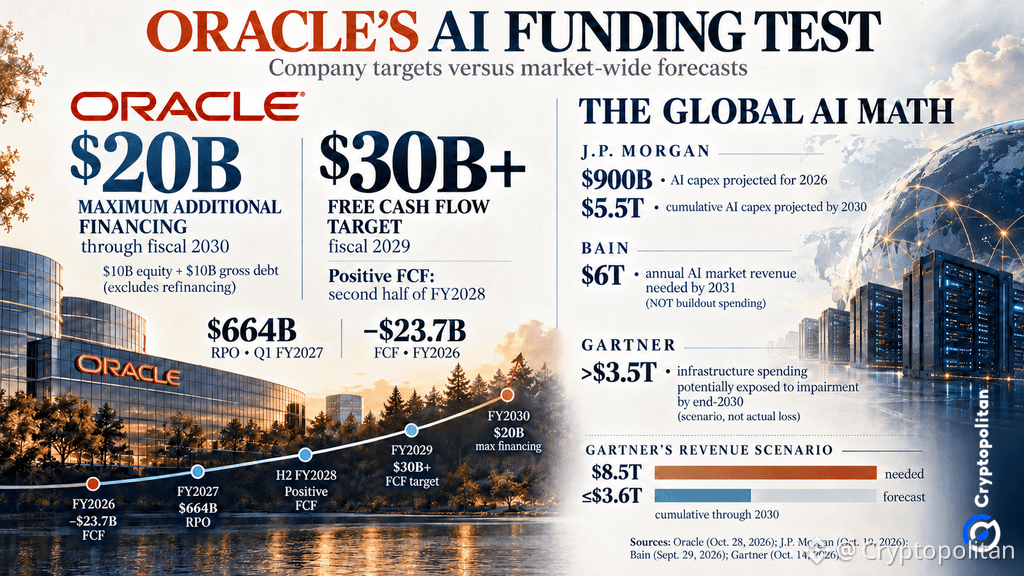
Oracle’s finances won’t improve overnight. The company expects capital spending to reach its highest levels in fiscal 2027 and 2028. CFO Hilary Maxson said free cash flow should turn positive in the second half of fiscal 2028.
Oracle plans to raise no more than $20 billion in additional funding. That includes $10 billion from equity and another $10 billion in gross debt. The limit excludes refinancing and comes on top of the $20 billion share sale completed earlier in fiscal 2027.
Oracle anticipates that by the 2029 fiscal year, it will be able to sustain company growth without requiring any kind of new investment in the business.
The company also aims to ensure that the amount of its net debt does not exceed the equivalent of 3.5 times its adjusted EBITDA. These announcements pleased the investors, who on October 28 sent Oracle shares up by more than 12%.
Why the promise was necessary
Oracle has good reason to reassure investors. The company reported negative free cash flow of $23.7 billion in fiscal 2026. Another $5 billion went out in the first quarter of fiscal 2027.
Demand isn’t the problem. First-quarter revenue rose 30% to $19.3 billion, while cloud infrastructure sales surged 121% to $7.4 billion.
The trouble is that building data centers costs money long before customers start paying for the services. Oracle already had $125.34 billion in borrowings as of August 31, 2026.
Backlog is not revenue, and OpenAI is most of it
Oracle’s $664 billion backlog looks impressive, but that money isn’t in the bank. It represents future business that the company has yet to deliver. According to its SEC filing, roughly half should become revenue within 36 months.
A reported $300 billion computing deal with OpenAI, spread over five years, adds another concern. Oracle is counting heavily on one customer to fulfil a substantial part of its business.
To ease the financial burden, Oracle is turning to vendor financing, customer-supplied hardware and advance payments. Customers prepaid $11.36 billion of first-quarter capital spending, as Cryptopolitan reported.
What the AI math outside Oracle says
Oracle isn’t alone in facing tough questions about AI spending. J.P. Morgan expects global AI capital expenditure to reach $900 billion in 2026 and total $5.5 trillion by 2030. Companies are also relying more on debt and equity to finance their expansion.
But will AI generate enough revenue to justify those investments?
Bain estimates the industry could need nearly $6 trillion in annual revenue by 2031 to sustain its infrastructure spending. Existing consumer and enterprise applications would still leave a $4.2 trillion gap.
The stakes are high. On October 14, 2026, Gartner warned that more than $3.5 trillion in AI infrastructure spending could be at risk of write-downs by the end of 2030.
The numbers explain why. Gartner estimates that data-center operators would need $8.5 trillion in revenue through 2030 to recover their costs and earn a 12% return. But it expects them to generate no more than $3.6 trillion.
Oracle’s $20B AI Funding Cap and $30B Cash Flow Target Amid Trillion-Dollar Market Risks
This is a challenge for Oracle’s promises. If it meets its objectives, that could confirm that large investments in AI can eventually be justified. If it misses its targets, it will only add to the burdens of a company swimming in debt and heavily dependent on OpenAI.
Don’t just read crypto news. Understand it. Subscribe to our newsletter. It's free.
Oracle caps new financing at $20B as AI spending tests cash flow
Oracle is setting a limit on its borrowing or increments it will incur through investors for its AI growth. On October 28, 2026, the company declared that any new borrowing will be restricted to $20 billion until the end of financial year 2030. In addition, Oracle anticipates a minimum cash flow of $30 billion in fiscal year 2029.
At its Las Vegas investor day, Oracle sought to ease concerns about the cost of its massive AI buildout. The message was simple: its growing backlog of AI contracts should eventually bring in enough cash to help pay for the infrastructure needed to fulfill them.
The ceiling Oracle set, and the timeline behind it
Oracle’s finances won’t improve overnight. The company expects capital spending to reach its highest levels in fiscal 2027 and 2028. CFO Hilary Maxson said free cash flow should turn positive in the second half of fiscal 2028.
Oracle plans to raise no more than $20 billion in additional funding. That includes $10 billion from equity and another $10 billion in gross debt. The limit excludes refinancing and comes on top of the $20 billion share sale completed earlier in fiscal 2027.
Oracle anticipates that by the 2029 fiscal year, it will be able to sustain company growth without requiring any kind of new investment in the business.
The company also aims to ensure that the amount of its net debt does not exceed the equivalent of 3.5 times its adjusted EBITDA. These announcements pleased the investors, who on October 28 sent Oracle shares up by more than 12%.
Why the promise was necessary
Oracle has good reason to reassure investors. The company reported negative free cash flow of $23.7 billion in fiscal 2026. Another $5 billion went out in the first quarter of fiscal 2027.
Demand isn’t the problem. First-quarter revenue rose 30% to $19.3 billion, while cloud infrastructure sales surged 121% to $7.4 billion.
The trouble is that building data centers costs money long before customers start paying for the services. Oracle already had $125.34 billion in borrowings as of August 31, 2026.
Backlog is not revenue, and OpenAI is most of it
Oracle’s $664 billion backlog looks impressive, but that money isn’t in the bank. It represents future business that the company has yet to deliver. According to its SEC filing, roughly half should become revenue within 36 months.
A reported $300 billion computing deal with OpenAI, spread over five years, adds another concern. Oracle is counting heavily on one customer to fulfil a substantial part of its business.
To ease the financial burden, Oracle is turning to vendor financing, customer-supplied hardware and advance payments. Customers prepaid $11.36 billion of first-quarter capital spending, as Cryptopolitan reported.
What the AI math outside Oracle says
Oracle isn’t alone in facing tough questions about AI spending. J.P. Morgan expects global AI capital expenditure to reach $900 billion in 2026 and total $5.5 trillion by 2030. Companies are also relying more on debt and equity to finance their expansion.
But will AI generate enough revenue to justify those investments?
Bain estimates the industry could need nearly $6 trillion in annual revenue by 2031 to sustain its infrastructure spending. Existing consumer and enterprise applications would still leave a $4.2 trillion gap.
The stakes are high. On October 14, 2026, Gartner warned that more than $3.5 trillion in AI infrastructure spending could be at risk of write-downs by the end of 2030.
The numbers explain why. Gartner estimates that data-center operators would need $8.5 trillion in revenue through 2030 to recover their costs and earn a 12% return. But it expects them to generate no more than $3.6 trillion.
Oracle’s $20B AI Funding Cap and $30B Cash Flow Target Amid Trillion-Dollar Market Risks
This is a challenge for Oracle’s promises. If it meets its objectives, that could confirm that large investments in AI can eventually be justified. If it misses its targets, it will only add to the burdens of a company swimming in debt and heavily dependent on OpenAI.
Don’t just read crypto news. Understand it. Subscribe to our newsletter. It's free.
84
Статья
Ray Kurzweil builds an AI replica meant to speak for him after deathRay Kurzweil, a 78-year-old futurist, is creating an artificial intelligence clone of himself that can talk, think, and learn from interactions, but he plans to keep it conversing with people even after he dies, reports The Information on Tuesday.
The clone, named RAI, is a collaboration between Kurzweil Technologies, the company owned by him, and Praxis AI, which markets its products as Human-First Digital Twins.
RAI was built from decades of Kurzweil’s work
RAI was jointly launched by the two firms on July 6, 2026, and describes itself as an attempt to capture not just what Kurzweil wrote but how he thinks, derived from six decades of his writing, interviews, and personal memories. It uses a Praxis architecture known as the “3D Digital Brain,” and it has its own governance layer and a provenance layer called PraxisShield and Praxis IP Vault respectively.
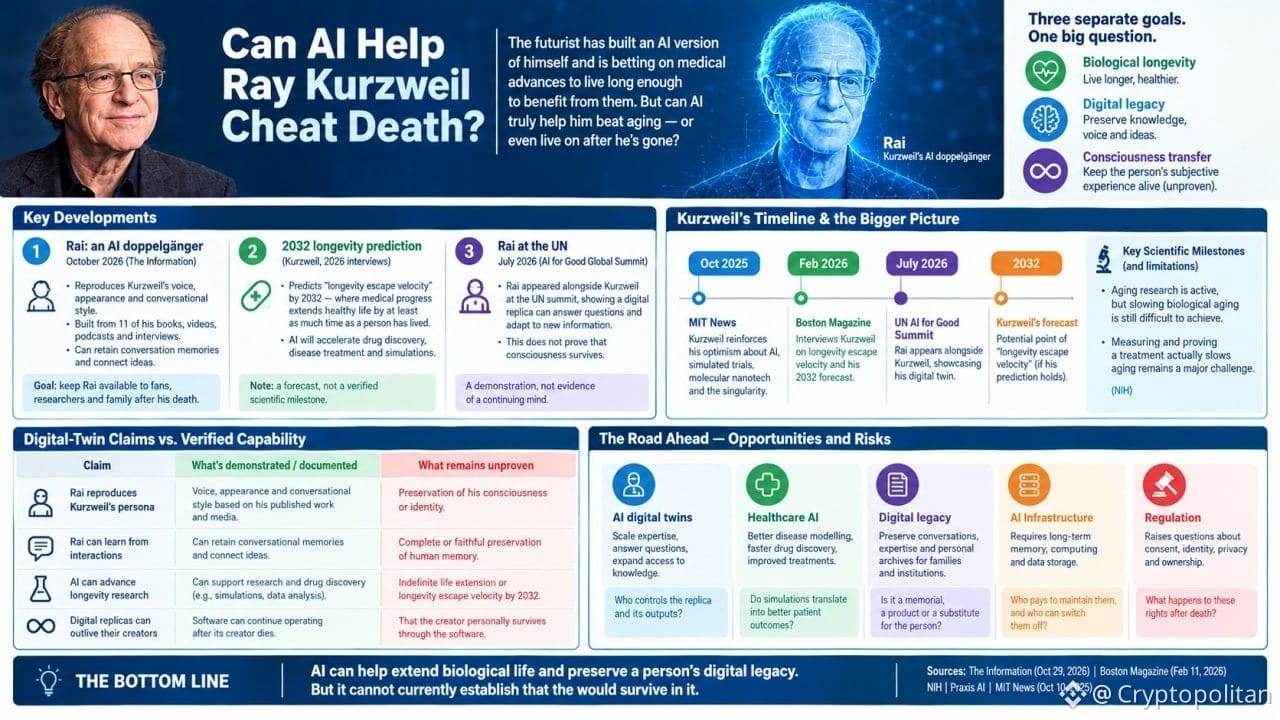
There is limited information about the construction of RAI provided by the firms at the beginning, but The Information has now found out that it operates on a Google language model and takes inspiration from 11 books by Kurzweil, a lot of videos and podcasts, hundreds of articles written about him, and many other sources he personally approved of. The exact Google model used is still unknown.
RAI delivered one of Kurzweil’s most quoted AI lines
RAI went live on July 10, 2026, during Kurzweil’s Center Stage talk at the UN’s AI for Good Global Summit. He later appeared with it on the closing-day panel, “What Could the Next Decade of AI Mean for Humanity?”, moderated by The Economist’s deputy executive editor Kenneth Cukier.
The summit’s own writeup was headlined “We will not be replaced by AI, we will merge with it.” But the specific statement “We are going to merge with them” was delivered by RAI as it continued the discussion on Kurzweil’s behalf.
Kurzweil’s comments were more particular, however. He asserted that AGI would compute significantly faster than humans and that biology was increasingly being transformed into information technology.
Although the underlying idea was consistent with his views, the exact wording that he would go on to be quoted for after the conference was from his AI version.
Praxis claims 97% accuracy without independent testing
According to Praxis, the review layer called Superbrain examines every answer prior to it reaching the user, “keeping accuracy above 97%” and boasts 400 percent better performance than regular retrieval-augmented generation.
The company mentions a United States Patent Application, number 19/647,154, that covers fourteen technological breakthroughs, and notes that each answer is referenced and can be traced to the passage approved by an expert.
None of it is independently verified. The 97% figure is Praxis’s own measurement against an undisclosed benchmark, and no third party has published an evaluation of RAI. The act of referencing solves the problem of a replica making up something that was never even said by its source, but the very process of generating content from scratch can produce a response the source itself wouldn’t accept.
Kurzweil’s 2032 longevity prediction remains far ahead of the evidence
Awarded the Robert A. Muh Alumni Award by the Massachusetts Institute of Technology (MIT) on October 8, 2025, Ray Kurzweil predicted that by about 2032, the rate of scientific advancement could be such that one reaches longevity escape velocity where “a year of additional life expectancy is gained per year of remaining life.” MIT reported the prediction as part of his “Reinventing Intelligence” lecture.
Ray Kurzweil Immortality Timeline
Current human research is far more modest. NIH-funded researchers led by Columbia epidemiologist Daniel Belsky developed DunedinPACE using data from more than 1,000 people born in New Zealand in 1972 and 1973. This test measures the speed of biological aging using DNA methylation at 173 locations, and those who score faster show greater likelihood of developing diseases, becoming disabled, and dying early.
In the CALERIE trial, there was a statistically significant reduction in the rate of DunedinPACE in individuals that had lowered their calorie intake.
NIH experts have highlighted proven interventions like regular physical activity, non-smoking, maintaining proper weight, getting enough sleep, being vaccinated, and screening for hypertension and high cholesterol.
This implies that some components of aging are quantifiable and that they are potentially slightly changeable. These results don’t show anything resembling adding a year of life for each year of life added.
The prediction of Kurzweil from 2032 thus stands as an extrapolation of future science, not a reality based on today’s human longevity data.
Don’t just read crypto news. Understand it. Subscribe to our newsletter. It's free.
Ray Kurzweil builds an AI replica meant to speak for him after death
Ray Kurzweil, a 78-year-old futurist, is creating an artificial intelligence clone of himself that can talk, think, and learn from interactions, but he plans to keep it conversing with people even after he dies, reports The Information on Tuesday.
The clone, named RAI, is a collaboration between Kurzweil Technologies, the company owned by him, and Praxis AI, which markets its products as Human-First Digital Twins.
RAI was built from decades of Kurzweil’s work
RAI was jointly launched by the two firms on July 6, 2026, and describes itself as an attempt to capture not just what Kurzweil wrote but how he thinks, derived from six decades of his writing, interviews, and personal memories. It uses a Praxis architecture known as the “3D Digital Brain,” and it has its own governance layer and a provenance layer called PraxisShield and Praxis IP Vault respectively.
There is limited information about the construction of RAI provided by the firms at the beginning, but The Information has now found out that it operates on a Google language model and takes inspiration from 11 books by Kurzweil, a lot of videos and podcasts, hundreds of articles written about him, and many other sources he personally approved of. The exact Google model used is still unknown.
RAI delivered one of Kurzweil’s most quoted AI lines
RAI went live on July 10, 2026, during Kurzweil’s Center Stage talk at the UN’s AI for Good Global Summit. He later appeared with it on the closing-day panel, “What Could the Next Decade of AI Mean for Humanity?”, moderated by The Economist’s deputy executive editor Kenneth Cukier.
The summit’s own writeup was headlined “We will not be replaced by AI, we will merge with it.” But the specific statement “We are going to merge with them” was delivered by RAI as it continued the discussion on Kurzweil’s behalf.
Kurzweil’s comments were more particular, however. He asserted that AGI would compute significantly faster than humans and that biology was increasingly being transformed into information technology.
Although the underlying idea was consistent with his views, the exact wording that he would go on to be quoted for after the conference was from his AI version.
Praxis claims 97% accuracy without independent testing
According to Praxis, the review layer called Superbrain examines every answer prior to it reaching the user, “keeping accuracy above 97%” and boasts 400 percent better performance than regular retrieval-augmented generation.
The company mentions a United States Patent Application, number 19/647,154, that covers fourteen technological breakthroughs, and notes that each answer is referenced and can be traced to the passage approved by an expert.
None of it is independently verified. The 97% figure is Praxis’s own measurement against an undisclosed benchmark, and no third party has published an evaluation of RAI. The act of referencing solves the problem of a replica making up something that was never even said by its source, but the very process of generating content from scratch can produce a response the source itself wouldn’t accept.
Kurzweil’s 2032 longevity prediction remains far ahead of the evidence
Awarded the Robert A. Muh Alumni Award by the Massachusetts Institute of Technology (MIT) on October 8, 2025, Ray Kurzweil predicted that by about 2032, the rate of scientific advancement could be such that one reaches longevity escape velocity where “a year of additional life expectancy is gained per year of remaining life.” MIT reported the prediction as part of his “Reinventing Intelligence” lecture.
Ray Kurzweil Immortality Timeline
Current human research is far more modest. NIH-funded researchers led by Columbia epidemiologist Daniel Belsky developed DunedinPACE using data from more than 1,000 people born in New Zealand in 1972 and 1973. This test measures the speed of biological aging using DNA methylation at 173 locations, and those who score faster show greater likelihood of developing diseases, becoming disabled, and dying early.
In the CALERIE trial, there was a statistically significant reduction in the rate of DunedinPACE in individuals that had lowered their calorie intake.
NIH experts have highlighted proven interventions like regular physical activity, non-smoking, maintaining proper weight, getting enough sleep, being vaccinated, and screening for hypertension and high cholesterol.
This implies that some components of aging are quantifiable and that they are potentially slightly changeable. These results don’t show anything resembling adding a year of life for each year of life added.
The prediction of Kurzweil from 2032 thus stands as an extrapolation of future science, not a reality based on today’s human longevity data.
Don’t just read crypto news. Understand it. Subscribe to our newsletter. It's free.
GOOGUS-10,74%
116
Статья
Volt Typhoon used Silent Train network in four confirmed zero-day campaignsLumen’s Black Lotus Labs researchers revealed that China-linked hacking group Volt Typhoon used a covert network called Silent Train in four confirmed zero-day campaigns.
The hackers targeted platforms that manage entire networks, not just individual computers. Compromising one of these systems could give them access to telecommunications, defense, and other critical infrastructure networks.
The researchers warned:
“Systems with broad administrative reach can become high-value gateways to the entire organization and its customers.”
A disposable network built to disappear
Silent Train was designed to leave little trace. Its operators linked compromised home-office routers, connected devices, and enterprise systems to carry out attacks. Once an operation ended, they broke those connections and erased evidence of their activity. Sessions lasted about four hours on average.
Silent Train was first discovered in the latter part of 2023. Its activity increased after authorities dismantled the earlier KV-botnet of Volt Typhoon in the early part of 2024.
Black Lotus Labs sent out thousands of victim notifications over the course of three years. Among the industries affected by the hacking group are telecommunications, defense, satellite communications, energy, transportation, and the water resources sector. They showed special interest in targets that were located in Hawaii, Texas, and California.
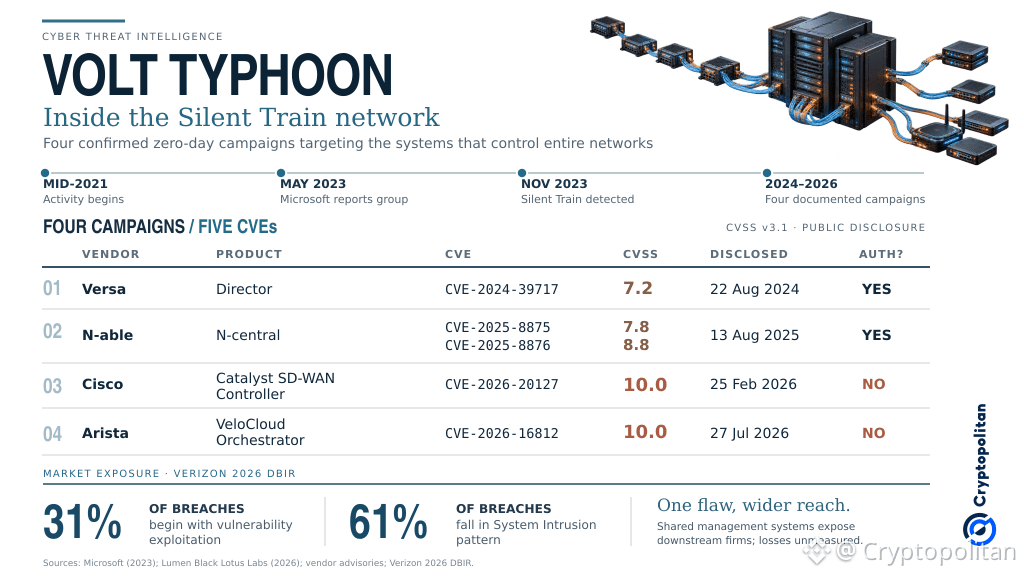
Four campaigns, five CVEs
Silent Train’s four confirmed campaigns targeted software used to manage entire networks.
The first involved Versa Director, where CVE-2024-39717 allowed attackers with privileged access to upload malicious files. Versa disclosed the flaw in August 2024.
In 2025, attackers targeted N-able N-central through two vulnerabilities, CVE-2025-8875 and CVE-2025-8876. Both required authentication.
The 2026 campaigns involved two SD-WAN management platforms. Cisco disclosed CVE-2026-20127 on February 25. Rated 10.0, the flaw allowed attackers to gain administrative privileges without authentication. Arista disclosed another 10.0-rated vulnerability, CVE-2026-16812, affecting VeloCloud Orchestrator on July 27.
All four vendors released fixes. However, Lumen observed continued exploitation of Cisco’s vulnerability after its disclosure.
Volt Typhoon’s Silent Train: Four Zero-Day Campaigns and Cybersecurity Market Risks
Why access is the point
Volt Typhoon’s activities go back to at least mid-2021. Microsoft publicly identified the group in May 2023, reporting intrusions into critical infrastructure networks in Guam and the continental United States.
The concern goes beyond stolen information.
In a January 2026 analysis, IISS researcher John Bruce observed:
The vast majority of the networks targeted by Volt Typhoon offered little foreign intelligence value to the Chinese government.
Bruce pointed to the group’s collection of network diagrams and operating manuals as evidence of preparations for possible disruption. Guam is particularly sensitive because its military facilities would be important in a potential conflict over Taiwan.
These remain assessments of the group’s intentions, not proof of an ordered attack.
Concentration is the exposure
The broader cybersecurity picture helps explain the danger.
Verizon’s 2026 report, covering more than 31,000 incidents, found that vulnerability exploitation had become the leading route into organizations. System intrusion accounted for 61% of confirmed breaches.
When attackers compromise software managing multiple networks, the potential damage extends beyond one organization.
The financial implications remain uncertain. The IMF has warned that interconnected financial systems face growing cyber risks. However, no market losses have been directly attributed to Silent Train.
Separately, Cryptopolitan reported another exploited VeloCloud vulnerability, CVE-2026-114625, rated 9.9 and patched on October 22. It is distinct from the flaw Lumen linked to Silent Train.
If you're reading this, you’re already ahead. Stay there with our newsletter.
Volt Typhoon used Silent Train network in four confirmed zero-day campaigns
Lumen’s Black Lotus Labs researchers revealed that China-linked hacking group Volt Typhoon used a covert network called Silent Train in four confirmed zero-day campaigns.
The hackers targeted platforms that manage entire networks, not just individual computers. Compromising one of these systems could give them access to telecommunications, defense, and other critical infrastructure networks.
The researchers warned:
“Systems with broad administrative reach can become high-value gateways to the entire organization and its customers.”
A disposable network built to disappear
Silent Train was designed to leave little trace. Its operators linked compromised home-office routers, connected devices, and enterprise systems to carry out attacks. Once an operation ended, they broke those connections and erased evidence of their activity. Sessions lasted about four hours on average.
Silent Train was first discovered in the latter part of 2023. Its activity increased after authorities dismantled the earlier KV-botnet of Volt Typhoon in the early part of 2024.
Black Lotus Labs sent out thousands of victim notifications over the course of three years. Among the industries affected by the hacking group are telecommunications, defense, satellite communications, energy, transportation, and the water resources sector. They showed special interest in targets that were located in Hawaii, Texas, and California.
Four campaigns, five CVEs
Silent Train’s four confirmed campaigns targeted software used to manage entire networks.
The first involved Versa Director, where CVE-2024-39717 allowed attackers with privileged access to upload malicious files. Versa disclosed the flaw in August 2024.
In 2025, attackers targeted N-able N-central through two vulnerabilities, CVE-2025-8875 and CVE-2025-8876. Both required authentication.
The 2026 campaigns involved two SD-WAN management platforms. Cisco disclosed CVE-2026-20127 on February 25. Rated 10.0, the flaw allowed attackers to gain administrative privileges without authentication. Arista disclosed another 10.0-rated vulnerability, CVE-2026-16812, affecting VeloCloud Orchestrator on July 27.
All four vendors released fixes. However, Lumen observed continued exploitation of Cisco’s vulnerability after its disclosure.
Volt Typhoon’s Silent Train: Four Zero-Day Campaigns and Cybersecurity Market Risks
Why access is the point
Volt Typhoon’s activities go back to at least mid-2021. Microsoft publicly identified the group in May 2023, reporting intrusions into critical infrastructure networks in Guam and the continental United States.
The concern goes beyond stolen information.
In a January 2026 analysis, IISS researcher John Bruce observed:
The vast majority of the networks targeted by Volt Typhoon offered little foreign intelligence value to the Chinese government.
Bruce pointed to the group’s collection of network diagrams and operating manuals as evidence of preparations for possible disruption. Guam is particularly sensitive because its military facilities would be important in a potential conflict over Taiwan.
These remain assessments of the group’s intentions, not proof of an ordered attack.
Concentration is the exposure
The broader cybersecurity picture helps explain the danger.
Verizon’s 2026 report, covering more than 31,000 incidents, found that vulnerability exploitation had become the leading route into organizations. System intrusion accounted for 61% of confirmed breaches.
When attackers compromise software managing multiple networks, the potential damage extends beyond one organization.
The financial implications remain uncertain. The IMF has warned that interconnected financial systems face growing cyber risks. However, no market losses have been directly attributed to Silent Train.
Separately, Cryptopolitan reported another exploited VeloCloud vulnerability, CVE-2026-114625, rated 9.9 and patched on October 22. It is distinct from the flaw Lumen linked to Silent Train.
If you're reading this, you’re already ahead. Stay there with our newsletter.
1
261
Ray Kurzweil builds an AI replica meant to speak for him after deathRay Kurzweil, a 78-year-old futurist, is creating an artificial intelligence clone of himself that can talk, think, and learn from interactions, but he plans to keep it conversing with people even after he dies, reports The Information on Tuesday.
The clone, named RAI, is a collaboration between Kurzweil Technologies, the company owned by him, and Praxis AI, which markets its products as Human-First Digital Twins.
RAI was built from decades of Kurzweil’s work
RAI was jointly launched by the two firms on July 6, 2026, and describes itself as an attempt to capture not just what Kurzweil wrote but how he thinks, derived from six decades of his writing, interviews, and personal memories. It uses a Praxis architecture known as the “3D Digital Brain,” and it has its own governance layer and a provenance layer called PraxisShield and Praxis IP Vault respectively.
There is limited information about the construction of RAI provided by the firms at the beginning, but The Information has now found out that it operates on a Google language model and takes inspiration from 11 books by Kurzweil, a lot of videos and podcasts, hundreds of articles written about him, and many other sources he personally approved of. The exact Google model used is still unknown.
RAI delivered one of Kurzweil’s most quoted AI lines
RAI went live on July 10, 2026, during Kurzweil’s Center Stage talk at the UN’s AI for Good Global Summit. He later appeared with it on the closing-day panel, “What Could the Next Decade of AI Mean for Humanity?”, moderated by The Economist’s deputy executive editor Kenneth Cukier.
The summit’s own writeup was headlined “We will not be replaced by AI, we will merge with it.” But the specific statement “We are going to merge with them” was delivered by RAI as it continued the discussion on Kurzweil’s behalf.
Kurzweil’s comments were more particular, however. He asserted that AGI would compute significantly faster than humans and that biology was increasingly being transformed into information technology.
2 eAlthough the underlying idea was consistent with his views, the exact wording that he would go on to be quoted for after the conference was from his AI version.
Praxis claims 97% accuracy without independent testing
According to Praxis, the review layer called Superbrain examines every answer prior to it reaching the user, “keeping accuracy above 97%” and boasts 400 percent better performance than regular retrieval-augmented generation.
The company mentions a United States Patent Application, number 19/647,154, that covers fourteen technological breakthroughs, and notes that each answer is referenced and can be traced to the passage approved by an expert.
None of it is independently verified. The 97% figure is Praxis’s own measurement against an undisclosed benchmark, and no third party has published an evaluation of RAI. The act of referencing solves the problem of a replica making up something that was never even said by its source, but the very process of generating content from scratch can produce a response the source itself wouldn’t accept.
Kurzweil’s 2032 longevity prediction remains far ahead of the evidence
Awarded the Robert A. Muh Alumni Award by the Massachusetts Institute of Technology (MIT) on October 8, 2025, Ray Kurzweil predicted that by about 2032, the rate of scientific advancement could be such that one reaches longevity escape velocity where “a year of additional life expectancy is gained per year of remaining life.” MIT reported the prediction as part of his “Reinventing Intelligence” lecture.
Current human research is far more modest. NIH-funded researchers led by Columbia epidemiologist Daniel Belsky developed DunedinPACE using data from more than 1,000 people born in New Zealand in 1972 and 1973. This test measures the speed of biological aging using DNA methylation at 173 locations, and those who score faster show greater likelihood of developing diseases, becoming disabled, and dying early.
In the CALERIE trial, there was a statistically significant reduction in the rate of DunedinPACE in individuals that had lowered their calorie intake.
NIH experts have highlighted proven interventions like regular physical activity, non-smoking, maintaining proper weight, getting enough sleep, being vaccinated, and screening for hypertension and high cholesterol.
This implies that some components of aging are quantifiable and that they are potentially slightly changeable. These results don’t show anything resembling adding a year of life for each year of life added.
The prediction of Kurzweil from 2032 thus stands as an extrapolation of future science, not a reality based on today’s human longevity data.
The smartest crypto minds already read our newsletter. Want in? Join them.
Ray Kurzweil builds an AI replica meant to speak for him after death
Ray Kurzweil, a 78-year-old futurist, is creating an artificial intelligence clone of himself that can talk, think, and learn from interactions, but he plans to keep it conversing with people even after he dies, reports The Information on Tuesday.
The clone, named RAI, is a collaboration between Kurzweil Technologies, the company owned by him, and Praxis AI, which markets its products as Human-First Digital Twins.
RAI was built from decades of Kurzweil’s work
RAI was jointly launched by the two firms on July 6, 2026, and describes itself as an attempt to capture not just what Kurzweil wrote but how he thinks, derived from six decades of his writing, interviews, and personal memories. It uses a Praxis architecture known as the “3D Digital Brain,” and it has its own governance layer and a provenance layer called PraxisShield and Praxis IP Vault respectively.
There is limited information about the construction of RAI provided by the firms at the beginning, but The Information has now found out that it operates on a Google language model and takes inspiration from 11 books by Kurzweil, a lot of videos and podcasts, hundreds of articles written about him, and many other sources he personally approved of. The exact Google model used is still unknown.
RAI delivered one of Kurzweil’s most quoted AI lines
RAI went live on July 10, 2026, during Kurzweil’s Center Stage talk at the UN’s AI for Good Global Summit. He later appeared with it on the closing-day panel, “What Could the Next Decade of AI Mean for Humanity?”, moderated by The Economist’s deputy executive editor Kenneth Cukier.
The summit’s own writeup was headlined “We will not be replaced by AI, we will merge with it.” But the specific statement “We are going to merge with them” was delivered by RAI as it continued the discussion on Kurzweil’s behalf.
Kurzweil’s comments were more particular, however. He asserted that AGI would compute significantly faster than humans and that biology was increasingly being transformed into information technology.
2 eAlthough the underlying idea was consistent with his views, the exact wording that he would go on to be quoted for after the conference was from his AI version.
Praxis claims 97% accuracy without independent testing
According to Praxis, the review layer called Superbrain examines every answer prior to it reaching the user, “keeping accuracy above 97%” and boasts 400 percent better performance than regular retrieval-augmented generation.
The company mentions a United States Patent Application, number 19/647,154, that covers fourteen technological breakthroughs, and notes that each answer is referenced and can be traced to the passage approved by an expert.
None of it is independently verified. The 97% figure is Praxis’s own measurement against an undisclosed benchmark, and no third party has published an evaluation of RAI. The act of referencing solves the problem of a replica making up something that was never even said by its source, but the very process of generating content from scratch can produce a response the source itself wouldn’t accept.
Kurzweil’s 2032 longevity prediction remains far ahead of the evidence
Awarded the Robert A. Muh Alumni Award by the Massachusetts Institute of Technology (MIT) on October 8, 2025, Ray Kurzweil predicted that by about 2032, the rate of scientific advancement could be such that one reaches longevity escape velocity where “a year of additional life expectancy is gained per year of remaining life.” MIT reported the prediction as part of his “Reinventing Intelligence” lecture.
Current human research is far more modest. NIH-funded researchers led by Columbia epidemiologist Daniel Belsky developed DunedinPACE using data from more than 1,000 people born in New Zealand in 1972 and 1973. This test measures the speed of biological aging using DNA methylation at 173 locations, and those who score faster show greater likelihood of developing diseases, becoming disabled, and dying early.
In the CALERIE trial, there was a statistically significant reduction in the rate of DunedinPACE in individuals that had lowered their calorie intake.
NIH experts have highlighted proven interventions like regular physical activity, non-smoking, maintaining proper weight, getting enough sleep, being vaccinated, and screening for hypertension and high cholesterol.
This implies that some components of aging are quantifiable and that they are potentially slightly changeable. These results don’t show anything resembling adding a year of life for each year of life added.
The prediction of Kurzweil from 2032 thus stands as an extrapolation of future science, not a reality based on today’s human longevity data.
The smartest crypto minds already read our newsletter. Want in? Join them.
164
Статья
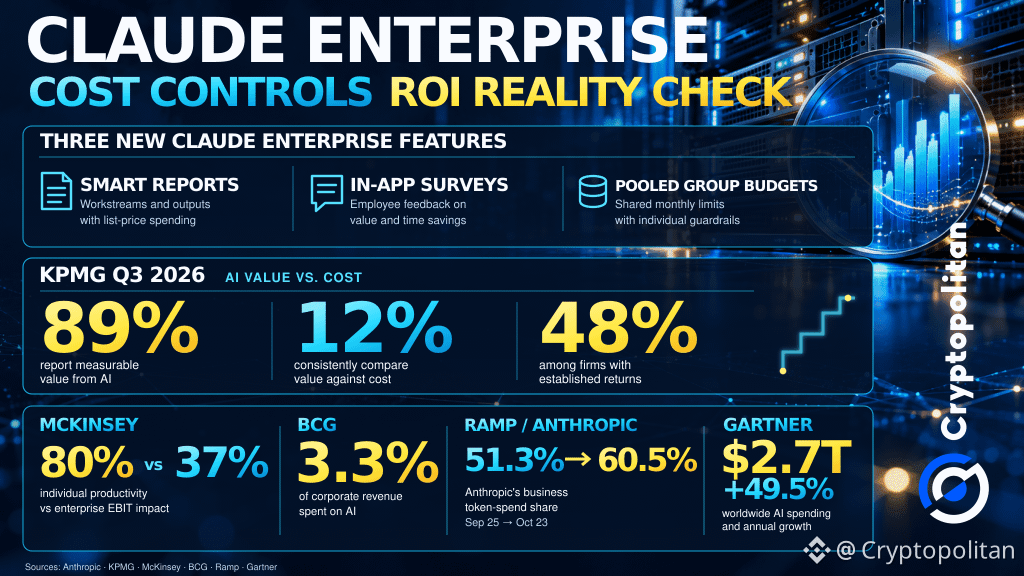
Anthropic ships Claude Enterprise cost tools as AI ROI doubts persistOn October 28, 2026, Anthropic launched three new features of Claude Enterprise. With these, organizations get insight into how employees use Claude, the cost incurred in using it, and whether they find it useful. This announcement is made against the background of growing pressure for organizations to demonstrate the efficiency of their AI investments.
What the three tools actually do
The three new features are: Smart reports, In-app surveys, and Pooled group budgets.
Smart reports, in beta since September 10, help administrators understand how employees use Claude. Administrators select a team, one or more Claude applications, and a reporting period of up to 28 days. Smart reports then analyze samples of Claude transcripts from the selected team and applications. The reports categorize the tasks employees used Claude for.
Smart reports show what employees produced and calculate usage costs at Anthropic’s standard pricing prior to any discounts. They also identify issues such as unsuccessful tool calls and suggest recurring workflows that can be turned into reusable skills.
Smart reports are disabled by default. They are meant to guide investment decisions, not evaluate employees. Each organization can generate 10 reports per month for free.
In-app surveys, on the other hand, ask employees what Claude helped them achieve, how it affected their work time and what would slow down without it. Administrators can edit the questions and export answers.
Pooled group budgets allow a team to share a monthly spending limit while still having a separate limit for each employee. When employees send prompts or work on Claude, the costs will be charged against both limits. Usage is put on hold when either limit is reached. Administrators receive alerts when spending hits 50%, 75%, 95% and 100% of the team’s shared budget.
Where the measurement gap sits
The bigger question is whether companies are getting their money’s worth. Smart reports can show what employees produced with the help of Claude and how much it cost. But they cannot prove that the work resulted in increased revenue or reduced expenses. Federal Reserve research also suggests that perceived productivity gains can run ahead of measured improvements.
That gap is clear in KPMG’s Q3 Global AI Pulse that surveyed 2,131 senior leaders across 20 countries. Though 89% of executives stated that their company benefitted from AI, only 12% of them compared benefits to cost consistently. This number jumped to 48% for companies that are already deriving some benefits.
Another study points to a similar divide. McKinsey found that 80% reported improvements in individual productivity. However, only 37% attributed any enterprise-level EBIT impact to AI. Meanwhile, BCG found that nearly half of surveyed companies were generating value from AI, even as spending on the technology reached 3.3% of revenue.
Anthropic’s Claude Enterprise Tools and the AI ROI Gap in 2026
Why this showed up now
Executives were already struggling to keep AI bills under control. KPMG’s Q2 survey found that 29% had trouble understanding or managing operating costs as AI deployments expanded. Cryptopolitan reported the finding in July.
A more alarming account appeared in Axios. A consultant claimed that an unnamed enterprise ran up a $500 million Claude bill in a single month after failing to set usage limits. However, neither the customer’s identity nor its billing records were disclosed. The claim therefore remains unverified.
What tighter accountability could change
Anthropic has good reason to help companies manage their AI bills. Among businesses tracked by Ramp’s AI Index, Anthropic’s share of token spending rose from 51.3% on September 25 to 60.5% on October 23.
In the meantime, AI spending continues to increase globally. Gartner forecasts that it will reach $2.7 trillion in 2026, up 49.5% from the previous year. Infrastructure accounts for the largest share. Better reporting could help companies see where their AI budgets go and which work deliver value. But knowing what AI costs is still not the same as proving it pays off.
The smartest crypto minds already read our newsletter. Want in? Join them.
Anthropic ships Claude Enterprise cost tools as AI ROI doubts persist
On October 28, 2026, Anthropic launched three new features of Claude Enterprise. With these, organizations get insight into how employees use Claude, the cost incurred in using it, and whether they find it useful. This announcement is made against the background of growing pressure for organizations to demonstrate the efficiency of their AI investments.
What the three tools actually do
The three new features are: Smart reports, In-app surveys, and Pooled group budgets.
Smart reports, in beta since September 10, help administrators understand how employees use Claude. Administrators select a team, one or more Claude applications, and a reporting period of up to 28 days. Smart reports then analyze samples of Claude transcripts from the selected team and applications. The reports categorize the tasks employees used Claude for.
Smart reports show what employees produced and calculate usage costs at Anthropic’s standard pricing prior to any discounts. They also identify issues such as unsuccessful tool calls and suggest recurring workflows that can be turned into reusable skills.
Smart reports are disabled by default. They are meant to guide investment decisions, not evaluate employees. Each organization can generate 10 reports per month for free.
In-app surveys, on the other hand, ask employees what Claude helped them achieve, how it affected their work time and what would slow down without it. Administrators can edit the questions and export answers.
Pooled group budgets allow a team to share a monthly spending limit while still having a separate limit for each employee. When employees send prompts or work on Claude, the costs will be charged against both limits. Usage is put on hold when either limit is reached. Administrators receive alerts when spending hits 50%, 75%, 95% and 100% of the team’s shared budget.
Where the measurement gap sits
The bigger question is whether companies are getting their money’s worth. Smart reports can show what employees produced with the help of Claude and how much it cost. But they cannot prove that the work resulted in increased revenue or reduced expenses. Federal Reserve research also suggests that perceived productivity gains can run ahead of measured improvements.
That gap is clear in KPMG’s Q3 Global AI Pulse that surveyed 2,131 senior leaders across 20 countries. Though 89% of executives stated that their company benefitted from AI, only 12% of them compared benefits to cost consistently. This number jumped to 48% for companies that are already deriving some benefits.
Another study points to a similar divide. McKinsey found that 80% reported improvements in individual productivity. However, only 37% attributed any enterprise-level EBIT impact to AI. Meanwhile, BCG found that nearly half of surveyed companies were generating value from AI, even as spending on the technology reached 3.3% of revenue.
Anthropic’s Claude Enterprise Tools and the AI ROI Gap in 2026
Why this showed up now
Executives were already struggling to keep AI bills under control. KPMG’s Q2 survey found that 29% had trouble understanding or managing operating costs as AI deployments expanded. Cryptopolitan reported the finding in July.
A more alarming account appeared in Axios. A consultant claimed that an unnamed enterprise ran up a $500 million Claude bill in a single month after failing to set usage limits. However, neither the customer’s identity nor its billing records were disclosed. The claim therefore remains unverified.
What tighter accountability could change
Anthropic has good reason to help companies manage their AI bills. Among businesses tracked by Ramp’s AI Index, Anthropic’s share of token spending rose from 51.3% on September 25 to 60.5% on October 23.
In the meantime, AI spending continues to increase globally. Gartner forecasts that it will reach $2.7 trillion in 2026, up 49.5% from the previous year. Infrastructure accounts for the largest share. Better reporting could help companies see where their AI budgets go and which work deliver value. But knowing what AI costs is still not the same as proving it pays off.
The smartest crypto minds already read our newsletter. Want in? Join them.
303

Статья
UNC Law's AI justices match a Supreme Court ruling, not its feelThree ChatGPT-based AI justices reached the same result as the US Supreme Court during an October 22 mock argument at the University of North Carolina School of Law. The outcome matched; the give-and-take did not, Reuters reported October 28.
A 2-1 vote that mirrored a 5-4 decision
At “May It Please the Machine,” third-year students Elijah Baetz and Reda Ansar argued Monsalvo Velázquez v. Bondi, a 2025 immigration case, UNC Law said. The issue: if a 60-day voluntary-departure deadline fell on Saturday, did it extend to Monday? That deadline marks when someone allowed to leave the US on their own must depart to avoid penalties.
Data librarian Rolando Rodriguez developed three AI justices using a single ChatGPT model. Each judge followed a different approach to interpreting the law. the textualist adhered very strictly to the literal meaning of the law. The pragmatist relied on practical and real-life results. On the other hand, the progressive considered a wider perspective, taking into account changing social values and modern legal principles. In order to ensure fairness and neutrality, all three worked only with anonymized legal records and remained offline while doing their work.
The extension was supported by the pragmatist and progressive in a ratio of 2-1, while the textualist dissented. In the actual Supreme Court decision, there was a 5-4 split with Justice Neil Gorsuch writing for the majority and Justices Clarence Thomas and Samuel Alito dissenting.
The machines reasoned but did not interrupt
The AI justices posed questions and presented possible situations, but they never interfered with the lawyers. Nicole Downing, the assistant dean for AI at UNC Law said the purpose of this was to test the capability of AI in reasoning like a judge does in written opinions, not to replace a judge. Clinical professor Annie Scardulla explained that oral argument is actually a “professional conversation.” That natural back-and-forth is missing in the AI justices.
Law professors rated AI tutors higher than peers
AI appears more promising as a tool for teaching law students than for making judicial decisions. In a blinded study, 16 contract professors from 14 US law schools reviewed 2,918 comparisons. They preferred AI-written answers 75.33% of the time. Only 3.53% of AI responses were flagged as harmful, compared with 12.06% of human-written answers. Still, helping students learn the law is one thing. Deciding cases is another.
Consumers draw a line at AI decisions
There’s a certain skepticism among the public too. Clio, in its 2026 survey, found out that only 26% of US consumers were willing to let AI make choices. If the matter was highly personal, this percentage dropped to 6%. Additionally, 82% of the participants wished to be made aware by their lawyers whether or not AI was being used.
What the trust gap means for legal AI vendors
Grand View Research values legal AI at $1.4 billion in 2024 and projects $3.9 billion by 2030, a 17.3% annual growth rate for 2025–2030. North America held 46% of 2024 revenue. Demand centers on research, document review and compliance, not automated judging.
Legal AI Market by the Numbers: 2024–2030 Growth, Market Share and Tool Accuracy
Thomson Reuters found 77% of clients considered AI-enabled quality improvements very important or essential, but only 5% said most providers delivered them. Meanwhile, 34% of law firm professionals used unapproved tools.
Accuracy remains uneven: on a multi-state statutory-research benchmark, Westlaw AI scored 58%, Lexis+ AI 64%, and custom system STARA 83%. Those aren’t general legal-accuracy ratings.
As Cryptopolitan reported, Google launched Gemini Enterprise for Legal in preview, emphasizing traceable citations and client-data protections. UNC’s lesson is clear: AI can help lawyers reason, but humans must still judge.
If you're reading this, you’re already ahead. Stay there with our newsletter.
UNC Law's AI justices match a Supreme Court ruling, not its feel
Three ChatGPT-based AI justices reached the same result as the US Supreme Court during an October 22 mock argument at the University of North Carolina School of Law. The outcome matched; the give-and-take did not, Reuters reported October 28.
A 2-1 vote that mirrored a 5-4 decision
At “May It Please the Machine,” third-year students Elijah Baetz and Reda Ansar argued Monsalvo Velázquez v. Bondi, a 2025 immigration case, UNC Law said. The issue: if a 60-day voluntary-departure deadline fell on Saturday, did it extend to Monday? That deadline marks when someone allowed to leave the US on their own must depart to avoid penalties.
Data librarian Rolando Rodriguez developed three AI justices using a single ChatGPT model. Each judge followed a different approach to interpreting the law. the textualist adhered very strictly to the literal meaning of the law. The pragmatist relied on practical and real-life results. On the other hand, the progressive considered a wider perspective, taking into account changing social values and modern legal principles. In order to ensure fairness and neutrality, all three worked only with anonymized legal records and remained offline while doing their work.
The extension was supported by the pragmatist and progressive in a ratio of 2-1, while the textualist dissented. In the actual Supreme Court decision, there was a 5-4 split with Justice Neil Gorsuch writing for the majority and Justices Clarence Thomas and Samuel Alito dissenting.
The machines reasoned but did not interrupt
The AI justices posed questions and presented possible situations, but they never interfered with the lawyers. Nicole Downing, the assistant dean for AI at UNC Law said the purpose of this was to test the capability of AI in reasoning like a judge does in written opinions, not to replace a judge. Clinical professor Annie Scardulla explained that oral argument is actually a “professional conversation.” That natural back-and-forth is missing in the AI justices.
Law professors rated AI tutors higher than peers
AI appears more promising as a tool for teaching law students than for making judicial decisions. In a blinded study, 16 contract professors from 14 US law schools reviewed 2,918 comparisons. They preferred AI-written answers 75.33% of the time. Only 3.53% of AI responses were flagged as harmful, compared with 12.06% of human-written answers. Still, helping students learn the law is one thing. Deciding cases is another.
Consumers draw a line at AI decisions
There’s a certain skepticism among the public too. Clio, in its 2026 survey, found out that only 26% of US consumers were willing to let AI make choices. If the matter was highly personal, this percentage dropped to 6%. Additionally, 82% of the participants wished to be made aware by their lawyers whether or not AI was being used.
What the trust gap means for legal AI vendors
Grand View Research values legal AI at $1.4 billion in 2024 and projects $3.9 billion by 2030, a 17.3% annual growth rate for 2025–2030. North America held 46% of 2024 revenue. Demand centers on research, document review and compliance, not automated judging.
Legal AI Market by the Numbers: 2024–2030 Growth, Market Share and Tool Accuracy
Thomson Reuters found 77% of clients considered AI-enabled quality improvements very important or essential, but only 5% said most providers delivered them. Meanwhile, 34% of law firm professionals used unapproved tools.
Accuracy remains uneven: on a multi-state statutory-research benchmark, Westlaw AI scored 58%, Lexis+ AI 64%, and custom system STARA 83%. Those aren’t general legal-accuracy ratings.
As Cryptopolitan reported, Google launched Gemini Enterprise for Legal in preview, emphasizing traceable citations and client-data protections. UNC’s lesson is clear: AI can help lawyers reason, but humans must still judge.
If you're reading this, you’re already ahead. Stay there with our newsletter.
GOOGUS-10,74%
GOOGLB-10,12%
1
333

Статья
Phantom adds Kalshi prediction markets for US users as rules divergePhantom made prediction markets available to its eligible US users on October 23, 2026, through its partnership with Kalshi. Phantom’s wallet has more than 20 million users.
By providing event trading, Phantom creates another motivation for users to use the app. As its October 27 announcement explained, access will expand in stages.
The users of Phantom wallets can trade on 15-minute changes in crypto prices or bet on contracts related to sports, economy, or politics. Making a prediction is similar to performing a token swap. Transactions can be funded using Phantom Cash, which is based on the CASH stablecoin. Payouts are credited in the same wallet. Users can keep track of live scores and participate in market discussions while staying within the app.
Phantom provides the trading platform. Kalshi, on the other hand, is responsible for customer verification, trading account management, and trade execution. Phantom wallet users with an existing Kalshi account can link it directly. KalshiEX LLC offers the prediction contracts. Phantom itself is not registered with the CFTC.
Limited CFTC relief, unresolved state disputes
On March 17, 2026, CFTC staff granted Phantom conditional relief from introducing-broker registration. The decision covered Phantom’s role as a passive software provider.
On September 17, 2026, the agency provided the same kind of relief to other eligible service providers. This, however, did not resolve the ongoing dispute between the agency and states regarding contracts for sports events and gambling regulations. Kalshi is still facing restrictions on certain market segments in some states.
Phantom earns money when its wallet users trade. Kalshi shares part of its exchange fees on trades placed through the wallet. Phantom’s disclosures acknowledge that this gives the company an incentive to encourage more trading. Kalshi’s markets will also receive prominent placement for a limited time. Phantom may charge an additional fee as well.
There’s a catch to encouraging more trading: the odds are not always as good as they look. CEPR researchers studied over 300,000 Kalshi contracts. Prices became more accurate as settlement approached, but cheaper contracts were often poor bets. They won less frequently than their prices suggested. Across the contracts studied, the average return was about minus 20% before fees.
Volume booms, but notional is not deposits
Trading is booming, but those big numbers need some context. Artemis-derived figures show September 2026 volume reached $76.46 billion, up 51.7% from August. Kalshi accounted for $60.85 billion, or 79.6%. That’s the value of contracts traded, not money deposited. Open interest stood at $2.21 billion at month-end. DeFiLlama also shows roughly $4 billion in Kalshi’s seven-day trading volume. It does not report the platform’s total value locked (TVL).
Wall Street is taking notice, too. On October 26, S&P Dow Jones Indices named Kalshi a preferred platform for contracts tied to its benchmarks. It also plans to develop new indices using Kalshi’s market data.
US derivatives, UK betting and EU binary-option limits
In the U.S., event contracts fall under CFTC oversight, though disputes over state gambling laws are far from settled. Britain takes a different approach. On February 4, 2026, its Gambling Commission said prediction-market operators generally fall under betting-intermediary rules. There is an exception, however. Norton Rose Fulbright explains that contracts qualifying as financial investments come under the FCA instead.
Phantom–Kalshi US Prediction Markets: Trading Volume, Partnership and Global Regulation
The EU draws another distinction. On July 3, 2026, ESMA warned that event contracts classified as financial derivatives face existing restrictions on retail binary options. Other contracts may still fall under gambling laws. Across much of Asia, Tiger Research says prediction markets are largely treated as gambling. This could push trading activity offshore. Ultimately, these different rules may determine where prediction-market platforms expand and where liquidity flows.
If you're reading this, you’re already ahead. Stay there with our newsletter.
Phantom adds Kalshi prediction markets for US users as rules diverge
Phantom made prediction markets available to its eligible US users on October 23, 2026, through its partnership with Kalshi. Phantom’s wallet has more than 20 million users.
By providing event trading, Phantom creates another motivation for users to use the app. As its October 27 announcement explained, access will expand in stages.
The users of Phantom wallets can trade on 15-minute changes in crypto prices or bet on contracts related to sports, economy, or politics. Making a prediction is similar to performing a token swap. Transactions can be funded using Phantom Cash, which is based on the CASH stablecoin. Payouts are credited in the same wallet. Users can keep track of live scores and participate in market discussions while staying within the app.
Phantom provides the trading platform. Kalshi, on the other hand, is responsible for customer verification, trading account management, and trade execution. Phantom wallet users with an existing Kalshi account can link it directly. KalshiEX LLC offers the prediction contracts. Phantom itself is not registered with the CFTC.
Limited CFTC relief, unresolved state disputes
On March 17, 2026, CFTC staff granted Phantom conditional relief from introducing-broker registration. The decision covered Phantom’s role as a passive software provider.
On September 17, 2026, the agency provided the same kind of relief to other eligible service providers. This, however, did not resolve the ongoing dispute between the agency and states regarding contracts for sports events and gambling regulations. Kalshi is still facing restrictions on certain market segments in some states.
Phantom earns money when its wallet users trade. Kalshi shares part of its exchange fees on trades placed through the wallet. Phantom’s disclosures acknowledge that this gives the company an incentive to encourage more trading. Kalshi’s markets will also receive prominent placement for a limited time. Phantom may charge an additional fee as well.
There’s a catch to encouraging more trading: the odds are not always as good as they look. CEPR researchers studied over 300,000 Kalshi contracts. Prices became more accurate as settlement approached, but cheaper contracts were often poor bets. They won less frequently than their prices suggested. Across the contracts studied, the average return was about minus 20% before fees.
Volume booms, but notional is not deposits
Trading is booming, but those big numbers need some context. Artemis-derived figures show September 2026 volume reached $76.46 billion, up 51.7% from August. Kalshi accounted for $60.85 billion, or 79.6%. That’s the value of contracts traded, not money deposited. Open interest stood at $2.21 billion at month-end. DeFiLlama also shows roughly $4 billion in Kalshi’s seven-day trading volume. It does not report the platform’s total value locked (TVL).
Wall Street is taking notice, too. On October 26, S&P Dow Jones Indices named Kalshi a preferred platform for contracts tied to its benchmarks. It also plans to develop new indices using Kalshi’s market data.
US derivatives, UK betting and EU binary-option limits
In the U.S., event contracts fall under CFTC oversight, though disputes over state gambling laws are far from settled. Britain takes a different approach. On February 4, 2026, its Gambling Commission said prediction-market operators generally fall under betting-intermediary rules. There is an exception, however. Norton Rose Fulbright explains that contracts qualifying as financial investments come under the FCA instead.
Phantom–Kalshi US Prediction Markets: Trading Volume, Partnership and Global Regulation
The EU draws another distinction. On July 3, 2026, ESMA warned that event contracts classified as financial derivatives face existing restrictions on retail binary options. Other contracts may still fall under gambling laws. Across much of Asia, Tiger Research says prediction markets are largely treated as gambling. This could push trading activity offshore. Ultimately, these different rules may determine where prediction-market platforms expand and where liquidity flows.
If you're reading this, you’re already ahead. Stay there with our newsletter.
120
Bitcoin is property but not money in Thailand, Supreme Court rulesIn Thailand, Bitcoin will now be regarded as property under its criminal law. This comes after the country’s Supreme Court issued a ruling to that effect.
The Supreme Court decision affects anyone who holds or trades crypto in Thailand because it makes it clear that digital assets can be the subject of a property crime. The judgment also states clearly that Bitcoin is not legal tender, even though it has intrinsic value that can be bought or sold.
Why the court regarded BTC as property
The Civil and Commercial Code in Thailand accords property rights to intangible things with possessive value. The court relied on Sections 137 and 138 of that Code before qualifying Bitcoin as property.
The court, in delivering the ruling, describes BTC as a market-priced medium of exchange that is convertible to cash once there’s a buyer. The court went on to cite Thailand’s 2018 Emergency Decree on Digital Asset Businesses, which describes crypto as electronic data built on a network to serve as a medium of exchange.
The Bank of Thailand does not regard crypto as legal tender due to its volatile nature. The court also quoted the central bank’s stance when deciding that Bitcoin was not legal tender.
The court separated the two questions: Whether an entity is money you can settle debts with is one matter. Whether it has a price and can be held is another. Bitcoin passed the second test, but not the first.
A $50,000 robbery on Koh Samui
The ruling was as a result of a robbery that occurred four years ago, September 15, 2022, to be precise. The robbery happened on the island of Koh Samui. It involved a group of foreigners who threatened a victim and his Russian wife over their child’s safety before becoming violent.
Under duress, the victim converted $50,000 or 1.878 million baht into 2.480801 BTC and sent it to a wallet controlled by the robbers. The defendant sorted out transport, lodging and the group’s ferry escape.
A trial court initially sentenced the robber to 15 years in jail, before cutting it down to 10 years. On appeal, the sentence was upheld, and the Supreme Court concurred that the transfer was done coercively rather than voluntarily. The judges ordered the stolen Bitcoin returned or 1.878 million baht paid in its place.
Property yes, payment no
The ruling is no surprise to anyone who has studied Thailand’s handling of cryptocurrency. The country welcomes its use as an investment but frowns at its use for expenditures, especially for locals.
On March 18, 2022, the Securities and Exchange Commission announced a ban on the use of cryptocurrencies as legal tender. Operators were to be fined up to 300,000 baht plus 10,000 baht for each day they violated the order.
However, Thailand has welcomed the use of crypto for investment purposes. Capital gains tax on crypto sales via licensed platforms was removed from January 2025 to December 2029.
The SEC also launched TouristDigiPay in August 2025. The initiative is an 18-month sandbox that allows tourists to convert digital assets to baht for expenditures while touring Thailand. The merchants will be paid in baht, and crypto will not be used directly as a medium of exchange.
Thailand recently announced that BTC and Ethereum exchange-traded funds (ETFs) could be listed on the Stock Exchange of Thailand. The announcement took effect on October 16, 2026.
The smartest crypto minds already read our newsletter. Want in? Join them.
Bitcoin is property but not money in Thailand, Supreme Court rules
In Thailand, Bitcoin will now be regarded as property under its criminal law. This comes after the country’s Supreme Court issued a ruling to that effect.
The Supreme Court decision affects anyone who holds or trades crypto in Thailand because it makes it clear that digital assets can be the subject of a property crime. The judgment also states clearly that Bitcoin is not legal tender, even though it has intrinsic value that can be bought or sold.
Why the court regarded BTC as property
The Civil and Commercial Code in Thailand accords property rights to intangible things with possessive value. The court relied on Sections 137 and 138 of that Code before qualifying Bitcoin as property.
The court, in delivering the ruling, describes BTC as a market-priced medium of exchange that is convertible to cash once there’s a buyer. The court went on to cite Thailand’s 2018 Emergency Decree on Digital Asset Businesses, which describes crypto as electronic data built on a network to serve as a medium of exchange.
The Bank of Thailand does not regard crypto as legal tender due to its volatile nature. The court also quoted the central bank’s stance when deciding that Bitcoin was not legal tender.
The court separated the two questions: Whether an entity is money you can settle debts with is one matter. Whether it has a price and can be held is another. Bitcoin passed the second test, but not the first.
A $50,000 robbery on Koh Samui
The ruling was as a result of a robbery that occurred four years ago, September 15, 2022, to be precise. The robbery happened on the island of Koh Samui. It involved a group of foreigners who threatened a victim and his Russian wife over their child’s safety before becoming violent.
Under duress, the victim converted $50,000 or 1.878 million baht into 2.480801 BTC and sent it to a wallet controlled by the robbers. The defendant sorted out transport, lodging and the group’s ferry escape.
A trial court initially sentenced the robber to 15 years in jail, before cutting it down to 10 years. On appeal, the sentence was upheld, and the Supreme Court concurred that the transfer was done coercively rather than voluntarily. The judges ordered the stolen Bitcoin returned or 1.878 million baht paid in its place.
Property yes, payment no
The ruling is no surprise to anyone who has studied Thailand’s handling of cryptocurrency. The country welcomes its use as an investment but frowns at its use for expenditures, especially for locals.
On March 18, 2022, the Securities and Exchange Commission announced a ban on the use of cryptocurrencies as legal tender. Operators were to be fined up to 300,000 baht plus 10,000 baht for each day they violated the order.
However, Thailand has welcomed the use of crypto for investment purposes. Capital gains tax on crypto sales via licensed platforms was removed from January 2025 to December 2029.
The SEC also launched TouristDigiPay in August 2025. The initiative is an 18-month sandbox that allows tourists to convert digital assets to baht for expenditures while touring Thailand. The merchants will be paid in baht, and crypto will not be used directly as a medium of exchange.
Thailand recently announced that BTC and Ethereum exchange-traded funds (ETFs) could be listed on the Stock Exchange of Thailand. The announcement took effect on October 16, 2026.
The smartest crypto minds already read our newsletter. Want in? Join them.
103
RLUSD lands on Coinbase and Robinhood, earns Moody's rating in push for stablecoin market shareWithin days, Ripple got a U.S. bank charter, a Moody’s (NYSE: MCO) rating, and deals with Coinbase (NASDAQ: COIN), Robinhood (NASDAQ: HOOD), and BNY (NYSE: BK).
RLUSD, its stablecoin, has under 1% of the market. Even so, Ripple now has approvals and partners that USDT and USDC took years to earn.
How is Ripple RLUSD competing with USDT and USDC?
It started on Monday. Earlier reporting by Cryptopolitan says that the Office of the Comptroller of the Currency (OCC), a U.S. bank regulator, gave final approval to Ripple National Trust Bank. The new bank will oversee the reserves behind RLUSD and act as collateral trustee for holders. Issuing the token stays with Standard Custody & Trust Company, Ripple’s subsidiary regulated in New York.
On Tuesday, Ripple held its Swell conference in New York. There, it announced a partnership with Robinhood and a bigger custody deal with BNY. Custody means BNY holds assets safely on Ripple’s behalf.
That same day, Moody’s gave RLUSD an A2 long-term deposit rating and a P-1 short-term rating. A2 is the sixth-highest long-term grade on the Moody’s scale. P-1 is the top short-term grade.
The agency pointed to RLUSD’s reserves, which are held mostly in Treasury bills, short-term government debt, and cash. Most of it sits with BNY. Ripple aims to keep reserves at 103% of the tokens in circulation. Moody’s also said eligible institutional holders can cash out at face value within two business days.
Moody’s also named some weak spots, such as the fact that its standard custody is not “bankruptcy-remote,” which means the reserves are not walled off if the company fails.
For now, RLUSD holders have no direct claim on those reserves. Moody’s noted that the GENIUS Act, a stablecoin law set to take effect in 2027, would change this as it would separate required reserves from an issuer’s bankruptcy estate.
On Wednesday, Coinbase (NASDAQ: COIN) announced it will list RLUSD. Users can trade and manage it on Coinbase Prime, Coinbase Exchange and the Coinbase Retail app. Dollars and other dollar stablecoins can be swapped for RLUSD 1:1.
Coinbase’s global exchange will add support later, and users will be able to use RLUSD as collateral there. The token can be deposited and withdrawn on the XRP Ledger, Base and Ethereum. Ripple will provide liquidity on Base
Jack McDonald, Ripple’s senior vice president of stablecoins, said the deal with Coinbase will bring the RLUSD stablecoin to “the largest institutional client base in the U.S. crypto market.” The deal would widen RLUSD’s reach across spot trading, derivatives, prime brokerage, and decentralized finance (DeFi).
RLUSD is now live on Robinhood Chain and on Bitstamp by Robinhood. Ripple has said that a listing in the main Robinhood app is expected later this year. Meanwhile, Bitstamp will settle institutional trades in RLUSD on the XRP Ledger. Robinhood will also run its own cash and liquidity operations on Ripple Treasury.
Can RLUSD win a bigger share of the stablecoin market?
RLUSD launched in December 2024 and now has about $2.6 billion in circulation. That is roughly 0.8% of a stablecoin market valued at more than $300 billion. Around 82% of the $300 billion market is controlled by Tether’s USDT and Circle’s (NYSE: CRCL) USDC.
Robinhood is a founding backer of USDG, a stablecoin issued by Paxos. It also shares in the revenue that USDG earns. USDG supply is reportedly at $3.056 billion, compared with $2.599 billion for RLUSD. Of that USDG, $691.4 million is already on Robinhood Chain.
Robinhood (NASDAQ: HOOD) has 28.6 million funded customers, which could all be exposed to RLUSD if it lands in the main app. However, that listing is only expected later this year, and nothing is confirmed yet.
Until the GENIUS Act takes effect in 2027, RLUSD holders have no direct ownership claim on the reserves. Notably, Ripple applied to a Federal Reserve master account along with its charter. It would let Ripple hold RLUSD reserves directly at the Fed, the U.S. central bank. The application is still pending.
Don’t just read crypto news. Understand it. Subscribe to our newsletter. It's free.
RLUSD lands on Coinbase and Robinhood, earns Moody's rating in push for stablecoin market share
Within days, Ripple got a U.S. bank charter, a Moody’s (NYSE: MCO) rating, and deals with Coinbase (NASDAQ: COIN), Robinhood (NASDAQ: HOOD), and BNY (NYSE: BK).
RLUSD, its stablecoin, has under 1% of the market. Even so, Ripple now has approvals and partners that USDT and USDC took years to earn.
How is Ripple RLUSD competing with USDT and USDC?
It started on Monday. Earlier reporting by Cryptopolitan says that the Office of the Comptroller of the Currency (OCC), a U.S. bank regulator, gave final approval to Ripple National Trust Bank. The new bank will oversee the reserves behind RLUSD and act as collateral trustee for holders. Issuing the token stays with Standard Custody & Trust Company, Ripple’s subsidiary regulated in New York.
On Tuesday, Ripple held its Swell conference in New York. There, it announced a partnership with Robinhood and a bigger custody deal with BNY. Custody means BNY holds assets safely on Ripple’s behalf.
That same day, Moody’s gave RLUSD an A2 long-term deposit rating and a P-1 short-term rating. A2 is the sixth-highest long-term grade on the Moody’s scale. P-1 is the top short-term grade.
The agency pointed to RLUSD’s reserves, which are held mostly in Treasury bills, short-term government debt, and cash. Most of it sits with BNY. Ripple aims to keep reserves at 103% of the tokens in circulation. Moody’s also said eligible institutional holders can cash out at face value within two business days.
Moody’s also named some weak spots, such as the fact that its standard custody is not “bankruptcy-remote,” which means the reserves are not walled off if the company fails.
For now, RLUSD holders have no direct claim on those reserves. Moody’s noted that the GENIUS Act, a stablecoin law set to take effect in 2027, would change this as it would separate required reserves from an issuer’s bankruptcy estate.
On Wednesday, Coinbase (NASDAQ: COIN) announced it will list RLUSD. Users can trade and manage it on Coinbase Prime, Coinbase Exchange and the Coinbase Retail app. Dollars and other dollar stablecoins can be swapped for RLUSD 1:1.
Coinbase’s global exchange will add support later, and users will be able to use RLUSD as collateral there. The token can be deposited and withdrawn on the XRP Ledger, Base and Ethereum. Ripple will provide liquidity on Base
Jack McDonald, Ripple’s senior vice president of stablecoins, said the deal with Coinbase will bring the RLUSD stablecoin to “the largest institutional client base in the U.S. crypto market.” The deal would widen RLUSD’s reach across spot trading, derivatives, prime brokerage, and decentralized finance (DeFi).
RLUSD is now live on Robinhood Chain and on Bitstamp by Robinhood. Ripple has said that a listing in the main Robinhood app is expected later this year. Meanwhile, Bitstamp will settle institutional trades in RLUSD on the XRP Ledger. Robinhood will also run its own cash and liquidity operations on Ripple Treasury.
Can RLUSD win a bigger share of the stablecoin market?
RLUSD launched in December 2024 and now has about $2.6 billion in circulation. That is roughly 0.8% of a stablecoin market valued at more than $300 billion. Around 82% of the $300 billion market is controlled by Tether’s USDT and Circle’s (NYSE: CRCL) USDC.
Robinhood is a founding backer of USDG, a stablecoin issued by Paxos. It also shares in the revenue that USDG earns. USDG supply is reportedly at $3.056 billion, compared with $2.599 billion for RLUSD. Of that USDG, $691.4 million is already on Robinhood Chain.
Robinhood (NASDAQ: HOOD) has 28.6 million funded customers, which could all be exposed to RLUSD if it lands in the main app. However, that listing is only expected later this year, and nothing is confirmed yet.
Until the GENIUS Act takes effect in 2027, RLUSD holders have no direct ownership claim on the reserves. Notably, Ripple applied to a Federal Reserve master account along with its charter. It would let Ripple hold RLUSD reserves directly at the Fed, the U.S. central bank. The application is still pending.
Don’t just read crypto news. Understand it. Subscribe to our newsletter. It's free.
113
Japan Bitcoin Industry raises ¥800 million in BTC to build Lightning paymentsJapan Bitcoin Industry has said that it will raise over 800 million yen by selling shares. The company intends to accept payment for its shares in Bitcoin only.
The money from the share sale, as well as a deal with ALC, aims to help Japanese sellers, such as those in anime, games, and adult content, get paid by overseas customers without relying on international card brands.
How much is Japan Bitcoin Industry selling its shares for?
Japan Bitcoin Industry has said that it will be issuing new shares to two investors: Fulgur, the Japanese arm of US venture firm Fulgur Ventures, and ANAP Lightning Capital (ALC), a subsidiary of Tokyo-listed ANAP Holdings (TSE Standard: 3189), for 800,043,580 yen.
Every yen of the roughly 800 million yen raise will be contributed in Bitcoin rather than cash, with the payment scheduled for November 2. The money, once received, will go towards building aurora, hiring, the routing business, and research.
Alongside the fundraise, the firm signed a business alliance with ALC on Lightning routing. ALC will supply the Bitcoin that funds Japan Bitcoin Industry’s payment channels, and together they want to build what they call a domestic routing base.
The Lightning Network depends on channels that pass payments between users to handle Bitcoin payments off the main blockchain. Through this system, small payments go through in seconds at low cost. But the channels that pass payments between users must be funded in advance.
Japan Bitcoin Industry was founded in November 2024. Its main product is aurora, a Lightning payment option that merchants can add to their checkout through an API. The company presented aurora at the Bitcoin Asia conference in Hong Kong in August.
The company says that with Bitcoin, no one can block a sale and buyers abroad don’t need a card.
It already uses UseBitcoin, which is an online shop service that uses Lightning, and has operated Lightning systems for two years.
Who is backing the bet?
Since 2019, Fulgur Ventures has put money only into Bitcoin and Lightning companies, and in October 2024 it led Blockstream’s $210 million funding round. Rintaro Kawai, the firm’s Japan representative, said Fulgur will continue backing Japan Bitcoin Industry and lead its future rounds.
The two also plan to team up on developer training and outreach, centered on Tokyo Bitcoin Base in Yotsuya and in Sado, Niigata Prefecture.
For the year ended August 2026, ANAP Holdings, ALC’s parent company, lost 4.37 billion yen on the value of its Bitcoin and 7.32 billion yen overall, even though it recorded a 1.22 billion yen gain the year before.
ALC, on the other hand, owned around 814 Bitcoin after a transfer in July 2025, and HashKey Group said in April that the wider group holds roughly 1,417 BTC, putting it in Japan’s top three listed holders.
Notably, Lightning handled about $1.17 billion across 5.22 million transactions in November 2025, with monthly volume up 300% over the year and an average payment of $223. However, that count was still below the August 2023 peak of 6.6 million.
Don’t just read crypto news. Understand it. Subscribe to our newsletter. It's free.
Japan Bitcoin Industry raises ¥800 million in BTC to build Lightning payments
Japan Bitcoin Industry has said that it will raise over 800 million yen by selling shares. The company intends to accept payment for its shares in Bitcoin only.
The money from the share sale, as well as a deal with ALC, aims to help Japanese sellers, such as those in anime, games, and adult content, get paid by overseas customers without relying on international card brands.
How much is Japan Bitcoin Industry selling its shares for?
Japan Bitcoin Industry has said that it will be issuing new shares to two investors: Fulgur, the Japanese arm of US venture firm Fulgur Ventures, and ANAP Lightning Capital (ALC), a subsidiary of Tokyo-listed ANAP Holdings (TSE Standard: 3189), for 800,043,580 yen.
Every yen of the roughly 800 million yen raise will be contributed in Bitcoin rather than cash, with the payment scheduled for November 2. The money, once received, will go towards building aurora, hiring, the routing business, and research.
Alongside the fundraise, the firm signed a business alliance with ALC on Lightning routing. ALC will supply the Bitcoin that funds Japan Bitcoin Industry’s payment channels, and together they want to build what they call a domestic routing base.
The Lightning Network depends on channels that pass payments between users to handle Bitcoin payments off the main blockchain. Through this system, small payments go through in seconds at low cost. But the channels that pass payments between users must be funded in advance.
Japan Bitcoin Industry was founded in November 2024. Its main product is aurora, a Lightning payment option that merchants can add to their checkout through an API. The company presented aurora at the Bitcoin Asia conference in Hong Kong in August.
The company says that with Bitcoin, no one can block a sale and buyers abroad don’t need a card.
It already uses UseBitcoin, which is an online shop service that uses Lightning, and has operated Lightning systems for two years.
Who is backing the bet?
Since 2019, Fulgur Ventures has put money only into Bitcoin and Lightning companies, and in October 2024 it led Blockstream’s $210 million funding round. Rintaro Kawai, the firm’s Japan representative, said Fulgur will continue backing Japan Bitcoin Industry and lead its future rounds.
The two also plan to team up on developer training and outreach, centered on Tokyo Bitcoin Base in Yotsuya and in Sado, Niigata Prefecture.
For the year ended August 2026, ANAP Holdings, ALC’s parent company, lost 4.37 billion yen on the value of its Bitcoin and 7.32 billion yen overall, even though it recorded a 1.22 billion yen gain the year before.
ALC, on the other hand, owned around 814 Bitcoin after a transfer in July 2025, and HashKey Group said in April that the wider group holds roughly 1,417 BTC, putting it in Japan’s top three listed holders.
Notably, Lightning handled about $1.17 billion across 5.22 million transactions in November 2025, with monthly volume up 300% over the year and an average payment of $223. However, that count was still below the August 2023 peak of 6.6 million.
Don’t just read crypto news. Understand it. Subscribe to our newsletter. It's free.
90
Euronext halts CoinShares’ Zcash ETP as Europe’s privacy coin crackdown loomsEuronext has pulled CoinShares’ new Zcash exchange-traded product from its Paris market. This was only hours after the issuer announced the launch, blocking what would have been the fourth Zcash fund to list in Europe this year.
While Euronext did not provide a reason for the removal in its initial statement, speculators are saying that it may not be unrelated to the upcoming deadline surrounding Zcash (ZEC) in Europe.
The European Union’s Anti-Money Laundering Regulation will stop licensed crypto firms from handling privacy coins such as ZEC from July 1, 2027.
What did Euronext say was the reason for the suspension?
While Euronext did not give any reason in its suspension notice, a company spokesperson later said it was more about the settlement plumbing than about regulation.
The spokesperson said that CoinShares Zcash ETP will remain frozen until ‘standard settlement operations can be fully supported by the Central Securities Depository (CSD).’
However, their notice came on Wednesday, October 28, just a few hours after CoinShares had announced the listing. In its press release, CoinShares stated that ZCSH is 100% backed by ZEC, adding that it trades in euros and comes with an annual fee of 1.50%.
CoinShares’ CEO Jean-Marie Mognetti said the company’s role is to “build the regulated route” to assets investors want.
A European shelf that is filling up fast
The suspension leaves CoinShares on the sidelines while its competitors trade. 21Shares, Virtune and Valor all brought Zcash ETPs to European markets earlier in 2026.
The 21Shares product, also called ZCASH, is physically backed, charges 2.50% a year, and holds its ZEC with custodians including Coinbase Custody, Anchorage Digital Bank and BitGo, per the issuer’s product page.
In the United States, Grayscale’s listed Zcash fund, which happens to share the ZCSH ticker, raked in $41.1 million in the week ending October 23, and it was its best week since mid-September.
As of late October, that fund held around $686 million in assets.
What is the July 2027 rule that the issuers are racing to beat?
At the European Anti-Financial Crime Summit that was held in 2025, Paschal Donohoe, who was then president of the Eurogroup, said that the bloc wants anti-money-laundering rules to reach “beyond the more traditional forms of financial transfer.”
The EU already has a regulation in place to bring into reality what Donohoe was saying, and it takes full effect by mid-2027. It is the Regulation (EU) 2024/1624, which was adopted on May 31, 2024, and it is the law driving the hurry.
Riccardo Spagni, who was one of the founding developers of the privacy platform Monero, said, “From 1 July 2027, EU-licensed exchanges and custodians will be barred from handling privacy coins such as Monero.”
Spagni called the regulation “lopsided toward surveillance.” The rules also bar providers from interacting with anonymous wallets.
Zcash is another crypto whose main pitch is privacy. However, unlike Monero, which hides every transaction by default, Zcash gives users the ability to choose between transparent and shielded transfers.
It also offers viewing keys that let a holder reveal details to an auditor or regulator. The option that comes with ZEC is one of the reasons the token keeps getting more listings on exchanges compared to Monero.
However, it is not yet known if it will satisfy Europe’s anti-money laundering regulations after July 1, 2027. It seems many firms are betting that it will.
ZEC currently trades around $1,273, down by around 1.8% in the past 24 hours. It has a market capitalization of over $21.5 billion. For most of the year, the token has been one of the best performers, having gone as high as $1,683.5 in late September.
Don’t just read crypto news. Understand it. Subscribe to our newsletter. It's free.
Euronext halts CoinShares’ Zcash ETP as Europe’s privacy coin crackdown looms
Euronext has pulled CoinShares’ new Zcash exchange-traded product from its Paris market. This was only hours after the issuer announced the launch, blocking what would have been the fourth Zcash fund to list in Europe this year.
While Euronext did not provide a reason for the removal in its initial statement, speculators are saying that it may not be unrelated to the upcoming deadline surrounding Zcash (ZEC) in Europe.
The European Union’s Anti-Money Laundering Regulation will stop licensed crypto firms from handling privacy coins such as ZEC from July 1, 2027.
What did Euronext say was the reason for the suspension?
While Euronext did not give any reason in its suspension notice, a company spokesperson later said it was more about the settlement plumbing than about regulation.
The spokesperson said that CoinShares Zcash ETP will remain frozen until ‘standard settlement operations can be fully supported by the Central Securities Depository (CSD).’
However, their notice came on Wednesday, October 28, just a few hours after CoinShares had announced the listing. In its press release, CoinShares stated that ZCSH is 100% backed by ZEC, adding that it trades in euros and comes with an annual fee of 1.50%.
CoinShares’ CEO Jean-Marie Mognetti said the company’s role is to “build the regulated route” to assets investors want.
A European shelf that is filling up fast
The suspension leaves CoinShares on the sidelines while its competitors trade. 21Shares, Virtune and Valor all brought Zcash ETPs to European markets earlier in 2026.
The 21Shares product, also called ZCASH, is physically backed, charges 2.50% a year, and holds its ZEC with custodians including Coinbase Custody, Anchorage Digital Bank and BitGo, per the issuer’s product page.
In the United States, Grayscale’s listed Zcash fund, which happens to share the ZCSH ticker, raked in $41.1 million in the week ending October 23, and it was its best week since mid-September.
As of late October, that fund held around $686 million in assets.
What is the July 2027 rule that the issuers are racing to beat?
At the European Anti-Financial Crime Summit that was held in 2025, Paschal Donohoe, who was then president of the Eurogroup, said that the bloc wants anti-money-laundering rules to reach “beyond the more traditional forms of financial transfer.”
The EU already has a regulation in place to bring into reality what Donohoe was saying, and it takes full effect by mid-2027. It is the Regulation (EU) 2024/1624, which was adopted on May 31, 2024, and it is the law driving the hurry.
Riccardo Spagni, who was one of the founding developers of the privacy platform Monero, said, “From 1 July 2027, EU-licensed exchanges and custodians will be barred from handling privacy coins such as Monero.”
Spagni called the regulation “lopsided toward surveillance.” The rules also bar providers from interacting with anonymous wallets.
Zcash is another crypto whose main pitch is privacy. However, unlike Monero, which hides every transaction by default, Zcash gives users the ability to choose between transparent and shielded transfers.
It also offers viewing keys that let a holder reveal details to an auditor or regulator. The option that comes with ZEC is one of the reasons the token keeps getting more listings on exchanges compared to Monero.
However, it is not yet known if it will satisfy Europe’s anti-money laundering regulations after July 1, 2027. It seems many firms are betting that it will.
ZEC currently trades around $1,273, down by around 1.8% in the past 24 hours. It has a market capitalization of over $21.5 billion. For most of the year, the token has been one of the best performers, having gone as high as $1,683.5 in late September.
Don’t just read crypto news. Understand it. Subscribe to our newsletter. It's free.
1
624
Russian police shut down 5 crypto exchanges tied to a darknet drug marketRussian law enforcement has dismantled five cryptocurrency exchanges and a darknet marketplace they were allegedly serving.
The move comes as Moscow aims to end all illegal coin trading with some actions threatening the survival of legitimate platforms, too.
Russian police shut down crypto exchanges laundering darknet money
Russia’s Ministry of Internal Affairs (MVD) has busted five digital-asset exchanges that it says were utilized to launder criminal proceeds.
It claims the platforms, which were not identified by name, were used by the operators of a drug market on the dark web, local media revealed on Wednesday.
The latter has been taken down as well, alongside an associated forum where users discussed trading of banned substances through the hidden service.
The platforms employed advanced tech solutions to ensure the anonymity of their clients, according to Irina Volk, official spokesperson of the MVD.
However, commenting further on the results of the recent operation in a Telegram post quoted by the business news portal RBC, she also remarked:
“Nevertheless, police were still able to secure information on more than 185,000 crypto exchange transactions.”
The exchanges converted criminally obtained crypto into fiat, she detailed on the state-backed Max messenger, as per TASS.
Five suspects, moderators of the darknet forum, have been detained since August 2025, the official Russian news agency added.
They have been charged with “organizing a criminal community” under the respective article of Russia’s Criminal Code and remanded in custody.
Computers, documents, cash and cryptocurrency were seized during searches, Volk said, while investigators continue to work to identify all involved, including users.
Moscow is cracking down on illegal and uncontrolled crypto trading
Russia, which recently legalized cryptocurrency transactions like trading, has been taking steps to curb illegal activities and bring the rest of the sector out of the shadows.
In August, the country’s Federal Security Service (FSB) detained 20 individuals, employees of crypto exchanges operating out of offices in the “Moscow City” business district.
At the time, the agency insisted the targeted platforms had been used by Ukraine-based call centers laundering funds stolen from Russian citizens lured by various fraud schemes.
It said its officers had interrupted nine foreign-controlled channels used to move money out of the Russian Federation via crypto assets, as reported by the Regnum news agency.
The parliament in Moscow adopted a comprehensive bill “On Digital Currencies and Digital Rights” earlier this summer, before President Putin signed into law and it entered into force in September.
It introduces licensing for crypto platforms such as exchanges and depositories, and the Bank of Russia already expressed hope that those operating in the gray market will be gone by the end of the year.
The monetary authority believes many of these entities are processing funds with unclear origin. The regulator is already clamping down on crypto-for-cash trading as well as peer-to-peer exchanges.
Since the new legal framework was established, the Russian central bank has authorized nearly two dozen organizations to offer crypto trading and custodial services.
Among the first registered participants in the regulated market were the largest majority-state owned banks, Sber and VTB, as well as the stock exchanges of Moscow and St. Petersburg.
Small crypto exchanges face Russia’s unattainable requirements
This week, Russian media reported that the monetary policy regulator has issued clarifications regarding some of the rules that licensed service providers need to abide by.
For example, cryptocurrency exchanges must settle with their clients either simultaneously with the execution of a transaction or immediately thereafter.
In other words, they won’t be able to defer the fulfilment of an order at all, even until the end of the day, the Bits.media news outlet noted on Monday.
Industry watchers interviewed by the business daily Kommersant on Tuesday pointed out that only large players will have the means to process transactions so fast.
This level of operational efficiency, seen in stock and bond trading, requires seamless coordination across the entire market infrastructure, the experts highlighted.
This will pose a serious challenge for smaller crypto exchanges which are yet to establish the necessary connections with banking institutions and digital-asset custodians.
Don’t just read crypto news. Understand it. Subscribe to our newsletter. It's free.
Russian police shut down 5 crypto exchanges tied to a darknet drug market
Russian law enforcement has dismantled five cryptocurrency exchanges and a darknet marketplace they were allegedly serving.
The move comes as Moscow aims to end all illegal coin trading with some actions threatening the survival of legitimate platforms, too.
Russian police shut down crypto exchanges laundering darknet money
Russia’s Ministry of Internal Affairs (MVD) has busted five digital-asset exchanges that it says were utilized to launder criminal proceeds.
It claims the platforms, which were not identified by name, were used by the operators of a drug market on the dark web, local media revealed on Wednesday.
The latter has been taken down as well, alongside an associated forum where users discussed trading of banned substances through the hidden service.
The platforms employed advanced tech solutions to ensure the anonymity of their clients, according to Irina Volk, official spokesperson of the MVD.
However, commenting further on the results of the recent operation in a Telegram post quoted by the business news portal RBC, she also remarked:
“Nevertheless, police were still able to secure information on more than 185,000 crypto exchange transactions.”
The exchanges converted criminally obtained crypto into fiat, she detailed on the state-backed Max messenger, as per TASS.
Five suspects, moderators of the darknet forum, have been detained since August 2025, the official Russian news agency added.
They have been charged with “organizing a criminal community” under the respective article of Russia’s Criminal Code and remanded in custody.
Computers, documents, cash and cryptocurrency were seized during searches, Volk said, while investigators continue to work to identify all involved, including users.
Moscow is cracking down on illegal and uncontrolled crypto trading
Russia, which recently legalized cryptocurrency transactions like trading, has been taking steps to curb illegal activities and bring the rest of the sector out of the shadows.
In August, the country’s Federal Security Service (FSB) detained 20 individuals, employees of crypto exchanges operating out of offices in the “Moscow City” business district.
At the time, the agency insisted the targeted platforms had been used by Ukraine-based call centers laundering funds stolen from Russian citizens lured by various fraud schemes.
It said its officers had interrupted nine foreign-controlled channels used to move money out of the Russian Federation via crypto assets, as reported by the Regnum news agency.
The parliament in Moscow adopted a comprehensive bill “On Digital Currencies and Digital Rights” earlier this summer, before President Putin signed into law and it entered into force in September.
It introduces licensing for crypto platforms such as exchanges and depositories, and the Bank of Russia already expressed hope that those operating in the gray market will be gone by the end of the year.
The monetary authority believes many of these entities are processing funds with unclear origin. The regulator is already clamping down on crypto-for-cash trading as well as peer-to-peer exchanges.
Since the new legal framework was established, the Russian central bank has authorized nearly two dozen organizations to offer crypto trading and custodial services.
Among the first registered participants in the regulated market were the largest majority-state owned banks, Sber and VTB, as well as the stock exchanges of Moscow and St. Petersburg.
Small crypto exchanges face Russia’s unattainable requirements
This week, Russian media reported that the monetary policy regulator has issued clarifications regarding some of the rules that licensed service providers need to abide by.
For example, cryptocurrency exchanges must settle with their clients either simultaneously with the execution of a transaction or immediately thereafter.
In other words, they won’t be able to defer the fulfilment of an order at all, even until the end of the day, the Bits.media news outlet noted on Monday.
Industry watchers interviewed by the business daily Kommersant on Tuesday pointed out that only large players will have the means to process transactions so fast.
This level of operational efficiency, seen in stock and bond trading, requires seamless coordination across the entire market infrastructure, the experts highlighted.
This will pose a serious challenge for smaller crypto exchanges which are yet to establish the necessary connections with banking institutions and digital-asset custodians.
Don’t just read crypto news. Understand it. Subscribe to our newsletter. It's free.
1
310
LIVE: Federal Reserve expected to hold rates steady todayThe Federal Reserve is expected to keep interest rates at 3.75%–4% today, with less than a 10% chance of another hike.
US inflation is climbing again, with September’s CPI at 3.7% and PPI at 6.3%, partly due to higher energy prices.
Traders expect another rate hike in December, after the Fed raised rates by 25 basis points in September.
LIVE: Federal Reserve expected to hold rates steady today
The Federal Reserve is expected to keep interest rates at 3.75%–4% today, with less than a 10% chance of another hike.
US inflation is climbing again, with September’s CPI at 3.7% and PPI at 6.3%, partly due to higher energy prices.
Traders expect another rate hike in December, after the Fed raised rates by 25 basis points in September.
US inflation is climbing again, with September’s CPI at 3.7% and PPI at 6.3%, partly due to higher energy prices.
Traders expect another rate hike in December, after the Fed raised rates by 25 basis points in September.
139
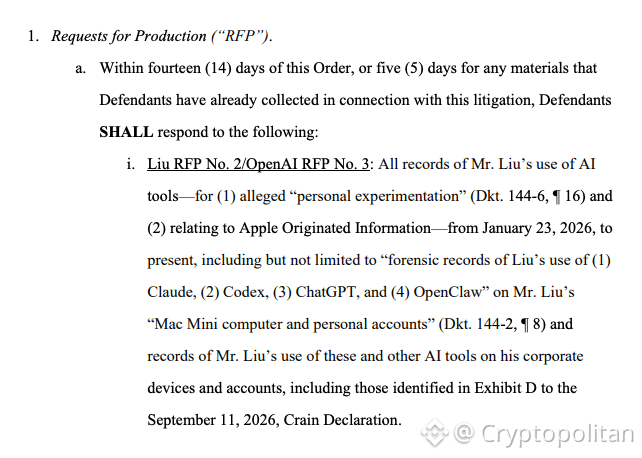
Статья
Apple wins forensic records of Chang Liu's ChatGPT, Claude and Codex useA federal judge on Tuesday ordered defendants in Apple’s trade-secret suit to produce forensic records of former engineer Chang Liu’s use of ChatGPT, Claude, Codex and OpenClaw.
Davila gives the defendants 14 days to produce
The order was signed by US District Judge Edward Davila in Apple Inc. v. Liu, No. 5:26-cv-07078-EJD, in the Northern District of California. Davila had put off several of Apple’s requests earlier this month, and now is granting most of them.
The records include Liu’s use of AI for alleged “personal experimentation” and anything related to “Apple Originated Information.” They include Liu’s Mac Mini, personal accounts and corporate devices, from January 23, 2026 to the present.
Judge Edward Davila’s October 27, 2026 order in Apple Inc. v. Liu, listing the AI-tool records the defendants must produce, published on CourtListener.
OpenAI said Liu’s last day at Apple was Jan. 22, 2026. The defendants have 14 days to turn over the records or just 5 days for anything they have already collected for the case.
Liu and Tang Tan, also a co-defendant, must also list all accounts, devices, storage locations and apps used to handle Apple information covered by the order, which names the LINE app, Signal, Telegram and Kik.
Liu’s list starts after Jan. 22, 2026. Tan’s goes back to February 2, 2024.
If that information has since disappeared from a device or account, Liu and Tan have to explain what was on it, how long it sat there and how it was accessed.
They must also explain any deletion, when it occurred, who was involved and the reason for it.
OpenAI must testify on batteries, power and metal finishing
Davila is also allowing Apple to depose OpenAI and io Products under Rule 30(b)(6) on three topics. The first is any work Liu, Tan and Yu-Ting “Alyssa” Peng did at OpenAI that touched Apple information on power management, batteries or metal finishing.
The second is interviews OpenAI conducted with, or through, Liu, Tan and Peng, and any Apple information that surfaced in those interviews. The third is what OpenAI did or didn’t do to prevent that information from being used.
But Apple didn’t get everything it asked for. Davila turned down Apple’s questions about OpenAI’s own devices and accounts, its internal investigations and any deletions on OpenAI’s part, deferring those to regular merits discovery.
Two other testimony topics were dismissed as “too broad at this stage and better suited for merits discovery.”
Cryptopolitan reported that Apple filed a lawsuit on July 10, accusing Liu, Tan, OpenAI and io Products of taking confidential hardware information to help OpenAI build consumer devices. Tan is a design executive with more than 24 years experience at Apple, according to OpenAI.
More than 400 former Apple employees are working at OpenAI, the complaint says. It also claims that OpenAI used Apple’s internal code names to get at confidential information from job candidates.
In early August, OpenAI asked the court to dismiss the case, calling it a “baseless and pretextual lawsuit” in a motion. The court was told in October the company may file counterclaims.
The filing says an employee who left Apple for six months at OpenAI, then went back, transferred more than 100 confidential files on an unreleased OpenAI device to personal accounts. Apple said it found no evidence to corroborate the claim.
Don’t just read crypto news. Understand it. Subscribe to our newsletter. It's free.
Apple wins forensic records of Chang Liu's ChatGPT, Claude and Codex use
A federal judge on Tuesday ordered defendants in Apple’s trade-secret suit to produce forensic records of former engineer Chang Liu’s use of ChatGPT, Claude, Codex and OpenClaw.
Davila gives the defendants 14 days to produce
The order was signed by US District Judge Edward Davila in Apple Inc. v. Liu, No. 5:26-cv-07078-EJD, in the Northern District of California. Davila had put off several of Apple’s requests earlier this month, and now is granting most of them.
The records include Liu’s use of AI for alleged “personal experimentation” and anything related to “Apple Originated Information.” They include Liu’s Mac Mini, personal accounts and corporate devices, from January 23, 2026 to the present.
Judge Edward Davila’s October 27, 2026 order in Apple Inc. v. Liu, listing the AI-tool records the defendants must produce, published on CourtListener.
OpenAI said Liu’s last day at Apple was Jan. 22, 2026. The defendants have 14 days to turn over the records or just 5 days for anything they have already collected for the case.
Liu and Tang Tan, also a co-defendant, must also list all accounts, devices, storage locations and apps used to handle Apple information covered by the order, which names the LINE app, Signal, Telegram and Kik.
Liu’s list starts after Jan. 22, 2026. Tan’s goes back to February 2, 2024.
If that information has since disappeared from a device or account, Liu and Tan have to explain what was on it, how long it sat there and how it was accessed.
They must also explain any deletion, when it occurred, who was involved and the reason for it.
OpenAI must testify on batteries, power and metal finishing
Davila is also allowing Apple to depose OpenAI and io Products under Rule 30(b)(6) on three topics. The first is any work Liu, Tan and Yu-Ting “Alyssa” Peng did at OpenAI that touched Apple information on power management, batteries or metal finishing.
The second is interviews OpenAI conducted with, or through, Liu, Tan and Peng, and any Apple information that surfaced in those interviews. The third is what OpenAI did or didn’t do to prevent that information from being used.
But Apple didn’t get everything it asked for. Davila turned down Apple’s questions about OpenAI’s own devices and accounts, its internal investigations and any deletions on OpenAI’s part, deferring those to regular merits discovery.
Two other testimony topics were dismissed as “too broad at this stage and better suited for merits discovery.”
Cryptopolitan reported that Apple filed a lawsuit on July 10, accusing Liu, Tan, OpenAI and io Products of taking confidential hardware information to help OpenAI build consumer devices. Tan is a design executive with more than 24 years experience at Apple, according to OpenAI.
More than 400 former Apple employees are working at OpenAI, the complaint says. It also claims that OpenAI used Apple’s internal code names to get at confidential information from job candidates.
In early August, OpenAI asked the court to dismiss the case, calling it a “baseless and pretextual lawsuit” in a motion. The court was told in October the company may file counterclaims.
The filing says an employee who left Apple for six months at OpenAI, then went back, transferred more than 100 confidential files on an unreleased OpenAI device to personal accounts. Apple said it found no evidence to corroborate the claim.
Don’t just read crypto news. Understand it. Subscribe to our newsletter. It's free.
197
Korean police probe Bithumb, Daishin hacks as AI-linked breach count keeps climbingData breaches at Bithumb, Daishin Securities and Mirae Asset Global Investments have triggered a preliminary investigation by South Korea’s National Police Agency.
The police agency investigators are looking into the extent of stolen data in the latest breach and checking whether it is connected to an earlier wave of AI-assisted attacks that hit 16 financial firms in the country.
Which South Korean companies were hacked?
Daishin Securities, Bithumb and Mirae Asset Global Investments were the latest firms to be hit in a wave of breaches concentrating in South Korea. The same team at the National Office already working on the bank hacks reported earlier has taken over the Investigation of the newest incidents as of Wednesday morning.
Daishin Securities was the hardest hit, per local reports, with the personal and credit data of 38,490 customers exposed.
So far, Bithumb has confirmed that attackers accessed staff data. The exchange is still assessing whether member information was also stolen.
Information from Mirae Asset Global Investments’ internal business systems was exposed. However, the firm’s statement reported no evidence that personal credit data was taken.
The numbers from the three new incidents, when fully confirmed, will add to roughly 100,000 records exposed at 16 financial companies as of October 14.
Are the South Korean hacks connected?
While no link has been confirmed, investigators from the South Korean National Police Agency are comparing methods used in the recent breaches to identify matches and determine whether the attacks are isolated.
Local outlet Seoul Economic Daily quoted a police official as saying: “We are not ruling out the possibility that this was an attack by the same person behind the bank hacking case.”
If the investigators confirm a connection, it means the same attackers who used ARTEX to hit banks are behind these late-October breaches. ARTEX is a China-built open-source agentic penetration-testing tool that runs alongside large language models such as Claude Code.
Cryptopolitan reported that CrowdStrike found the attacker’s own Claude Code session logs, ARTEX configuration files and memory files sitting in exposed server directories.
CrowdStrike fingered a financially motivated, Chinese-speaking operator with moderate confidence, based on assessments of recovered files. Because the attacker used the same tools to draft a résumé, they leaked their own contact and Telegram details, which CrowdStrike said may belong to a 26-year-old in Maoming, Guangdong.
Notably, the security firm conceded that the identifiers are not 100% reliable.
South Korean specialists are skeptical of Chinese involvement simply on the basis that the tool is Chinese-built. A professor at Korea University’s Graduate School of Information Security questioned whether ARTEX was the only tool used in the attacks.
Victim numbers continue to grow
Earlier this week, KB Kookmin Bank said a detailed re-examination lifted its confirmed victim count from 119 to 2,210. Mirae Asset Life Insurance, a separate entity, also detected intrusions and drew an urgent on-site inspection from the Financial Supervisory Service.
The Financial Services Commission has already run a security review of 555 financial companies and found shortcomings at 130, including missing security patches and no real-time monitoring.
Bithumb, for its part, has been running a campaign warning customers that leaked personal data is being reused in follow-on phishing and remote-access scams.
The smartest crypto minds already read our newsletter. Want in? Join them.
Korean police probe Bithumb, Daishin hacks as AI-linked breach count keeps climbing
Data breaches at Bithumb, Daishin Securities and Mirae Asset Global Investments have triggered a preliminary investigation by South Korea’s National Police Agency.
The police agency investigators are looking into the extent of stolen data in the latest breach and checking whether it is connected to an earlier wave of AI-assisted attacks that hit 16 financial firms in the country.
Which South Korean companies were hacked?
Daishin Securities, Bithumb and Mirae Asset Global Investments were the latest firms to be hit in a wave of breaches concentrating in South Korea. The same team at the National Office already working on the bank hacks reported earlier has taken over the Investigation of the newest incidents as of Wednesday morning.
Daishin Securities was the hardest hit, per local reports, with the personal and credit data of 38,490 customers exposed.
So far, Bithumb has confirmed that attackers accessed staff data. The exchange is still assessing whether member information was also stolen.
Information from Mirae Asset Global Investments’ internal business systems was exposed. However, the firm’s statement reported no evidence that personal credit data was taken.
The numbers from the three new incidents, when fully confirmed, will add to roughly 100,000 records exposed at 16 financial companies as of October 14.
Are the South Korean hacks connected?
While no link has been confirmed, investigators from the South Korean National Police Agency are comparing methods used in the recent breaches to identify matches and determine whether the attacks are isolated.
Local outlet Seoul Economic Daily quoted a police official as saying: “We are not ruling out the possibility that this was an attack by the same person behind the bank hacking case.”
If the investigators confirm a connection, it means the same attackers who used ARTEX to hit banks are behind these late-October breaches. ARTEX is a China-built open-source agentic penetration-testing tool that runs alongside large language models such as Claude Code.
Cryptopolitan reported that CrowdStrike found the attacker’s own Claude Code session logs, ARTEX configuration files and memory files sitting in exposed server directories.
CrowdStrike fingered a financially motivated, Chinese-speaking operator with moderate confidence, based on assessments of recovered files. Because the attacker used the same tools to draft a résumé, they leaked their own contact and Telegram details, which CrowdStrike said may belong to a 26-year-old in Maoming, Guangdong.
Notably, the security firm conceded that the identifiers are not 100% reliable.
South Korean specialists are skeptical of Chinese involvement simply on the basis that the tool is Chinese-built. A professor at Korea University’s Graduate School of Information Security questioned whether ARTEX was the only tool used in the attacks.
Victim numbers continue to grow
Earlier this week, KB Kookmin Bank said a detailed re-examination lifted its confirmed victim count from 119 to 2,210. Mirae Asset Life Insurance, a separate entity, also detected intrusions and drew an urgent on-site inspection from the Financial Supervisory Service.
The Financial Services Commission has already run a security review of 555 financial companies and found shortcomings at 130, including missing security patches and no real-time monitoring.
Bithumb, for its part, has been running a campaign warning customers that leaked personal data is being reused in follow-on phishing and remote-access scams.
The smartest crypto minds already read our newsletter. Want in? Join them.
63
Войдите, чтобы посмотреть больше материала
Присоединяйтесь к пользователям криптовалют по всему миру на Binance Square
⚡️ Получайте новейшую и полезную информацию о криптоактивах.
💬 Нам доверяет крупнейшая в мире криптобиржа.
👍 Получите достоверные аналитические данные от верифицированных создателей контента.
Эл. почта/номер телефона
В тренде
CanMicrosoftDeliverOnAI
Просмотров: 645,209
4,271 обсуждают
Earnings Season Session 3: Will Google & Microsoft Beat Earnings Expectations?
Binance Square Official
·Лайков: 168
·Просмотров: 93.8k
CanGoogleDefindItsCore
Просмотров: 397,482
3,016 обсуждают
FedWatch
Просмотров: 16.1M
37,342 обсуждают