

Cryptofuturist2148
172 Публикации

Cryptofuturist2148
Отправить жалобу
Заблокировать пользователя
I post cool projects that I am into.Not financial advice.
0 подписок(и/а)
115 подписчиков(а)
173 понравилось
Посты
Все
Цитирования
PINNED
🌹💰Attention , From October 9, 2026, to April 7, 2027, we are executing 180 high-conviction daily calls across Binance.
The Strategy: Deploying capital into one coin daily ($10 to $100 per day). Risk is managed coin-by-coin with strict invalidations, only spot trading with zero leverage no gambling, if you want to put leverage into this proceed at your own risk.
The Target: Out of 180 total daily calls, we are hunting for 60 winning asymmetric outliers hitting 10x to 1,000x returns.
The Potential Balance Range:
Conservative Tier ($10/day, averaging 10x-25x on wins): $60,000 to $150,000 📈💵
Balanced Tier ($50/day, averaging 50x on wins): $294,000 to $300,000+ 💵💵💵💵
Outlier Tier ($100/day, hitting heavier 100x+ multipliers): $600,000 to $1,000,000+ 💵💵💵💵💵💵💵💵
Who is ready to print with me for the next 180 days
👇 Drop "READY" below for the first post.
8
Проверено
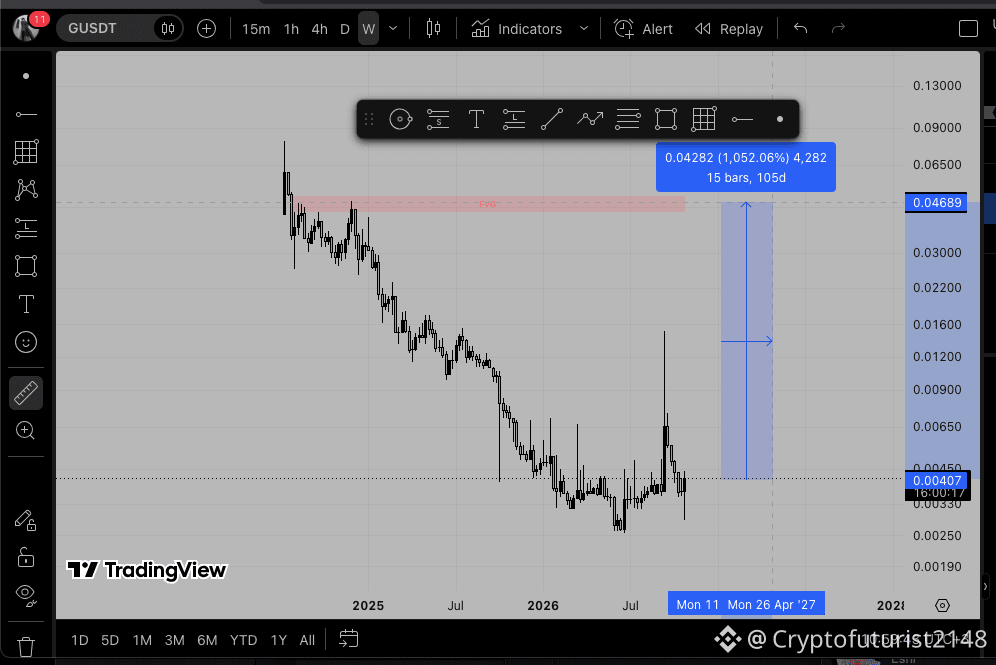
$G (Gravity) is up 26% in 24 hours 🚀
$G/USDT is trading near $0.004, after a 24h low of about $0.00324. Volume is $41.1M against a market cap of roughly $44.7M, which is very heavy turnover for a token this size.
Why now?
There's a timely catalyst. Galxe announced in July that the Gravity Alpha mainnet shuts down on November 1, 2026, with Gravity L1 now fully operational. That deadline is today. Galxe also told users that G Staking is being sunset as part of the move to L1, and that users should unstake before November 1. The migration to Galxe's own Layer 1 is complete, and the market seems to be noticing.
What Gravity is:
Gravity is Galxe's Layer 1 chain. G is the gas token and is also used for staking and governance. Max supply is 12B, with about 11.2B circulating.
What to watch:
Whether price holds above the breakout level or gives the move back. Whether volume stays elevated or fades. The Fear & Greed Index is still at 35 ("Fear"), so this is a token-specific move, not a market-wide rally.
Not financial advice. DYOR.
$G #Gravity #Galxe #Layer1
174
Статья
The $6.3 Billion Binance Hack: What Happened, Who's Behind It, and How to Protect Your CryptoOn October 29, 2026, the crypto industry saw its biggest theft ever. Binance, the world's largest exchange, said hackers stole about $6.3 billion, far beyond the previous record. Here is what we know, what it means for the market, and what you can do to protect your own assets.
What happened
Blockchain analysis firms TRM Labs and Chainalysis say most of the theft unfolded over about 20 minutes, with the attacker moving roughly $6.36 billion out of Binance wallets across 10 blockchains. That dwarfs the $1.5 billion stolen from Bybit in February 2025.
Binance suspended deposits and withdrawals and said it would cover all losses, telling Al Jazeera that user funds were "safe." It also warned that the $6.3 billion figure may continue to rise as it traces more assets.
How the attack worked
Binance's first finding was that the breach went through an engineer's laptop, which let the attacker reach a service container and submit unauthorized withdrawal transactions. Co-CEO Richard Teng said it was not a "one-click" action but a complex process.
The picture has since widened. On Friday, Binance said further investigation had uncovered additional points of breach, though it still found no evidence that any wallet private key had leaked. Mark Karpeles, former head of the collapsed Mt Gox exchange, told Reuters he believes the attackers probably accessed keys for at least two Binance wallets. That disagreement is unresolved, so treat the technical details as preliminary.
The lesson is already clear: big breaches often start with people and devices, not with broken cryptography.
Who is blamed
TRM said it assessed "with high confidence" that the attack was carried out by TraderTraitor, a North Korean unit linked to the Lazarus Group. Chainalysis reached the same conclusion, and the FBI blamed the Bybit hack on the same unit. Pangolin Intelligence, a Singapore-based tracking firm, also believes a North Korean unit was responsible.
Binance is more cautious. Teng said the company's investigation has not attributed responsibility to any individual. North Korea has previously denied hacking allegations. This remains attribution by analysts, not an official finding.
Why it matters beyond crypto
North Korea's crypto theft has become a source of foreign currency that experts say helps prop up its economy and fund its sanctioned nuclear programme. TRM's Ari Redbord called it a global security issue, not just a crypto theft.
The race to freeze the money
Binance said about $3 billion has been frozen, including more than $2.3 billion by stablecoin issuers Tether and Circle, but it has not said what happened to the remaining $3.3 billion. The reason is that freezing works only for tokens whose issuer or governing body can block specific addresses. Stablecoins can be frozen, while many other assets cannot.
One analyst warned that the "cat and mouse game has barely begun," with North Korea likely to use money laundering networks to cash out. Funds not frozen early are rarely recovered.
Can Binance cover it?
The stolen amount is more than six times Binance's SAFU emergency fund, which was set up in 2018 and held in Bitcoin. Sources differ on its size: 21shares puts it at 15,000 BTC, about $1.18 billion. Either way, Binance has said company funds will cover the rest. Its proof of reserves as of October 1 showed net user balances of $134 billion against about $136 billion on-chain, a surplus near $2 billion. The company has said it will cover everyone, but the numbers show how much depends on its balance sheet.
Market reaction
Bitcoin hit a six-week low of $76,368 and Ether fell to a two-month low, while Coinbase shares fell 4.8%. Bitcoin's fall of just over 2% over 24 hours was far smaller than its 26% drawdown after FTX. The market treated this as a failure at one company, not a failure of Bitcoin. Analysts said crypto was already under pressure from higher US interest rates and weaker ETF demand.
DeFi saw only brief spillover. The attacker deposited 60 million stolen USDT into Aave and borrowed about $44.6 million in WETH within about three minutes. Aave froze its markets as a precaution and reported no bad debt.
The bigger lesson: centralized exchanges are giant targets
Sean Foley of Macquarie University said assets at a centralized exchange are only as safe as the exchange itself, and the larger its holdings, the bigger the target. Insurance won't save you either: most crime and cyber policies don't cover stolen cryptocurrency.
This is a pattern, not a one-off. TRM's 2026 report counted $2.87 billion stolen in nearly 150 attacks in 2025.
How to protect your crypto
You can't control an exchange's security, but you can control your exposure.
1. Don't keep everything on one platform. Keep only trading funds on exchanges. Move long-term holdings to a hardware wallet that you control.
2. Plan for a pause. Even when users are covered, withdrawals can be frozen for days. Keep an emergency reserve you can reach anytime.
3. Use phishing-resistant 2FA. Use a hardware security key or passkey instead of SMS codes, and turn on anti-phishing codes and withdrawal address whitelisting.
4. Treat your own device like a vault door. This attack began with an engineer's laptop. Keep your devices updated, avoid pirated software and unknown extensions, and don't do crypto on a machine you use for everything.
5. Split your funds. Use separate wallets for daily use, DeFi and long-term storage, so one failure can't take everything.
6. Clean up permissions. Delete unused API keys and revoke old smart contract approvals.
7. Watch for scams. After a big hack, fake "refund" and "compensation" links spread fast. Never share your seed phrase, and only trust official channels.
8. Back up offline. Store your seed phrase on paper or metal, never in screenshots, notes apps or cloud storage.
9. Don't panic-sell. The market's quick recovery shows that panic selling usually locks in losses.
What to watch next
Withdrawals. Binance said it was on track to resume withdrawals within 45 hours of Friday's update.Recovery. Whether the remaining $3.3 billion is traced or laundered.Cause. Whether the investigation confirms stolen keys or a different path.Official attribution. Whether governments formally name North Korea.
Bottom line
No security setup is perfect, and the biggest names are not immune. The best defense is to make sure no single failure, whether yours or an exchange's, can wipe you out.
This article is for information only and is not financial advice. Details are based on reporting from October 30-31, 2026 and may change as the investigation continues.
💬 After this hack, how much of your crypto will you keep on exchanges? Tell us in the comments.
#Binance #CryptoSecurity #BinanceHack #SelfCustody #BinanceSquare
The $6.3 Billion Binance Hack: What Happened, Who's Behind It, and How to Protect Your Crypto
On October 29, 2026, the crypto industry saw its biggest theft ever. Binance, the world's largest exchange, said hackers stole about $6.3 billion, far beyond the previous record. Here is what we know, what it means for the market, and what you can do to protect your own assets.
What happened
Blockchain analysis firms TRM Labs and Chainalysis say most of the theft unfolded over about 20 minutes, with the attacker moving roughly $6.36 billion out of Binance wallets across 10 blockchains. That dwarfs the $1.5 billion stolen from Bybit in February 2025.
Binance suspended deposits and withdrawals and said it would cover all losses, telling Al Jazeera that user funds were "safe." It also warned that the $6.3 billion figure may continue to rise as it traces more assets.
How the attack worked
Binance's first finding was that the breach went through an engineer's laptop, which let the attacker reach a service container and submit unauthorized withdrawal transactions. Co-CEO Richard Teng said it was not a "one-click" action but a complex process.
The picture has since widened. On Friday, Binance said further investigation had uncovered additional points of breach, though it still found no evidence that any wallet private key had leaked. Mark Karpeles, former head of the collapsed Mt Gox exchange, told Reuters he believes the attackers probably accessed keys for at least two Binance wallets. That disagreement is unresolved, so treat the technical details as preliminary.
The lesson is already clear: big breaches often start with people and devices, not with broken cryptography.
Who is blamed
TRM said it assessed "with high confidence" that the attack was carried out by TraderTraitor, a North Korean unit linked to the Lazarus Group. Chainalysis reached the same conclusion, and the FBI blamed the Bybit hack on the same unit. Pangolin Intelligence, a Singapore-based tracking firm, also believes a North Korean unit was responsible.
Binance is more cautious. Teng said the company's investigation has not attributed responsibility to any individual. North Korea has previously denied hacking allegations. This remains attribution by analysts, not an official finding.
Why it matters beyond crypto
North Korea's crypto theft has become a source of foreign currency that experts say helps prop up its economy and fund its sanctioned nuclear programme. TRM's Ari Redbord called it a global security issue, not just a crypto theft.
The race to freeze the money
Binance said about $3 billion has been frozen, including more than $2.3 billion by stablecoin issuers Tether and Circle, but it has not said what happened to the remaining $3.3 billion. The reason is that freezing works only for tokens whose issuer or governing body can block specific addresses. Stablecoins can be frozen, while many other assets cannot.
One analyst warned that the "cat and mouse game has barely begun," with North Korea likely to use money laundering networks to cash out. Funds not frozen early are rarely recovered.
Can Binance cover it?
The stolen amount is more than six times Binance's SAFU emergency fund, which was set up in 2018 and held in Bitcoin. Sources differ on its size: 21shares puts it at 15,000 BTC, about $1.18 billion. Either way, Binance has said company funds will cover the rest. Its proof of reserves as of October 1 showed net user balances of $134 billion against about $136 billion on-chain, a surplus near $2 billion. The company has said it will cover everyone, but the numbers show how much depends on its balance sheet.
Market reaction
Bitcoin hit a six-week low of $76,368 and Ether fell to a two-month low, while Coinbase shares fell 4.8%. Bitcoin's fall of just over 2% over 24 hours was far smaller than its 26% drawdown after FTX. The market treated this as a failure at one company, not a failure of Bitcoin. Analysts said crypto was already under pressure from higher US interest rates and weaker ETF demand.
DeFi saw only brief spillover. The attacker deposited 60 million stolen USDT into Aave and borrowed about $44.6 million in WETH within about three minutes. Aave froze its markets as a precaution and reported no bad debt.
The bigger lesson: centralized exchanges are giant targets
Sean Foley of Macquarie University said assets at a centralized exchange are only as safe as the exchange itself, and the larger its holdings, the bigger the target. Insurance won't save you either: most crime and cyber policies don't cover stolen cryptocurrency.
This is a pattern, not a one-off. TRM's 2026 report counted $2.87 billion stolen in nearly 150 attacks in 2025.
How to protect your crypto
You can't control an exchange's security, but you can control your exposure.
1. Don't keep everything on one platform. Keep only trading funds on exchanges. Move long-term holdings to a hardware wallet that you control.
2. Plan for a pause. Even when users are covered, withdrawals can be frozen for days. Keep an emergency reserve you can reach anytime.
3. Use phishing-resistant 2FA. Use a hardware security key or passkey instead of SMS codes, and turn on anti-phishing codes and withdrawal address whitelisting.
4. Treat your own device like a vault door. This attack began with an engineer's laptop. Keep your devices updated, avoid pirated software and unknown extensions, and don't do crypto on a machine you use for everything.
5. Split your funds. Use separate wallets for daily use, DeFi and long-term storage, so one failure can't take everything.
6. Clean up permissions. Delete unused API keys and revoke old smart contract approvals.
7. Watch for scams. After a big hack, fake "refund" and "compensation" links spread fast. Never share your seed phrase, and only trust official channels.
8. Back up offline. Store your seed phrase on paper or metal, never in screenshots, notes apps or cloud storage.
9. Don't panic-sell. The market's quick recovery shows that panic selling usually locks in losses.
What to watch next
Withdrawals. Binance said it was on track to resume withdrawals within 45 hours of Friday's update.Recovery. Whether the remaining $3.3 billion is traced or laundered.Cause. Whether the investigation confirms stolen keys or a different path.Official attribution. Whether governments formally name North Korea.
Bottom line
No security setup is perfect, and the biggest names are not immune. The best defense is to make sure no single failure, whether yours or an exchange's, can wipe you out.
This article is for information only and is not financial advice. Details are based on reporting from October 30-31, 2026 and may change as the investigation continues.
💬 After this hack, how much of your crypto will you keep on exchanges? Tell us in the comments.
#Binance #CryptoSecurity #BinanceHack #SelfCustody #BinanceSquare
1
798
💥 What If Your Exchange Got Hacked Tomorrow? Lessons From the $6.3B Binance Breach
Most of us ask, “Is my exchange secure?” After this week, a better question is: “If it fails, what happens to me?”
Here’s what the incident teaches us 👇
1️⃣ Not every asset is recoverable
Freezing only works for tokens whose issuer can block addresses. Tether and Circle froze over $2.4B in stablecoins within hours. Other assets are much harder to claw back once they move.
👉 Know which of your assets could be frozen after a theft and which could not.
2️⃣ A safety fund isn’t full coverage
Binance says it will cover all losses. Its SAFU fund (15,000 BTC, about $1.18B) covers only part of the unfrozen amount, and the rest comes from company funds. That’s reassuring, but it shows why an exchange’s balance sheet matters.
👉 Check proof of reserves, not just promises.
3️⃣ One device can be the weak point
Early findings point to a compromised engineer’s laptop, not a leaked wallet key. Attackers go after people before they go after code.
👉 Delete unused API keys, review your logged-in sessions, and use a separate email just for crypto.
4️⃣ Problems spread in minutes
Within about three minutes, the attacker had deposited stolen USDT into Aave and borrowed WETH against it. One breach can reach other platforms almost instantly.
👉 Don’t put all your capital on one platform or protocol.
5️⃣ Panic is optional
Bitcoin dropped only about 2% after the hack, compared to 26% after FTX. The market saw a single-company breach, not a flaw in Bitcoin.
👉 Set your exit rules now, so you aren’t deciding in the middle of a crisis.
✅ 5-minute self-audit
☐ How much of my portfolio sits on one exchange?
☐ Could I live with a 48-hour withdrawal pause?
☐ Do I have funds outside the exchange?
☐ Do I know where my backups are?
Security isn’t about trusting one platform more. It’s about making sure no single failure can hurt you badly. 🛡️
💬 What % of your crypto is on exchanges vs. self-custody? Drop a rough number below 👇
#Binance
95
Статья
Securing Your Wallets and Accounts: Lessons from the Binance HackSecuring Your Wallets and Accounts: Lessons from the Binance Hack
Updated October 30, 2026. Reporting on the Binance incident is still changing, so treat the figures and attribution below as preliminary.
The biggest exchange in crypto has been hit by what is being described as possibly the largest hack in the industry's history. Whatever the final numbers turn out to be, the lesson for ordinary users is the same one we keep relearning: security is a chain, and you only control some of the links. This post separates the links you can't control from the ones you can, and gives you a concrete plan for the second group.
The short version: keep only trading-sized balances on exchanges, lock your account with a hardware key or passkey and a withdrawal whitelist, move long-term holdings to a hardware wallet with an offline seed backup, and treat every post-hack email, DM or "compensation" link as a scam until proven otherwise.
WHAT WE KNOW, AND WHAT WE DON'T
As of this writing, reporting says Binance suspended withdrawals after suspicious outflows from its hot wallets, and that more than 2.5 billion US dollars in assets has been frozen. Estimates of the total moved vary widely, from roughly 5.8 billion to about 6.3 billion US dollars depending on the outlet and the tracker. Stablecoin issuers have reportedly frozen some funds. Several blockchain investigators have publicly linked the theft to North Korea's TraderTraitor group, based on similarities with earlier thefts. That attribution is an assessment, not a confirmed finding. Former CEO Changpeng Zhao has said he expects user funds to be fully covered.
What we do not know yet: how the attackers got in, whether any individual user accounts were compromised, how much will be recovered, and whether users will be made whole. Anyone who tells you the root cause today is guessing. Be skeptical of any thread, video or Telegram channel that claims inside knowledge.
This is also not Binance's first major incident. In May 2019, attackers took 7,000 BTC from a hot wallet holding about 2 percent of the exchange's Bitcoin. Binance said the attackers used phishing, viruses and other attacks, and had obtained user API keys and 2FA codes. Back then Binance covered the loss from its SAFU emergency fund. Different year, different scale, same category of problem: the weak point was operational security around hot wallets and credentials, not the cryptography of Bitcoin itself.
THE FIRST LESSON: KNOW WHICH RISK YOU ARE CARRYING
When you hold crypto, you can be exposed to three very different kinds of risk.
Platform risk. If your coins sit on an exchange, you hold an IOU. A breach of the exchange's own infrastructure can hurt you no matter how perfect your personal security is. You can't fix this with a better password. You can only decide how much you are willing to expose to it.Account risk. Someone takes over your exchange login, drains your balance, or abuses your API keys. This is the most common way individuals lose money, and it is almost entirely within your control.Wallet risk. If you self-custody, nobody can freeze or reverse anything, including you and including thieves. Your seed phrase and your signing habits are the whole game.
Most people think about only one of these at a time. A good setup addresses all three.
PART 1: REDUCE YOUR PLATFORM RISK
You can't audit an exchange's internals, so the only lever is exposure.
Treat exchanges as places to trade, not places to store. Keep what you actively trade on the exchange and move the rest to self-custody.Spread across venues if you must hold on exchanges. One breach should not be able to take everything.Don't treat insurance funds and "proof of reserves" as guarantees. Funds like SAFU and reserve attestations are useful signals, but they are only as good as the company's solvency and willingness to pay, and a reserve snapshot says little about operational security.Expect friction during incidents. Withdrawals can be paused for days. If you might need your money on short notice, don't have all of it behind a withdrawal button someone else controls.Understand stablecoin freezes. Issuers like Tether and Circle can freeze addresses. That's helpful against thieves and a reminder that stablecoins are not bearer assets in the way Bitcoin is.
A simple rule of thumb: only keep on an exchange an amount whose total loss, or a month-long freeze, you could absorb.
PART 2: LOCK DOWN YOUR EXCHANGE ACCOUNT
If you keep any balance on Binance or any other exchange, do all of the following today.
Authentication
Use passkeys or hardware security keys (FIDO2 or YubiKey) where offered. They are resistant to phishing because they only work on the real site.Use an authenticator app instead of SMS. SMS codes are vulnerable to SIM swapping and interception. Remove SMS as a 2FA method entirely if the platform allows it.Use a unique, long password from a password manager. Never reuse a password between your exchange, your email and anything else.Protect your email as if it were your bank. Whoever controls your email can reset almost everything. Put a hardware key or passkey on it, and use a different email address for exchanges than the one you use for newsletters and shopping.
Withdrawal protections
Turn on the withdrawal address whitelist. With it on, funds can only leave to addresses you pre-approved, often with a delay on new additions. This single setting defeats many account takeovers.Enable the anti-phishing code. Binance and others let you set a code that appears in every genuine email from them. If an email lacks it, it's fake.Set withdrawal limits and cooldowns if available, so a stolen session can't empty everything at once.Review active sessions and devices regularly and revoke anything unfamiliar.
API keys, a lesson straight from 2019
Attackers in the 2019 incident got hold of user API keys. If you trade through bots or third-party tools:
Create keys with the minimum permissions. Trading only, never withdrawal, unless you have an exceptional reason.Restrict each key to specific IP addresses.Use one key per tool, so you can revoke one without breaking the rest.Delete keys you no longer use. Also never paste keys into code you commit, chat tools, or screenshots. Keys leaked via code repositories are a recurring cause of losses.After any security incident at a platform, rotate your keys as a precaution.
PART 3: SECURE YOUR SELF-CUSTODY WALLETS
Self-custody removes platform risk and replaces it with responsibility. Here is a setup that works for most people.
Hardware first
Use a hardware wallet for any meaningful amount. Buy it directly from the manufacturer, never from a marketplace or a reseller, and be suspicious of any device that arrives pre-initialized or with a pre-written recovery card.Keep your firmware updated, but only through the manufacturer's official app.
Your seed phrase is the money
Write it on paper or stamp it in metal. Never store it digitally. No photos, no notes apps, no cloud drives, no password managers, no emails to yourself.Never type it into anything except your hardware device during a genuine recovery. No support agent, exchange, wallet app or airdrop site will ever legitimately ask for it.Store backups in at least two physically separate, secure places. A fire or a flood shouldn't be able to destroy the only copy.Consider an optional passphrase (the "25th word"). It adds a second factor, but if you forget it, the funds are gone. Only use it if you can manage the extra backup.
Split your setup by purpose
A clean structure looks like this:
Cold wallet: long-term holdings, rarely touched, hardware-backed.Warm wallet: a separate hardware-backed account for occasional use.Hot wallet: a browser or mobile wallet with only a small amount, for experimenting and DeFi.
Never connect your cold wallet to unfamiliar sites. If a hot wallet is compromised, you lose a small amount rather than everything.
For larger sums, use multisig
A multi-signature wallet requires several independent keys to approve a transaction, for example two of three. No single stolen key or device can move the funds. Place keys on different devices, in different locations, ideally with different manufacturers.
Verify what you sign
The February 2025 Bybit theft, about 1.5 billion US dollars, is the cautionary tale here. Per public post-mortems, the attackers did not break the multisig wallet's cryptography. They compromised the interface that signers used, so the screen showed a routine transfer while the transaction actually handed control of the wallet to the attackers. The signers did their job and approved what they saw.
The takeaway for individuals:
Read the transaction details on your hardware device's own screen, not just in the browser.Treat blind signing as dangerous. Avoid approving data you can't read, and disable blind signing in your hardware wallet settings unless you truly need it.Compare the full destination address, not just the first and last few characters.Send a small test transaction before moving large amounts to a new address.Be wary of address poisoning, where a scammer sends you a tiny transaction from an address that resembles one you've used, hoping you'll copy it from your history.
Token approvals
Every time you approve a smart contract to spend your tokens, that permission can persist indefinitely. Periodically review and revoke unused approvals using a reputable approval-checking tool, and avoid granting unlimited allowances when a specific amount will do.
PART 4: THE HUMAN LAYER
Most successful attacks, including the large ones, start with a person rather than a flaw in code. State-linked groups in particular are known for patient social engineering.
Fake job offers and "interviews." Be very cautious with anyone who asks you to download software, run a coding test or open a file as part of a hiring process. Run unknown files only in a separate, throwaway environment.Impersonation of support staff. Exchange support will not DM you first, will not ask for your 2FA codes, and will not ask you to "verify" your wallet.Urgency is the tell. "Your account will be frozen in 30 minutes" is a manipulation tactic, not a policy.Type or bookmark the URL. Do not click links in emails, ads or social posts to reach an exchange or wallet. Search-engine ads for wallet and exchange names are a known scam route.Keep your devices clean. Use a current operating system, avoid pirated software, don't install browser extensions casually, and consider a dedicated device or browser profile for crypto.
Expect a wave of scams right now
Big breaches reliably trigger secondary fraud. Over the next weeks, expect:
Fake emails and texts about "compensation claims" or "account verification" after the hack.Fake Binance support accounts offering to "recover" funds for a fee.Cloned websites asking you to connect a wallet or enter your seed phrase to "claim reimbursement."
If Binance owes you something, it will show up in your account or be announced on its official channels. You will not need to give anyone your seed phrase or 2FA codes to receive it.
IF YOU HAVE FUNDS ON BINANCE RIGHT NOW
Withdrawals are reportedly suspended, so your options are limited. Focus on what you can control:
Don't panic-click. Rushing is how people fall for the fake "recovery" sites.Secure your account: change your password, move to a hardware key or authenticator app, review devices and sessions, and enable the withdrawal whitelist and anti-phishing code.Rotate or delete API keys.Check your email for anything suspicious and secure that account too.Only follow official announcements from Binance's verified channels, accessed through a bookmark or by typing the address yourself.Keep records: screenshots of balances, trade history and any communications, in case you need them later.When withdrawals resume, consider moving long-term holdings to self-custody in stages, starting with a small test transfer.
THE ONE-PAGE CHECKLIST
Exchange account
Hardware key or passkey enabled, SMS 2FA removedUnique password in a password managerEmail secured with its own strong 2FAWithdrawal whitelist and anti-phishing code onAPI keys: trade-only, IP-restricted, unused ones deletedOnly trading-sized balances left on the platform
Self-custody
Hardware wallet bought direct from the manufacturerSeed phrase on paper or metal, offline, two locationsCold, warm and hot wallets kept separateMultisig for large holdingsTransactions verified on the device screen, blind signing offOld token approvals revoked
Habits
Bookmarked URLs onlyNobody ever gets your seed phrase or codesSkepticism toward anything urgent, unsolicited or too generous
THE BIGGER PICTURE
Every large crypto theft prompts the same debate about whether the answer is better exchanges or no exchanges. The honest answer is that it depends on what you are doing with the funds. Exchanges are convenient and sometimes necessary. Self-custody is powerful and unforgiving. The people who come out of these events in good shape are not the ones who found the perfect option. They're the ones who limited their exposure in advance, removed the easy attack paths, and never relied on a single point of failure.
We'll update this post as Binance and independent investigators publish more about what happened.
SOURCES
Status figures and attribution come from early reporting that is changing hour by hour. Check Binance's official channels for updates.
Euronews: Binance confirms major hack with more than 2.5bn USD frozen https://www.euronews.com/2026/10/30/crypto-platform-binance-confirms-major-hack-with-more-than-25bn-frozenThe Block: Binance investigating hack as suspicious outflows reach up to 5.8 billion USD https://www.theblock.co/news/markets/2026-10-29-binance-investigating-hack-suspicious-outflows-5-billion-432171Cointelegraph: North Korea's TraderTraitor linked to 6.3B USD Binance hack https://cointelegraph.com/news/north-korea-linked-to-63b-binance-hack-by-crypto-investigatorsCoingape: Binance suspected of suffering over 5B USD hack as Tether, Circle freeze assets https://coingape.com/binance-suspected-of-suffering-over-5b-hack-as-tether-circle-freeze-assets/The Jakarta Post: Crypto platform Binance confirms major hack, more than 2.5b USD frozen https://www.thejakartapost.com/business/2026/10/30/crypto-platform-binance-confirms-major-hack-more-than-25b-frozenDecrypt: Binance hack security breach (May 2019) https://decrypt.co/6930/binance-hack-security-breach
The 2025 Bybit details are drawn from public post-mortems.
This post is general information, not financial advice.
Securing Your Wallets and Accounts: Lessons from the Binance Hack
Securing Your Wallets and Accounts: Lessons from the Binance Hack
Updated October 30, 2026. Reporting on the Binance incident is still changing, so treat the figures and attribution below as preliminary.
The biggest exchange in crypto has been hit by what is being described as possibly the largest hack in the industry's history. Whatever the final numbers turn out to be, the lesson for ordinary users is the same one we keep relearning: security is a chain, and you only control some of the links. This post separates the links you can't control from the ones you can, and gives you a concrete plan for the second group.
The short version: keep only trading-sized balances on exchanges, lock your account with a hardware key or passkey and a withdrawal whitelist, move long-term holdings to a hardware wallet with an offline seed backup, and treat every post-hack email, DM or "compensation" link as a scam until proven otherwise.
WHAT WE KNOW, AND WHAT WE DON'T
As of this writing, reporting says Binance suspended withdrawals after suspicious outflows from its hot wallets, and that more than 2.5 billion US dollars in assets has been frozen. Estimates of the total moved vary widely, from roughly 5.8 billion to about 6.3 billion US dollars depending on the outlet and the tracker. Stablecoin issuers have reportedly frozen some funds. Several blockchain investigators have publicly linked the theft to North Korea's TraderTraitor group, based on similarities with earlier thefts. That attribution is an assessment, not a confirmed finding. Former CEO Changpeng Zhao has said he expects user funds to be fully covered.
What we do not know yet: how the attackers got in, whether any individual user accounts were compromised, how much will be recovered, and whether users will be made whole. Anyone who tells you the root cause today is guessing. Be skeptical of any thread, video or Telegram channel that claims inside knowledge.
This is also not Binance's first major incident. In May 2019, attackers took 7,000 BTC from a hot wallet holding about 2 percent of the exchange's Bitcoin. Binance said the attackers used phishing, viruses and other attacks, and had obtained user API keys and 2FA codes. Back then Binance covered the loss from its SAFU emergency fund. Different year, different scale, same category of problem: the weak point was operational security around hot wallets and credentials, not the cryptography of Bitcoin itself.
THE FIRST LESSON: KNOW WHICH RISK YOU ARE CARRYING
When you hold crypto, you can be exposed to three very different kinds of risk.
Platform risk. If your coins sit on an exchange, you hold an IOU. A breach of the exchange's own infrastructure can hurt you no matter how perfect your personal security is. You can't fix this with a better password. You can only decide how much you are willing to expose to it.Account risk. Someone takes over your exchange login, drains your balance, or abuses your API keys. This is the most common way individuals lose money, and it is almost entirely within your control.Wallet risk. If you self-custody, nobody can freeze or reverse anything, including you and including thieves. Your seed phrase and your signing habits are the whole game.
Most people think about only one of these at a time. A good setup addresses all three.
PART 1: REDUCE YOUR PLATFORM RISK
You can't audit an exchange's internals, so the only lever is exposure.
Treat exchanges as places to trade, not places to store. Keep what you actively trade on the exchange and move the rest to self-custody.Spread across venues if you must hold on exchanges. One breach should not be able to take everything.Don't treat insurance funds and "proof of reserves" as guarantees. Funds like SAFU and reserve attestations are useful signals, but they are only as good as the company's solvency and willingness to pay, and a reserve snapshot says little about operational security.Expect friction during incidents. Withdrawals can be paused for days. If you might need your money on short notice, don't have all of it behind a withdrawal button someone else controls.Understand stablecoin freezes. Issuers like Tether and Circle can freeze addresses. That's helpful against thieves and a reminder that stablecoins are not bearer assets in the way Bitcoin is.
A simple rule of thumb: only keep on an exchange an amount whose total loss, or a month-long freeze, you could absorb.
PART 2: LOCK DOWN YOUR EXCHANGE ACCOUNT
If you keep any balance on Binance or any other exchange, do all of the following today.
Authentication
Use passkeys or hardware security keys (FIDO2 or YubiKey) where offered. They are resistant to phishing because they only work on the real site.Use an authenticator app instead of SMS. SMS codes are vulnerable to SIM swapping and interception. Remove SMS as a 2FA method entirely if the platform allows it.Use a unique, long password from a password manager. Never reuse a password between your exchange, your email and anything else.Protect your email as if it were your bank. Whoever controls your email can reset almost everything. Put a hardware key or passkey on it, and use a different email address for exchanges than the one you use for newsletters and shopping.
Withdrawal protections
Turn on the withdrawal address whitelist. With it on, funds can only leave to addresses you pre-approved, often with a delay on new additions. This single setting defeats many account takeovers.Enable the anti-phishing code. Binance and others let you set a code that appears in every genuine email from them. If an email lacks it, it's fake.Set withdrawal limits and cooldowns if available, so a stolen session can't empty everything at once.Review active sessions and devices regularly and revoke anything unfamiliar.
API keys, a lesson straight from 2019
Attackers in the 2019 incident got hold of user API keys. If you trade through bots or third-party tools:
Create keys with the minimum permissions. Trading only, never withdrawal, unless you have an exceptional reason.Restrict each key to specific IP addresses.Use one key per tool, so you can revoke one without breaking the rest.Delete keys you no longer use. Also never paste keys into code you commit, chat tools, or screenshots. Keys leaked via code repositories are a recurring cause of losses.After any security incident at a platform, rotate your keys as a precaution.
PART 3: SECURE YOUR SELF-CUSTODY WALLETS
Self-custody removes platform risk and replaces it with responsibility. Here is a setup that works for most people.
Hardware first
Use a hardware wallet for any meaningful amount. Buy it directly from the manufacturer, never from a marketplace or a reseller, and be suspicious of any device that arrives pre-initialized or with a pre-written recovery card.Keep your firmware updated, but only through the manufacturer's official app.
Your seed phrase is the money
Write it on paper or stamp it in metal. Never store it digitally. No photos, no notes apps, no cloud drives, no password managers, no emails to yourself.Never type it into anything except your hardware device during a genuine recovery. No support agent, exchange, wallet app or airdrop site will ever legitimately ask for it.Store backups in at least two physically separate, secure places. A fire or a flood shouldn't be able to destroy the only copy.Consider an optional passphrase (the "25th word"). It adds a second factor, but if you forget it, the funds are gone. Only use it if you can manage the extra backup.
Split your setup by purpose
A clean structure looks like this:
Cold wallet: long-term holdings, rarely touched, hardware-backed.Warm wallet: a separate hardware-backed account for occasional use.Hot wallet: a browser or mobile wallet with only a small amount, for experimenting and DeFi.
Never connect your cold wallet to unfamiliar sites. If a hot wallet is compromised, you lose a small amount rather than everything.
For larger sums, use multisig
A multi-signature wallet requires several independent keys to approve a transaction, for example two of three. No single stolen key or device can move the funds. Place keys on different devices, in different locations, ideally with different manufacturers.
Verify what you sign
The February 2025 Bybit theft, about 1.5 billion US dollars, is the cautionary tale here. Per public post-mortems, the attackers did not break the multisig wallet's cryptography. They compromised the interface that signers used, so the screen showed a routine transfer while the transaction actually handed control of the wallet to the attackers. The signers did their job and approved what they saw.
The takeaway for individuals:
Read the transaction details on your hardware device's own screen, not just in the browser.Treat blind signing as dangerous. Avoid approving data you can't read, and disable blind signing in your hardware wallet settings unless you truly need it.Compare the full destination address, not just the first and last few characters.Send a small test transaction before moving large amounts to a new address.Be wary of address poisoning, where a scammer sends you a tiny transaction from an address that resembles one you've used, hoping you'll copy it from your history.
Token approvals
Every time you approve a smart contract to spend your tokens, that permission can persist indefinitely. Periodically review and revoke unused approvals using a reputable approval-checking tool, and avoid granting unlimited allowances when a specific amount will do.
PART 4: THE HUMAN LAYER
Most successful attacks, including the large ones, start with a person rather than a flaw in code. State-linked groups in particular are known for patient social engineering.
Fake job offers and "interviews." Be very cautious with anyone who asks you to download software, run a coding test or open a file as part of a hiring process. Run unknown files only in a separate, throwaway environment.Impersonation of support staff. Exchange support will not DM you first, will not ask for your 2FA codes, and will not ask you to "verify" your wallet.Urgency is the tell. "Your account will be frozen in 30 minutes" is a manipulation tactic, not a policy.Type or bookmark the URL. Do not click links in emails, ads or social posts to reach an exchange or wallet. Search-engine ads for wallet and exchange names are a known scam route.Keep your devices clean. Use a current operating system, avoid pirated software, don't install browser extensions casually, and consider a dedicated device or browser profile for crypto.
Expect a wave of scams right now
Big breaches reliably trigger secondary fraud. Over the next weeks, expect:
Fake emails and texts about "compensation claims" or "account verification" after the hack.Fake Binance support accounts offering to "recover" funds for a fee.Cloned websites asking you to connect a wallet or enter your seed phrase to "claim reimbursement."
If Binance owes you something, it will show up in your account or be announced on its official channels. You will not need to give anyone your seed phrase or 2FA codes to receive it.
IF YOU HAVE FUNDS ON BINANCE RIGHT NOW
Withdrawals are reportedly suspended, so your options are limited. Focus on what you can control:
Don't panic-click. Rushing is how people fall for the fake "recovery" sites.Secure your account: change your password, move to a hardware key or authenticator app, review devices and sessions, and enable the withdrawal whitelist and anti-phishing code.Rotate or delete API keys.Check your email for anything suspicious and secure that account too.Only follow official announcements from Binance's verified channels, accessed through a bookmark or by typing the address yourself.Keep records: screenshots of balances, trade history and any communications, in case you need them later.When withdrawals resume, consider moving long-term holdings to self-custody in stages, starting with a small test transfer.
THE ONE-PAGE CHECKLIST
Exchange account
Hardware key or passkey enabled, SMS 2FA removedUnique password in a password managerEmail secured with its own strong 2FAWithdrawal whitelist and anti-phishing code onAPI keys: trade-only, IP-restricted, unused ones deletedOnly trading-sized balances left on the platform
Self-custody
Hardware wallet bought direct from the manufacturerSeed phrase on paper or metal, offline, two locationsCold, warm and hot wallets kept separateMultisig for large holdingsTransactions verified on the device screen, blind signing offOld token approvals revoked
Habits
Bookmarked URLs onlyNobody ever gets your seed phrase or codesSkepticism toward anything urgent, unsolicited or too generous
THE BIGGER PICTURE
Every large crypto theft prompts the same debate about whether the answer is better exchanges or no exchanges. The honest answer is that it depends on what you are doing with the funds. Exchanges are convenient and sometimes necessary. Self-custody is powerful and unforgiving. The people who come out of these events in good shape are not the ones who found the perfect option. They're the ones who limited their exposure in advance, removed the easy attack paths, and never relied on a single point of failure.
We'll update this post as Binance and independent investigators publish more about what happened.
SOURCES
Status figures and attribution come from early reporting that is changing hour by hour. Check Binance's official channels for updates.
Euronews: Binance confirms major hack with more than 2.5bn USD frozen https://www.euronews.com/2026/10/30/crypto-platform-binance-confirms-major-hack-with-more-than-25bn-frozenThe Block: Binance investigating hack as suspicious outflows reach up to 5.8 billion USD https://www.theblock.co/news/markets/2026-10-29-binance-investigating-hack-suspicious-outflows-5-billion-432171Cointelegraph: North Korea's TraderTraitor linked to 6.3B USD Binance hack https://cointelegraph.com/news/north-korea-linked-to-63b-binance-hack-by-crypto-investigatorsCoingape: Binance suspected of suffering over 5B USD hack as Tether, Circle freeze assets https://coingape.com/binance-suspected-of-suffering-over-5b-hack-as-tether-circle-freeze-assets/The Jakarta Post: Crypto platform Binance confirms major hack, more than 2.5b USD frozen https://www.thejakartapost.com/business/2026/10/30/crypto-platform-binance-confirms-major-hack-more-than-25b-frozenDecrypt: Binance hack security breach (May 2019) https://decrypt.co/6930/binance-hack-security-breach
The 2025 Bybit details are drawn from public post-mortems.
This post is general information, not financial advice.
1
3
2.1k

Статья
HUMA Rips 46% in 24 Hours: The Flush, the Arf Link, and the Unlock That Decides ItPrices and percentages as of Oct 27, 2026, ~1:37 PM. Figures marked (est.) are my own calculations, explained in the methodology note at the end.
⚡ TL;DR: HUMA is trading near $0.0265 after a violent overnight rebound. The headline number overstates the move, the most interesting catalyst is indirect, and a 332.5M-token unlock lands in a month. This is a real move on a small base, but it isn’t a confirmed trend change.
📊 1. Two numbers, one move
Binance’s rolling 24-hour view shows +46.18%, while the HUMA/USDT daily candle on TradingView shows +17.63%. Backing into the math, the 24-hour window starts near $0.0181 (est.), and the daily candle opens near $0.0227 (est.). HUMA flushed to roughly $0.018 overnight, bounced, and reclaimed its prior range. 🩸➡️🟢 About 30 points of the 46% is the V-shaped recovery, not new upside.
For context, the token traded at $0.0263 on October 24 before sliding 5.14% to $0.0232 on October 26. 📉 It’s still down 13.65% over 30 days and 37.36% over a year. All-time-high figures differ by source: some list $0.0693, while CoinGecko lists $0.1156, likely capturing the launch spike. Either way, HUMA is far below it.
🧩 2. What Huma is, and the split that matters
Huma is a payment-finance protocol on Solana. ☀️ Depositors put in USDC and receive PST, a receipt token that accrues yield from short-term payment financing. For anyone trading HUMA, the key point is that PST is the yield engine while HUMA handles governance. The product that has grown is not the token that’s pumping.
The product is growing 📈:
💰 PST reportedly crossed $322M in market cap on September 14, more than double April’s $158M, with yield in a 7–9% range (per Crypto Briefing).🏦 DefiLlama shows $211M in TVL, up 17.1% in 30 days, ranking #4 among yield protocols.✅ Huma says it has facilitated over $12B in cumulative payment volume with zero credit defaults. These are the project’s own claims and not independently verified.
🔗 3. Why the Ripple–Arf news matters more than it looks
At first glance it’s an XRPL deal that doesn’t involve HUMA. The link is concentration. Solana Compass reports that much of Huma’s institutional volume runs through Arf, and a community post on Binance Square (not an official source) identifies Arf facilities as the largest asset generating PayFi yield. That cuts both ways:
🟢 Bull read: Ripple and Arf are bringing RLUSD settlement liquidity to licensed cross-border payment firms. Arf reports about $10B in annual settlement volume (self-reported) and merged with Huma in 2024. A stronger Arf means a stronger demand pipeline for Huma’s rails.🔴 Bear read: Arf is expanding onto XRPL with RLUSD, which competes for the same settlement capital, and PST’s yield structure carries counterparty concentration. Also, no financial commitment or RLUSD allocation was disclosed.
So the headline is real but second-order. 🕵️ Traders likely front-ran the narrative, and I found no HUMA-specific announcement today.
🏛️ 4. The institutional layer
PST is gaining TradFi-adjacent distribution. Bitwise launched a Morpho vault where PST makes up about 39.74% of the collateral basket, and Bitwise’s PAPY vault lets borrowers pledge Huma’s PST alongside other tokenized credit. That validates the product. ⚠️ What’s unproven is how much of it flows to HUMA holders, since I found no revenue share for the token.
⚖️ 5. The valuation disconnect
At $0.0265, HUMA’s market cap is roughly $86M (est.) on about 3.26B circulating, or about $265M fully diluted (est.) on the 10B max supply. Note that aggregators disagree on circulating supply (roughly 1.7B to 3.5B), so the market cap moves with the source. 🤯 PST’s $322M market cap is larger than HUMA’s entire FDV, but PST is a USDC-backed receipt, not equity, so the comparison shows scale, not cheapness. The real question is whether governance rights and Feathers-based allocations (the Maxi mode forgoes base yield to maximize Feather accumulation toward HUMA allocation) create durable demand once incentive seasons end. The last revenue figure I found, $8M annualized in April 2025 (project-reported), is stale, so I’m not building a valuation multiple on it.
🔓 6. The unlock, the real risk
The first team and investor unlock was pushed from May to November 26, covering allocations that total 39.9% of supply, with about 332.5M HUMA in the first batch (per CoinMarketCap’s AI-generated summaries, so verify against the official tokenomics before relying on it). That’s about 10% of circulating supply (est.), roughly $8.8M at today’s price (est.). 🚨 The original pre-launch design described linear vesting over three years after the lock-up, so this is likely the start of a recurring overhang, not a one-off. I couldn’t verify how the delay changed that schedule. Recipients also got a better exit price than they had last week. 💸
🎯 7. Levels and macro
🧱 Resistance: $0.027, with $0.0263 being the October 24 high. Support sits near $0.025.✅ Confirmation: a daily close above $0.027 on rising volume.❌ Invalidation: losing $0.025, which retraces the move.🌍 Macro: Bitcoin is near $80,000 after slipping below it on pre-Fed de-risking, with the Fed decision October 28 and PCE data October 29.
🔮 8. Scenarios
🐂 Bull: narrative rotation into PayFi, a clean close above $0.027, and volume holding. Price consolidates above $0.025 into the unlock.
⚖️ Base: HUMA chops between $0.023 and $0.027 as macro volatility hits, and the percentage gain bleeds off.
🐻 Bear: no HUMA-specific catalyst appears, the macro events go badly, and unlock positioning pushes price back toward the $0.018 flush low (est.).
🔍 Data caveats
I don’t have the exact 24h low or volume for Binance’s HUMA/USDT pair, so the $0.018 flush level is inferred.I couldn’t confirm that the Arf/Ripple news drove today’s bid.I found no whale, listing, or leverage data for today’s move.
🏁 Bottom line
HUMA bounced hard off an overnight low, and the underlying product is growing. 📈 But today’s gain mostly recovers a dip, the token is separate from the yield product, and the unlock is a month out. Wait for the close above $0.027. 🧠 Not financial advice. Size for the volatility.
🧮 Methodology note (est.)
$0.0181 and $0.0227: current price divided by (1 + the displayed percentage change) for the 24h and daily figures.~$86M market cap: $0.0265 × ~3.26B circulating.~$265M FDV: $0.0265 × 10B max supply.~10% float: 332.5M ÷ ~3.26B.~$8.8M unlock value: 332.5M × $0.0265.
📚 Sources
Price and market data
Binance HUMA price page and TradingView HUMAUSDT (screenshots, Oct 27, 1:37 PM)CoinMarketCap AI price analysis (auto-generated): coinmarketcap.com/cmc-ai/huma-finance/price-analysis/Zypto gainers board: zypto.com/crypto-prices/top/gainers/KuCoin HUMA page: kucoin.com/price/humaCoinGecko HUMA page: coingecko.com/en/coins/huma-finance/usdAnalytics Insight, Bitcoin near $80K ahead of the Fed: analyticsinsight.net
Protocol and PST
Solana Compass, PST $322M: solanacompass.com/news/huma-finances-pst-crosses-322m-market-cap-solanas-largest-yield-bearing-assetCrypto Briefing, PST $322M: cryptobriefing.com/huma-finance-pst-token-322m-solana/Solana Compass, PST $200M (relays Huma’s self-reported $12B volume and zero-defaults claims): solanacompass.com/news/huma-finances-pst-crosses-200m-market-cap-a-top-3-yield-bearing-asset-on-solanaSolana Compass project page: solanacompass.com/projects/humaDefiLlama, Huma Finance V2: defillama.com/protocol/huma-finance-v2Binance Square community post (user-generated, not official): binance.com/en/square/profile/bchillmanChainwire/Decrypt, Huma 2.0 launch (project press release): decrypt.co/314278
Arf and Ripple
FXStreet, Ripple and Arf partnership: fxstreet.comCrypto Briefing, Arf and Ripple RLUSD liquidity: cryptobriefing.com/arf-ripple-rlusd-xrp-ledger-liquidity/DiarioBitcoin, no commitment disclosed: diariobitcoin.com
Institutional
Stablecon, Bitwise and Sentora vaults on Morpho: content.stablecon.com
Tokenomics and unlock
CoinMarketCap AI, latest updates (auto-generated): coinmarketcap.com/cmc-ai/huma-finance/latest-updates/CoinMarketCap AI, price prediction (auto-generated): coinmarketcap.com/cmc-ai/huma-finance/price-prediction/NFT Evening, original vesting terms (pre-launch): nftevening.com/huma-finance-price-prediction-huma/
HUMA Rips 46% in 24 Hours: The Flush, the Arf Link, and the Unlock That Decides It
Prices and percentages as of Oct 27, 2026, ~1:37 PM. Figures marked (est.) are my own calculations, explained in the methodology note at the end.
⚡ TL;DR: HUMA is trading near $0.0265 after a violent overnight rebound. The headline number overstates the move, the most interesting catalyst is indirect, and a 332.5M-token unlock lands in a month. This is a real move on a small base, but it isn’t a confirmed trend change.
📊 1. Two numbers, one move
Binance’s rolling 24-hour view shows +46.18%, while the HUMA/USDT daily candle on TradingView shows +17.63%. Backing into the math, the 24-hour window starts near $0.0181 (est.), and the daily candle opens near $0.0227 (est.). HUMA flushed to roughly $0.018 overnight, bounced, and reclaimed its prior range. 🩸➡️🟢 About 30 points of the 46% is the V-shaped recovery, not new upside.
For context, the token traded at $0.0263 on October 24 before sliding 5.14% to $0.0232 on October 26. 📉 It’s still down 13.65% over 30 days and 37.36% over a year. All-time-high figures differ by source: some list $0.0693, while CoinGecko lists $0.1156, likely capturing the launch spike. Either way, HUMA is far below it.
🧩 2. What Huma is, and the split that matters
Huma is a payment-finance protocol on Solana. ☀️ Depositors put in USDC and receive PST, a receipt token that accrues yield from short-term payment financing. For anyone trading HUMA, the key point is that PST is the yield engine while HUMA handles governance. The product that has grown is not the token that’s pumping.
The product is growing 📈:
💰 PST reportedly crossed $322M in market cap on September 14, more than double April’s $158M, with yield in a 7–9% range (per Crypto Briefing).🏦 DefiLlama shows $211M in TVL, up 17.1% in 30 days, ranking #4 among yield protocols.✅ Huma says it has facilitated over $12B in cumulative payment volume with zero credit defaults. These are the project’s own claims and not independently verified.
🔗 3. Why the Ripple–Arf news matters more than it looks
At first glance it’s an XRPL deal that doesn’t involve HUMA. The link is concentration. Solana Compass reports that much of Huma’s institutional volume runs through Arf, and a community post on Binance Square (not an official source) identifies Arf facilities as the largest asset generating PayFi yield. That cuts both ways:
🟢 Bull read: Ripple and Arf are bringing RLUSD settlement liquidity to licensed cross-border payment firms. Arf reports about $10B in annual settlement volume (self-reported) and merged with Huma in 2024. A stronger Arf means a stronger demand pipeline for Huma’s rails.🔴 Bear read: Arf is expanding onto XRPL with RLUSD, which competes for the same settlement capital, and PST’s yield structure carries counterparty concentration. Also, no financial commitment or RLUSD allocation was disclosed.
So the headline is real but second-order. 🕵️ Traders likely front-ran the narrative, and I found no HUMA-specific announcement today.
🏛️ 4. The institutional layer
PST is gaining TradFi-adjacent distribution. Bitwise launched a Morpho vault where PST makes up about 39.74% of the collateral basket, and Bitwise’s PAPY vault lets borrowers pledge Huma’s PST alongside other tokenized credit. That validates the product. ⚠️ What’s unproven is how much of it flows to HUMA holders, since I found no revenue share for the token.
⚖️ 5. The valuation disconnect
At $0.0265, HUMA’s market cap is roughly $86M (est.) on about 3.26B circulating, or about $265M fully diluted (est.) on the 10B max supply. Note that aggregators disagree on circulating supply (roughly 1.7B to 3.5B), so the market cap moves with the source. 🤯 PST’s $322M market cap is larger than HUMA’s entire FDV, but PST is a USDC-backed receipt, not equity, so the comparison shows scale, not cheapness. The real question is whether governance rights and Feathers-based allocations (the Maxi mode forgoes base yield to maximize Feather accumulation toward HUMA allocation) create durable demand once incentive seasons end. The last revenue figure I found, $8M annualized in April 2025 (project-reported), is stale, so I’m not building a valuation multiple on it.
🔓 6. The unlock, the real risk
The first team and investor unlock was pushed from May to November 26, covering allocations that total 39.9% of supply, with about 332.5M HUMA in the first batch (per CoinMarketCap’s AI-generated summaries, so verify against the official tokenomics before relying on it). That’s about 10% of circulating supply (est.), roughly $8.8M at today’s price (est.). 🚨 The original pre-launch design described linear vesting over three years after the lock-up, so this is likely the start of a recurring overhang, not a one-off. I couldn’t verify how the delay changed that schedule. Recipients also got a better exit price than they had last week. 💸
🎯 7. Levels and macro
🧱 Resistance: $0.027, with $0.0263 being the October 24 high. Support sits near $0.025.✅ Confirmation: a daily close above $0.027 on rising volume.❌ Invalidation: losing $0.025, which retraces the move.🌍 Macro: Bitcoin is near $80,000 after slipping below it on pre-Fed de-risking, with the Fed decision October 28 and PCE data October 29.
🔮 8. Scenarios
🐂 Bull: narrative rotation into PayFi, a clean close above $0.027, and volume holding. Price consolidates above $0.025 into the unlock.
⚖️ Base: HUMA chops between $0.023 and $0.027 as macro volatility hits, and the percentage gain bleeds off.
🐻 Bear: no HUMA-specific catalyst appears, the macro events go badly, and unlock positioning pushes price back toward the $0.018 flush low (est.).
🔍 Data caveats
I don’t have the exact 24h low or volume for Binance’s HUMA/USDT pair, so the $0.018 flush level is inferred.I couldn’t confirm that the Arf/Ripple news drove today’s bid.I found no whale, listing, or leverage data for today’s move.
🏁 Bottom line
HUMA bounced hard off an overnight low, and the underlying product is growing. 📈 But today’s gain mostly recovers a dip, the token is separate from the yield product, and the unlock is a month out. Wait for the close above $0.027. 🧠 Not financial advice. Size for the volatility.
🧮 Methodology note (est.)
$0.0181 and $0.0227: current price divided by (1 + the displayed percentage change) for the 24h and daily figures.~$86M market cap: $0.0265 × ~3.26B circulating.~$265M FDV: $0.0265 × 10B max supply.~10% float: 332.5M ÷ ~3.26B.~$8.8M unlock value: 332.5M × $0.0265.
📚 Sources
Price and market data
Binance HUMA price page and TradingView HUMAUSDT (screenshots, Oct 27, 1:37 PM)CoinMarketCap AI price analysis (auto-generated): coinmarketcap.com/cmc-ai/huma-finance/price-analysis/Zypto gainers board: zypto.com/crypto-prices/top/gainers/KuCoin HUMA page: kucoin.com/price/humaCoinGecko HUMA page: coingecko.com/en/coins/huma-finance/usdAnalytics Insight, Bitcoin near $80K ahead of the Fed: analyticsinsight.net
Protocol and PST
Solana Compass, PST $322M: solanacompass.com/news/huma-finances-pst-crosses-322m-market-cap-solanas-largest-yield-bearing-assetCrypto Briefing, PST $322M: cryptobriefing.com/huma-finance-pst-token-322m-solana/Solana Compass, PST $200M (relays Huma’s self-reported $12B volume and zero-defaults claims): solanacompass.com/news/huma-finances-pst-crosses-200m-market-cap-a-top-3-yield-bearing-asset-on-solanaSolana Compass project page: solanacompass.com/projects/humaDefiLlama, Huma Finance V2: defillama.com/protocol/huma-finance-v2Binance Square community post (user-generated, not official): binance.com/en/square/profile/bchillmanChainwire/Decrypt, Huma 2.0 launch (project press release): decrypt.co/314278
Arf and Ripple
FXStreet, Ripple and Arf partnership: fxstreet.comCrypto Briefing, Arf and Ripple RLUSD liquidity: cryptobriefing.com/arf-ripple-rlusd-xrp-ledger-liquidity/DiarioBitcoin, no commitment disclosed: diariobitcoin.com
Institutional
Stablecon, Bitwise and Sentora vaults on Morpho: content.stablecon.com
Tokenomics and unlock
CoinMarketCap AI, latest updates (auto-generated): coinmarketcap.com/cmc-ai/huma-finance/latest-updates/CoinMarketCap AI, price prediction (auto-generated): coinmarketcap.com/cmc-ai/huma-finance/price-prediction/NFT Evening, original vesting terms (pre-launch): nftevening.com/huma-finance-price-prediction-huma/
1
122
Genuine question :
when you make money you are a "scammer" when you lose money you are a "degenerate gambler", why is there so much hate and toxicity in trading ?
Genuine question :
when you make money you are a "scammer" when you lose money you are a "degenerate gambler", why is there so much hate and toxicity in trading ?
when you make money you are a "scammer" when you lose money you are a "degenerate gambler", why is there so much hate and toxicity in trading ?
71
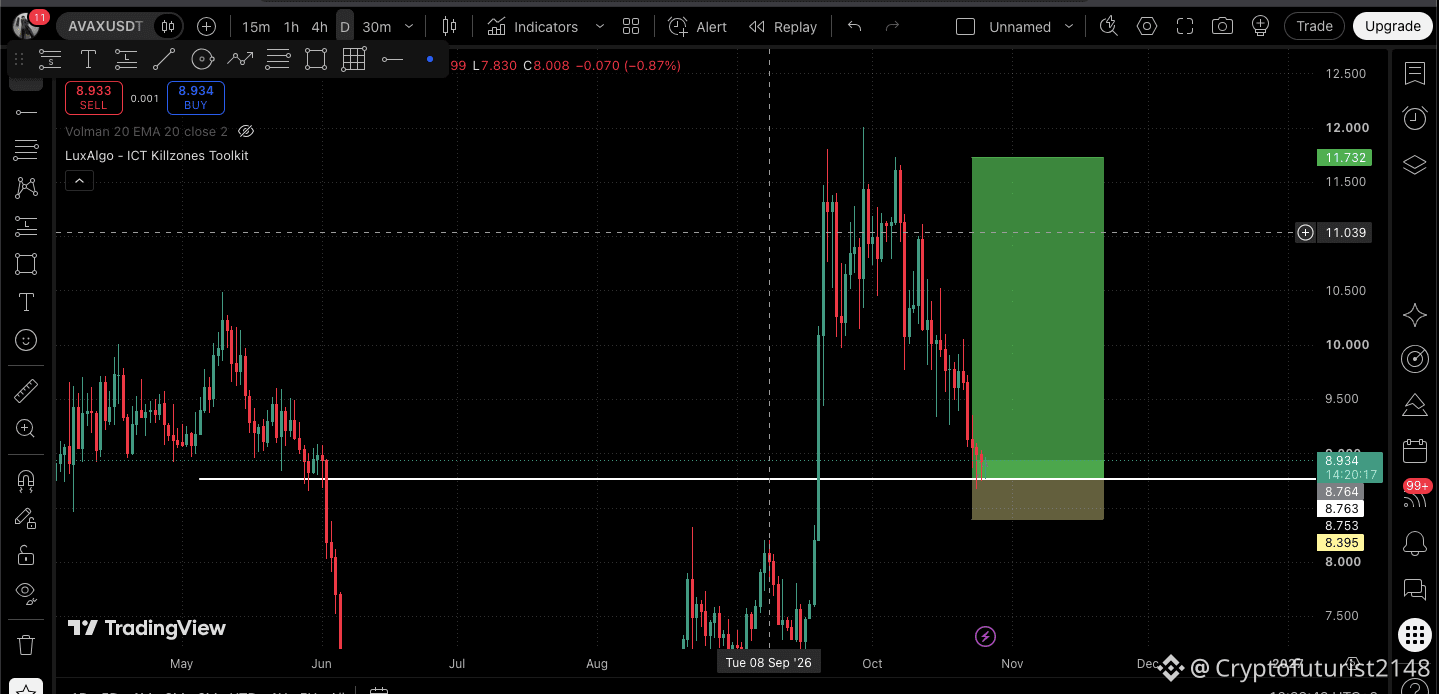
🔺 $AVAX Deep Dive: Great Network, Struggling Token
📊 Snapshot
Price ~$8.90 | Mcap ~$3.95B
94% below ATH ($147.50)
Down ~10.9% this week
⚙️ Why it matters
Avalanche runs custom L1 chains on shared security. Record 911 ms block time on Oct 23, and the Etna, Octane and Granite upgrades cut costs and cross-chain fees.
🏦 Bull case
BlackRock’s BUIDL and Apollo’s ACRED live on Avalanche via Securitize Tokenized RWA TVL up 69% to $1.33B in Q4 2025 DIFC Courts (Dubai) and Hyundai Card are building on it Grayscale opened in-kind subscriptions for its AVAX staking ETF
🐻 Bear case
Spot ETF inflows flat since Oct 8, net assets down to $51.4M Solana ETFs hold ~30x more New L1s no longer stake 2,000 AVAX each, so less token demand Staking rewards come from new issuance
📉➡️📈 Technical Long (Daily)
🟢 Entry: ~$8.76
🔴 Stop: $8.395
🎯 Target: $11.73
⚖️ R:R ~8:1
$8.50-$8.90 support has held before. A daily close below $8.395 invalidates it. A weekly close above $10.93 would signal a real recovery.
🧠 Bottom line: The network is delivering, the token isn’t yet. Value accrual is the question, so the trade comes down to support.
⚠️ My personal idea, not advice. Crypto is volatile. DYOR.
#AVAX #Avalanche #RWA #Crypto #TradingSetup
382
📈 $ERA (Caldera) Is Up 25%+ Today: Here’s What the Data Shows
While $QUICK is heading for the exit on Binance, $ERA is going the other way. 👀
📊 Market snapshot
💰 Price: ~$0.09 (intraday high around $0.10)
📈 24h move: +25%
🔥 Volume: tens of millions of dollars in 24 hours, with buy-side order flow leading on Binance Futures and Lbank
🏷️ Market cap: roughly $13M, which is small
🔍 What is Caldera?
Caldera builds high-performance, customizable, application-specific Layer-2 blockchains. Projects can launch their own chain tailored to their needs instead of competing for block space on a shared network. ERA is the token tied to that ecosystem.
📉 The bigger picture
This pump needs context. ERA hit an all-time high near $1.96 in July 2025 and sits about 95% below it. A 25% day is a big move, but it’s a bounce within a long downtrend, not a recovery.
🧠 What to watch
Volume: Does it hold up after today, or fade as the hype cools? Binance Futures activity: Strong futures flow can mean leverage-driven moves that reverse quickly. Resistance near the $0.10 high: A clean break would be a stronger signal. News or catalysts: I couldn’t find one behind today’s move, so it may be purely trading-driven.
⚠️ Risk check
Small-cap tokens that pump 25% in a day can drop just as fast. Position sizing and stop-losses matter more than the headline number.
Not financial advice. Crypto is highly volatile. DYOR.
#Caldera #ERA #Altcoins #Binance #Crypto #Layer2
124
one of the most diabolical falls I have seen this week. 🤧
one of the most diabolical falls I have seen this week. 🤧

Cryptofuturist2148
·
--
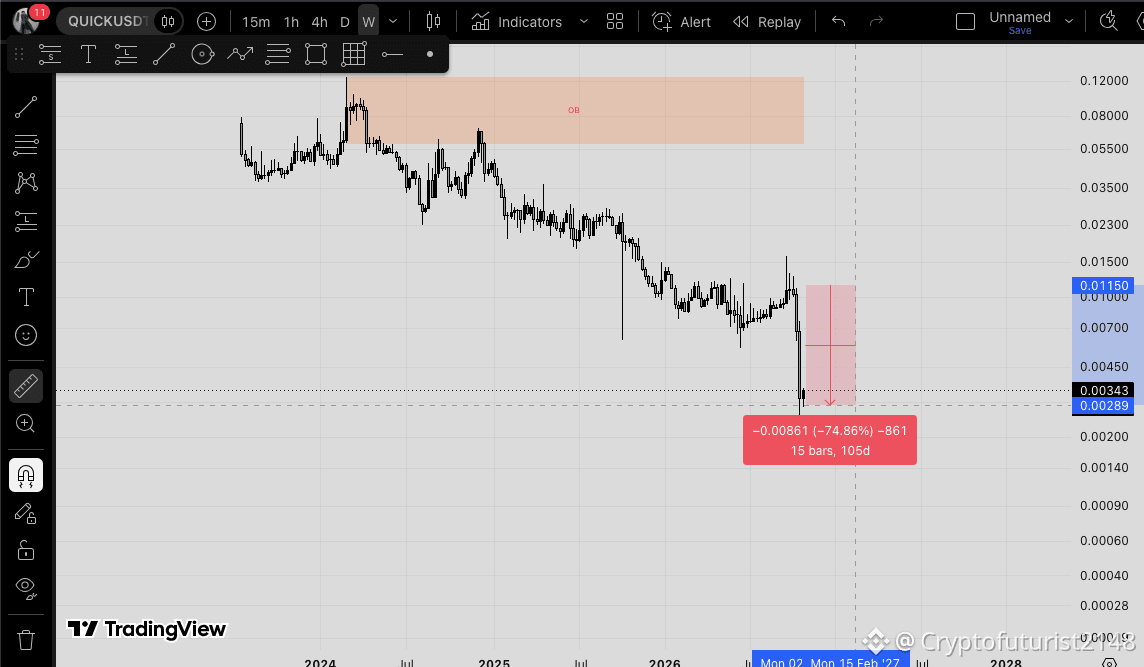
Падение⚠️ $QUICK Update: Binance Delisting Notice
💰 Price: ~$0.0035, down sharply in recent weeks
📅 Key dates:
Oct 28: $QUICK removed from all Binance spot trading pairs
Dec 28: withdrawals end
Binance said QUICK no longer met its requirements for continued listing.
✅ If you hold QUICK on Binance:
Withdraw to a self-custody wallet before the deadline Or exit your position before Oct 28 $QUICK still trades on QuickSwap (Polygon) via DEX pools
Check the official Binance announcement for exact details.
⚠️ Not financial advice. Delistings can cause high volatility and thin liquidity. DYOR.
#QUICK #QuickSwap #Binance #Delisting #Polygon
2
97
·
--
Падение
⚠️ $QUICK Update: Binance Delisting Notice
💰 Price: ~$0.0035, down sharply in recent weeks
📅 Key dates:
Oct 28: $QUICK removed from all Binance spot trading pairs
Dec 28: withdrawals end
Binance said QUICK no longer met its requirements for continued listing.
✅ If you hold QUICK on Binance:
Withdraw to a self-custody wallet before the deadline Or exit your position before Oct 28 $QUICK still trades on QuickSwap (Polygon) via DEX pools
Check the official Binance announcement for exact details.
⚠️ Not financial advice. Delistings can cause high volatility and thin liquidity. DYOR.
#QUICK #QuickSwap #Binance #Delisting #Polygon
1
260
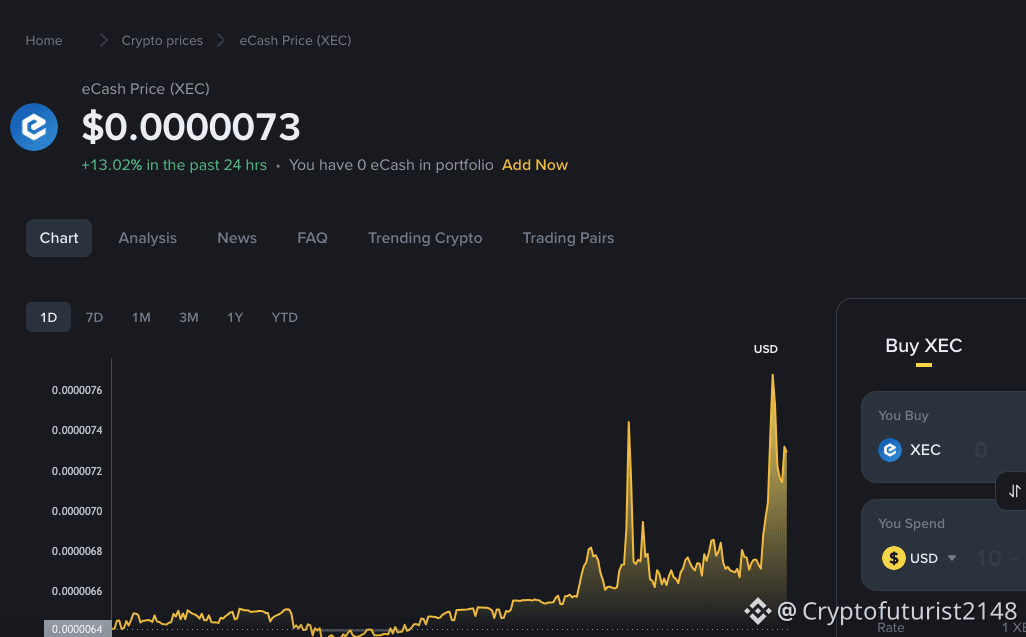
$XEC (eCash) is up 13% in 24 hours, trading at $0.0000073 on Binance 📈
The chart sat flat near $0.0000064 for most of the day, then spiked twice, topping out around $0.0000076 (about +17%) before easing back.
Why now? No confirmed news. Possible drivers:
Chatter around the unrelated ECX Bitcoin fork (mainnet ~Oct 31) Leverage and short squeezes on a thin market An oversold bounce after a roughly 20% slide over the past two weeks
Levels to watch:
Resistance: $0.0000071, which it has just pushed through Support: $0.0000064
A daily close above $0.0000071 on solid volume would mean more than one green candle. Without it, this could look like July’s pump, which gave back its gains within days.
Low-priced and thin = fast moves both ways. Not financial advice. DYOR.
#XEC #eCash #Crypto
1
288
Статья
# $T (Threshold) Pumps 30%+ in a Day: What's Behind It?What happened
Threshold Network's token T was the top gainer among the top 200 coins today, up 31.68% while BTC was down 0.22%. This is a standalone move, not a market-wide rally.
The numbers differ by source and time window:
CoinCodex shows about +32% over 24 hours.Tokenpost reported a move of 62.86% within one hour, reaching 0.0075 USDT.Pluang shows a 1-day change of +62.28%, which probably reflects a different measurement window.
If you're quoting "35%", note that it depends on the exchange and timeframe. The spike was sharp and concentrated.
Where it came from
T had been near its lows. DefiLlama lists an all-time low of $0.0032 on Jun 25, 2026 against an all-time high of $0.23 in March 2022. TradingView data from earlier shows it around 0.0037 USDT, down 77.5% over the past year. A pump from the ~$0.004 range is a big percentage on a tiny dollar move, which is how low-priced tokens often behave.
The catalyst: I can't find one
I found no confirmed news, listing or protocol announcement tied to today's move. These are the plausible narratives, and none is confirmed as the trigger:
The tBTC / institutional Bitcoin story. T's pitch is tBTC, a decentralized Bitcoin bridge. Analysts have framed T rallies as a bet on "Bitcoin Capital Markets Go On-Chain" and tBTC adoption.A Q4 2026 technical upgrade. The network plans to migrate tBTC's signing from ECDSA to FROST Schnorr in Q4 2026. Traders may be positioning ahead of it.Buyback and treasury mechanics. Since the 2025 restructuring, the DAO treasury accrues T through buybacks funded by bridge fees. This is a long-standing narrative, not new news.Thin liquidity. DefiLlama showed only about $2.98M of on-chain token liquidity, so modest buying can move the price a lot.
Pattern check: this has happened before
T has a history of violent pumps followed by fades:
A 56% weekly surge in July 2026, which analysts called severely overbought.A 64.74% move reported on KuCoin roughly 52 days ago.A 26%+ single-day jump about 46 days ago.A daily price table showing a +15.8% day on Sep 14 followed by -12.2% the next day.
Each time the token ended up back near its lows. That doesn't predict what happens now, but it's the base rate to weigh against any "this time is different" story.
Fundamentals vs. price
DefiLlama shows protocol revenue of $271.8K in Q2 2026 and only $36.26K so far in Q3, with token holder net income at $0. Revenue is declining while the token is up 30%+, so today's move looks driven by price action and narrative rather than a fundamental change.
What I'd watch
Volume vs. liquidity. Does the spike hold on rising volume, or fade as it did before?Whether a real announcement follows. Check the Threshold forum, X account and tBTC integrations for news.Resistance near $0.0078. One source flagged this zone in an earlier rally.Funding and open interest on perp markets, which show whether this is spot buying or leveraged speculation.
This is a summary of public data, not financial advice. Moves like this in small caps can reverse as fast as they arrive.
I can turn this into a shorter X thread or put it in a doc if you'd like. And if you have the exchange and exact timeframe behind your 35% figure, I can tighten the numbers.
# $T (Threshold) Pumps 30%+ in a Day: What's Behind It?
What happened
Threshold Network's token T was the top gainer among the top 200 coins today, up 31.68% while BTC was down 0.22%. This is a standalone move, not a market-wide rally.
The numbers differ by source and time window:
CoinCodex shows about +32% over 24 hours.Tokenpost reported a move of 62.86% within one hour, reaching 0.0075 USDT.Pluang shows a 1-day change of +62.28%, which probably reflects a different measurement window.
If you're quoting "35%", note that it depends on the exchange and timeframe. The spike was sharp and concentrated.
Where it came from
T had been near its lows. DefiLlama lists an all-time low of $0.0032 on Jun 25, 2026 against an all-time high of $0.23 in March 2022. TradingView data from earlier shows it around 0.0037 USDT, down 77.5% over the past year. A pump from the ~$0.004 range is a big percentage on a tiny dollar move, which is how low-priced tokens often behave.
The catalyst: I can't find one
I found no confirmed news, listing or protocol announcement tied to today's move. These are the plausible narratives, and none is confirmed as the trigger:
The tBTC / institutional Bitcoin story. T's pitch is tBTC, a decentralized Bitcoin bridge. Analysts have framed T rallies as a bet on "Bitcoin Capital Markets Go On-Chain" and tBTC adoption.A Q4 2026 technical upgrade. The network plans to migrate tBTC's signing from ECDSA to FROST Schnorr in Q4 2026. Traders may be positioning ahead of it.Buyback and treasury mechanics. Since the 2025 restructuring, the DAO treasury accrues T through buybacks funded by bridge fees. This is a long-standing narrative, not new news.Thin liquidity. DefiLlama showed only about $2.98M of on-chain token liquidity, so modest buying can move the price a lot.
Pattern check: this has happened before
T has a history of violent pumps followed by fades:
A 56% weekly surge in July 2026, which analysts called severely overbought.A 64.74% move reported on KuCoin roughly 52 days ago.A 26%+ single-day jump about 46 days ago.A daily price table showing a +15.8% day on Sep 14 followed by -12.2% the next day.
Each time the token ended up back near its lows. That doesn't predict what happens now, but it's the base rate to weigh against any "this time is different" story.
Fundamentals vs. price
DefiLlama shows protocol revenue of $271.8K in Q2 2026 and only $36.26K so far in Q3, with token holder net income at $0. Revenue is declining while the token is up 30%+, so today's move looks driven by price action and narrative rather than a fundamental change.
What I'd watch
Volume vs. liquidity. Does the spike hold on rising volume, or fade as it did before?Whether a real announcement follows. Check the Threshold forum, X account and tBTC integrations for news.Resistance near $0.0078. One source flagged this zone in an earlier rally.Funding and open interest on perp markets, which show whether this is spot buying or leveraged speculation.
This is a summary of public data, not financial advice. Moves like this in small caps can reverse as fast as they arrive.
I can turn this into a shorter X thread or put it in a doc if you'd like. And if you have the exchange and exact timeframe behind your 35% figure, I can tighten the numbers.
2
341
Статья
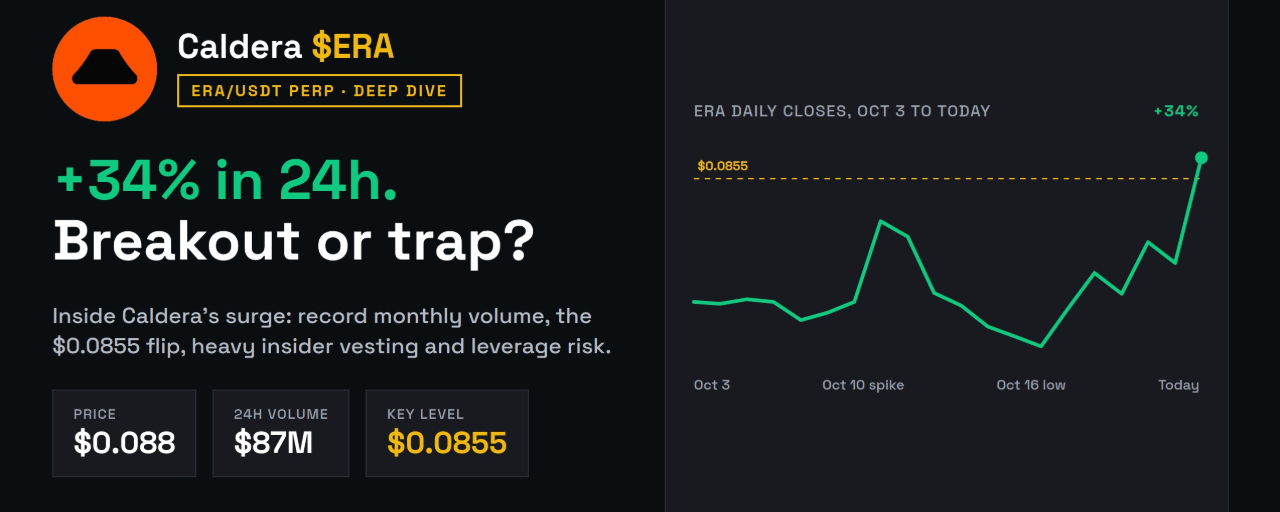
ERAUSDT Deep Dive: Why a 34% Spike in Caldera Is More Interesting (and Riskier) Than It LooksERA is up about 34% in 24 hours, trading near $0.088, while most of the market is red. Here's a data-driven look at what's behind the move, what the structure says, and where the risks are.
1. The backdrop: ERA is moving against the tape
ERA's jump comes in a weak market. Bitcoin is around $80,600 and just lost its 50-day moving average for the first time in 66 days. Total crypto market cap is about $2.72T, down roughly 3% on the day. Bitcoin dominance sits near 60%, a sign that altcoins are taking the heavier damage. The Fed decision on October 28 is the next macro event.
So ERA isn't riding a market-wide bid. That points to idiosyncratic, speculative flow: traders rotating into a low-cap name while the rest of the market bleeds. This kind of relative strength can be a genuine accumulation signal, but it can also be a sign of thin, leveraged flow, which is why the next sections matter.
2. Reading the chart: where this spike sits in October
ERA's October price action tells a clear story. Based on daily closes:
Oct 3-9: Quiet. Price held in a tight $0.062-$0.065 band on very low volume, often only $1-3M a day. Oct 10: First pop, +20% to about $0.0785, followed by a $68M volume day on Oct 11 with a lower close. Oct 10-16: The full gain unwound. Price fell about 26% to roughly $0.058 in six days. Oct 17-20: A second leg, up about 30% in four days to around $0.075. Oct 21-22: Small pullback, with volume fading back to around $19M. Today: A new push to about $0.088, with 24h volume near $87M.
Three observations stand out:
Higher highs. Today's price is above the October 10 closing high (about 13% higher) and above the roughly $0.0855 intraday peak from the earlier spike. Structurally, this is the first genuine breakout of the month, not another retest of the same ceiling.
Volume is at a monthly record. $87M against a $13M market cap is roughly 6.6x. The Oct 11 spike was about 5x, and early-October baseline volume was a fraction of that.
But high volume has failed before. On Oct 11, huge volume came with a lower close, a classic sign of distribution into strength. What matters is whether today's volume produces a strong daily close or another rejection. Watch the close, not the wick.
3. Key levels
Measured from the October 16 low (about $0.058) to today's price (about $0.0886):
$0.09 / $0.10: Psychological resistance. Above $0.10, there's little recent structure in the data I reviewed. $0.0855-$0.088: The breakout zone. Closing back below it would suggest a failed breakout. $0.0768 (38.2% retracement): Lines up with the Oct 10 closing high of $0.0785. A natural first support on a pullback. $0.0732 (50%): Near the Oct 20 close of about $0.075. $0.0696 (61.8%): Roughly where the prior range's upper half sits. $0.058-$0.054: The October low and the September 16 low of $0.0542. Losing this would erase the entire recovery.
4. The supply question: "tiny float" is only half the story
Most data aggregators show about 175M ERA circulating (17.5% of the 1B supply), giving a market cap near $13M and a fully diluted valuation of roughly $89M. That's the basis for calling ERA a thin micro-cap.
But trackers disagree. One vesting tracker shows closer to 320M ERA unlocked, around 32% of supply. On that basis, market cap at today's price would be nearer $28M, not $13M. Neither figure is "wrong". They count different wallets and schedules. It matters because your read of how thin the float is, and how much dilution to expect, depends on which number you trust.
The bigger concern is the vesting schedule. The core team (147.5M) and early backers (320.8M) together hold about 47% of supply. Their one-year cliff ended in July 2026, and the allocations now vest linearly over about 24 months. Add monthly releases from the foundation, community treasury and R&D, and my estimate is roughly 23-27M new ERA per month entering the market. Depending on which float figure you use, that's about 8-14% added supply every month.
That's not an immediate crash risk, but it's constant background sell pressure. Rallies need continuous new demand just to stay flat.
5. Fundamentals: real project, unclear current demand
Caldera is a genuine infrastructure player. It has helped launch 100+ rollups since 2023, raised $25M with Founders Fund leading the Series A, and built the Metalayer to link rollups with shared liquidity. ERA is used for gas, validator staking and governance. More recent developments include ERA Drops (February 2026) and a reported partnership with BitcoinOS.
Valuation context: ERA's all-time high was about $2, implying a fully diluted valuation near $2B. At about $0.088, the FDV is roughly $89M, down around 95%. That's a steep reset, but it doesn't tell you the token is cheap. Value depends on whether rollup-as-a-service demand converts into actual ERA demand through fees and staking. I couldn't find fresh on-chain metrics, so I can't say whether usage is growing, and I found no specific news that explains today's move.
6. Why the perp matters: leverage and funding
Buy-side flow is leading on Binance Futures and LBank, so the perpetual is setting the price. That raises four things to watch on ERAUSDT:
Funding rate: Strongly positive funding means crowded longs and rising flush risk. Neutral funding on a rising price suggests the rally isn't overleveraged. At a 0.10% funding rate, a $10,000 long pays about $10 each settlement. Check the contract page for the current interval, since many Binance perps settle every 4 hours. Open interest: Price up with OI up means new money. Price up with OI down means shorts are being squeezed out, which tends to be short-lived. Liquidation distance: ERA's recent daily moves of +20%, +10%, +9% and +13% mean 10x leverage has almost no room. A 5x position, with roughly 20% to liquidation, would have been wiped by the 26% unwind after Oct 10. Funding cap: ERAUSDT has previously carried a wider ±2% funding cap, which signals Binance treats it as volatile. Confirm current settings before trading.
7. Scenarios
Bull case: ERA closes the day above $0.0855-$0.088, volume stays elevated into the weekend, and funding stays reasonable. Targets are $0.09, then $0.10. This is the cleanest setup, but it has to survive a weak broader market and the Fed decision.
Base case: Momentum cools and price retraces to $0.073-$0.077 before deciding. That would still be a healthy pullback in a higher range.
Bear case: The breakout fails, funding flips and longs get flushed. Price falls back through $0.07 toward the $0.058 base. The October 10 to 16 unwind is the template.
I'm not assigning probabilities. The honest read is that the setup improved today, but the evidence from earlier October spikes plus a risk-off market argues for caution.
8. Practical risk management
Size so a full stop-out is survivable, especially on the perp. Avoid chasing a vertical candle. Waiting for a daily close and a retest gives you a better entry. Don't open leveraged positions right before a funding settlement if you're paying. Take partial profits into strength. Watch the Oct 28 Fed decision and Bitcoin's reaction to its 50-day average, since a broader move can overwhelm any single token's setup.
Bottom line
ERA's breakout is real on the chart: higher highs, record monthly volume, and relative strength in a weak market. But it's a flow-driven micro-cap move with no confirmed catalyst, heavy ongoing insider vesting, and a history this month of spikes that fully retraced. The decisive question is whether it can close above its previous highs and hold them once the excitement cools.
Not financial advice. Perpetual contracts use leverage and can result in total loss of margin. Always do your own research.
#ERA #Caldera #ERAUSDT #BinanceSquare #Altcoins
ERAUSDT Deep Dive: Why a 34% Spike in Caldera Is More Interesting (and Riskier) Than It Looks
ERA is up about 34% in 24 hours, trading near $0.088, while most of the market is red. Here's a data-driven look at what's behind the move, what the structure says, and where the risks are.
1. The backdrop: ERA is moving against the tape
ERA's jump comes in a weak market. Bitcoin is around $80,600 and just lost its 50-day moving average for the first time in 66 days. Total crypto market cap is about $2.72T, down roughly 3% on the day. Bitcoin dominance sits near 60%, a sign that altcoins are taking the heavier damage. The Fed decision on October 28 is the next macro event.
So ERA isn't riding a market-wide bid. That points to idiosyncratic, speculative flow: traders rotating into a low-cap name while the rest of the market bleeds. This kind of relative strength can be a genuine accumulation signal, but it can also be a sign of thin, leveraged flow, which is why the next sections matter.
2. Reading the chart: where this spike sits in October
ERA's October price action tells a clear story. Based on daily closes:
Oct 3-9: Quiet. Price held in a tight $0.062-$0.065 band on very low volume, often only $1-3M a day. Oct 10: First pop, +20% to about $0.0785, followed by a $68M volume day on Oct 11 with a lower close. Oct 10-16: The full gain unwound. Price fell about 26% to roughly $0.058 in six days. Oct 17-20: A second leg, up about 30% in four days to around $0.075. Oct 21-22: Small pullback, with volume fading back to around $19M. Today: A new push to about $0.088, with 24h volume near $87M.
Three observations stand out:
Higher highs. Today's price is above the October 10 closing high (about 13% higher) and above the roughly $0.0855 intraday peak from the earlier spike. Structurally, this is the first genuine breakout of the month, not another retest of the same ceiling.
Volume is at a monthly record. $87M against a $13M market cap is roughly 6.6x. The Oct 11 spike was about 5x, and early-October baseline volume was a fraction of that.
But high volume has failed before. On Oct 11, huge volume came with a lower close, a classic sign of distribution into strength. What matters is whether today's volume produces a strong daily close or another rejection. Watch the close, not the wick.
3. Key levels
Measured from the October 16 low (about $0.058) to today's price (about $0.0886):
$0.09 / $0.10: Psychological resistance. Above $0.10, there's little recent structure in the data I reviewed. $0.0855-$0.088: The breakout zone. Closing back below it would suggest a failed breakout. $0.0768 (38.2% retracement): Lines up with the Oct 10 closing high of $0.0785. A natural first support on a pullback. $0.0732 (50%): Near the Oct 20 close of about $0.075. $0.0696 (61.8%): Roughly where the prior range's upper half sits. $0.058-$0.054: The October low and the September 16 low of $0.0542. Losing this would erase the entire recovery.
4. The supply question: "tiny float" is only half the story
Most data aggregators show about 175M ERA circulating (17.5% of the 1B supply), giving a market cap near $13M and a fully diluted valuation of roughly $89M. That's the basis for calling ERA a thin micro-cap.
But trackers disagree. One vesting tracker shows closer to 320M ERA unlocked, around 32% of supply. On that basis, market cap at today's price would be nearer $28M, not $13M. Neither figure is "wrong". They count different wallets and schedules. It matters because your read of how thin the float is, and how much dilution to expect, depends on which number you trust.
The bigger concern is the vesting schedule. The core team (147.5M) and early backers (320.8M) together hold about 47% of supply. Their one-year cliff ended in July 2026, and the allocations now vest linearly over about 24 months. Add monthly releases from the foundation, community treasury and R&D, and my estimate is roughly 23-27M new ERA per month entering the market. Depending on which float figure you use, that's about 8-14% added supply every month.
That's not an immediate crash risk, but it's constant background sell pressure. Rallies need continuous new demand just to stay flat.
5. Fundamentals: real project, unclear current demand
Caldera is a genuine infrastructure player. It has helped launch 100+ rollups since 2023, raised $25M with Founders Fund leading the Series A, and built the Metalayer to link rollups with shared liquidity. ERA is used for gas, validator staking and governance. More recent developments include ERA Drops (February 2026) and a reported partnership with BitcoinOS.
Valuation context: ERA's all-time high was about $2, implying a fully diluted valuation near $2B. At about $0.088, the FDV is roughly $89M, down around 95%. That's a steep reset, but it doesn't tell you the token is cheap. Value depends on whether rollup-as-a-service demand converts into actual ERA demand through fees and staking. I couldn't find fresh on-chain metrics, so I can't say whether usage is growing, and I found no specific news that explains today's move.
6. Why the perp matters: leverage and funding
Buy-side flow is leading on Binance Futures and LBank, so the perpetual is setting the price. That raises four things to watch on ERAUSDT:
Funding rate: Strongly positive funding means crowded longs and rising flush risk. Neutral funding on a rising price suggests the rally isn't overleveraged. At a 0.10% funding rate, a $10,000 long pays about $10 each settlement. Check the contract page for the current interval, since many Binance perps settle every 4 hours. Open interest: Price up with OI up means new money. Price up with OI down means shorts are being squeezed out, which tends to be short-lived. Liquidation distance: ERA's recent daily moves of +20%, +10%, +9% and +13% mean 10x leverage has almost no room. A 5x position, with roughly 20% to liquidation, would have been wiped by the 26% unwind after Oct 10. Funding cap: ERAUSDT has previously carried a wider ±2% funding cap, which signals Binance treats it as volatile. Confirm current settings before trading.
7. Scenarios
Bull case: ERA closes the day above $0.0855-$0.088, volume stays elevated into the weekend, and funding stays reasonable. Targets are $0.09, then $0.10. This is the cleanest setup, but it has to survive a weak broader market and the Fed decision.
Base case: Momentum cools and price retraces to $0.073-$0.077 before deciding. That would still be a healthy pullback in a higher range.
Bear case: The breakout fails, funding flips and longs get flushed. Price falls back through $0.07 toward the $0.058 base. The October 10 to 16 unwind is the template.
I'm not assigning probabilities. The honest read is that the setup improved today, but the evidence from earlier October spikes plus a risk-off market argues for caution.
8. Practical risk management
Size so a full stop-out is survivable, especially on the perp. Avoid chasing a vertical candle. Waiting for a daily close and a retest gives you a better entry. Don't open leveraged positions right before a funding settlement if you're paying. Take partial profits into strength. Watch the Oct 28 Fed decision and Bitcoin's reaction to its 50-day average, since a broader move can overwhelm any single token's setup.
Bottom line
ERA's breakout is real on the chart: higher highs, record monthly volume, and relative strength in a weak market. But it's a flow-driven micro-cap move with no confirmed catalyst, heavy ongoing insider vesting, and a history this month of spikes that fully retraced. The decisive question is whether it can close above its previous highs and hold them once the excitement cools.
Not financial advice. Perpetual contracts use leverage and can result in total loss of margin. Always do your own research.
#ERA #Caldera #ERAUSDT #BinanceSquare #Altcoins
1
218
🌋 $ERA RA is up 34% in 24 hours. Here’s the quick breakdown before you chase it.
What is Caldera?
Caldera is a rollup-as-a-service platform that lets teams launch custom Ethereum-style chains without building the infrastructure themselves. It has helped launch 100+ rollups and is backed by Founders Fund. Its Metalayer links those chains into one network with shared liquidity and fast bridging, and ERA powers it through gas, validator staking and governance. Total supply is 1B, with 7% airdropped to the community at launch.
The move 📈
Price: around $0.088, up roughly 33-34% in 24h Volume: about $87M in 24h against a market cap of only ~$13M Buy-side flow is leading on Binance Futures and LBank Range: hit a low of ~$0.054 on Sep 16 Still down roughly 86% year on year and 95%+ below the ~$2 all-time high
Why is it moving?
I couldn’t find a major announcement, partnership or listing today. This looks like a flow-driven micro-cap move:
Only ~17% of supply is circulating, so a small amount of buying moves the price a lot Futures-led momentum can amplify moves through liquidations and leverage ERA has spiked repeatedly this month, then faded back toward the $0.057-$0.078 range
What to watch 👀
$0.085-$0.09: the last spike topped out here. A clean break on real volume matters more than another wick Volume follow-through: an earlier volume spike on Oct 11 faded fast Funding and open interest on ERAUSDT: crowded longs raise flush risk Supply overhang: ~83% of tokens aren’t circulating yet, so check the unlock schedule
Bottom line
Solid infrastructure project, but today’s pop looks driven by momentum, not news. Projects like this can build value through real adoption over time, but micro-caps also reverse just as fast. The question is whether ERA can hold above its recent highs once the excitement cools. Keep size small, use stops, and don’t chase vertical candles.
Not financial advice. Crypto is highly volatile. DYOR.
#Caldera #ERA #Metalayer #BinanceSquare #Altcoins
2
1
224

Статья
$BMT Is Up Over 220% This Week. Here’s What’s Behind ItWhat is BMT?
Bubblemaps:
is an on-chain analytics platform that turns wallet data into visual bubble maps. These show how a token’s supply is distributed, so users can spot insiders, team wallets and suspicious clusters. BMT is its native utility and governance token, used to vote on research priorities and submit crypto crime cases.
The product has a strong reputation. Its recent investigations flagged a suspected insider-trading ring of 19 accounts and a dev who sniped a third of a new token’s supply from side wallets. That keeps the name in front of traders, even though it hasn’t driven token demand on its own.
The price action 📈
Starting point: BMT spent most of 2026 near its lows. It hit about $0.0137 in late March and was down roughly 80% year on year.Oct 22: Up about 20% to around $0.027, with shorts getting liquidated.Oct 23: Intraday high of $0.03, up about 32% on the day.Late Oct 23 into Oct 24: Broke above $0.039, with some trackers showing about $0.043.
Circulating supply is about 638M of 1B. At these prices that’s a market cap in the mid-$20M range, still tiny next to the March 2025 all-time high near $0.32.
Why it’s pumping
1. The Upbit KRW listing (the main catalyst). Upbit announced a BMT/KRW pair, with trading opening at 12:00 KST on October 24 and Solana-only deposits and withdrawals. Upbit had listed BMT only against BTC and USDT back in August, so a won pair opens it to Korean retail, a much deeper pool of buyers. BMT has seen this before: its Bithumb KRW listing in March 2025 helped fuel weekly gains above 200%.
2. Small cap, thin liquidity. At roughly $10M before the move, it takes little capital to push the price. Rising prices then trigger short liquidations, which push it higher still.
3. Momentum and attention. Once BMT started trending, traders piled in. During the August rally, analysts noted no single fundamental catalyst explained it. The same applies now: Upbit is the one concrete trigger, and the rest is speculation feeding on itself.
What to watch 👀
Listing-day volatility. Upbit limits early trading: buy orders are restricted for the first 5 minutes and only limit orders are allowed for about 2 hours. Expect sharp swings once those limits lift.“Buy the rumor, sell the news.” Coins often peak around the listing itself, and profit-taking can follow fast.The $0.04 zone. It acted as resistance in August before a volume breakout. Watch whether it now holds as support.Funding and open interest on BMTUSDT. Crowded longs after a 200%+ week raise the risk of a sharp flush.Round-trip risk. BMT has spiked and faded before, and it’s still far below its highs.
Bottom line
BMT is a legitimate analytics project with a small float and a fresh Korean listing, a classic setup for explosive but unstable price action. The move looks driven by flows and sentiment more than fundamentals. If you trade it, keep size small, use stops, and don’t chase vertical candles.
Not financial advice. Crypto is highly volatile and you can lose your entire investment. Always do your own research.
#BMT #Bubblemaps #Upbit #BinanceSquare #Altcoins
$BMT Is Up Over 220% This Week. Here’s What’s Behind It
What is BMT?
Bubblemaps:
is an on-chain analytics platform that turns wallet data into visual bubble maps. These show how a token’s supply is distributed, so users can spot insiders, team wallets and suspicious clusters. BMT is its native utility and governance token, used to vote on research priorities and submit crypto crime cases.
The product has a strong reputation. Its recent investigations flagged a suspected insider-trading ring of 19 accounts and a dev who sniped a third of a new token’s supply from side wallets. That keeps the name in front of traders, even though it hasn’t driven token demand on its own.
The price action 📈
Starting point: BMT spent most of 2026 near its lows. It hit about $0.0137 in late March and was down roughly 80% year on year.Oct 22: Up about 20% to around $0.027, with shorts getting liquidated.Oct 23: Intraday high of $0.03, up about 32% on the day.Late Oct 23 into Oct 24: Broke above $0.039, with some trackers showing about $0.043.
Circulating supply is about 638M of 1B. At these prices that’s a market cap in the mid-$20M range, still tiny next to the March 2025 all-time high near $0.32.
Why it’s pumping
1. The Upbit KRW listing (the main catalyst). Upbit announced a BMT/KRW pair, with trading opening at 12:00 KST on October 24 and Solana-only deposits and withdrawals. Upbit had listed BMT only against BTC and USDT back in August, so a won pair opens it to Korean retail, a much deeper pool of buyers. BMT has seen this before: its Bithumb KRW listing in March 2025 helped fuel weekly gains above 200%.
2. Small cap, thin liquidity. At roughly $10M before the move, it takes little capital to push the price. Rising prices then trigger short liquidations, which push it higher still.
3. Momentum and attention. Once BMT started trending, traders piled in. During the August rally, analysts noted no single fundamental catalyst explained it. The same applies now: Upbit is the one concrete trigger, and the rest is speculation feeding on itself.
What to watch 👀
Listing-day volatility. Upbit limits early trading: buy orders are restricted for the first 5 minutes and only limit orders are allowed for about 2 hours. Expect sharp swings once those limits lift.“Buy the rumor, sell the news.” Coins often peak around the listing itself, and profit-taking can follow fast.The $0.04 zone. It acted as resistance in August before a volume breakout. Watch whether it now holds as support.Funding and open interest on BMTUSDT. Crowded longs after a 200%+ week raise the risk of a sharp flush.Round-trip risk. BMT has spiked and faded before, and it’s still far below its highs.
Bottom line
BMT is a legitimate analytics project with a small float and a fresh Korean listing, a classic setup for explosive but unstable price action. The move looks driven by flows and sentiment more than fundamentals. If you trade it, keep size small, use stops, and don’t chase vertical candles.
Not financial advice. Crypto is highly volatile and you can lose your entire investment. Always do your own research.
#BMT #Bubblemaps #Upbit #BinanceSquare #Altcoins
1
176
🔥 $SOPH/USDT up +30% to $0.00206: Is this a Dead Cat Bounce or a Real Reversal? ⚡
After hitting all-time lows around $0.0016, $SOPH just staged a sudden +30% pump back to $0.00206.
Here is the quick breakdown on why it’s moving and whether it can hold:
🚨 Why it nosedived (The Bear Case)
Chain Shutdown Notice: Sophon announced the permanent shutdown of its Ethereum Layer-2 mainnet (saving ~$3M/yr in costs). Users must withdraw assets by Nov 25.
Utility Shift: The L2 gas fee and network staking utility for $SOPH are gone, creating heavy short-term selling pressure.
🚀 Why it’s pumping (The Bull Case)
Pivot to Base: The team is transitioning from chain infrastructure to a consumer product studio on Base, starting with apps like Pyre.
Buyback & Burn: Gas utility is being replaced by revenue-funded $SOPH token buybacks and burns.
VC Runway: backed by top-tier funds ($45M+ raised), giving them the runway to execute the pivot.
📊 Technical Levels to Watch
Resistance: $0.00225 (Needs a clean break above this to target $0.00350)
Support: $0.00170 (Key low; losing this invalidates the bounce)
💡 The Bottom Line: Today's surge is a high-beta relief squeeze off extreme oversold levels. Short-term traders can play the $0.0017 – $0.00225 range with tight stops, while long-term buyers should wait for clear revenue/burn data from their new Base apps.
Are you BUYING the rebound or SELLING the news? 👇
#Crypto #BinanceSquare #SOPH #Trading #Web3
🔥 $SOPH /USDT up +30% to $0.00206: Is this a Dead Cat Bounce or a Real Reversal? ⚡
After hitting all-time lows around $0.0016, $SOPH just staged a sudden +30% pump back to $0.00206.
Here is the quick breakdown on why it’s moving and whether it can hold:
🚨 Why it nosedived (The Bear Case)
Chain Shutdown Notice: Sophon announced the permanent shutdown of its Ethereum Layer-2 mainnet (saving ~$3M/yr in costs). Users must withdraw assets by Nov 25.
Utility Shift: The L2 gas fee and network staking utility for $SOPH are gone, creating heavy short-term selling pressure.
🚀 Why it’s pumping (The Bull Case)
Pivot to Base: The team is transitioning from chain infrastructure to a consumer product studio on Base, starting with apps like Pyre.
Buyback & Burn: Gas utility is being replaced by revenue-funded $SOPH token buybacks and burns.
VC Runway: backed by top-tier funds ($45M+ raised), giving them the runway to execute the pivot.
📊 Technical Levels to Watch
Resistance: $0.00225 (Needs a clean break above this to target $0.00350)
Support: $0.00170 (Key low; losing this invalidates the bounce)
💡 The Bottom Line: Today's surge is a high-beta relief squeeze off extreme oversold levels. Short-term traders can play the $0.0017 – $0.00225 range with tight stops, while long-term buyers should wait for clear revenue/burn data from their new Base apps.
Are you BUYING the rebound or SELLING the news? 👇
#Crypto #BinanceSquare #SOPH #Trading #Web3
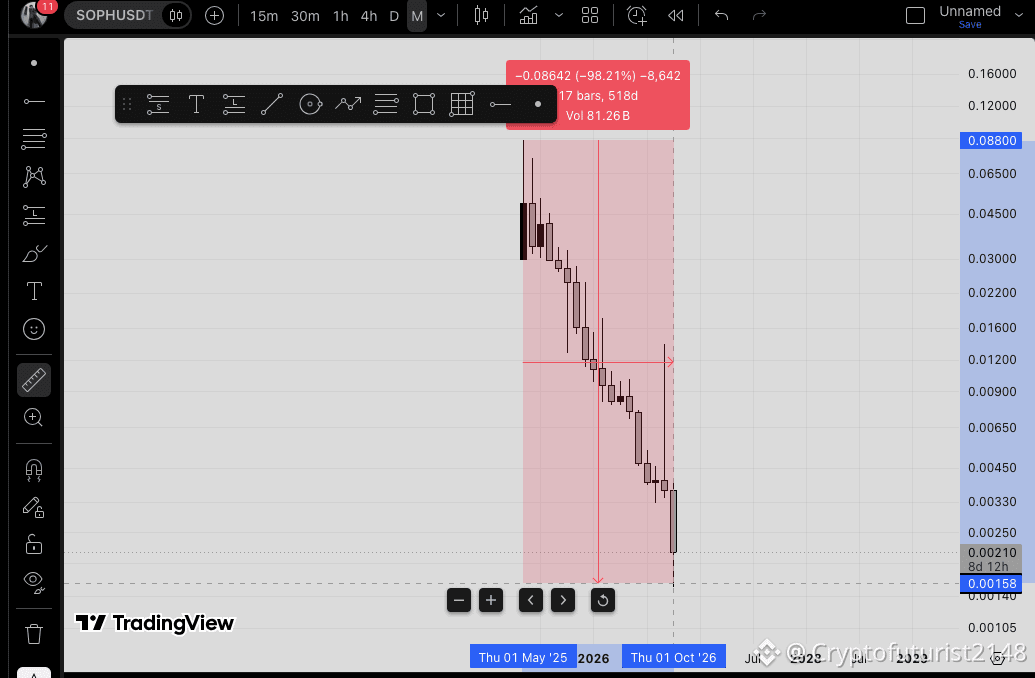
1
336

Статья
$SOPH/USDT Deep Dive: +30% Rebound at $0.00206 — Dead Cat Bounce or Structural Reversal?Ticker: SOPH/USDT
Current Price Zone: $0.00206 – $0.00225
24-Hour Trend: +30.5% Surge
Historical Peak: ~$0.110 (May 2025)
Market Sentiment: Extremely High Volatility / High Risk
1. Executive Summary & Current Market Action
After a relentless multi-month drawdown that saw $SOPH sink to fresh historical lows around $0.00160–$0.00179, the token has suddenly exploded in 24-hour trading volume, staging a +30% sharp rally back to $0.00206.
This sudden spike has left traders facing a critical question: Is this an exit pump before a total shutdown, or the beginning of a fundamental pivot recovery?
[ Historical High: $0.11 ] \ \ (Severe Drawdown / Fundamental Crisis) \ `--> [ ATL Zone: ~$0.0016 - $0.0017 ] \ `--> [ TODAY: +30% Rebound to ~$0.00206 ]
2. Deep Study Cases: The Fundamental Drivers
To understand if $SOPH can sustain this push or if it is "about to die," we must look at the two radically competing narrative cases governing the asset:
🔴 Case 1: The Bearish Case (Why It’s Nosediving & At Risk of Dying)
Layer-2 Mainnet Sunset & Utility Loss:
Sophon’s original ecosystem—a ZK-Stack Layer-2 Validium—announced the shutdown of its L2 network due to unsustainable operational costs (exceeding $3M annually). The final chain shutdown and withdrawal phase effectively eliminates SOPH’s original primary utility as a network gas and sequencer staking token.
Exchange Delisting & Regulatory Overhang:
Major Tier-1 exchanges placed $SOPH under review/monitoring tags, while platforms like Upbit scheduled trading halts. In the short term, this destroys order-book liquidity and triggers reflexive sell pressure from institutional and retail holders exiting before exchange cutoffs.
Severe Supply Overhang:
With a 10 Billion total token cap and previously locked early contributor/seed allocations, any relief rally risks getting absorbed by legacy holders seeking exit liquidity.
🟢 Case 2: The Bullish Case (Why It Could Pivot & Shoot Up)
Strategic Transition to Base / Consumer Studio Model:
Rather than shutting down completely, the project is pivoting away from high-cost L2 infrastructure to become a lean consumer product studio on Base. Its inaugural consumer flagship dApp (e.g., Pyre) marks a total focus on user traction over network bloat.
Fundamental Tokenomics Revamp (Buyback & Burn):
Under the new paradigm, gas fee utility is replaced by a revenue-driven buyback-and-burn mechanism. If consumer dApps generate real revenue, token burns could systematically deflate the massive 10B supply, shifting SOPH from inflationary utility to a deflationary value-accrual asset.
High-Profile VC Backing & War Chest:
Having previously raised over $45M from top-tier funds including Binance Labs, SevenX Ventures, and OKX Blockdream Ventures, the core team retains substantial runway and institutional backing to pivot execution away from failed infrastructure toward consumer adoption.
3. Technical Analysis & Key Price Levels
From a technical perspective on the lower timeframes (1H/4H), today's +30% push represents a momentum breakout from extreme oversold conditions. However, key technical hurdles remain:
ZonePrice LevelTechnical SignificanceImmediate Resistance$0.00225 - $0.0025024h High & previous breakdown structure; must clear to confirm momentum.Major Trend Resistance$0.00350 - $0.00400Major liquidation cluster; breaking this shifts trend on the daily chart.Key Support Zone$0.00170 - $0.00180Recent historical low floor; losing this invalidates the bounce.
[ $0.0035+ ] ---> Trend Reversal Target (Bullish Confirmation) ^ | [ $0.00225 ] ---> Current Resistance Barrier (24h High) ^ [ $0.00206 ] ---> TODAY'S SPOT PRICE v [ $0.00170 ] ---> Critical Support / Historical Low (Stop-Loss Zone)
4. Outlook: Short-Term Squeeze vs. Long-Term Survival
Short-Term (Days to Weeks): High-Risk Speculative Squeeze
The current 30% jump displays classic characteristics of a short-squeeze or speculative relief pump on an asset sitting at extreme historical lows. Traders looking for momentum play should manage risk tightly, as volatility will remain extreme due to exchange monitoring updates.
Long-Term (6–12 Months): Binary Execution Risk
$SOPH is facing a binary outcome:
Bull Scenario: Successful rollout on Base, strong user metrics on consumer dApps, and aggressive token burns catalyzing a multi-x valuation recovery.
Bear Scenario: Failure to capture dApp market share, leading to liquidity dry-up and complete ecosystem depreciation.
💡 Trader Summary & Verdict
Binance Square Risk Advisory:
$SOPH is currently a high-beta, high-risk operational pivot asset. Today’s 30% rally shows that buyers exist at extreme discount levels, but long-term bullish structural trends will require concrete execution metrics from their Base consumer migration.
For Day Traders: Trade the range between $0.0017 support and $0.00225 resistance, setting strict stop-losses.
For Long-Term Investors: Wait for clear revenue/burn data from the new consumer applications before taking high-conviction position entries.
$SOPH/USDT Deep Dive: +30% Rebound at $0.00206 — Dead Cat Bounce or Structural Reversal?
Ticker: SOPH/USDT
Current Price Zone: $0.00206 – $0.00225
24-Hour Trend: +30.5% Surge
Historical Peak: ~$0.110 (May 2025)
Market Sentiment: Extremely High Volatility / High Risk
1. Executive Summary & Current Market Action
After a relentless multi-month drawdown that saw $SOPH sink to fresh historical lows around $0.00160–$0.00179, the token has suddenly exploded in 24-hour trading volume, staging a +30% sharp rally back to $0.00206.
This sudden spike has left traders facing a critical question: Is this an exit pump before a total shutdown, or the beginning of a fundamental pivot recovery?
[ Historical High: $0.11 ] \ \ (Severe Drawdown / Fundamental Crisis) \ `--> [ ATL Zone: ~$0.0016 - $0.0017 ] \ `--> [ TODAY: +30% Rebound to ~$0.00206 ]
2. Deep Study Cases: The Fundamental Drivers
To understand if $SOPH can sustain this push or if it is "about to die," we must look at the two radically competing narrative cases governing the asset:
🔴 Case 1: The Bearish Case (Why It’s Nosediving & At Risk of Dying)
Layer-2 Mainnet Sunset & Utility Loss:
Sophon’s original ecosystem—a ZK-Stack Layer-2 Validium—announced the shutdown of its L2 network due to unsustainable operational costs (exceeding $3M annually). The final chain shutdown and withdrawal phase effectively eliminates SOPH’s original primary utility as a network gas and sequencer staking token.
Exchange Delisting & Regulatory Overhang:
Major Tier-1 exchanges placed $SOPH under review/monitoring tags, while platforms like Upbit scheduled trading halts. In the short term, this destroys order-book liquidity and triggers reflexive sell pressure from institutional and retail holders exiting before exchange cutoffs.
Severe Supply Overhang:
With a 10 Billion total token cap and previously locked early contributor/seed allocations, any relief rally risks getting absorbed by legacy holders seeking exit liquidity.
🟢 Case 2: The Bullish Case (Why It Could Pivot & Shoot Up)
Strategic Transition to Base / Consumer Studio Model:
Rather than shutting down completely, the project is pivoting away from high-cost L2 infrastructure to become a lean consumer product studio on Base. Its inaugural consumer flagship dApp (e.g., Pyre) marks a total focus on user traction over network bloat.
Fundamental Tokenomics Revamp (Buyback & Burn):
Under the new paradigm, gas fee utility is replaced by a revenue-driven buyback-and-burn mechanism. If consumer dApps generate real revenue, token burns could systematically deflate the massive 10B supply, shifting SOPH from inflationary utility to a deflationary value-accrual asset.
High-Profile VC Backing & War Chest:
Having previously raised over $45M from top-tier funds including Binance Labs, SevenX Ventures, and OKX Blockdream Ventures, the core team retains substantial runway and institutional backing to pivot execution away from failed infrastructure toward consumer adoption.
3. Technical Analysis & Key Price Levels
From a technical perspective on the lower timeframes (1H/4H), today's +30% push represents a momentum breakout from extreme oversold conditions. However, key technical hurdles remain:
ZonePrice LevelTechnical SignificanceImmediate Resistance$0.00225 - $0.0025024h High & previous breakdown structure; must clear to confirm momentum.Major Trend Resistance$0.00350 - $0.00400Major liquidation cluster; breaking this shifts trend on the daily chart.Key Support Zone$0.00170 - $0.00180Recent historical low floor; losing this invalidates the bounce.
[ $0.0035+ ] ---> Trend Reversal Target (Bullish Confirmation) ^ | [ $0.00225 ] ---> Current Resistance Barrier (24h High) ^ [ $0.00206 ] ---> TODAY'S SPOT PRICE v [ $0.00170 ] ---> Critical Support / Historical Low (Stop-Loss Zone)
4. Outlook: Short-Term Squeeze vs. Long-Term Survival
Short-Term (Days to Weeks): High-Risk Speculative Squeeze
The current 30% jump displays classic characteristics of a short-squeeze or speculative relief pump on an asset sitting at extreme historical lows. Traders looking for momentum play should manage risk tightly, as volatility will remain extreme due to exchange monitoring updates.
Long-Term (6–12 Months): Binary Execution Risk
$SOPH is facing a binary outcome:
Bull Scenario: Successful rollout on Base, strong user metrics on consumer dApps, and aggressive token burns catalyzing a multi-x valuation recovery.
Bear Scenario: Failure to capture dApp market share, leading to liquidity dry-up and complete ecosystem depreciation.
💡 Trader Summary & Verdict
Binance Square Risk Advisory:
$SOPH is currently a high-beta, high-risk operational pivot asset. Today’s 30% rally shows that buyers exist at extreme discount levels, but long-term bullish structural trends will require concrete execution metrics from their Base consumer migration.
For Day Traders: Trade the range between $0.0017 support and $0.00225 resistance, setting strict stop-losses.
For Long-Term Investors: Wait for clear revenue/burn data from the new consumer applications before taking high-conviction position entries.
1
1
289

Статья
DigiByte Is Down 98%. Is the Best-Built Quiet Coin Actually Dying?DigiByte (DGB) is alive, technically credible, and commercially marginal. Its chain has produced a block every 15 seconds since 2014, it shipped a stablecoin protocol this summer, and its developers got through a real attack in June. But the coin trades about 98% below its 2021 peak, the stablecoin is still tiny, and much of the good news comes from the community itself. The code is moving, but the price has fallen far further than its peers'.
Where the price stands
DGB peaked at about $0.18 on May 1, 2021, according to OKX and most price trackers. On October 20 to 22, 2026 it traded around $0.0033 to $0.0035, with a market cap of roughly $62 million to $65 million. That is about 98% below the high.
The recent trend is down. On October 5 the coin was near $0.0043 with a market cap of about $75 million. Two weeks later it was roughly 20% lower. Daily volume runs about $2 million to $3.5 million, around 3% to 5% of market cap, so the coin is tradable but moves easily on small flows.
About 18.5 billion of the 21 billion maximum supply, roughly 88%, is already in circulation. That leaves little scheduled dilution, and new supply arrives at a falling rate of about 3% a year.
What DigiByte is
DigiByte is a proof-of-work blockchain built on Bitcoin's design and launched in January 2014 by Jared Tate. There was no ICO and no venture round. A premine of 105 million coins, 0.5% of eventual supply, was split between early adopters and development.
Its technical case rests on a few real choices. Five mining algorithms run at once (SHA-256, Scrypt, Skein, Qubit and Odocrypt), each mining about a fifth of blocks with its own difficulty, so an attacker who dominates one algorithm still controls only a fifth of block production. Blocks arrive every 15 seconds instead of Bitcoin's 10 minutes, and difficulty adjusts every block. DigiShield, the per-block adjustment it introduced in February 2014, reportedly spread to more than 25 other chains, including Dogecoin, Zcash and Bitcoin Cash, although that count comes from a mining-pool write-up and is not independently confirmed. DigiByte also activated SegWit in April 2017, ahead of Bitcoin, and Taproot in April 2025.
So the technology is competent. The open question is whether competence is worth anything when the market does not need another payments coin.
The hard years
The weakness is people, not code. In May 2020, after a rally of about 900%, Tate announced he was stepping back and criticized an industry culture focused on cashing out. The coin fell around 20% on the news. He returned within months, but in 2023 he said he had put in roughly $500,000 of his own money and more than 10,000 hours while working other jobs to pay his bills, and he asked the community to carry more of the load.
Development showed the strain. The node software sat on an old Bitcoin Core base (v7.17.3) for years while other chains modernized. A volunteer effort eventually rebased it onto newer code, and a v9 line built on Bitcoin Core 26.2 followed in 2026. That catch-up work matters for what happened next.
Summer 2026: an attack and a stablecoin
The Groestl incident. Groestl was one of the original five algorithms, retired in 2019. According to a miner-focused account, the rule rejecting Groestl blocks was accidentally dropped during a 2021 to 2022 code rebase and went unnoticed for years. On June 28, 2026, at block 23,751,096, someone reactivated it and mined about 1,356 blocks at minimal difficulty, worth roughly 351,000 DGB. Older nodes forked away from the main chain and several exchanges paused deposits and withdrawals.
The damage was limited. The release notes reportedly state that no coins were stolen and no confirmed transactions were reversed, and the deepest reorganization was four blocks. A mandatory fix called AlgoLock followed. The network held and the response was quick, but a basic consensus rule had been missing for years, which says something about how thinly reviewed the code was.
DigiDollar. This stablecoin protocol activated on mainnet on July 17, 2026 at block 23,869,440 through a miner-signaled soft fork. Users lock DGB in time-locked vaults as collateral and mint a dollar-pegged token on-chain, with no issuing company and no liquidation engine. A reported 35 oracle slots, with 7 signatures required, supply the price feed. As engineering, a decentralized, overcollateralized stablecoin on a Bitcoin-style chain is unusual.
DigiDollar by the numbers
As of mid-October 2026, a community-written post reported DigiDollar supply of about $246,000 to $250,000, backed by roughly 170 million to 175 million DGB locked across hundreds of vaults at collateral ratios of 240% to 330%. Against a market cap near $63 million, that supply is about 0.4%, and the locked DGB is roughly 1% of circulating supply.
There is a fair positive reading. An early August headline cited more than 50 million DGB locked, so the locked amount has grown roughly three to four times in about ten weeks. Locked collateral also leaves circulating supply.
But this is a start, not traction. There was no public confirmation, as of mid-October, that DigiDollar had been integrated into any payment product, including the UPay card that community posts have discussed. Most coverage comes from supporters, and stablecoins win on liquidity and exchange access, which DigiDollar does not have yet.
DigiByte versus its peers
DigiByte's closest rivals are other proof-of-work payment coins: Litecoin, Dogecoin and Kaspa. All three fell hard in the same bear market, so the useful comparison is how much further DigiByte fell.
DigiByte peaked near $0.18 (May 2021) and is about 98% below it, with a market cap near $62 million to $65 million. Litecoin peaked near $410 (May 2021), is about 84% to 89% below it, and has a market cap of roughly $3.4 billion to $4.9 billion. Dogecoin peaked near $0.74 (May 2021), is about 84% to 88% below it, and is a top-10 coin worth roughly $13 billion to $17.5 billion. Kaspa peaked near $0.21 in 2024, is about 87% below it, and has a market cap near $0.75 billion.
In plain terms, a holder of Litecoin, Dogecoin or Kaspa at the peak kept roughly 11 to 16 cents of each dollar, while a DigiByte holder kept about 2 cents. A shared bear market explains most of what the peers lost, but not the gap between them and DigiByte.
The size gap is also large. Litecoin is roughly 50 to 80 times DigiByte's market cap, Kaspa about 12 times and Dogecoin more than 200 times. Dogecoin has the strongest brand and a 21Shares exchange-traded product that listed on Nasdaq in January 2026. Litecoin is the oldest payments coin of the group, with deep liquidity and a block-reward halving expected in 2027. Neither advantage is technical.
Kaspa is the closest match on engineering, a fast proof-of-work chain with a loyal community, and it still fell about 87% from its 2024 peak. Good technology did not protect its price. DigiDollar is the one feature DigiByte's supporters describe as a first on a Bitcoin-style chain. Whether the peers have equivalents was not checked, and at about $250,000 of supply it has not yet closed the price gap.
Peer figures are snapshots from different dates between March and October 2026 (Dogecoin's are from March to May), so treat them as ranges.
Money, exchanges and mining
There is no company, venture raise or treasury behind DigiByte. The project relies on volunteers and a foundation, which keeps it independent and also under-resourced.
The coin trades on Binance, LBank, BitMart, HTX and others. In one July snapshot the Binance DGB/USDT pair traded about $166,000 in a day, behind LBank at $1.7 million, so access is broad but shallow. It has not always been smooth: Poloniex announced a delisting of DGB in December 2019.
The block reward is about 251 DGB, shrinking roughly 1.1% a month, and a block is worth around a dollar. Mining is mostly a hobby for people who already own SHA-256 hardware, which gives the network miners but not necessarily investors.
The verdict
Call DigiByte alive but marginal. It does not look like a zombie: the chain is maintained, the team shipped something new, and the numbers that can be checked on-chain are real, if small. It is also not a recovery story. The price is still falling, volume is thin, and its best idea, DigiDollar, is a quarter-million-dollar experiment.
The base case is a slow drift with occasional rallies, and a coin like this can sit near these levels for years. For anyone holding it, the useful question is whether they would buy it today at this price, knowing what is known now.
Signs of further decline would be DigiDollar supply stalling or shrinking while DGB drifts lower, another consensus bug or a long gap without releases, volume falling below about $1 million a day, or a major exchange delisting. Signs of a real change would be DigiDollar supply growing into the millions with use outside the community, independent audits of the consensus code after the Groestl lesson, and price holding after volume rises instead of fading within days.
Sources and limits
Figures come from public price trackers (Coinbase, OKX, Coinlore, WorldCoinIndex, Coinranking, KuCoin, KoinX, The Block, MEXC) and project write-ups dated March to October 2026. They differ slightly between sources, so numbers are ranges. Chain history and the Groestl incident come mainly from a mining-pool article, and DigiDollar usage figures come from a community post, so neither is audited. On-chain data was not independently verified.
This is analysis, not financial advice. Small-cap crypto can move 20% or more in a day, so do your own research and only risk what you can afford to lose.
DigiByte Is Down 98%. Is the Best-Built Quiet Coin Actually Dying?
DigiByte (DGB) is alive, technically credible, and commercially marginal. Its chain has produced a block every 15 seconds since 2014, it shipped a stablecoin protocol this summer, and its developers got through a real attack in June. But the coin trades about 98% below its 2021 peak, the stablecoin is still tiny, and much of the good news comes from the community itself. The code is moving, but the price has fallen far further than its peers'.
Where the price stands
DGB peaked at about $0.18 on May 1, 2021, according to OKX and most price trackers. On October 20 to 22, 2026 it traded around $0.0033 to $0.0035, with a market cap of roughly $62 million to $65 million. That is about 98% below the high.
The recent trend is down. On October 5 the coin was near $0.0043 with a market cap of about $75 million. Two weeks later it was roughly 20% lower. Daily volume runs about $2 million to $3.5 million, around 3% to 5% of market cap, so the coin is tradable but moves easily on small flows.
About 18.5 billion of the 21 billion maximum supply, roughly 88%, is already in circulation. That leaves little scheduled dilution, and new supply arrives at a falling rate of about 3% a year.
What DigiByte is
DigiByte is a proof-of-work blockchain built on Bitcoin's design and launched in January 2014 by Jared Tate. There was no ICO and no venture round. A premine of 105 million coins, 0.5% of eventual supply, was split between early adopters and development.
Its technical case rests on a few real choices. Five mining algorithms run at once (SHA-256, Scrypt, Skein, Qubit and Odocrypt), each mining about a fifth of blocks with its own difficulty, so an attacker who dominates one algorithm still controls only a fifth of block production. Blocks arrive every 15 seconds instead of Bitcoin's 10 minutes, and difficulty adjusts every block. DigiShield, the per-block adjustment it introduced in February 2014, reportedly spread to more than 25 other chains, including Dogecoin, Zcash and Bitcoin Cash, although that count comes from a mining-pool write-up and is not independently confirmed. DigiByte also activated SegWit in April 2017, ahead of Bitcoin, and Taproot in April 2025.
So the technology is competent. The open question is whether competence is worth anything when the market does not need another payments coin.
The hard years
The weakness is people, not code. In May 2020, after a rally of about 900%, Tate announced he was stepping back and criticized an industry culture focused on cashing out. The coin fell around 20% on the news. He returned within months, but in 2023 he said he had put in roughly $500,000 of his own money and more than 10,000 hours while working other jobs to pay his bills, and he asked the community to carry more of the load.
Development showed the strain. The node software sat on an old Bitcoin Core base (v7.17.3) for years while other chains modernized. A volunteer effort eventually rebased it onto newer code, and a v9 line built on Bitcoin Core 26.2 followed in 2026. That catch-up work matters for what happened next.
Summer 2026: an attack and a stablecoin
The Groestl incident. Groestl was one of the original five algorithms, retired in 2019. According to a miner-focused account, the rule rejecting Groestl blocks was accidentally dropped during a 2021 to 2022 code rebase and went unnoticed for years. On June 28, 2026, at block 23,751,096, someone reactivated it and mined about 1,356 blocks at minimal difficulty, worth roughly 351,000 DGB. Older nodes forked away from the main chain and several exchanges paused deposits and withdrawals.
The damage was limited. The release notes reportedly state that no coins were stolen and no confirmed transactions were reversed, and the deepest reorganization was four blocks. A mandatory fix called AlgoLock followed. The network held and the response was quick, but a basic consensus rule had been missing for years, which says something about how thinly reviewed the code was.
DigiDollar. This stablecoin protocol activated on mainnet on July 17, 2026 at block 23,869,440 through a miner-signaled soft fork. Users lock DGB in time-locked vaults as collateral and mint a dollar-pegged token on-chain, with no issuing company and no liquidation engine. A reported 35 oracle slots, with 7 signatures required, supply the price feed. As engineering, a decentralized, overcollateralized stablecoin on a Bitcoin-style chain is unusual.
DigiDollar by the numbers
As of mid-October 2026, a community-written post reported DigiDollar supply of about $246,000 to $250,000, backed by roughly 170 million to 175 million DGB locked across hundreds of vaults at collateral ratios of 240% to 330%. Against a market cap near $63 million, that supply is about 0.4%, and the locked DGB is roughly 1% of circulating supply.
There is a fair positive reading. An early August headline cited more than 50 million DGB locked, so the locked amount has grown roughly three to four times in about ten weeks. Locked collateral also leaves circulating supply.
But this is a start, not traction. There was no public confirmation, as of mid-October, that DigiDollar had been integrated into any payment product, including the UPay card that community posts have discussed. Most coverage comes from supporters, and stablecoins win on liquidity and exchange access, which DigiDollar does not have yet.
DigiByte versus its peers
DigiByte's closest rivals are other proof-of-work payment coins: Litecoin, Dogecoin and Kaspa. All three fell hard in the same bear market, so the useful comparison is how much further DigiByte fell.
DigiByte peaked near $0.18 (May 2021) and is about 98% below it, with a market cap near $62 million to $65 million. Litecoin peaked near $410 (May 2021), is about 84% to 89% below it, and has a market cap of roughly $3.4 billion to $4.9 billion. Dogecoin peaked near $0.74 (May 2021), is about 84% to 88% below it, and is a top-10 coin worth roughly $13 billion to $17.5 billion. Kaspa peaked near $0.21 in 2024, is about 87% below it, and has a market cap near $0.75 billion.
In plain terms, a holder of Litecoin, Dogecoin or Kaspa at the peak kept roughly 11 to 16 cents of each dollar, while a DigiByte holder kept about 2 cents. A shared bear market explains most of what the peers lost, but not the gap between them and DigiByte.
The size gap is also large. Litecoin is roughly 50 to 80 times DigiByte's market cap, Kaspa about 12 times and Dogecoin more than 200 times. Dogecoin has the strongest brand and a 21Shares exchange-traded product that listed on Nasdaq in January 2026. Litecoin is the oldest payments coin of the group, with deep liquidity and a block-reward halving expected in 2027. Neither advantage is technical.
Kaspa is the closest match on engineering, a fast proof-of-work chain with a loyal community, and it still fell about 87% from its 2024 peak. Good technology did not protect its price. DigiDollar is the one feature DigiByte's supporters describe as a first on a Bitcoin-style chain. Whether the peers have equivalents was not checked, and at about $250,000 of supply it has not yet closed the price gap.
Peer figures are snapshots from different dates between March and October 2026 (Dogecoin's are from March to May), so treat them as ranges.
Money, exchanges and mining
There is no company, venture raise or treasury behind DigiByte. The project relies on volunteers and a foundation, which keeps it independent and also under-resourced.
The coin trades on Binance, LBank, BitMart, HTX and others. In one July snapshot the Binance DGB/USDT pair traded about $166,000 in a day, behind LBank at $1.7 million, so access is broad but shallow. It has not always been smooth: Poloniex announced a delisting of DGB in December 2019.
The block reward is about 251 DGB, shrinking roughly 1.1% a month, and a block is worth around a dollar. Mining is mostly a hobby for people who already own SHA-256 hardware, which gives the network miners but not necessarily investors.
The verdict
Call DigiByte alive but marginal. It does not look like a zombie: the chain is maintained, the team shipped something new, and the numbers that can be checked on-chain are real, if small. It is also not a recovery story. The price is still falling, volume is thin, and its best idea, DigiDollar, is a quarter-million-dollar experiment.
The base case is a slow drift with occasional rallies, and a coin like this can sit near these levels for years. For anyone holding it, the useful question is whether they would buy it today at this price, knowing what is known now.
Signs of further decline would be DigiDollar supply stalling or shrinking while DGB drifts lower, another consensus bug or a long gap without releases, volume falling below about $1 million a day, or a major exchange delisting. Signs of a real change would be DigiDollar supply growing into the millions with use outside the community, independent audits of the consensus code after the Groestl lesson, and price holding after volume rises instead of fading within days.
Sources and limits
Figures come from public price trackers (Coinbase, OKX, Coinlore, WorldCoinIndex, Coinranking, KuCoin, KoinX, The Block, MEXC) and project write-ups dated March to October 2026. They differ slightly between sources, so numbers are ranges. Chain history and the Groestl incident come mainly from a mining-pool article, and DigiDollar usage figures come from a community post, so neither is audited. On-chain data was not independently verified.
This is analysis, not financial advice. Small-cap crypto can move 20% or more in a day, so do your own research and only risk what you can afford to lose.
1
53
Проверено

Статья
IOST: Autopsy or Patient?Verdict in one paragraph
IOST is not dead, but it is not healthy either. The chain still produces blocks, a mandatory upgrade just shipped, and Korean and Japanese exchanges still give it liquidity. But the evidence of real demand is thin, development went silent for over two years, and the price action this year has been driven by squeezes and listing flows rather than usage. The honest label is zombie with a pulse: it can keep existing for a long time, and that says very little about whether holding it makes sense.
1. The price story: down about 99% and still volatile
Peak: all-time high of roughly $0.13 to $0.14 per coin in January 2018, depending on the tracker. Today's price of about $0.0011 to $0.0016 is roughly 99% below that. (The $1.6B peak market cap you mentioned is plausible for that era, but I did not verify it directly.)New lows this year: the all-time low of about $0.000525 was set on August 19, 2026, only two months ago. A coin printing fresh all-time lows in 2026 is not in recovery.Current size: market cap of roughly $28M to $59M depending on the tracker and the hour, with ranking somewhere between #379 and #455 on different sites. Trackers disagree on circulating supply and price because the moves are so fast.Where it sat earlier: about $0.0011 and a $36M market cap in March 2026. So after a drop to $0.0006 in July and the August low, it has only returned to roughly where it began the year.
2. What actually moved the price this year
The three big recent moves all look like trading events, not adoption:
September 9 (about +120% in a day): a short squeeze. Futures open interest (about $72M) exceeded the spot market cap (about $68M), and traders had stacked heavily on the short side. The close fell about 46% the next day.Mid-October (about +41%): came six days after the v4.0.0 node release. Neither the release notes nor the project's announcement mention price, and the notes describe maintenance only.October 21 to 22: listings on major South Korean exchanges pushed daily volume up roughly 53-fold and briefly more than doubled the price before it retraced.
Pattern: sharp spikes, heavy leverage, and fast reversals. That is what a thin, speculative small cap looks like.
3. Development and the chain itself
Signs of life
The chain has produced blocks since February 2019 and had 17 witnesses (block producers) in late October 2026.go-iost v4.0.0 is a mandatory, backward-incompatible upgrade, completed by all mainnet consensus nodes around October 19. Upbit paused IOST deposits and withdrawals for the hard fork, which shows exchanges are still supporting it.
Signs of neglect
The previous node release was v3.11.5 on June 28, 2024. That is about 838 days with no new version.The main branch of the code repository shows no commits from late June 2024 to early October 2026.The v4.0.0 notes are housekeeping (newer Go version, newer Ubuntu base, fixes to validation and signing). Nothing in them touches tokenization or the Layer 2 that the pitch depends on.
Reading: someone is keeping the lights on. That is not the same as building.
4. The pivot: real-world asset tokenization
Since the IOST 3.0 announcement in March 2025, the pitch has moved from a fast Layer 1 to a BNB Chain Layer 2 for tokenized real-world assets and payments, plus the older chain.
Usage numbers are weak evidence. The project's own mid-2026 recap cites more than 1.03 billion cumulative transactions, about 1.23 million accounts and 1,446 deployed contracts. Cumulative totals say nothing about current daily demand.No visible DeFi footprint. IOST did not appear among the notable chains in the DefiLlama rankings I could see, and I found no independent evidence of meaningful tokenized assets on IOST. Absence from what I saw is not proof of zero, so verify this yourself before relying on it.The market it is chasing is real but crowded. DefiLlama tracked about $31.6B of active tokenized real-world assets in mid-October 2026, led by established issuers such as Securitize, Tether, Spiko and Ondo, with growth coming from chains like Stellar, X Layer and Robinhood Chain. IOST is a very small, late entrant against well-funded competitors.The bridge is unfinished. As of late October, the BNB Chain to IOST direction of the official bridge was still marked coming soon.
5. Tokenomics and control
Supply cap is 90 billion; roughly 36 billion (about 40%) is circulating. At current prices the fully diluted valuation is about $70M to $100M.The 2025 BNB Chain Layer 2 launch added 21.32 billion new tokens. Promotional material says total supply doubles over about five years, with most of the new supply going to the community and with burns and DAO buybacks to offset it. Treat the details as marketing claims until verified.The BNB Chain token contract can still mint up to the cap, controlled by a three-of-four multisig wallet, with no holder vote. Anyone holding that version is exposed to dilution decisions made by four signers.
6. Funding and exchange access
Funding: the project announced a $21M raise (from DWF Labs, Presto and Rollman Management Group) in the first week of June 2025, followed by a reported $3M buyback program. That was over a year ago. The price still made new lows in August 2026, so the money did not stop the slide.Exchange access: still on Binance, Upbit, Bithumb, OKX and others, and newly added or expanded on Korean venues. On the negative side, Phemex delisted its IOST perpetual in August 2026.Community activity: the project keeps hosting events in Japan (January and May 2026) and has strong support from Japanese and Korean exchanges. This is real, but it is distribution and marketing, not product usage.
7. Scorecard
Question
Answer
Is the chain running?
Yes
Is it being actively developed?
Barely: one maintenance release after 838 days
Is there verifiable demand?
Not that I could find
Is the price driven by usage?
No, by squeezes and listings
Does it have funding and exchange access?
Yes, for now
Is dilution a risk?
Yes, large and partly controlled by a small multisig
Is the pivot differentiated?
Not visibly, in a crowded field
8. What would bury it, and what would revive it
Signals it is truly dying
Another long gap in code commits after v4.0.0.Delistings from Korean, Japanese or Binance venues, or volume collapsing back to a few million dollars a day.The BNB Chain bridge direction staying unfinished, or large mints from the multisig.New lows below about $0.0005.
Signals it is genuinely recovering
Independently verifiable tokenized assets or payment volume on its Layer 2 (checkable on-chain, not from the project's own recap).Regular releases and visible third-party developers.Price strength that holds after volume normalizes, instead of reversing within a day.
9. Bottom line
Call it a zombie, not a corpse. The base case is a slow bleed punctuated by violent, mostly speculative rallies. If you hold it, the question that matters is whether you would buy it today at this price with this evidence, not whether it returns to where you bought. If the answer is no, the rallies are the liquidity events to weigh, and you should only risk what you can afford to lose.
Sources and caveats
Price and market Coinbase, KuCoin, Binance.US, Phemex, OKX, DigitalCoinPrice and CoinMarketCap pages, October 20 to 22, 2026. They disagree with each other, so figures are ranges.Development and chain facts: a Phemex Academy article updated October 22, 2026, which cites the project's GitHub and Medium posts. It is exchange-published content, so verify against the repository itself.Rally explanations: KuCoin news (September short squeeze, October 22 daily report) and an Interactive Crypto article on v4.0.0. User posts on KuCoin Square were treated as sentiment only.Project background and self-reported stats: IOST's Medium feed, CoinMarketCap's project description and Yellow.com summaries.Real-world asset market: DefiLlama RWA dashboard, October 16, 2026.I could not independently check on-chain usage, validator economics or the BNB Chain Layer 2's actual volumes. That gap is itself informative, but it is a gap in what I found, not proof of absence.
IOST: Autopsy or Patient?
Verdict in one paragraph
IOST is not dead, but it is not healthy either. The chain still produces blocks, a mandatory upgrade just shipped, and Korean and Japanese exchanges still give it liquidity. But the evidence of real demand is thin, development went silent for over two years, and the price action this year has been driven by squeezes and listing flows rather than usage. The honest label is zombie with a pulse: it can keep existing for a long time, and that says very little about whether holding it makes sense.
1. The price story: down about 99% and still volatile
Peak: all-time high of roughly $0.13 to $0.14 per coin in January 2018, depending on the tracker. Today's price of about $0.0011 to $0.0016 is roughly 99% below that. (The $1.6B peak market cap you mentioned is plausible for that era, but I did not verify it directly.)New lows this year: the all-time low of about $0.000525 was set on August 19, 2026, only two months ago. A coin printing fresh all-time lows in 2026 is not in recovery.Current size: market cap of roughly $28M to $59M depending on the tracker and the hour, with ranking somewhere between #379 and #455 on different sites. Trackers disagree on circulating supply and price because the moves are so fast.Where it sat earlier: about $0.0011 and a $36M market cap in March 2026. So after a drop to $0.0006 in July and the August low, it has only returned to roughly where it began the year.
2. What actually moved the price this year
The three big recent moves all look like trading events, not adoption:
September 9 (about +120% in a day): a short squeeze. Futures open interest (about $72M) exceeded the spot market cap (about $68M), and traders had stacked heavily on the short side. The close fell about 46% the next day.Mid-October (about +41%): came six days after the v4.0.0 node release. Neither the release notes nor the project's announcement mention price, and the notes describe maintenance only.October 21 to 22: listings on major South Korean exchanges pushed daily volume up roughly 53-fold and briefly more than doubled the price before it retraced.
Pattern: sharp spikes, heavy leverage, and fast reversals. That is what a thin, speculative small cap looks like.
3. Development and the chain itself
Signs of life
The chain has produced blocks since February 2019 and had 17 witnesses (block producers) in late October 2026.go-iost v4.0.0 is a mandatory, backward-incompatible upgrade, completed by all mainnet consensus nodes around October 19. Upbit paused IOST deposits and withdrawals for the hard fork, which shows exchanges are still supporting it.
Signs of neglect
The previous node release was v3.11.5 on June 28, 2024. That is about 838 days with no new version.The main branch of the code repository shows no commits from late June 2024 to early October 2026.The v4.0.0 notes are housekeeping (newer Go version, newer Ubuntu base, fixes to validation and signing). Nothing in them touches tokenization or the Layer 2 that the pitch depends on.
Reading: someone is keeping the lights on. That is not the same as building.
4. The pivot: real-world asset tokenization
Since the IOST 3.0 announcement in March 2025, the pitch has moved from a fast Layer 1 to a BNB Chain Layer 2 for tokenized real-world assets and payments, plus the older chain.
Usage numbers are weak evidence. The project's own mid-2026 recap cites more than 1.03 billion cumulative transactions, about 1.23 million accounts and 1,446 deployed contracts. Cumulative totals say nothing about current daily demand.No visible DeFi footprint. IOST did not appear among the notable chains in the DefiLlama rankings I could see, and I found no independent evidence of meaningful tokenized assets on IOST. Absence from what I saw is not proof of zero, so verify this yourself before relying on it.The market it is chasing is real but crowded. DefiLlama tracked about $31.6B of active tokenized real-world assets in mid-October 2026, led by established issuers such as Securitize, Tether, Spiko and Ondo, with growth coming from chains like Stellar, X Layer and Robinhood Chain. IOST is a very small, late entrant against well-funded competitors.The bridge is unfinished. As of late October, the BNB Chain to IOST direction of the official bridge was still marked coming soon.
5. Tokenomics and control
Supply cap is 90 billion; roughly 36 billion (about 40%) is circulating. At current prices the fully diluted valuation is about $70M to $100M.The 2025 BNB Chain Layer 2 launch added 21.32 billion new tokens. Promotional material says total supply doubles over about five years, with most of the new supply going to the community and with burns and DAO buybacks to offset it. Treat the details as marketing claims until verified.The BNB Chain token contract can still mint up to the cap, controlled by a three-of-four multisig wallet, with no holder vote. Anyone holding that version is exposed to dilution decisions made by four signers.
6. Funding and exchange access
Funding: the project announced a $21M raise (from DWF Labs, Presto and Rollman Management Group) in the first week of June 2025, followed by a reported $3M buyback program. That was over a year ago. The price still made new lows in August 2026, so the money did not stop the slide.Exchange access: still on Binance, Upbit, Bithumb, OKX and others, and newly added or expanded on Korean venues. On the negative side, Phemex delisted its IOST perpetual in August 2026.Community activity: the project keeps hosting events in Japan (January and May 2026) and has strong support from Japanese and Korean exchanges. This is real, but it is distribution and marketing, not product usage.
7. Scorecard
Question
Answer
Is the chain running?
Yes
Is it being actively developed?
Barely: one maintenance release after 838 days
Is there verifiable demand?
Not that I could find
Is the price driven by usage?
No, by squeezes and listings
Does it have funding and exchange access?
Yes, for now
Is dilution a risk?
Yes, large and partly controlled by a small multisig
Is the pivot differentiated?
Not visibly, in a crowded field
8. What would bury it, and what would revive it
Signals it is truly dying
Another long gap in code commits after v4.0.0.Delistings from Korean, Japanese or Binance venues, or volume collapsing back to a few million dollars a day.The BNB Chain bridge direction staying unfinished, or large mints from the multisig.New lows below about $0.0005.
Signals it is genuinely recovering
Independently verifiable tokenized assets or payment volume on its Layer 2 (checkable on-chain, not from the project's own recap).Regular releases and visible third-party developers.Price strength that holds after volume normalizes, instead of reversing within a day.
9. Bottom line
Call it a zombie, not a corpse. The base case is a slow bleed punctuated by violent, mostly speculative rallies. If you hold it, the question that matters is whether you would buy it today at this price with this evidence, not whether it returns to where you bought. If the answer is no, the rallies are the liquidity events to weigh, and you should only risk what you can afford to lose.
Sources and caveats
Price and market Coinbase, KuCoin, Binance.US, Phemex, OKX, DigitalCoinPrice and CoinMarketCap pages, October 20 to 22, 2026. They disagree with each other, so figures are ranges.Development and chain facts: a Phemex Academy article updated October 22, 2026, which cites the project's GitHub and Medium posts. It is exchange-published content, so verify against the repository itself.Rally explanations: KuCoin news (September short squeeze, October 22 daily report) and an Interactive Crypto article on v4.0.0. User posts on KuCoin Square were treated as sentiment only.Project background and self-reported stats: IOST's Medium feed, CoinMarketCap's project description and Yellow.com summaries.Real-world asset market: DefiLlama RWA dashboard, October 16, 2026.I could not independently check on-chain usage, validator economics or the BNB Chain Layer 2's actual volumes. That gap is itself informative, but it is a gap in what I found, not proof of absence.
1
279
Войдите, чтобы посмотреть больше материала
Присоединяйтесь к пользователям криптовалют по всему миру на Binance Square
⚡️ Получайте новейшую и полезную информацию о криптоактивах.
💬 Нам доверяет крупнейшая в мире криптобиржа.
👍 Получите достоверные аналитические данные от верифицированных создателей контента.
Эл. почта/номер телефона
В тренде
BinanceRestoresWithdrawalsForEthereumNetwork&BNBSmartChain
Просмотров: 72
23 обсуждают
Binance Restores Withdrawals for ETH and BSC Networks in Phased Rollout
Binance News
·Лайков: 14
·Просмотров: 4.7k
BinanceUpdatesProofofReservesAddresses
Просмотров: 2,514
141 обсуждают
BinanceToResumePhaseOneOfWithdrawals
Просмотров: 17,187
473 обсуждают