

Muhamamd Adeel
276 Публикации

Muhamamd Adeel
Отправить жалобу
Заблокировать пользователя
Daily provide Latest News.
10 подписок(и/а)
50 подписчиков(а)
58 понравилось
Посты
Все
Цитирования
Статья
The Fed Didn't Cut — It Warned. Now PCE Decides Bitcoin's $80K FateThe Fed didn't cut. It warned — and Bitcoin just paid for it.
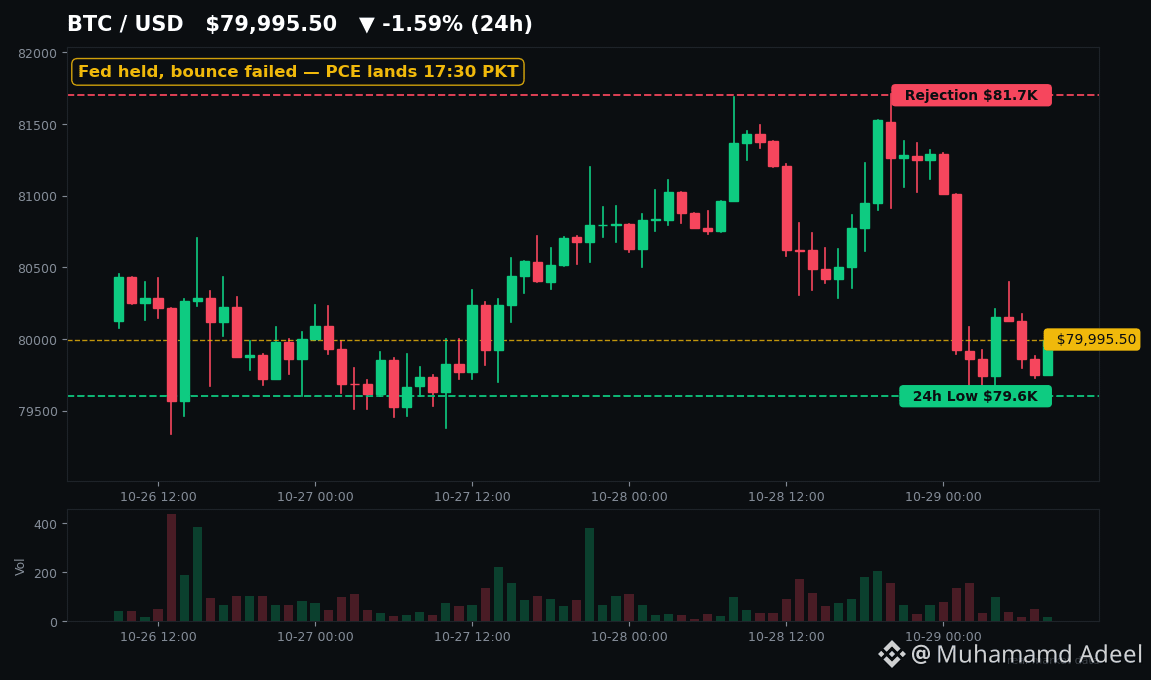
$BTC slipped back below $80,000 in Thursday's Asian session, wiping out its entire post-Fed bounce. The question now isn't what the Fed did. It's what tonight's inflation print does next.
**The bounce that failed**
After the Fed held rates at 3.75%–4.00% on Wednesday, Bitcoin popped above $81,700. Then the tone sank in: the vote was 10–2, with both dissenters pushing for a hike, not a cut. Chair Kevin Warsh refused to commit on December and repeated that inflation "remains elevated."
Then Asia opened risk-off. Samsung's chip unit missed estimates, the Kospi fell over 2%, Nasdaq futures slid 1.4% — and crypto followed. Bitcoin fell to around $79,600, and roughly $356 million in futures positions were liquidated in 24 hours (CoinDesk).
Here's what this really means: the market had priced a hold, but not a hawkish one. Bitwise's Matt Hougan still raised his long-term Bitcoin target this week, but short-term, traders are treating $80,000 as the line in the sand. Check $BTC's chart — a reclaim of $81,700 reopens the range toward $85,000; another rejection keeps the door open to the mid-$70,000s. The last time Bitcoin lost $80,000, in February 2025, it chopped sideways for six weeks before finding a bottom near $74,400. Round numbers break fast and reclaim slowly.
**The ETF split nobody's talking about**
Wednesday's flows tell a two-speed story. US spot Bitcoin ETFs took in $137.3 million — a third straight inflow day, but almost all of it was one fund, BlackRock's IBIT ($136 million). Spot Ethereum ETFs lost $21.4 million, their third straight outflow day.
Meanwhile on-chain, the distribution continued: a whale sold 1.02 million SOL over five days, and Bitcoin saw net inflows back onto exchanges on October 28. Not panic — but not accumulation either. $ETH is sitting near $2,310, and $SOL near $100, both weaker than Bitcoin on the week. If you're watching alts, this is the tell: money is rotating toward Bitcoin, not out of crypto entirely.
**The quiet winner: stablecoins**
Buried under the selloff, Visa revealed its stablecoin settlement has passed a $25 billion annualized run rate — up 10x in a year, across 10 blockchains. That's real adoption, not a price chart. While traders argue about December, the plumbing keeps getting built. Google also unveiled a multi-party custody service for banks this week. The institutions aren't waiting for the perfect entry.
**What actually decides this next**
September PCE and Q3 GDP land today at 17:30 PKT — after this post. Forecasts put core PCE around 0.3% month-on-month and 3.1% year-on-year. A hotter print strengthens the December-hike case markets already price at roughly 80%+. A softer one gives Bitcoin its reclaim shot.
So here's the setup: $80,000 lost, $81,700 the reclaim level, $79,600 the floor to hold, and one data print tonight that decides which way this breaks. Watch the PCE print — then watch the levels.
Not financial advice. DYOR.
The Fed Didn't Cut — It Warned. Now PCE Decides Bitcoin's $80K Fate
The Fed didn't cut. It warned — and Bitcoin just paid for it.
$BTC slipped back below $80,000 in Thursday's Asian session, wiping out its entire post-Fed bounce. The question now isn't what the Fed did. It's what tonight's inflation print does next.
**The bounce that failed**
After the Fed held rates at 3.75%–4.00% on Wednesday, Bitcoin popped above $81,700. Then the tone sank in: the vote was 10–2, with both dissenters pushing for a hike, not a cut. Chair Kevin Warsh refused to commit on December and repeated that inflation "remains elevated."
Then Asia opened risk-off. Samsung's chip unit missed estimates, the Kospi fell over 2%, Nasdaq futures slid 1.4% — and crypto followed. Bitcoin fell to around $79,600, and roughly $356 million in futures positions were liquidated in 24 hours (CoinDesk).
Here's what this really means: the market had priced a hold, but not a hawkish one. Bitwise's Matt Hougan still raised his long-term Bitcoin target this week, but short-term, traders are treating $80,000 as the line in the sand. Check $BTC 's chart — a reclaim of $81,700 reopens the range toward $85,000; another rejection keeps the door open to the mid-$70,000s. The last time Bitcoin lost $80,000, in February 2025, it chopped sideways for six weeks before finding a bottom near $74,400. Round numbers break fast and reclaim slowly.
**The ETF split nobody's talking about**
Wednesday's flows tell a two-speed story. US spot Bitcoin ETFs took in $137.3 million — a third straight inflow day, but almost all of it was one fund, BlackRock's IBIT ($136 million). Spot Ethereum ETFs lost $21.4 million, their third straight outflow day.
Meanwhile on-chain, the distribution continued: a whale sold 1.02 million SOL over five days, and Bitcoin saw net inflows back onto exchanges on October 28. Not panic — but not accumulation either. $ETH is sitting near $2,310, and $SOL near $100, both weaker than Bitcoin on the week. If you're watching alts, this is the tell: money is rotating toward Bitcoin, not out of crypto entirely.
**The quiet winner: stablecoins**
Buried under the selloff, Visa revealed its stablecoin settlement has passed a $25 billion annualized run rate — up 10x in a year, across 10 blockchains. That's real adoption, not a price chart. While traders argue about December, the plumbing keeps getting built. Google also unveiled a multi-party custody service for banks this week. The institutions aren't waiting for the perfect entry.
**What actually decides this next**
September PCE and Q3 GDP land today at 17:30 PKT — after this post. Forecasts put core PCE around 0.3% month-on-month and 3.1% year-on-year. A hotter print strengthens the December-hike case markets already price at roughly 80%+. A softer one gives Bitcoin its reclaim shot.
So here's the setup: $80,000 lost, $81,700 the reclaim level, $79,600 the floor to hold, and one data print tonight that decides which way this breaks. Watch the PCE print — then watch the levels.
Not financial advice. DYOR.
Статья
Uniswap Just Handed Its Chain to Optimism — and $OP Is Still 97% Off Its PeakUniswap just handed its own chain to Optimism — and $OP is still sitting 97% below its all-time high.
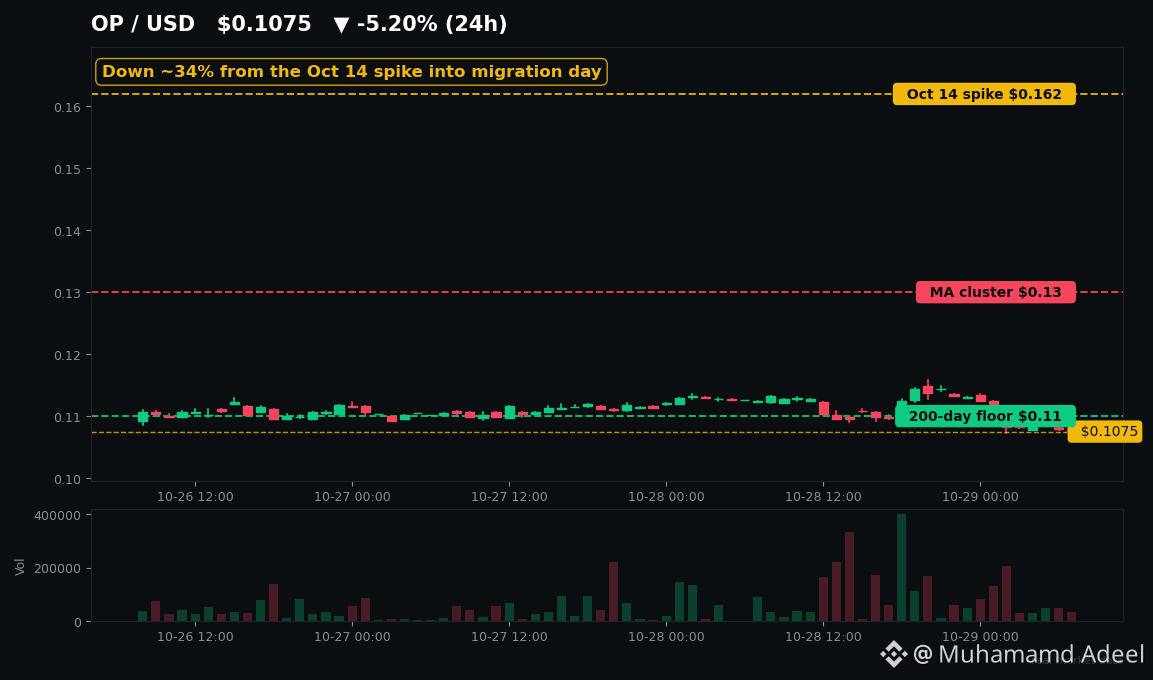
Let that sink in. Today, October 29, Unichain's mainnet is scheduled to migrate to OP Enterprise, putting Optimism in charge of the sequencers, RPC and monitoring for the chain built by crypto's biggest DEX. It is the strongest enterprise endorsement the Superchain has ever received. And the token? It trades around $0.11 — down roughly a third from where it spiked two weeks ago on this very news.
Here's what actually happens today
Nothing changes for users, by design. Same chain ID, same contracts, same balances, same $UNI Uniswap v2, v3 and v4 deployments. What changes is who runs the machine: Uniswap Labs steps back from production operations; Optimism steps in. Unichain stays a Stage 1 rollup with permissionless fault proofs, and its upgrades now sit under Optimism governance.
That is the part the market already traded. When the deal was announced on October 9, $OP jumped nearly 20% in a day to $0.1621, with volume roughly doubling to around $226 million. By October 15, most of it was gone. Classic sell-the-news — except the "news" hasn't even happened yet. The governance proposal says the cutover is "targeted for" October 29 — no completion confirmed as of this morning. Today is the prove-it moment, not the victory lap.
Why this is bigger than one chain
Optimism is becoming the operator of other people's chains, not just its own. The same model already covers Ink and Soneium, and ether.fi is moving its Cash product (70,000+ cards, $160M+ TVL) to OP Mainnet. If the Superchain becomes brands' infrastructure layer, revenue follows.
Governance approved Upgrade 20: 50% of Superchain revenue goes to $OP buybacks — but not until February 2027, on a one-year trial. That is a future catalyst, not a current prop. Anyone telling you buybacks are supporting the price today is selling you something.
The honest bear case
The chain data explains the fade. OP Mainnet DeFi TVL sits around $422 million, with a $35.7 million net outflow in 24 hours and DEX volume down nearly 50% week-on-week. Unichain itself is tiny — roughly $26 million in DeFi TVL. And native interoperability — the "no more bridges" dream — is still dateless: this migration only prepares for it, starting with $ETH transfers.
$OP is clinging to roughly $0.11, the last widely watched structural floor, with a stack of moving averages overhead at $0.12–$0.13. Hold $0.11 and reclaim that zone and the repair story gets real. Lose $0.11 and there is very little underneath. Check $OP's chart into today's close — this is the level that decides whether migration day is a footnote or a turning point.
My take: infrastructure is getting stronger while the token gets weaker. That gap eventually closes one way or the other. Today tells us which way it starts closing — and after a 97% drawdown, the upside, if it comes, will not be small.
Not financial advice. DYOR.
Uniswap Just Handed Its Chain to Optimism — and $OP Is Still 97% Off Its Peak
Uniswap just handed its own chain to Optimism — and $OP is still sitting 97% below its all-time high.
Let that sink in. Today, October 29, Unichain's mainnet is scheduled to migrate to OP Enterprise, putting Optimism in charge of the sequencers, RPC and monitoring for the chain built by crypto's biggest DEX. It is the strongest enterprise endorsement the Superchain has ever received. And the token? It trades around $0.11 — down roughly a third from where it spiked two weeks ago on this very news.
Here's what actually happens today
Nothing changes for users, by design. Same chain ID, same contracts, same balances, same $UNI Uniswap v2, v3 and v4 deployments. What changes is who runs the machine: Uniswap Labs steps back from production operations; Optimism steps in. Unichain stays a Stage 1 rollup with permissionless fault proofs, and its upgrades now sit under Optimism governance.
That is the part the market already traded. When the deal was announced on October 9, $OP jumped nearly 20% in a day to $0.1621, with volume roughly doubling to around $226 million. By October 15, most of it was gone. Classic sell-the-news — except the "news" hasn't even happened yet. The governance proposal says the cutover is "targeted for" October 29 — no completion confirmed as of this morning. Today is the prove-it moment, not the victory lap.
Why this is bigger than one chain
Optimism is becoming the operator of other people's chains, not just its own. The same model already covers Ink and Soneium, and ether.fi is moving its Cash product (70,000+ cards, $160M+ TVL) to OP Mainnet. If the Superchain becomes brands' infrastructure layer, revenue follows.
Governance approved Upgrade 20: 50% of Superchain revenue goes to $OP buybacks — but not until February 2027, on a one-year trial. That is a future catalyst, not a current prop. Anyone telling you buybacks are supporting the price today is selling you something.
The honest bear case
The chain data explains the fade. OP Mainnet DeFi TVL sits around $422 million, with a $35.7 million net outflow in 24 hours and DEX volume down nearly 50% week-on-week. Unichain itself is tiny — roughly $26 million in DeFi TVL. And native interoperability — the "no more bridges" dream — is still dateless: this migration only prepares for it, starting with $ETH transfers.
$OP is clinging to roughly $0.11, the last widely watched structural floor, with a stack of moving averages overhead at $0.12–$0.13. Hold $0.11 and reclaim that zone and the repair story gets real. Lose $0.11 and there is very little underneath. Check $OP 's chart into today's close — this is the level that decides whether migration day is a footnote or a turning point.
My take: infrastructure is getting stronger while the token gets weaker. That gap eventually closes one way or the other. Today tells us which way it starts closing — and after a 97% drawdown, the upside, if it comes, will not be small.
Not financial advice. DYOR.
Статья
AVAX's Network Is Booming. Its Price Is Stuck at $8.70.Everyone's asking why Avalanche's price won't move.
Here's the uncomfortable answer: the network is booming — and the market doesn't care yet.
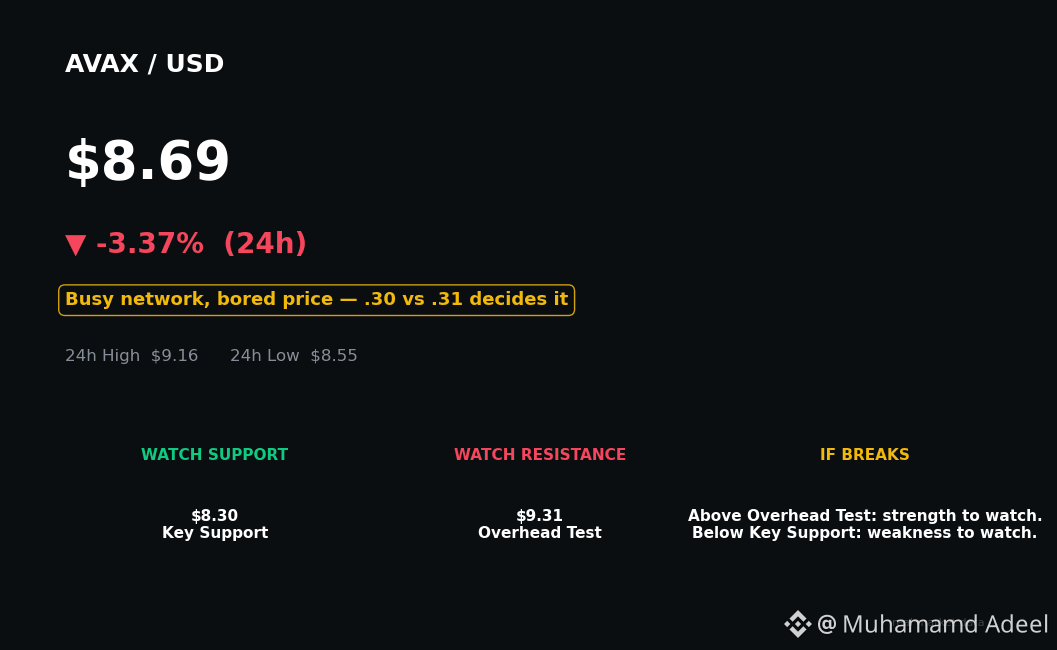
$AVAX is trading around $8.70 today, down on the day, after a small bounce on October 28 to $8.98 that still left it pinned below a stack of short-term moving averages. The 24-hour range, $8.58 to $9.16, tells you everything: this is a coin going nowhere fast, in a market that just got a very clear message from the Fed.
And that message was not a cut.
The Fed held rates at 3.75–4.00% on October 28, in a 10–2 vote, with two dissenters actually wanting a hike. The next decision lands December 8–9. So if you were waiting for easy money to lift every altcoin, you are still waiting — and $BTC, the market's anchor, is setting the tone for everything else right now.
So why is AVAX worth watching anyway? Because underneath the flat price, the activity numbers are loud.
October DEX volume on Avalanche hit $4.1 billion, up 29% month-on-month, with Pharaoh Exchange accounting for roughly 75% of it. The chain posted a record 911ms average block time on October 23. DeFi TVL sits around $561 million. That is not a dead chain. That is a chain doing real volume while its token trades like nobody noticed.
That gap — busy network, bored price — is the whole trade-relevant story here.
Now the levels, honestly. Check $AVAX's chart against these lines, because they are doing all the talking right now. Support to watch sits around $8.30. Overhead, the first real test is $9.15–$9.31, the zone from the October 28 bounce. Hold above $8.30 and the bounce story stays alive. Lose it, and the next conversation gets a lot uglier, fast — AVAX has a long history of falling harder than the market when fear takes over, then bouncing violently only after that fear clears.
And here is the risk you cannot skip. On October 27–28, a flash-loan attacker drained about $1.01 million in USDC from a Tranche Vault on Avalanche linked to Fence Finance and Valinor Digital, flagged by security firm Blockaid. Small in dollars, big in symbolism: it hit the institutional credit story Avalanche is trying to sell. Add a small Foundation unlock on November 8 — 1.67 million AVAX, about 0.35% of total supply — and you have a coin with no shortage of excuses to stay heavy.
So what does this really mean? AVAX is a divergence trade in plain sight: real usage on one side, a fragile chart and a hawkish Fed backdrop on the other. One of those two stories breaks first. Watch $8.30 and $9.15–$9.31 — they will tell you which one, before the headlines do.
Not financial advice. DYOR.
AVAX's Network Is Booming. Its Price Is Stuck at $8.70.
Everyone's asking why Avalanche's price won't move.
Here's the uncomfortable answer: the network is booming — and the market doesn't care yet.
$AVAX is trading around $8.70 today, down on the day, after a small bounce on October 28 to $8.98 that still left it pinned below a stack of short-term moving averages. The 24-hour range, $8.58 to $9.16, tells you everything: this is a coin going nowhere fast, in a market that just got a very clear message from the Fed.
And that message was not a cut.
The Fed held rates at 3.75–4.00% on October 28, in a 10–2 vote, with two dissenters actually wanting a hike. The next decision lands December 8–9. So if you were waiting for easy money to lift every altcoin, you are still waiting — and $BTC , the market's anchor, is setting the tone for everything else right now.
So why is AVAX worth watching anyway? Because underneath the flat price, the activity numbers are loud.
October DEX volume on Avalanche hit $4.1 billion, up 29% month-on-month, with Pharaoh Exchange accounting for roughly 75% of it. The chain posted a record 911ms average block time on October 23. DeFi TVL sits around $561 million. That is not a dead chain. That is a chain doing real volume while its token trades like nobody noticed.
That gap — busy network, bored price — is the whole trade-relevant story here.
Now the levels, honestly. Check $AVAX 's chart against these lines, because they are doing all the talking right now. Support to watch sits around $8.30. Overhead, the first real test is $9.15–$9.31, the zone from the October 28 bounce. Hold above $8.30 and the bounce story stays alive. Lose it, and the next conversation gets a lot uglier, fast — AVAX has a long history of falling harder than the market when fear takes over, then bouncing violently only after that fear clears.
And here is the risk you cannot skip. On October 27–28, a flash-loan attacker drained about $1.01 million in USDC from a Tranche Vault on Avalanche linked to Fence Finance and Valinor Digital, flagged by security firm Blockaid. Small in dollars, big in symbolism: it hit the institutional credit story Avalanche is trying to sell. Add a small Foundation unlock on November 8 — 1.67 million AVAX, about 0.35% of total supply — and you have a coin with no shortage of excuses to stay heavy.
So what does this really mean? AVAX is a divergence trade in plain sight: real usage on one side, a fragile chart and a hawkish Fed backdrop on the other. One of those two stories breaks first. Watch $8.30 and $9.15–$9.31 — they will tell you which one, before the headlines do.
Not financial advice. DYOR.
24
Статья
Sky's Stablecoin Is Winning. Its Token Just Broke Key Support.While everyone watched the Fed hold rates on Wednesday, DeFi's oldest bank quietly split in two.
Its stablecoin is growing faster than any top-10 rival. Its token just slipped below a level traders were defending. That contradiction is the whole trade in Sky right now — and most people searching for it are looking at the wrong ticker.
First, the ticker confusion. MakerDAO is now Sky. The old governance token $MKR was migrated into $SKY at 1 to 24,000, and major exchanges converted balances and delisted MKR pairs. MKR still shows near $1,510 on price sites, but trades thinly now — $SKY is the chart that matters.
Now the split. CoinDesk's October stablecoin report found Sky Dollar (USDS) grew 3.5% to $6.74 billion — the largest percentage gain among the ten biggest stablecoins. DAI, Sky's original stablecoin, reclaimed fourth place at $4.73 billion. Its savings product, sUSDS, still pays 3.80%.
But the protocol underneath is shrinking. Sky's total value locked is about $5.39 billion, down roughly 10% over 30 days, on about $28 million in fees and $13 million in revenue. Stablecoin up, collateral base down — that tension is the trade.
Institutions noticed anyway. Galaxy Digital put $100 million into sUSDS in September. Stablecoin Development Corp disclosed in early October that it holds roughly 10% of SKY, staked and unsold. Standard Chartered called Sky "DeFi's federal bank" with a $0.325 SKY target by end-2028. And Moody's gave Sky its first-ever rating of a stablecoin protocol — except it was B3, speculative grade, alongside S&P's B-.
Here is the honest version of that headline: the ratings make Sky legible to institutions, not safe. Moody's flagged roughly $90 million of equity against about $10 billion of managed assets — near 0.9% capital. Reserves sit well short of governance's $150 million target. And the GENIUS Act compliance date lands on 18 January 2027, with rules that could complicate the yield pitch sUSDS sells on.
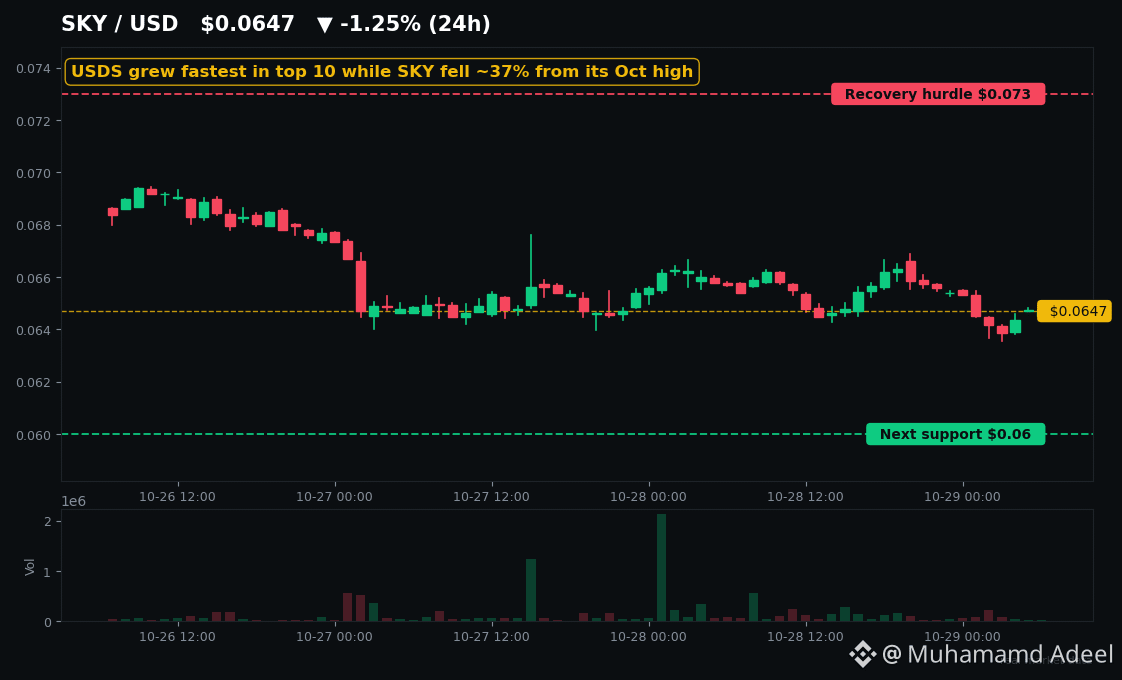
The chart tells the same cautious story. $SKY trades near $0.0647, roughly 35% below its early-October high near $0.10. A 26 October analysis put support at the 200-day average near $0.0667 and the recovery hurdle at $0.0730 — price has now slipped under that support, with roughly $0.060 as the next floor. A daily close back above $0.0730 would change the picture; a slide through $0.060 would confirm the fade. Check the $SKY chart against those two lines — that is where this story gets settled.
History warns against getting carried away: the 2024 rebrand rally faded within weeks, and in December 2024 Maker posted record fees while MKR still fell nearly 20% that month. Strong protocol numbers and a rising token are not the same thing. Remember too that Sky's lending runs heavily on $ETH-backed collateral.
So here is the take: Sky is winning the stablecoin race nobody is watching, while its token pays for a thin capital cushion and a regulatory clock. That divergence resolves with fresh inflows — or another leg down. Which side are you watching first?
Not financial advice. DYOR.
Sky's Stablecoin Is Winning. Its Token Just Broke Key Support.
While everyone watched the Fed hold rates on Wednesday, DeFi's oldest bank quietly split in two.
Its stablecoin is growing faster than any top-10 rival. Its token just slipped below a level traders were defending. That contradiction is the whole trade in Sky right now — and most people searching for it are looking at the wrong ticker.
First, the ticker confusion. MakerDAO is now Sky. The old governance token $MKR was migrated into $SKY at 1 to 24,000, and major exchanges converted balances and delisted MKR pairs. MKR still shows near $1,510 on price sites, but trades thinly now — $SKY is the chart that matters.
Now the split. CoinDesk's October stablecoin report found Sky Dollar (USDS) grew 3.5% to $6.74 billion — the largest percentage gain among the ten biggest stablecoins. DAI, Sky's original stablecoin, reclaimed fourth place at $4.73 billion. Its savings product, sUSDS, still pays 3.80%.
But the protocol underneath is shrinking. Sky's total value locked is about $5.39 billion, down roughly 10% over 30 days, on about $28 million in fees and $13 million in revenue. Stablecoin up, collateral base down — that tension is the trade.
Institutions noticed anyway. Galaxy Digital put $100 million into sUSDS in September. Stablecoin Development Corp disclosed in early October that it holds roughly 10% of SKY, staked and unsold. Standard Chartered called Sky "DeFi's federal bank" with a $0.325 SKY target by end-2028. And Moody's gave Sky its first-ever rating of a stablecoin protocol — except it was B3, speculative grade, alongside S&P's B-.
Here is the honest version of that headline: the ratings make Sky legible to institutions, not safe. Moody's flagged roughly $90 million of equity against about $10 billion of managed assets — near 0.9% capital. Reserves sit well short of governance's $150 million target. And the GENIUS Act compliance date lands on 18 January 2027, with rules that could complicate the yield pitch sUSDS sells on.
The chart tells the same cautious story. $SKY trades near $0.0647, roughly 35% below its early-October high near $0.10. A 26 October analysis put support at the 200-day average near $0.0667 and the recovery hurdle at $0.0730 — price has now slipped under that support, with roughly $0.060 as the next floor. A daily close back above $0.0730 would change the picture; a slide through $0.060 would confirm the fade. Check the $SKY chart against those two lines — that is where this story gets settled.
History warns against getting carried away: the 2024 rebrand rally faded within weeks, and in December 2024 Maker posted record fees while MKR still fell nearly 20% that month. Strong protocol numbers and a rising token are not the same thing. Remember too that Sky's lending runs heavily on $ETH -backed collateral.
So here is the take: Sky is winning the stablecoin race nobody is watching, while its token pays for a thin capital cushion and a regulatory clock. That divergence resolves with fresh inflows — or another leg down. Which side are you watching first?
Not financial advice. DYOR.
Статья
The Fed Held — and ETH's Bounce Already Faded. December Is the Real FightThe Fed gave crypto exactly what it expected yesterday — and the market still slipped overnight.
That's the tell. The hold wasn't the story. The hawkish tone was.
The FOMC voted 10–2 to hold rates at 3.75%–4.00%, with two officials already pushing for a hike. The statement called inflation "elevated," Chair Warsh refused to commit on December, and traders repriced the December meeting on the spot — roughly 8-in-10 odds of a hike now.
As Theo CIO Iggy Ioppe put it: "Markets had the hold priced, but not the hawkish tone." With headline inflation at 3.7% and the 10-year near 5%, risk assets now compete with a near-5% risk-free rate.
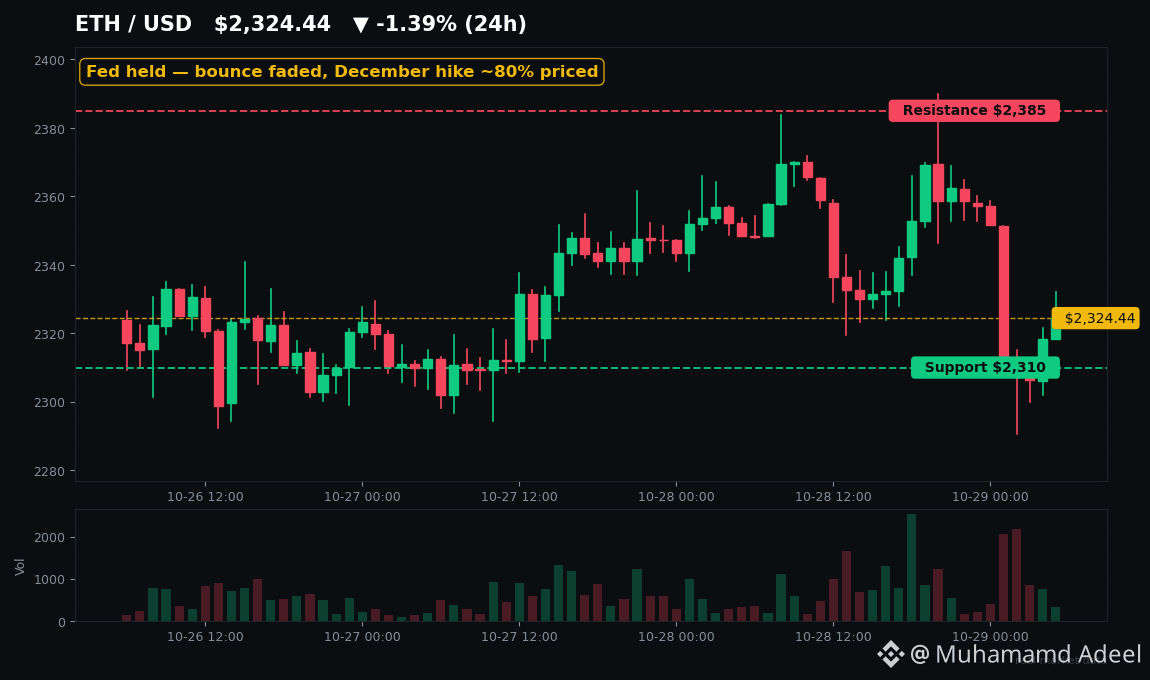
The bounce that followed proved the point. ETH popped to test $2,355 resistance off its 200-day average, then faded to around $2,330 by this morning. Bitcoin did the same dance — toward $81,500, then a slip under $80,000 overnight before steadying near $80,400. Fear & Greed sits Neutral at 51. Not panic — exhaustion.
Underneath the price, the whale tape is split. On 28 October, three ICO-era wallets moved more than $34 million of ETH onto exchanges, including 7,594 ETH to Kraken from a wallet that bought at around $0.31. But in the same 24 hours, another whale bought 14,600 ETH (about $34 million) via BitGo, and a separate whale levered up to a $53 million long on Aave. Same day, same price, opposite bets.
The levels that matter for ETH
ETH is parked on support at $2,310–$2,323, with resistance at $2,355–$2,385. Lose $2,295 and analysts see $2,200 next — and data shows roughly $927 million in long liquidations stacked below $2,251. Reclaim $2,425–$2,450 on a daily close, though, and the picture flips toward $2,800. Check the chart on $ETH and you'll see how tight this range really is.
The majors aren't moving together. $SOL is clinging to the $100 line after dipping just under it this morning. XRP is softer at around $1.30. The exception is BNB, the only major still green at roughly $758.
History says don't expect a quick snapback. Across past hawkish holds, Bitcoin averaged a 1.2% drop on the day and 4.1% over the next five sessions — and altcoins historically fell about twice as hard. December pricing at ~80% says this one wasn't fully priced in.
So here's the honest setup. ETH's institutional demand is still broken — US spot ETH ETFs have bled in almost every October session, with more than $1 billion out this month, and the Glamsterdam upgrade just got delayed with no new date. That's the bear case. The bull case: big buyers absorbing supply at $2,300, not chasing $2,800.
What breaks the tie? Thursday's PCE report, then jobs on 6 November and CPI on 10 November. A soft print cuts December hike odds and this fade reverses fast. A hot one confirms the hike — and $BTC losing $80,000 for good drags every major down with it.
So: does ETH's $2,310 floor hold until PCE? Bounce or bull trap — what do you think?
Not financial advice. DYOR.
The Fed Held — and ETH's Bounce Already Faded. December Is the Real Fight
The Fed gave crypto exactly what it expected yesterday — and the market still slipped overnight.
That's the tell. The hold wasn't the story. The hawkish tone was.
The FOMC voted 10–2 to hold rates at 3.75%–4.00%, with two officials already pushing for a hike. The statement called inflation "elevated," Chair Warsh refused to commit on December, and traders repriced the December meeting on the spot — roughly 8-in-10 odds of a hike now.
As Theo CIO Iggy Ioppe put it: "Markets had the hold priced, but not the hawkish tone." With headline inflation at 3.7% and the 10-year near 5%, risk assets now compete with a near-5% risk-free rate.
The bounce that followed proved the point. ETH popped to test $2,355 resistance off its 200-day average, then faded to around $2,330 by this morning. Bitcoin did the same dance — toward $81,500, then a slip under $80,000 overnight before steadying near $80,400. Fear & Greed sits Neutral at 51. Not panic — exhaustion.
Underneath the price, the whale tape is split. On 28 October, three ICO-era wallets moved more than $34 million of ETH onto exchanges, including 7,594 ETH to Kraken from a wallet that bought at around $0.31. But in the same 24 hours, another whale bought 14,600 ETH (about $34 million) via BitGo, and a separate whale levered up to a $53 million long on Aave. Same day, same price, opposite bets.
The levels that matter for ETH
ETH is parked on support at $2,310–$2,323, with resistance at $2,355–$2,385. Lose $2,295 and analysts see $2,200 next — and data shows roughly $927 million in long liquidations stacked below $2,251. Reclaim $2,425–$2,450 on a daily close, though, and the picture flips toward $2,800. Check the chart on $ETH and you'll see how tight this range really is.
The majors aren't moving together. $SOL is clinging to the $100 line after dipping just under it this morning. XRP is softer at around $1.30. The exception is BNB, the only major still green at roughly $758.
History says don't expect a quick snapback. Across past hawkish holds, Bitcoin averaged a 1.2% drop on the day and 4.1% over the next five sessions — and altcoins historically fell about twice as hard. December pricing at ~80% says this one wasn't fully priced in.
So here's the honest setup. ETH's institutional demand is still broken — US spot ETH ETFs have bled in almost every October session, with more than $1 billion out this month, and the Glamsterdam upgrade just got delayed with no new date. That's the bear case. The bull case: big buyers absorbing supply at $2,300, not chasing $2,800.
What breaks the tie? Thursday's PCE report, then jobs on 6 November and CPI on 10 November. A soft print cuts December hike odds and this fade reverses fast. A hot one confirms the hike — and $BTC losing $80,000 for good drags every major down with it.
So: does ETH's $2,310 floor hold until PCE? Bounce or bull trap — what do you think?
Not financial advice. DYOR.
Статья
WIF at $0.18 While BTC Fights for $80K — Is the Meme Trade Quietly Giving Up?Bitcoin got the Fed pause. Dogwifhat got the slide.
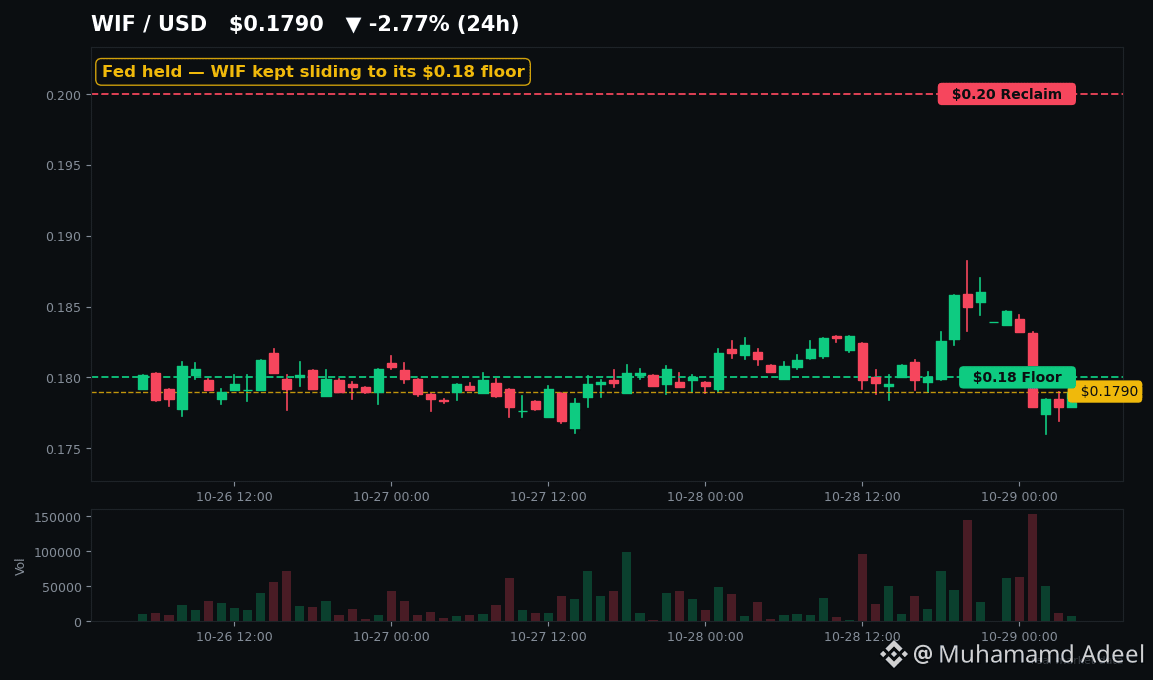
The Fed held rates at 3.75%-4.00% on 28 October in a 10-2 vote — both dissenters wanted a hike, not a cut. Bitcoin first held near $81K, then slipped under $80K overnight. And $WIF? It didn't bounce or panic. It just kept sliding, down roughly 2-3% in 24 hours to about $0.179.
Here's the interesting part: WIF isn't falling on its own bad news. No fresh listing, delisting or confirmed scandal — and no unlock cliff, because all roughly 999 million WIF already circulate, with mint and freeze authorities revoked. Nobody can print more of it.
In a risk-off tape, nobody is rushing to defend the meme trade.
The numbers tell a slow bleed, not a crash. WIF traded near $0.21 on 21 October and drifted to $0.18 by 27 October — down about 13% on the week and 22% on the month, with a market cap of roughly $178 million, about 96% below its $4.83 all-time high from 31 March 2024. Yet 24-hour volume is still near $50 million. People are still trading it — just not bidding it up.
The line to watch is $0.18 — WIF's 200-day moving average and lower Bollinger Band, its last obvious floor. Hold above it and the floor stays intact, even with every shorter average overhead. Break below and supports sit near $0.175 and $0.173, then about $0.154. Reclaim $0.19-$0.20 first, and that's the first sign sellers are losing their grip.
Worth pulling up the $WIF chart here — the next break decides which scenario plays out.
Now the rotation question. Across Solana memes, there is no visible rush into WIF. $SOL itself is sliding with the broader market, and fellow Solana meme $BONK has been flat and quiet into the Fed decision too. The social chatter feels retrospective, not electric — the crowd debating whether attention alone is still enough, rather than starting a new hype wave. Holders agree: roughly 265,000, essentially flat over the last day — not fleeing, but no new crowd arriving either.
And the honest risks: WIF has no product, no revenue and no burn — its value rests entirely on attention and liquidity. The top 10 accounts hold roughly 44-45% of supply, though that includes exchange wallets, so the true whale share can't be stated precisely. And the cautionary tale is in WIF's own history: the Las Vegas Sphere campaign that helped fuel the 2024 run raised about $700,000 from the community — and the ad never ran.
So here's my take: not a crash, not an unlock, not a scandal. Just a coin with no catalyst and no crowd rushing back, sitting on its last obvious floor while Bitcoin decides whether $80K holds. If $0.18 holds and $0.19-$0.20 gets reclaimed, the conversation changes. Until then, the hat stays on — but the party hasn't restarted.
Keep $WIF on your watchlist and check its chart alongside $SOL before the next move.
Not financial advice. DYOR.
WIF at $0.18 While BTC Fights for $80K — Is the Meme Trade Quietly Giving Up?
Bitcoin got the Fed pause. Dogwifhat got the slide.
The Fed held rates at 3.75%-4.00% on 28 October in a 10-2 vote — both dissenters wanted a hike, not a cut. Bitcoin first held near $81K, then slipped under $80K overnight. And $WIF ? It didn't bounce or panic. It just kept sliding, down roughly 2-3% in 24 hours to about $0.179.
Here's the interesting part: WIF isn't falling on its own bad news. No fresh listing, delisting or confirmed scandal — and no unlock cliff, because all roughly 999 million WIF already circulate, with mint and freeze authorities revoked. Nobody can print more of it.
In a risk-off tape, nobody is rushing to defend the meme trade.
The numbers tell a slow bleed, not a crash. WIF traded near $0.21 on 21 October and drifted to $0.18 by 27 October — down about 13% on the week and 22% on the month, with a market cap of roughly $178 million, about 96% below its $4.83 all-time high from 31 March 2024. Yet 24-hour volume is still near $50 million. People are still trading it — just not bidding it up.
The line to watch is $0.18 — WIF's 200-day moving average and lower Bollinger Band, its last obvious floor. Hold above it and the floor stays intact, even with every shorter average overhead. Break below and supports sit near $0.175 and $0.173, then about $0.154. Reclaim $0.19-$0.20 first, and that's the first sign sellers are losing their grip.
Worth pulling up the $WIF chart here — the next break decides which scenario plays out.
Now the rotation question. Across Solana memes, there is no visible rush into WIF. $SOL itself is sliding with the broader market, and fellow Solana meme $BONK has been flat and quiet into the Fed decision too. The social chatter feels retrospective, not electric — the crowd debating whether attention alone is still enough, rather than starting a new hype wave. Holders agree: roughly 265,000, essentially flat over the last day — not fleeing, but no new crowd arriving either.
And the honest risks: WIF has no product, no revenue and no burn — its value rests entirely on attention and liquidity. The top 10 accounts hold roughly 44-45% of supply, though that includes exchange wallets, so the true whale share can't be stated precisely. And the cautionary tale is in WIF's own history: the Las Vegas Sphere campaign that helped fuel the 2024 run raised about $700,000 from the community — and the ad never ran.
So here's my take: not a crash, not an unlock, not a scandal. Just a coin with no catalyst and no crowd rushing back, sitting on its last obvious floor while Bitcoin decides whether $80K holds. If $0.18 holds and $0.19-$0.20 gets reclaimed, the conversation changes. Until then, the hat stays on — but the party hasn't restarted.
Keep $WIF on your watchlist and check its chart alongside $SOL before the next move.
Not financial advice. DYOR.
2
Статья
Bitcoin Lost $80K Hours After the Fed Held — December Is the Real FightThe Fed didn't cut. And $BTC didn't celebrate.
It held $81,000 for a few hours after the decision — then gave it all back overnight, slipping back under $80,000. If you thought the FOMC would settle this market, think again. It just moved the fight to December.
Here's what actually happened.
On October 28, the Fed held rates at 3.75%–4.00% in a 10–2 vote. But look at who dissented: Governor Lisa Cook and Cleveland Fed President Beth Hammack both wanted a hike, not a cut. There was no dovish voice in the room at all. Chair Kevin Warsh called inflation "too high" — above target for close to six years — and flatly refused to pre-commit on December.
Traders now price roughly an 85% chance of a December hike. The Fed didn't promise one — the market priced one anyway.
So how did Bitcoin react? With a shrug, then a fade.
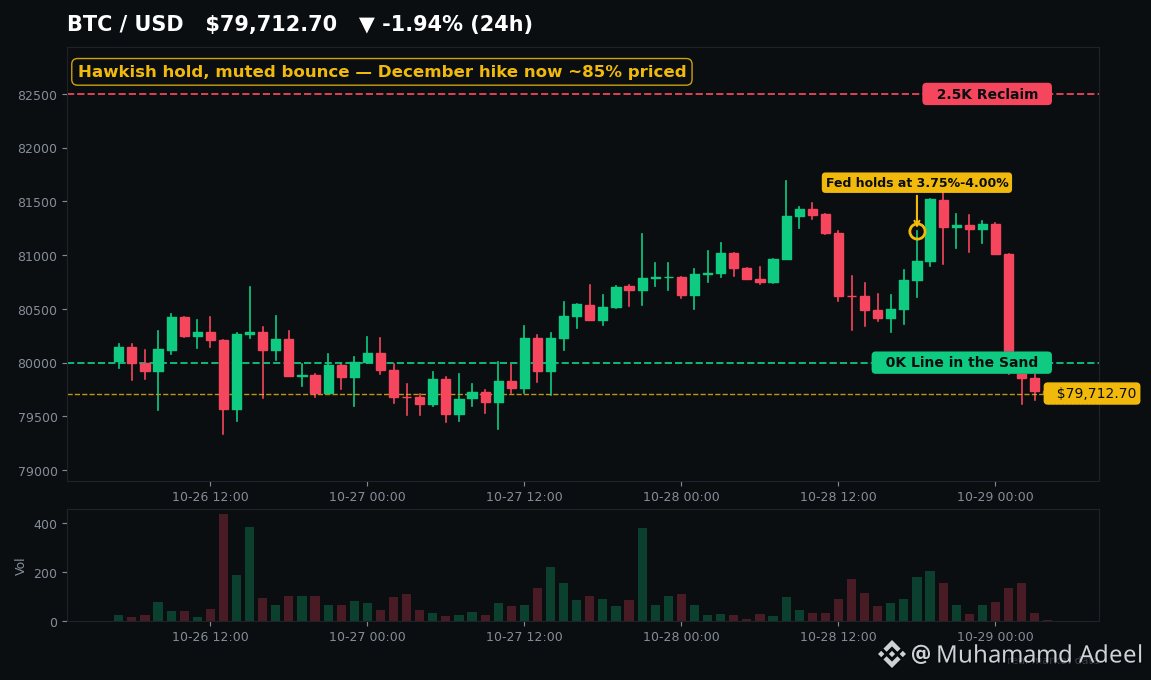
Before the announcement, $BTC spiked to $81,687, dipped below $80,500, then reclaimed roughly $81,000–$81,200 — a gain of under 1%. Options volatility barely moved. Not a breakout — the hold was already priced in.
Then Asia woke up, tech stocks wobbled, and the bounce unwound. By this morning Bitcoin was back around $79,700, below the line it had just defended. The relief rally lasted hours, not days.
Now the levels that actually matter.
$80,000 is the line in the sand. Hold it on a daily close and the next tests are $81,500–$81,750, then $82,500 — the reclaim that would flip the short-term story. Lose it and the path points to $79,440, then $77,466, where over $1.3 billion in long liquidations cluster. Check $BTC's chart against those levels — that's where this story gets decided.
Here's what this really means, and why I'm not calling this a bottom yet.
History says decision day is usually the quiet part. Across five past hawkish holds, Bitcoin averaged a 4.1% drop over the following five sessions. The damage, when it came, came after — not during. The exception proves the rule: September's fully priced-in hike rallied, because uncertainty clearing was the event. This time, uncertainty didn't clear. It moved to December 8–9.
Bright spots exist, though. Spot Bitcoin ETFs posted two straight inflow days heading into the decision — $110 million Monday, $176 million Tuesday — cutting October's net outflows to roughly $26 million. And nearly 15,000 BTC left exchanges on October 27, the biggest daily outflow in five weeks. But whales also parked roughly $500 million on Coinbase Prime around the same time. That's two-way positioning, not conviction — and a deposit is not a sale.
$ETH ticked slightly higher after the decision, but nothing screamed risk-on.
What I'm watching next: today's PCE print and Q3 GDP — the data Warsh said will decide December — then nearly $11 billion in Bitcoin options expiring October 30.
The Fed didn't rescue Bitcoin yesterday. It just postponed the decision. Until Bitcoin reclaims $82,500 or December pricing cools off, every bounce is guilty until proven innocent.
Not financial advice. DYOR.
Bitcoin Lost $80K Hours After the Fed Held — December Is the Real Fight
The Fed didn't cut. And $BTC didn't celebrate.
It held $81,000 for a few hours after the decision — then gave it all back overnight, slipping back under $80,000. If you thought the FOMC would settle this market, think again. It just moved the fight to December.
Here's what actually happened.
On October 28, the Fed held rates at 3.75%–4.00% in a 10–2 vote. But look at who dissented: Governor Lisa Cook and Cleveland Fed President Beth Hammack both wanted a hike, not a cut. There was no dovish voice in the room at all. Chair Kevin Warsh called inflation "too high" — above target for close to six years — and flatly refused to pre-commit on December.
Traders now price roughly an 85% chance of a December hike. The Fed didn't promise one — the market priced one anyway.
So how did Bitcoin react? With a shrug, then a fade.
Before the announcement, $BTC spiked to $81,687, dipped below $80,500, then reclaimed roughly $81,000–$81,200 — a gain of under 1%. Options volatility barely moved. Not a breakout — the hold was already priced in.
Then Asia woke up, tech stocks wobbled, and the bounce unwound. By this morning Bitcoin was back around $79,700, below the line it had just defended. The relief rally lasted hours, not days.
Now the levels that actually matter.
$80,000 is the line in the sand. Hold it on a daily close and the next tests are $81,500–$81,750, then $82,500 — the reclaim that would flip the short-term story. Lose it and the path points to $79,440, then $77,466, where over $1.3 billion in long liquidations cluster. Check $BTC 's chart against those levels — that's where this story gets decided.
Here's what this really means, and why I'm not calling this a bottom yet.
History says decision day is usually the quiet part. Across five past hawkish holds, Bitcoin averaged a 4.1% drop over the following five sessions. The damage, when it came, came after — not during. The exception proves the rule: September's fully priced-in hike rallied, because uncertainty clearing was the event. This time, uncertainty didn't clear. It moved to December 8–9.
Bright spots exist, though. Spot Bitcoin ETFs posted two straight inflow days heading into the decision — $110 million Monday, $176 million Tuesday — cutting October's net outflows to roughly $26 million. And nearly 15,000 BTC left exchanges on October 27, the biggest daily outflow in five weeks. But whales also parked roughly $500 million on Coinbase Prime around the same time. That's two-way positioning, not conviction — and a deposit is not a sale.
$ETH ticked slightly higher after the decision, but nothing screamed risk-on.
What I'm watching next: today's PCE print and Q3 GDP — the data Warsh said will decide December — then nearly $11 billion in Bitcoin options expiring October 30.
The Fed didn't rescue Bitcoin yesterday. It just postponed the decision. Until Bitcoin reclaims $82,500 or December pricing cools off, every bounce is guilty until proven innocent.
Not financial advice. DYOR.
Статья
Whales Parked $498M on Coinbase Prime Hours Before the Fed DecidesThree whales just parked $498 million of Bitcoin on Coinbase Prime — hours before the Fed decides.
And here's the twist: the market as a whole did the exact opposite. So which signal do you trust tonight?
Lookonchain flagged it overnight: three whales deposited a combined 6,168 $BTC, worth roughly $498.5 million, into Coinbase Prime. That's an institutional venue, not a retail exchange app. No sale has been confirmed, though: a deposit is not a dump — parked coins are coins ready to move, not coins sold.
But timing is everything. This landed hours before tonight's FOMC decision at 23:00 PKT, with Chair Warsh's press conference at 23:30. The market is pricing roughly a 90% chance of a hold at 3.75–4.00% — but nobody knows the tone yet, and the tone is what moves markets. These whales just made sure they can act the second they hear it.
Now look at the other side of the tape. Exchange balances fell on net on 27 October, according to trackers — though honestly, those trackers disagree wildly on how much, so don't let anyone sell you a precise number. Meanwhile US spot Bitcoin ETFs pulled in $176 million on Tuesday, after $110.3 million on Monday. That's $286 million in two days, almost all of it through BlackRock's IBIT, and it nearly erased October's ETF outflows.
Whales moving coins IN to one venue, coins leaving exchanges overall, ETF money coming back — all true at once. That's a market positioning, not committing.
Sentiment agrees. Alternative.me's Crypto Fear & Greed Index sits at Neutral, around 51 — up from 48 yesterday, down from 63 a week ago. Not fear. Not greed. Just undecided.
And $ETH tells the other half of the story. While Bitcoin ETFs took in $286 million over two days, Ethereum ETFs bled about $149 million over the same stretch, taking October's ETH outflows to roughly $1.32 billion. Same market, opposite flows. Bitcoin is getting the benefit of the doubt. Ethereum isn't — yet.
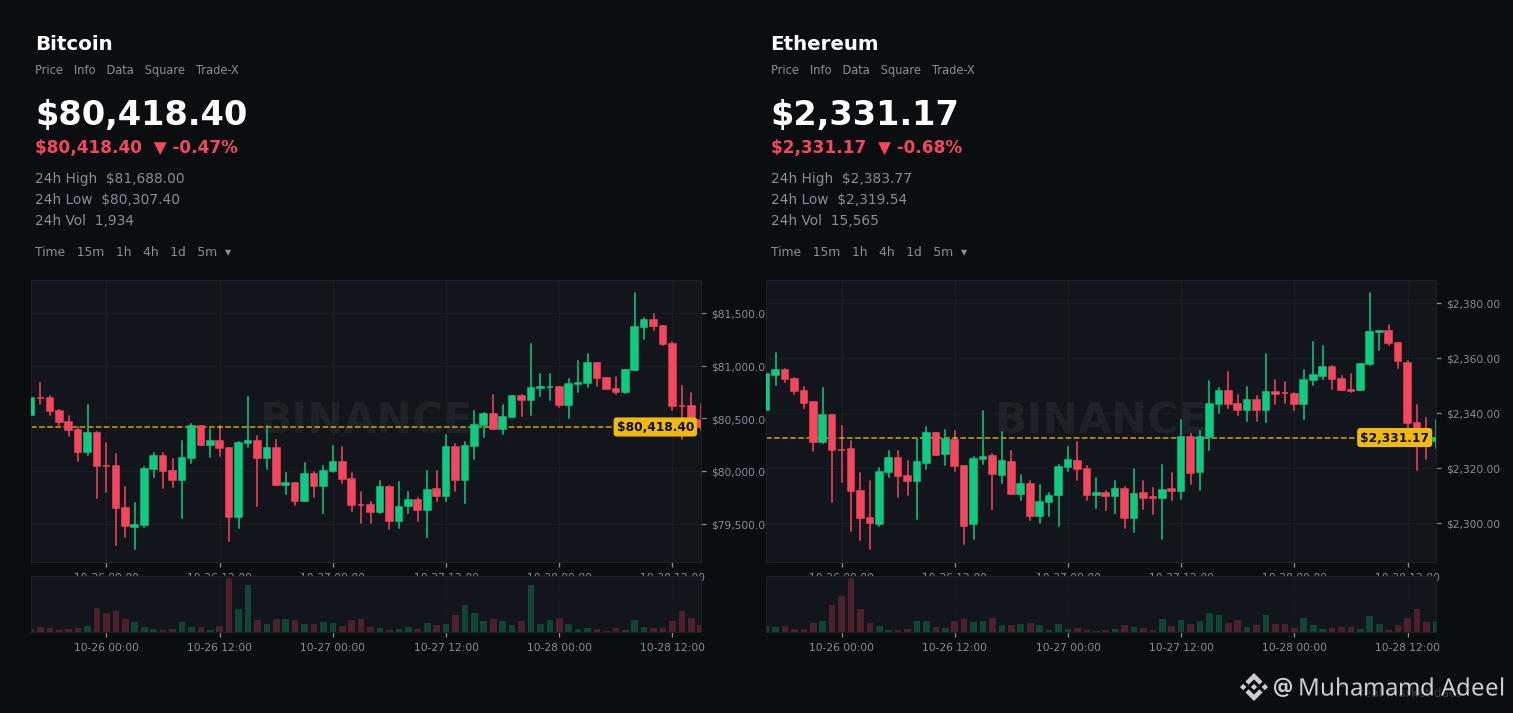
Here's what I'm watching into 23:00 PKT. $BTC reclaimed $81,000 today after dipping below $80,000 on Monday, trading roughly in the $80,400–$81,800 range — pull up its chart and you'll see the battle lines clearly. Analyst Michaël van de Poppe calls $81,000 the flip level: hold it and the path opens toward $82,500–$84,000, per Santiment's read. Lose $79,000 decisively and that structure breaks, with analyst Ali Martinez flagging $77,000 below. For Ethereum, watch $2,300 — losing it confirms the ETH lag is getting worse.
History says don't overreact to the first hour tonight. In 2025's Fed meetings, Bitcoin usually chopped or dipped first, then found its real direction over the next 24 hours.
So tonight, ignore the loudest headline. Watch whether those Prime coins actually move — or just sit there. That will tell you more than any prediction will.
What are you watching first after the press conference — the whales, or the ETFs?
Not financial advice. DYOR.
Whales Parked $498M on Coinbase Prime Hours Before the Fed Decides
Three whales just parked $498 million of Bitcoin on Coinbase Prime — hours before the Fed decides.
And here's the twist: the market as a whole did the exact opposite. So which signal do you trust tonight?
Lookonchain flagged it overnight: three whales deposited a combined 6,168 $BTC , worth roughly $498.5 million, into Coinbase Prime. That's an institutional venue, not a retail exchange app. No sale has been confirmed, though: a deposit is not a dump — parked coins are coins ready to move, not coins sold.
But timing is everything. This landed hours before tonight's FOMC decision at 23:00 PKT, with Chair Warsh's press conference at 23:30. The market is pricing roughly a 90% chance of a hold at 3.75–4.00% — but nobody knows the tone yet, and the tone is what moves markets. These whales just made sure they can act the second they hear it.
Now look at the other side of the tape. Exchange balances fell on net on 27 October, according to trackers — though honestly, those trackers disagree wildly on how much, so don't let anyone sell you a precise number. Meanwhile US spot Bitcoin ETFs pulled in $176 million on Tuesday, after $110.3 million on Monday. That's $286 million in two days, almost all of it through BlackRock's IBIT, and it nearly erased October's ETF outflows.
Whales moving coins IN to one venue, coins leaving exchanges overall, ETF money coming back — all true at once. That's a market positioning, not committing.
Sentiment agrees. Alternative.me's Crypto Fear & Greed Index sits at Neutral, around 51 — up from 48 yesterday, down from 63 a week ago. Not fear. Not greed. Just undecided.
And $ETH tells the other half of the story. While Bitcoin ETFs took in $286 million over two days, Ethereum ETFs bled about $149 million over the same stretch, taking October's ETH outflows to roughly $1.32 billion. Same market, opposite flows. Bitcoin is getting the benefit of the doubt. Ethereum isn't — yet.
Here's what I'm watching into 23:00 PKT. $BTC reclaimed $81,000 today after dipping below $80,000 on Monday, trading roughly in the $80,400–$81,800 range — pull up its chart and you'll see the battle lines clearly. Analyst Michaël van de Poppe calls $81,000 the flip level: hold it and the path opens toward $82,500–$84,000, per Santiment's read. Lose $79,000 decisively and that structure breaks, with analyst Ali Martinez flagging $77,000 below. For Ethereum, watch $2,300 — losing it confirms the ETH lag is getting worse.
History says don't overreact to the first hour tonight. In 2025's Fed meetings, Bitcoin usually chopped or dipped first, then found its real direction over the next 24 hours.
So tonight, ignore the loudest headline. Watch whether those Prime coins actually move — or just sit there. That will tell you more than any prediction will.
What are you watching first after the press conference — the whales, or the ETFs?
Not financial advice. DYOR.
Статья
Two Central Banks Split Today. Tonight, the Fed Decides Bitcoin's FateTwo central banks voted today — and they went in opposite directions.
Canada hiked. New Zealand shocked everyone by holding. Tonight at 11pm PKT, the Fed votes — and Bitcoin is parked exactly on the line that decides what happens next.
Canada raised rates by 25 basis points to 2.50% — its first hike since July 2023 — after September inflation hit 3.1%. Hours earlier, New Zealand held at 2.75% in a narrow 4-3 vote, even though traders had priced roughly a 9-in-10 chance of a hike. The Kiwi dollar fell more than 1% on the surprise.
The lesson for tonight? Priced-in expectations mean nothing when the vote lands.
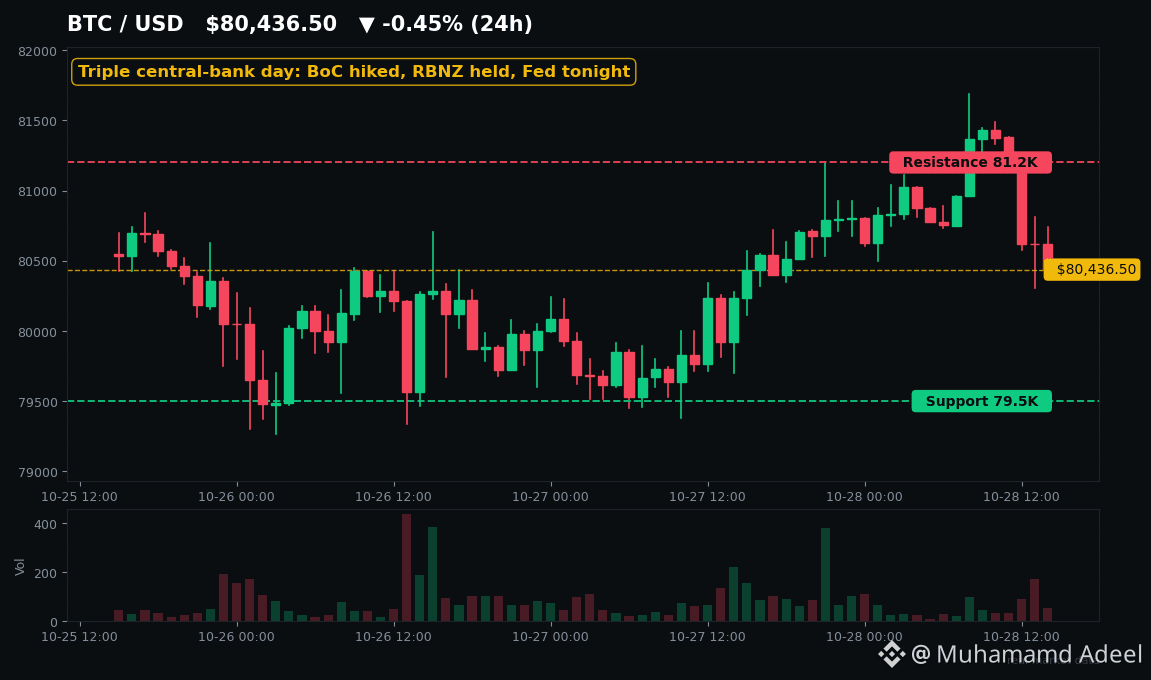
Bitcoin reclaimed above $81,000 this morning, then faded to about $80,435 by early evening (Kraken). Support sits around $79,500, with the recent low near $79,200. Resistance is $81,200 — and above that, the October open at $83,600. A break below $79,200 opens the $75,000–$76,000 zone; a reclaim of $81,200 flips the script. Into Warsh's 11:30pm PKT press conference, check the $BTC chart.
The money, meanwhile, is splitting. US spot Bitcoin ETFs took in $176 million on 27 October — a second straight inflow day, led by BlackRock's IBIT at about $151 million. Ethereum ETFs went the other way, losing $60.2 million the same day. Traders are picking Bitcoin over ETH into the decision — and if $BTC breaks, $ETH usually moves harder.
On-chain, the positioning is defensive, not euphoric. Nearly 15,000 BTC left exchanges on 27 October, the biggest daily outflow in five weeks. But whale holdings fell by roughly $664 million in 24 hours, and Hyperliquid-tracked whales flipped net short on Bitcoin for the first time since March.
Here's what the "boring hold" crowd misses: in 2026, priced-in holds still hurt. Bitcoin fell 6.2% in the 24 hours after January's hold and 5.1% after June's, when hawkish projections did the damage. September's hike, by contrast, rallied — uncertainty cleared. It's never the decision. It's the guidance.
Tonight, watch two things, not the rate itself: how many officials dissent in favour of hiking — three or more signals real tightening urgency — and whether Warsh firms up December or leaves it open. December hike odds sit around 75–84% depending on the source — a long way from settled. And December's meeting lands a day before November's CPI print, so the Fed decides nearly blind on fresh inflation data.
Meanwhile, Treasury Secretary Bessent said yesterday Treasury will push crypto rules via the SEC and CFTC after CLARITY stalled — no rule, no timetable.
So tonight's setup is simple. A hawkish hold — dissent plus firm December language — and a break below $80,000 puts $79,200, then the mid-$70,000s, in play. A data-dependent hold that leaves December open, and a reclaim of $81,200 puts $83,600 back in view. Sentiment is dead neutral at 51 — exactly when one sentence moves everything.
The hold is priced. The press conference isn't.
Not financial advice. DYOR.
Two Central Banks Split Today. Tonight, the Fed Decides Bitcoin's Fate
Two central banks voted today — and they went in opposite directions.
Canada hiked. New Zealand shocked everyone by holding. Tonight at 11pm PKT, the Fed votes — and Bitcoin is parked exactly on the line that decides what happens next.
Canada raised rates by 25 basis points to 2.50% — its first hike since July 2023 — after September inflation hit 3.1%. Hours earlier, New Zealand held at 2.75% in a narrow 4-3 vote, even though traders had priced roughly a 9-in-10 chance of a hike. The Kiwi dollar fell more than 1% on the surprise.
The lesson for tonight? Priced-in expectations mean nothing when the vote lands.
Bitcoin reclaimed above $81,000 this morning, then faded to about $80,435 by early evening (Kraken). Support sits around $79,500, with the recent low near $79,200. Resistance is $81,200 — and above that, the October open at $83,600. A break below $79,200 opens the $75,000–$76,000 zone; a reclaim of $81,200 flips the script. Into Warsh's 11:30pm PKT press conference, check the $BTC chart.
The money, meanwhile, is splitting. US spot Bitcoin ETFs took in $176 million on 27 October — a second straight inflow day, led by BlackRock's IBIT at about $151 million. Ethereum ETFs went the other way, losing $60.2 million the same day. Traders are picking Bitcoin over ETH into the decision — and if $BTC breaks, $ETH usually moves harder.
On-chain, the positioning is defensive, not euphoric. Nearly 15,000 BTC left exchanges on 27 October, the biggest daily outflow in five weeks. But whale holdings fell by roughly $664 million in 24 hours, and Hyperliquid-tracked whales flipped net short on Bitcoin for the first time since March.
Here's what the "boring hold" crowd misses: in 2026, priced-in holds still hurt. Bitcoin fell 6.2% in the 24 hours after January's hold and 5.1% after June's, when hawkish projections did the damage. September's hike, by contrast, rallied — uncertainty cleared. It's never the decision. It's the guidance.
Tonight, watch two things, not the rate itself: how many officials dissent in favour of hiking — three or more signals real tightening urgency — and whether Warsh firms up December or leaves it open. December hike odds sit around 75–84% depending on the source — a long way from settled. And December's meeting lands a day before November's CPI print, so the Fed decides nearly blind on fresh inflation data.
Meanwhile, Treasury Secretary Bessent said yesterday Treasury will push crypto rules via the SEC and CFTC after CLARITY stalled — no rule, no timetable.
So tonight's setup is simple. A hawkish hold — dissent plus firm December language — and a break below $80,000 puts $79,200, then the mid-$70,000s, in play. A data-dependent hold that leaves December open, and a reclaim of $81,200 puts $83,600 back in view. Sentiment is dead neutral at 51 — exactly when one sentence moves everything.
The hold is priced. The press conference isn't.
Not financial advice. DYOR.
Статья
Ondo Just Put Nvidia & Tesla on Robinhood Chain — While $ONDO Sits at $0.42You can now buy Nvidia on Robinhood Chain — and trade it against the exact same stock issued by someone else.
That sounds like a small technical detail. It is actually the moment tokenized stocks stopped being a press release and started being a market.
On 27 October, Ondo bridged 15 tokenized stocks and ETFs — Nvidia, Apple, Tesla, Meta, Alphabet, SpaceX, Strategy, Circle, GameStop, plus the S&P 500 and Nasdaq-100 ETFs — onto Robinhood Chain. Eleven of them now sit in new Uniswap v4 StablePair pools, paired directly against Robinhood's own Stock Tokens for the same underlying share.
Two issuers. Same stock. One pool. Traders can swap between the two versions, liquidity providers earn the fees, and any price gap becomes an arbitrage trade. Add 24/7 Ondo mint and redeem — including weekends, when Robinhood's window is closed — and you have something tokenized stocks never really had: a live, always-on liquidity loop.
Issuance was never the hard part. Anybody can mint a token and call it a stock. What was missing was a reason for two different versions of the same asset to trade against each other, in size, around the clock. Ondo just built that reason.
And it is not happening in isolation. On 28 October, Securitize — the firm behind BlackRock's BUIDL — added Stellar to its institutional tokenization network, citing built-in compliance tools like KYC, sanctions screening and asset clawbacks. Wall Street's backbone, DTCC, also went live with its tokenization service today. Institutions are not debating tokenization anymore. They are wiring it in.
So here is the uncomfortable question: if all of this is shipping, why is the token at the centre of it still sitting near $0.42?
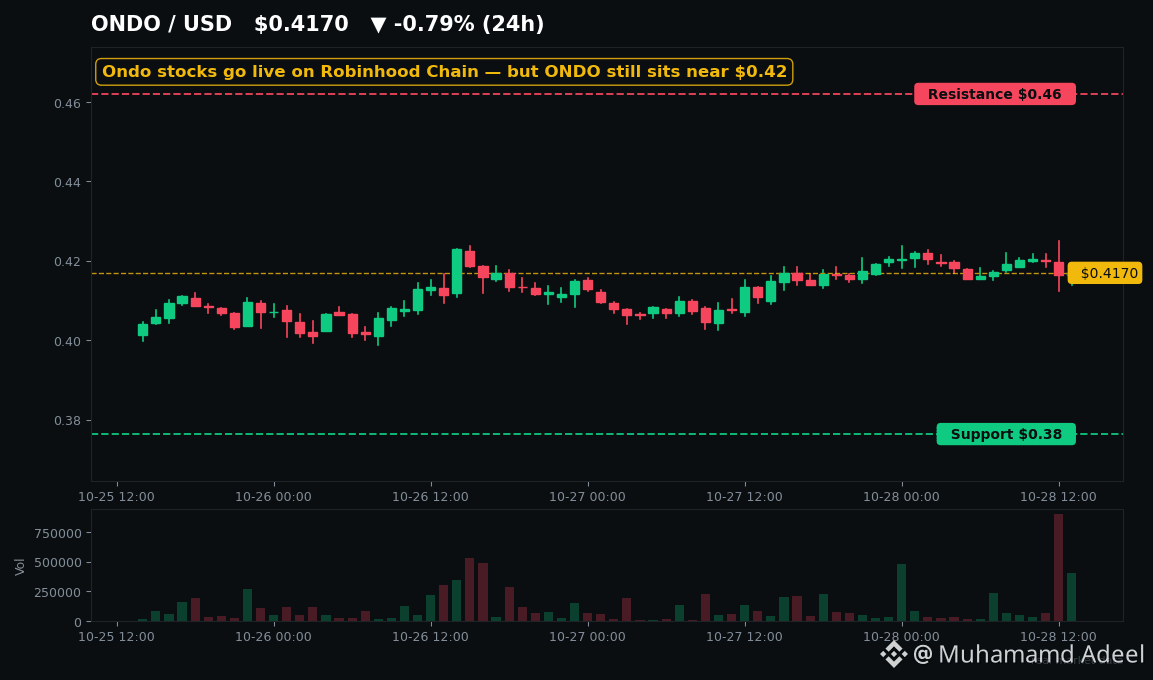
$ONDO is trading around $0.42, roughly flat on the day and still about 9% down on the week. The honest setup is a bounce inside a range, not a breakout. Support sits near $0.38, with resistance near $0.46. A break above $0.46 would signal buyers finally backing the news with real money; a slip below $0.38 would say the market still does not believe the story yet. Pull up $ONDO's chart and watch which of those two lines breaks first — that is the line that decides the next leg.
The pipes tell the same story. Chainlink launched CustodySync with Anchorage Digital on 26 October, connecting a qualified custodian's collateral system to onchain lending, and $LINK is trading near $11.75, above roughly $11.66 support with resistance near $12.20. Real usage shipping, price still waiting for proof.
Let us also be honest about scale, because the big numbers get abused. Distributed, actually-tradable tokenized real-world assets sit near $39 billion (RWA.xyz, October 2026). You will see a $400 billion figure floating around — but that counts assets merely recorded on blockchains. Only about $39 billion of it is genuinely circulating. The gap between those two numbers is the gap between the pitch and the product.
The risks are just as real. Nine companies have already objected to the OKX-ICE tokenized-stock venue, and a Wall Street Journal ad this week urged S&P 500 CEOs to use the SEC's 30-day opt-out to block tokenization of their shares. ONDO itself is a governance token — it gives holders no shareholder rights or dividends. And Ondo's request for SEC no-action relief is exactly that: a request, not an approval. We have seen this movie before — Binance's tokenized stocks in 2021 lasted about three months before regulators shut them down.
So here is my take. Tokenized stocks just grew up a little: two issuers, one pool, 24/7 trading. But the trade is not "RWA grows, therefore the token moons." It is watching whether real volume follows real infrastructure — starting with whether $ONDO breaks $0.46, or fades back to $0.38 first.
Not financial advice. DYOR.
Ondo Just Put Nvidia & Tesla on Robinhood Chain — While $ONDO Sits at $0.42
You can now buy Nvidia on Robinhood Chain — and trade it against the exact same stock issued by someone else.
That sounds like a small technical detail. It is actually the moment tokenized stocks stopped being a press release and started being a market.
On 27 October, Ondo bridged 15 tokenized stocks and ETFs — Nvidia, Apple, Tesla, Meta, Alphabet, SpaceX, Strategy, Circle, GameStop, plus the S&P 500 and Nasdaq-100 ETFs — onto Robinhood Chain. Eleven of them now sit in new Uniswap v4 StablePair pools, paired directly against Robinhood's own Stock Tokens for the same underlying share.
Two issuers. Same stock. One pool. Traders can swap between the two versions, liquidity providers earn the fees, and any price gap becomes an arbitrage trade. Add 24/7 Ondo mint and redeem — including weekends, when Robinhood's window is closed — and you have something tokenized stocks never really had: a live, always-on liquidity loop.
Issuance was never the hard part. Anybody can mint a token and call it a stock. What was missing was a reason for two different versions of the same asset to trade against each other, in size, around the clock. Ondo just built that reason.
And it is not happening in isolation. On 28 October, Securitize — the firm behind BlackRock's BUIDL — added Stellar to its institutional tokenization network, citing built-in compliance tools like KYC, sanctions screening and asset clawbacks. Wall Street's backbone, DTCC, also went live with its tokenization service today. Institutions are not debating tokenization anymore. They are wiring it in.
So here is the uncomfortable question: if all of this is shipping, why is the token at the centre of it still sitting near $0.42?
$ONDO is trading around $0.42, roughly flat on the day and still about 9% down on the week. The honest setup is a bounce inside a range, not a breakout. Support sits near $0.38, with resistance near $0.46. A break above $0.46 would signal buyers finally backing the news with real money; a slip below $0.38 would say the market still does not believe the story yet. Pull up $ONDO 's chart and watch which of those two lines breaks first — that is the line that decides the next leg.
The pipes tell the same story. Chainlink launched CustodySync with Anchorage Digital on 26 October, connecting a qualified custodian's collateral system to onchain lending, and $LINK is trading near $11.75, above roughly $11.66 support with resistance near $12.20. Real usage shipping, price still waiting for proof.
Let us also be honest about scale, because the big numbers get abused. Distributed, actually-tradable tokenized real-world assets sit near $39 billion (RWA.xyz, October 2026). You will see a $400 billion figure floating around — but that counts assets merely recorded on blockchains. Only about $39 billion of it is genuinely circulating. The gap between those two numbers is the gap between the pitch and the product.
The risks are just as real. Nine companies have already objected to the OKX-ICE tokenized-stock venue, and a Wall Street Journal ad this week urged S&P 500 CEOs to use the SEC's 30-day opt-out to block tokenization of their shares. ONDO itself is a governance token — it gives holders no shareholder rights or dividends. And Ondo's request for SEC no-action relief is exactly that: a request, not an approval. We have seen this movie before — Binance's tokenized stocks in 2021 lasted about three months before regulators shut them down.
So here is my take. Tokenized stocks just grew up a little: two issuers, one pool, 24/7 trading. But the trade is not "RWA grows, therefore the token moons." It is watching whether real volume follows real infrastructure — starting with whether $ONDO breaks $0.46, or fades back to $0.38 first.
Not financial advice. DYOR.
2
Статья
5 Tokenized Stocks Just Went Live on Binance — Hours Before the Fed DecidesBinance just put five more Wall Street names on crypto rails — hours before the Fed decides.
The five new bStocks went live on Binance Spot at 17:00 PKT today: AppLovin (APPB), Bending Spoons (BSPB), GE Vernova (GEVB), and a leveraged long/short pair on SK Hynix — GraniteShares 2x Long (SKUUB) and 2x Short (SKDDB) Daily ETFs. All five trade against $USDT, with spot algo bots enabled and Convert access opening within an hour of launch at no conversion fee.
The timing is the story. SK Hynix shares jumped 10.89% in Seoul today to 1,487,000 won after record third-quarter results — revenue of 104.62 trillion won and operating profit of 83.33 trillion won, both all-time highs — plus a shareholder-return plan worth roughly 100 trillion won. So the leveraged pair lists on the exact day its underlying ripped — which is also the warning: SKUUB and SKDDB reset their 2x leverage every single day. Hold them for a week of choppy trading and the maths works against you, even if SK Hynix ends up roughly flat. They are day-trading tools, not buy-and-hold exposure.
The other names tell a different story. AppLovin closed Tuesday at $262.82, near its 52-week low and down roughly 61% this year — a beaten-down momentum name now tradeable with $USDT around the clock. GE Vernova went the other way, up 4.7% on Tuesday to $895.08. Bending Spoons is the curiosity of the batch, a recent tech listing most crypto traders have never touched.
Here is what you are actually buying, because the distinction matters. A bStock is a BEP-20 token on $BNB Chain that tracks the underlying share or ETF, backed 1:1 by shares held in custody according to Binance. It is not the share itself. You get price exposure, fractional size, and 24/7 trading — but no voting rights, no direct ownership, and dividends come back as more tokens, not cash. Binance says the program passed $1 billion in assets within about four months of its June launch — but the IMF's October report found tokenized stocks run about 1.5x as volatile as the shares underneath, drifting furthest from the real stock when the underlying market is closed.
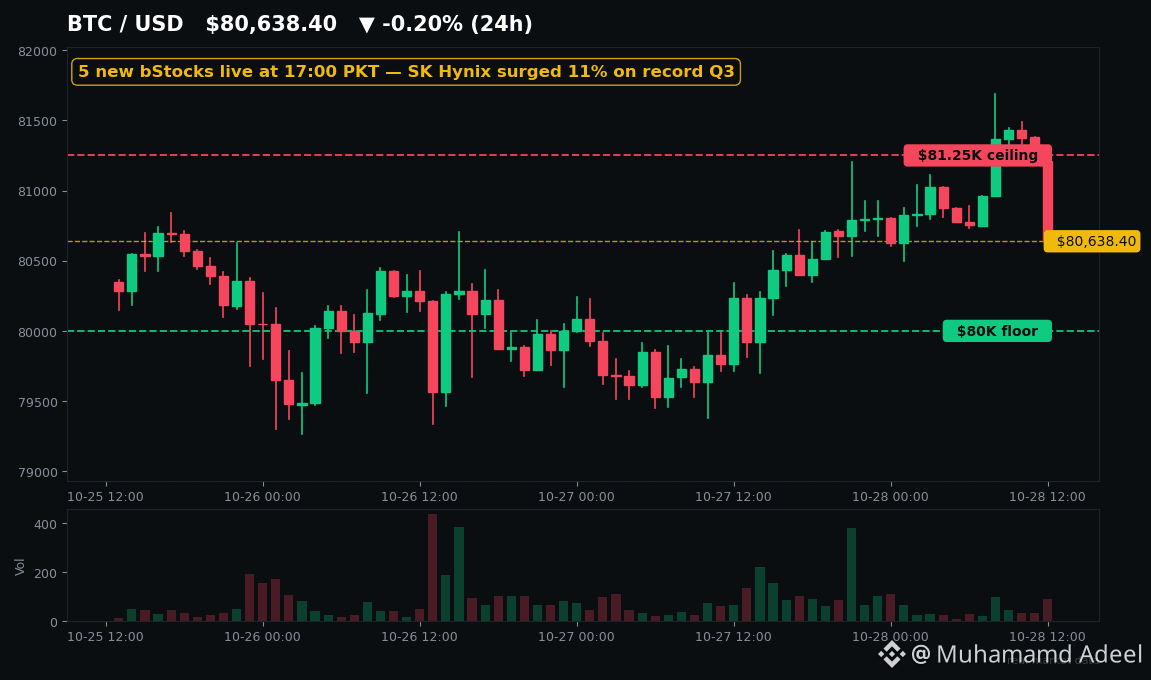
That matters tonight: Seoul is closed, and the FOMC decision lands at 23:00 PKT, with a hold widely expected and the December signal doing the real damage. Bitcoin is holding just above $80,000 into that decision — $80,638 live, with $80K as the floor and $81.25K as the ceiling. If the Fed surprises, every one of these new tokens reprices in the same volatility window.
So here is the honest take: this is not a listing-day pop story — bStocks track their underlyings, they do not moon on their own. The trade is the access itself: Wall Street names, in USDT, tradeable while Wall Street sleeps, on a night the Fed could move everything. Watch $APPB's first prints tonight and judge the launch by spreads and tracking, not hype. And the SK Hynix pair cuts both ways, twice as fast.
Not financial advice. DYOR.
5 Tokenized Stocks Just Went Live on Binance — Hours Before the Fed Decides
Binance just put five more Wall Street names on crypto rails — hours before the Fed decides.
The five new bStocks went live on Binance Spot at 17:00 PKT today: AppLovin (APPB), Bending Spoons (BSPB), GE Vernova (GEVB), and a leveraged long/short pair on SK Hynix — GraniteShares 2x Long (SKUUB) and 2x Short (SKDDB) Daily ETFs. All five trade against $USDT, with spot algo bots enabled and Convert access opening within an hour of launch at no conversion fee.
The timing is the story. SK Hynix shares jumped 10.89% in Seoul today to 1,487,000 won after record third-quarter results — revenue of 104.62 trillion won and operating profit of 83.33 trillion won, both all-time highs — plus a shareholder-return plan worth roughly 100 trillion won. So the leveraged pair lists on the exact day its underlying ripped — which is also the warning: SKUUB and SKDDB reset their 2x leverage every single day. Hold them for a week of choppy trading and the maths works against you, even if SK Hynix ends up roughly flat. They are day-trading tools, not buy-and-hold exposure.
The other names tell a different story. AppLovin closed Tuesday at $262.82, near its 52-week low and down roughly 61% this year — a beaten-down momentum name now tradeable with $USDT around the clock. GE Vernova went the other way, up 4.7% on Tuesday to $895.08. Bending Spoons is the curiosity of the batch, a recent tech listing most crypto traders have never touched.
Here is what you are actually buying, because the distinction matters. A bStock is a BEP-20 token on $BNB Chain that tracks the underlying share or ETF, backed 1:1 by shares held in custody according to Binance. It is not the share itself. You get price exposure, fractional size, and 24/7 trading — but no voting rights, no direct ownership, and dividends come back as more tokens, not cash. Binance says the program passed $1 billion in assets within about four months of its June launch — but the IMF's October report found tokenized stocks run about 1.5x as volatile as the shares underneath, drifting furthest from the real stock when the underlying market is closed.
That matters tonight: Seoul is closed, and the FOMC decision lands at 23:00 PKT, with a hold widely expected and the December signal doing the real damage. Bitcoin is holding just above $80,000 into that decision — $80,638 live, with $80K as the floor and $81.25K as the ceiling. If the Fed surprises, every one of these new tokens reprices in the same volatility window.
So here is the honest take: this is not a listing-day pop story — bStocks track their underlyings, they do not moon on their own. The trade is the access itself: Wall Street names, in USDT, tradeable while Wall Street sleeps, on a night the Fed could move everything. Watch $APPB 's first prints tonight and judge the launch by spreads and tracking, not hype. And the SK Hynix pair cuts both ways, twice as fast.
Not financial advice. DYOR.
Статья
ETH staking just hit a record — and tonight's FOMC could light the fuse44 million ETH are now locked in staking. A record — over 36% of all ETH in existence.
And yet the price is sitting near $2,350, down about 12% in a month. So why are holders locking up MORE, hours before the biggest macro event of the month?
Because something just flipped under the surface. And tonight's Fed decision is the spark.
**The queue flip nobody is talking about**
In late October, roughly 1.27 million ETH were queued up waiting to ENTER staking — against only about 3,500 ETH queued to exit. That's not a typo. Three weeks earlier, the exit queue was 850,000 ETH long after a validator scare sent stakers rushing for the door.
That overhang is gone. Bitwise's Q4 report put total staked ETH at a record 43.8 million (35.9% of supply), with nearly 2 million ETH flowing in during Q3 alone — the sixth straight quarter of growth.
Translation: the people who already own ETH aren't selling it. They're locking it away.
**But here's the uncomfortable part**
Staking locks supply. It doesn't create demand. And demand is the hole in this story.
Spot ETH ETFs have bled roughly $1.18 billion in October — their worst month of 2026 — even as Bitcoin ETFs pulled in money on the same days. BitMine, the biggest ETH treasury, now holds 6.05 million ETH with 86% of it staked, and it's nearly at its self-imposed 5% of supply cap. So the obvious question: who buys once the biggest buyer stops?
Meanwhile $ETH is still losing the war that matters most. The ETH/BTC ratio sits near 0.029, close to the low end of its range, and $BTC dominance is near 58–60%. Staking is absorbing supply, but relative strength hasn't followed — yet.
**Tonight decides which side blinks**
The Fed announces at 11pm PKT tonight, with a hold at 3.75–4.00% widely expected. The decision itself is mostly priced in. What isn't priced in is the tone — specifically, what it signals about December.
History says that's exactly what moves ETH. Priced-in decisions have produced muted reactions; hawkish guidance has repeatedly knocked ETH down harder than BTC.
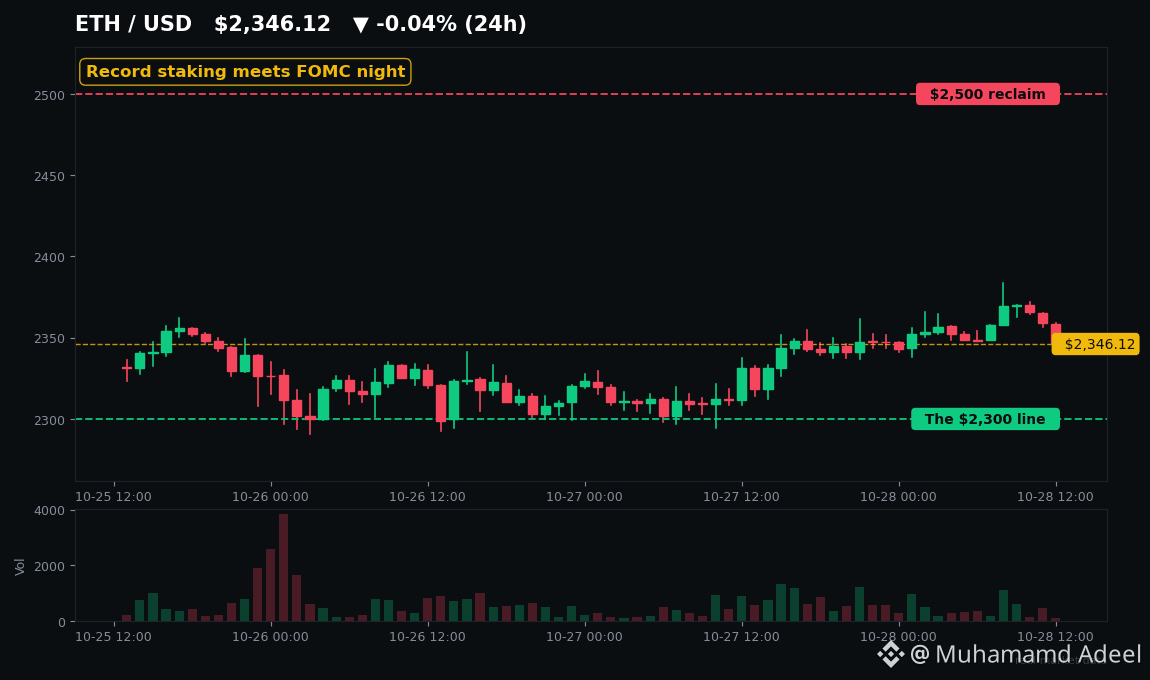
So here's what I'm watching — check the $ETH chart before the announcement, because this is where it gets decided:
If $2,300 holds (the 27 October low was $2,297) and the guidance leans soft, the reclaim target traders keep citing is $2,500. If a hawkish tone breaks $2,300, the next zone to watch is $2,240–$2,280, with $2,150 flagged by QCP Capital below that.
One honest warning: staked ETH isn't gone forever. With the exit queue now near-empty, unstaking is fast — if support breaks after the press conference, a fresh exit wave could build quickly. And staking yield has already compressed to 2.63% from 2.81%.
Record staking. Record ETF outflows. Both true at the same time. Tonight tells us which one the market believes.
Does record staking matter if ETH/BTC keeps falling? Tell me in the comments.
Not financial advice. DYOR.
ETH staking just hit a record — and tonight's FOMC could light the fuse
44 million ETH are now locked in staking. A record — over 36% of all ETH in existence.
And yet the price is sitting near $2,350, down about 12% in a month. So why are holders locking up MORE, hours before the biggest macro event of the month?
Because something just flipped under the surface. And tonight's Fed decision is the spark.
**The queue flip nobody is talking about**
In late October, roughly 1.27 million ETH were queued up waiting to ENTER staking — against only about 3,500 ETH queued to exit. That's not a typo. Three weeks earlier, the exit queue was 850,000 ETH long after a validator scare sent stakers rushing for the door.
That overhang is gone. Bitwise's Q4 report put total staked ETH at a record 43.8 million (35.9% of supply), with nearly 2 million ETH flowing in during Q3 alone — the sixth straight quarter of growth.
Translation: the people who already own ETH aren't selling it. They're locking it away.
**But here's the uncomfortable part**
Staking locks supply. It doesn't create demand. And demand is the hole in this story.
Spot ETH ETFs have bled roughly $1.18 billion in October — their worst month of 2026 — even as Bitcoin ETFs pulled in money on the same days. BitMine, the biggest ETH treasury, now holds 6.05 million ETH with 86% of it staked, and it's nearly at its self-imposed 5% of supply cap. So the obvious question: who buys once the biggest buyer stops?
Meanwhile $ETH is still losing the war that matters most. The ETH/BTC ratio sits near 0.029, close to the low end of its range, and $BTC dominance is near 58–60%. Staking is absorbing supply, but relative strength hasn't followed — yet.
**Tonight decides which side blinks**
The Fed announces at 11pm PKT tonight, with a hold at 3.75–4.00% widely expected. The decision itself is mostly priced in. What isn't priced in is the tone — specifically, what it signals about December.
History says that's exactly what moves ETH. Priced-in decisions have produced muted reactions; hawkish guidance has repeatedly knocked ETH down harder than BTC.
So here's what I'm watching — check the $ETH chart before the announcement, because this is where it gets decided:
If $2,300 holds (the 27 October low was $2,297) and the guidance leans soft, the reclaim target traders keep citing is $2,500. If a hawkish tone breaks $2,300, the next zone to watch is $2,240–$2,280, with $2,150 flagged by QCP Capital below that.
One honest warning: staked ETH isn't gone forever. With the exit queue now near-empty, unstaking is fast — if support breaks after the press conference, a fresh exit wave could build quickly. And staking yield has already compressed to 2.63% from 2.81%.
Record staking. Record ETF outflows. Both true at the same time. Tonight tells us which one the market believes.
Does record staking matter if ETH/BTC keeps falling? Tell me in the comments.
Not financial advice. DYOR.
Статья
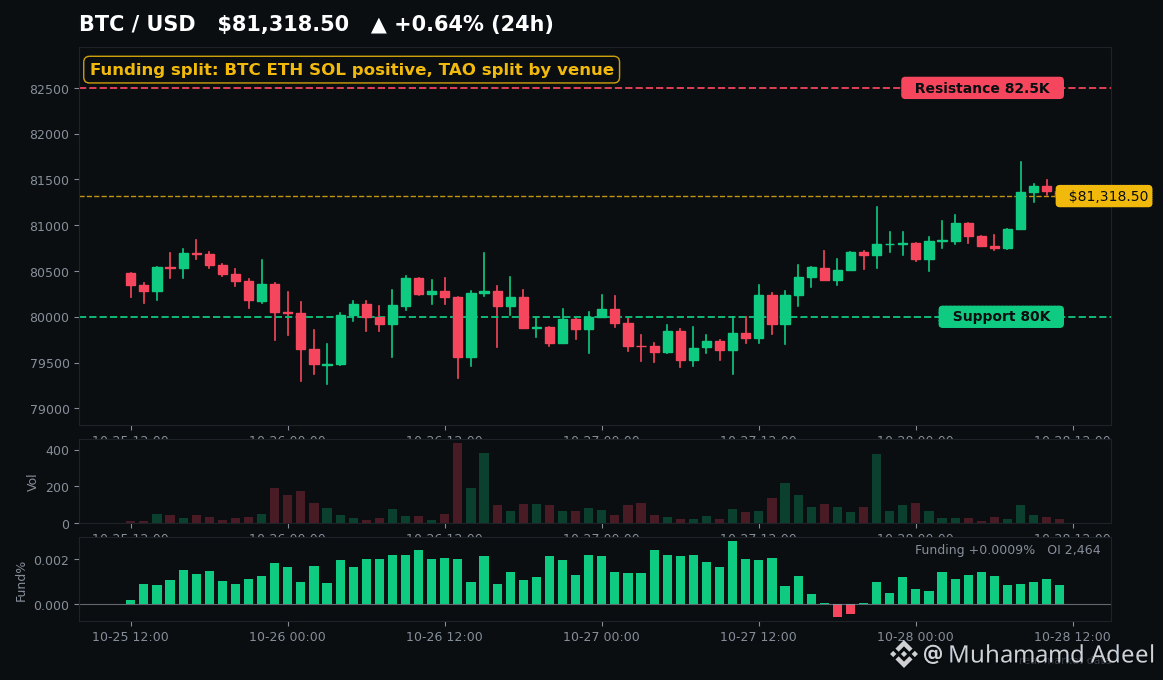
All Green Into the Fed — But Funding Split. That's the TellEverything bounced into the Fed tonight. But funding didn't move together — and that split is the tell.
Look at the board with me. $BTC reclaimed roughly $81K, $ETH sits near $2,360, SOL near $103, and HYPE is up about 4% on the day. All green. Not all green the same way — and that's what you should be watching hours before the decision lands tonight at 11 p.m. PKT, with about a 90% chance of a hold at 3.75%-4.00% already priced in.
Here's the split. Perpetual funding stayed positive for BTC, ETH and SOL — BTC around +0.0082% per 8 hours on an open-interest-weighted basis, with 18 of 19 exchanges positive. SOL's aggregated funding sits near 8.28% annualised with open interest around $4.9B, up 1.3% in 24 hours. No euphoria here — longs are paying to stay long, but nobody is piling in.
Then there's TAO — the one genuine funding split of the day. On Binance, MEXC, Bybit and OKX, TAO funding went negative, with OKX as low as -0.0187% per 8 hours. On Hyperliquid it printed capped-positive at +0.0100%. Same coin, opposite payments, depending on where you stand. Check $SOL's chart against TAO's funding board and you'll see it: the majors agree, the outlier doesn't.
BTC's own open interest tells two stories at once. On Binance it was near-flat, down just 0.18% in 24 hours. Across all exchanges it rose 1.1% to about $54.93B. Spot agrees: a preliminary read showed about 12,570 BTC leaving exchanges on 27 October, while US spot ETFs took in $176M into BTC — against $60.2M out of ETH and $19.2M out of SOL.
The liquidations back it up. In the 24 hours to early 28 October, about $149M was liquidated (Coinglass) — and shorts took roughly twice the damage of longs, $99.9M against $48.6M. One hour on 27 October squeezed $14.82M of ETH shorts against just $10K of longs.
Why does this matter? History says guidance, not the rate itself, decides what happens next. In September 2024 a dovish cut saw altcoins beat BTC, up 5.68% against 4.4%. In December 2024 a hawkish cut saw them fall harder, SOL down 7% while BTC fell 5.4%. And in October 2025 a calm BTC still flushed $700M+ around a priced-in meeting.
So here is what I'm watching. If $BTC holds $80K into the announcement and reclaims $82.5K, the squeeze case strengthens — shorts already bled $99.9M before the event. If $80K breaks, the $75K zone is the next conversation, and alts historically fall further than BTC on a hawkish surprise. One caution before you size anything up: HYPE just unlocked 12M tokens today, roughly $330M of dilution, even as its price bounced — and its funding flips sign by venue, so don't trust a single HYPE funding print. This snapshot also goes stale fast, with GDP and PCE data landing on 29 October.
The Fed hasn't spoken yet. But futures already told you the secret: everything rose, nobody agreed how. Watch the funding split tonight.
Not financial advice. DYOR.
All Green Into the Fed — But Funding Split. That's the Tell
Everything bounced into the Fed tonight. But funding didn't move together — and that split is the tell.
Look at the board with me. $BTC reclaimed roughly $81K, $ETH sits near $2,360, SOL near $103, and HYPE is up about 4% on the day. All green. Not all green the same way — and that's what you should be watching hours before the decision lands tonight at 11 p.m. PKT, with about a 90% chance of a hold at 3.75%-4.00% already priced in.
Here's the split. Perpetual funding stayed positive for BTC, ETH and SOL — BTC around +0.0082% per 8 hours on an open-interest-weighted basis, with 18 of 19 exchanges positive. SOL's aggregated funding sits near 8.28% annualised with open interest around $4.9B, up 1.3% in 24 hours. No euphoria here — longs are paying to stay long, but nobody is piling in.
Then there's TAO — the one genuine funding split of the day. On Binance, MEXC, Bybit and OKX, TAO funding went negative, with OKX as low as -0.0187% per 8 hours. On Hyperliquid it printed capped-positive at +0.0100%. Same coin, opposite payments, depending on where you stand. Check $SOL 's chart against TAO's funding board and you'll see it: the majors agree, the outlier doesn't.
BTC's own open interest tells two stories at once. On Binance it was near-flat, down just 0.18% in 24 hours. Across all exchanges it rose 1.1% to about $54.93B. Spot agrees: a preliminary read showed about 12,570 BTC leaving exchanges on 27 October, while US spot ETFs took in $176M into BTC — against $60.2M out of ETH and $19.2M out of SOL.
The liquidations back it up. In the 24 hours to early 28 October, about $149M was liquidated (Coinglass) — and shorts took roughly twice the damage of longs, $99.9M against $48.6M. One hour on 27 October squeezed $14.82M of ETH shorts against just $10K of longs.
Why does this matter? History says guidance, not the rate itself, decides what happens next. In September 2024 a dovish cut saw altcoins beat BTC, up 5.68% against 4.4%. In December 2024 a hawkish cut saw them fall harder, SOL down 7% while BTC fell 5.4%. And in October 2025 a calm BTC still flushed $700M+ around a priced-in meeting.
So here is what I'm watching. If $BTC holds $80K into the announcement and reclaims $82.5K, the squeeze case strengthens — shorts already bled $99.9M before the event. If $80K breaks, the $75K zone is the next conversation, and alts historically fall further than BTC on a hawkish surprise. One caution before you size anything up: HYPE just unlocked 12M tokens today, roughly $330M of dilution, even as its price bounced — and its funding flips sign by venue, so don't trust a single HYPE funding print. This snapshot also goes stale fast, with GDP and PCE data landing on 29 October.
The Fed hasn't spoken yet. But futures already told you the secret: everything rose, nobody agreed how. Watch the funding split tonight.
Not financial advice. DYOR.
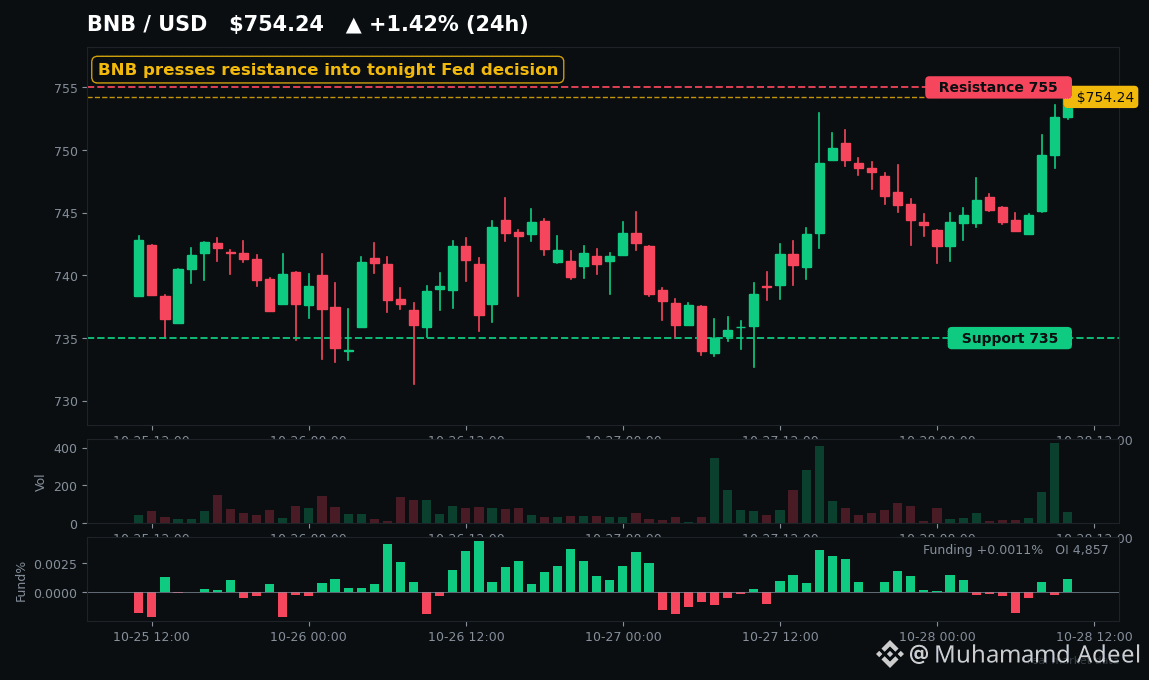
Статья
BNB at $754 on Decision Day: Fed Tonight, Jenner Testnet TonightBNB is walking into decision day at $754 — and it is carrying two triggers at once. Tonight the Fed decides, and BNB Chain's Jenner upgrade is due on testnet. Price is parked right on the line that will decide what happens next.
First, Jenner — in plain English. Slated for BNB Chain's testnet today, it reserves 5% of each block's gas for payments by default (governance can raise it to 10%), adds millisecond timestamps, and lays the groundwork for CAS20, a compliant standard for stablecoins and tokenized assets. But be precise: this is testnet, not mainnet, the mainnet date is still to be announced, and CAS20's controls need separate activation. History says don't expect a testnet pop — past upgrades mostly chopped sideways on the day itself.
Why it still matters: BNB Chain is already the RWA chain in practice. Non-stablecoin RWA supply hit $4.96 billion in Q3, up 24%, and Binance is adding five new tokenized-stock pairs today. Jenner is the plumbing for that business: payments that get through in congestion. The chain's own numbers tell a split story: Q3 revenue jumped 54% to $54.2 million while average daily active addresses fell 14% to 2.10 million. More money per user, fewer users.
Now the levels that matter. $BNB is pressing $755 resistance, with $765 above it. Below, $739 is the first support, then $735, then $724 if selling accelerates. TradingKey's 27 October take put $800 in view if the $750-$760 zone breaks on volume — but only with a Fed hold behind it. A break above $755 on volume changes the conversation; a loss of $739 flips it back to a range trade. Check $BNB's chart against those two lines tonight — that is where the decision will be read first.
Because the Fed is the wild card. The decision lands at 2pm ET, with Chair Warsh speaking at 2:30pm, and a hold at 3.75-4.00% is widely expected — already priced in. So the trade is Warsh's tone and any signal about December. Last December proved the point: a fully priced-in decision still knocked BNB down 2.9% in a day once guidance turned hawkish. With $BTC back above $80K and Fear & Greed at a neutral 51, the market is positioned to react, not celebrate.
The honest risks: the DOJ is still reviewing Binance's 2023 settlement — no new charges, no finding of a breach, but no timetable. Funding is near-neutral, so leverage is not overheated, yet 72% of Binance accounts are net long, so a hawkish surprise would hit a long-skewed book. And Jenner changes nothing on mainnet today. Buying the headline, you are early; watching the plumbing, you are on time.
So here is my take: BNB is caught between two catalysts — a testnet upgrade building for the RWA future, and a Fed decision tonight that decides whether risk gets rewarded at all. Watch $755 above and $739 below; whichever breaks first tells you which story the market believes. Watch $BNB's chart into tonight's announcement and decide for yourself.
Not financial advice. DYOR.
BNB at $754 on Decision Day: Fed Tonight, Jenner Testnet Tonight
BNB is walking into decision day at $754 — and it is carrying two triggers at once. Tonight the Fed decides, and BNB Chain's Jenner upgrade is due on testnet. Price is parked right on the line that will decide what happens next.
First, Jenner — in plain English. Slated for BNB Chain's testnet today, it reserves 5% of each block's gas for payments by default (governance can raise it to 10%), adds millisecond timestamps, and lays the groundwork for CAS20, a compliant standard for stablecoins and tokenized assets. But be precise: this is testnet, not mainnet, the mainnet date is still to be announced, and CAS20's controls need separate activation. History says don't expect a testnet pop — past upgrades mostly chopped sideways on the day itself.
Why it still matters: BNB Chain is already the RWA chain in practice. Non-stablecoin RWA supply hit $4.96 billion in Q3, up 24%, and Binance is adding five new tokenized-stock pairs today. Jenner is the plumbing for that business: payments that get through in congestion. The chain's own numbers tell a split story: Q3 revenue jumped 54% to $54.2 million while average daily active addresses fell 14% to 2.10 million. More money per user, fewer users.
Now the levels that matter. $BNB is pressing $755 resistance, with $765 above it. Below, $739 is the first support, then $735, then $724 if selling accelerates. TradingKey's 27 October take put $800 in view if the $750-$760 zone breaks on volume — but only with a Fed hold behind it. A break above $755 on volume changes the conversation; a loss of $739 flips it back to a range trade. Check $BNB 's chart against those two lines tonight — that is where the decision will be read first.
Because the Fed is the wild card. The decision lands at 2pm ET, with Chair Warsh speaking at 2:30pm, and a hold at 3.75-4.00% is widely expected — already priced in. So the trade is Warsh's tone and any signal about December. Last December proved the point: a fully priced-in decision still knocked BNB down 2.9% in a day once guidance turned hawkish. With $BTC back above $80K and Fear & Greed at a neutral 51, the market is positioned to react, not celebrate.
The honest risks: the DOJ is still reviewing Binance's 2023 settlement — no new charges, no finding of a breach, but no timetable. Funding is near-neutral, so leverage is not overheated, yet 72% of Binance accounts are net long, so a hawkish surprise would hit a long-skewed book. And Jenner changes nothing on mainnet today. Buying the headline, you are early; watching the plumbing, you are on time.
So here is my take: BNB is caught between two catalysts — a testnet upgrade building for the RWA future, and a Fed decision tonight that decides whether risk gets rewarded at all. Watch $755 above and $739 below; whichever breaks first tells you which story the market believes. Watch $BNB 's chart into tonight's announcement and decide for yourself.
Not financial advice. DYOR.
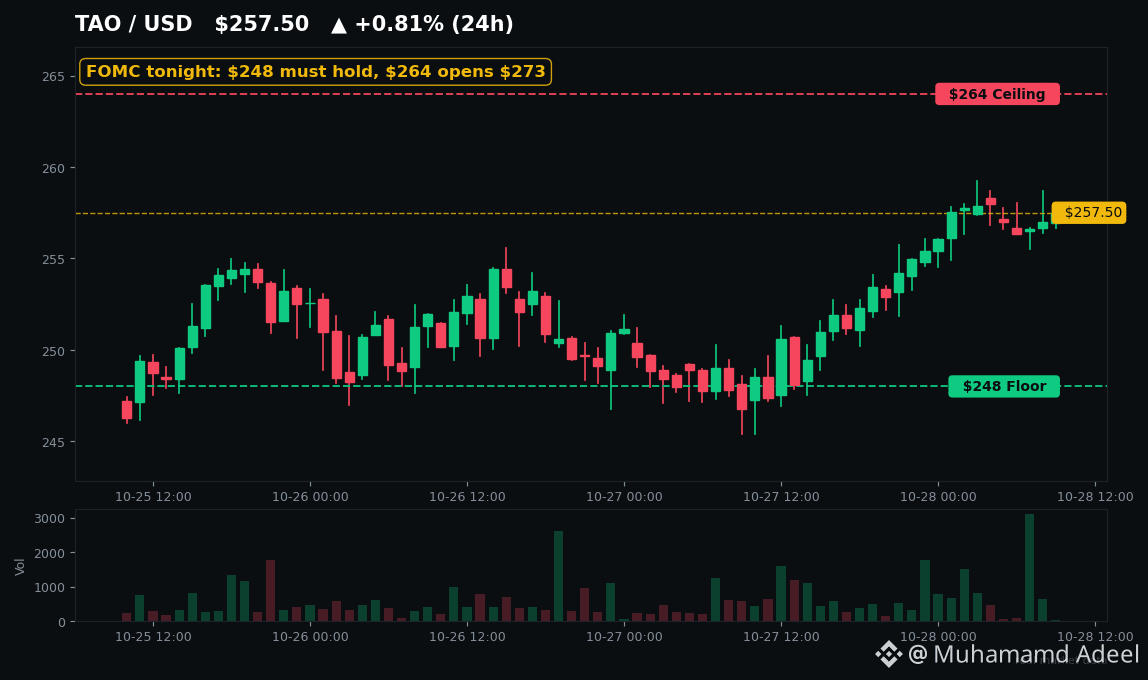
Статья
TAO Is the Loudest AI Token Today — But Its Chart Isn't Buying It YetTAO is the loudest AI token on crypto Twitter today — and that's exactly why you should check its chart before you believe the noise.
$TAO is trading around $257, a few percent higher on the day. Sounds like a comeback. It isn't — not yet. It's still down roughly 5-6% on the week, about 16% on the month, and roughly 66% below its April 2024 all-time high near $760-770. This is a bounce inside a downtrend, walking straight into tonight's Fed decision.
So why is everyone talking about it? One post lit the match. On 27 October, investor Jason Calacanis said he is long TAO and loves "Bittensor's focus on scaling AI" — in the same breath as calling for a brutal year for Bitcoin and a possible retest of $57,000. That's one investor's thesis, not a catalyst. Stocktwits sentiment still flipped "extremely bearish" as message volume jumped 60%+ in a week. Attention is up. Mood is not.
The quieter story matters more. Grayscale took a real step on 23 October, filing Amendment No. 2 to its S-1 to seek a NYSE Arca listing for its Bittensor Trust under the ticker GTAO. A filing step, not an approval — no launch date, and the trust currently cannot stake TAO.
On-chain, the picture is two-sided. One money-flow read has large holders accumulating since early September at the strongest pace since TAO's Binance listing. But in the last few days, exchange inflows have started to exceed outflows — coins moving toward exchanges, usually read as a pre-sale step. Futures open interest near $392-400M, funding near flat. eTAO went live 20 Oct, letting subnet owners adjust emission splits weekly.
Here's what this really means: TAO is a base-building story, not a breakout story. A year ago subnet demand pushed TAO past $450; today it sits near $250-257, closer to base than breakout.
Levels to watch on $TAO's chart: $245-248 is the floor that has to hold. A daily close below it opens the September low near $215, with $190 underneath. Above, $261-264 is the first ceiling, then $273 — where buyers were rejected on 21 October. A close above $264 opens $273; a close below $248 changes the whole conversation.
Now the honest risks. One analysis puts subnet customer revenue near $30 million a year against $300 million+ in yearly emissions, with ~3,600 new TAO minted daily. And the AI-spending scare is fresh: Anthropic's S-1 on 26 October disclosed an $80.7 billion first-half net loss, and AI tokens slid that day — $NEAR fell 1.5%, $FET slipped 0.5% — while Bitcoin stayed near flat. Tonight's Fed decision (~23:00 PKT, hold ~90% priced) can override all of it either way. Ignore recycled March Nvidia praise as fresh news.
The take? TAO has the narrative, the paperwork, and the accumulation — but not the trend yet. Watch $248 and $264 tonight. Check $TAO's chart — which side are you on?
Not financial advice. DYOR.
TAO Is the Loudest AI Token Today — But Its Chart Isn't Buying It Yet
TAO is the loudest AI token on crypto Twitter today — and that's exactly why you should check its chart before you believe the noise.
$TAO is trading around $257, a few percent higher on the day. Sounds like a comeback. It isn't — not yet. It's still down roughly 5-6% on the week, about 16% on the month, and roughly 66% below its April 2024 all-time high near $760-770. This is a bounce inside a downtrend, walking straight into tonight's Fed decision.
So why is everyone talking about it? One post lit the match. On 27 October, investor Jason Calacanis said he is long TAO and loves "Bittensor's focus on scaling AI" — in the same breath as calling for a brutal year for Bitcoin and a possible retest of $57,000. That's one investor's thesis, not a catalyst. Stocktwits sentiment still flipped "extremely bearish" as message volume jumped 60%+ in a week. Attention is up. Mood is not.
The quieter story matters more. Grayscale took a real step on 23 October, filing Amendment No. 2 to its S-1 to seek a NYSE Arca listing for its Bittensor Trust under the ticker GTAO. A filing step, not an approval — no launch date, and the trust currently cannot stake TAO.
On-chain, the picture is two-sided. One money-flow read has large holders accumulating since early September at the strongest pace since TAO's Binance listing. But in the last few days, exchange inflows have started to exceed outflows — coins moving toward exchanges, usually read as a pre-sale step. Futures open interest near $392-400M, funding near flat. eTAO went live 20 Oct, letting subnet owners adjust emission splits weekly.
Here's what this really means: TAO is a base-building story, not a breakout story. A year ago subnet demand pushed TAO past $450; today it sits near $250-257, closer to base than breakout.
Levels to watch on $TAO 's chart: $245-248 is the floor that has to hold. A daily close below it opens the September low near $215, with $190 underneath. Above, $261-264 is the first ceiling, then $273 — where buyers were rejected on 21 October. A close above $264 opens $273; a close below $248 changes the whole conversation.
Now the honest risks. One analysis puts subnet customer revenue near $30 million a year against $300 million+ in yearly emissions, with ~3,600 new TAO minted daily. And the AI-spending scare is fresh: Anthropic's S-1 on 26 October disclosed an $80.7 billion first-half net loss, and AI tokens slid that day — $NEAR fell 1.5%, $FET slipped 0.5% — while Bitcoin stayed near flat. Tonight's Fed decision (~23:00 PKT, hold ~90% priced) can override all of it either way. Ignore recycled March Nvidia praise as fresh news.
The take? TAO has the narrative, the paperwork, and the accumulation — but not the trend yet. Watch $248 and $264 tonight. Check $TAO 's chart — which side are you on?
Not financial advice. DYOR.
4
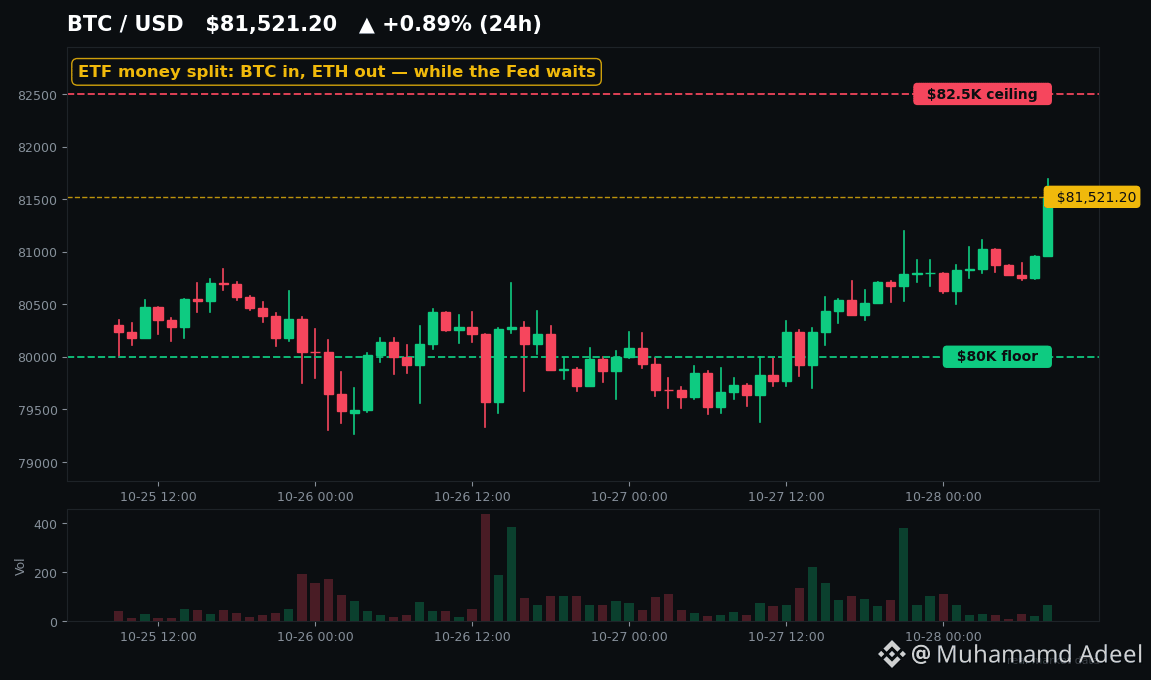
Статья
While Everyone Watches the Fed, 4 Stories Actually Moved Crypto TodayEveryone is staring at the Fed tonight. Meanwhile, the market quietly moved on four stories you probably missed.
Tonight's decision (11pm PKT) is almost fully priced in — markets put a hold at around 90%. The real question isn't tonight's rate. It's what Chair Warsh signals about December. So while the crowd waits, here's what actually happened today.
1. ETF money split in two directions
US spot Bitcoin ETFs pulled in $176M on 27 October — BlackRock's IBIT alone took $151.5M, Fidelity's FBTC $24.5M, and not a single fund saw an outflow. That's two straight inflow days after a $773M two-day bleed.
But Ethereum ETFs went the other way: $60.2M out, with BlackRock's ETHA shedding $93.3M. Same market, same day, opposite flows. The takeaway? Institutions are buying the $BTC dip and trimming $ETH exposure into the Fed — and that divergence is exactly what you want to watch on the charts tonight. If $BTC holds above $80K and clears the $82,500 zone, the IBIT bid looks like smart positioning. Lose $80K on a hawkish December hint, and this bounce was just a relief rally.
2. A data-leak wave hit Coinbase, Bithumb and two Korean firms
Coinbase confirmed an incident at analytics vendor Amplitude exposed a small subset of customer contact data — no breach of its own systems, no funds affected. Bithumb detected a breach of its internal office system on 27 October and says trading systems are separate, with no crypto losses reported. In South Korea, Daishin Securities reported hackers accessed personal data of 38,490 clients, Mirae Asset was also hit, and regulators activated their highest-level emergency response. No coins were stolen — but your inbox is now the attack surface. Expect the phishing attempts.
3. Binance pulled back in Brazil — but only in Brazil
From 27 October, Binance restricted 8 products for Brazilian users (lending, margin, Launchpool, Megadrop and more) and delisted 22 tokens locally, after filing for a Brazilian licence on 23 October ahead of a 30 October deadline. This is not a global delisting — it's one exchange getting compliant in one country. Filing is not approval, though, so Brazilian users should watch what happens after the deadline.
4. ZEC jumped 8% while Galaxy called the bottom
$ZEC reclaimed $1,320, up about 8% on the day, ahead of its NU7 upgrade expected around 5 November and on its 10th anniversary. Privacy is the hot narrative again. And Galaxy's research chief Alex Thorn went further, arguing the bear market ended in June and Bitcoin is in the accumulation phase that has preceded every prior advance. The counterweight? Bitcoin whales on Hyperliquid flipped net short for the first time since June. One side is accumulating, the other is betting against the bounce. Tonight's statement picks a winner.
So here's the setup: a hold is priced, December is the trigger, $80K is the floor and $82,500 is the ceiling to watch. The stories above are why the tape looks the way it does right now — trade the reaction, not the headline.
Not financial advice. DYOR.
While Everyone Watches the Fed, 4 Stories Actually Moved Crypto Today
Everyone is staring at the Fed tonight. Meanwhile, the market quietly moved on four stories you probably missed.
Tonight's decision (11pm PKT) is almost fully priced in — markets put a hold at around 90%. The real question isn't tonight's rate. It's what Chair Warsh signals about December. So while the crowd waits, here's what actually happened today.
1. ETF money split in two directions
US spot Bitcoin ETFs pulled in $176M on 27 October — BlackRock's IBIT alone took $151.5M, Fidelity's FBTC $24.5M, and not a single fund saw an outflow. That's two straight inflow days after a $773M two-day bleed.
But Ethereum ETFs went the other way: $60.2M out, with BlackRock's ETHA shedding $93.3M. Same market, same day, opposite flows. The takeaway? Institutions are buying the $BTC dip and trimming $ETH exposure into the Fed — and that divergence is exactly what you want to watch on the charts tonight. If $BTC holds above $80K and clears the $82,500 zone, the IBIT bid looks like smart positioning. Lose $80K on a hawkish December hint, and this bounce was just a relief rally.
2. A data-leak wave hit Coinbase, Bithumb and two Korean firms
Coinbase confirmed an incident at analytics vendor Amplitude exposed a small subset of customer contact data — no breach of its own systems, no funds affected. Bithumb detected a breach of its internal office system on 27 October and says trading systems are separate, with no crypto losses reported. In South Korea, Daishin Securities reported hackers accessed personal data of 38,490 clients, Mirae Asset was also hit, and regulators activated their highest-level emergency response. No coins were stolen — but your inbox is now the attack surface. Expect the phishing attempts.
3. Binance pulled back in Brazil — but only in Brazil
From 27 October, Binance restricted 8 products for Brazilian users (lending, margin, Launchpool, Megadrop and more) and delisted 22 tokens locally, after filing for a Brazilian licence on 23 October ahead of a 30 October deadline. This is not a global delisting — it's one exchange getting compliant in one country. Filing is not approval, though, so Brazilian users should watch what happens after the deadline.
4. ZEC jumped 8% while Galaxy called the bottom
$ZEC reclaimed $1,320, up about 8% on the day, ahead of its NU7 upgrade expected around 5 November and on its 10th anniversary. Privacy is the hot narrative again. And Galaxy's research chief Alex Thorn went further, arguing the bear market ended in June and Bitcoin is in the accumulation phase that has preceded every prior advance. The counterweight? Bitcoin whales on Hyperliquid flipped net short for the first time since June. One side is accumulating, the other is betting against the bounce. Tonight's statement picks a winner.
So here's the setup: a hold is priced, December is the trigger, $80K is the floor and $82,500 is the ceiling to watch. The stories above are why the tape looks the way it does right now — trade the reaction, not the headline.
Not financial advice. DYOR.
5
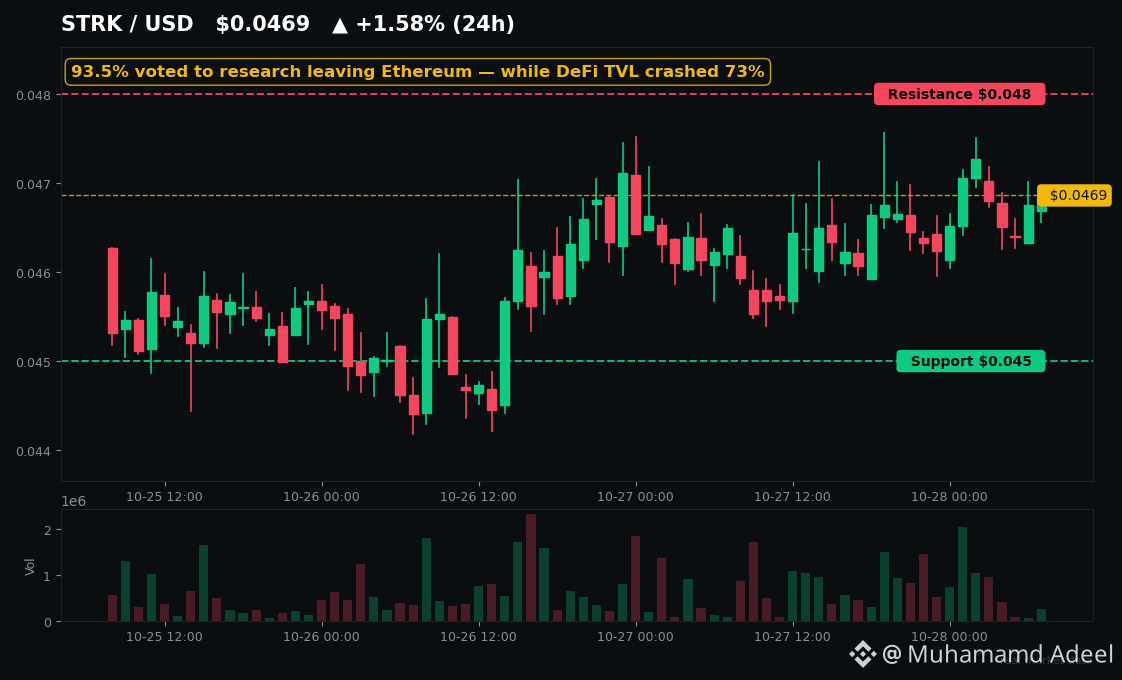
Статья
Starknet Voted to Leave Ethereum. Then Its Biggest App Walked Out.Starknet just voted 93.5% in favour of researching life beyond Ethereum.
Then its biggest app walked out the door — and $STRK gave back almost everything it gained in October.
Here's the story nobody is telling straight.
On 8 October, StarkWare floated a radical idea: turn Starknet from an Ethereum Layer 2 into an independent, post-quantum Layer 1 — arguing its STARK proofs could make it fully quantum-resistant by 2027, years ahead of Ethereum's own timeline. The market loved it. $STRK ripped more than 120% to about $0.126 on 11 October, its best level since December 2025.
Then reality showed up.
A week later, governance delivered the vote: 93.52% of voting power backed researching the move. Read that word again — researching. The poll was non-binding, StarkWare abstained, and no migration, no new token and no date exists. Any actual exit still needs a separate binding vote, with a draft whitepaper hoped for November. That matters for $ETH holders too: Starknet was built to scale Ethereum, and now it is openly weighing leaving it.
And on the very same day the vote closed, 22 October, Starknet's DeFi base was hollowed out. Perp exchange Extended — roughly 74% of the chain's DeFi value — migrated about $120M of settlement to Circle's Arc chain. DeFi TVL collapsed from about $158M to roughly $42M in a day. Today it sits near $41M, with stablecoin liquidity down from $147M to about $37M.
So this is the trade now: a chain debating its entire identity, priced near $0.047 — down about 19% in a week, roughly 99% below its February 2024 high of $4.41 — while its own ecosystem is thinner than it was a month ago.
What am I watching? The range, first. $STRK is coiled between support near $0.045 and resistance near $0.048. Hold above $0.044 and a retest of $0.048–$0.050 is on the table; lose $0.044 and $0.040 comes into view fast. Check the $STRK chart before tonight's Fed decision at 23:00 PKT — this post lands hours before it, so the macro move hasn't happened yet, and a coin this thin can move violently either way on it.
And here's the honest risk, because the bull case needs it: another 127M STRK unlocks on 15 November, part of a monthly schedule running to March 2027. History says unlocks alone only dent the price — but they turn dangerous when they land on a faded narrative, and October's rally already proved it: it round-tripped in under two weeks. Starknet has done this before, too — a breakout from last October's lows faded for months afterwards.
Compared with $ARB and the rest of the L2 pack, Starknet is now the outlier: the boldest idea in the sector, on the thinnest DeFi base. If the November whitepaper turns the research vote into a real roadmap, this $0.047 zone is the one everyone will wish they'd watched. If it doesn't, the unlock calendar and the empty DeFi shelves do the talking.
Not financial advice. DYOR.
Starknet Voted to Leave Ethereum. Then Its Biggest App Walked Out.
Starknet just voted 93.5% in favour of researching life beyond Ethereum.
Then its biggest app walked out the door — and $STRK gave back almost everything it gained in October.
Here's the story nobody is telling straight.
On 8 October, StarkWare floated a radical idea: turn Starknet from an Ethereum Layer 2 into an independent, post-quantum Layer 1 — arguing its STARK proofs could make it fully quantum-resistant by 2027, years ahead of Ethereum's own timeline. The market loved it. $STRK ripped more than 120% to about $0.126 on 11 October, its best level since December 2025.
Then reality showed up.
A week later, governance delivered the vote: 93.52% of voting power backed researching the move. Read that word again — researching. The poll was non-binding, StarkWare abstained, and no migration, no new token and no date exists. Any actual exit still needs a separate binding vote, with a draft whitepaper hoped for November. That matters for $ETH holders too: Starknet was built to scale Ethereum, and now it is openly weighing leaving it.
And on the very same day the vote closed, 22 October, Starknet's DeFi base was hollowed out. Perp exchange Extended — roughly 74% of the chain's DeFi value — migrated about $120M of settlement to Circle's Arc chain. DeFi TVL collapsed from about $158M to roughly $42M in a day. Today it sits near $41M, with stablecoin liquidity down from $147M to about $37M.
So this is the trade now: a chain debating its entire identity, priced near $0.047 — down about 19% in a week, roughly 99% below its February 2024 high of $4.41 — while its own ecosystem is thinner than it was a month ago.
What am I watching? The range, first. $STRK is coiled between support near $0.045 and resistance near $0.048. Hold above $0.044 and a retest of $0.048–$0.050 is on the table; lose $0.044 and $0.040 comes into view fast. Check the $STRK chart before tonight's Fed decision at 23:00 PKT — this post lands hours before it, so the macro move hasn't happened yet, and a coin this thin can move violently either way on it.
And here's the honest risk, because the bull case needs it: another 127M STRK unlocks on 15 November, part of a monthly schedule running to March 2027. History says unlocks alone only dent the price — but they turn dangerous when they land on a faded narrative, and October's rally already proved it: it round-tripped in under two weeks. Starknet has done this before, too — a breakout from last October's lows faded for months afterwards.
Compared with $ARB and the rest of the L2 pack, Starknet is now the outlier: the boldest idea in the sector, on the thinnest DeFi base. If the November whitepaper turns the research vote into a real roadmap, this $0.047 zone is the one everyone will wish they'd watched. If it doesn't, the unlock calendar and the empty DeFi shelves do the talking.
Not financial advice. DYOR.
13
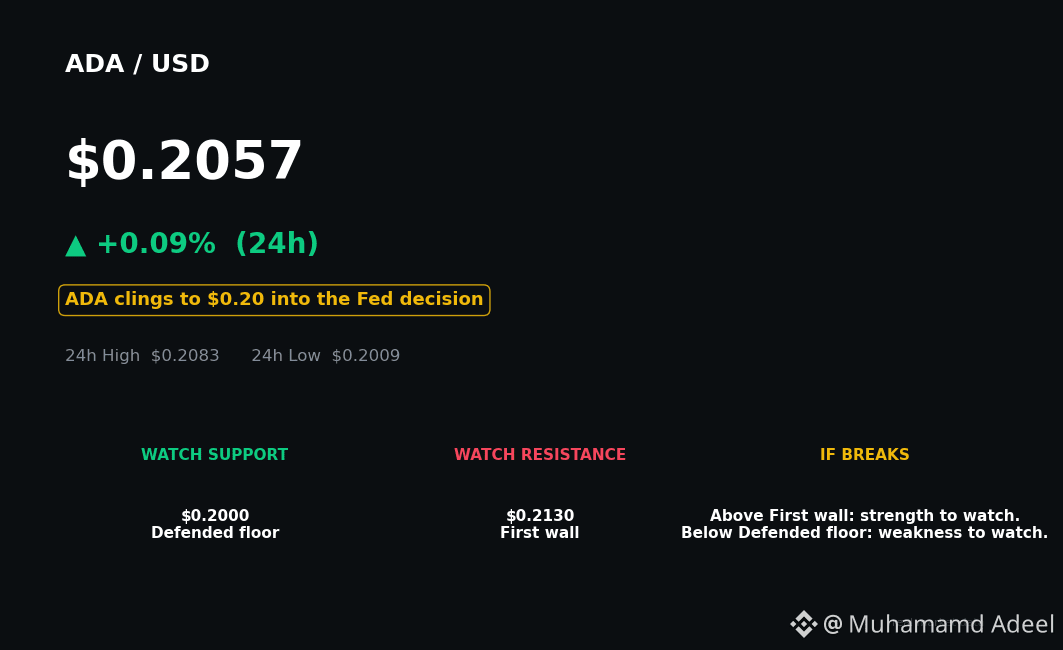
Статья
$ADA Holds Its Breath: The One Level That Matters Into the FOMCADA is down to its last line of defence: $0.20.
Not a metaphor, the actual number. Cardano's token is trading around $0.206 this morning, down 8% in a week and 19% in a month, after falling from $0.28 in early October. And today the Federal Reserve announces its decision.
So here's the setup: one coin, one line in the sand, and the biggest macro trigger of the month landing within hours.
Why does $0.20 matter so much? Because it has already been tested repeatedly. The 26 October low printed at $0.2005 — a whisker above it. Lose it on a daily close, and the next marker $ADA traders are watching is the 30 August low at $0.1894. Hold it, and the fight moves straight to the wall above: $0.213 first, then the $0.218–$0.224 band where the key moving averages sit.
That wall is real. Analyst Ali Martinez warned that a daily close below $0.21 would open a conditional path toward $0.17 — and that warning has now landed, with $0.21 flipped from support to resistance. CoinDesk's 27 October note put it plainly: ADA has bounced about 3% off its recent low but faces strong resistance near $0.22, and the Fed decision may determine the next breakout attempt.
And this is where the story gets strange. The price is capitulating, but the chain is not standing still. Cardano opened its Dijkstra public testnet on 21 October, a staging step toward the next protocol version. Leios, the big scaling upgrade, is not live yet (its mainnet window runs from December into March and still needs a governance vote), but the pipeline is moving. Meanwhile the community is in an open fight over a 22-million-ADA "Strategic Copper Reserve" proposal, reviewed at a governance session on 27 October, with early delegate votes running heavily against it.
The on-chain picture backs the bears more than the bulls. Large holders sold more than 110 million ADA in five days to mid-October, mid-sized wallets trimmed their share of supply, the share of supply in profit collapsed from about 31% to 18%, and daily active addresses fell 41%. Cardano's DeFi TVL, around $58 million, has slipped below its stablecoin supply of about $69 million.
History is no comfort either. October has been red for ADA in six of the last eight years, Cardano's big upgrades have repeatedly turned into sell-the-news events, and after last October's Fed cut ADA still fell 6% the next session. A dovish headline alone has never been enough.
So watch the levels, not the noise. If $0.20 holds into the Fed's guidance — a hold is overwhelmingly priced in, so December's signal is the real trigger — the reclaim to watch is $0.22. If it gives way, $0.1894 is next, with the $0.17 scenario back on the table. While $BTC holds near $80K, altcoins take their cue from the macro tape.
Pull up the $ADA chart and watch $0.20 today. Is this the floor that finally holds — or the line that breaks?
Not financial advice. DYOR.
$ADA Holds Its Breath: The One Level That Matters Into the FOMC
ADA is down to its last line of defence: $0.20.
Not a metaphor, the actual number. Cardano's token is trading around $0.206 this morning, down 8% in a week and 19% in a month, after falling from $0.28 in early October. And today the Federal Reserve announces its decision.
So here's the setup: one coin, one line in the sand, and the biggest macro trigger of the month landing within hours.
Why does $0.20 matter so much? Because it has already been tested repeatedly. The 26 October low printed at $0.2005 — a whisker above it. Lose it on a daily close, and the next marker $ADA traders are watching is the 30 August low at $0.1894. Hold it, and the fight moves straight to the wall above: $0.213 first, then the $0.218–$0.224 band where the key moving averages sit.
That wall is real. Analyst Ali Martinez warned that a daily close below $0.21 would open a conditional path toward $0.17 — and that warning has now landed, with $0.21 flipped from support to resistance. CoinDesk's 27 October note put it plainly: ADA has bounced about 3% off its recent low but faces strong resistance near $0.22, and the Fed decision may determine the next breakout attempt.
And this is where the story gets strange. The price is capitulating, but the chain is not standing still. Cardano opened its Dijkstra public testnet on 21 October, a staging step toward the next protocol version. Leios, the big scaling upgrade, is not live yet (its mainnet window runs from December into March and still needs a governance vote), but the pipeline is moving. Meanwhile the community is in an open fight over a 22-million-ADA "Strategic Copper Reserve" proposal, reviewed at a governance session on 27 October, with early delegate votes running heavily against it.
The on-chain picture backs the bears more than the bulls. Large holders sold more than 110 million ADA in five days to mid-October, mid-sized wallets trimmed their share of supply, the share of supply in profit collapsed from about 31% to 18%, and daily active addresses fell 41%. Cardano's DeFi TVL, around $58 million, has slipped below its stablecoin supply of about $69 million.
History is no comfort either. October has been red for ADA in six of the last eight years, Cardano's big upgrades have repeatedly turned into sell-the-news events, and after last October's Fed cut ADA still fell 6% the next session. A dovish headline alone has never been enough.
So watch the levels, not the noise. If $0.20 holds into the Fed's guidance — a hold is overwhelmingly priced in, so December's signal is the real trigger — the reclaim to watch is $0.22. If it gives way, $0.1894 is next, with the $0.17 scenario back on the table. While $BTC holds near $80K, altcoins take their cue from the macro tape.
Pull up the $ADA chart and watch $0.20 today. Is this the floor that finally holds — or the line that breaks?
Not financial advice. DYOR.
28
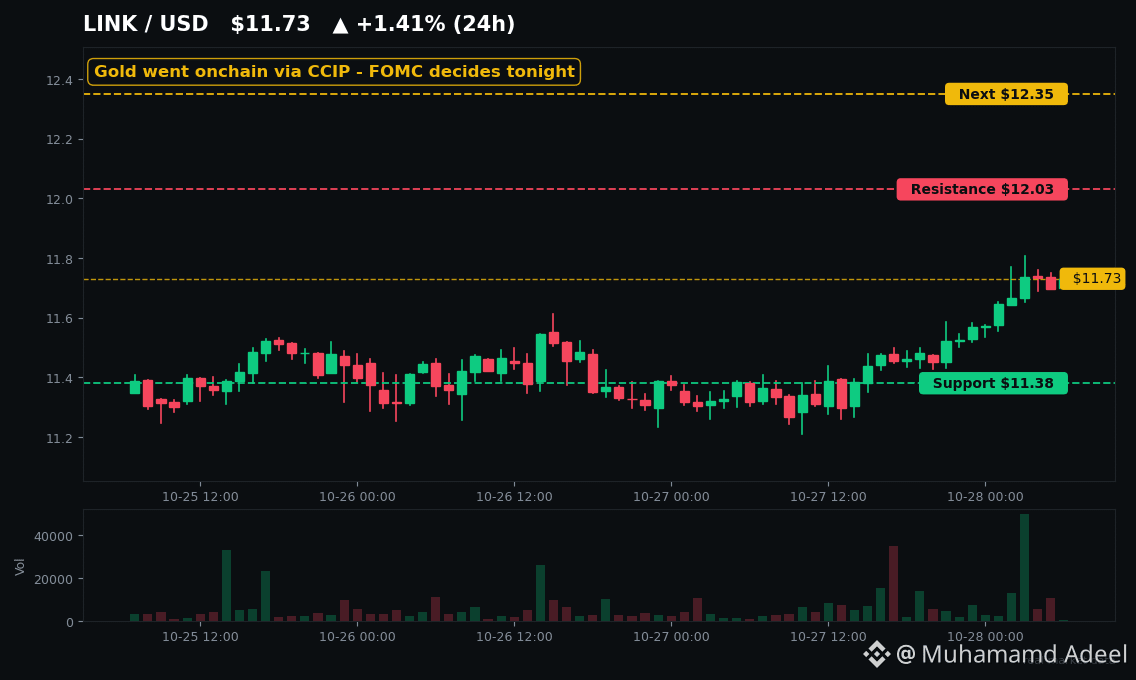
Статья
Gold Went Onchain, LINK Bounced — Tonight the Fed DecidesYesterday, gold went onchain through Chainlink. Today, $LINK is sitting at $11.73 — and tonight, the Fed decides which way it breaks.
That's the whole setup. And it's a better one than it looks.
Here's what actually happened: the Hong Kong Gold Exchange — one of the world's biggest gold trading venues — announced it is bringing its gold-backed token to Chainlink's CCIP. Each XGZ token represents one gram of physical 99.99% fine gold, and the plan, built with GoldZip and Midas Labs, is to let it move across blockchains instead of staying locked on Ethereum. This is an announced integration, not live volume yet — but it's the kind of real-world asset plumbing only Chainlink gets asked to build.
It wasn't even the week's only institutional headline. Chainlink also launched CustodySync with Anchorage Digital Bank, letting qualified custodians offer clients access to DeFi lending without moving assets out of custody. That's the $AAVE-adjacent world — lending markets running on Chainlink price feeds and Proof of Reserve — and it's aimed squarely at the capital that has never touched DeFi before.
So why is the token still down?
Because the market has heard this song before. $LINK is still about 20% down over the last 30 days and roughly 78% below its $52.99 all-time high from May 2021. It traded near $15.70 earlier in October and has given most of that back. Spot LINK ETFs have now gone five straight sessions with zero net inflows, sitting at roughly $179 million cumulative. And Chainlink's own numbers tell the same split story: more than $85 billion in value secured by CCIP and over $15 billion migrated cross-chain in 2026 — yet the token keeps lagging the headlines.
That's the tension to trade, not ignore. The levels are clean. Support sits at $11.38 — the zone LINK just bounced from. A daily close above $12.03 opens the path toward $12.35, then $12.81. Lose $11.38 and the next downside zone is $10.87. Check $LINK's chart and you'll see it: the token is coiled right between those two lines, hours before the biggest macro event of the week.
The Fed announces at 11:00 p.m. PKT tonight, with markets pricing around a 90% chance of a hold. A calm hold could let the gold and custody news finally do some work. A hawkish surprise would likely drag everything — LINK included — back toward that $11.38 floor first.
One more thing on the calendar: Link:NYC lands tomorrow, and this week's announcements were explicitly framed as the road to it. If there's a second headline coming, that's where it drops.
So here's my take: the infrastructure story has never been stronger, and the price has never cared less. One of those two things gives way — and tonight's Fed decision probably picks which one moves first.
Not financial advice. DYOR.
Gold Went Onchain, LINK Bounced — Tonight the Fed Decides
Yesterday, gold went onchain through Chainlink. Today, $LINK is sitting at $11.73 — and tonight, the Fed decides which way it breaks.
That's the whole setup. And it's a better one than it looks.
Here's what actually happened: the Hong Kong Gold Exchange — one of the world's biggest gold trading venues — announced it is bringing its gold-backed token to Chainlink's CCIP. Each XGZ token represents one gram of physical 99.99% fine gold, and the plan, built with GoldZip and Midas Labs, is to let it move across blockchains instead of staying locked on Ethereum. This is an announced integration, not live volume yet — but it's the kind of real-world asset plumbing only Chainlink gets asked to build.
It wasn't even the week's only institutional headline. Chainlink also launched CustodySync with Anchorage Digital Bank, letting qualified custodians offer clients access to DeFi lending without moving assets out of custody. That's the $AAVE -adjacent world — lending markets running on Chainlink price feeds and Proof of Reserve — and it's aimed squarely at the capital that has never touched DeFi before.
So why is the token still down?
Because the market has heard this song before. $LINK is still about 20% down over the last 30 days and roughly 78% below its $52.99 all-time high from May 2021. It traded near $15.70 earlier in October and has given most of that back. Spot LINK ETFs have now gone five straight sessions with zero net inflows, sitting at roughly $179 million cumulative. And Chainlink's own numbers tell the same split story: more than $85 billion in value secured by CCIP and over $15 billion migrated cross-chain in 2026 — yet the token keeps lagging the headlines.
That's the tension to trade, not ignore. The levels are clean. Support sits at $11.38 — the zone LINK just bounced from. A daily close above $12.03 opens the path toward $12.35, then $12.81. Lose $11.38 and the next downside zone is $10.87. Check $LINK 's chart and you'll see it: the token is coiled right between those two lines, hours before the biggest macro event of the week.
The Fed announces at 11:00 p.m. PKT tonight, with markets pricing around a 90% chance of a hold. A calm hold could let the gold and custody news finally do some work. A hawkish surprise would likely drag everything — LINK included — back toward that $11.38 floor first.
One more thing on the calendar: Link:NYC lands tomorrow, and this week's announcements were explicitly framed as the road to it. If there's a second headline coming, that's where it drops.
So here's my take: the infrastructure story has never been stronger, and the price has never cared less. One of those two things gives way — and tonight's Fed decision probably picks which one moves first.
Not financial advice. DYOR.
27
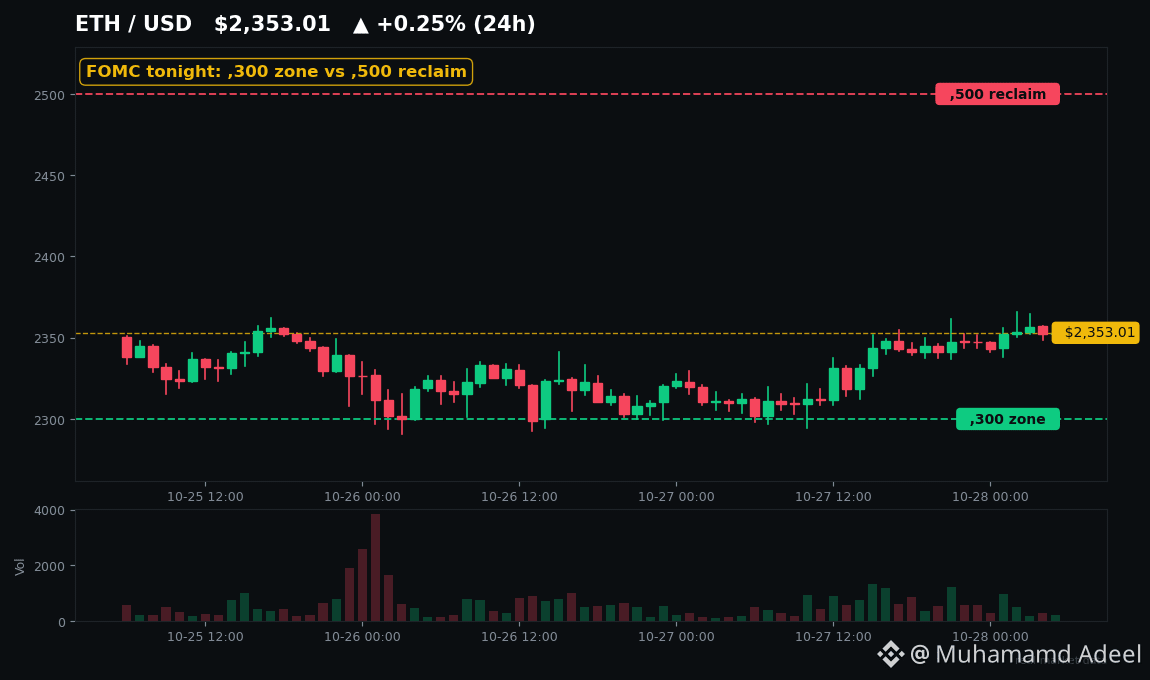
Статья
FOMC Tonight: ETH Holds $2,300 — But $2,500 Is the Real TestTonight, the Fed decides — and Ethereum is sitting exactly where it shouldn't be comfortable.
$ETH is hovering around $2,350, clinging to the $2,300 zone after dipping to $2,297 on Tuesday. That zone has now been tested again and again in October. Tonight's announcement at 11pm PKT doesn't just test it once more — it decides whether the floor holds or the reclaim begins.
Here's what this really means. The market has already priced in a hold at 3.75%-4.00% — roughly 90% odds. Nobody is waiting for the decision itself. Everyone is waiting for what the Fed signals about December. That's the whole trade.
And something quietly shifted underneath the fear. After Monday's $88.6M spot ETH ETF outflow, Tuesday's session flipped back to a small inflow of about $33.1M, per ETF trackers. One day doesn't end a month of bleeding — October's outflows topped $1B — but it breaks the script that institutions are only selling. Meanwhile, exchanges saw a record single-day ETH outflow of nearly 170,000 ETH last week. Supply is tightening at the same time old whales are depositing coins to exchanges. This is not a clean story. It's a tug-of-war, and tonight picks a side.
So who leads if the guidance softens? Watch the tape, not the hype.
XRP led this morning's bounce at around $1.33, and it's the only major besides BNB in the green on the week. $BNB has been the steadiest major of the bunch, holding near $745 with $750-$760 as its next ceiling. But $SOL is the swing candidate: stuck near $102, with $98.50 as the line that decides whether it drops toward $93-$96 or charges toward $107 and $111. History says that's how it works — when the Fed surprised dovish at Jackson Hole in August 2025, ETH ripped about 11-14% and SOL led the alt leg. When guidance disappointed, like the hawkish cut in December 2024, ETH fell harder than Bitcoin and the majors fell hardest of all.
The levels are simple, and they're all that matter tonight:
ETH: hold the $2,300 zone and the path opens to $2,400, then $2,450-$2,470, then the $2,500 zone. Lose $2,300 on a daily close and $2,276 is next, with $2,150 below that. SOL: $100 must hold, $110-$111 confirms strength. BNB: $736 is the floor, $780 is the prize. XRP: $1.30 holds, $1.35-$1.38 is the test.
The honest risk? A hold with hawkish December talk is the bear case — fully priced decision, unpriced disappointment. That's exactly how green days turned red within hours in past cycles. Don't chase the first spike after the announcement. Wait for the press conference tone, then watch which level breaks first.
Check $ETH's chart tonight before you react to the headlines — the levels will tell you faster than the commentary will.
Not financial advice. DYOR.
FOMC Tonight: ETH Holds $2,300 — But $2,500 Is the Real Test
Tonight, the Fed decides — and Ethereum is sitting exactly where it shouldn't be comfortable.
$ETH is hovering around $2,350, clinging to the $2,300 zone after dipping to $2,297 on Tuesday. That zone has now been tested again and again in October. Tonight's announcement at 11pm PKT doesn't just test it once more — it decides whether the floor holds or the reclaim begins.
Here's what this really means. The market has already priced in a hold at 3.75%-4.00% — roughly 90% odds. Nobody is waiting for the decision itself. Everyone is waiting for what the Fed signals about December. That's the whole trade.
And something quietly shifted underneath the fear. After Monday's $88.6M spot ETH ETF outflow, Tuesday's session flipped back to a small inflow of about $33.1M, per ETF trackers. One day doesn't end a month of bleeding — October's outflows topped $1B — but it breaks the script that institutions are only selling. Meanwhile, exchanges saw a record single-day ETH outflow of nearly 170,000 ETH last week. Supply is tightening at the same time old whales are depositing coins to exchanges. This is not a clean story. It's a tug-of-war, and tonight picks a side.
So who leads if the guidance softens? Watch the tape, not the hype.
XRP led this morning's bounce at around $1.33, and it's the only major besides BNB in the green on the week. $BNB has been the steadiest major of the bunch, holding near $745 with $750-$760 as its next ceiling. But $SOL is the swing candidate: stuck near $102, with $98.50 as the line that decides whether it drops toward $93-$96 or charges toward $107 and $111. History says that's how it works — when the Fed surprised dovish at Jackson Hole in August 2025, ETH ripped about 11-14% and SOL led the alt leg. When guidance disappointed, like the hawkish cut in December 2024, ETH fell harder than Bitcoin and the majors fell hardest of all.
The levels are simple, and they're all that matter tonight:
ETH: hold the $2,300 zone and the path opens to $2,400, then $2,450-$2,470, then the $2,500 zone. Lose $2,300 on a daily close and $2,276 is next, with $2,150 below that. SOL: $100 must hold, $110-$111 confirms strength. BNB: $736 is the floor, $780 is the prize. XRP: $1.30 holds, $1.35-$1.38 is the test.
The honest risk? A hold with hawkish December talk is the bear case — fully priced decision, unpriced disappointment. That's exactly how green days turned red within hours in past cycles. Don't chase the first spike after the announcement. Wait for the press conference tone, then watch which level breaks first.
Check $ETH 's chart tonight before you react to the headlines — the levels will tell you faster than the commentary will.
Not financial advice. DYOR.
39
Войдите, чтобы посмотреть больше материала
Присоединяйтесь к пользователям криптовалют по всему миру на Binance Square
⚡️ Получайте новейшую и полезную информацию о криптоактивах.
💬 Нам доверяет крупнейшая в мире криптобиржа.
👍 Получите достоверные аналитические данные от верифицированных создателей контента.
Эл. почта/номер телефона
В тренде
CanMicrosoftDeliverOnAI
Просмотров: 651,069
4,309 обсуждают
Earnings Season Session 3: Will Google & Microsoft Beat Earnings Expectations?
Binance Square Official
·Лайков: 169
·Просмотров: 94.4k
CanGoogleDefindItsCore
Просмотров: 400,950
3,044 обсуждают
FedWatch
Просмотров: 16.1M
37,368 обсуждают