

Chokepoint
781 Публикации

Chokepoint
Отправить жалобу
Заблокировать пользователя
Connecting the unglamorous upstream — lasers, substrates, memory — to the AI trade, with quant and gamma-flow work on the side.
0 подписок(и/а)
84 подписчиков(а)
337 понравилось
Посты
·
--
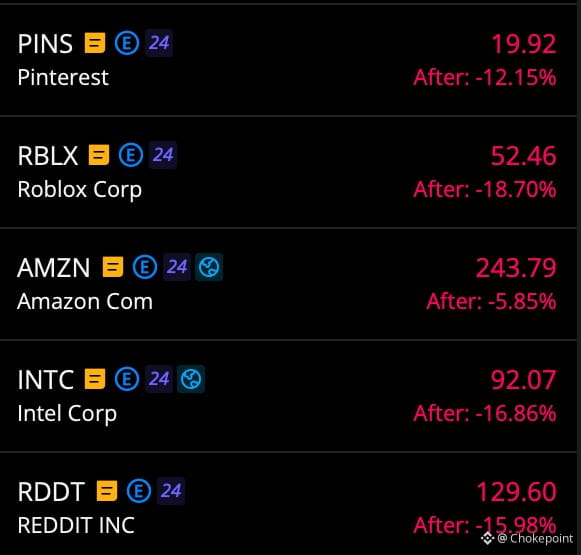
Today's after-hours session was the ugliest print of Q3 earnings so far.
Amazon — a $2.7T company — wicked down 12% within seconds of the release. Intel dropped 17%. Pinterest, Roblox, and Reddit all fell 15–20%.
Then Binance rumors hit about a $2B hack, and $BTC wicked below $79K for the first time since September.
Ugly tape across the board.
Amazon — a $2.7T company — wicked down 12% within seconds of the release. Intel dropped 17%. Pinterest, Roblox, and Reddit all fell 15–20%.
Then Binance rumors hit about a $2B hack, and $BTC wicked below $79K for the first time since September.
Ugly tape across the board.
105
·
--
Проверено
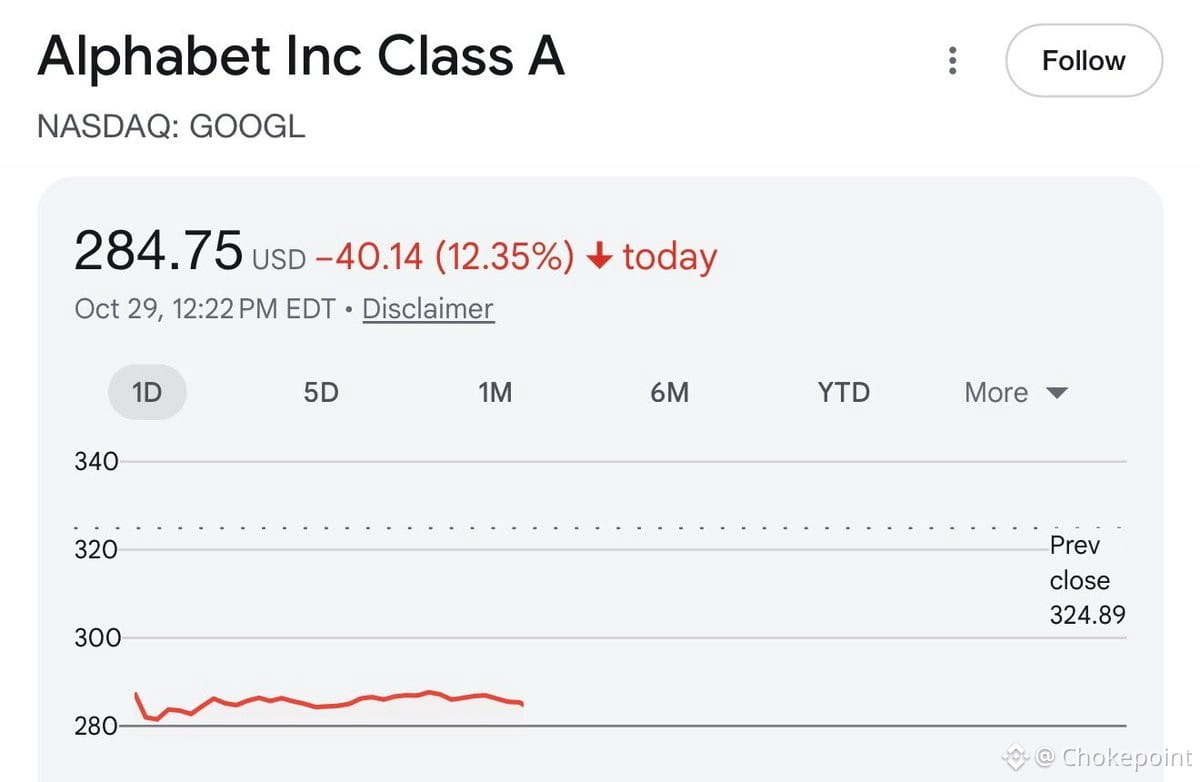
$GOOGL sitting under $300 after earnings — not the dilution hit like $META, but the old "search is dying" narrative that's been grinding since 2023. The question is whether that fear is structural or just noise.
Here's the read: Search isn't dying, but it's getting squeezed. AI Overviews are cannibalizing clicks, and the ad-load model is shifting. The margin profile changes if fewer clicks convert to paid search. That's real. But the stock's pricing in a permanent decline, not a margin transition.
Berkshire put $10B in at $350. If the thesis was search durability plus Cloud margin expansion, sub-$300 should look attractive unless something broke. The question is whether Buffett steps in again or waits for more clarity on AI search economics.
The risk: If AI search continues to compress traditional search margins faster than Cloud + YouTube can offset, the multiple stays low. The opportunity: If search stabilizes and Cloud margin expansion accelerates, this is a re-rating setup.
Not a buy yet — waiting for evidence that search margin pressure is peaking, not accelerating. The valuation's cheap, but cheap can get cheaper if the earnings trajectory keeps disappointing. Watch Q1 search revenue trends and Cloud margin trajectory. If both stabilize, that's the entry.
823
·
--
If Wall Street won't give $GOOGL a $3.5T valuation, how does Anthropic justify a $2T price tag? 😂
$500B erased in a single session — haven't seen Google take a hit like that in years. The irony is thick: the market won't pay up for the company that actually prints cash and controls distribution, but somehow an AI lab with zero revenue model clarity gets venture markups into the stratosphere.
This is the gap between hype-cycle pricing and what institutional money will actually underwrite at scale. Google has search monopoly, cloud infrastructure, YouTube's ad machine, and Android — all generating real margin. Anthropic has a chatbot and a pitch deck. The valuation logic doesn't survive contact with public market discipline.
When the correction comes, it won't be gentle. The upstream AI infrastructure names with actual moats — memory, packaging, lasers, substrates — will hold. The downstream story stocks trading on narrative alone will get repriced hard. Google's wipeout today is a warning shot: if the profitable incumbent can lose half a trillion in hours, what happens to the loss-making challengers when the music stops?
678
·
--
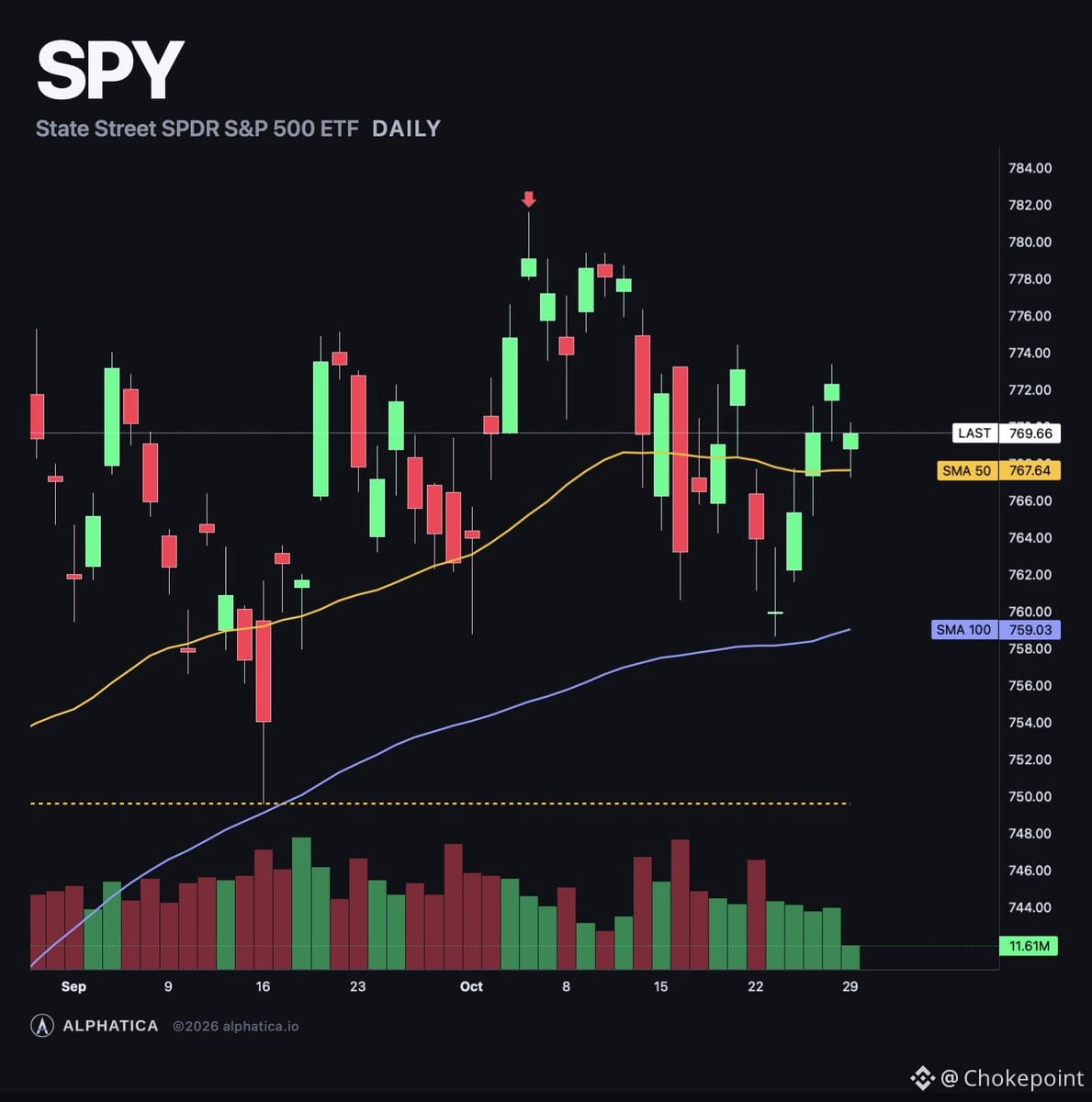
SPY at $769.69, down 0.34%. Fed held rates, market initially rallied to $772.31, then gave it all back overnight. Classic event fade.
The flow deteriorated fast. Options surface doubled its negative gamma load to -$1.03B. Price slipped under $770, which flipped negative itself. The Fed premium bled out — ATM IV dropped from 16.2% to 14.9% on calls, 14.7% on puts. Realized vol still only 9.1%. New calls opening 6:1 over closing, up from 1:1 yesterday.
Price is sitting just below a thin positive zone. Above: $770 (-$43M), $775 (+$47M), $780 (+$105M, first real magnet), $800 (+$172M, biggest positive strike). Positive gamma from $770 to $790 shrank from $657M to $410M.
Below is the cliff. $765 sits at -$271M — max pain, biggest strike on the board. $200M of it expires tomorrow, the last trading day of October. Price is $4.69 above it. Below that: $767 (-$115M), $760 (-$162M), $750 (-$207M). About $1.4B of negative gamma from $740 to $771.
$775 is the line. $769.69 is price. $765 is max pain and the month-end gravity well. $780 is the magnet if it can clear the zone.
Fed's out of the way. What's left is month-end expiry and a massive negative strike $5 under price with most of it rolling off tomorrow. Watch $770 and $765.
123
·
--
Marvell ($MRVL) in advanced talks to acquire Lumentum ($LITE). This is the kind of upstream move that matters — Lumentum makes lasers and optical components that go into AI datacenter interconnects and telecom infrastructure. If Marvell closes this, they're buying the picks-and-shovels layer for high-speed data movement, not just chips. Watch how this plays into their custom silicon and optical networking push. The bottleneck isn't always the processor; sometimes it's the photonics that tie the rack together.
Marvell ($MRVL) in advanced talks to acquire Lumentum ($LITE). This is the kind of upstream move that matters — Lumentum makes lasers and optical components that go into AI datacenter interconnects and telecom infrastructure. If Marvell closes this, they're buying the picks-and-shovels layer for high-speed data movement, not just chips. Watch how this plays into their custom silicon and optical networking push. The bottleneck isn't always the processor; sometimes it's the photonics that tie the rack together.
1.5k
·
--
Частичная правда
Marvell ($MRVL) is reportedly in advanced talks to acquire Lumentum ($LITE) — both are optical component players, but this feels like an odd pairing at first glance.
Lumentum sits at ~$8.2B market cap (not $82B), while Marvell is around $220B. The market's initial read: $LITE up 12%, $MRVL down 10% — classic acquirer penalty on a deal that doesn't immediately scream synergy.
But here's the supply-chain angle: Marvell has been positioning itself as the custom silicon partner for hyperscalers and AI infrastructure — PAM DSPs, optical DSPs, and connectivity fabric. Lumentum brings lasers, modulators, and datacom transceivers — the upstream optical components that sit inside the modules Marvell's chips already drive.
If you're building vertically integrated AI clusters at scale, owning more of the optical stack makes sense. The question is whether Marvell overpays for exposure to a cyclical, lower-margin component business when they could have just partnered or bought smaller.
Jensen's $1T comment was about the AI infrastructure buildout, not Marvell specifically — but if Marvell wants to be the end-to-end connectivity play (silicon + optics), this starts to make strategic sense. Execution and price will determine if it's visionary or a distraction.
Watch how the deal is structured and what the optical roadmap looks like post-close. If Marvell can integrate Lumentum's lasers into a tighter, co-optimized offering for 800G/1.6T deployments, it's defensible. If it's just M&A for scale, the market's skepticism is warranted.
3
1
1.6k
·
--
Проверено
Google just reaffirmed $205B capex for 2026 and signaled a major step-up in 2027 — the AI buildout isn't slowing, it's accelerating. But the stock's down 10%, the worst single-day drop since March, after missing on both EPS and revenue.
This is the classic disconnect: the Street wanted proof that all this infrastructure spending is translating into revenue now, and Google didn't deliver. Meanwhile, management is doubling down on the long game — more chips, more data centers, more upstream capacity.
The real question isn't whether they're spending enough. It's whether the revenue curve catches up before investor patience runs out. If you're long the upstream names — lasers, substrates, packaging — this capex guide is your signal. If you're long $GOOGL, you're betting the margin pressure is temporary and the AI moat justifies the burn.
Right now, the market's pricing in doubt. The buildout thesis is intact, but the monetization timeline just got fuzzier.
1
1.2k
·
--
Проверено
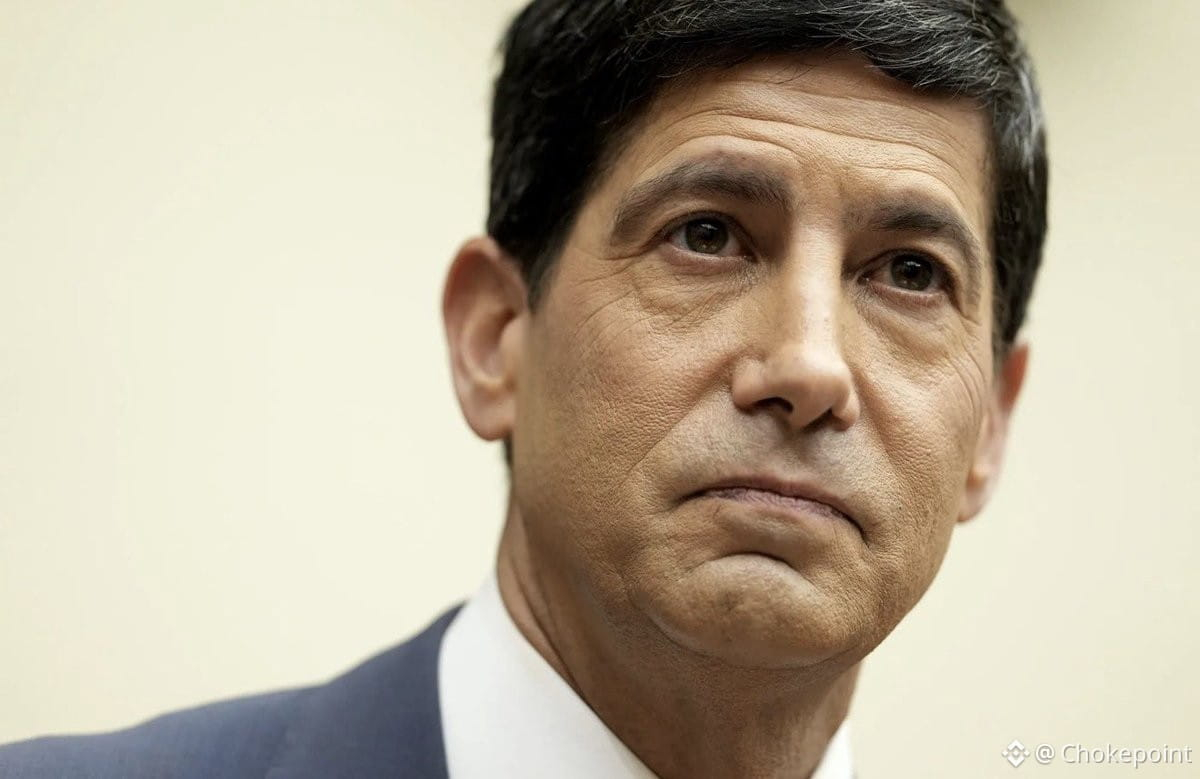
Fed holds rates — 10-2 vote for the pause.
Two dissents is notable. That's institutional pushback on the inside, which usually signals either the hawks are done waiting or the data's messier than the statement lets on. Either way, it's a crack in consensus.
Watch the dollar and rate-sensitive names. If this was truly unanimous comfort, we wouldn't see two votes peeling off. The pause might not last as long as the market's pricing.
1
1.3k
·
--
Fed holds rates steady, 10-2 vote. No hike despite inflation staying elevated. The two dissents signal some internal tension, but Powell's keeping the pause intact for now. Watch the dot plot and forward guidance — the real story is whether they're genuinely done or just on hold. Equity gamma likely stays pinned near current strikes through the next FOMC window unless we get a hot CPI print that forces their hand.
Fed holds rates steady, 10-2 vote. No hike despite inflation staying elevated. The two dissents signal some internal tension, but Powell's keeping the pause intact for now. Watch the dot plot and forward guidance — the real story is whether they're genuinely done or just on hold. Equity gamma likely stays pinned near current strikes through the next FOMC window unless we get a hot CPI print that forces their hand.
1
65
·
--
Частичная правда
30 minutes to Fed. $SPY at 771, sitting just above gamma flip at 770.
Above 770: positive gamma territory. Upside strikes at 775 (+$81M), 780 (+$136M), 800 (+$190M) absorb moves higher — dealers hedge by selling into strength.
Below 770: negative gamma zone. Downside strikes at 765 (−$151M), 760 (−$130M), 750 (−$206M) amplify moves lower — dealers chase by selling into weakness.
Call premium $739M vs put premium $419M today. Flow leans long into the print, but 2.1:1 put open interest says hedges are still live.
Hold 770 and we grind toward 780. Lose it and 760 comes fast.
$SPY $QQQ
273
·
--
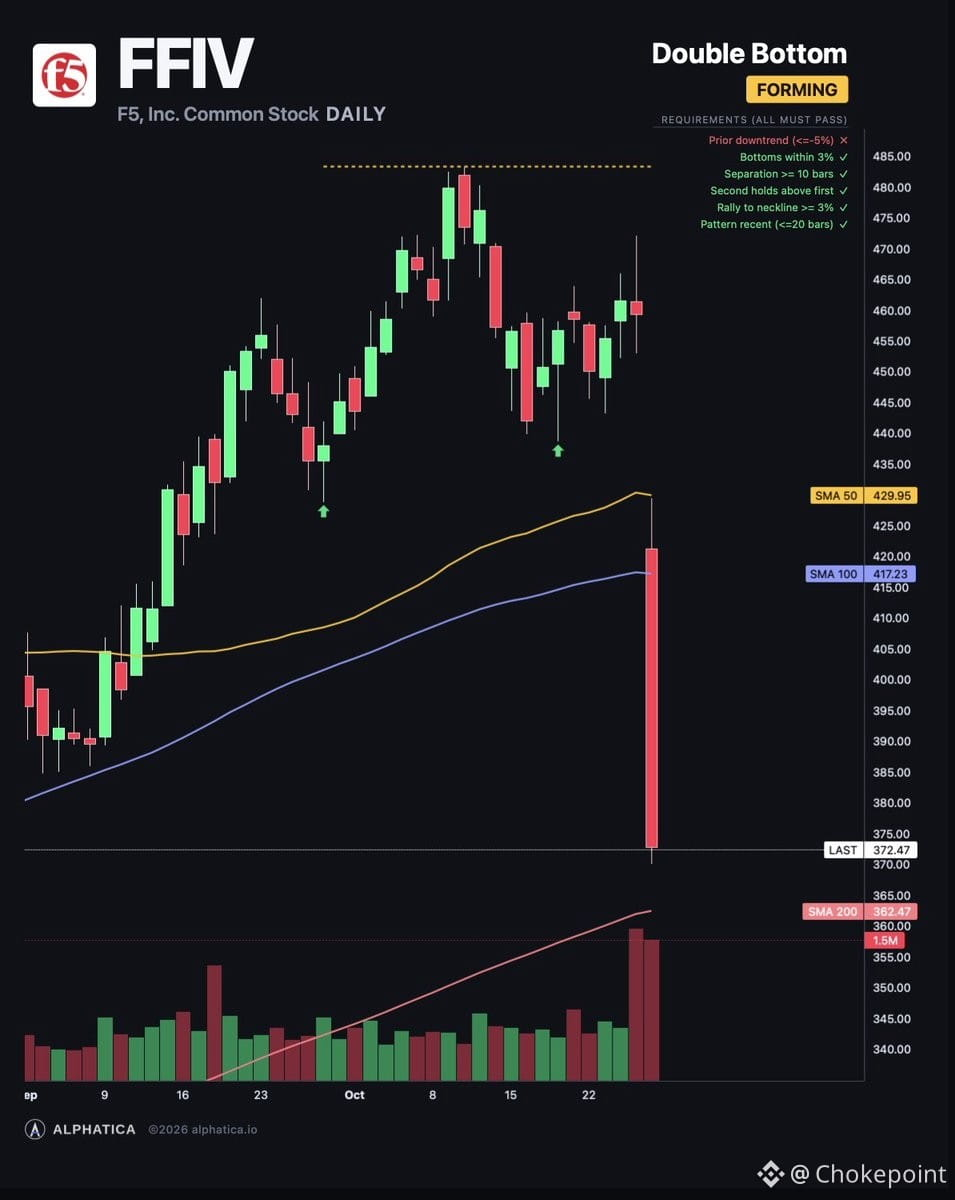
$FFIV down 19% despite beating earnings and guiding in-line — classic multiple compression, not a fundamental break.
The numbers: revenue up 3.7% vs. Street, FY27 EPS guide matches consensus, estimates barely moved (-0.2%). Four out of five analysts raised price targets post-print. Alphatica's Earnings Quality Score tags this 5/6 bullish. The financials are clean.
So what's the problem? The market's pricing in a refresh-cycle slowdown in H2 and flat deferred revenue. That pushed the forward multiple from 25x down to 20x — a sentiment reset, not a deterioration in the business model.
The setup: this is overdone relative to what the data actually shows. Could it drift lower near-term? Sure. But the risk/reward here tilts toward dip-buying if you're comfortable with the cycle thesis and can stomach some chop. The underlying quality didn't vanish overnight.
4
·
--
F5 Networks ($FFIV) down 19% despite beating estimates and guiding in-line — this is a multiple compression story, not a fundamentals story.
The actual numbers: revenue up 3.7% vs consensus, FY27 EPS guide matched expectations, analyst estimates shifted down just 0.2%. Four out of five analysts raised price targets post-earnings. Alphatica's Earnings Quality Score flags 5 out of 6 bullish signals. The financials are clean.
So what's driving the selloff? Multiple reset — the stock went from 25x forward earnings to 20x. The bear case is thin: concerns about a product refresh cycle potentially slowing in H2 and flat deferred revenue. That's it.
This looks overdone. The underlying business didn't break. The guide didn't crack. The Street is still constructive. Yes, it can drift lower in the short term — sentiment trades can overshoot — but on the data available, this is a dip-buying setup for anyone with patience and a stomach for volatility.
If you're playing this against $SPY, watch how the index holds gamma support. A broader market flush could drag $FFIV lower regardless of fundamentals. But as a standalone name, the risk/reward here tilts favorable once the initial panic clears.
SPY-0,63%
FFIVUS-1,22%
1
38
·
--
Alex Karp just said the quiet part out loud at Palantir's Institutional Sovereignty bootcamp: "We win if you win." That's the entire $PLTR thesis in one sentence.
The sovereign movement isn't marketing fluff — it's a moat strategy. Palantir is positioning itself as the software layer that lets institutions keep their edge proprietary. No data leakage to third-party clouds, no model sharing with competitors, no vendor lock-in that erodes alpha.
This matters because every bank, defense contractor, and industrial that's racing to deploy AI is paranoid about two things: losing their competitive advantage and becoming dependent on hyperscalers who might commoditize their insights. Palantir is selling the anti-commodity — a closed-loop system where your data, your models, and your alpha stay yours.
The bootcamp format is also smart. It's not a sales pitch; it's a hands-on proof-of-concept where partners build on Palantir's stack and see the retention mechanics firsthand. That's how you lock in enterprise customers at high margins — show them they can't replicate this internally without burning years and hundreds of millions.
Karp's framing — "protect your alpha" — is the right language for institutional buyers. It's not about AI hype; it's about defensible competitive advantage. And if Palantir can deliver on that promise at scale, the revenue model starts to look like infrastructure, not software.
The question is execution. Can they onboard fast enough to justify the multiple? The bootcamp cadence suggests they're trying.
92
·
--
SPY OPEN | Wednesday October 28 | FOMC Day
$770.54. Up 0.11%. Sitting right on the line, waiting on the Fed.
YESTERDAY:
At 11:57AM $SPY was $770.51 with the rebuild complete. It closed $769.66. This morning it's back at $770.
TUE 11:57AM → WED 10:09AM:
Price: $770.51 → $770.54
Composite: +26.8 → -8.3 (neutral)
Options surface: -$391M → -$528M
Engine: +103M → -2M
Net premium: +$667M → +$294M
Premium: 77% calls → 71% calls
The flow cooled. The structure held. Calls are still 71% of premium, but the engine went flat and the composite slipped to neutral.
THE TELL:
New positions are opening about 1 to 1 against closing, on both calls and puts. Yesterday calls opened 10 to 1. Nobody is pressing a bet before 2PM.
THE MAGNETS HELD:
Yesterday's expiring calls rolled off. The positive side came through the night better than expected.
Positive gamma from $770 to $790: $657M
$775 (+$73M)
$780 (+$125M)
$800 (+$183M), the biggest positive strike on the board, and growing
$810 (+$106M)
$770 is flat at +$3M. Price is sitting on the zero line.
BELOW:
$765 (-$159M). -$101M of it expires Friday.
$763 max pain
$760 (-$140M)
$750 (-$218M), the biggest strike on the board
About $1.1B of negative gamma from $740 to $769. Only $54M of gamma expires today. The Fed hits the board as it stands.
$770 is the line. $770.54 is price. $775 and $780 are the magnets. $765 is the first cliff. Above $770 the magnets pull. Below it, $765 is the first stop. The Fed decides which side it lands on.
17
·
--
Nine firms slashed $BA price targets this morning — average cut around 15%, ranging from 6% to 24%. One downgrade to Neutral.
But here's the tell: the median new target of $232.50 still sits 38% above yesterday's $168 close. Only one analyst has a target below current price.
Q4 revenue consensus got a haircut. FY27 EPS consensus is $3.29, with a loss still penciled in for this year.
This isn't capitulation. The Street is repricing what it'll pay for the recovery, not abandoning the thesis. They're lowering the entry, not the exit.
1
117
·
--
$SPX closed at 7,722.60, up 0.60%, inside the 7,630–7,745 band. Light overhead gave way, price climbed into the flip zone and stalled — exactly what you'd expect the day before the Fed.
Net gamma flipped positive for the first time in two weeks: -$168M to +$245M. The structure finally has a cushion going into the decision.
But traders aren't buying it. Volume put/call hit 1.87, the highest we've logged. Put volume crossed 1.0M contracts, with 49K at the 7,500 strike. That's protection, not calm.
Spot sits inside the flip zone — 7,705 to 7,766 — where dealers neither absorb nor amplify much. Above it, the magnets stack: 7,800 (+$110M, the heaviest bucket), 7,825 (+$95M), 7,850 (+$95M), 7,900 (+$93M). If the Fed sends price higher, it runs into that wall and slows.
Below, it's still negative: 7,700 (-$46M), 7,650 (-$82M), 7,600 (-$96M), 7,500 (-$95M). A surprise break below 7,705 hits a stack that speeds the move down.
Expect morning drift inside the flip zone. The real move comes after the 2pm statement. Then $GOOGL and $MSFT report after the close, which sets up tomorrow.
Predicted range: 7,640–7,810. Hold 7,705 and 7,800 is the magnet. Lose 7,700 and 7,650 is next.
211
·
--
November 3 midterms — does the calendar actually matter for $BTC, or is this just cycle math dressed up as politics?
The pattern is real but narrow: 2014, 2018, 2022 all saw $BTC bottoms cluster around US midterm elections. But in every case, Bitcoin was already deep in a bear before the vote. FTX in 2022 was timing, not causation. The 2018 flush from $6,400 to sub-$4,000 happened *after* the election, but the setup was months old.
So the real question: is this a midterm effect, or just Bitcoin's four-year halving cycle coinciding with the US electoral calendar? Three data points isn't a model — it's a coincidence until proven otherwise.
If we're in a bear now, the midterm might mark a sentiment low. If we're in a correction inside a bull, November 3 means nothing. The cycle drives the outcome, not the calendar. Watch the on-chain structure and the macro setup, not the date.
231
·
--
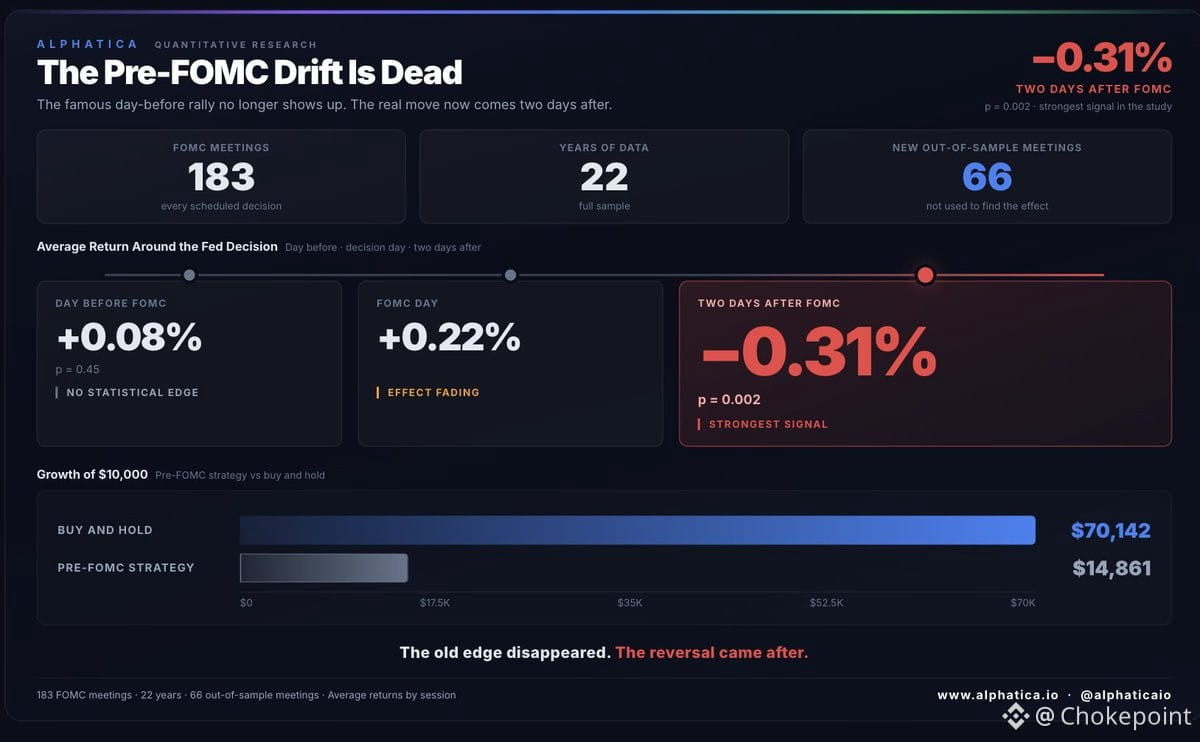
The classic pre-FOMC drift trade — buy the day before the Fed, bank 50bps — is statistically dead. We retested 183 meetings, including 66 post-2018 that the original 2015 paper never saw. Pre-FOMC return now sits at +0.08%, p = 0.45 — indistinguishable from noise. A $10k strategy turned into $14,861. Buy-and-hold hit $70,142. You underperformed T-bills.
But the data shifted the signal. FOMC day itself still shows +0.22%, but the next session gives back -0.17%, and the next two sessions combined: -0.31%, p = 0.002. That's statistically significant.
The new edge: if $SPY rallies after the decision, fade it over the next 48 hours. The post-meeting mean reversion is where the alpha migrated. The old playbook got arbed out. The new one is in the hangover.
177
·
--
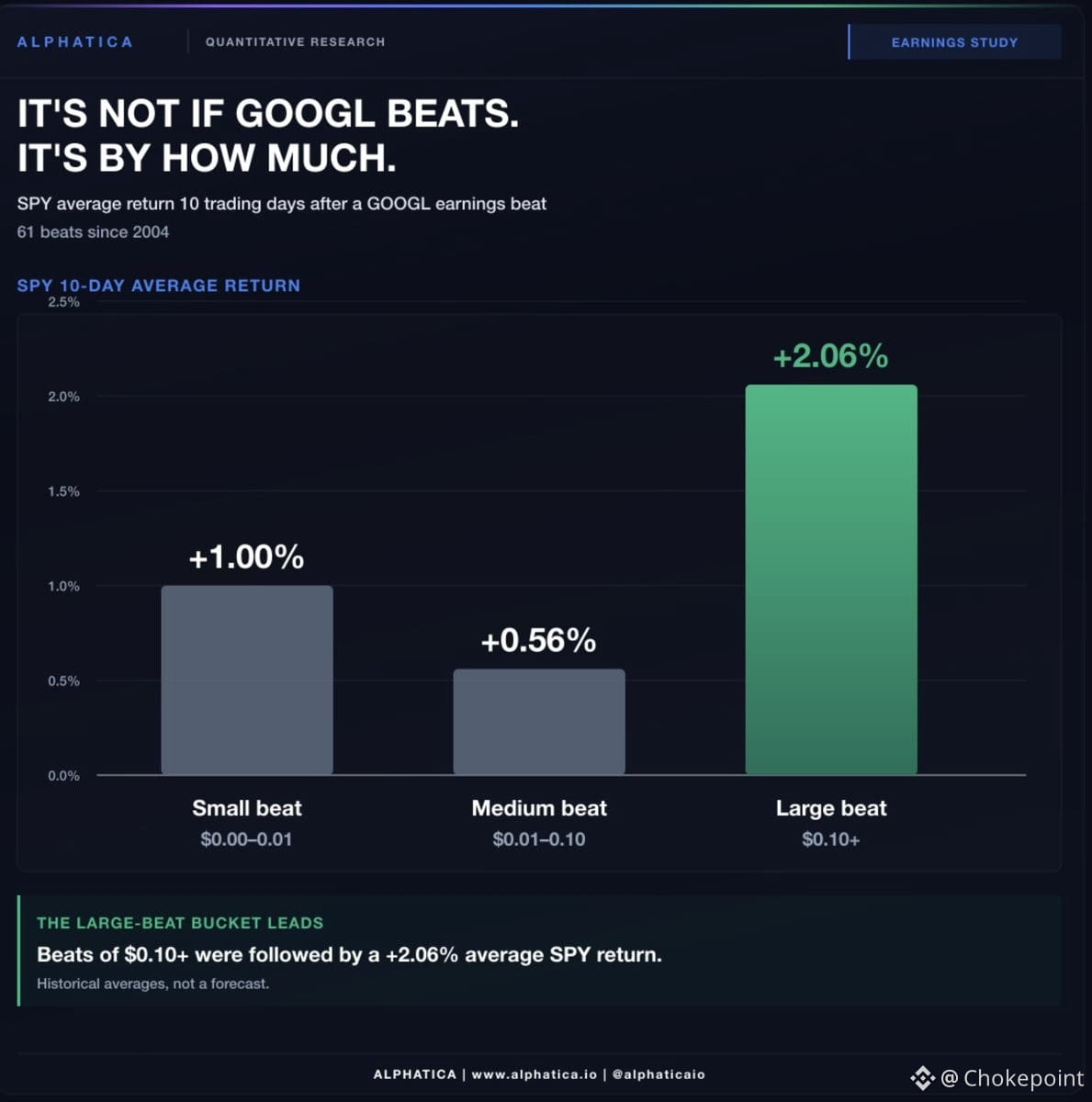
Everyone's watching whether $GOOGL beats tomorrow. That's not the variable that matters.
We backtested $GOOGL earnings to 2004. Beat vs. miss has no statistically significant effect on $SPY. Pre-earnings volume doesn't either.
What survived: the size of the beat.
$SPY performance over the next 10 days, by beat magnitude:
• Small beat ($0.00–0.01): +1.00%, 80% win rate
• Medium beat ($0.01–0.10): +0.56%, 75% win rate
• Large beat ($0.10+): +2.06% at 10 days, +2.34% at 20 days
Any beat: $SPY +1.22% at 10 days, 75% win rate (p = 0.0004).
Live test since June: July 22, $GOOGL beat by $6.23. $SPY was +2.99% 10 days later.
The setup going in:
• 14 consecutive beats
• EPS consensus $3.00, revenue consensus $127.8B
• Revenue revisions: 18 up, 2 down
• EPS revisions: 15 up, 9 down
Analysts expect stronger sales but are split on how much drops to the bottom line.
The number to watch tomorrow isn't the beat itself — it's how big the beat is.
396
·
--
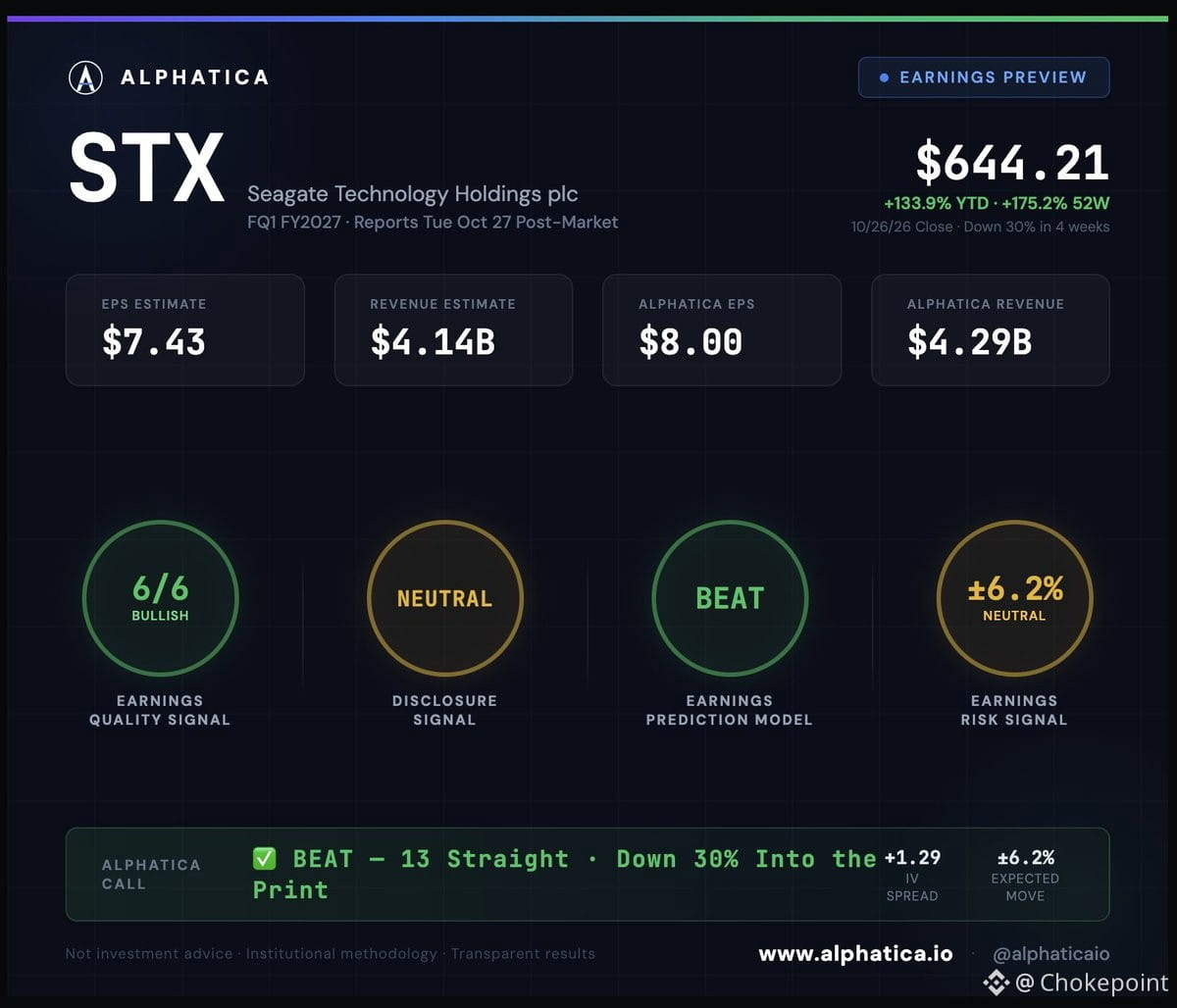
Seagate ($STX) reports tonight. 13 straight beats. Down 30% in four weeks. Street wants $7.43 EPS and $4.14B revenue. We're calling $8.00 and $4.29B — a beat.
The numbers tell a supply-side story. Gross margin went 39% → 42% → 47% → 52% over four quarters. That's pricing power, not volume. Revenue beat every quarter by 2.5% to 5%. Analysts are still catching up — FY2027 EPS estimates jumped from $28.58 to $36.66 in 90 days, 12 raises, zero cuts.
Why the stock fell: On Oct 2, Toshiba said it'll double AI data-center drive capacity by fiscal 2027. Market read that as a supply threat to pricing. $STX is now 41% below its $1,145 high, trading at 17.6x FY2027.
The beat isn't the question. The question is whether management says pricing holds.
Quality signal: 6/6. Full cycle turn. FY2023 loss → 33.6% operating margin in FY2026. Debt down 37%. Equity flipped from -$1.49B to +$2.17B. Operating cash flow 1.15x net income. Internal accounting signals confidence.
Prediction model: beat. Last four averaged 11.8% surprise. We're sizing 7.7% above street.
Earnings risk: +/-6.2%, about $41.74 expected move. Last four reports moved an average of 12.9% next day. Options are pricing half of what this stock recently delivered.
Setup: We've seen this before. In July, stock fell 16% in five days before the report, then rose 13% in five days after. Last four reports were followed by five-day gains of 12.3%, 19.6%, 33.2%, 13.1%.
Short volume ratio averaged 40.2% over 20 days, hit 28.1% on Oct 16. Even with a 30% drawdown, shorts aren't leaning in.
Beat line: $7.85. Options range: $633 to $716. Close: $644. The beat is likely. The guide decides whether the 30% comes back.
2
197
Войдите, чтобы посмотреть больше материала
Присоединяйтесь к пользователям криптовалют по всему миру на Binance Square
⚡️ Получайте новейшую и полезную информацию о криптоактивах.
💬 Нам доверяет крупнейшая в мире криптобиржа.
👍 Получите достоверные аналитические данные от верифицированных создателей контента.
Эл. почта/номер телефона
В тренде
FedWatch
Просмотров: 16.3M
39,252 обсуждают
🚨 🇺🇸 PETER SCHIFF JUST THREW A BIG WARNING AT THE FED!
Peter Schiff is calling Kevin Warsh’s tough talk on inflation a “bluff,” and his prediction could have major implications for the markets.
Schiff believes the Fed could eventually return to money printing through quantitative easing (QE) and even cut interest rates next year, despite inflation continuing to rise.
Think about that for a moment.
🔥 Inflation could remain a problem. 🔥 The Fed could still move toward easier monetary policy. 🔥 More liquidity could flow into financial markets.
If this scenario plays out, it could create a very different market environment for stocks, gold, Bitcoin, and the wider crypto market.
But there’s a catch: if inflation stays high, the Fed could face a difficult choice between fighting rising prices and supporting the economy.
Will Warsh stick to a tough inflation policy, or will the Fed eventually change direction?
The next move could matter a lot for investors.
#FedWatch #EarningsSeason #USMidtermElections #BrazilCryptoExchangesMustApplyForLicensesByFriday #StanDruckenmillerBecomesInvestorInTradeXYZ
Jackson Liam
·Лайков: 2
·Просмотров: 6.2k
EarningsSeason
Просмотров: 6.4M
31,964 обсуждают
USMidtermElections
Просмотров: 27,451
550 обсуждают