
Raja Ali Ali
508 Публикации

Raja Ali Ali
Отправить жалобу
Заблокировать пользователя
Трейдер с регулярными сделками
1.3 г
74 подписок(и/а)
305 подписчиков(а)
696 понравилось
Посты
·
--
🚨 CRYPTO NEWS: THAILAND’S NEW BTC & ETH ETF RULES TAKE EFFECT TODAY! 🇹🇭
Big development for the crypto market! 👀
📢 Thailand’s Securities and Exchange Commission has introduced rules for cryptocurrency ETFs, effective October 16, 2026.
🔹 Bitcoin (BTC): Included in the initial eligible assets.
🔹 Ethereum (ETH): Also included in the initial eligible assets.
🔹 Investor protection: The rules require regulated custodians and at least 80% average exposure to the tracked crypto asset.
📊 Why does this matter?
Clearer investment rules could help strengthen the structure of crypto investment products and make regulated market access easier.
⚠️ However, new regulations do not guarantee price increases. Market conditions and investor demand still matter.
💬 Your opinion: Will regulated crypto ETFs attract more institutional investors to BTC and ETH?
Drop your thoughts below! 👇
#Ethereum #CryptoNews #BTC #ETH #CryptoMarket $BTC
{future}(BTCUSDT)
🚨 CRYPTO NEWS: THAILAND’S NEW BTC & ETH ETF RULES TAKE EFFECT TODAY! 🇹🇭
Big development for the crypto market! 👀
📢 Thailand’s Securities and Exchange Commission has introduced rules for cryptocurrency ETFs, effective October 16, 2026.
🔹 Bitcoin (BTC): Included in the initial eligible assets.
🔹 Ethereum (ETH): Also included in the initial eligible assets.
🔹 Investor protection: The rules require regulated custodians and at least 80% average exposure to the tracked crypto asset.
📊 Why does this matter?
Clearer investment rules could help strengthen the structure of crypto investment products and make regulated market access easier.
⚠️ However, new regulations do not guarantee price increases. Market conditions and investor demand still matter.
💬 Your opinion: Will regulated crypto ETFs attract more institutional investors to BTC and ETH?
Drop your thoughts below! 👇
#Ethereum #CryptoNews #BTC #ETH #CryptoMarket $BTC
123
·
--
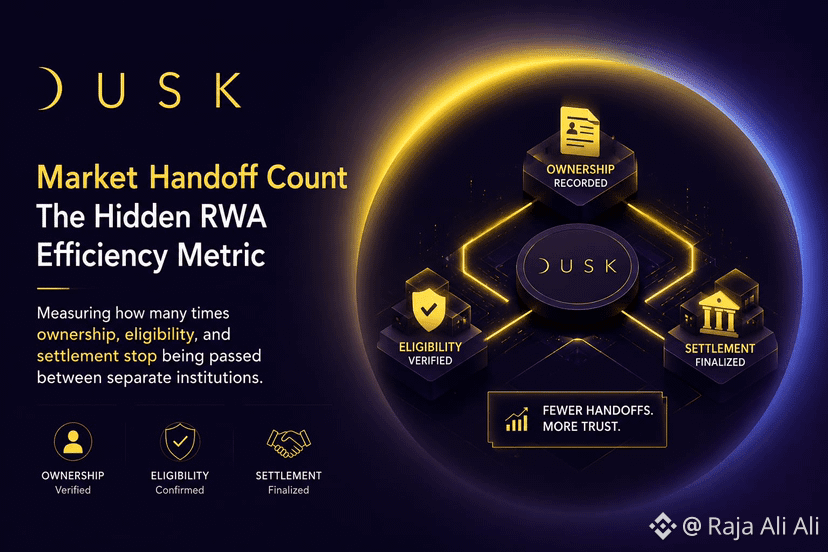
I keep noticing that financial markets can look automated right up until something has to move from one institution to another. Ownership gets recorded here, investor eligibility is checked somewhere else, settlement happens through another system, and suddenly the transaction is waiting on people and databases agreeing with each other.
That makes me wonder whether $DUSK needs a stranger RWA metric: Market Handoff Count.
Instead of asking only how many assets or transactions move onchain, I’d count how many times responsibility for the same transaction changes hands. An investor is verified, but another institution still needs that answer. Ownership changes, but another ledger has to recognize it. Settlement completes, yet someone downstream may still reconcile the record.
On the surface, each institution is doing its job. In practice, every handoff creates another place where proof becomes a decision again.
Maybe Dusk’s real efficiency appears when those boundaries start disappearing. If eligibility, ownership and settlement can share the same trusted financial state, fewer participants need to rebuild what the previous participant already established.
But fewer handoffs also concentrate responsibility. If one shared state is wrong, the mistake travels further.
So I wouldn’t automatically celebrate a lower number.
It starts to matter when handoffs disappear without accountability disappearing with them.
#dusk $DUSK @Dusk
1
81
·
--
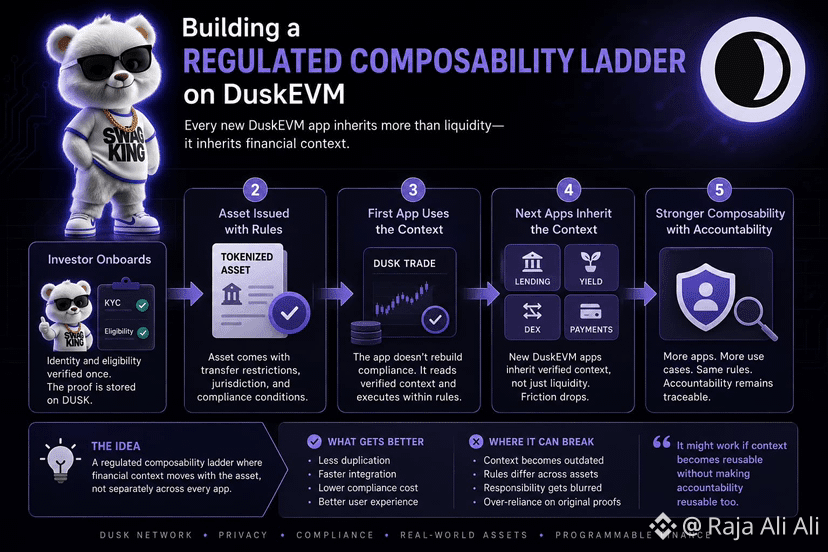
I keep noticing that “composability” sounds much simpler until the asset involved has rules attached to it. In normal DeFi, one app can inherit liquidity from another and immediately do something with it. With regulated assets, the money can arrive before the context does.
That makes me wonder if $DUSK could build something closer to a regulated composability ladder on DuskEVM.
Imagine one application already knows that an investor passed an eligibility check. Another knows the asset has transfer restrictions. A third handles settlement. If a new app can use those verified states without collecting the same documents and rebuilding the same compliance process, it inherits more than liquidity. It inherits financial context.
But this is where I hesitate.
Proof that someone was eligible yesterday is not necessarily permission to trade today. Jurisdictions change, investor status changes, and different assets can interpret the same verification differently. Reusing context could remove duplication, but it could also quietly move responsibility from the app making the decision to the system that produced the original proof.
So I’d measure the ladder by how much verified context survives between applications without manual review.
It might work if context becomes reusable without making accountability reusable too.
#dusk $DUSK @Dusk_Foundation
{future}(DUSKUSDT)
I keep noticing that “composability” sounds much simpler until the asset involved has rules attached to it. In normal DeFi, one app can inherit liquidity from another and immediately do something with it. With regulated assets, the money can arrive before the context does.
That makes me wonder if $DUSK could build something closer to a regulated composability ladder on DuskEVM.
Imagine one application already knows that an investor passed an eligibility check. Another knows the asset has transfer restrictions. A third handles settlement. If a new app can use those verified states without collecting the same documents and rebuilding the same compliance process, it inherits more than liquidity. It inherits financial context.
But this is where I hesitate.
Proof that someone was eligible yesterday is not necessarily permission to trade today. Jurisdictions change, investor status changes, and different assets can interpret the same verification differently. Reusing context could remove duplication, but it could also quietly move responsibility from the app making the decision to the system that produced the original proof.
So I’d measure the ladder by how much verified context survives between applications without manual review.
It might work if context becomes reusable without making accountability reusable too.
#dusk $DUSK @Dusk
1
92
·
--
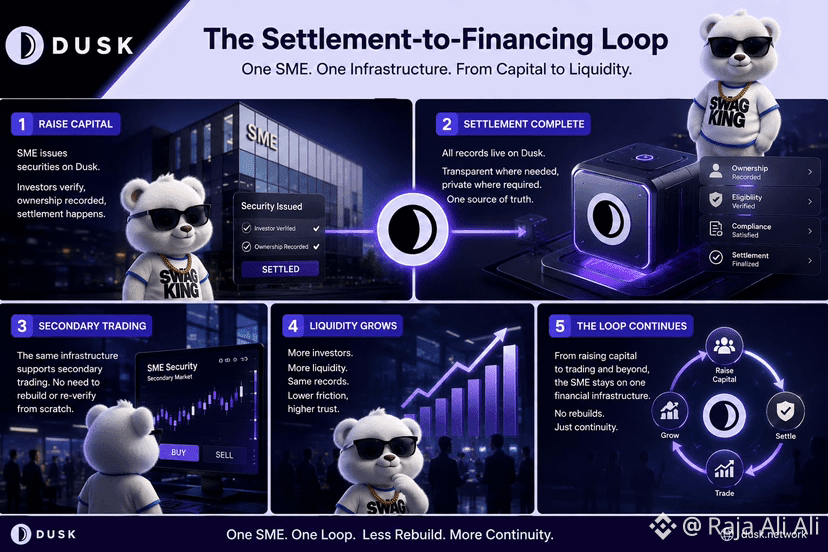
To be honest, I keep thinking the expensive part of SME financing may not be raising the money. It might be everything the company has to rebuild once that money needs somewhere else to go.
An SME could issue securities through $DUSK, investors complete eligibility checks, ownership gets recorded and settlement happens. On the surface, that looks finished.
Then secondary trading begins.
Suddenly the same company may need another venue, another investor check, another ownership reconciliation, maybe another institution deciding whether the previous records are acceptable. The asset exists already, but the financial workflow starts again.
That makes me wonder about a “Settlement-to-Financing Loop.”
If issuance, investor eligibility, ownership records, settlement and later trading can reuse the same underlying financial state, an SME would not just tokenize an asset once. Each completed step could become infrastructure for the next one.
But reuse creates another problem. A verified record does not automatically mean another institution will accept the decision behind it. Regulations change. Investor status changes. Responsibility still has to sit somewhere.
So the interesting metric may not be how many SMEs issue on Dusk.
I’d watch how little infrastructure an SME has to rebuild when its capital moves from issuance into an actual secondary market.
That is where continuity starts to matter.
#dusk $DUSK @Dusk
To be honest, I keep thinking the expensive part of SME financing may not be raising the money. It might be everything the company has to rebuild once that money needs somewhere else to go.
An SME could issue securities through $DUSK , investors complete eligibility checks, ownership gets recorded and settlement happens. On the surface, that looks finished.
Then secondary trading begins.
Suddenly the same company may need another venue, another investor check, another ownership reconciliation, maybe another institution deciding whether the previous records are acceptable. The asset exists already, but the financial workflow starts again.
That makes me wonder about a “Settlement-to-Financing Loop.”
If issuance, investor eligibility, ownership records, settlement and later trading can reuse the same underlying financial state, an SME would not just tokenize an asset once. Each completed step could become infrastructure for the next one.
But reuse creates another problem. A verified record does not automatically mean another institution will accept the decision behind it. Regulations change. Investor status changes. Responsibility still has to sit somewhere.
So the interesting metric may not be how many SMEs issue on Dusk.
I’d watch how little infrastructure an SME has to rebuild when its capital moves from issuance into an actual secondary market.
That is where continuity starts to matter.
#dusk $DUSK @Dusk
1
79
·
--
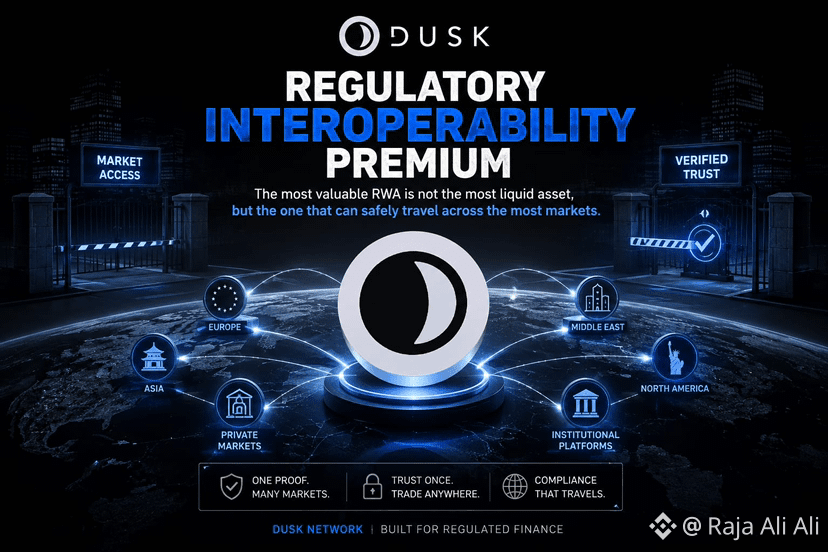
To be honest, I keep thinking liquidity might be the wrong first question for tokenized assets. An RWA can trade heavily in one market and still become strangely useless the moment someone tries to move it somewhere else.
That is where I see a possible “Regulatory Interoperability Premium” around $DUSK.
Imagine one tokenized bond accepted by a single venue. Now imagine another that can move between several regulated markets because each one can verify the investor, ownership record and required compliance proofs without rebuilding everything from zero. Same underlying asset, maybe even less trading volume, but much wider financial reach.
On the surface, both are liquid assets. In practice, one carries its regulatory context with it. The other keeps hitting borders.
And those borders are expensive. Another identity check. Another eligibility decision. Manual review. Different disclosure rules. Someone still has to accept responsibility for the previous market’s verification.
That last part bothers me.
“proof can travel faster than institutional trust”
So maybe the premium would not come from interoperability itself, but from how often another regulated venue is actually willing to inherit previous answers.
I’d watch markets-per-asset alongside liquidity.
Because an RWA that trades everywhere it is legally allowed to exist may eventually be more useful than one that simply trades a lot in one place.
It fails if every border still forces the asset back to zero.
#dusk $DUSK @Dusk_Foundation
$UAI
{alpha}(560x3e5d4f8aee0d9b3082d5f6da5d6e225d17ba9ea0)
$TUT
{future}(TUTUSDT)
{future}(DUSKUSDT)
To be honest, I keep thinking liquidity might be the wrong first question for tokenized assets. An RWA can trade heavily in one market and still become strangely useless the moment someone tries to move it somewhere else.
That is where I see a possible “Regulatory Interoperability Premium” around $DUSK .
Imagine one tokenized bond accepted by a single venue. Now imagine another that can move between several regulated markets because each one can verify the investor, ownership record and required compliance proofs without rebuilding everything from zero. Same underlying asset, maybe even less trading volume, but much wider financial reach.
On the surface, both are liquid assets. In practice, one carries its regulatory context with it. The other keeps hitting borders.
And those borders are expensive. Another identity check. Another eligibility decision. Manual review. Different disclosure rules. Someone still has to accept responsibility for the previous market’s verification.
That last part bothers me.
“proof can travel faster than institutional trust”
So maybe the premium would not come from interoperability itself, but from how often another regulated venue is actually willing to inherit previous answers.
I’d watch markets-per-asset alongside liquidity.
Because an RWA that trades everywhere it is legally allowed to exist may eventually be more useful than one that simply trades a lot in one place.
It fails if every border still forces the asset back to zero.
#dusk $DUSK @Dusk
$UAI
$TUT
1
155
·
--
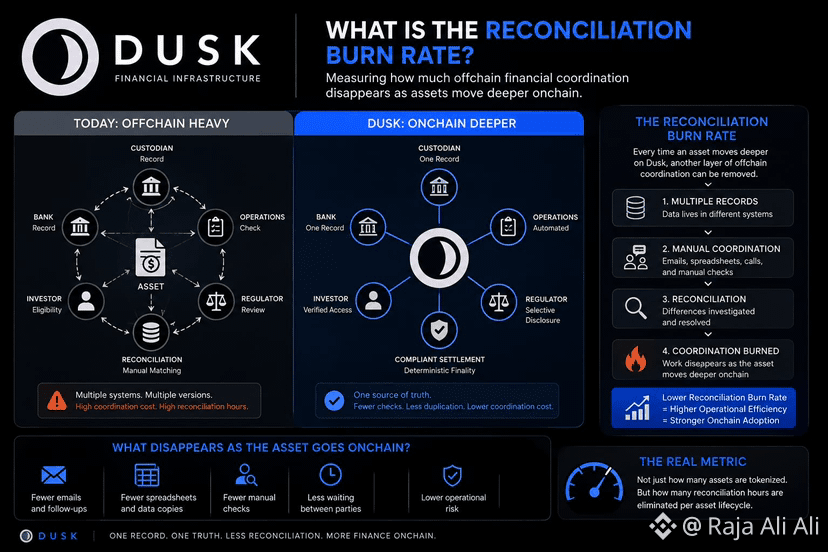
To be honest, I keep thinking tokenization gets measured at the wrong moment. We celebrate when an asset moves onchain, but the expensive part may be everything institutions still have to do around it afterward.
A trade settles. Then someone checks the ownership record against another system. Cash records get matched. Eligibility gets confirmed again. Operations teams investigate differences. On the surface, the asset is digital. In practice, people are still reconciling different versions of what happened.
That makes me wonder if Dusk could create something like a “Reconciliation Burn Rate.”
Not tokens being burned. Coordination being burned.
If issuance, ownership, compliance checks, transfers and settlement increasingly share the same underlying record on Dusk, each step could remove another reason for institutions to compare separate databases. One asset moving deeper onchain might gradually consume less email, fewer spreadsheets, fewer manual checks and less waiting between parties.
But I think the difficult part is measuring what actually disappears.
A blockchain record can prove that something happened. It does not automatically make every bank, custodian or regulator accept that record as the operational truth.
So maybe the useful metric isn't simply assets tokenized.
It is reconciliation hours eliminated per asset lifecycle.
It works if institutions actually stop maintaining the parallel records.
$SC #dusk $DUSK @Dusk_Foundation
{spot}(SCUSDT)
$TRUMP
{spot}(TRUMPUSDT)
To be honest, I keep thinking tokenization gets measured at the wrong moment. We celebrate when an asset moves onchain, but the expensive part may be everything institutions still have to do around it afterward.
A trade settles. Then someone checks the ownership record against another system. Cash records get matched. Eligibility gets confirmed again. Operations teams investigate differences. On the surface, the asset is digital. In practice, people are still reconciling different versions of what happened.
That makes me wonder if Dusk could create something like a “Reconciliation Burn Rate.”
Not tokens being burned. Coordination being burned.
If issuance, ownership, compliance checks, transfers and settlement increasingly share the same underlying record on Dusk, each step could remove another reason for institutions to compare separate databases. One asset moving deeper onchain might gradually consume less email, fewer spreadsheets, fewer manual checks and less waiting between parties.
But I think the difficult part is measuring what actually disappears.
A blockchain record can prove that something happened. It does not automatically make every bank, custodian or regulator accept that record as the operational truth.
So maybe the useful metric isn't simply assets tokenized.
It is reconciliation hours eliminated per asset lifecycle.
It works if institutions actually stop maintaining the parallel records.
$SC #dusk $DUSK @Dusk
$TRUMP
2
2
173
·
--
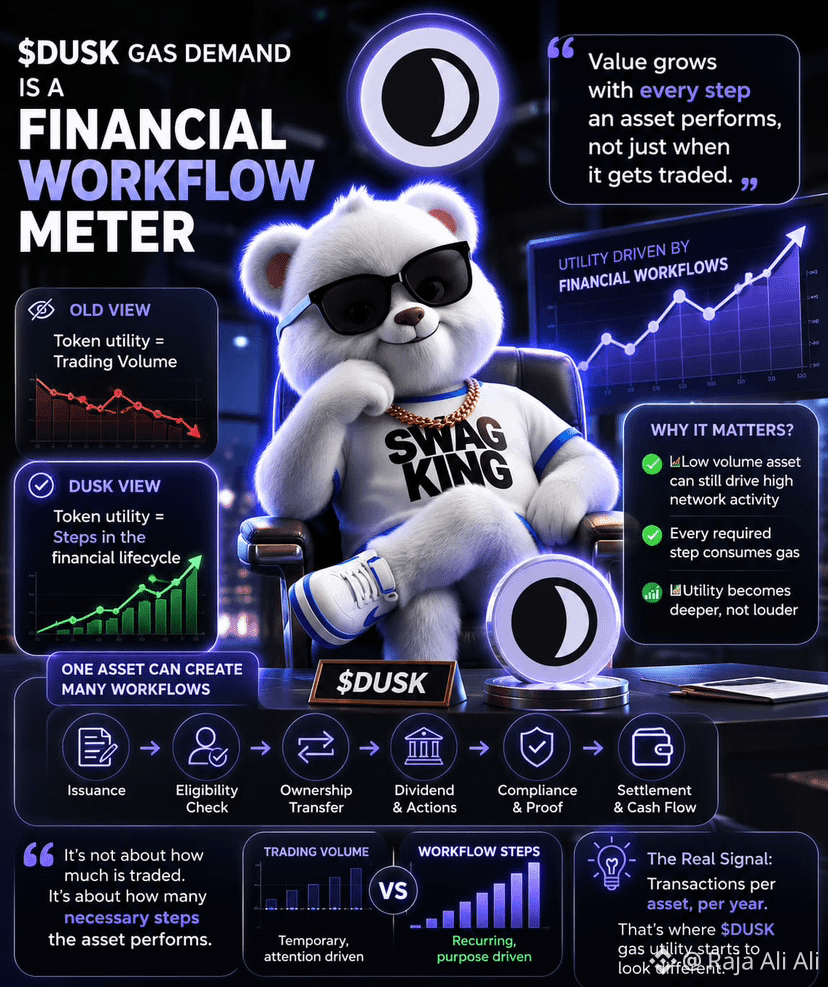
To be honest, I keep wondering if trading volume is the wrong place to look for $DUSK utility. A regulated asset can trade once, then keep creating work for years.
Think about what happens after issuance. Ownership changes. Eligibility gets checked. Cash and securities settle. Dividends move. Corporate actions happen. Someone eventually needs proof for reporting or review. On the surface these look like separate financial processes. Onchain, each can become another transaction consuming gas.
That makes $DUSK gas demand look less like a trading meter and more like a financial workflow meter.
One asset with low secondary volume could theoretically create more recurring network activity than a heavily traded token if its lifecycle keeps producing required actions. And required matters here. A speculative trade can disappear when attention leaves. A dividend or ownership update cannot simply be skipped because the market got quiet.
But I think this only becomes meaningful if those workflows actually settle on Dusk. If institutions still perform compliance checks, servicing, reporting and cash coordination somewhere else, the chain records only fragments of the lifecycle.
So maybe the metric worth watching isn't transactions per second.
It is transactions per asset, per year.
If that number keeps rising without needing speculative volume, that is where Dusk gas utility starts to look different.
#dusk $DUSK @Dusk_Foundation
{future}(DUSKUSDT)
To be honest, I keep wondering if trading volume is the wrong place to look for $DUSK utility. A regulated asset can trade once, then keep creating work for years.
Think about what happens after issuance. Ownership changes. Eligibility gets checked. Cash and securities settle. Dividends move. Corporate actions happen. Someone eventually needs proof for reporting or review. On the surface these look like separate financial processes. Onchain, each can become another transaction consuming gas.
That makes $DUSK gas demand look less like a trading meter and more like a financial workflow meter.
One asset with low secondary volume could theoretically create more recurring network activity than a heavily traded token if its lifecycle keeps producing required actions. And required matters here. A speculative trade can disappear when attention leaves. A dividend or ownership update cannot simply be skipped because the market got quiet.
But I think this only becomes meaningful if those workflows actually settle on Dusk. If institutions still perform compliance checks, servicing, reporting and cash coordination somewhere else, the chain records only fragments of the lifecycle.
So maybe the metric worth watching isn't transactions per second.
It is transactions per asset, per year.
If that number keeps rising without needing speculative volume, that is where Dusk gas utility starts to look different.
#dusk $DUSK @Dusk
1
69
·
--
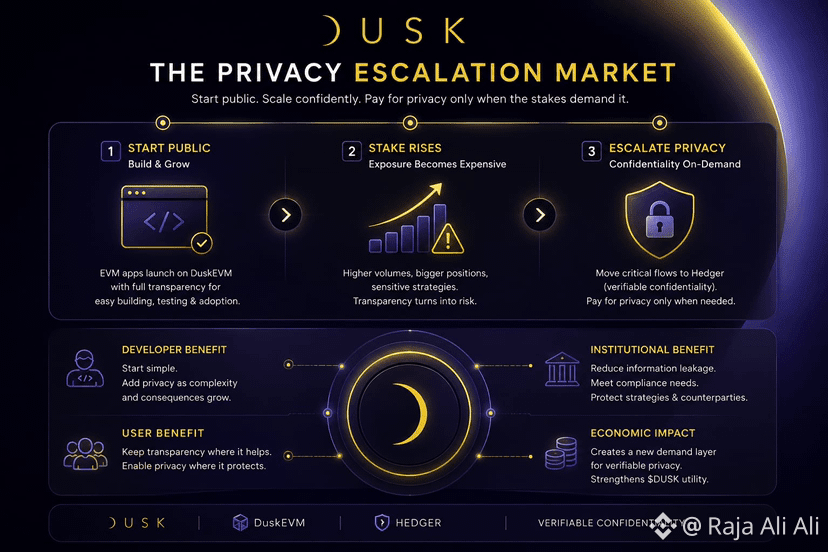
To be honest, I keep wondering whether privacy becomes valuable only when something becomes expensive enough to hide.
An EVM app on DuskEVM could start almost normally. Public contracts, visible activity, familiar Solidity tooling. At that stage, confidentiality might just feel like extra weight. More complexity for a problem the app does not have yet.
Then money gets larger.
A small trade becomes institutional order flow. A simple wallet becomes linked to investor eligibility. Positions start revealing strategy, counterparties, maybe even information competitors can use. Suddenly the same transparency that made the application easy to inspect starts creating consequences.
That makes me think about $DUSK as potentially creating a kind of privacy escalation market.
Developers would not necessarily choose public or private architecture once. They could move toward confidentiality as the economic cost of being observable rises. Hedger becomes less like a privacy feature and more like another operating layer the application starts paying for when exposure becomes expensive.
But there is friction here. Moving sensitive activity into confidential execution after an app already has users, contracts and workflows could be messy. Privacy introduced too late cannot erase what was already exposed.
So maybe the real test is whether DuskEVM makes that escalation cheap enough to happen before transparency becomes a liability.
That is where it starts to matter.
#dusk $DUSK @Dusk
1
2
79
·
--
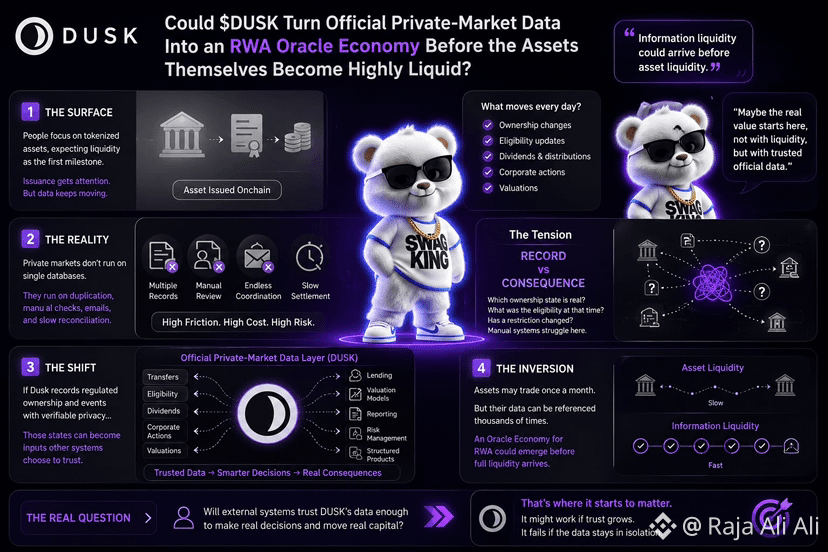
To be honest, I keep wondering if we are looking at RWA liquidity too early. Private assets may trade slowly for years, but the information around them doesn’t stay still. Ownership changes. Eligibility changes. Dividends happen. Valuations move. Corporate actions create new records.
That makes me think $DUSK could produce something valuable before those assets become deeply liquid: official private-market data that other systems actually need to trust.
On the surface, an oracle just brings data somewhere else. In practice, private markets make that messy. Which ownership record is authoritative? Was the investor eligible when the transfer happened? Has a restriction changed? Institutions normally answer these questions through separate databases, documents and manual reconciliation.
So the interesting tension becomes record versus consequence.
If Dusk becomes part of the infrastructure where regulated ownership and asset events are recorded, those verified states could potentially become inputs for lending, valuation, reporting or other financial systems. The asset itself might trade once a month while its data gets referenced constantly.
That feels like a strange inversion: information liquidity could arrive before asset liquidity.
But it only matters if outside systems trust the source enough to make real decisions from it. Otherwise Dusk just creates cleaner records inside another closed market.
That is where it starts to matter.
#dusk $DUSK @Dusk
1
2
68
·
--
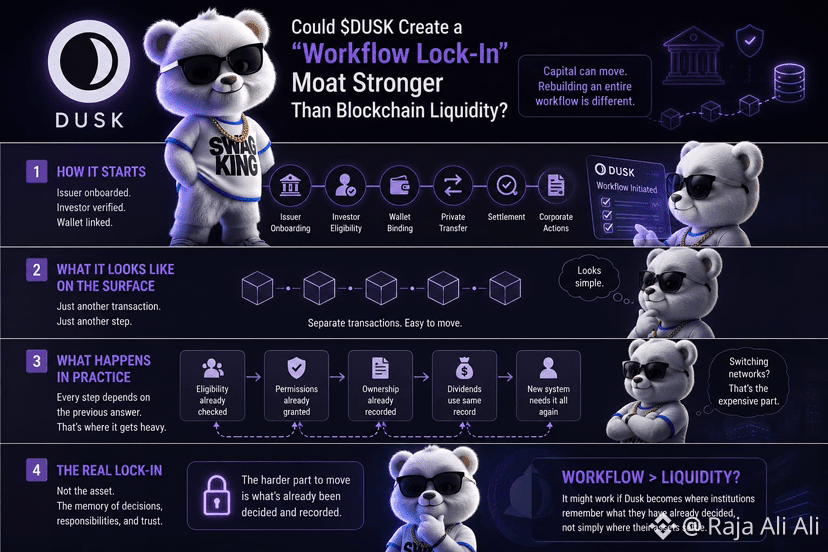
To be honest, I keep wondering whether blockchain liquidity is even the hardest thing for institutions to leave behind. Capital can move. Rebuilding an entire workflow is different.
If Dusk becomes the place where an issuer handles investor eligibility, private transfers, settlement and later corporate actions, each step starts depending on answers produced earlier. The wallet was already checked. The investor was already approved. Ownership is already recorded. A dividend later uses that same record.
On the surface, these are separate transactions. In practice, they become a chain of institutional decisions.
That creates a strange kind of lock-in. Moving an asset elsewhere may be technically easy, but moving the surrounding trust becomes heavier. Another system might need eligibility checked again, records reconciled, permissions rebuilt and responsibility reassigned. Suddenly switching networks is not mainly a bridge problem. It is a coordination problem.
But I’m slightly uncomfortable calling that a moat automatically. If institutions still keep their real compliance records outside Dusk, the workflow may remain portable and Dusk becomes only one execution layer among many.
The stronger moat appears when leaving means repeating work nobody wants to repeat.
It might work if Dusk becomes where institutions remember what they have already decided, not simply where their assets happen to settle.
#dusk $DUSK @Dusk_Foundation $ACE $ALPINE
{future}(ALPINEUSDT)
{future}(ACEUSDT)
To be honest, I keep wondering whether blockchain liquidity is even the hardest thing for institutions to leave behind. Capital can move. Rebuilding an entire workflow is different.
If Dusk becomes the place where an issuer handles investor eligibility, private transfers, settlement and later corporate actions, each step starts depending on answers produced earlier. The wallet was already checked. The investor was already approved. Ownership is already recorded. A dividend later uses that same record.
On the surface, these are separate transactions. In practice, they become a chain of institutional decisions.
That creates a strange kind of lock-in. Moving an asset elsewhere may be technically easy, but moving the surrounding trust becomes heavier. Another system might need eligibility checked again, records reconciled, permissions rebuilt and responsibility reassigned. Suddenly switching networks is not mainly a bridge problem. It is a coordination problem.
But I’m slightly uncomfortable calling that a moat automatically. If institutions still keep their real compliance records outside Dusk, the workflow may remain portable and Dusk becomes only one execution layer among many.
The stronger moat appears when leaving means repeating work nobody wants to repeat.
It might work if Dusk becomes where institutions remember what they have already decided, not simply where their assets happen to settle.
#dusk $DUSK @Dusk $ACE $ALPINE
2
227
·
--
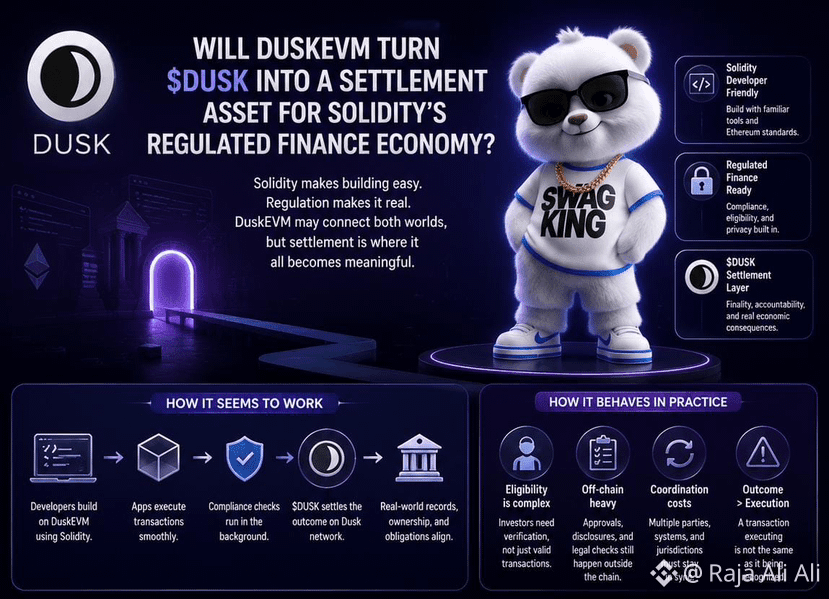
To be honest, I keep wondering whether DuskEVM’s real value is less about bringing Solidity developers to Dusk and more about deciding where their financial activity eventually settles.
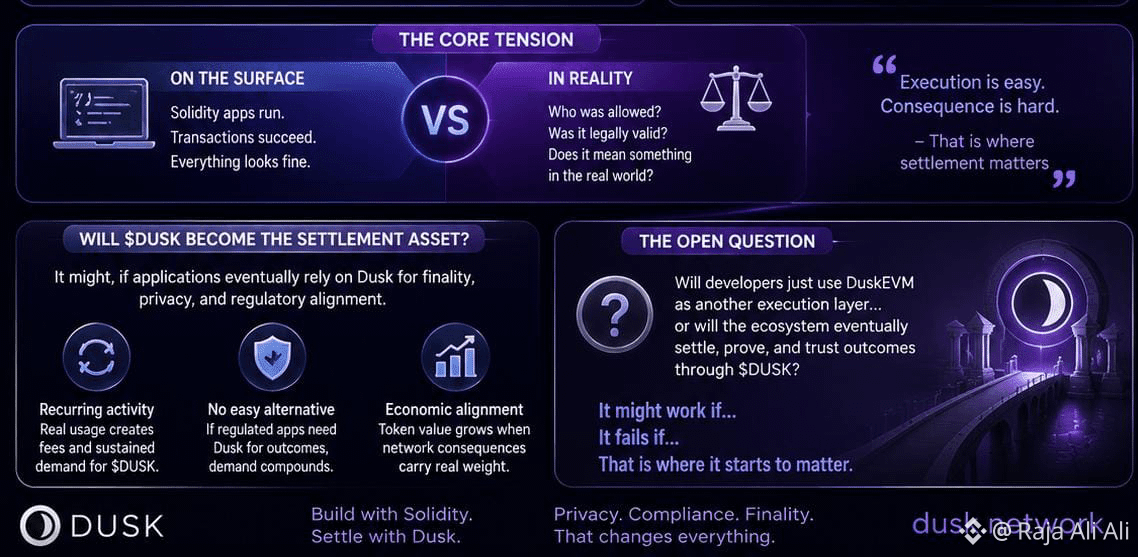
On the surface, compatibility makes the path simple. Developers can build with tools they already understand instead of learning an entirely new environment. But regulated finance becomes heavier once an application touches real securities. A transaction being technically valid does not mean the investor was eligible, the transfer was legally permitted, or the final ownership record means anything outside the chain.
That is where I think the interesting tension appears. Solidity can remain the application language, while $DUSK potentially becomes part of the settlement layer underneath it. Developers may barely think about Dusk at first. Yet every regulated trade eventually has to become a recognized outcome somewhere.
And settlement is where consequences accumulate.
Still, compatibility alone cannot force that demand. If applications execute through DuskEVM but economic activity gets abstracted away from $DUSK, developer adoption could grow without equivalent token demand. There is also the old institutional friction: identity checks, approvals and legal responsibility do not disappear because Solidity handles the transaction.
Maybe the real question is not whether DuskEVM attracts Ethereum developers. It is whether their applications eventually have nowhere more useful to settle. That is where it starts to matter.
$GPS $STAR #dusk @Dusk_Foundation
{future}(DUSKUSDT)
{alpha}(560x8fce7206e3043dd360f115afa956ee31b90b787c)
{future}(GPSUSDT)
To be honest, I keep wondering whether DuskEVM’s real value is less about bringing Solidity developers to Dusk and more about deciding where their financial activity eventually settles.
On the surface, compatibility makes the path simple. Developers can build with tools they already understand instead of learning an entirely new environment. But regulated finance becomes heavier once an application touches real securities. A transaction being technically valid does not mean the investor was eligible, the transfer was legally permitted, or the final ownership record means anything outside the chain.
That is where I think the interesting tension appears. Solidity can remain the application language, while $DUSK potentially becomes part of the settlement layer underneath it. Developers may barely think about Dusk at first. Yet every regulated trade eventually has to become a recognized outcome somewhere.
And settlement is where consequences accumulate.
Still, compatibility alone cannot force that demand. If applications execute through DuskEVM but economic activity gets abstracted away from $DUSK , developer adoption could grow without equivalent token demand. There is also the old institutional friction: identity checks, approvals and legal responsibility do not disappear because Solidity handles the transaction.
Maybe the real question is not whether DuskEVM attracts Ethereum developers. It is whether their applications eventually have nowhere more useful to settle. That is where it starts to matter.
$GPS $STAR #dusk @Dusk
1
1
176
·
--
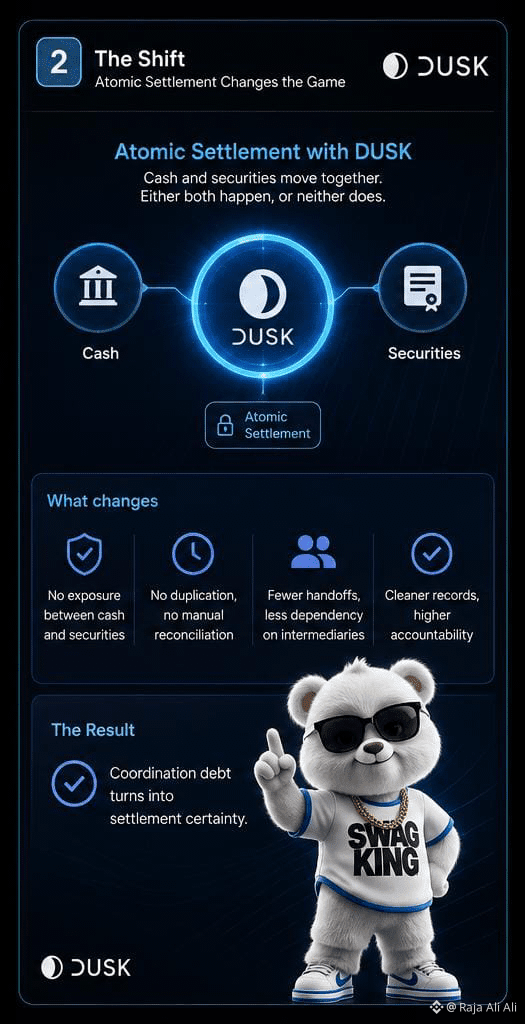
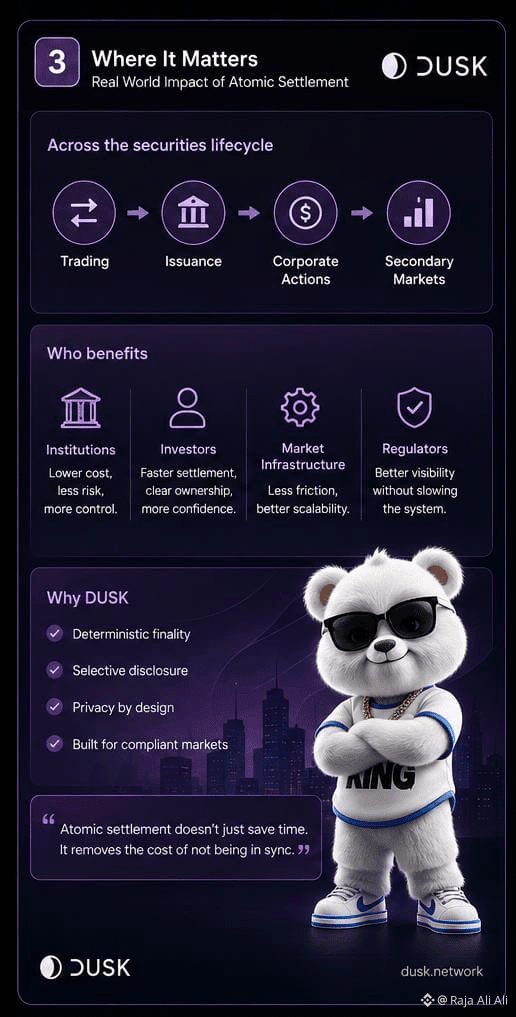
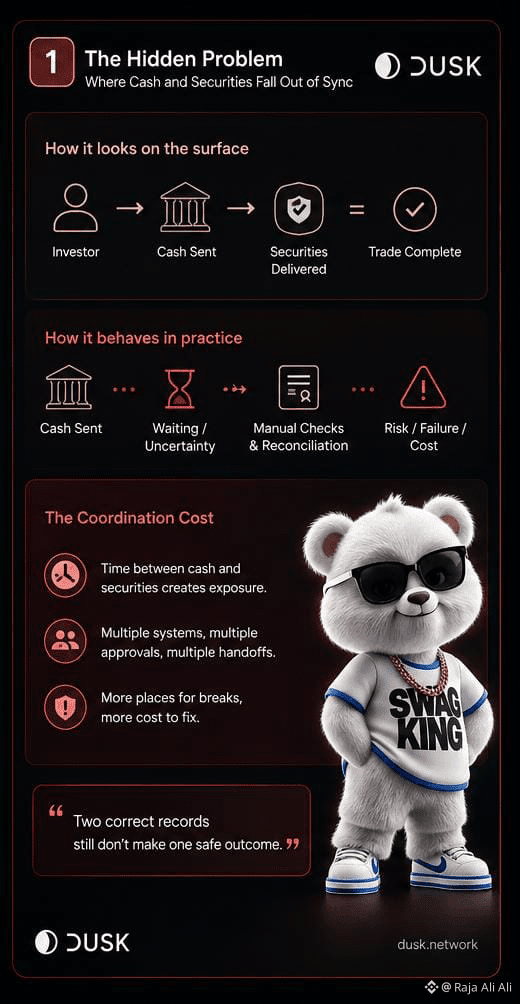
To be honest, I used to think settlement problems were mostly about speed. The longer I look at tokenized securities, though, the stranger problem seems to be coordination. Cash can be ready in one system while the security is waiting somewhere else, and suddenly two individually correct records still cannot produce one safe outcome.
That is where atomic settlement around $Dusk gets interesting to me. If the cash and security can exchange as one event, either both move or neither does. On the surface that sounds like a technical improvement. In practice, it could remove an entire period where institutions are asking: did they pay, did we deliver, who moves first, and what happens if one side fails?
I almost think of this as coordination debt.
Every minute between the cash decision and the ownership outcome creates another place for reconciliation, collateral, manual checks or responsibility to accumulate. Atomic settlement compresses that gap.
But I’m not sure the blockchain is the hardest part. Cash may still sit inside banks, eligibility decisions can happen elsewhere, and internal approvals rarely move atomically.
So $Dusk could make the securities leg perfectly synchronized while institutions remain fragmented around it.
It works if atomic settlement removes coordination rather than simply moving that coordination one layer outward.
$DOLO $AIO
#dusk $DUSK @Dusk_Foundation
{alpha}(560x81a7da4074b8e0ed51bea40f9dcbdf4d9d4832b4)
{future}(DOLOUSDT)
To be honest, I used to think settlement problems were mostly about speed. The longer I look at tokenized securities, though, the stranger problem seems to be coordination. Cash can be ready in one system while the security is waiting somewhere else, and suddenly two individually correct records still cannot produce one safe outcome.
That is where atomic settlement around $Dusk gets interesting to me. If the cash and security can exchange as one event, either both move or neither does. On the surface that sounds like a technical improvement. In practice, it could remove an entire period where institutions are asking: did they pay, did we deliver, who moves first, and what happens if one side fails?
I almost think of this as coordination debt.
Every minute between the cash decision and the ownership outcome creates another place for reconciliation, collateral, manual checks or responsibility to accumulate. Atomic settlement compresses that gap.
But I’m not sure the blockchain is the hardest part. Cash may still sit inside banks, eligibility decisions can happen elsewhere, and internal approvals rarely move atomically.
So $Dusk could make the securities leg perfectly synchronized while institutions remain fragmented around it.
It works if atomic settlement removes coordination rather than simply moving that coordination one layer outward.
$DOLO $AIO
#dusk $DUSK @Dusk
178
·
--
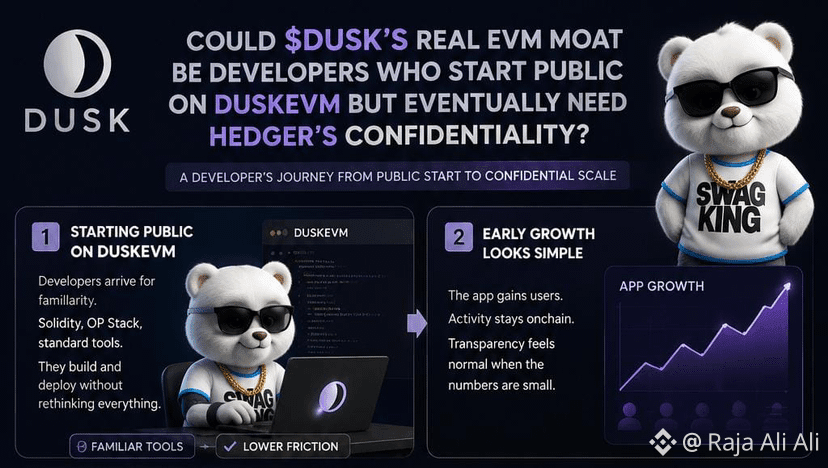
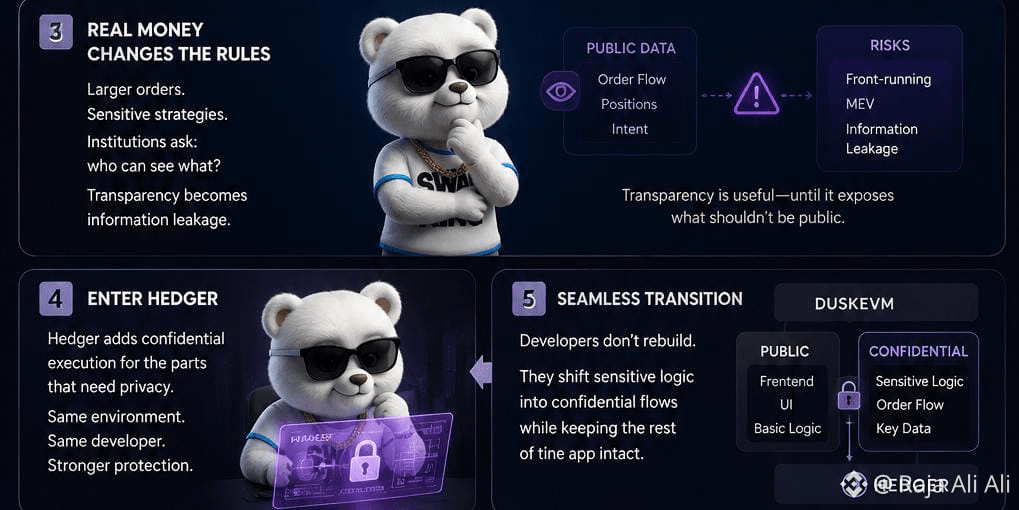
To be honest, I used to think DuskEVM’s main job was simply making $DUSK easier for Ethereum developers to approach. Familiar tools, familiar contracts, less friction. But I’m starting to think the interesting part comes later, when something built publicly becomes valuable enough that being public starts creating problems.
A developer can begin on DuskEVM without redesigning everything around confidentiality. That works while the stakes are low. Then real capital arrives. Order sizes become sensitive. Positions reveal intent. Institutional users start asking who can see what before they participate.
At that point, transparency stops being only a feature. It can become information leakage.
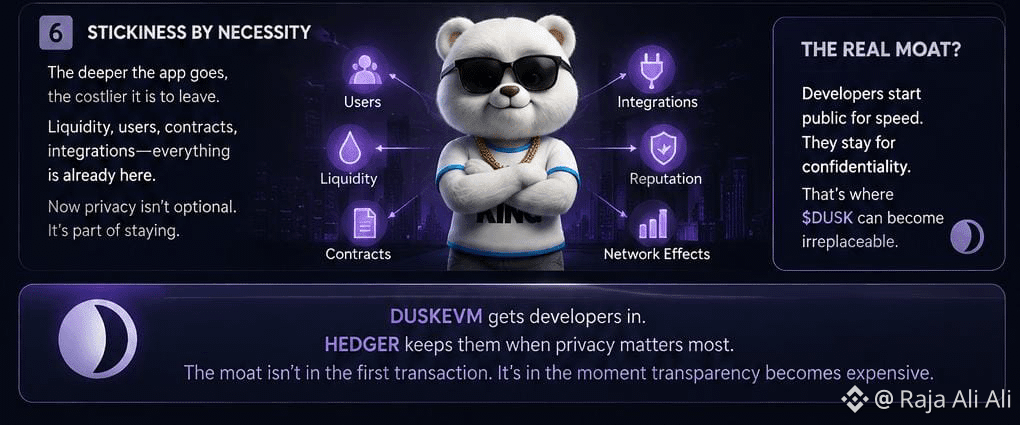
This is where Hedger changes how I look at the EVM strategy. If developers can move sensitive parts of an existing workflow toward confidential execution without rebuilding the whole application somewhere else, DuskEVM becomes more than an onboarding layer. It becomes the public entrance to a system developers may grow deeper into.
But that depends on the transition being genuinely simple. If adding confidentiality creates duplicated contracts, fragmented liquidity, extra audits or difficult coordination between public and private states, developers may just leave.
So maybe $DUSK’s EVM moat is not attracting developers with privacy on day one.
It might work if Dusk makes privacy useful exactly when success makes transparency expensive.
#dusk $DUSK @Dusk
To be honest, I used to think DuskEVM’s main job was simply making $DUSK easier for Ethereum developers to approach. Familiar tools, familiar contracts, less friction. But I’m starting to think the interesting part comes later, when something built publicly becomes valuable enough that being public starts creating problems.
A developer can begin on DuskEVM without redesigning everything around confidentiality. That works while the stakes are low. Then real capital arrives. Order sizes become sensitive. Positions reveal intent. Institutional users start asking who can see what before they participate.
At that point, transparency stops being only a feature. It can become information leakage.
This is where Hedger changes how I look at the EVM strategy. If developers can move sensitive parts of an existing workflow toward confidential execution without rebuilding the whole application somewhere else, DuskEVM becomes more than an onboarding layer. It becomes the public entrance to a system developers may grow deeper into.
But that depends on the transition being genuinely simple. If adding confidentiality creates duplicated contracts, fragmented liquidity, extra audits or difficult coordination between public and private states, developers may just leave.
So maybe $DUSK ’s EVM moat is not attracting developers with privacy on day one.
It might work if Dusk makes privacy useful exactly when success makes transparency expensive.
#dusk $DUSK @Dusk
3
2
100
·
--
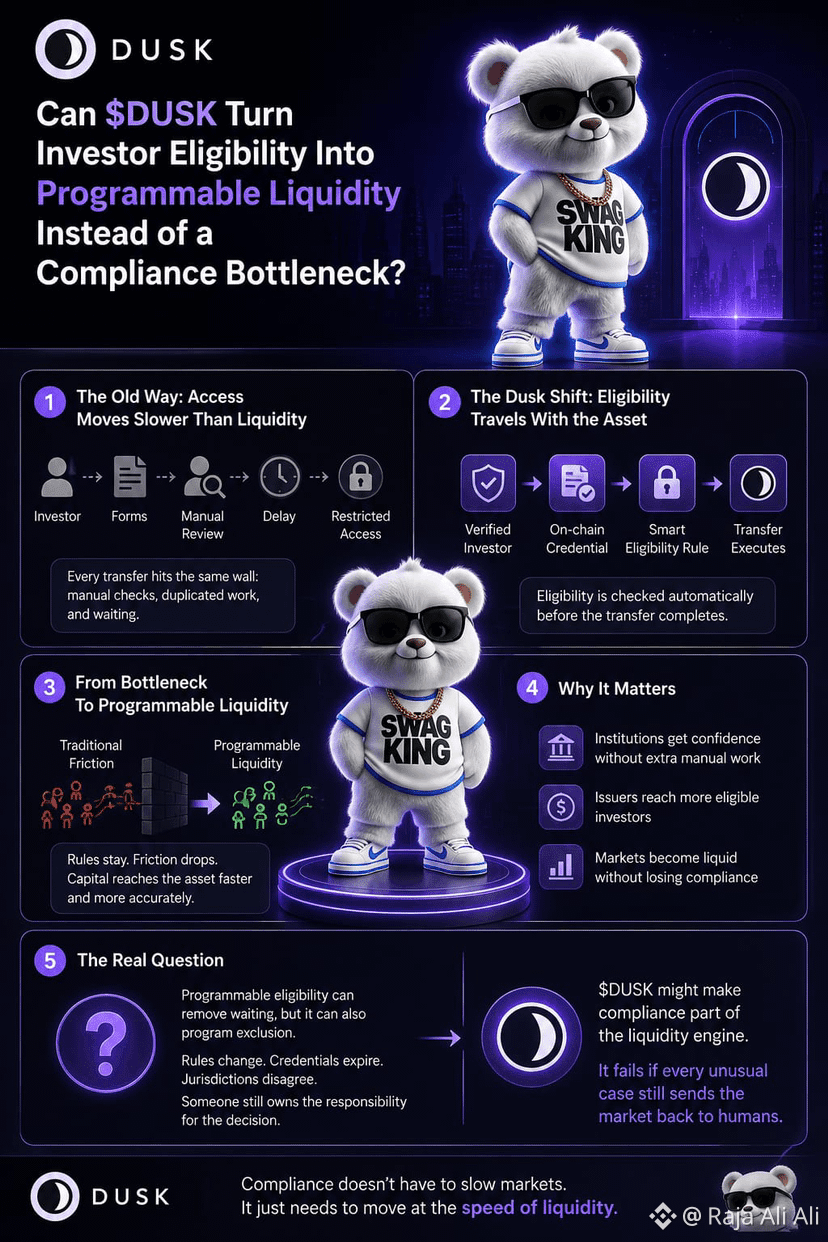
To be honest, I keep wondering whether investor eligibility is being treated as a compliance check when it is actually part of liquidity itself.
A tokenized security can technically trade, but that doesn't mean every buyer can receive it. Someone still has to prove identity, jurisdiction, investor status, maybe other restrictions. If those checks happen manually each time, the asset is liquid on paper while access remains slow in practice.
That distinction feels important for $DUSK.
If eligibility rules can travel with the asset and be checked automatically before a transfer completes, then compliance stops being something that happens after liquidity finds a buyer. It starts shaping which liquidity can actually reach the asset in the first place.
But I think there is another problem hiding here.
“Programmable eligibility can remove waiting, but it can also program exclusion.”
Rules change. Credentials expire. Jurisdictions disagree. A wallet approved yesterday might fail tomorrow, and someone still needs responsibility for deciding whether that failure is correct.
So the interesting metric may not be how many investors Dusk verifies. I’d watch how often eligible capital can move without falling back into manual review.
$DUSK might make compliance part of the liquidity engine.
It fails if every unusual case still sends the market back to humans.
#dusk $DUSK @Dusk
To be honest, I keep wondering whether investor eligibility is being treated as a compliance check when it is actually part of liquidity itself.
A tokenized security can technically trade, but that doesn't mean every buyer can receive it. Someone still has to prove identity, jurisdiction, investor status, maybe other restrictions. If those checks happen manually each time, the asset is liquid on paper while access remains slow in practice.
That distinction feels important for $DUSK .
If eligibility rules can travel with the asset and be checked automatically before a transfer completes, then compliance stops being something that happens after liquidity finds a buyer. It starts shaping which liquidity can actually reach the asset in the first place.
But I think there is another problem hiding here.
“Programmable eligibility can remove waiting, but it can also program exclusion.”
Rules change. Credentials expire. Jurisdictions disagree. A wallet approved yesterday might fail tomorrow, and someone still needs responsibility for deciding whether that failure is correct.
So the interesting metric may not be how many investors Dusk verifies. I’d watch how often eligible capital can move without falling back into manual review.
$DUSK might make compliance part of the liquidity engine.
It fails if every unusual case still sends the market back to humans.
#dusk $DUSK @Dusk
1
3
92
·
--
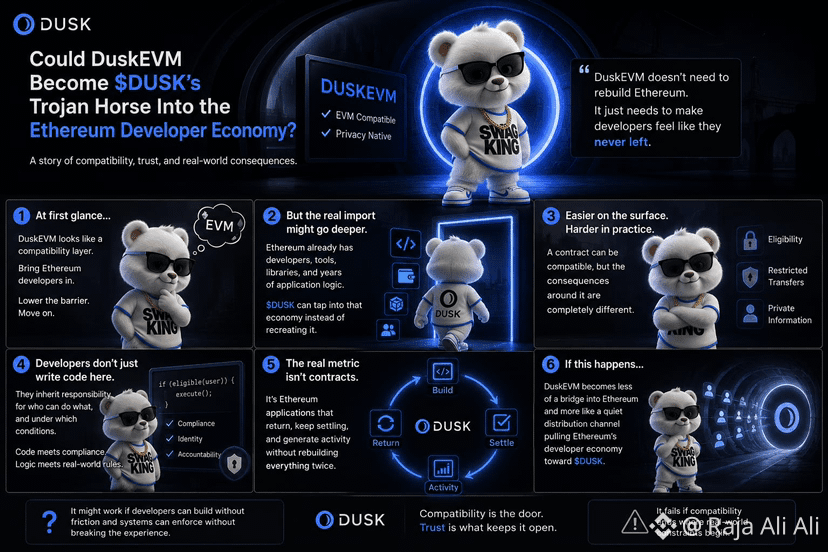
To be honest, DuskEVM initially looked like a compatibility feature to me. Let Ethereum developers bring familiar contracts and tools into Dusk, reduce the learning curve, move on.
But I think the more interesting part is what gets imported in the other direction.
Ethereum already has developers, libraries, wallets and years of application logic. $DUSK doesn't need to recreate that economy if DuskEVM can make those developers feel like they barely left it. The friction moves somewhere else: from learning a new programming environment to dealing with privacy, identity and regulated assets inside one they already understand.
That sounds easier. In practice, maybe not.
A contract can be compatible while the consequences around it are completely different. Once tokenized securities involve eligibility, restricted transfers or private information, developers aren't only writing code anymore. Their applications start inheriting responsibility for who can do what, and under which conditions.
So I keep wondering whether DuskEVM's real adoption metric is not contracts deployed, but Ethereum applications that return and keep generating settlement activity without requiring teams to rebuild everything twice.
If that happens, DuskEVM becomes less of a bridge into Ethereum and more like a quiet distribution channel pulling Ethereum's developer economy toward $DUSK.
It fails if compatibility ends where real-world constraints begin.
#dusk $DUSK @Dusk_Foundation
To be honest, DuskEVM initially looked like a compatibility feature to me. Let Ethereum developers bring familiar contracts and tools into Dusk, reduce the learning curve, move on.
But I think the more interesting part is what gets imported in the other direction.
Ethereum already has developers, libraries, wallets and years of application logic. $DUSK doesn't need to recreate that economy if DuskEVM can make those developers feel like they barely left it. The friction moves somewhere else: from learning a new programming environment to dealing with privacy, identity and regulated assets inside one they already understand.
That sounds easier. In practice, maybe not.
A contract can be compatible while the consequences around it are completely different. Once tokenized securities involve eligibility, restricted transfers or private information, developers aren't only writing code anymore. Their applications start inheriting responsibility for who can do what, and under which conditions.
So I keep wondering whether DuskEVM's real adoption metric is not contracts deployed, but Ethereum applications that return and keep generating settlement activity without requiring teams to rebuild everything twice.
If that happens, DuskEVM becomes less of a bridge into Ethereum and more like a quiet distribution channel pulling Ethereum's developer economy toward $DUSK .
It fails if compatibility ends where real-world constraints begin.
#dusk $DUSK @Dusk
3
4
103
·
--
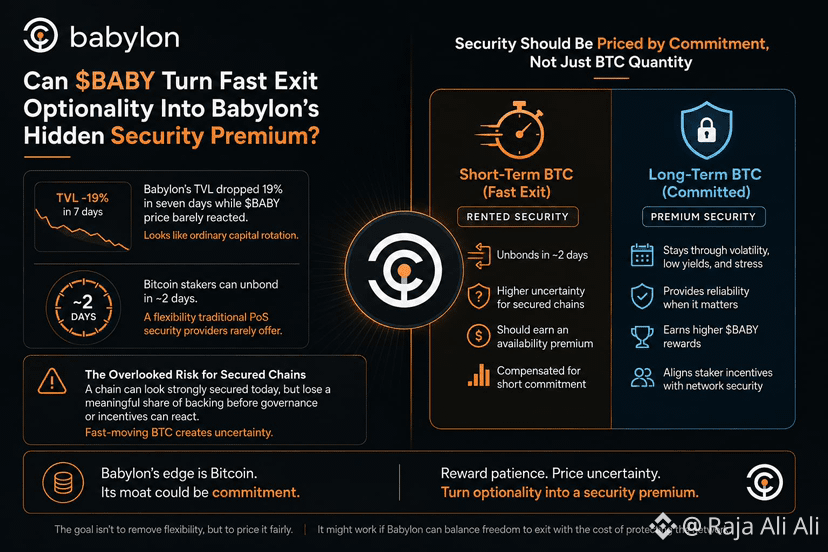
To be honest, Babylon’s 19% TVL drop in seven days looked like ordinary capital rotation at first. The $BABY price barely reacted, so the market seemed to treat the exit as movement, not stress.
But the more I looked at the unbonding design, the less neutral that movement felt. Bitcoin stakers can leave in roughly two days. That is valuable flexibility for the holder, especially when yields fall or another opportunity appears. For the chain borrowing that security, though, the same flexibility becomes uncertainty.
A network can record strong Bitcoin backing today, yet that number does not guarantee the capital will remain when conditions get uncomfortable. Governance may need days to debate incentives. Operators may need time to replace lost security. BTC does not have to wait for either.
This makes me question whether all staked Bitcoin should earn the same $BABY rewards. Capital that stays through volatility, weak yields, and actual network pressure is doing something different from capital that leaves at the first better price. One provides quantity. The other provides availability.
Maybe fast-moving BTC should be priced like rented security, while longer commitments earn a separate premium. It might work if Babylon can reward patience without turning flexibility into a penalty.
#baby $BABY @babylonlabs_io
To be honest, Babylon’s 19% TVL drop in seven days looked like ordinary capital rotation at first. The $BABY price barely reacted, so the market seemed to treat the exit as movement, not stress.
But the more I looked at the unbonding design, the less neutral that movement felt. Bitcoin stakers can leave in roughly two days. That is valuable flexibility for the holder, especially when yields fall or another opportunity appears. For the chain borrowing that security, though, the same flexibility becomes uncertainty.
A network can record strong Bitcoin backing today, yet that number does not guarantee the capital will remain when conditions get uncomfortable. Governance may need days to debate incentives. Operators may need time to replace lost security. BTC does not have to wait for either.
This makes me question whether all staked Bitcoin should earn the same $BABY rewards. Capital that stays through volatility, weak yields, and actual network pressure is doing something different from capital that leaves at the first better price. One provides quantity. The other provides availability.
Maybe fast-moving BTC should be priced like rented security, while longer commitments earn a separate premium. It might work if Babylon can reward patience without turning flexibility into a penalty.
#baby $BABY @BabylonLabs_io
4
3
142
·
--
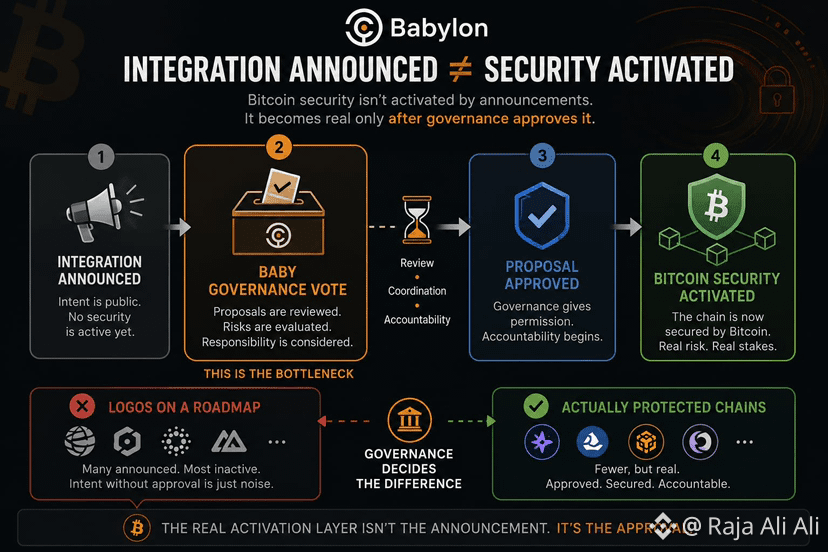
To be honest, I used to treat an integration announcement as the moment Bitcoin security became active. A chain appears on the map, the partnership is public, and it feels like the system has already expanded. But the more I look at Babylon’s structure, the less convincing that feels.
The security may be technically available, yet still inactive in practice. Governance has to approve the connection, participants need time to review it, responsibilities must be assigned, and someone has to accept the risk if the integration behaves differently under pressure. The announcement records intent. The vote creates consequence.
That changes how I think about $BABY. Maybe the scarce resource is not the number of networks willing to integrate, but the speed and quality with which governance can process them without becoming careless. More integrations could actually make the system heavier. Proposals compete for attention, voters repeat similar reviews, and weaker decisions may pass simply because participation gets tired.
So the real activation layer might be governance throughput: how many security relationships the network can evaluate, approve, and keep accountable at once.
It might work if governance scales with the integration map. It fails if the map grows faster than the network’s ability to make responsible decisions.
#baby $BABY @babylonlabs_io
To be honest, I used to treat an integration announcement as the moment Bitcoin security became active. A chain appears on the map, the partnership is public, and it feels like the system has already expanded. But the more I look at Babylon’s structure, the less convincing that feels.
The security may be technically available, yet still inactive in practice. Governance has to approve the connection, participants need time to review it, responsibilities must be assigned, and someone has to accept the risk if the integration behaves differently under pressure. The announcement records intent. The vote creates consequence.
That changes how I think about $BABY . Maybe the scarce resource is not the number of networks willing to integrate, but the speed and quality with which governance can process them without becoming careless. More integrations could actually make the system heavier. Proposals compete for attention, voters repeat similar reviews, and weaker decisions may pass simply because participation gets tired.
So the real activation layer might be governance throughput: how many security relationships the network can evaluate, approve, and keep accountable at once.
It might work if governance scales with the integration map. It fails if the map grows faster than the network’s ability to make responsible decisions.
#baby $BABY @BabylonLabs_io
3
2
89
·
--
#baby $BABY @babylonlabs_io
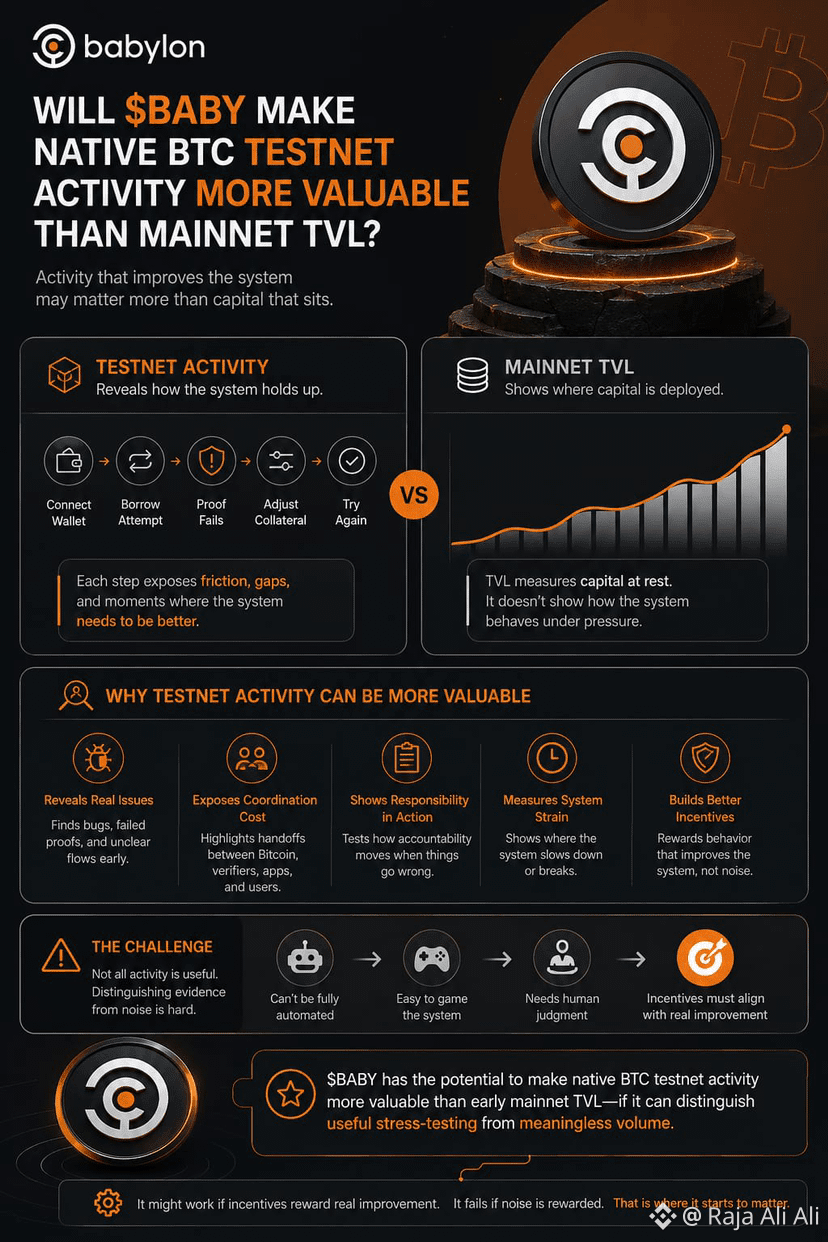
To be honest, I used to treat testnet activity as the soft part of the story and mainnet TVL as the number that eventually proves everything. Real capital feels harder to argue with. But the more I look at native BTC borrowing, the less clean that comparison becomes.
TVL records where money sits. Testnet activity can reveal where the system starts to strain.
A wallet connecting once tells me very little. A user repeating the borrowing flow, failing a proof, waiting through verification, adjusting collateral, then trying again tells me much more. It exposes the points where responsibility moves between Bitcoin, verifiers, applications, and the person taking the loan. That friction is not visible in a large TVL figure.
I keep wondering whether #Baby could eventually reward this kind of useful behavior rather than raw participation. Not clicks. Not faucet volume. Actual stress-testing that finds duplicated checks, slow coordination, unclear failures, or moments where someone still needs to step in manually.
The difficult part is deciding which activity improved the system and which activity only made the dashboard look busy. That decision cannot be fully automated without creating another layer of gaming.
Native BTC testnet activity might become more valuable than early mainnet TVL, but only if #Baby can distinguish evidence from noise. That is where it starts to matter.
{future}(BABYUSDT)
$BICO
{future}(BICOUSDT)
$VIC
{future}(VICUSDT)
#baby $BABY @BabylonLabs_io
To be honest, I used to treat testnet activity as the soft part of the story and mainnet TVL as the number that eventually proves everything. Real capital feels harder to argue with. But the more I look at native BTC borrowing, the less clean that comparison becomes.
TVL records where money sits. Testnet activity can reveal where the system starts to strain.
A wallet connecting once tells me very little. A user repeating the borrowing flow, failing a proof, waiting through verification, adjusting collateral, then trying again tells me much more. It exposes the points where responsibility moves between Bitcoin, verifiers, applications, and the person taking the loan. That friction is not visible in a large TVL figure.
I keep wondering whether #Baby could eventually reward this kind of useful behavior rather than raw participation. Not clicks. Not faucet volume. Actual stress-testing that finds duplicated checks, slow coordination, unclear failures, or moments where someone still needs to step in manually.
The difficult part is deciding which activity improved the system and which activity only made the dashboard look busy. That decision cannot be fully automated without creating another layer of gaming.
Native BTC testnet activity might become more valuable than early mainnet TVL, but only if #Baby can distinguish evidence from noise. That is where it starts to matter.
$BICO
$VIC
2
1
232
·
--
#baby $BABY @babylonlabs_io
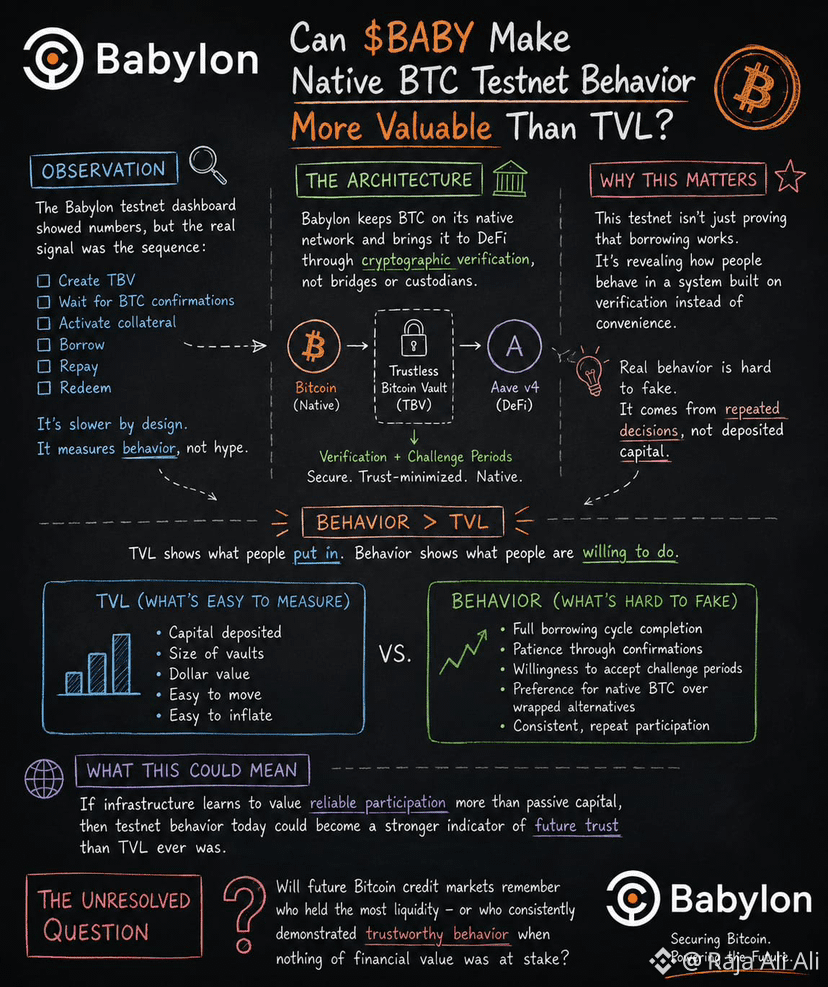
At first I assumed native BTC testnet activity would mostly be a warm-up before the numbers that everyone eventually watches, especially TVL. That framing didn’t hold up. When I looked closer, the more interesting signal wasn’t how much capital appeared, but how people behaved while nothing irreversible was at stake. Size wasn’t the filter. Repetition was. Every borrow attempt, every hesitation before locking native BTC, every return to test the flow again revealed something TVL rarely captures: whether users were learning a habit or simply chasing an incentive. With Babylon, that distinction feels more important than it first appears because behavior forms before liquidity settles. A large balance can arrive overnight, but confidence usually accumulates through repeated actions under familiar conditions. The risk didn’t disappear. It just shifted toward whether those patterns survive once real capital replaces test assets. And I keep wondering whether the strongest signal is the balance that eventually arrives, or the quiet behavior that appeared long before anyone had a financial reason to stay.
{future}(BABYUSDT)
$BLESS $STAR
{alpha}(560x8fce7206e3043dd360f115afa956ee31b90b787c)
{alpha}(560x7c8217517ed4711fe2deccdfeffe8d906b9ae11f)
#USToCancelIranAttackSubjectToDeal #CryptoLiquidationsReach$330MInADay #ColdcardExploitHits$89MAcrossThreeWaves #GoldTradesAbove$4000
#baby $BABY @BabylonLabs_io
At first I assumed native BTC testnet activity would mostly be a warm-up before the numbers that everyone eventually watches, especially TVL. That framing didn’t hold up. When I looked closer, the more interesting signal wasn’t how much capital appeared, but how people behaved while nothing irreversible was at stake. Size wasn’t the filter. Repetition was. Every borrow attempt, every hesitation before locking native BTC, every return to test the flow again revealed something TVL rarely captures: whether users were learning a habit or simply chasing an incentive. With Babylon, that distinction feels more important than it first appears because behavior forms before liquidity settles. A large balance can arrive overnight, but confidence usually accumulates through repeated actions under familiar conditions. The risk didn’t disappear. It just shifted toward whether those patterns survive once real capital replaces test assets. And I keep wondering whether the strongest signal is the balance that eventually arrives, or the quiet behavior that appeared long before anyone had a financial reason to stay.
$BLESS $STAR
#USToCancelIranAttackSubjectToDeal #CryptoLiquidationsReach$330MInADay #ColdcardExploitHits$89MAcrossThreeWaves #GoldTradesAbove$4000
5
3
383
·
--
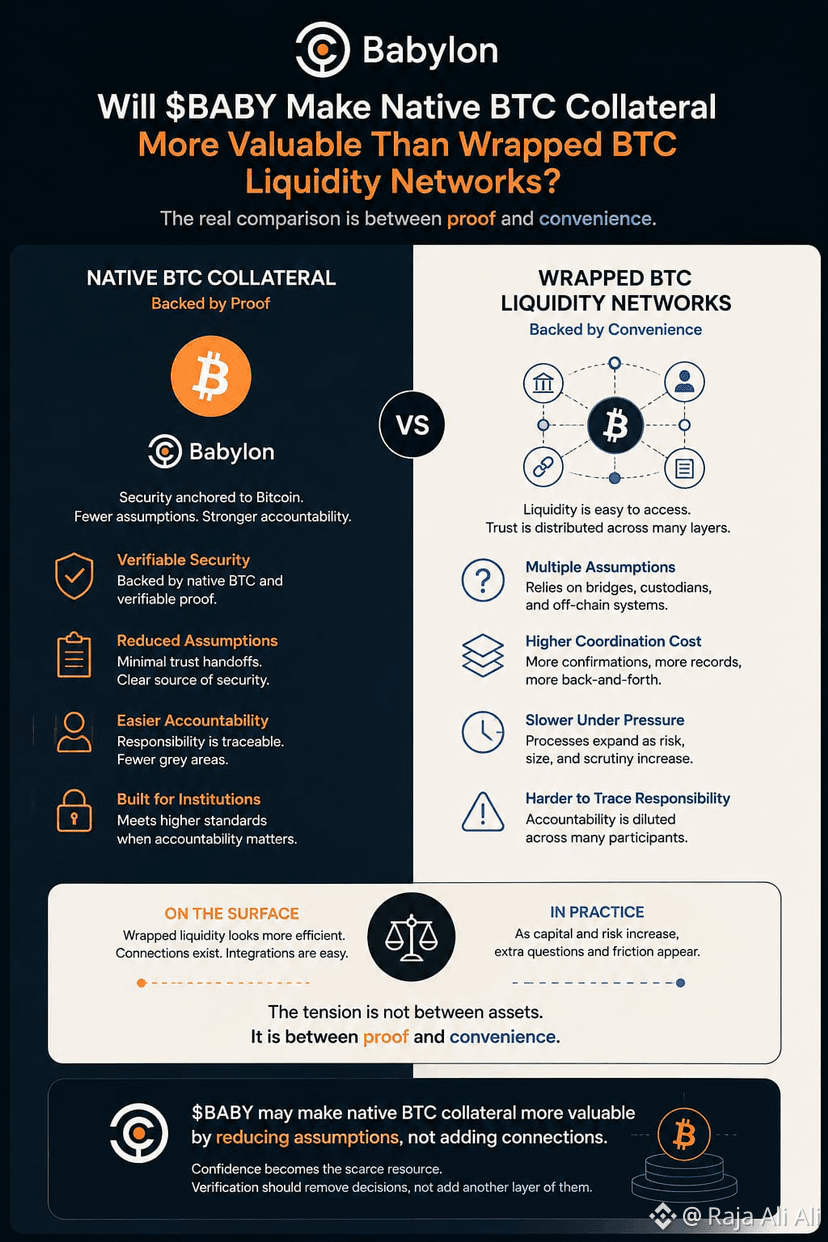
To be honest, I keep coming back to a question that seems smaller than it probably is. We spend a lot of time comparing native BTC collateral with wrapped BTC liquidity, but I am starting to think the real comparison is between proof and convenience rather than assets themselves.
Wrapped liquidity feels efficient because it is already connected to everything. The paths exist. The integrations are familiar. But the moment larger amounts of capital or stricter risk controls enter the picture, those shortcuts begin collecting extra questions. Someone wants another confirmation. Another record. Another explanation of where trust actually shifted. The coordination cost quietly grows.
That makes me wonder whether $BABY changes the value of native BTC by reducing the number of assumptions instead of increasing the number of connections. At first that sounded less useful to me because fewer connections can look like less flexibility. But maybe flexibility is not always the scarce resource. Sometimes confidence is.
I keep noticing that institutions rarely slow down because moving assets is impossible. They slow down because responsibility becomes harder to trace than the assets themselves. That difference is easy to ignore until accountability matters more than speed.
It might work if verification keeps removing decisions instead of adding another layer of them.
#baby $BABY @babylonlabs_io
To be honest, I keep coming back to a question that seems smaller than it probably is. We spend a lot of time comparing native BTC collateral with wrapped BTC liquidity, but I am starting to think the real comparison is between proof and convenience rather than assets themselves.
Wrapped liquidity feels efficient because it is already connected to everything. The paths exist. The integrations are familiar. But the moment larger amounts of capital or stricter risk controls enter the picture, those shortcuts begin collecting extra questions. Someone wants another confirmation. Another record. Another explanation of where trust actually shifted. The coordination cost quietly grows.
That makes me wonder whether $BABY changes the value of native BTC by reducing the number of assumptions instead of increasing the number of connections. At first that sounded less useful to me because fewer connections can look like less flexibility. But maybe flexibility is not always the scarce resource. Sometimes confidence is.
I keep noticing that institutions rarely slow down because moving assets is impossible. They slow down because responsibility becomes harder to trace than the assets themselves. That difference is easy to ignore until accountability matters more than speed.
It might work if verification keeps removing decisions instead of adding another layer of them.
#baby $BABY @BabylonLabs_io
3
2
82
Войдите, чтобы посмотреть больше материала
Присоединяйтесь к пользователям криптовалют по всему миру на Binance Square
⚡️ Получайте новейшую и полезную информацию о криптоактивах.
💬 Нам доверяет крупнейшая в мире криптобиржа.
👍 Получите достоверные аналитические данные от верифицированных создателей контента.
Эл. почта/номер телефона
В тренде
NvidiaEarningsTonight:AIStocks’NextMove?
Просмотров: 2,222
97 обсуждают
Nvidia Earnings Day: Interim CEO's First Appearance — Can the AI Story Hold?
Binance News
·Лайков: 3
·Просмотров: 2k
A Packed Week of Earnings and Data Tests Markets
Просмотров: 91,693
509 обсуждают
AnthropicIPOTestsInvestorAppetiteForAI
Просмотров: 186,304
1,936 обсуждают