
YousafAli03
7 Публикации

YousafAli03
Отправить жалобу
Заблокировать пользователя
Открытая сделка
Случайный трейдер
2.3 г
1 подписок(и/а)
1 подписчиков(а)
12 понравилось
Посты
Портфель
·
--
💧 What Is Market Liquidity & Why Does It Matter in Crypto?
Liquidity is one of the most important concepts every crypto trader should understand.
In simple words, liquidity means how easily an asset can be bought or sold without causing a large change in its price.
🔹 High liquidity: More buyers and sellers → easier execution → generally lower slippage.
🔹 Low liquidity: Fewer buyers and sellers → larger price impact → potentially higher slippage.
📌 Simple Example
Imagine $BTC is trading at $100,000.
If there are many buy and sell orders around $100,000, you can place a large order without moving the price much.
👉 High liquidity
But if there are very few orders available, a large buy order may push the price from $100,000 to $100,500 or higher while being filled.
👉 Low liquidity
That difference is called price impact, and it is why liquidity matters.
🔑 What to Watch:
• Trading volume
• Order-book depth
• Bid/ask spread
• Slippage
• Liquidity around important price levels
💡 Remember: High liquidity generally means smoother trading, while low liquidity can mean greater price impact and slippage.
Do you check liquidity before entering a trade? 👇
⚠️ Educational content only. Not financial advice. Do your own research.
💧 What Is Market Liquidity & Why Does It Matter in Crypto?
Liquidity is one of the most important concepts every crypto trader should understand.
In simple words, liquidity means how easily an asset can be bought or sold without causing a large change in its price.
🔹 High liquidity: More buyers and sellers → easier execution → generally lower slippage.
🔹 Low liquidity: Fewer buyers and sellers → larger price impact → potentially higher slippage.
📌 Simple Example
Imagine $BTC is trading at $100,000.
If there are many buy and sell orders around $100,000, you can place a large order without moving the price much.
👉 High liquidity
But if there are very few orders available, a large buy order may push the price from $100,000 to $100,500 or higher while being filled.
👉 Low liquidity
That difference is called price impact, and it is why liquidity matters.
🔑 What to Watch:
• Trading volume
• Order-book depth
• Bid/ask spread
• Slippage
• Liquidity around important price levels
💡 Remember: High liquidity generally means smoother trading, while low liquidity can mean greater price impact and slippage.
Do you check liquidity before entering a trade? 👇
⚠️ Educational content only. Not financial advice. Do your own research.
Liquidity is one of the most important concepts every crypto trader should understand.
In simple words, liquidity means how easily an asset can be bought or sold without causing a large change in its price.
🔹 High liquidity: More buyers and sellers → easier execution → generally lower slippage.
🔹 Low liquidity: Fewer buyers and sellers → larger price impact → potentially higher slippage.
📌 Simple Example
Imagine $BTC is trading at $100,000.
If there are many buy and sell orders around $100,000, you can place a large order without moving the price much.
👉 High liquidity
But if there are very few orders available, a large buy order may push the price from $100,000 to $100,500 or higher while being filled.
👉 Low liquidity
That difference is called price impact, and it is why liquidity matters.
🔑 What to Watch:
• Trading volume
• Order-book depth
• Bid/ask spread
• Slippage
• Liquidity around important price levels
💡 Remember: High liquidity generally means smoother trading, while low liquidity can mean greater price impact and slippage.
Do you check liquidity before entering a trade? 👇
⚠️ Educational content only. Not financial advice. Do your own research.
2
55
·
--
📊 Weekly Crypto Market Recap: Winners, Losers & Volatility Drivers
This week, the crypto market showed how quickly sentiment can shift. 📈📉
🔹 BTC: Focus remains on key support and resistance zones.
🔹 ETH: Traders are watching whether momentum can continue or face another rejection.
🔹 Altcoins: Performance remained mixed, with some sectors showing stronger momentum than others.
🔹 Volatility: Macro news, liquidity, market sentiment, and leverage continued to influence short-term price action.
What to watch next week:
➡️ BTC market structure
➡️ ETH/BTC performance
➡️ Altcoin volume
➡️ Market liquidity
➡️ Major economic events
💬 Which factor had the biggest impact on your trading this week?
This is market commentary for educational purposes, not financial advice.
#Crypto #BTC #ETH #Altcoins #BinanceSquare
📊 Weekly Crypto Market Recap: Winners, Losers & Volatility Drivers
This week, the crypto market showed how quickly sentiment can shift. 📈📉
🔹 BTC: Focus remains on key support and resistance zones.
🔹 ETH: Traders are watching whether momentum can continue or face another rejection.
🔹 Altcoins: Performance remained mixed, with some sectors showing stronger momentum than others.
🔹 Volatility: Macro news, liquidity, market sentiment, and leverage continued to influence short-term price action.
What to watch next week:
➡️ BTC market structure
➡️ ETH/BTC performance
➡️ Altcoin volume
➡️ Market liquidity
➡️ Major economic events
💬 Which factor had the biggest impact on your trading this week?
This is market commentary for educational purposes, not financial advice.
#Crypto #BTC #ETH #Altcoins #BinanceSquare
This week, the crypto market showed how quickly sentiment can shift. 📈📉
🔹 BTC: Focus remains on key support and resistance zones.
🔹 ETH: Traders are watching whether momentum can continue or face another rejection.
🔹 Altcoins: Performance remained mixed, with some sectors showing stronger momentum than others.
🔹 Volatility: Macro news, liquidity, market sentiment, and leverage continued to influence short-term price action.
What to watch next week:
➡️ BTC market structure
➡️ ETH/BTC performance
➡️ Altcoin volume
➡️ Market liquidity
➡️ Major economic events
💬 Which factor had the biggest impact on your trading this week?
This is market commentary for educational purposes, not financial advice.
#Crypto #BTC #ETH #Altcoins #BinanceSquare
82
·
--
$BTC Market Update: Key Levels to Watch 📈
Bitcoin is currently showing an interesting technical structure. Traders are watching whether price can maintain support while building momentum toward the next resistance zone.
🔹 Support: Watch the recent swing-low area
🔹 Resistance: Previous local high
🔹 Momentum: RSI can help confirm strength or weakness
🔹 Volume: A breakout with strong volume is generally more meaningful than a low-volume move.
⚠️ Technical analysis is not a guarantee of future price movement. Always manage risk and do your own research.
Question: Which $BTC level are you watching most closely right now? 👇
#BTC #Bitcoin #Crypto #TechnicalAnalysis #BinanceSquare
{spot}(BTCUSDT)
$BTC Market Update: Key Levels to Watch 📈
Bitcoin is currently showing an interesting technical structure. Traders are watching whether price can maintain support while building momentum toward the next resistance zone.
🔹 Support: Watch the recent swing-low area
🔹 Resistance: Previous local high
🔹 Momentum: RSI can help confirm strength or weakness
🔹 Volume: A breakout with strong volume is generally more meaningful than a low-volume move.
⚠️ Technical analysis is not a guarantee of future price movement. Always manage risk and do your own research.
Question: Which $BTC level are you watching most closely right now? 👇
#BTC #Bitcoin #Crypto #TechnicalAnalysis #BinanceSquare
Bitcoin is currently showing an interesting technical structure. Traders are watching whether price can maintain support while building momentum toward the next resistance zone.
🔹 Support: Watch the recent swing-low area
🔹 Resistance: Previous local high
🔹 Momentum: RSI can help confirm strength or weakness
🔹 Volume: A breakout with strong volume is generally more meaningful than a low-volume move.
⚠️ Technical analysis is not a guarantee of future price movement. Always manage risk and do your own research.
Question: Which $BTC level are you watching most closely right now? 👇
#BTC #Bitcoin #Crypto #TechnicalAnalysis #BinanceSquare
2
71
·
--
$SOL vs $ADA vs $AVAX — Which Layer 1 Has the Strongest Setup?
Layer 1 networks remain an important part of the crypto ecosystem, but each has a different design and market narrative.
🔹 SOL — High-throughput blockchain with a strong DeFi and consumer-app ecosystem.
🔹 ADA — Research-driven blockchain focused on a structured development approach.
🔹 AVAX — Flexible Layer 1 ecosystem with customizable blockchain infrastructure.
Instead of chasing price alone, compare:
📈 Price structure
📊 Trading volume
🔗 Network activity
💰 Total Value Locked (TVL)
🔥 Ecosystem growth
Which metric do you check first when comparing Layer 1 projects?
Share your analysis below
#Layer1 #SOL #ADA #AVAX #BinanceSquare
{spot}(SOLUSDT)
$SOL vs $ADA vs $AVAX — Which Layer 1 Has the Strongest Setup?
Layer 1 networks remain an important part of the crypto ecosystem, but each has a different design and market narrative.
🔹 SOL — High-throughput blockchain with a strong DeFi and consumer-app ecosystem.
🔹 ADA — Research-driven blockchain focused on a structured development approach.
🔹 AVAX — Flexible Layer 1 ecosystem with customizable blockchain infrastructure.
Instead of chasing price alone, compare:
📈 Price structure
📊 Trading volume
🔗 Network activity
💰 Total Value Locked (TVL)
🔥 Ecosystem growth
Which metric do you check first when comparing Layer 1 projects?
Share your analysis below
#Layer1 #SOL #ADA #AVAX #BinanceSquare
Layer 1 networks remain an important part of the crypto ecosystem, but each has a different design and market narrative.
🔹 SOL — High-throughput blockchain with a strong DeFi and consumer-app ecosystem.
🔹 ADA — Research-driven blockchain focused on a structured development approach.
🔹 AVAX — Flexible Layer 1 ecosystem with customizable blockchain infrastructure.
Instead of chasing price alone, compare:
📈 Price structure
📊 Trading volume
🔗 Network activity
💰 Total Value Locked (TVL)
🔥 Ecosystem growth
Which metric do you check first when comparing Layer 1 projects?
Share your analysis below
#Layer1 #SOL #ADA #AVAX #BinanceSquare
2
233
·
--
📊 $BNB Ecosystem Watch: Key Chart Setup & Ecosystem Highlights
$BNB remains one of the major assets in the crypto market, with its ecosystem spanning BNB Chain, DeFi, stablecoins, and Web3 applications.
🔎 What to watch on the chart: • Key support and resistance zones
• Trading volume around breakouts
• Higher highs / higher lows for trend confirmation
• Momentum indicators such as RSI
⚠️ A breakout without strong volume can turn into a fakeout, so confirmation matters.
What are you watching on $BNB right now — breakout, consolidation, or pullback? 👇
#BNB #Crypto #TechnicalAnalysis #BinanceSquare #BNBChain
{spot}(BNBUSDT)
📊 $BNB Ecosystem Watch: Key Chart Setup & Ecosystem Highlights
$BNB remains one of the major assets in the crypto market, with its ecosystem spanning BNB Chain, DeFi, stablecoins, and Web3 applications.
🔎 What to watch on the chart: • Key support and resistance zones
• Trading volume around breakouts
• Higher highs / higher lows for trend confirmation
• Momentum indicators such as RSI
⚠️ A breakout without strong volume can turn into a fakeout, so confirmation matters.
What are you watching on $BNB right now — breakout, consolidation, or pullback? 👇
#BNB #Crypto #TechnicalAnalysis #BinanceSquare #BNBChain
$BNB remains one of the major assets in the crypto market, with its ecosystem spanning BNB Chain, DeFi, stablecoins, and Web3 applications.
🔎 What to watch on the chart: • Key support and resistance zones
• Trading volume around breakouts
• Higher highs / higher lows for trend confirmation
• Momentum indicators such as RSI
⚠️ A breakout without strong volume can turn into a fakeout, so confirmation matters.
What are you watching on $BNB right now — breakout, consolidation, or pullback? 👇
#BNB #Crypto #TechnicalAnalysis #BinanceSquare #BNBChain
2
90
·
--
Рост
📊 $ETH Price Action: Breakout or Fakeout?
Ethereum is approaching an important technical zone. The next move could determine its short-term direction.
🟢 Bullish: A confirmed breakout above resistance with strong volume could open the door for further upside.
🔴 Bearish: A rejection followed by a move below support could signal a fakeout.
👀 Watch:
• Support & resistance
• Trading volume
• Market structure
• $BTC direction
⚠️ Don’t chase breakouts. Wait for confirmation and manage risk.
What do you think — $ETH breakout or fakeout? 👇
#ETH #Ethereum #Crypto #TechnicalAnalysis #BinanceSquare
📊 $ETH Price Action: Breakout or Fakeout?
Ethereum is approaching an important technical zone. The next move could determine its short-term direction.
🟢 Bullish: A confirmed breakout above resistance with strong volume could open the door for further upside.
🔴 Bearish: A rejection followed by a move below support could signal a fakeout.
👀 Watch:
• Support & resistance
• Trading volume
• Market structure
• $BTC direction
⚠️ Don’t chase breakouts. Wait for confirmation and manage risk.
What do you think — $ETH breakout or fakeout? 👇
#ETH #Ethereum #Crypto #TechnicalAnalysis #BinanceSquare
Ethereum is approaching an important technical zone. The next move could determine its short-term direction.
🟢 Bullish: A confirmed breakout above resistance with strong volume could open the door for further upside.
🔴 Bearish: A rejection followed by a move below support could signal a fakeout.
👀 Watch:
• Support & resistance
• Trading volume
• Market structure
• $BTC direction
⚠️ Don’t chase breakouts. Wait for confirmation and manage risk.
What do you think — $ETH breakout or fakeout? 👇
#ETH #Ethereum #Crypto #TechnicalAnalysis #BinanceSquare
2
88
·
--
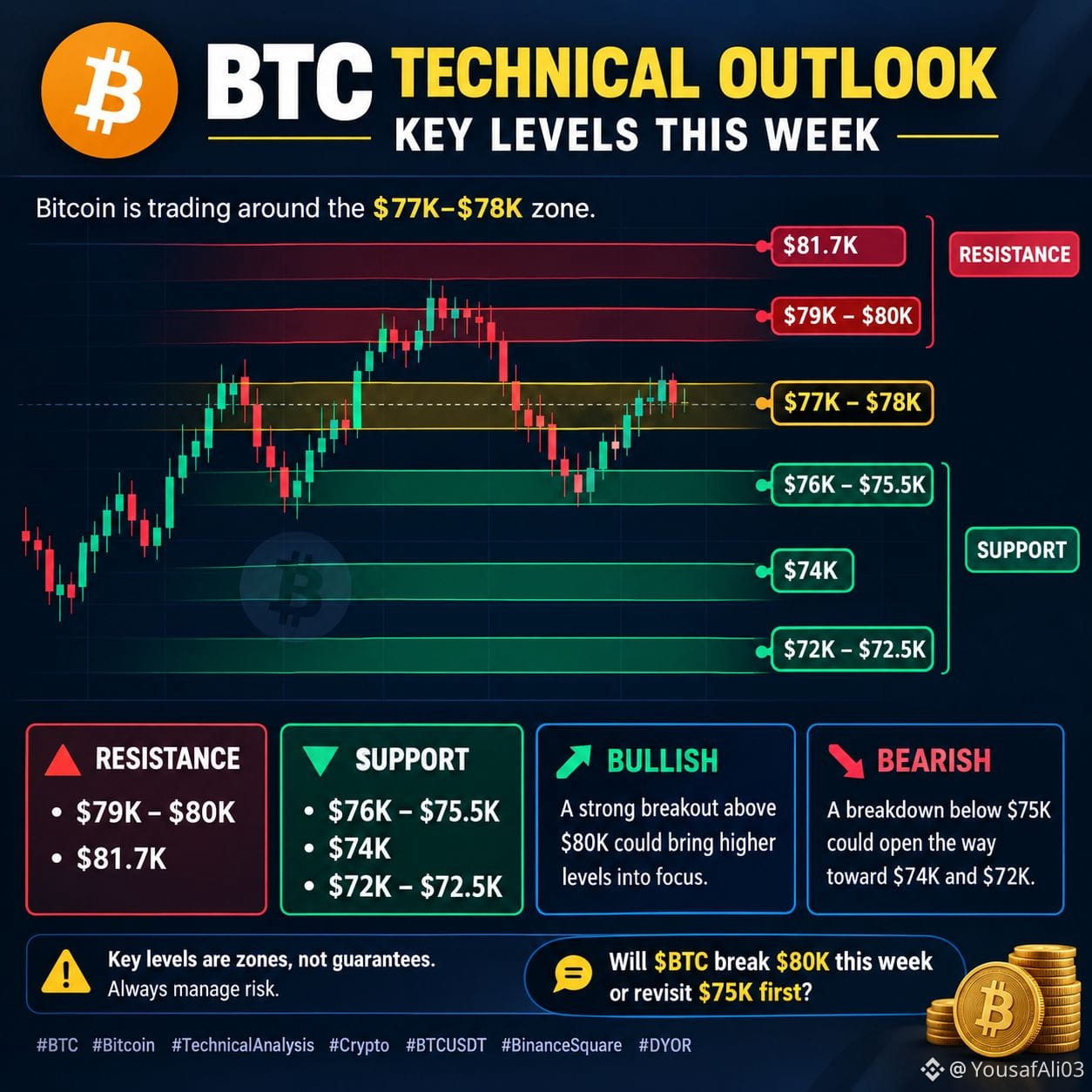
📊 $BTC TECHNICAL OUTLOOK | KEY LEVELS THIS WEEK
Bitcoin is trading around the $77K–$78K zone.
🔴 Resistance
• $79K–$80K
• $81.7K
🟢 Support
• $76K–$75.5K
• $74K
• $72K–$72.5K
📈 Bullish: A strong breakout above $80K could bring higher levels into focus.
📉 Bearish: A breakdown below $75K could open the way toward $74K and $72K.
⚠️ Key levels are zones, not guarantees. Always manage risk.
💬 Will $BTC break $80K this week or revisit $75K first?
#BTC #Bitcoin #TechnicalAnalysis #Crypto #BTCUSDT #BinanceSquare #DYOR
📊 $BTC TECHNICAL OUTLOOK | KEY LEVELS THIS WEEK
Bitcoin is trading around the $77K–$78K zone.
🔴 Resistance
• $79K–$80K
• $81.7K
🟢 Support
• $76K–$75.5K
• $74K
• $72K–$72.5K
📈 Bullish: A strong breakout above $80K could bring higher levels into focus.
📉 Bearish: A breakdown below $75K could open the way toward $74K and $72K.
⚠️ Key levels are zones, not guarantees. Always manage risk.
💬 Will $BTC break $80K this week or revisit $75K first?
#BTC #Bitcoin #TechnicalAnalysis #Crypto #BTCUSDT #BinanceSquare #DYOR
Bitcoin is trading around the $77K–$78K zone.
🔴 Resistance
• $79K–$80K
• $81.7K
🟢 Support
• $76K–$75.5K
• $74K
• $72K–$72.5K
📈 Bullish: A strong breakout above $80K could bring higher levels into focus.
📉 Bearish: A breakdown below $75K could open the way toward $74K and $72K.
⚠️ Key levels are zones, not guarantees. Always manage risk.
💬 Will $BTC break $80K this week or revisit $75K first?
#BTC #Bitcoin #TechnicalAnalysis #Crypto #BTCUSDT #BinanceSquare #DYOR
1
2
225
Войдите, чтобы посмотреть больше материала
Присоединяйтесь к пользователям криптовалют по всему миру на Binance Square
⚡️ Получайте новейшую и полезную информацию о криптоактивах.
💬 Нам доверяет крупнейшая в мире криптобиржа.
👍 Получите достоверные аналитические данные от верифицированных создателей контента.
Эл. почта/номер телефона