
BillyBlue
63 Публикации

BillyBlue
Отправить жалобу
Заблокировать пользователя
17 подписок(и/а)
16 подписчиков(а)
26 понравилось
Посты
·
--
#pons fundamentals are great.
Maintaining top launchpad spot on Robinhood Chain and is trading at 1.8x price-to-buybacks.
PUMP trades at 14x price-to-buybacks:
#pons fundamentals are great.
Maintaining top launchpad spot on Robinhood Chain and is trading at 1.8x price-to-buybacks.
PUMP trades at 14x price-to-buybacks:
Maintaining top launchpad spot on Robinhood Chain and is trading at 1.8x price-to-buybacks.
PUMP trades at 14x price-to-buybacks:
46
·
--
#dusk $DUSK
{spot}(DUSKUSDT)
Dusk Network is a game changer: privacy-first L1 for regulated finance. Confidential smart contracts + XSC standard enable private tokenized securities with selective disclosure for compliance—no more transparency vs privacy trade-off. #DuskNetwork #Privacy #RWA
#dusk $DUSK
Dusk Network is a game changer: privacy-first L1 for regulated finance. Confidential smart contracts + XSC standard enable private tokenized securities with selective disclosure for compliance—no more transparency vs privacy trade-off. #DuskNetwork #Privacy #RWA
Dusk Network is a game changer: privacy-first L1 for regulated finance. Confidential smart contracts + XSC standard enable private tokenized securities with selective disclosure for compliance—no more transparency vs privacy trade-off. #DuskNetwork #Privacy #RWA
8
·
--
#dusk $DUSK
{spot}(DUSKUSDT)
Dusk Network is a game changer: privacy-first L1 for regulated finance. Confidential smart contracts + XSC standard enable private tokenized securities with selective disclosure for compliance—no more transparency vs privacy trade-off. #DuskNetwork #Privacy #RWA
#dusk $DUSK
Dusk Network is a game changer: privacy-first L1 for regulated finance. Confidential smart contracts + XSC standard enable private tokenized securities with selective disclosure for compliance—no more transparency vs privacy trade-off. #DuskNetwork #Privacy #RWA
Dusk Network is a game changer: privacy-first L1 for regulated finance. Confidential smart contracts + XSC standard enable private tokenized securities with selective disclosure for compliance—no more transparency vs privacy trade-off. #DuskNetwork #Privacy #RWA
11
·
--
#dusk $DUSK
Dusk Network: privacy L1 for finance. Powers XSC + confidential smart contracts.*l
#DuskNetwork #PrivacyBlockchain #XSC #ConfidentialDeFi
#dusk $DUSK
Dusk Network: privacy L1 for finance. Powers XSC + confidential smart contracts.*l
#DuskNetwork #PrivacyBlockchain #XSC #ConfidentialDeFi
Dusk Network: privacy L1 for finance. Powers XSC + confidential smart contracts.*l
#DuskNetwork #PrivacyBlockchain #XSC #ConfidentialDeFi
17
·
--
Which memecoin will surprise everyone this week?
Which memecoin will surprise everyone this week?
29
·
--
Статья
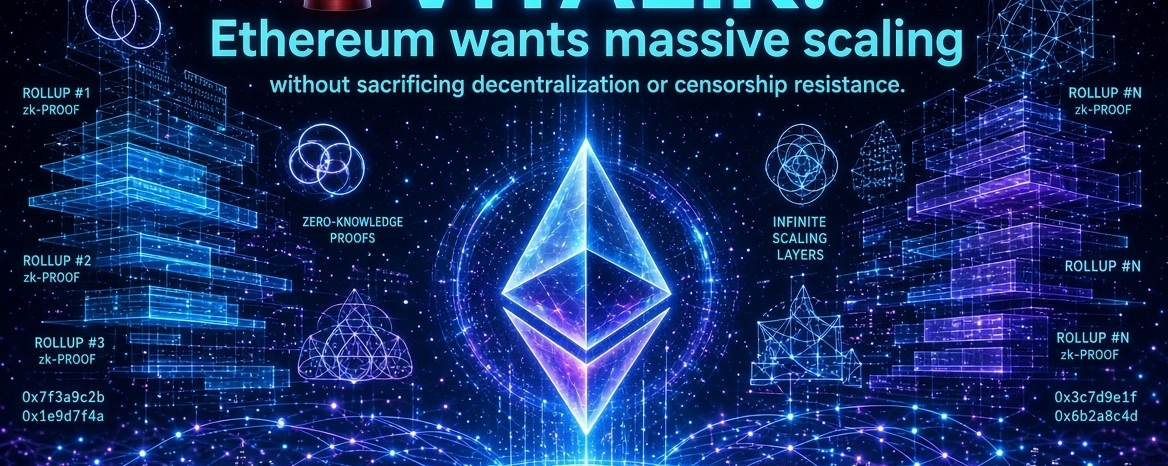
VITALIK: Ethereum wants massive scaling without sacrificing decentralization or censorshipEthereum’s co-founder Vitalik Buterin has repeatedly framed the network’s next phase around a non-negotiable principle: deliver orders-of-magnitude more capacity while keeping the properties that make Ethereum distinct. The goal is not simply higher throughput. It is high performance that still allows ordinary users to run nodes, resists censorship, remains open to global participation, and stays robust even if major operators or developers walk away.
At the center of this vision sits a deliberate prioritization of bandwidth over aggressive latency reduction. Buterin has argued that increasing data bandwidth is safer than chasing ever-lower latency. Latency faces hard physical limits set by the speed of light and by the need for validators in diverse locations—including home setups far from data-center hubs—to stay competitive. Bandwidth, by contrast, is an engineering problem that can be solved with data availability sampling, erasure coding, and zero-knowledge proofs. Technologies such as PeerDAS already enable nodes to verify large volumes of data without downloading everything. Combined with ZK proofs, this path opens the door to scaling capacity thousands of times relative to earlier designs, while still allowing a widely distributed validator set.
The longer-term architecture, often discussed under the banner of “Lean Ethereum,” treats this scaling as part of a deeper redesign. Verification is shifting from every node re-executing every transaction toward compact cryptographic proofs—recursive STARKs in particular—that let most participants check correctness without replaying the full computation. Blobs, originally introduced to cheapen data for layer-2s, are expected to carry more of Ethereum’s own block data over time. The result is a network that can support far higher gas limits and data throughput without forcing every participant onto expensive hardware.
Decentralization remains the constraint that shapes these choices. Buterin has emphasized the “walkaway test”: applications and the base layer itself should continue functioning if original maintainers disappear. That requires keeping solo staking and home operation viable. Economic and technical parameters are therefore designed so that staking from financial centers does not systematically outperform participation from ordinary machines and locations. Geographic and infrastructural concentration is treated as a centralization risk to be actively resisted. Gas scheduling, state growth controls, and multidimensional resource pricing are all being refined so that execution capacity can rise faster than the permanent state that every node must hold.
Censorship resistance is equally non-negotiable. Mechanisms such as FOCIL (fork-choice enforced inclusion lists) aim to force inclusion of transactions that the broader network can already see, reducing the power of any single block builder or sequencer to exclude activity. The same ethos extends to privacy becoming a first-class design goal rather than an afterthought, and to quantum resistance being treated as an urgent protocol priority rather than a distant future concern. LeanSPHINCS-style signatures, updated cryptography, and careful protocol simplification are part of making the system both more secure and more auditable over the long term.
This approach also reframes the role of layer-2 networks. As layer-1 capacity itself expands, the original idea of L2s as branded “shards” of Ethereum has evolved. L2s remain valuable for specialized features—extreme scaling, non-EVM environments, privacy-focused designs, or ultra-low latency—but the base layer is no longer dependent on them solely for throughput. The shared security and censorship-resistance guarantees of Ethereum itself become the foundation that specialized systems can choose to inherit at different levels of closeness.
The practical roadmap unfolds over years rather than a single upgrade. Near-term improvements—block-level access lists, proposer-builder separation refinements, gas repricings, and further PeerDAS iterations—raise capacity while clients and formal verification mature. Over a longer horizon, state is expected to split into a moderated “dynamic” layer that retains full flexibility and newer, more restrictive but highly scalable storage types suited to tokens, NFTs, and many DeFi patterns. Proof systems move from optional to increasingly mandatory. The overall trajectory aims for a protocol that is simpler in its core, quantum-safe by default, private by design, and capable of supporting far higher activity without concentrating power.
The underlying bet is that Ethereum can be both the world’s decentralized settlement and coordination layer and a high-performance system. By treating decentralization and censorship resistance as hard constraints rather than optional features, the scaling path is forced to remain compatible with a broad, heterogeneous set of participants. That is the standard Vitalik continues to set: massive scale is welcome, but only if the network still looks and behaves like #Ethereum...
VITALIK: Ethereum wants massive scaling without sacrificing decentralization or censorship
Ethereum’s co-founder Vitalik Buterin has repeatedly framed the network’s next phase around a non-negotiable principle: deliver orders-of-magnitude more capacity while keeping the properties that make Ethereum distinct. The goal is not simply higher throughput. It is high performance that still allows ordinary users to run nodes, resists censorship, remains open to global participation, and stays robust even if major operators or developers walk away.
At the center of this vision sits a deliberate prioritization of bandwidth over aggressive latency reduction. Buterin has argued that increasing data bandwidth is safer than chasing ever-lower latency. Latency faces hard physical limits set by the speed of light and by the need for validators in diverse locations—including home setups far from data-center hubs—to stay competitive. Bandwidth, by contrast, is an engineering problem that can be solved with data availability sampling, erasure coding, and zero-knowledge proofs. Technologies such as PeerDAS already enable nodes to verify large volumes of data without downloading everything. Combined with ZK proofs, this path opens the door to scaling capacity thousands of times relative to earlier designs, while still allowing a widely distributed validator set.
The longer-term architecture, often discussed under the banner of “Lean Ethereum,” treats this scaling as part of a deeper redesign. Verification is shifting from every node re-executing every transaction toward compact cryptographic proofs—recursive STARKs in particular—that let most participants check correctness without replaying the full computation. Blobs, originally introduced to cheapen data for layer-2s, are expected to carry more of Ethereum’s own block data over time. The result is a network that can support far higher gas limits and data throughput without forcing every participant onto expensive hardware.
Decentralization remains the constraint that shapes these choices. Buterin has emphasized the “walkaway test”: applications and the base layer itself should continue functioning if original maintainers disappear. That requires keeping solo staking and home operation viable. Economic and technical parameters are therefore designed so that staking from financial centers does not systematically outperform participation from ordinary machines and locations. Geographic and infrastructural concentration is treated as a centralization risk to be actively resisted. Gas scheduling, state growth controls, and multidimensional resource pricing are all being refined so that execution capacity can rise faster than the permanent state that every node must hold.
Censorship resistance is equally non-negotiable. Mechanisms such as FOCIL (fork-choice enforced inclusion lists) aim to force inclusion of transactions that the broader network can already see, reducing the power of any single block builder or sequencer to exclude activity. The same ethos extends to privacy becoming a first-class design goal rather than an afterthought, and to quantum resistance being treated as an urgent protocol priority rather than a distant future concern. LeanSPHINCS-style signatures, updated cryptography, and careful protocol simplification are part of making the system both more secure and more auditable over the long term.
This approach also reframes the role of layer-2 networks. As layer-1 capacity itself expands, the original idea of L2s as branded “shards” of Ethereum has evolved. L2s remain valuable for specialized features—extreme scaling, non-EVM environments, privacy-focused designs, or ultra-low latency—but the base layer is no longer dependent on them solely for throughput. The shared security and censorship-resistance guarantees of Ethereum itself become the foundation that specialized systems can choose to inherit at different levels of closeness.
The practical roadmap unfolds over years rather than a single upgrade. Near-term improvements—block-level access lists, proposer-builder separation refinements, gas repricings, and further PeerDAS iterations—raise capacity while clients and formal verification mature. Over a longer horizon, state is expected to split into a moderated “dynamic” layer that retains full flexibility and newer, more restrictive but highly scalable storage types suited to tokens, NFTs, and many DeFi patterns. Proof systems move from optional to increasingly mandatory. The overall trajectory aims for a protocol that is simpler in its core, quantum-safe by default, private by design, and capable of supporting far higher activity without concentrating power.
The underlying bet is that Ethereum can be both the world’s decentralized settlement and coordination layer and a high-performance system. By treating decentralization and censorship resistance as hard constraints rather than optional features, the scaling path is forced to remain compatible with a broad, heterogeneous set of participants. That is the standard Vitalik continues to set: massive scale is welcome, but only if the network still looks and behaves like #Ethereum...
At the center of this vision sits a deliberate prioritization of bandwidth over aggressive latency reduction. Buterin has argued that increasing data bandwidth is safer than chasing ever-lower latency. Latency faces hard physical limits set by the speed of light and by the need for validators in diverse locations—including home setups far from data-center hubs—to stay competitive. Bandwidth, by contrast, is an engineering problem that can be solved with data availability sampling, erasure coding, and zero-knowledge proofs. Technologies such as PeerDAS already enable nodes to verify large volumes of data without downloading everything. Combined with ZK proofs, this path opens the door to scaling capacity thousands of times relative to earlier designs, while still allowing a widely distributed validator set.
The longer-term architecture, often discussed under the banner of “Lean Ethereum,” treats this scaling as part of a deeper redesign. Verification is shifting from every node re-executing every transaction toward compact cryptographic proofs—recursive STARKs in particular—that let most participants check correctness without replaying the full computation. Blobs, originally introduced to cheapen data for layer-2s, are expected to carry more of Ethereum’s own block data over time. The result is a network that can support far higher gas limits and data throughput without forcing every participant onto expensive hardware.
Decentralization remains the constraint that shapes these choices. Buterin has emphasized the “walkaway test”: applications and the base layer itself should continue functioning if original maintainers disappear. That requires keeping solo staking and home operation viable. Economic and technical parameters are therefore designed so that staking from financial centers does not systematically outperform participation from ordinary machines and locations. Geographic and infrastructural concentration is treated as a centralization risk to be actively resisted. Gas scheduling, state growth controls, and multidimensional resource pricing are all being refined so that execution capacity can rise faster than the permanent state that every node must hold.
Censorship resistance is equally non-negotiable. Mechanisms such as FOCIL (fork-choice enforced inclusion lists) aim to force inclusion of transactions that the broader network can already see, reducing the power of any single block builder or sequencer to exclude activity. The same ethos extends to privacy becoming a first-class design goal rather than an afterthought, and to quantum resistance being treated as an urgent protocol priority rather than a distant future concern. LeanSPHINCS-style signatures, updated cryptography, and careful protocol simplification are part of making the system both more secure and more auditable over the long term.
This approach also reframes the role of layer-2 networks. As layer-1 capacity itself expands, the original idea of L2s as branded “shards” of Ethereum has evolved. L2s remain valuable for specialized features—extreme scaling, non-EVM environments, privacy-focused designs, or ultra-low latency—but the base layer is no longer dependent on them solely for throughput. The shared security and censorship-resistance guarantees of Ethereum itself become the foundation that specialized systems can choose to inherit at different levels of closeness.
The practical roadmap unfolds over years rather than a single upgrade. Near-term improvements—block-level access lists, proposer-builder separation refinements, gas repricings, and further PeerDAS iterations—raise capacity while clients and formal verification mature. Over a longer horizon, state is expected to split into a moderated “dynamic” layer that retains full flexibility and newer, more restrictive but highly scalable storage types suited to tokens, NFTs, and many DeFi patterns. Proof systems move from optional to increasingly mandatory. The overall trajectory aims for a protocol that is simpler in its core, quantum-safe by default, private by design, and capable of supporting far higher activity without concentrating power.
The underlying bet is that Ethereum can be both the world’s decentralized settlement and coordination layer and a high-performance system. By treating decentralization and censorship resistance as hard constraints rather than optional features, the scaling path is forced to remain compatible with a broad, heterogeneous set of participants. That is the standard Vitalik continues to set: massive scale is welcome, but only if the network still looks and behaves like #Ethereum...
43
·
--
Статья
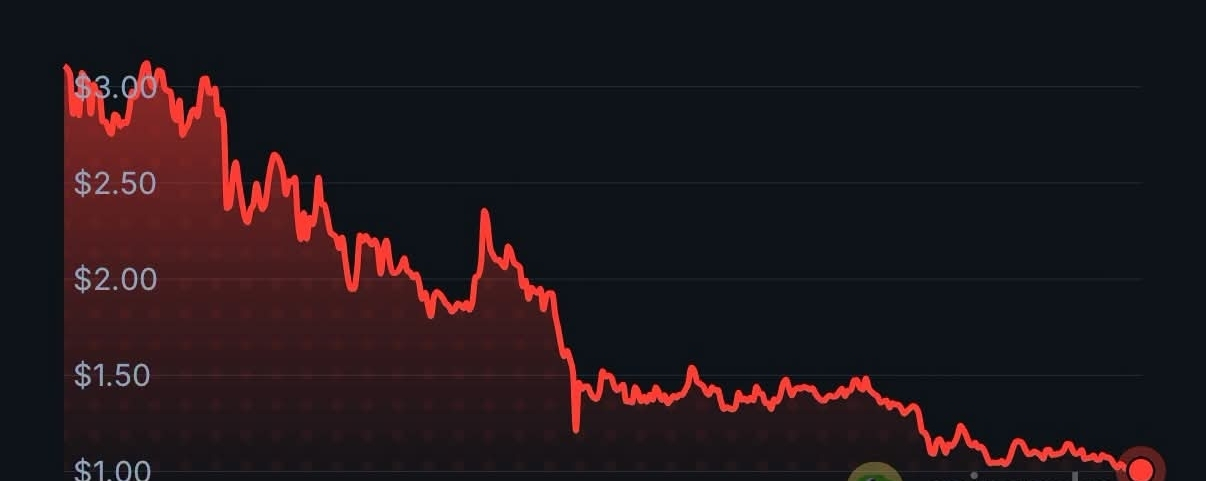
XRP last hit its all-time high of around $3.65 in mid-July 2025.#Xrp🔥🔥 last hit its all-time high of around $3.65 in mid-July 2025. Roughly 13 months later, in mid-August 2026, the token trades near $1.00—down more than 70% from that peak and roughly 45-50% lower year-to-date in many datasets.
That sharp retracement has left many holders and prospective buyers asking the classic question: buy, sell, or hold?
The 2025 Rally and What Followed
XRP’s 2025 surge was powered by the long-awaited resolution of major U.S. regulatory overhangs, the launch of multiple spot XRP ETFs, and a broader altcoin rotation. Prices climbed past previous cycle highs, briefly eclipsing the old 2018 peak in some datasets and establishing a new high near $3.65. Optimism ran high that clearer legal status plus institutional products would unlock sustained demand.
Instead, the market delivered a classic post-euphoria correction. ETF inflows, while positive overall (cumulative figures have hovered around $1.5 billion since late 2025 launches), have slowed dramatically at times—sometimes to near-zero weekly net flows. Macro headwinds, delayed U.S. market-structure legislation (notably the CLARITY Act), and profit-taking after the rapid run-up all weighed on price. By August 2026 the token sits at a psychological support zone around $1, with many technical indicators showing overhead resistance from stacked moving averages.
Fundamental Backdrop: Progress Amid Price Weakness
Ripple and the XRP Ledger have continued to advance on several fronts even as the token price declined. Spot XRP ETFs now exist in the U.S., giving traditional investors a regulated vehicle. Ripple has expanded licensing (including MiCA authorization in Europe), grown its RLUSD stablecoin to multi-billion-dollar market capitalization, and deepened institutional partnerships. Tokenized funds, payment corridors, and on-chain infrastructure upgrades (including proposed amendments for vaults, lending, and confidential transfers) signal ongoing real-world utility work.
Daily transaction activity on the ledger has risen meaningfully in periods, and major financial institutions continue to explore or deploy XRPL-related solutions for payments, settlement, and tokenization. Yet a persistent critique remains: much of the ledger’s institutional usage does not automatically translate into proportional buying pressure on the XRP token itself. Banks and asset managers can use the technology or stablecoins without large ongoing XRP accumulation.
Regulatory clarity is still incomplete. Classification progress and ETF availability removed some overhang, but full U.S. market-structure legislation has faced delays, leaving a residual uncertainty that appears to have capped institutional enthusiasm relative to earlier forecasts of multi-billion-dollar annual ETF inf Buy, Sell, or Hold? A Framework
Sell case: Momentum is weak. Price is far below the 2025 high, ETF demand has cooled relative to optimistic projections, and the broader crypto market has not delivered a decisive altcoin recovery. Traders focused on technicals or shorter time horizons may prefer to exit or reduce exposure near current levels, especially if $1 support fails and macro conditions remain risk-off. Opportunity cost is real—capital tied up in a lagging asset could be deployed elsewhere.
Buy case: At roughly 70%+ below the recent ATH, XRP is priced for modest expectations. If regulatory catalysts materialize, ETF flows re-accelerate, or broader crypto risk appetite returns, the downside may already be largely reflected. Long-term bulls point to network effects in payments and tokenization, Ripple’s expanding product suite, and the structural demand from existing ETFs as reasons the token could reprice higher over multi-year horizons. Dollar-cost averaging or opportunistic accumulation near support appeals to those with high conviction and long time frames who view current levels as discounted relative to 2025 peak optimism.
Hold case: For existing holders who bought well below current prices or who maintain a multi-year thesis around institutional adoption of XRPL, holding through the drawdown is the default. Selling now crystallizes losses relative to the 2025 high without clear evidence that the fundamental story has permanently broken. Holding also preserves optionality if delayed legislation or renewed institutional flows eventually materialize. The key is position sizing—exposure should be sized so that further declines do not force emotional exits.
Practical Considerations
No single answer fits every investor. Risk tolerance, time horizon, portfolio concentration, and tax situation matter. XRP remains highly volatile; a move back toward $1.20–1.50 or a breakdown toward $0.80–0.90 are both plausible near-term paths depending on Bitcoin leadership, regulatory headlines, and ETF flow data. Leverage amplifies both upside and downside and is generally unsuitable for most participants.
Position management tools help: clear invalidation levels (e.g., sustained breaks of key supports), rebalancing rules, and avoiding over-concentration. Those new to the asset should treat any allocation as speculative risk capital.
Bottom Line
XRP’s journey from a $3.65 high in July 2025 to roughly $1 a year later illustrates both the power of narrative-driven crypto rallies and the difficulty of sustaining them once regulatory and flow catalysts fade. The underlying technology and institutional relationships continue to develop, yet price has decoupled from that progress in the short term.
For aggressive traders, selling or staying on the sidelines until clearer momentum returns may be rational. For long-term believers in cross-border payments and tokenized finance infrastructure, current levels offer a potential accumulation zone—provided positions are sized appropriately and expectations are tempered. Most balanced participants will find the “hold with optional small adds on strength or deeper weakness” approach the least regretful path while the market digests the post-ATH reality and waits for the next decisive catalyst. Always conduct independent research and consider personal financial circumstances before acting.
XRP last hit its all-time high of around $3.65 in mid-July 2025.
#Xrp🔥🔥 last hit its all-time high of around $3.65 in mid-July 2025. Roughly 13 months later, in mid-August 2026, the token trades near $1 .00—down more than 70% from that peak and roughly 45-50% lower year-to-date in many datasets.
That sharp retracement has left many holders and prospective buyers asking the classic question: buy, sell, or hold?
The 2025 Rally and What Followed
XRP’s 2025 surge was powered by the long-awaited resolution of major U.S. regulatory overhangs, the launch of multiple spot XRP ETFs, and a broader altcoin rotation. Prices climbed past previous cycle highs, briefly eclipsing the old 2018 peak in some datasets and establishing a new high near $3.65. Optimism ran high that clearer legal status plus institutional products would unlock sustained demand.
Instead, the market delivered a classic post-euphoria correction. ETF inflows, while positive overall (cumulative figures have hovered around $1 .5 billion since late 2025 launches), have slowed dramatically at times—sometimes to near-zero weekly net flows. Macro headwinds, delayed U.S. market-structure legislation (notably the CLARITY Act), and profit-taking after the rapid run-up all weighed on price. By August 2026 the token sits at a psychological support zone around $1 , with many technical indicators showing overhead resistance from stacked moving averages.
Fundamental Backdrop: Progress Amid Price Weakness
Ripple and the XRP Ledger have continued to advance on several fronts even as the token price declined. Spot XRP ETFs now exist in the U.S., giving traditional investors a regulated vehicle. Ripple has expanded licensing (including MiCA authorization in Europe), grown its RLUSD stablecoin to multi-billion-dollar market capitalization, and deepened institutional partnerships. Tokenized funds, payment corridors, and on-chain infrastructure upgrades (including proposed amendments for vaults, lending, and confidential transfers) signal ongoing real-world utility work.
Daily transaction activity on the ledger has risen meaningfully in periods, and major financial institutions continue to explore or deploy XRPL-related solutions for payments, settlement, and tokenization. Yet a persistent critique remains: much of the ledger’s institutional usage does not automatically translate into proportional buying pressure on the XRP token itself. Banks and asset managers can use the technology or stablecoins without large ongoing XRP accumulation.
Regulatory clarity is still incomplete. Classification progress and ETF availability removed some overhang, but full U.S. market-structure legislation has faced delays, leaving a residual uncertainty that appears to have capped institutional enthusiasm relative to earlier forecasts of multi-billion-dollar annual ETF inf Buy, Sell, or Hold? A Framework
Sell case: Momentum is weak. Price is far below the 2025 high, ETF demand has cooled relative to optimistic projections, and the broader crypto market has not delivered a decisive altcoin recovery. Traders focused on technicals or shorter time horizons may prefer to exit or reduce exposure near current levels, especially if $1 support fails and macro conditions remain risk-off. Opportunity cost is real—capital tied up in a lagging asset could be deployed elsewhere.
Buy case: At roughly 70%+ below the recent ATH, XRP is priced for modest expectations. If regulatory catalysts materialize, ETF flows re-accelerate, or broader crypto risk appetite returns, the downside may already be largely reflected. Long-term bulls point to network effects in payments and tokenization, Ripple’s expanding product suite, and the structural demand from existing ETFs as reasons the token could reprice higher over multi-year horizons. Dollar-cost averaging or opportunistic accumulation near support appeals to those with high conviction and long time frames who view current levels as discounted relative to 2025 peak optimism.
Hold case: For existing holders who bought well below current prices or who maintain a multi-year thesis around institutional adoption of XRPL, holding through the drawdown is the default. Selling now crystallizes losses relative to the 2025 high without clear evidence that the fundamental story has permanently broken. Holding also preserves optionality if delayed legislation or renewed institutional flows eventually materialize. The key is position sizing—exposure should be sized so that further declines do not force emotional exits.
Practical Considerations
No single answer fits every investor. Risk tolerance, time horizon, portfolio concentration, and tax situation matter. XRP remains highly volatile; a move back toward $1 .20–1.50 or a breakdown toward $0.80–0.90 are both plausible near-term paths depending on Bitcoin leadership, regulatory headlines, and ETF flow data. Leverage amplifies both upside and downside and is generally unsuitable for most participants.
Position management tools help: clear invalidation levels (e.g., sustained breaks of key supports), rebalancing rules, and avoiding over-concentration. Those new to the asset should treat any allocation as speculative risk capital.
Bottom Line
XRP’s journey from a $3.65 high in July 2025 to roughly $1 a year later illustrates both the power of narrative-driven crypto rallies and the difficulty of sustaining them once regulatory and flow catalysts fade. The underlying technology and institutional relationships continue to develop, yet price has decoupled from that progress in the short term.
For aggressive traders, selling or staying on the sidelines until clearer momentum returns may be rational. For long-term believers in cross-border payments and tokenized finance infrastructure, current levels offer a potential accumulation zone—provided positions are sized appropriately and expectations are tempered. Most balanced participants will find the “hold with optional small adds on strength or deeper weakness” approach the least regretful path while the market digests the post-ATH reality and waits for the next decisive catalyst. Always conduct independent research and consider personal financial circumstances before acting.
That sharp retracement has left many holders and prospective buyers asking the classic question: buy, sell, or hold?
The 2025 Rally and What Followed
XRP’s 2025 surge was powered by the long-awaited resolution of major U.S. regulatory overhangs, the launch of multiple spot XRP ETFs, and a broader altcoin rotation. Prices climbed past previous cycle highs, briefly eclipsing the old 2018 peak in some datasets and establishing a new high near $3.65. Optimism ran high that clearer legal status plus institutional products would unlock sustained demand.
Instead, the market delivered a classic post-euphoria correction. ETF inflows, while positive overall (cumulative figures have hovered around $1 .5 billion since late 2025 launches), have slowed dramatically at times—sometimes to near-zero weekly net flows. Macro headwinds, delayed U.S. market-structure legislation (notably the CLARITY Act), and profit-taking after the rapid run-up all weighed on price. By August 2026 the token sits at a psychological support zone around $1 , with many technical indicators showing overhead resistance from stacked moving averages.
Fundamental Backdrop: Progress Amid Price Weakness
Ripple and the XRP Ledger have continued to advance on several fronts even as the token price declined. Spot XRP ETFs now exist in the U.S., giving traditional investors a regulated vehicle. Ripple has expanded licensing (including MiCA authorization in Europe), grown its RLUSD stablecoin to multi-billion-dollar market capitalization, and deepened institutional partnerships. Tokenized funds, payment corridors, and on-chain infrastructure upgrades (including proposed amendments for vaults, lending, and confidential transfers) signal ongoing real-world utility work.
Daily transaction activity on the ledger has risen meaningfully in periods, and major financial institutions continue to explore or deploy XRPL-related solutions for payments, settlement, and tokenization. Yet a persistent critique remains: much of the ledger’s institutional usage does not automatically translate into proportional buying pressure on the XRP token itself. Banks and asset managers can use the technology or stablecoins without large ongoing XRP accumulation.
Regulatory clarity is still incomplete. Classification progress and ETF availability removed some overhang, but full U.S. market-structure legislation has faced delays, leaving a residual uncertainty that appears to have capped institutional enthusiasm relative to earlier forecasts of multi-billion-dollar annual ETF inf Buy, Sell, or Hold? A Framework
Sell case: Momentum is weak. Price is far below the 2025 high, ETF demand has cooled relative to optimistic projections, and the broader crypto market has not delivered a decisive altcoin recovery. Traders focused on technicals or shorter time horizons may prefer to exit or reduce exposure near current levels, especially if $1 support fails and macro conditions remain risk-off. Opportunity cost is real—capital tied up in a lagging asset could be deployed elsewhere.
Buy case: At roughly 70%+ below the recent ATH, XRP is priced for modest expectations. If regulatory catalysts materialize, ETF flows re-accelerate, or broader crypto risk appetite returns, the downside may already be largely reflected. Long-term bulls point to network effects in payments and tokenization, Ripple’s expanding product suite, and the structural demand from existing ETFs as reasons the token could reprice higher over multi-year horizons. Dollar-cost averaging or opportunistic accumulation near support appeals to those with high conviction and long time frames who view current levels as discounted relative to 2025 peak optimism.
Hold case: For existing holders who bought well below current prices or who maintain a multi-year thesis around institutional adoption of XRPL, holding through the drawdown is the default. Selling now crystallizes losses relative to the 2025 high without clear evidence that the fundamental story has permanently broken. Holding also preserves optionality if delayed legislation or renewed institutional flows eventually materialize. The key is position sizing—exposure should be sized so that further declines do not force emotional exits.
Practical Considerations
No single answer fits every investor. Risk tolerance, time horizon, portfolio concentration, and tax situation matter. XRP remains highly volatile; a move back toward $1 .20–1.50 or a breakdown toward $0.80–0.90 are both plausible near-term paths depending on Bitcoin leadership, regulatory headlines, and ETF flow data. Leverage amplifies both upside and downside and is generally unsuitable for most participants.
Position management tools help: clear invalidation levels (e.g., sustained breaks of key supports), rebalancing rules, and avoiding over-concentration. Those new to the asset should treat any allocation as speculative risk capital.
Bottom Line
XRP’s journey from a $3.65 high in July 2025 to roughly $1 a year later illustrates both the power of narrative-driven crypto rallies and the difficulty of sustaining them once regulatory and flow catalysts fade. The underlying technology and institutional relationships continue to develop, yet price has decoupled from that progress in the short term.
For aggressive traders, selling or staying on the sidelines until clearer momentum returns may be rational. For long-term believers in cross-border payments and tokenized finance infrastructure, current levels offer a potential accumulation zone—provided positions are sized appropriately and expectations are tempered. Most balanced participants will find the “hold with optional small adds on strength or deeper weakness” approach the least regretful path while the market digests the post-ATH reality and waits for the next decisive catalyst. Always conduct independent research and consider personal financial circumstances before acting.
103
·
--
Статья
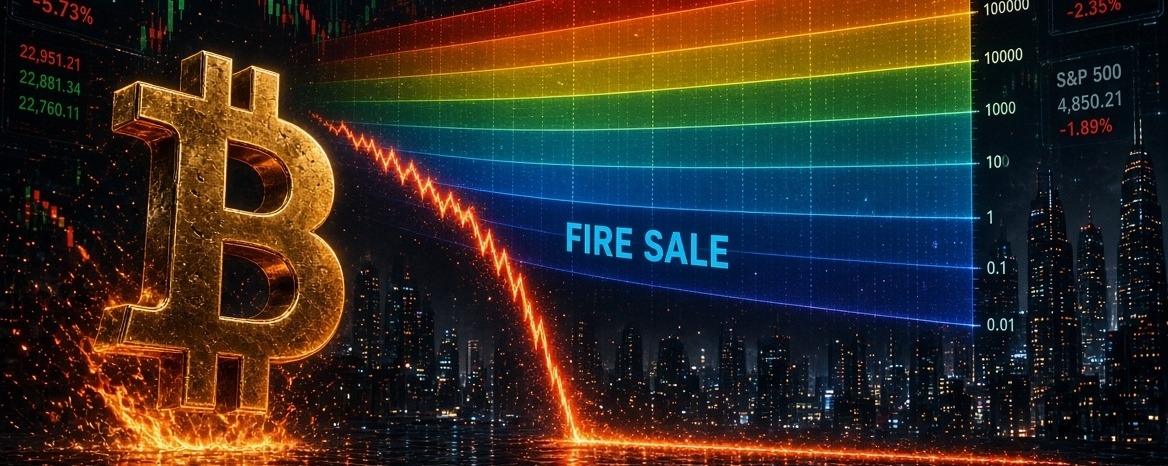
Bitcoin has never lingered this long below the Rainbow Chart’s “Fire Sale”Bitcoin has never lingered this long below the Rainbow Chart’s “Fire Sale” band. That statement, circulating widely in mid-August 2026, captures an unusual stretch of extreme undervaluation relative to Bitcoin’s long-term logarithmic growth trajectory.
The #bitcoin Rainbow Chart overlays color-coded valuation bands on a log-scale price chart. The deepest blue zone—“Basically a Fire Sale!”—has historically marked periods of deep capitulation. Prior visits to or breaches of this level (notably 2015, the March 2020 COVID crash, and the November 2022 FTX collapse) were relatively short-lived compared with the current multi-month residence. Price now sits near $63,000, roughly 50% below the October 2025 peak near $126,000 and meaningfully below the model’s lowest band (recently estimated around $63,000–$65,000 depending on the exact fit). Volatility-adjusted metrics show the deviation from the long-term model price is deeper than at the 2022 bottom.
This does not guarantee an imminent bottom. The chart is a heuristic, not a timing tool. Bands can be recalibrated, and structural changes—spot ETF flows, corporate treasuries, and different liquidity regimes—mean past cycle shapes are imperfect guides. Bitcoin can remain “cheap” for extended periods if macro headwinds (rates, risk appetite, geopolitics) persist. Extended time in the zone has, however, consistently coincided with eventual powerful recoveries once selling pressure exhausted itself.
Historically, accumulation during Fire Sale conditions produced outsized multi-year returns. After the prolonged 2014–2015 undervaluation, Bitcoin rose from the low hundreds to nearly $20,000. The 2018–2019 and 2022 bottoms similarly preceded multi-hundred-percent advances into the subsequent cycle highs. Returns after earlier Fire Sale readings ranged from several hundred percent to orders of magnitude higher for those who held through the next expansion. The common pattern was not a V-shaped bounce the day the band was breached, but a grinding process of seller exhaustion, followed by gradual demand return and then acceleration once momentum shifted.
What happens next depends on several interlocking factors. First is seller exhaustion. On-chain data has already shown declining activity from long-term holders and reduced spot selling pressure in recent months. When the marginal seller is largely finished, price can stabilize even without immediate strong buying. Second is institutional and ETF demand. Spot Bitcoin ETFs created a structural buyer base that did not exist in prior cycles; sustained net inflows would provide a floor and fuel for recovery. Third is the broader macro backdrop—interest-rate path, dollar strength, and risk-asset appetite. Easing financial conditions have historically been highly supportive of Bitcoin’s expansion phases.
Two plausible near-to-medium-term paths stand out. In a constructive scenario, the current stretch marks late-cycle capitulation. Price finds a durable base in the low-to-mid $60,000s (or slightly lower if a final flush occurs), then begins a multi-month recovery as fear fades and capital rotates back in. That recovery could eventually retest prior highs and push into new all-time territory in the next expansion, consistent with the Rainbow Chart’s higher bands over subsequent years. In a more cautious scenario, the model’s assumptions about growth trajectory prove stretched by the new market structure, and Bitcoin grinds sideways or lower for longer while still remaining “cheap” on a relative basis. Either way, the risk/reward for long-term holders who can tolerate volatility has historically improved at these extremes.
Patience has been the defining trait of successful participants in prior Fire Sale episodes. Timing the exact low is rarely possible; sizing positions for extended discomfort and focusing on multi-year horizons has been more reliable. The current record duration below the band is unusual precisely because previous extreme discounts resolved within shorter windows. Whether this cycle follows the historical script or rewrites it, the valuation signal is clear: relative to its own long-term trend, Bitcoin is trading at levels rarely seen outside of major cycle lows.
Bitcoin has never lingered this long below the Rainbow Chart’s “Fire Sale”
Bitcoin has never lingered this long below the Rainbow Chart’s “Fire Sale” band. That statement, circulating widely in mid-August 2026, captures an unusual stretch of extreme undervaluation relative to Bitcoin’s long-term logarithmic growth trajectory.
The #bitcoin Rainbow Chart overlays color-coded valuation bands on a log-scale price chart. The deepest blue zone—“Basically a Fire Sale!”—has historically marked periods of deep capitulation. Prior visits to or breaches of this level (notably 2015, the March 2020 COVID crash, and the November 2022 FTX collapse) were relatively short-lived compared with the current multi-month residence. Price now sits near $63,000, roughly 50% below the October 2025 peak near $126,000 and meaningfully below the model’s lowest band (recently estimated around $63,000–$65,000 depending on the exact fit). Volatility-adjusted metrics show the deviation from the long-term model price is deeper than at the 2022 bottom.
This does not guarantee an imminent bottom. The chart is a heuristic, not a timing tool. Bands can be recalibrated, and structural changes—spot ETF flows, corporate treasuries, and different liquidity regimes—mean past cycle shapes are imperfect guides. Bitcoin can remain “cheap” for extended periods if macro headwinds (rates, risk appetite, geopolitics) persist. Extended time in the zone has, however, consistently coincided with eventual powerful recoveries once selling pressure exhausted itself.
Historically, accumulation during Fire Sale conditions produced outsized multi-year returns. After the prolonged 2014–2015 undervaluation, Bitcoin rose from the low hundreds to nearly $20,000. The 2018–2019 and 2022 bottoms similarly preceded multi-hundred-percent advances into the subsequent cycle highs. Returns after earlier Fire Sale readings ranged from several hundred percent to orders of magnitude higher for those who held through the next expansion. The common pattern was not a V-shaped bounce the day the band was breached, but a grinding process of seller exhaustion, followed by gradual demand return and then acceleration once momentum shifted.
What happens next depends on several interlocking factors. First is seller exhaustion. On-chain data has already shown declining activity from long-term holders and reduced spot selling pressure in recent months. When the marginal seller is largely finished, price can stabilize even without immediate strong buying. Second is institutional and ETF demand. Spot Bitcoin ETFs created a structural buyer base that did not exist in prior cycles; sustained net inflows would provide a floor and fuel for recovery. Third is the broader macro backdrop—interest-rate path, dollar strength, and risk-asset appetite. Easing financial conditions have historically been highly supportive of Bitcoin’s expansion phases.
Two plausible near-to-medium-term paths stand out. In a constructive scenario, the current stretch marks late-cycle capitulation. Price finds a durable base in the low-to-mid $60,000s (or slightly lower if a final flush occurs), then begins a multi-month recovery as fear fades and capital rotates back in. That recovery could eventually retest prior highs and push into new all-time territory in the next expansion, consistent with the Rainbow Chart’s higher bands over subsequent years. In a more cautious scenario, the model’s assumptions about growth trajectory prove stretched by the new market structure, and Bitcoin grinds sideways or lower for longer while still remaining “cheap” on a relative basis. Either way, the risk/reward for long-term holders who can tolerate volatility has historically improved at these extremes.
Patience has been the defining trait of successful participants in prior Fire Sale episodes. Timing the exact low is rarely possible; sizing positions for extended discomfort and focusing on multi-year horizons has been more reliable. The current record duration below the band is unusual precisely because previous extreme discounts resolved within shorter windows. Whether this cycle follows the historical script or rewrites it, the valuation signal is clear: relative to its own long-term trend, Bitcoin is trading at levels rarely seen outside of major cycle lows.
The #bitcoin Rainbow Chart overlays color-coded valuation bands on a log-scale price chart. The deepest blue zone—“Basically a Fire Sale!”—has historically marked periods of deep capitulation. Prior visits to or breaches of this level (notably 2015, the March 2020 COVID crash, and the November 2022 FTX collapse) were relatively short-lived compared with the current multi-month residence. Price now sits near $63,000, roughly 50% below the October 2025 peak near $126,000 and meaningfully below the model’s lowest band (recently estimated around $63,000–$65,000 depending on the exact fit). Volatility-adjusted metrics show the deviation from the long-term model price is deeper than at the 2022 bottom.
This does not guarantee an imminent bottom. The chart is a heuristic, not a timing tool. Bands can be recalibrated, and structural changes—spot ETF flows, corporate treasuries, and different liquidity regimes—mean past cycle shapes are imperfect guides. Bitcoin can remain “cheap” for extended periods if macro headwinds (rates, risk appetite, geopolitics) persist. Extended time in the zone has, however, consistently coincided with eventual powerful recoveries once selling pressure exhausted itself.
Historically, accumulation during Fire Sale conditions produced outsized multi-year returns. After the prolonged 2014–2015 undervaluation, Bitcoin rose from the low hundreds to nearly $20,000. The 2018–2019 and 2022 bottoms similarly preceded multi-hundred-percent advances into the subsequent cycle highs. Returns after earlier Fire Sale readings ranged from several hundred percent to orders of magnitude higher for those who held through the next expansion. The common pattern was not a V-shaped bounce the day the band was breached, but a grinding process of seller exhaustion, followed by gradual demand return and then acceleration once momentum shifted.
What happens next depends on several interlocking factors. First is seller exhaustion. On-chain data has already shown declining activity from long-term holders and reduced spot selling pressure in recent months. When the marginal seller is largely finished, price can stabilize even without immediate strong buying. Second is institutional and ETF demand. Spot Bitcoin ETFs created a structural buyer base that did not exist in prior cycles; sustained net inflows would provide a floor and fuel for recovery. Third is the broader macro backdrop—interest-rate path, dollar strength, and risk-asset appetite. Easing financial conditions have historically been highly supportive of Bitcoin’s expansion phases.
Two plausible near-to-medium-term paths stand out. In a constructive scenario, the current stretch marks late-cycle capitulation. Price finds a durable base in the low-to-mid $60,000s (or slightly lower if a final flush occurs), then begins a multi-month recovery as fear fades and capital rotates back in. That recovery could eventually retest prior highs and push into new all-time territory in the next expansion, consistent with the Rainbow Chart’s higher bands over subsequent years. In a more cautious scenario, the model’s assumptions about growth trajectory prove stretched by the new market structure, and Bitcoin grinds sideways or lower for longer while still remaining “cheap” on a relative basis. Either way, the risk/reward for long-term holders who can tolerate volatility has historically improved at these extremes.
Patience has been the defining trait of successful participants in prior Fire Sale episodes. Timing the exact low is rarely possible; sizing positions for extended discomfort and focusing on multi-year horizons has been more reliable. The current record duration below the band is unusual precisely because previous extreme discounts resolved within shorter windows. Whether this cycle follows the historical script or rewrites it, the valuation signal is clear: relative to its own long-term trend, Bitcoin is trading at levels rarely seen outside of major cycle lows.
80
·
--

Статья
CZ to Donate BNB and 币安人生 Tokens to Giggle Academy, Then Abandon the Wallet
ChangpengChangpeng Zhao, better known as CZ, the founder of Binance, has announced a decisive move regarding one of his public wallets that has become a magnet for meme coins. He will donate the BNB and 币安人生 (Binance Life) tokens held in the address to Giggle Academy, after which he will stop using the wallet entirely and allow it to function as a burn address. The stated reason is straightforward: to break the cycle of random meme tokens being sent to the wallet and the subsequent wave of community over-interpretation that follows every attempt to clean it up.
In a post on X, CZ explained the sequence of events that led to the decision. While testing Trust Wallet, he found the interface overwhelmed by meme coins—so many that locating even his BNB became difficult. He attempted to burn some of the tokens as a cleanup step. That simple action immediately triggered extensive community discussion and speculation about what the burns “meant.” CZ noted that the more he burns, the more tokens people send, making a permanent clean-up impossible. The transparent nature of the blockchain ensures that every transaction on a high-profile address is scrutinized and frequently over-interpreted. He even considered requesting an “Ignore Coin” feature from the Trust Wallet team to hide the clutter, but dismissed the idea because the vast majority of users would never need it.
The practical solution he settled on is clean and final. He will transfer the remaining BNB and the 币安人生 tokens (which he had purchased with #BNB ) to Giggle Academy. Once that transfer is complete, he will cease using the address, effectively turning it into a permanent burn destination for any future tokens that arrive. Reports circulating alongside the announcement put the combined value of the BNB and 币安人生 tokens at approximately $960,000.
This episode sits against the broader backdrop of CZ’s public relationship with meme coins and his education-focused philanthropy. Giggle Academy, the free learning platform he founded, aims to deliver basic education—primarily language and foundational skills—to children worldwide through a gamified, adaptive app. It operates with no revenue model and has already reached more than one million children in under two years. Donations, whether in BNB, stablecoins, or meme tokens, are routinely converted into usable funds to support content creation, community incentives, and expansion. CZ has repeatedly emphasized that Giggle Academy is not a crypto project and does not manage tokenomics for donors; any tokens sent without prior agreement may be sold.
The 币安人生 token itself reflects the peculiar dynamics of the current meme-coin culture on BNB Chain. Inspired by CZ’s memoir (whose Chinese title and proceeds are linked to charitable giving), community-driven tokens frequently send portions of supply or trading fees to addresses associated with CZ or Giggle Academy. While some of these efforts generate genuine donations that support education, they also create noise. Public figures’ wallets become de facto billboards, and every transfer or burn is parsed for hidden signals about endorsements, market moves, or project legitimacy. CZ’s decision to abandon the address is an attempt to remove that signal entirely.
The transparency of public blockchains, usually celebrated as a feature, here becomes a liability for someone of CZ’s visibility. Every interaction is recorded, indexed, and discussed in real time across social platforms and on-chain analytics tools. What begins as a practical desire to declutter a wallet interface escalates into community narrative. By donating the valuable assets and walking away from the address, CZ is choosing to prioritize the educational mission of Giggle Academy over continued engagement with the constant stream of unsolicited tokens.
This move also fits a longer pattern of CZ directing resources toward education and philanthropy after stepping back from day-to-day leadership at Binance. Royalties from his memoir are earmarked for Giggle Academy. He has previously highlighted large inflows of BNB and meme-derived fees that have helped the platform scale. At the same time, he has been clear that donors should not expect specific treatment of their tokens beyond the academy’s existing practice of converting most donations into usable currency near month-end.
For the broader crypto community, the announcement underscores a recurring tension. Meme coins thrive on attention, and associating with high-profile figures is one of the fastest ways to generate it. Yet the recipients of that attention often find the resulting volume of spam tokens and interpretive noise counterproductive. Turning a wallet into a burn address is a blunt but effective response: future tokens sent there will simply disappear from circulation without generating further commentary from the owner.
The practical outcome is that Giggle Academy receives a meaningful donation that can be deployed toward free education for children, while CZ removes himself from an ongoing cycle of unintended engagement. In an ecosystem where every on-chain action by prominent figures is amplified and analyzed, sometimes the most significant statement is to stop participating in the conversation altogether. By donating the assets and abandoning the wallet, CZ is doing exactly that—channeling value to a stated public good and then stepping away from the noise that had attached itself to the address.
CZ to Donate BNB and 币安人生 Tokens to Giggle Academy, Then Abandon the Wallet Changpeng
Changpeng Zhao, better known as CZ, the founder of Binance, has announced a decisive move regarding one of his public wallets that has become a magnet for meme coins. He will donate the BNB and 币安人生 (Binance Life) tokens held in the address to Giggle Academy, after which he will stop using the wallet entirely and allow it to function as a burn address. The stated reason is straightforward: to break the cycle of random meme tokens being sent to the wallet and the subsequent wave of community over-interpretation that follows every attempt to clean it up.
In a post on X, CZ explained the sequence of events that led to the decision. While testing Trust Wallet, he found the interface overwhelmed by meme coins—so many that locating even his BNB became difficult. He attempted to burn some of the tokens as a cleanup step. That simple action immediately triggered extensive community discussion and speculation about what the burns “meant.” CZ noted that the more he burns, the more tokens people send, making a permanent clean-up impossible. The transparent nature of the blockchain ensures that every transaction on a high-profile address is scrutinized and frequently over-interpreted. He even considered requesting an “Ignore Coin” feature from the Trust Wallet team to hide the clutter, but dismissed the idea because the vast majority of users would never need it.
The practical solution he settled on is clean and final. He will transfer the remaining BNB and the 币安人生 tokens (which he had purchased with #BNB ) to Giggle Academy. Once that transfer is complete, he will cease using the address, effectively turning it into a permanent burn destination for any future tokens that arrive. Reports circulating alongside the announcement put the combined value of the BNB and 币安人生 tokens at approximately $960,000.
This episode sits against the broader backdrop of CZ’s public relationship with meme coins and his education-focused philanthropy. Giggle Academy, the free learning platform he founded, aims to deliver basic education—primarily language and foundational skills—to children worldwide through a gamified, adaptive app. It operates with no revenue model and has already reached more than one million children in under two years. Donations, whether in BNB, stablecoins, or meme tokens, are routinely converted into usable funds to support content creation, community incentives, and expansion. CZ has repeatedly emphasized that Giggle Academy is not a crypto project and does not manage tokenomics for donors; any tokens sent without prior agreement may be sold.
The 币安人生 token itself reflects the peculiar dynamics of the current meme-coin culture on BNB Chain. Inspired by CZ’s memoir (whose Chinese title and proceeds are linked to charitable giving), community-driven tokens frequently send portions of supply or trading fees to addresses associated with CZ or Giggle Academy. While some of these efforts generate genuine donations that support education, they also create noise. Public figures’ wallets become de facto billboards, and every transfer or burn is parsed for hidden signals about endorsements, market moves, or project legitimacy. CZ’s decision to abandon the address is an attempt to remove that signal entirely.
The transparency of public blockchains, usually celebrated as a feature, here becomes a liability for someone of CZ’s visibility. Every interaction is recorded, indexed, and discussed in real time across social platforms and on-chain analytics tools. What begins as a practical desire to declutter a wallet interface escalates into community narrative. By donating the valuable assets and walking away from the address, CZ is choosing to prioritize the educational mission of Giggle Academy over continued engagement with the constant stream of unsolicited tokens.
This move also fits a longer pattern of CZ directing resources toward education and philanthropy after stepping back from day-to-day leadership at Binance. Royalties from his memoir are earmarked for Giggle Academy. He has previously highlighted large inflows of BNB and meme-derived fees that have helped the platform scale. At the same time, he has been clear that donors should not expect specific treatment of their tokens beyond the academy’s existing practice of converting most donations into usable currency near month-end.
For the broader crypto community, the announcement underscores a recurring tension. Meme coins thrive on attention, and associating with high-profile figures is one of the fastest ways to generate it. Yet the recipients of that attention often find the resulting volume of spam tokens and interpretive noise counterproductive. Turning a wallet into a burn address is a blunt but effective response: future tokens sent there will simply disappear from circulation without generating further commentary from the owner.
The practical outcome is that Giggle Academy receives a meaningful donation that can be deployed toward free education for children, while CZ removes himself from an ongoing cycle of unintended engagement. In an ecosystem where every on-chain action by prominent figures is amplified and analyzed, sometimes the most significant statement is to stop participating in the conversation altogether. By donating the assets and abandoning the wallet, CZ is doing exactly that—channeling value to a stated public good and then stepping away from the noise that had attached itself to the address.
In a post on X, CZ explained the sequence of events that led to the decision. While testing Trust Wallet, he found the interface overwhelmed by meme coins—so many that locating even his BNB became difficult. He attempted to burn some of the tokens as a cleanup step. That simple action immediately triggered extensive community discussion and speculation about what the burns “meant.” CZ noted that the more he burns, the more tokens people send, making a permanent clean-up impossible. The transparent nature of the blockchain ensures that every transaction on a high-profile address is scrutinized and frequently over-interpreted. He even considered requesting an “Ignore Coin” feature from the Trust Wallet team to hide the clutter, but dismissed the idea because the vast majority of users would never need it.
The practical solution he settled on is clean and final. He will transfer the remaining BNB and the 币安人生 tokens (which he had purchased with #BNB ) to Giggle Academy. Once that transfer is complete, he will cease using the address, effectively turning it into a permanent burn destination for any future tokens that arrive. Reports circulating alongside the announcement put the combined value of the BNB and 币安人生 tokens at approximately $960,000.
This episode sits against the broader backdrop of CZ’s public relationship with meme coins and his education-focused philanthropy. Giggle Academy, the free learning platform he founded, aims to deliver basic education—primarily language and foundational skills—to children worldwide through a gamified, adaptive app. It operates with no revenue model and has already reached more than one million children in under two years. Donations, whether in BNB, stablecoins, or meme tokens, are routinely converted into usable funds to support content creation, community incentives, and expansion. CZ has repeatedly emphasized that Giggle Academy is not a crypto project and does not manage tokenomics for donors; any tokens sent without prior agreement may be sold.
The 币安人生 token itself reflects the peculiar dynamics of the current meme-coin culture on BNB Chain. Inspired by CZ’s memoir (whose Chinese title and proceeds are linked to charitable giving), community-driven tokens frequently send portions of supply or trading fees to addresses associated with CZ or Giggle Academy. While some of these efforts generate genuine donations that support education, they also create noise. Public figures’ wallets become de facto billboards, and every transfer or burn is parsed for hidden signals about endorsements, market moves, or project legitimacy. CZ’s decision to abandon the address is an attempt to remove that signal entirely.
The transparency of public blockchains, usually celebrated as a feature, here becomes a liability for someone of CZ’s visibility. Every interaction is recorded, indexed, and discussed in real time across social platforms and on-chain analytics tools. What begins as a practical desire to declutter a wallet interface escalates into community narrative. By donating the valuable assets and walking away from the address, CZ is choosing to prioritize the educational mission of Giggle Academy over continued engagement with the constant stream of unsolicited tokens.
This move also fits a longer pattern of CZ directing resources toward education and philanthropy after stepping back from day-to-day leadership at Binance. Royalties from his memoir are earmarked for Giggle Academy. He has previously highlighted large inflows of BNB and meme-derived fees that have helped the platform scale. At the same time, he has been clear that donors should not expect specific treatment of their tokens beyond the academy’s existing practice of converting most donations into usable currency near month-end.
For the broader crypto community, the announcement underscores a recurring tension. Meme coins thrive on attention, and associating with high-profile figures is one of the fastest ways to generate it. Yet the recipients of that attention often find the resulting volume of spam tokens and interpretive noise counterproductive. Turning a wallet into a burn address is a blunt but effective response: future tokens sent there will simply disappear from circulation without generating further commentary from the owner.
The practical outcome is that Giggle Academy receives a meaningful donation that can be deployed toward free education for children, while CZ removes himself from an ongoing cycle of unintended engagement. In an ecosystem where every on-chain action by prominent figures is amplified and analyzed, sometimes the most significant statement is to stop participating in the conversation altogether. By donating the assets and abandoning the wallet, CZ is doing exactly that—channeling value to a stated public good and then stepping away from the noise that had attached itself to the address.
193
·
--
S&P hits 3800, ETH $1900.
4800, still $1900.
5800, $1900.
6800, $1900.
Today 7800—first time ever—and ETH remains $1900.
Years of conviction, volatility, and hope delivered zero progress against simple equity compounding. The best years of your life spent watching one number stay frozen while the other doubled. Brutal opportunity cost.
S&P hits 3800, ETH $1900.
4800, still $1900.
5800, $1900.
6800, $1900.
Today 7800—first time ever—and ETH remains $1900.
Years of conviction, volatility, and hope delivered zero progress against simple equity compounding. The best years of your life spent watching one number stay frozen while the other doubled. Brutal opportunity cost.
4800, still $1900.
5800, $1900.
6800, $1900.
Today 7800—first time ever—and ETH remains $1900.
Years of conviction, volatility, and hope delivered zero progress against simple equity compounding. The best years of your life spent watching one number stay frozen while the other doubled. Brutal opportunity cost.
16
·
--
Статья
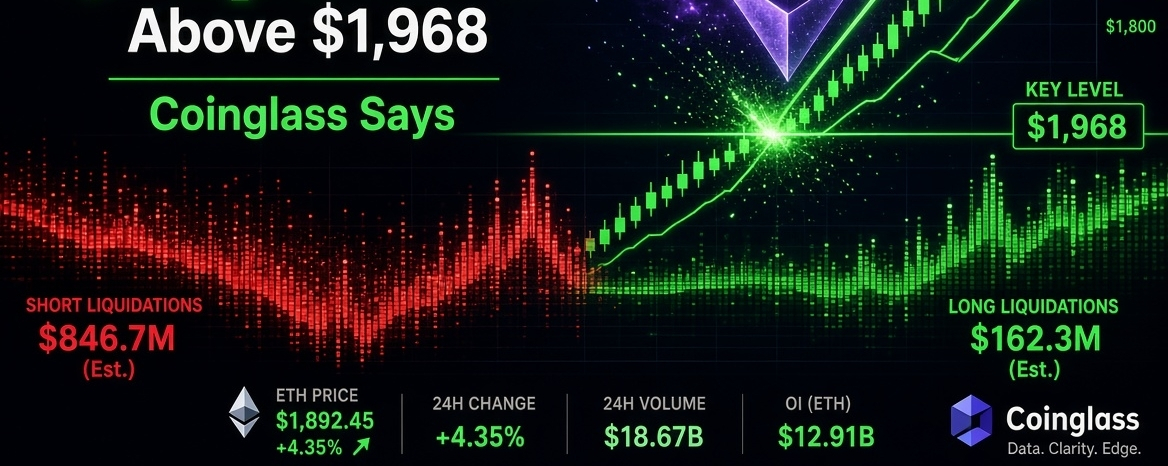
ETH Faces $846 Million Short Liquidations Above $1,968, Coinglass SaysEthereum is sitting on a powder keg of short positions. According to the latest data from Coinglass, if ETH breaks above $1,968, the cumulative short liquidation intensity across major centralized exchanges will reach approximately $846 million. That figure represents one of the more significant near-term liquidation clusters currently visible on the Ethereum futures market and has quickly drawn attention from traders watching for a potential short squeeze.
The setup is straightforward yet powerful. #ETH #Ethereum #Crypt #Liquidations ##USJulyCPI&PPIDueThisWeek CryptoMarket Large numbers of leveraged traders have positioned themselves short around and above current price levels. As price approaches $1,968, those positions face mounting pressure. A decisive move through that level would force exchanges to automatically close out underwater short accounts, creating a cascade of market buy orders. Those forced buys can accelerate the upward move, liquidating even more shorts in a self-reinforcing loop commonly known as a short squeeze.
Liquidation maps from Coinglass function as heatmaps of leverage risk. They aggregate open interest across major exchanges and estimate the dollar value of positions that would be forcibly closed at specific price thresholds. The $846 million short liquidation cluster above $1,968 stands out because it is both sizable and relatively close to current trading levels. In recent sessions ETH has been hovering in the $1,880–$1,900 range, meaning the distance to the key trigger is not extreme. A modest bullish impulse or a wave of covering could be enough to test the level.
This kind of positioning imbalance does not guarantee an immediate breakout. Markets can grind sideways or reverse before reaching high-liquidity clusters. However, the presence of such a large short overhang creates asymmetric risk. On the upside, a push through $1,968 could unlock significant forced buying. On the downside, Coinglass data also shows that a drop below roughly $1,788 would trigger around $727 million in long liquidations. The market therefore sits between two meaningful liquidity pools, with the short side currently more concentrated just overhead.
The broader context adds weight to the data. Ethereum has spent recent weeks consolidating after a period of weakness, tracking broader crypto market sentiment that has been dominated by Bitcoin’s own technical struggles. Funding rates on ETH perpetual futures have fluctuated, at times turning negative as shorts paid to maintain their positions. Open interest remains elevated relative to some quieter periods earlier in the year, indicating that leveraged traders have not fully exited the market. When open interest stays high and price compresses near a major liquidation cluster, the conditions for a sharp directional move improve.
A short squeeze of this magnitude would not necessarily mark the start of a sustained bull market. It could simply be a violent, short-lived liquidation event that clears overleveraged positions before price settles into a new range. Historical examples in both Bitcoin and Ethereum show that large liquidation cascades often produce rapid candles followed by periods of digestion. Still, the mechanical effect is real: every short that gets liquidated becomes a market buy, and $846 million in concentrated short risk is enough to move price meaningfully in a market that has shown sensitivity to leverage flows.
Traders monitoring the situation are watching several confirmation signals. A clean break and hold above $1,968 on rising volume would increase the probability of cascading liquidations. Failure to reclaim the level, or a sharp rejection, would leave the short cluster intact and potentially shift focus back toward the long liquidation zone lower down. Exchange-specific data also matters; the largest concentrations of short leverage often sit on Binance, OKX, and Bybit, meaning activity on those platforms can amplify or dampen the effect.
Coinglass’s liquidation estimates are not precise predictions of exact dollar flows. They are modeled intensities based on open interest and estimated leverage at different price bands. Actual liquidations can be higher or lower depending on how positions are distributed, how quickly price moves, and whether traders add or reduce risk in real time. Nevertheless, the $846 million figure provides a clear, data-driven reason why many market participants are treating $1,968 as a critical near-term level for Ethereum.
In a market still recovering from broader risk-off pressure, the existence of this short liquidation wall offers both opportunity and danger. For bulls, it represents potential fuel. For bears, it is a level that must be defended or risk forced covering. Either way, the Coinglass data has put $1,968 firmly on the radar. If Ethereum can push through it with momentum, the $846 million short liquidation cluster will no longer be theoretical—it will become live market activity.
ETH Faces $846 Million Short Liquidations Above $1,968, Coinglass Says
Ethereum is sitting on a powder keg of short positions. According to the latest data from Coinglass, if ETH breaks above $1,968, the cumulative short liquidation intensity across major centralized exchanges will reach approximately $846 million. That figure represents one of the more significant near-term liquidation clusters currently visible on the Ethereum futures market and has quickly drawn attention from traders watching for a potential short squeeze.
The setup is straightforward yet powerful. #ETH #Ethereum #Crypt #Liquidations ##USJulyCPI&PPIDueThisWeek CryptoMarket Large numbers of leveraged traders have positioned themselves short around and above current price levels. As price approaches $1,968, those positions face mounting pressure. A decisive move through that level would force exchanges to automatically close out underwater short accounts, creating a cascade of market buy orders. Those forced buys can accelerate the upward move, liquidating even more shorts in a self-reinforcing loop commonly known as a short squeeze.
Liquidation maps from Coinglass function as heatmaps of leverage risk. They aggregate open interest across major exchanges and estimate the dollar value of positions that would be forcibly closed at specific price thresholds. The $846 million short liquidation cluster above $1,968 stands out because it is both sizable and relatively close to current trading levels. In recent sessions ETH has been hovering in the $1,880–$1,900 range, meaning the distance to the key trigger is not extreme. A modest bullish impulse or a wave of covering could be enough to test the level.
This kind of positioning imbalance does not guarantee an immediate breakout. Markets can grind sideways or reverse before reaching high-liquidity clusters. However, the presence of such a large short overhang creates asymmetric risk. On the upside, a push through $1,968 could unlock significant forced buying. On the downside, Coinglass data also shows that a drop below roughly $1,788 would trigger around $727 million in long liquidations. The market therefore sits between two meaningful liquidity pools, with the short side currently more concentrated just overhead.
The broader context adds weight to the data. Ethereum has spent recent weeks consolidating after a period of weakness, tracking broader crypto market sentiment that has been dominated by Bitcoin’s own technical struggles. Funding rates on ETH perpetual futures have fluctuated, at times turning negative as shorts paid to maintain their positions. Open interest remains elevated relative to some quieter periods earlier in the year, indicating that leveraged traders have not fully exited the market. When open interest stays high and price compresses near a major liquidation cluster, the conditions for a sharp directional move improve.
A short squeeze of this magnitude would not necessarily mark the start of a sustained bull market. It could simply be a violent, short-lived liquidation event that clears overleveraged positions before price settles into a new range. Historical examples in both Bitcoin and Ethereum show that large liquidation cascades often produce rapid candles followed by periods of digestion. Still, the mechanical effect is real: every short that gets liquidated becomes a market buy, and $846 million in concentrated short risk is enough to move price meaningfully in a market that has shown sensitivity to leverage flows.
Traders monitoring the situation are watching several confirmation signals. A clean break and hold above $1,968 on rising volume would increase the probability of cascading liquidations. Failure to reclaim the level, or a sharp rejection, would leave the short cluster intact and potentially shift focus back toward the long liquidation zone lower down. Exchange-specific data also matters; the largest concentrations of short leverage often sit on Binance, OKX, and Bybit, meaning activity on those platforms can amplify or dampen the effect.
Coinglass’s liquidation estimates are not precise predictions of exact dollar flows. They are modeled intensities based on open interest and estimated leverage at different price bands. Actual liquidations can be higher or lower depending on how positions are distributed, how quickly price moves, and whether traders add or reduce risk in real time. Nevertheless, the $846 million figure provides a clear, data-driven reason why many market participants are treating $1,968 as a critical near-term level for Ethereum.
In a market still recovering from broader risk-off pressure, the existence of this short liquidation wall offers both opportunity and danger. For bulls, it represents potential fuel. For bears, it is a level that must be defended or risk forced covering. Either way, the Coinglass data has put $1,968 firmly on the radar. If Ethereum can push through it with momentum, the $846 million short liquidation cluster will no longer be theoretical—it will become live market activity.
The setup is straightforward yet powerful. #ETH #Ethereum #Crypt #Liquidations ##USJulyCPI&PPIDueThisWeek CryptoMarket Large numbers of leveraged traders have positioned themselves short around and above current price levels. As price approaches $1,968, those positions face mounting pressure. A decisive move through that level would force exchanges to automatically close out underwater short accounts, creating a cascade of market buy orders. Those forced buys can accelerate the upward move, liquidating even more shorts in a self-reinforcing loop commonly known as a short squeeze.
Liquidation maps from Coinglass function as heatmaps of leverage risk. They aggregate open interest across major exchanges and estimate the dollar value of positions that would be forcibly closed at specific price thresholds. The $846 million short liquidation cluster above $1,968 stands out because it is both sizable and relatively close to current trading levels. In recent sessions ETH has been hovering in the $1,880–$1,900 range, meaning the distance to the key trigger is not extreme. A modest bullish impulse or a wave of covering could be enough to test the level.
This kind of positioning imbalance does not guarantee an immediate breakout. Markets can grind sideways or reverse before reaching high-liquidity clusters. However, the presence of such a large short overhang creates asymmetric risk. On the upside, a push through $1,968 could unlock significant forced buying. On the downside, Coinglass data also shows that a drop below roughly $1,788 would trigger around $727 million in long liquidations. The market therefore sits between two meaningful liquidity pools, with the short side currently more concentrated just overhead.
The broader context adds weight to the data. Ethereum has spent recent weeks consolidating after a period of weakness, tracking broader crypto market sentiment that has been dominated by Bitcoin’s own technical struggles. Funding rates on ETH perpetual futures have fluctuated, at times turning negative as shorts paid to maintain their positions. Open interest remains elevated relative to some quieter periods earlier in the year, indicating that leveraged traders have not fully exited the market. When open interest stays high and price compresses near a major liquidation cluster, the conditions for a sharp directional move improve.
A short squeeze of this magnitude would not necessarily mark the start of a sustained bull market. It could simply be a violent, short-lived liquidation event that clears overleveraged positions before price settles into a new range. Historical examples in both Bitcoin and Ethereum show that large liquidation cascades often produce rapid candles followed by periods of digestion. Still, the mechanical effect is real: every short that gets liquidated becomes a market buy, and $846 million in concentrated short risk is enough to move price meaningfully in a market that has shown sensitivity to leverage flows.
Traders monitoring the situation are watching several confirmation signals. A clean break and hold above $1,968 on rising volume would increase the probability of cascading liquidations. Failure to reclaim the level, or a sharp rejection, would leave the short cluster intact and potentially shift focus back toward the long liquidation zone lower down. Exchange-specific data also matters; the largest concentrations of short leverage often sit on Binance, OKX, and Bybit, meaning activity on those platforms can amplify or dampen the effect.
Coinglass’s liquidation estimates are not precise predictions of exact dollar flows. They are modeled intensities based on open interest and estimated leverage at different price bands. Actual liquidations can be higher or lower depending on how positions are distributed, how quickly price moves, and whether traders add or reduce risk in real time. Nevertheless, the $846 million figure provides a clear, data-driven reason why many market participants are treating $1,968 as a critical near-term level for Ethereum.
In a market still recovering from broader risk-off pressure, the existence of this short liquidation wall offers both opportunity and danger. For bulls, it represents potential fuel. For bears, it is a level that must be defended or risk forced covering. Either way, the Coinglass data has put $1,968 firmly on the radar. If Ethereum can push through it with momentum, the $846 million short liquidation cluster will no longer be theoretical—it will become live market activity.
6
·
--
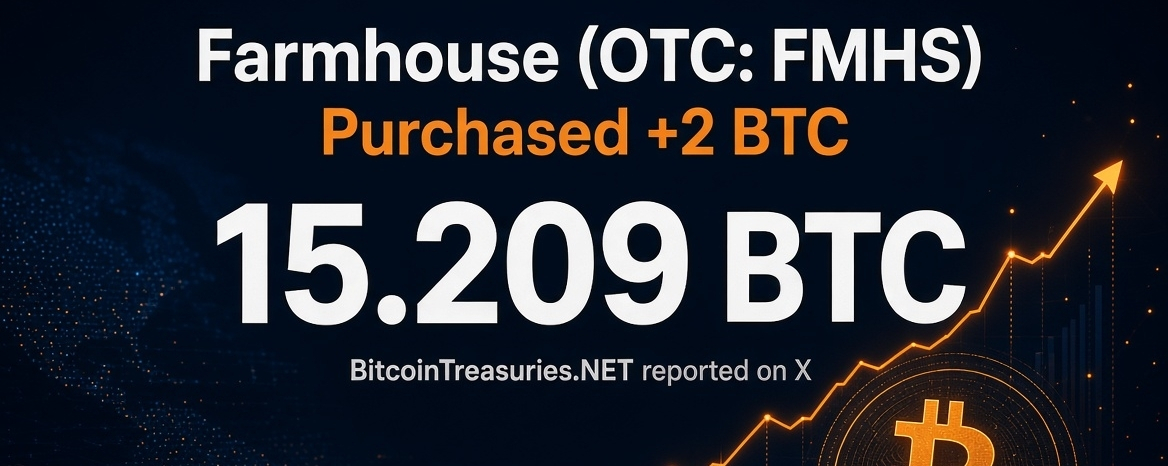
Статья
Farmhouse (OTC: FMHS) has purchased an additional 2 Bitcoin, bringing its total holdings to 15 BTCBitcoinTreasuries.NET reported on X that publicly traded company Farmhouse (OTC: FMHS) has purchased an additional 2 Bitcoin, bringing its total holdings to 15.209 BTC. Odaily confirmed the update, noting that Farmhouse now holds 15.209 Bitcoin following the latest acquisition.
The company’s own announcement provided further detail. Farmhouse stated it added another 2.0 BTC to its treasury at an average price of $63,761. The total Bitcoin held now stands at 15.209, with a blended average cost basis of $64,547. Management highlighted the move with a simple claim: “We have the best entry in the treasury space.”
This latest purchase continues a pattern of steady accumulation that Farmhouse has maintained through periods of market weakness. Earlier in the year the company was holding single-digit Bitcoin amounts. Over successive buys it has more than doubled its position while keeping its average entry relatively contained compared with many larger corporate treasuries that accumulated during higher price ranges. The strategy is deliberate. Farmhouse positions itself as an “anti-debasement” treasury, targeting roughly 70 percent of its reserve assets in Bitcoin and 30 percent in gold, with additional smaller allocations to income-oriented digital credit instruments.
The timing is notable. Bitcoin has spent recent sessions under pressure, trading near multi-month lows and testing key technical levels. Many market participants have grown cautious, reducing risk or waiting for clearer directional signals. Farmhouse has chosen the opposite approach: buying into the softness. Its most recent 2 BTC purchase occurred at prices below $64,000, improving the overall cost basis of the treasury. For a small-cap OTC company with a market capitalization in the low single-digit millions, each incremental Bitcoin purchase represents a meaningful commitment relative to its size.
Farmhouse’s approach differs from the high-profile corporate Bitcoin strategies that dominated headlines in previous cycles. It does not attempt to issue large convertible notes or raise hundreds of millions specifically for Bitcoin accumulation. Instead it has focused on consistent, relatively small purchases while maintaining transparency about both Bitcoin and gold holdings. The company maintains a public website that displays live treasury metrics, average entry prices, and historical purchase events. This level of disclosure is unusual among micro-cap names and appears designed to attract shareholders who specifically want exposure to a dual Bitcoin-and-gold reserve strategy.
The broader corporate Bitcoin treasury landscape has continued to expand even as price action has cooled. Trackers such as BitcoinTreasuries.NET monitor dozens of public companies that have added BTC to their balance sheets. While the largest holders still dominate absolute figures, smaller and mid-sized firms like Farmhouse contribute to the overall narrative of gradual institutional and corporate adoption. Each incremental purchase, regardless of size, removes Bitcoin from circulating supply and signals that some balance-sheet managers continue to view the asset as a long-term store of value rather than a short-term trading vehicle.
Whether Farmhouse’s strategy will translate into sustained shareholder value remains an open question. OTC equities of this size can be thinly traded and highly volatile. The company’s market capitalization is modest, and its core operating businesses have historically been limited. The Bitcoin and gold treasury has become a primary point of differentiation. By continuing to accumulate at current levels, management is effectively betting that the long-term appreciation of these scarce assets will outweigh near-term equity market indifference.
For now, the facts are straightforward. Farmhouse has added another 2 Bitcoin. Its total holdings stand at 15.209 BTC at an average cost of $64,547. BitcoinTreasuries.NET recorded the transaction, Odaily reported it, and the company itself confirmed the details. In a market still searching for direction, one small public company is quietly stacking.
Farmhouse (OTC: FMHS) has purchased an additional 2 Bitcoin, bringing its total holdings to 15 BTC
BitcoinTreasuries.NET reported on X that publicly traded company Farmhouse (OTC: FMHS) has purchased an additional 2 Bitcoin, bringing its total holdings to 15.209 BTC. Odaily confirmed the update, noting that Farmhouse now holds 15.209 Bitcoin following the latest acquisition.
The company’s own announcement provided further detail. Farmhouse stated it added another 2.0 BTC to its treasury at an average price of $63,761. The total Bitcoin held now stands at 15.209, with a blended average cost basis of $64,547. Management highlighted the move with a simple claim: “We have the best entry in the treasury space.”
This latest purchase continues a pattern of steady accumulation that Farmhouse has maintained through periods of market weakness. Earlier in the year the company was holding single-digit Bitcoin amounts. Over successive buys it has more than doubled its position while keeping its average entry relatively contained compared with many larger corporate treasuries that accumulated during higher price ranges. The strategy is deliberate. Farmhouse positions itself as an “anti-debasement” treasury, targeting roughly 70 percent of its reserve assets in Bitcoin and 30 percent in gold, with additional smaller allocations to income-oriented digital credit instruments.
The timing is notable. Bitcoin has spent recent sessions under pressure, trading near multi-month lows and testing key technical levels. Many market participants have grown cautious, reducing risk or waiting for clearer directional signals. Farmhouse has chosen the opposite approach: buying into the softness. Its most recent 2 BTC purchase occurred at prices below $64,000, improving the overall cost basis of the treasury. For a small-cap OTC company with a market capitalization in the low single-digit millions, each incremental Bitcoin purchase represents a meaningful commitment relative to its size.
Farmhouse’s approach differs from the high-profile corporate Bitcoin strategies that dominated headlines in previous cycles. It does not attempt to issue large convertible notes or raise hundreds of millions specifically for Bitcoin accumulation. Instead it has focused on consistent, relatively small purchases while maintaining transparency about both Bitcoin and gold holdings. The company maintains a public website that displays live treasury metrics, average entry prices, and historical purchase events. This level of disclosure is unusual among micro-cap names and appears designed to attract shareholders who specifically want exposure to a dual Bitcoin-and-gold reserve strategy.
The broader corporate Bitcoin treasury landscape has continued to expand even as price action has cooled. Trackers such as BitcoinTreasuries.NET monitor dozens of public companies that have added BTC to their balance sheets. While the largest holders still dominate absolute figures, smaller and mid-sized firms like Farmhouse contribute to the overall narrative of gradual institutional and corporate adoption. Each incremental purchase, regardless of size, removes Bitcoin from circulating supply and signals that some balance-sheet managers continue to view the asset as a long-term store of value rather than a short-term trading vehicle.
Whether Farmhouse’s strategy will translate into sustained shareholder value remains an open question. OTC equities of this size can be thinly traded and highly volatile. The company’s market capitalization is modest, and its core operating businesses have historically been limited. The Bitcoin and gold treasury has become a primary point of differentiation. By continuing to accumulate at current levels, management is effectively betting that the long-term appreciation of these scarce assets will outweigh near-term equity market indifference.
For now, the facts are straightforward. Farmhouse has added another 2 Bitcoin. Its total holdings stand at 15.209 BTC at an average cost of $64,547. BitcoinTreasuries.NET recorded the transaction, Odaily reported it, and the company itself confirmed the details. In a market still searching for direction, one small public company is quietly stacking.
The company’s own announcement provided further detail. Farmhouse stated it added another 2.0 BTC to its treasury at an average price of $63,761. The total Bitcoin held now stands at 15.209, with a blended average cost basis of $64,547. Management highlighted the move with a simple claim: “We have the best entry in the treasury space.”
This latest purchase continues a pattern of steady accumulation that Farmhouse has maintained through periods of market weakness. Earlier in the year the company was holding single-digit Bitcoin amounts. Over successive buys it has more than doubled its position while keeping its average entry relatively contained compared with many larger corporate treasuries that accumulated during higher price ranges. The strategy is deliberate. Farmhouse positions itself as an “anti-debasement” treasury, targeting roughly 70 percent of its reserve assets in Bitcoin and 30 percent in gold, with additional smaller allocations to income-oriented digital credit instruments.
The timing is notable. Bitcoin has spent recent sessions under pressure, trading near multi-month lows and testing key technical levels. Many market participants have grown cautious, reducing risk or waiting for clearer directional signals. Farmhouse has chosen the opposite approach: buying into the softness. Its most recent 2 BTC purchase occurred at prices below $64,000, improving the overall cost basis of the treasury. For a small-cap OTC company with a market capitalization in the low single-digit millions, each incremental Bitcoin purchase represents a meaningful commitment relative to its size.
Farmhouse’s approach differs from the high-profile corporate Bitcoin strategies that dominated headlines in previous cycles. It does not attempt to issue large convertible notes or raise hundreds of millions specifically for Bitcoin accumulation. Instead it has focused on consistent, relatively small purchases while maintaining transparency about both Bitcoin and gold holdings. The company maintains a public website that displays live treasury metrics, average entry prices, and historical purchase events. This level of disclosure is unusual among micro-cap names and appears designed to attract shareholders who specifically want exposure to a dual Bitcoin-and-gold reserve strategy.
The broader corporate Bitcoin treasury landscape has continued to expand even as price action has cooled. Trackers such as BitcoinTreasuries.NET monitor dozens of public companies that have added BTC to their balance sheets. While the largest holders still dominate absolute figures, smaller and mid-sized firms like Farmhouse contribute to the overall narrative of gradual institutional and corporate adoption. Each incremental purchase, regardless of size, removes Bitcoin from circulating supply and signals that some balance-sheet managers continue to view the asset as a long-term store of value rather than a short-term trading vehicle.
Whether Farmhouse’s strategy will translate into sustained shareholder value remains an open question. OTC equities of this size can be thinly traded and highly volatile. The company’s market capitalization is modest, and its core operating businesses have historically been limited. The Bitcoin and gold treasury has become a primary point of differentiation. By continuing to accumulate at current levels, management is effectively betting that the long-term appreciation of these scarce assets will outweigh near-term equity market indifference.
For now, the facts are straightforward. Farmhouse has added another 2 Bitcoin. Its total holdings stand at 15.209 BTC at an average cost of $64,547. BitcoinTreasuries.NET recorded the transaction, Odaily reported it, and the company itself confirmed the details. In a market still searching for direction, one small public company is quietly stacking.
33
·
--
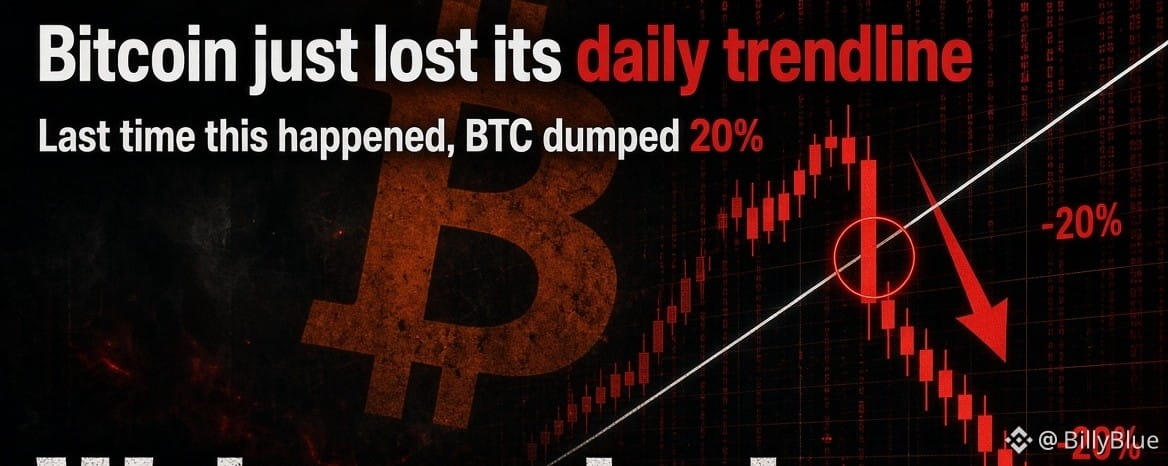
Статья
Bitcoin just lost its daily trendline.
Last time this happened, BTC dumped 20%.
We’re cookThe chart doesn’t lie, and right now it’s screaming the same warning it has delivered before. Bitcoin has sliced through its rising daily trendline with the kind of conviction that usually precedes pain. Not a wick. Not a brief probe. A clean, sustained break that has left the structure broken and the bulls looking over their shoulders.
This isn’t the first time. The last time price lost this same daily trendline in similar fashion, Bitcoin didn’t politely consolidate or stage a gentle higher-low recovery. It dumped roughly 20% in the weeks that followed. Liquidity got hunted. Overleveraged longs got liquidated in waves. The “it’s just a healthy pullback” crowd went quiet. The pattern is familiar enough that many of the same voices who called the previous breakdown are already drawing the same parallels today.
What makes this break particularly concerning is the context. Bitcoin has been grinding lower for weeks, failing to reclaim key moving averages and struggling to hold even modest bounces. Volume on the downside has been heavier than the upside attempts. Funding rates have flipped negative more often than not. Open interest has been bleeding. These are not the conditions of a market that is simply resting before the next leg higher. They are the conditions of a market that has lost its short-term structural support and is now searching for the next level of demand.
Trendlines are not magic. They are visual representations of the path of least resistance and the points where buyers previously stepped in with enough force to turn the tape. When that path is broken and price closes below it with momentum, the burden of proof shifts. Bulls now need to reclaim the trendline and hold it, preferably with expanding volume, to invalidate the breakdown. Until that happens, the path of least resistance is lower.
The previous 20% episode taught a hard lesson about complacency. Many traders treated the first break as noise. They averaged down. They talked about “discount buying.” Then the cascade arrived. Support levels that looked solid on the daily chart turned into resistance on the way back up. The move was orderly at first, then accelerated as stop losses and forced selling piled on. That sequence is still fresh in the memory of anyone who lived through it.
Today’s setup carries similar risk. The daily trendline that just failed had been respected for a meaningful stretch of time. Its loss removes a key reference point that buyers were using to manage risk. Below it, the next significant supports sit meaningfully lower. A 20% move from current levels would not be an extreme outlier given the historical reaction to the same technical event. It would simply be a repeat of the last time the market delivered this particular signal.
None of this guarantees an immediate collapse. Markets can grind, chop, and frustrate both sides for longer than expected. But the technical damage is real. The daily structure is broken. The last time it broke in this manner, the downside followed. Ignoring that history because “this time is different” is how traders end up holding bags while price discovers where the real buyers are.
The chart has spoken. Bitcoin just lost its daily trendline. Last time this happened, it dumped 20%.
We’re cooked.
Bitcoin just lost its daily trendline. Last time this happened, BTC dumped 20%. We’re cook
The chart doesn’t lie, and right now it’s screaming the same warning it has delivered before. Bitcoin has sliced through its rising daily trendline with the kind of conviction that usually precedes pain. Not a wick. Not a brief probe. A clean, sustained break that has left the structure broken and the bulls looking over their shoulders.
This isn’t the first time. The last time price lost this same daily trendline in similar fashion, Bitcoin didn’t politely consolidate or stage a gentle higher-low recovery. It dumped roughly 20% in the weeks that followed. Liquidity got hunted. Overleveraged longs got liquidated in waves. The “it’s just a healthy pullback” crowd went quiet. The pattern is familiar enough that many of the same voices who called the previous breakdown are already drawing the same parallels today.
What makes this break particularly concerning is the context. Bitcoin has been grinding lower for weeks, failing to reclaim key moving averages and struggling to hold even modest bounces. Volume on the downside has been heavier than the upside attempts. Funding rates have flipped negative more often than not. Open interest has been bleeding. These are not the conditions of a market that is simply resting before the next leg higher. They are the conditions of a market that has lost its short-term structural support and is now searching for the next level of demand.
Trendlines are not magic. They are visual representations of the path of least resistance and the points where buyers previously stepped in with enough force to turn the tape. When that path is broken and price closes below it with momentum, the burden of proof shifts. Bulls now need to reclaim the trendline and hold it, preferably with expanding volume, to invalidate the breakdown. Until that happens, the path of least resistance is lower.
The previous 20% episode taught a hard lesson about complacency. Many traders treated the first break as noise. They averaged down. They talked about “discount buying.” Then the cascade arrived. Support levels that looked solid on the daily chart turned into resistance on the way back up. The move was orderly at first, then accelerated as stop losses and forced selling piled on. That sequence is still fresh in the memory of anyone who lived through it.
Today’s setup carries similar risk. The daily trendline that just failed had been respected for a meaningful stretch of time. Its loss removes a key reference point that buyers were using to manage risk. Below it, the next significant supports sit meaningfully lower. A 20% move from current levels would not be an extreme outlier given the historical reaction to the same technical event. It would simply be a repeat of the last time the market delivered this particular signal.
None of this guarantees an immediate collapse. Markets can grind, chop, and frustrate both sides for longer than expected. But the technical damage is real. The daily structure is broken. The last time it broke in this manner, the downside followed. Ignoring that history because “this time is different” is how traders end up holding bags while price discovers where the real buyers are.
The chart has spoken. Bitcoin just lost its daily trendline. Last time this happened, it dumped 20%.
We’re cooked.
This isn’t the first time. The last time price lost this same daily trendline in similar fashion, Bitcoin didn’t politely consolidate or stage a gentle higher-low recovery. It dumped roughly 20% in the weeks that followed. Liquidity got hunted. Overleveraged longs got liquidated in waves. The “it’s just a healthy pullback” crowd went quiet. The pattern is familiar enough that many of the same voices who called the previous breakdown are already drawing the same parallels today.
What makes this break particularly concerning is the context. Bitcoin has been grinding lower for weeks, failing to reclaim key moving averages and struggling to hold even modest bounces. Volume on the downside has been heavier than the upside attempts. Funding rates have flipped negative more often than not. Open interest has been bleeding. These are not the conditions of a market that is simply resting before the next leg higher. They are the conditions of a market that has lost its short-term structural support and is now searching for the next level of demand.
Trendlines are not magic. They are visual representations of the path of least resistance and the points where buyers previously stepped in with enough force to turn the tape. When that path is broken and price closes below it with momentum, the burden of proof shifts. Bulls now need to reclaim the trendline and hold it, preferably with expanding volume, to invalidate the breakdown. Until that happens, the path of least resistance is lower.
The previous 20% episode taught a hard lesson about complacency. Many traders treated the first break as noise. They averaged down. They talked about “discount buying.” Then the cascade arrived. Support levels that looked solid on the daily chart turned into resistance on the way back up. The move was orderly at first, then accelerated as stop losses and forced selling piled on. That sequence is still fresh in the memory of anyone who lived through it.
Today’s setup carries similar risk. The daily trendline that just failed had been respected for a meaningful stretch of time. Its loss removes a key reference point that buyers were using to manage risk. Below it, the next significant supports sit meaningfully lower. A 20% move from current levels would not be an extreme outlier given the historical reaction to the same technical event. It would simply be a repeat of the last time the market delivered this particular signal.
None of this guarantees an immediate collapse. Markets can grind, chop, and frustrate both sides for longer than expected. But the technical damage is real. The daily structure is broken. The last time it broke in this manner, the downside followed. Ignoring that history because “this time is different” is how traders end up holding bags while price discovers where the real buyers are.
The chart has spoken. Bitcoin just lost its daily trendline. Last time this happened, it dumped 20%.
We’re cooked.
47
·
--
Статья
KB Securities Says Samsung Electronics and SK Hynix Are Deeply UndervaluedSouth Korea’s two memory chip giants, Samsung Electronics and SK Hynix, remain deeply undervalued relative to their explosive earnings growth, according to KB Securities. In a report dated August 13, 2026, Kim Dong-won, head of research at the brokerage, argued that the companies have entered an “extreme undervaluation” zone as their projected profits soar while share prices lag far behind.
KB Securities forecasts that the combined operating profit of Samsung Electronics and SK Hynix will surge from 91 trillion won in 2025 to 641 trillion won in 2026 and reach 964 trillion won in 2027—approaching the 1,000 trillion won mark. For 2027 specifically, the brokerage estimates Samsung’s operating profit at 575 trillion won and SK Hynix’s at 389 trillion won. These figures imply massive year-over-year gains, with the two firms expected to dominate Korean market earnings.
Despite this trajectory, valuations look strikingly cheap. Based on closing prices as of August 12, 2026, the price-to-earnings ratios (PER) on expected 2027 results stood at just 3.7 times for Samsung Electronics and 3.2 times for SK Hynix. Kim noted that profits are projected to multiply dramatically—roughly 13 times for Samsung and more than 8 times for SK Hynix compared with 2025 levels—yet stock prices have not kept pace. Recent liquidations of high-leverage positions contributed to declines of over 40% from prior highs for both names, further compressing multiples.
Near-term momentum also looks strong. KB Securities expects both companies to deliver record quarterly results in the third quarter of 2026. Samsung’s Q3 operating profit is forecast at 112 trillion won (up 817% year-on-year), while SK Hynix is seen posting 77 trillion won (up 579%). The broader backdrop is an AI-driven memory supercycle, with high-bandwidth memory (HBM), tight supply, rising prices for DRAM and NAND, and growing long-term supply agreements with cloud and GPU customers providing visibility.
This is not an isolated call. Earlier in 2026, KB Securities had already highlighted significant undervaluation. In an April report, it projected the pair’s combined 2026 operating profit at 586 trillion won—about five times that of TSMC—while their combined market capitalization trailed TSMC’s. At the time, KB suggested a fair combined market cap exceeding 3,300 trillion won, with Samsung potentially above 2,000 trillion won and SK Hynix above 1,300 trillion won. The August update intensifies the message by pointing to even lower forward multiples amid continued earnings upgrades.
Kim also pointed to potential catalysts beyond pure earnings. For Samsung, large-scale shareholder returns of at least 600 trillion won over the next three years could push the dividend yield above 7% at current prices, potentially attracting long-term capital such as sovereign wealth funds. Drawing parallels with TSMC’s experience, the brokerage suggested that improved shareholder returns, combined with structural supply-demand tightness in memory, could support a valuation re-rating.
Memory chips have become critical infrastructure for AI expansion. Limited capacity growth alongside robust demand from hyperscalers and the rise of agentic AI are expected to sustain elevated prices and margins for an extended period. While the semiconductor industry remains cyclical and risks such as shifts in AI capital expenditure exist, KB Securities maintains that current valuations fail to reflect the scale and durability of the upcycle for these two Korean leaders.
In summary, KB Securities’ latest analysis reinforces a consistent theme: Samsung Electronics and SK Hynix are generating (or are on track to generate) extraordinary profits driven by the AI memory boom, yet trade at historically low earnings multiples. Investors watching the sector will be monitoring whether the extreme undervaluation thesis translates into a sustained re-rating as quarterly results and longer-term forecasts materialize.
KB Securities Says Samsung Electronics and SK Hynix Are Deeply Undervalued
South Korea’s two memory chip giants, Samsung Electronics and SK Hynix, remain deeply undervalued relative to their explosive earnings growth, according to KB Securities. In a report dated August 13, 2026, Kim Dong-won, head of research at the brokerage, argued that the companies have entered an “extreme undervaluation” zone as their projected profits soar while share prices lag far behind.
KB Securities forecasts that the combined operating profit of Samsung Electronics and SK Hynix will surge from 91 trillion won in 2025 to 641 trillion won in 2026 and reach 964 trillion won in 2027—approaching the 1,000 trillion won mark. For 2027 specifically, the brokerage estimates Samsung’s operating profit at 575 trillion won and SK Hynix’s at 389 trillion won. These figures imply massive year-over-year gains, with the two firms expected to dominate Korean market earnings.
Despite this trajectory, valuations look strikingly cheap. Based on closing prices as of August 12, 2026, the price-to-earnings ratios (PER) on expected 2027 results stood at just 3.7 times for Samsung Electronics and 3.2 times for SK Hynix. Kim noted that profits are projected to multiply dramatically—roughly 13 times for Samsung and more than 8 times for SK Hynix compared with 2025 levels—yet stock prices have not kept pace. Recent liquidations of high-leverage positions contributed to declines of over 40% from prior highs for both names, further compressing multiples.
Near-term momentum also looks strong. KB Securities expects both companies to deliver record quarterly results in the third quarter of 2026. Samsung’s Q3 operating profit is forecast at 112 trillion won (up 817% year-on-year), while SK Hynix is seen posting 77 trillion won (up 579%). The broader backdrop is an AI-driven memory supercycle, with high-bandwidth memory (HBM), tight supply, rising prices for DRAM and NAND, and growing long-term supply agreements with cloud and GPU customers providing visibility.
This is not an isolated call. Earlier in 2026, KB Securities had already highlighted significant undervaluation. In an April report, it projected the pair’s combined 2026 operating profit at 586 trillion won—about five times that of TSMC—while their combined market capitalization trailed TSMC’s. At the time, KB suggested a fair combined market cap exceeding 3,300 trillion won, with Samsung potentially above 2,000 trillion won and SK Hynix above 1,300 trillion won. The August update intensifies the message by pointing to even lower forward multiples amid continued earnings upgrades.
Kim also pointed to potential catalysts beyond pure earnings. For Samsung, large-scale shareholder returns of at least 600 trillion won over the next three years could push the dividend yield above 7% at current prices, potentially attracting long-term capital such as sovereign wealth funds. Drawing parallels with TSMC’s experience, the brokerage suggested that improved shareholder returns, combined with structural supply-demand tightness in memory, could support a valuation re-rating.
Memory chips have become critical infrastructure for AI expansion. Limited capacity growth alongside robust demand from hyperscalers and the rise of agentic AI are expected to sustain elevated prices and margins for an extended period. While the semiconductor industry remains cyclical and risks such as shifts in AI capital expenditure exist, KB Securities maintains that current valuations fail to reflect the scale and durability of the upcycle for these two Korean leaders.
In summary, KB Securities’ latest analysis reinforces a consistent theme: Samsung Electronics and SK Hynix are generating (or are on track to generate) extraordinary profits driven by the AI memory boom, yet trade at historically low earnings multiples. Investors watching the sector will be monitoring whether the extreme undervaluation thesis translates into a sustained re-rating as quarterly results and longer-term forecasts materialize.
KB Securities forecasts that the combined operating profit of Samsung Electronics and SK Hynix will surge from 91 trillion won in 2025 to 641 trillion won in 2026 and reach 964 trillion won in 2027—approaching the 1,000 trillion won mark. For 2027 specifically, the brokerage estimates Samsung’s operating profit at 575 trillion won and SK Hynix’s at 389 trillion won. These figures imply massive year-over-year gains, with the two firms expected to dominate Korean market earnings.
Despite this trajectory, valuations look strikingly cheap. Based on closing prices as of August 12, 2026, the price-to-earnings ratios (PER) on expected 2027 results stood at just 3.7 times for Samsung Electronics and 3.2 times for SK Hynix. Kim noted that profits are projected to multiply dramatically—roughly 13 times for Samsung and more than 8 times for SK Hynix compared with 2025 levels—yet stock prices have not kept pace. Recent liquidations of high-leverage positions contributed to declines of over 40% from prior highs for both names, further compressing multiples.
Near-term momentum also looks strong. KB Securities expects both companies to deliver record quarterly results in the third quarter of 2026. Samsung’s Q3 operating profit is forecast at 112 trillion won (up 817% year-on-year), while SK Hynix is seen posting 77 trillion won (up 579%). The broader backdrop is an AI-driven memory supercycle, with high-bandwidth memory (HBM), tight supply, rising prices for DRAM and NAND, and growing long-term supply agreements with cloud and GPU customers providing visibility.
This is not an isolated call. Earlier in 2026, KB Securities had already highlighted significant undervaluation. In an April report, it projected the pair’s combined 2026 operating profit at 586 trillion won—about five times that of TSMC—while their combined market capitalization trailed TSMC’s. At the time, KB suggested a fair combined market cap exceeding 3,300 trillion won, with Samsung potentially above 2,000 trillion won and SK Hynix above 1,300 trillion won. The August update intensifies the message by pointing to even lower forward multiples amid continued earnings upgrades.
Kim also pointed to potential catalysts beyond pure earnings. For Samsung, large-scale shareholder returns of at least 600 trillion won over the next three years could push the dividend yield above 7% at current prices, potentially attracting long-term capital such as sovereign wealth funds. Drawing parallels with TSMC’s experience, the brokerage suggested that improved shareholder returns, combined with structural supply-demand tightness in memory, could support a valuation re-rating.
Memory chips have become critical infrastructure for AI expansion. Limited capacity growth alongside robust demand from hyperscalers and the rise of agentic AI are expected to sustain elevated prices and margins for an extended period. While the semiconductor industry remains cyclical and risks such as shifts in AI capital expenditure exist, KB Securities maintains that current valuations fail to reflect the scale and durability of the upcycle for these two Korean leaders.
In summary, KB Securities’ latest analysis reinforces a consistent theme: Samsung Electronics and SK Hynix are generating (or are on track to generate) extraordinary profits driven by the AI memory boom, yet trade at historically low earnings multiples. Investors watching the sector will be monitoring whether the extreme undervaluation thesis translates into a sustained re-rating as quarterly results and longer-term forecasts materialize.
47
·
--

Статья
Shein’s Long Road to Hong Kong: A Scaled-Back IPO Amid Shifting Market RealitiesShein, the Singapore-headquartered fast-fashion giant founded in China, is moving closer to its long-awaited public listing. According to people familiar with the matter and reports citing Sina Finance, the company plans to begin taking investor orders for its Hong Kong initial public offering as early as August 20, with a potential debut on the Hong Kong Stock Exchange around August 28. The offering is expected to raise between $2 billion and $3 billion, though final details remain fluid.
The company had originally targeted a valuation of around $30 billion—already a sharp reduction from its private-market peak of nearly $100 billion in 2022 and later rounds that valued it near $64 billion. Investor pushback, however, could force that figure lower still. Some reports indicate advisers have been pitching the company at valuations in the mid-to-high $20 billion range, reflecting caution among potential buyers. Existing shareholders are expected to subscribe for roughly half of the shares on offer, providing a measure of support for the deal.
This Hong Kong listing represents Shein’s third major attempt to go public. Earlier efforts to list in New York and London stalled amid political opposition, regulatory scrutiny of its Chinese supply chain, and concerns over labor practices and intellectual property. Chinese regulators approved the Hong Kong path in July 2026, clearing the final major domestic hurdle after years of delays.
The scaled-back expectations stem from a changed business environment. Shein’s explosive growth during the pandemic—driven by ultra-low prices, rapid design-to-shelf cycles, and heavy digital marketing—has slowed. Higher shipping costs, the end of the U.S. de minimis duty exemption for small parcels, new European fees on low-value packages, and intensifying competition from rivals such as Temu have pressured margins. Financial disclosures showed net profit falling from a peak of about $3.4 billion to roughly $2 billion, with the first quarter of 2026 swinging to a $99 million loss. Revenue growth has decelerated markedly from earlier double-digit rates.
Analysts have offered mixed views on fair value. Some place it in the $22–25 billion range based on projected 2027 earnings, while others see support closer to the company’s internal $30 billion target when comparing multiples to peers such as H&M or Inditex. Shein has told prospective investors it expects earnings to dip further this year before recovering toward 2025 levels by 2027.
Discussions remain ongoing, and sources emphasize that the size, valuation, and precise timing of the IPO could still shift based on investor feedback during the order period. For a company that once symbolized the boundless upside of digital-first, ultra-fast fashion, the Hong Kong debut will test whether public markets still see the same growth potential—or whether the era of sky-high private valuations for the sector has firmly closed. The outcome in late August will mark a significant chapter in Shein’s evolution from private disruptor to publicly traded retailer.
Shein’s Long Road to Hong Kong: A Scaled-Back IPO Amid Shifting Market Realities
Shein, the Singapore-headquartered fast-fashion giant founded in China, is moving closer to its long-awaited public listing. According to people familiar with the matter and reports citing Sina Finance, the company plans to begin taking investor orders for its Hong Kong initial public offering as early as August 20, with a potential debut on the Hong Kong Stock Exchange around August 28. The offering is expected to raise between $2 billion and $3 billion, though final details remain fluid.
The company had originally targeted a valuation of around $30 billion—already a sharp reduction from its private-market peak of nearly $100 billion in 2022 and later rounds that valued it near $64 billion. Investor pushback, however, could force that figure lower still. Some reports indicate advisers have been pitching the company at valuations in the mid-to-high $20 billion range, reflecting caution among potential buyers. Existing shareholders are expected to subscribe for roughly half of the shares on offer, providing a measure of support for the deal.
This Hong Kong listing represents Shein’s third major attempt to go public. Earlier efforts to list in New York and London stalled amid political opposition, regulatory scrutiny of its Chinese supply chain, and concerns over labor practices and intellectual property. Chinese regulators approved the Hong Kong path in July 2026, clearing the final major domestic hurdle after years of delays.
The scaled-back expectations stem from a changed business environment. Shein’s explosive growth during the pandemic—driven by ultra-low prices, rapid design-to-shelf cycles, and heavy digital marketing—has slowed. Higher shipping costs, the end of the U.S. de minimis duty exemption for small parcels, new European fees on low-value packages, and intensifying competition from rivals such as Temu have pressured margins. Financial disclosures showed net profit falling from a peak of about $3.4 billion to roughly $2 billion, with the first quarter of 2026 swinging to a $99 million loss. Revenue growth has decelerated markedly from earlier double-digit rates.
Analysts have offered mixed views on fair value. Some place it in the $22–25 billion range based on projected 2027 earnings, while others see support closer to the company’s internal $30 billion target when comparing multiples to peers such as H&M or Inditex. Shein has told prospective investors it expects earnings to dip further this year before recovering toward 2025 levels by 2027.
Discussions remain ongoing, and sources emphasize that the size, valuation, and precise timing of the IPO could still shift based on investor feedback during the order period. For a company that once symbolized the boundless upside of digital-first, ultra-fast fashion, the Hong Kong debut will test whether public markets still see the same growth potential—or whether the era of sky-high private valuations for the sector has firmly closed. The outcome in late August will mark a significant chapter in Shein’s evolution from private disruptor to publicly traded retailer.
The company had originally targeted a valuation of around $30 billion—already a sharp reduction from its private-market peak of nearly $100 billion in 2022 and later rounds that valued it near $64 billion. Investor pushback, however, could force that figure lower still. Some reports indicate advisers have been pitching the company at valuations in the mid-to-high $20 billion range, reflecting caution among potential buyers. Existing shareholders are expected to subscribe for roughly half of the shares on offer, providing a measure of support for the deal.
This Hong Kong listing represents Shein’s third major attempt to go public. Earlier efforts to list in New York and London stalled amid political opposition, regulatory scrutiny of its Chinese supply chain, and concerns over labor practices and intellectual property. Chinese regulators approved the Hong Kong path in July 2026, clearing the final major domestic hurdle after years of delays.
The scaled-back expectations stem from a changed business environment. Shein’s explosive growth during the pandemic—driven by ultra-low prices, rapid design-to-shelf cycles, and heavy digital marketing—has slowed. Higher shipping costs, the end of the U.S. de minimis duty exemption for small parcels, new European fees on low-value packages, and intensifying competition from rivals such as Temu have pressured margins. Financial disclosures showed net profit falling from a peak of about $3.4 billion to roughly $2 billion, with the first quarter of 2026 swinging to a $99 million loss. Revenue growth has decelerated markedly from earlier double-digit rates.
Analysts have offered mixed views on fair value. Some place it in the $22–25 billion range based on projected 2027 earnings, while others see support closer to the company’s internal $30 billion target when comparing multiples to peers such as H&M or Inditex. Shein has told prospective investors it expects earnings to dip further this year before recovering toward 2025 levels by 2027.
Discussions remain ongoing, and sources emphasize that the size, valuation, and precise timing of the IPO could still shift based on investor feedback during the order period. For a company that once symbolized the boundless upside of digital-first, ultra-fast fashion, the Hong Kong debut will test whether public markets still see the same growth potential—or whether the era of sky-high private valuations for the sector has firmly closed. The outcome in late August will mark a significant chapter in Shein’s evolution from private disruptor to publicly traded retailer.
69
·
--
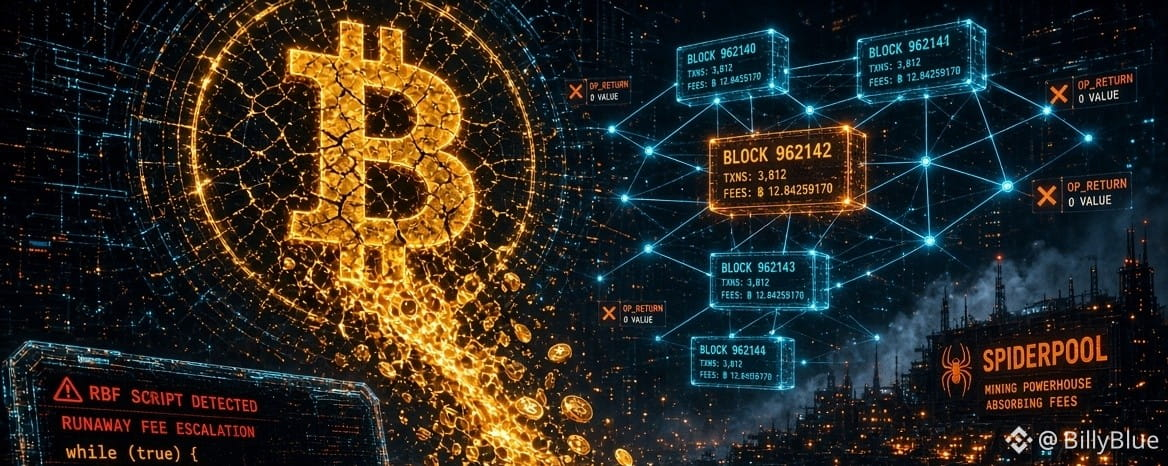
Статья
The Costly Script: How a Bitcoin Automation Error Turned 1.6 BTC into Miner FeesBitcoin block 962142 quietly absorbed one of the more expensive self-inflicted wounds in recent on-chain history. A single transaction entered the ledger with one input of 160,343,885 satoshis—roughly 1.603 BTC—and zero value delivered to any recipient. Every satoshi became a network fee. Miners, specifically those operating under SpiderPool, collected the entire amount. At prevailing prices near $64,000, the fee was worth approximately $102,800 to $103,000. That one transaction supplied about 88% of the block’s total fees of roughly 1.82 BTC.
The mechanism was Replace-by-Fee, or RBF. Bitcoin’s fee market is dynamic; mempool conditions shift constantly, and a transaction that looks competitive at broadcast can sit unconfirmed for hours or longer. RBF allows a sender to broadcast a new version of an unconfirmed transaction that spends the same inputs but attaches a higher fee, signaling priority to miners. When used carefully, it is a practical tool for unsticking payments. When left unbounded, it becomes a runaway process.
According to reporting from Odaily and subsequent coverage by BeInCrypto, Lookonchain, and others, the user ran an automated script designed to bump the fee once per second. No sensible ceiling was coded into the loop. Each replacement version increased the fee further, steadily consuming more of the input balance. Eventually the arithmetic left nothing for an output. Bitcoin’s consensus rules impose no hard upper limit on what a sender may voluntarily offer miners; the protocol simply requires that inputs equal or exceed outputs plus fees. A zero-value (or pure OP_RETURN data) output is valid. Nodes accepted the final version, and SpiderPool included it.
Some deeper on-chain examination suggested the episode may have involved more than one related transaction from the same source. Earlier activity had consolidated scattered UTXOs into a cleaner 1.6 BTC input with a normal, low fee. Subsequent replacements then escalated dramatically, with reported fee rates climbing into the hundreds of thousands or even over a million satoshis per virtual byte—orders of magnitude above the block’s median. Whether the final form was a pure fee burn or an intended data payload that went wrong, the economic result was identical: the full input value transferred to miners.
SpiderPool’s block contained roughly 4,700 transactions. The remaining thousands of ordinary payments contributed only a tiny fraction of the total fees. For the pool, the windfall arrived as pure revenue on top of the standard block subsidy. For the user, it was a complete loss of principal with no corresponding transfer completed.
The episode underscores a recurring lesson in Bitcoin’s design. Automation is powerful and increasingly common for wallet management, consolidation, and fee optimization. Yet scripts that interact with irreversible, adversarial markets require hard limits, monitoring, and fail-safes. A missing fee cap, an unchecked loop, or an assumption that “it will stop before it gets ridiculous” can convert a routine operation into a six-figure donation to the network’s security budget.
RBF itself is not the villain. It exists precisely because fee estimation is imperfect and congestion is real. The failure mode was operational: an unbounded process meeting a system that will cheerfully accept any fee a user is willing to pay. In a market where transactions compete openly for block space, the highest bidder wins—even when the bidder is a malfunctioning script that has already spent everything it owns.
The transaction stands as a public, permanent reminder on the blockchain. One input, zero productive outputs, 1.6 BTC transferred to miners in block 962142. Automation without constraints remains one of the more expensive ways to learn how Bitcoin’s fee market actually works.
The Costly Script: How a Bitcoin Automation Error Turned 1.6 BTC into Miner Fees
Bitcoin block 962142 quietly absorbed one of the more expensive self-inflicted wounds in recent on-chain history. A single transaction entered the ledger with one input of 160,343,885 satoshis—roughly 1.603 BTC—and zero value delivered to any recipient. Every satoshi became a network fee. Miners, specifically those operating under SpiderPool, collected the entire amount. At prevailing prices near $64,000, the fee was worth approximately $102,800 to $103,000. That one transaction supplied about 88% of the block’s total fees of roughly 1.82 BTC.
The mechanism was Replace-by-Fee, or RBF. Bitcoin’s fee market is dynamic; mempool conditions shift constantly, and a transaction that looks competitive at broadcast can sit unconfirmed for hours or longer. RBF allows a sender to broadcast a new version of an unconfirmed transaction that spends the same inputs but attaches a higher fee, signaling priority to miners. When used carefully, it is a practical tool for unsticking payments. When left unbounded, it becomes a runaway process.
According to reporting from Odaily and subsequent coverage by BeInCrypto, Lookonchain, and others, the user ran an automated script designed to bump the fee once per second. No sensible ceiling was coded into the loop. Each replacement version increased the fee further, steadily consuming more of the input balance. Eventually the arithmetic left nothing for an output. Bitcoin’s consensus rules impose no hard upper limit on what a sender may voluntarily offer miners; the protocol simply requires that inputs equal or exceed outputs plus fees. A zero-value (or pure OP_RETURN data) output is valid. Nodes accepted the final version, and SpiderPool included it.
Some deeper on-chain examination suggested the episode may have involved more than one related transaction from the same source. Earlier activity had consolidated scattered UTXOs into a cleaner 1.6 BTC input with a normal, low fee. Subsequent replacements then escalated dramatically, with reported fee rates climbing into the hundreds of thousands or even over a million satoshis per virtual byte—orders of magnitude above the block’s median. Whether the final form was a pure fee burn or an intended data payload that went wrong, the economic result was identical: the full input value transferred to miners.
SpiderPool’s block contained roughly 4,700 transactions. The remaining thousands of ordinary payments contributed only a tiny fraction of the total fees. For the pool, the windfall arrived as pure revenue on top of the standard block subsidy. For the user, it was a complete loss of principal with no corresponding transfer completed.
The episode underscores a recurring lesson in Bitcoin’s design. Automation is powerful and increasingly common for wallet management, consolidation, and fee optimization. Yet scripts that interact with irreversible, adversarial markets require hard limits, monitoring, and fail-safes. A missing fee cap, an unchecked loop, or an assumption that “it will stop before it gets ridiculous” can convert a routine operation into a six-figure donation to the network’s security budget.
RBF itself is not the villain. It exists precisely because fee estimation is imperfect and congestion is real. The failure mode was operational: an unbounded process meeting a system that will cheerfully accept any fee a user is willing to pay. In a market where transactions compete openly for block space, the highest bidder wins—even when the bidder is a malfunctioning script that has already spent everything it owns.
The transaction stands as a public, permanent reminder on the blockchain. One input, zero productive outputs, 1.6 BTC transferred to miners in block 962142. Automation without constraints remains one of the more expensive ways to learn how Bitcoin’s fee market actually works.
The mechanism was Replace-by-Fee, or RBF. Bitcoin’s fee market is dynamic; mempool conditions shift constantly, and a transaction that looks competitive at broadcast can sit unconfirmed for hours or longer. RBF allows a sender to broadcast a new version of an unconfirmed transaction that spends the same inputs but attaches a higher fee, signaling priority to miners. When used carefully, it is a practical tool for unsticking payments. When left unbounded, it becomes a runaway process.
According to reporting from Odaily and subsequent coverage by BeInCrypto, Lookonchain, and others, the user ran an automated script designed to bump the fee once per second. No sensible ceiling was coded into the loop. Each replacement version increased the fee further, steadily consuming more of the input balance. Eventually the arithmetic left nothing for an output. Bitcoin’s consensus rules impose no hard upper limit on what a sender may voluntarily offer miners; the protocol simply requires that inputs equal or exceed outputs plus fees. A zero-value (or pure OP_RETURN data) output is valid. Nodes accepted the final version, and SpiderPool included it.
Some deeper on-chain examination suggested the episode may have involved more than one related transaction from the same source. Earlier activity had consolidated scattered UTXOs into a cleaner 1.6 BTC input with a normal, low fee. Subsequent replacements then escalated dramatically, with reported fee rates climbing into the hundreds of thousands or even over a million satoshis per virtual byte—orders of magnitude above the block’s median. Whether the final form was a pure fee burn or an intended data payload that went wrong, the economic result was identical: the full input value transferred to miners.
SpiderPool’s block contained roughly 4,700 transactions. The remaining thousands of ordinary payments contributed only a tiny fraction of the total fees. For the pool, the windfall arrived as pure revenue on top of the standard block subsidy. For the user, it was a complete loss of principal with no corresponding transfer completed.
The episode underscores a recurring lesson in Bitcoin’s design. Automation is powerful and increasingly common for wallet management, consolidation, and fee optimization. Yet scripts that interact with irreversible, adversarial markets require hard limits, monitoring, and fail-safes. A missing fee cap, an unchecked loop, or an assumption that “it will stop before it gets ridiculous” can convert a routine operation into a six-figure donation to the network’s security budget.
RBF itself is not the villain. It exists precisely because fee estimation is imperfect and congestion is real. The failure mode was operational: an unbounded process meeting a system that will cheerfully accept any fee a user is willing to pay. In a market where transactions compete openly for block space, the highest bidder wins—even when the bidder is a malfunctioning script that has already spent everything it owns.
The transaction stands as a public, permanent reminder on the blockchain. One input, zero productive outputs, 1.6 BTC transferred to miners in block 962142. Automation without constraints remains one of the more expensive ways to learn how Bitcoin’s fee market actually works.
107
·
--
**Truth Speaker (Crypto OG) on Binance Square drops no-BS crypto insights from a 2017 OG.** Follow before the next big move drops and you miss it. Real talk only.
#BinanceSquare #CryptoOG #TruthSpeaker #Bitcoin
**Truth Speaker (Crypto OG) on Binance Square drops no-BS crypto insights from a 2017 OG.** Follow before the next big move drops and you miss it. Real talk only.
#BinanceSquare #CryptoOG #TruthSpeaker #Bitcoin
#BinanceSquare #CryptoOG #TruthSpeaker #Bitcoin
9
·
--
Binance Alpha is a game changer by giving users early access to promising Web3 tokens via easy trading, Alpha Points, airdrops and curated discoveries that open doors to future listings.
#BinanceAlpha #Crypto #Web3 #Binance #Airdrops #Blockchain #DeFi #TokenLaunch
Binance Alpha is a game changer by giving users early access to promising Web3 tokens via easy trading, Alpha Points, airdrops and curated discoveries that open doors to future listings.
#BinanceAlpha #Crypto #Web3 #Binance #Airdrops #Blockchain #DeFi #TokenLaunch
#BinanceAlpha #Crypto #Web3 #Binance #Airdrops #Blockchain #DeFi #TokenLaunch
54
·
--
Bitcoin and Ethereum dominate the crypto market. BTC acts as digital gold while ETH powers innovative smart contracts and DeFi.
#BTC #ETH #Bitcoin #Ethereum #Crypto #Blockchain #DeFi
Bitcoin and Ethereum dominate the crypto market. BTC acts as digital gold while ETH powers innovative smart contracts and DeFi.
#BTC #ETH #Bitcoin #Ethereum #Crypto #Blockchain #DeFi
#BTC #ETH #Bitcoin #Ethereum #Crypto #Blockchain #DeFi
69
·
--
Проверено
**Top 10 Binance Alpha Projects (Early Access to Emerging Web3 Projects)**
*As of early August 2026 – rankings based on market data and activity. The list changes frequently; always check the official Binance Alpha / Binance Wallet Markets page for the latest.*
1. **Ondo (ONDO)**
Leading RWA (Real World Assets) project frequently topping Alpha market-cap rankings.
2. **Aster (ASTER)**
High trading volume standout on Alpha.
3. **Binance Life (币安人生)**
Popular community/meme-style token with strong Alpha presence.
4. **Fartcoin (FARTCOIN)**
Meme token that consistently ranks high in both market cap and volume on Alpha.
5. **SOON**
Notable early Alpha project with solid market presence.
6. **SKYAI**
AI-focused project frequently appearing in Alpha rankings and spotlight.
7. **ARC (AI Rig Complex)**
AI-related project active in the Alpha ecosystem.
8. **AIXBT**
AI + trading related token with consistent volume on Alpha.
9. **GRVT**
Recently featured on Alpha with airdrop activity (July 2026).
10. **DAPPOS (DOS)**
Newest addition (launched on Binance Alpha on August 10, 2026) with ongoing airdrop for Alpha Points holders.
### Notes
- Binance Alpha highlights early-stage projects that may (but are not guaranteed to) later list on Binance Spot or Futures.
- Many projects also run Alpha Points airdrops and Alpha Box events.
- Other frequently mentioned names include AGT, AIA, CGPT, SHELL, PLUME, and various AI/meme/DeFi tokens.
For the most accurate and real-time list, open the **Binance app → Alpha / Markets → Alpha** section or visit the official Binance Wallet Alpha page.
**Top 10 Binance Alpha Projects (Early Access to Emerging Web3 Projects)**
*As of early August 2026 – rankings based on market data and activity. The list changes frequently; always check the official Binance Alpha / Binance Wallet Markets page for the latest.*
1. **Ondo (ONDO)**
Leading RWA (Real World Assets) project frequently topping Alpha market-cap rankings.
2. **Aster (ASTER)**
High trading volume standout on Alpha.
3. **Binance Life (币安人生)**
Popular community/meme-style token with strong Alpha presence.
4. **Fartcoin (FARTCOIN)**
Meme token that consistently ranks high in both market cap and volume on Alpha.
5. **SOON**
Notable early Alpha project with solid market presence.
6. **SKYAI**
AI-focused project frequently appearing in Alpha rankings and spotlight.
7. **ARC (AI Rig Complex)**
AI-related project active in the Alpha ecosystem.
8. **AIXBT**
AI + trading related token with consistent volume on Alpha.
9. **GRVT**
Recently featured on Alpha with airdrop activity (July 2026).
10. **DAPPOS (DOS)**
Newest addition (launched on Binance Alpha on August 10, 2026) with ongoing airdrop for Alpha Points holders.
### Notes
- Binance Alpha highlights early-stage projects that may (but are not guaranteed to) later list on Binance Spot or Futures.
- Many projects also run Alpha Points airdrops and Alpha Box events.
- Other frequently mentioned names include AGT, AIA, CGPT, SHELL, PLUME, and various AI/meme/DeFi tokens.
For the most accurate and real-time list, open the **Binance app → Alpha / Markets → Alpha** section or visit the official Binance Wallet Alpha page.
*As of early August 2026 – rankings based on market data and activity. The list changes frequently; always check the official Binance Alpha / Binance Wallet Markets page for the latest.*
1. **Ondo (ONDO)**
Leading RWA (Real World Assets) project frequently topping Alpha market-cap rankings.
2. **Aster (ASTER)**
High trading volume standout on Alpha.
3. **Binance Life (币安人生)**
Popular community/meme-style token with strong Alpha presence.
4. **Fartcoin (FARTCOIN)**
Meme token that consistently ranks high in both market cap and volume on Alpha.
5. **SOON**
Notable early Alpha project with solid market presence.
6. **SKYAI**
AI-focused project frequently appearing in Alpha rankings and spotlight.
7. **ARC (AI Rig Complex)**
AI-related project active in the Alpha ecosystem.
8. **AIXBT**
AI + trading related token with consistent volume on Alpha.
9. **GRVT**
Recently featured on Alpha with airdrop activity (July 2026).
10. **DAPPOS (DOS)**
Newest addition (launched on Binance Alpha on August 10, 2026) with ongoing airdrop for Alpha Points holders.
### Notes
- Binance Alpha highlights early-stage projects that may (but are not guaranteed to) later list on Binance Spot or Futures.
- Many projects also run Alpha Points airdrops and Alpha Box events.
- Other frequently mentioned names include AGT, AIA, CGPT, SHELL, PLUME, and various AI/meme/DeFi tokens.
For the most accurate and real-time list, open the **Binance app → Alpha / Markets → Alpha** section or visit the official Binance Wallet Alpha page.
1
319
Войдите, чтобы посмотреть больше материала
Присоединяйтесь к пользователям криптовалют по всему миру на Binance Square
⚡️ Получайте новейшую и полезную информацию о криптоактивах.
💬 Нам доверяет крупнейшая в мире криптобиржа.
👍 Получите достоверные аналитические данные от верифицированных создателей контента.
Эл. почта/номер телефона
В тренде
AppleDebutsFoldablePhone
Просмотров: 46,054
904 обсуждают
Apple just dropped the foldable iPhone — and the market is paying attention. This isn't just another product cycle; it's a new product category, a new CEO on stage, and a $1,999 price tag that pushes $AAPL further into ultra-premium territory. Foldables are the narrative, and Apple is now the headline.
#appledebutsfoldablephone #EUExtendsCentralContactPointToCASPs #US10YTreasuryYieldHitsHighestSinceNov2023 #BrentCrudeTops$100 #USTreasuryToBuyBackUpTo$6BLongDatedDebt
KimHotbae
·Лайков: 2
·Просмотров: 2.9k
TSMCAugustRevenueUp53.3%YoY
Просмотров: 10,432
292 обсуждают
IranSaysReadyToEscalateWarWithUS
Просмотров: 13,123
293 обсуждают